Chapter 13 Test Bank KEY
1. A price taker is a buyer or seller who:
2. A competitive market is one in which:
3. Standardized goods are:
4. Perfectly competitive markets:
5. Most markets in the United States:
6. The definition of a price taker is:
7. An essential characteristic of a perfectly competitive market is that buyers and sellers have:
8. An essential characteristic of a perfectly competitive market is:
9. In a perfectly competitive market price takers exist because there are:
10. When firms have market power, it means that they:
11. When firms have market power, it means that they:
12. An essential characteristic of a perfectly competitive market is:
13. Which is not an essential characteristic of a perfectly competitive market?
14. A good that is perfectly standardized is:
15. Standardized goods and services refers to those that:
16. An example of a standardized good is:
17. Commodities:
18. An example of a standardized good is:
19. One implication of goods being standardized in a market is:
20. Transactions costs are defined to be the:
21. In perfectly competitive markets, transactions costs are:
22. A characteristic that is important, but not essential to defining a perfectly competitive market is:
23. Having free entry and exit in a market can help drive:
24. Collusion is:
25. In a perfectly competitive market, producers:
26. In a perfectly competitive market, total revenue:
27. For firms that sell one product in a perfectly competitive market, the market price is:
28. For firms that sell one product in a perfectly competitive market, the market price:
29. For firms that sell one product in a perfectly competitive market, the market price:
30. For firms that sell one product in a perfectly competitive market, average revenue is:
31. For firms that sell one product in a perfectly competitive market, average revenue is:
13-7
32. For firms that sell one product in a perfectly competitive market, marginal revenue is:
33. For firms that sell one product in a perfectly competitive market, marginal revenue is always:
34. For firms that sell one product in a perfectly competitive market, average revenue will:
35. This table shows price and quantity produced for a single firm in a perfectly competitive market.
Price
Quantity
$10
23
$10
24
$10
25
$10
26
Given the information in the table shown, what is the marginal revenue when 25 units are produced?
36. This table shows price and quantity produced for a single firm in a perfectly competitive market.
Price
Quantity
$10
23
$10
24
$10
25
$10
26
Given the information in the table shown, what is the total revenue when 23 units are produced?
37. This table shows price and quantity produced for a single firm in a perfectly competitive market.
Price
Quantity
$10
23
$10
24
$10
25
$10
26
Given the information in the table shown, what is the average revenue when 24 units are produced?
38. This table shows price and quantity produced for a single firm in a perfectly competitive market.
Price
Quantity
$10
23
$10
24
$10
25
$10
26
Given the information in the table shown, what is the market price?
39. If a perfectly competitive firm faces a market price of $3 per unit, and it decides to produce 30,000
units, the market price will likely:
40. If a firm in a perfectly competitive market faces a market price of $5, and it decides to produce 400
units, the firm’s total revenue will be:
41. If a firm in a perfectly competitive market faces a market price of $4, and it decides to produce 700
units, the firm’s average revenue will be:
42. If a firm in a perfectly competitive market faces a market price of $2, and it decides to increase its
production from 2,000 units to 4,000 units, the firm’s marginal revenue:
43. If a firm in a perfectly competitive market faces a market price of $8, and it decides to increase its
production from 300 units to 550 units, the firm’s total revenue will:
44. If a firm in a perfectly competitive market faces a market price of $7, and it decides to increase its
production from 4,000 to 12,000 units, the firm’s marginal revenue will:
45. When a firm faces a perfectly competitive market and buys its inputs from perfectly competitive
markets, the only choice the firm has to affect its profits is to:
46. Because firms in perfectly competitive markets can sell any quantity without driving down prices, they
should:
47. Firms in perfectly competitive markets who wish to maximize profits ought to produce:
48. Firms in perfectly competitive markets who wish to maximize profits should produce where:
49. Firms in perfectly competitive markets who wish to maximize profits should:
50. Firms in perfectly competitive markets who wish to maximize profits should produce:
51. A firm in a perfectly competitive market can maximize its profits by producing:
52. For a firm in a perfectly competitive market, if it produces where marginal cost exceeds marginal
revenue it:
53. For a firm in a perfectly competitive market, if it is producing at a level of output where marginal costs
are less than marginal revenue it:
54. For a firm in a perfectly competitive market, if it is producing at a level of output where marginal costs
are equal to marginal revenue it:
55. Firms in perfectly competitive markets typically have:
13–13
56. If a firm in a perfectly competitive market is producing at a level of output where marginal costs
exceed marginal revenue, its profits:
57. If a firm in a perfectly competitive market is producing at a level of output where marginal costs are
less than marginal revenue, its profit:
58. The profit-maximizing level of output for any firm in a perfectly competitive market is to produce
where:
59. This table shows the total costs for various levels of output for a firm operating in a perfectly
competitive market.
Price
Quantity
TC
$50
0
$10.00
$50
1
$20.00
$50
2
$27.50
$50
3
$77.50
$50
4
$147.50
$50
5
$250.00
13–14
According to the table shown, what is the market price?
60. This table shows the total costs for various levels of output for a firm operating in a perfectly
competitive market.
Price
Quantity
TC
$50
0
$10.00
$50
1
$20.00
$50
2
$27.50
$50
3
$77.50
$50
4
$147.50
$50
5
$250.00
According to the table shown, what is the firm’s total revenue when 4 units are produced?
61. This table shows the total costs for various levels of output for a firm operating in a perfectly
competitive market.
Price
Quantity
TC
$50
0
$10.00
$50
1
$20.00
$50
2
$27.50
$50
3
$77.50
$50
4
$147.50
$50
5
$250.00
According to the table shown, what is the firm’s marginal revenue from the 3rd unit produced?
62. This table shows the total costs for various levels of output for a firm operating in a perfectly
competitive market.
Price
Quantity
TC
$50
0
$10.00
$50
1
$20.00
$50
2
$27.50
$50
3
$77.50
$50
4
$147.50
$50
5
$250.00
According to the table shown, what is the firm’s marginal cost from producing the 2nd unit?
63. This table shows the total costs for various levels of output for a firm operating in a perfectly
competitive market.
Price
Quantity
TC
$50
0
$10.00
$50
1
$20.00
$50
2
$27.50
$50
3
$77.50
$50
4
$147.50
$50
5
$250.00
According to the table shown, the firm’s marginal revenue:
64. This table shows the total costs for various levels of output for a firm operating in a perfectly
competitive market.
Price
Quantity
TC
$50
0
$10.00
$50
1
$20.00
$50
2
$27.50
$50
3
$77.50
$50
4
$147.50
$50
5
$250.00
According to the table shown, the firm’s marginal costs:
13–17
65. This table shows the total costs for various levels of output for a firm operating in a perfectly
competitive market.
Price
Quantity
TC
$50
0
$10.00
$50
1
$20.00
$50
2
$27.50
$50
3
$77.50
$50
4
$147.50
$50
5
$250.00
According to the table shown, the firm’s profit is:
66. This table shows the total costs for various levels of output for a firm operating in a perfectly
competitive market.
Price
Quantity
TC
$50
0
$10.00
$50
1
$20.00
$50
2
$27.50
$50
3
$77.50
$50
4
$147.50
$50
5
$250.00
13–18
According to the table shown, when 5 units are produced:
67. This table shows the total costs for various levels of output for a firm operating in a perfectly
competitive market.
Price
Quantity
TC
$50
0
$10.00
$50
1
$20.00
$50
2
$27.50
$50
3
$77.50
$50
4
$147.50
$50
5
$250.00
According to the table shown, when 1 unit is produced:
68. This table shows the total costs for various levels of output for a firm operating in a perfectly
competitive market.
Price
Quantity
TC
$50
0
$10.00
$50
1
$20.00
$50
2
$27.50
$50
3
$77.50
$50
4
$147.50
$50
5
$250.00
According to the table shown, fixed costs must be:
69.
According to the graph shown, the profits at point A are:
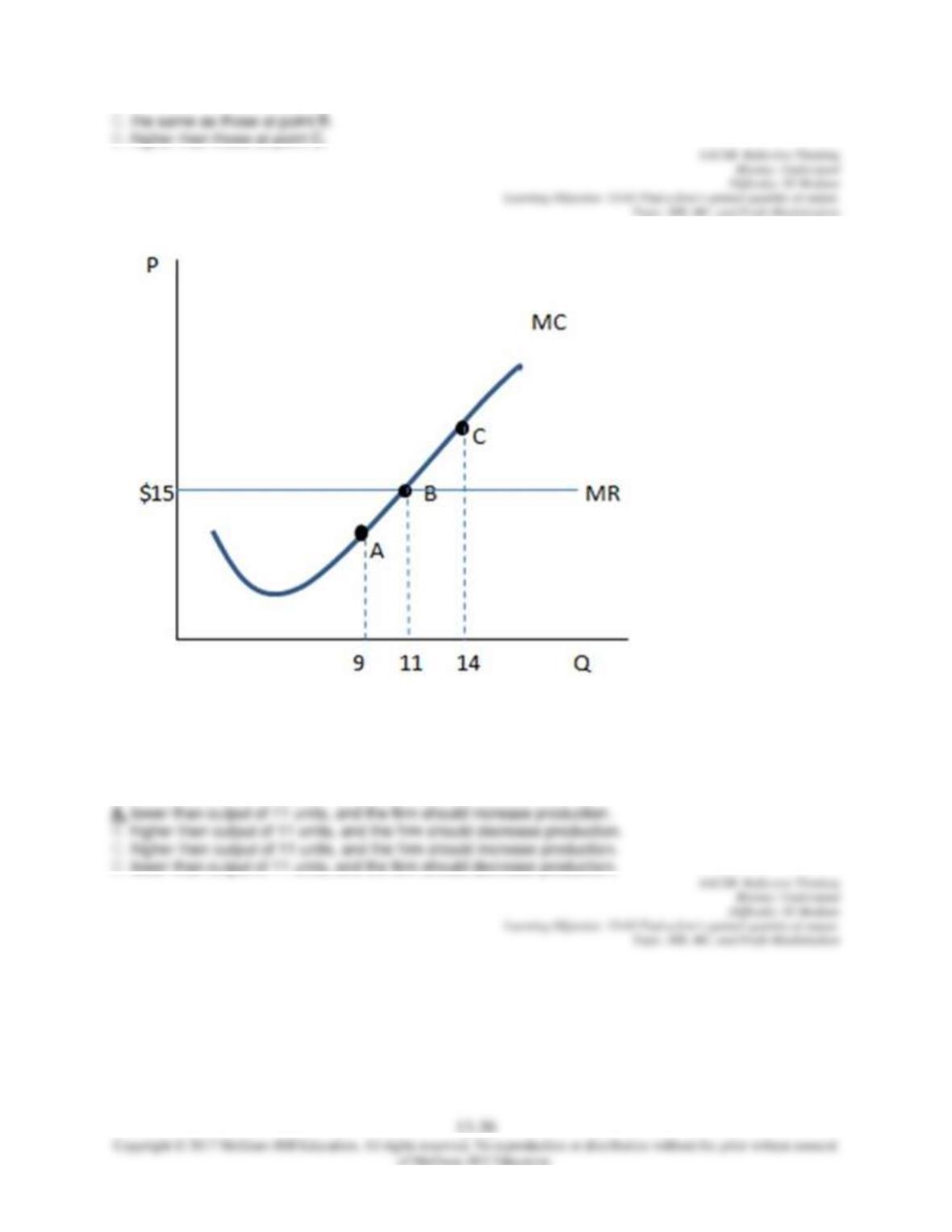
70.
According to the graph shown, producing 9 units earns profits that are: