Microeconomics: Theory and Applications with Calculus, 3e (Perloff)
Chapter 13 Game Theory
13.1 Static Games
1) Game theory shows that
A) sometimes pursuing profit maximization will not yield the highest joint profit.
B) interdependencies between firms have to be taken into account when few firms dominate the market.
C) in an oligopolistic market, firms are likely to collude.
D) All of the above.
2) Chess is an example of a
A) game with perfect information.
B) game with imperfect information.
C) game with incomplete information.
D) static game.
3) Which of the following games is NOT analyzed with game theory?
A) State Lottery
B) Poker
C) Car Chases
D) Auctions
4) What aspects of a game are specified by “the rules of the game”?
A) timing of players’ moves
B) payoffs
C) information available to each player
D) All of the above
5) The “Normal-Form” of a game is a description including
A) the players.
B) the strategies possible.
C) the payoffs.
D) All of the above
6) For an oligopolistic firm, which of the following can be identified as a strategy?
A) Produce 10,000 units regardless of what the rivals do.
B) Advertise if the rival advertises, do not advertise if the rival does not advertise.
C) Raise the price if the rival raises the price, keep the current price if the rival lowers its price.
D) All of above
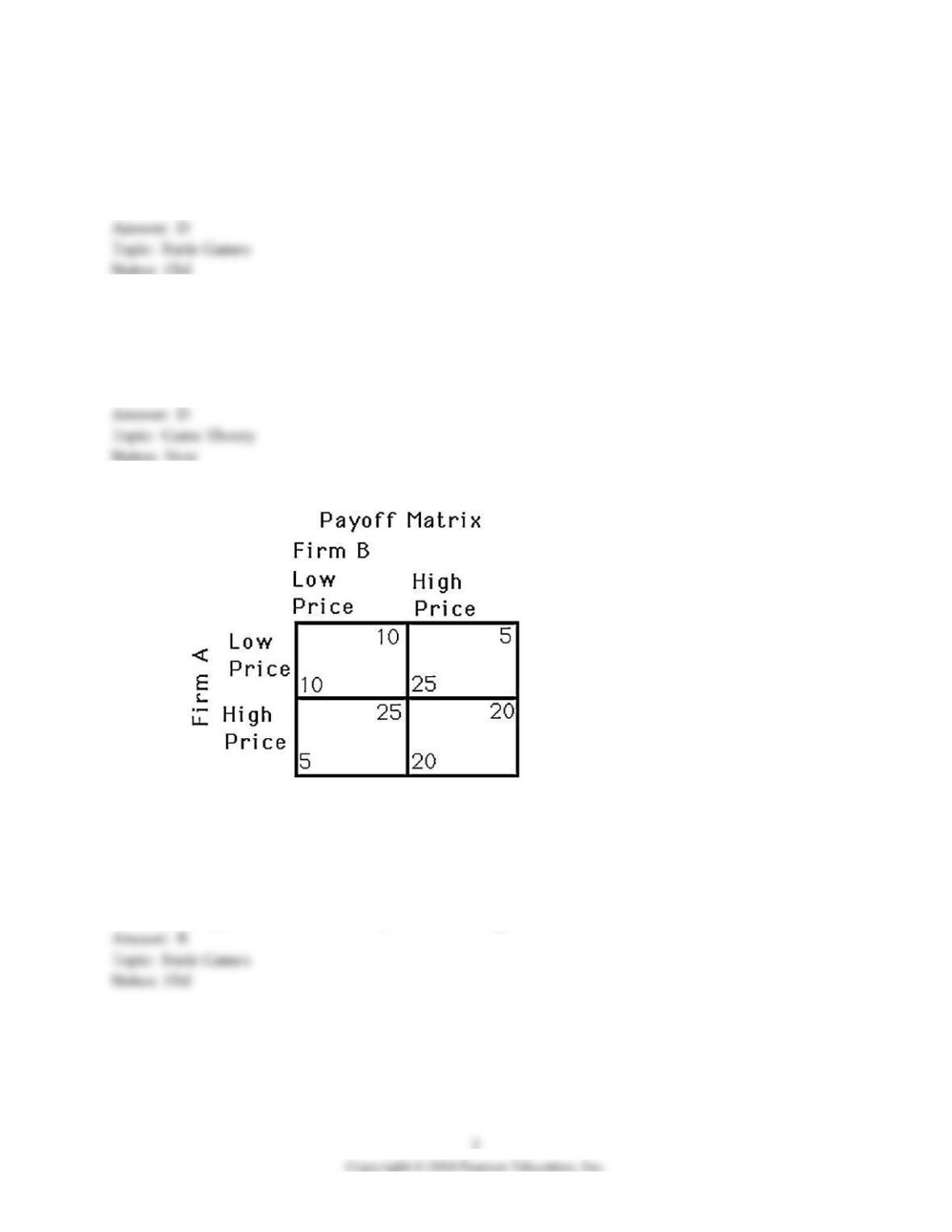
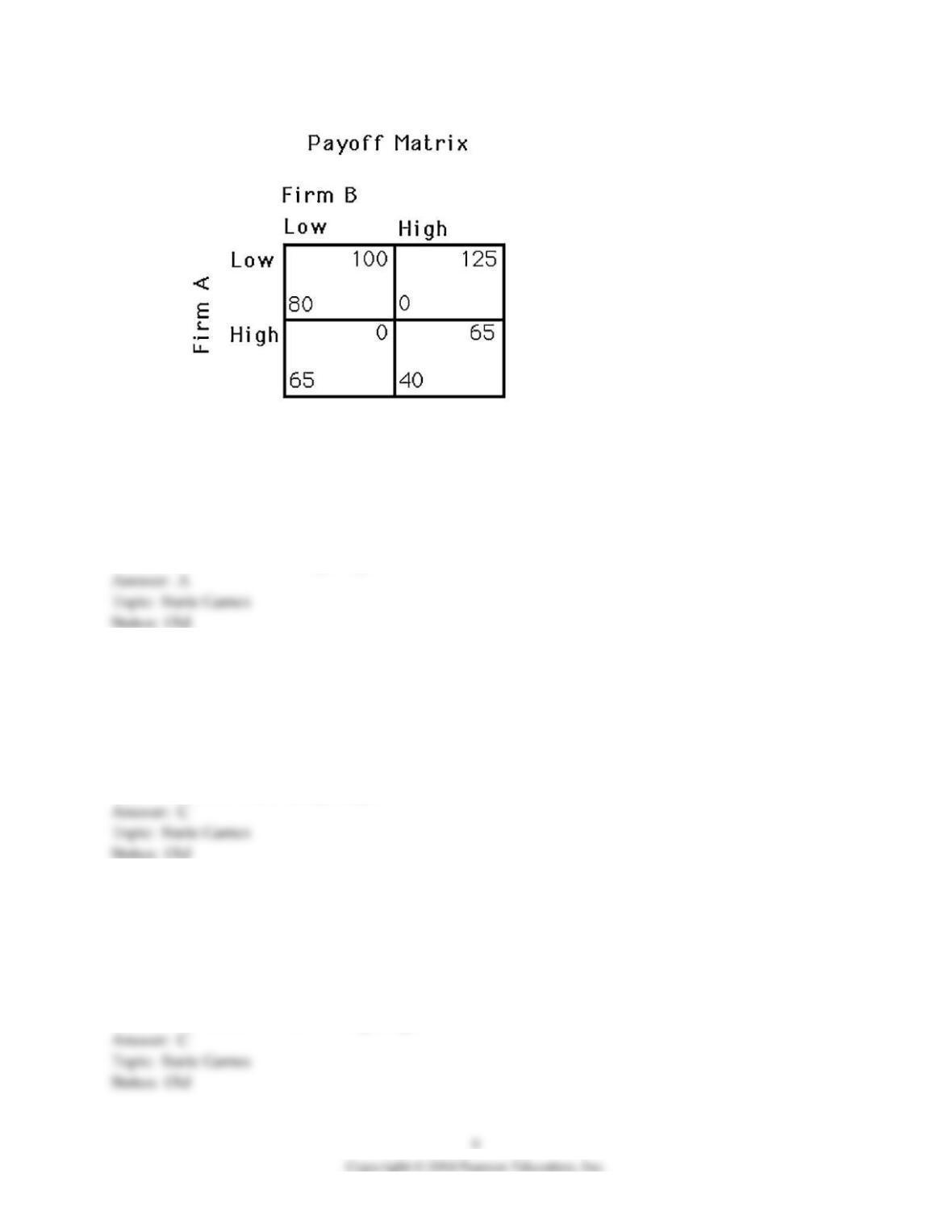
7) The above figure shows a payoff matrix for two firms, A and B, that must choose between a high–price
strategy and a low-price strategy. For firm B,
A) setting a high price is the dominant strategy.
B) setting a low price is the dominant strategy.
C) there is no dominant strategy.
D) doing the opposite of firm A is always the best strategy.
8) The above figure shows a payoff matrix for two firms, A and B, that must choose between a high-price
strategy and a low-price strategy. For firm A,
A) setting a low price is the dominant strategy.
B) setting a high price is the dominant strategy.
C) setting a high price when firm B sets a high price, and setting a low price when firm B sets a low price
is the dominant strategy.
D) setting a high price when firm B sets a low price, and setting a low price when firm B sets a high price
is the dominant strategy.
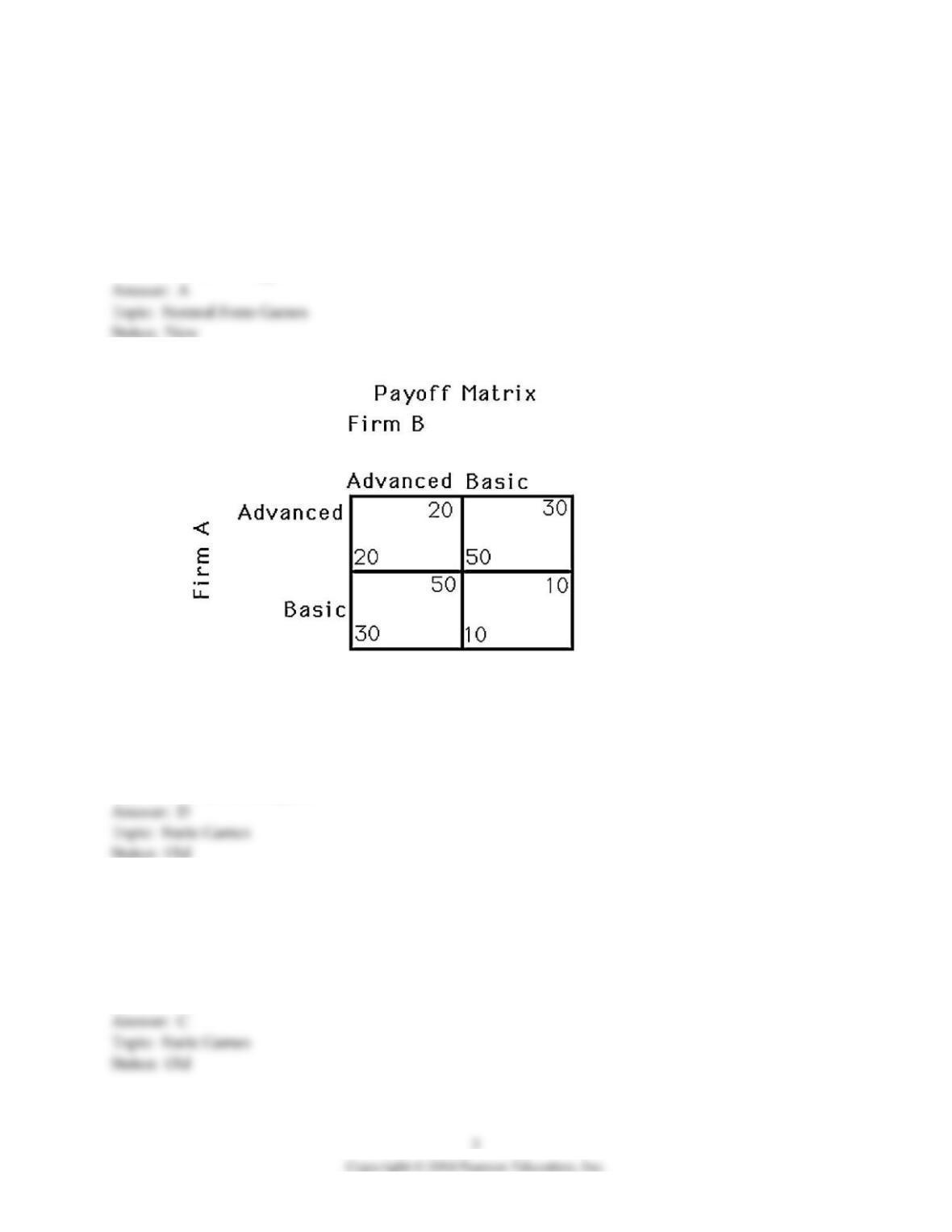
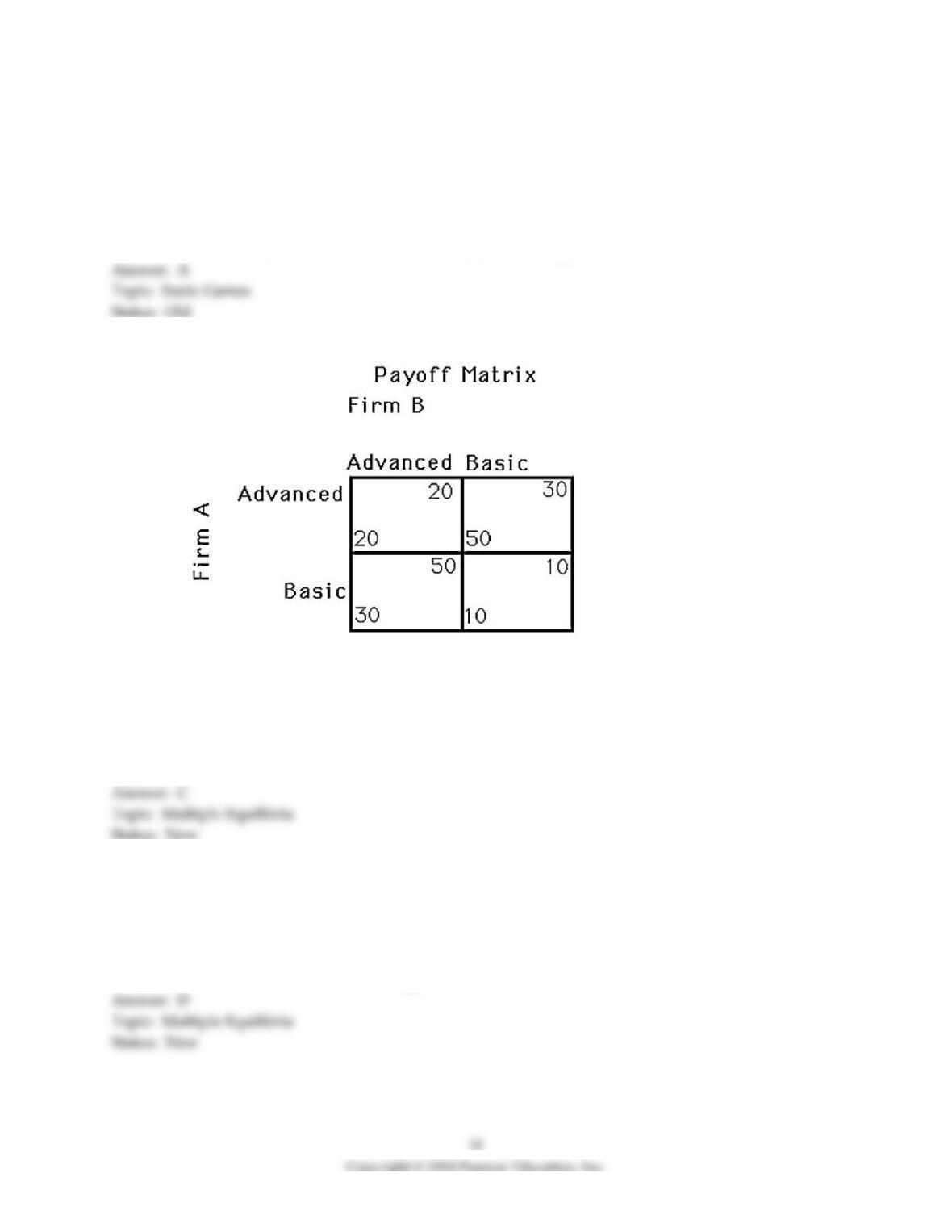
9) The above figure shows a payoff matrix for two firms, A and B, that must choose between selling basic
computers or advanced computers. Firm B’s dominant strategy
A) is to make basic computers.
B) is to make advanced computers.
C) is to adopt firm A’s strategy.
D) does not exist in this game.
10) The above figure shows a payoff matrix for two firms, A and B, that must choose between selling
basic computers or advanced computers. How many Nash equilibria are there?
A) 0
B) 1
C) 2
D) 4
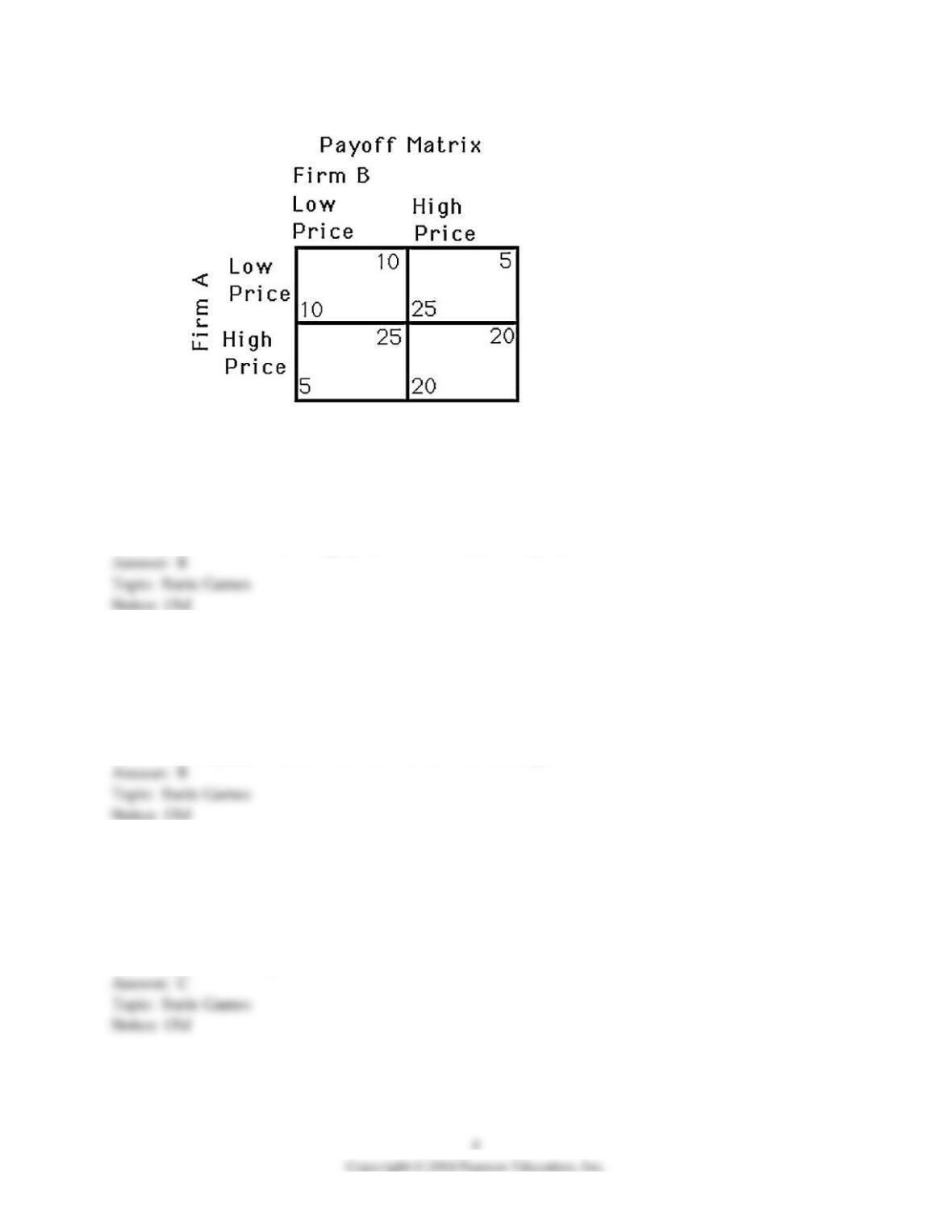
11) The above figure shows a payoff matrix for two firms, A and B, that must choose between a high–
price strategy and a low-price strategy. The Nash equilibrium in this game
A) does not exist.
B) occurs when both firms set a low price.
C) occurs when both firms set a high price.
D) occurs when firm A sets a high price and firm B sets a low price.
12) In a two-player simultaneous game, if player A has a dominant strategy and player B does not, player
B will
A) employ a mixed strategy.
B) choose his best strategy assuming that player A plays her dominant strategy.
C) not achieve a Nash equilibrium.
D) assume that player A does not choose her dominant strategy.
13) After analyzing his opponent a tennis player decides to serve 10% of his serves to the left, 50% of his
serves to the right, and 40% of his serves at the body of his opponent. This illustrates a
A) deterministic strategy.
B) dominant strategy.
C) mixed strategy.
D) non-game theoretic problem.
14) A mixed strategy may
A) be part of a Nash equilibrium.
B) be a set of probabilities of selecting each possible action.
C) lead identical firms to choose different actions.
D) All of the above.
15) When neither player has a dominant strategy,
A) game theory will not provide information.
B) no Nash-Equilibrium exists.
C) at least one Nash-Equilibrium exists.
D) the game cannot be analyzed.
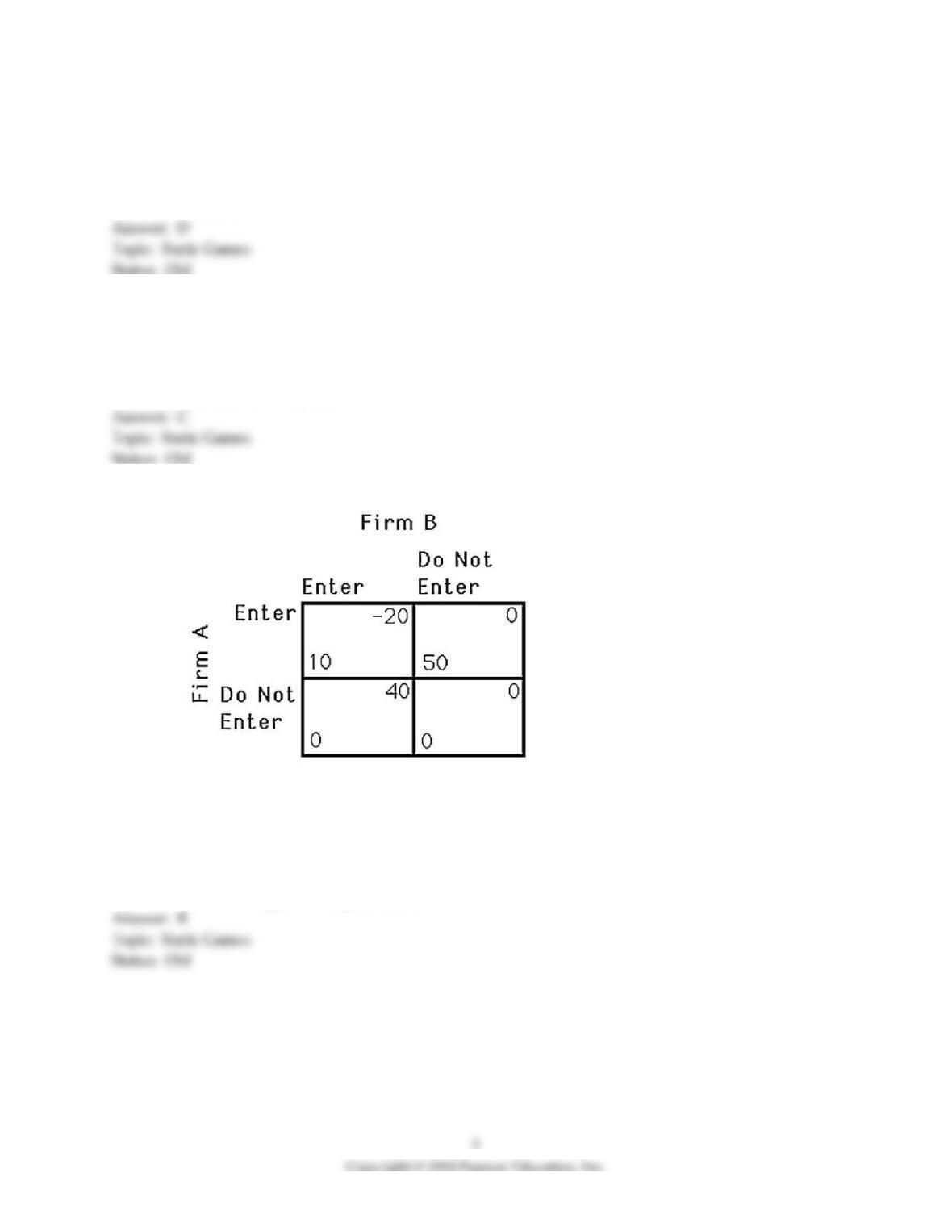
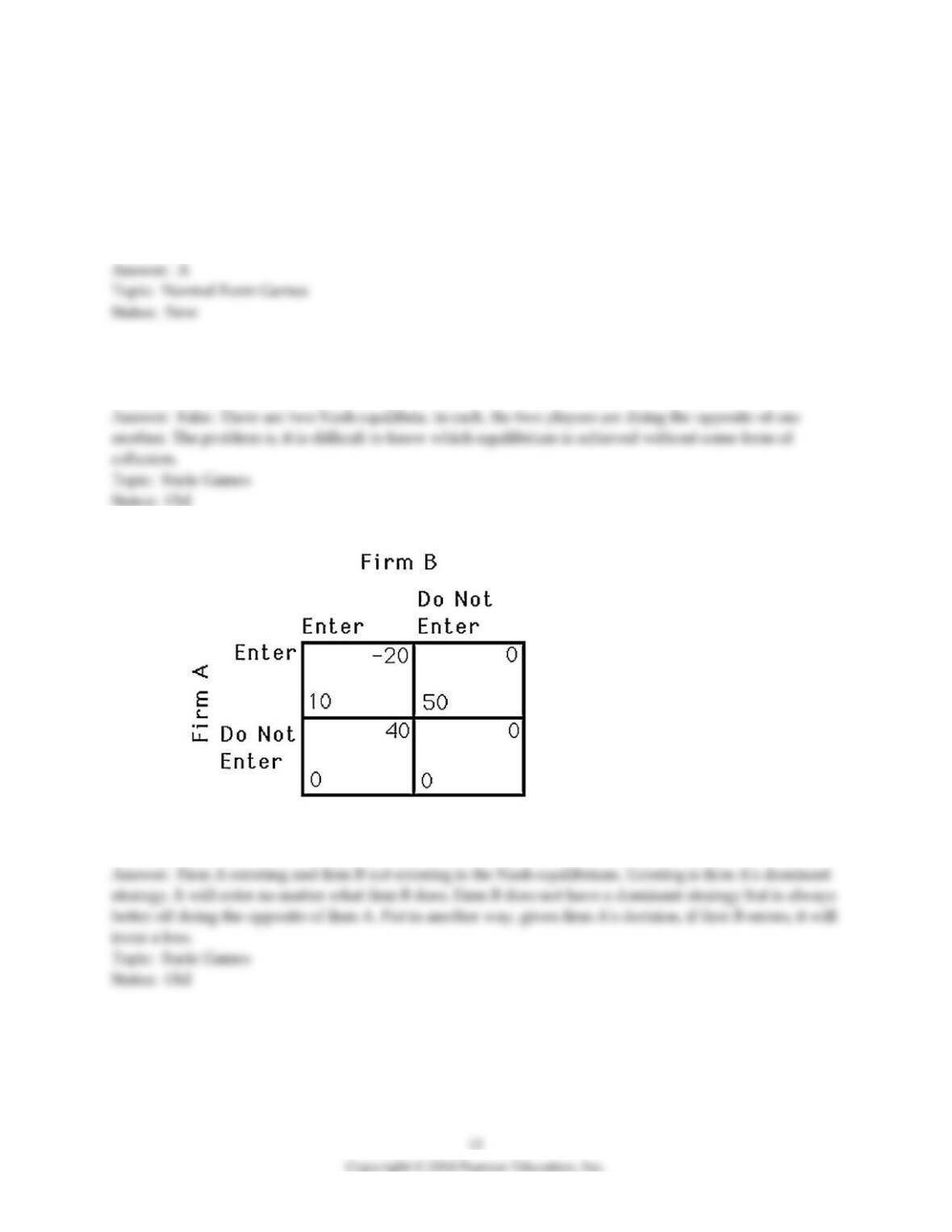
16) The above figure shows the payoff to two airlines, A and B, of serving a particular route. If the two
airlines must decide simultaneously, which one of the following statements is true?
A) Firm A does not have a dominant strategy.
B) Firm B does not have a dominant strategy.
C) Neither firm entering is a Nash equilibrium.
D) The outcome of the game is unpredictable.
17) The above figure shows the payoff to two airlines, A and B, of serving a particular route. If the two
airlines must decide simultaneously, which one of the following statements is true?
A) Firm A has a dominant strategy.
B) Firm B has a dominant strategy.
C) Neither firm entering is a Nash equilibrium.
D) The outcome of the game is unpredictable.
18) The above figure shows the payoff to two airlines, A and B, of serving a particular route. If the two
airlines must decide simultaneously, which one of the following statements is true?
A) Only firm A will enter the market.
B) Only firm B will enter the market.
C) Neither firm entering is a Nash equilibrium.
D) The outcome of the game is unpredictable.
19) The above figure shows the payoff to two airlines, A and B, of serving a particular route. If the two
airlines must decide simultaneously, which one of the following statements is true?
A) Since firm B has no dominant strategy, its decision is unpredictable.
B) Since firm B’s decision is unpredictable, firm A’s decision is unpredictable.
C) Neither firm entering is a Nash equilibrium.
D) Firm B will not enter because it knows firm A will.
20) The above figure shows the payoff to two airlines, A and B, of serving a particular route. If the two
airlines must decide simultaneously, what will happen if the government offers a $30 subsidy to airlines
that serve this route?
A) Both firms will enter profitably.
B) Firm A will decide not to enter since firm B will.
C) Firm B is still better off not entering.
D) Neither firm will have a dominant strategy.
21) The above figure shows the payoff to two airlines, A and B, of serving a particular route. If the two
airlines must decide simultaneously, what will happen if the government offers a $30 subsidy to airlines
that serve this route?
A) The Nash equilibrium remains the same.
B) Only firm A will have a dominant strategy.
C) Both firms will choose to enter the market.
D) Joint profts will be maximized.
22) The above figure shows the payoff to two airlines, A and B, of serving a particular route. If the two
airlines must decide simultaneously, how many Nash equilibria are there?
A) 0
B) 1
C) 2
D) It cannot be determined.
23) The above figure shows the payoff to two airlines, A and B, of serving a particular route. If the two
airlines must decide simultaneously, what happens if the government imposes a $20 per firm tax on firms
that service this route?
A) Neither firm has a dominant strategy.
B) Not entering is a dominant strategy for both firms.
C) Neither firm entering is a Nash equilibrium.
D) Only firm A will enter.
24) The above figure shows the payoff to two airlines, A and B, of serving a particular route. If the two
airlines must decide simultaneously, and the government imposes a $20 per firm tax on firms that service
this route, which of the following maximizes the firms’ joint profits?
A) Neither firm services the route.
B) Firm A offers firm B $20 to not enter.
C) Both firms will service this route.
D) Firm B offers firm A $30 to not enter.
25) A single-period duopoly firm can choose output level A or B. The firm decides it will produce level A
regardless of what the other firm produces. This decision may occur because
A) producing the output level A is a dominant strategy.
B) this firm has simply decided to always produce at level A.
C) Both A and B are possible.
D) None of the above.
26) In a non-cooperative, imperfect information, simultaneous-choice, one-period game, a Nash
equilibrium
A) will never exist.
B) will always include dominant strategies.
C) will always result in both players taking the same action.
D) may not maximize the sum of the firms’ profits.
27) Collusion is more likely to occur when
A) there is fear of punishment for not colluding.
B) there is a known finite time horizon.
C) there are large gains to be made by cheating on an agreement.
D) the game lasts only one period.
28) The above figure shows the payoff matrix for two firms, A and B, selecting an advertising budget. The
firms must choose between a high advertising budget and a low advertising budget. Firm A’s dominant
strategy
A) does not exist.
B) is to do the opposite of firm B.
C) is to select a high advertising budget.
D) is to select a low advertising budget.
29) The above figure shows the payoff matrix for two firms, A and B, selecting an advertising budget. The
firms must choose between a high advertising budget and a low advertising budget. Firm B’s dominant
strategy
A) does not exist.
B) is to copy firm A.
C) is to select a high advertising budget.
D) is to select a low advertising budget.
30) The above figure shows the payoff matrix for two firms, A and B, selecting an advertising budget. The
firms must choose between a high advertising budget and a low advertising budget. A Nash equilibrium
is that
A) firm A selects a high advertising budget and firm B selects a low advertising budget.
B) firm A selects a low advertising budget and firm B selects a high advertising budget.
C) both firms select a high advertising budget.
D) both firms select a low advertising budget.
31) The above figure shows the payoff matrix for two firms, A and B, selecting an advertising budget. The
firms must choose between a high advertising budget and a low advertising budget. A Nash equilibrium
A) occurs when both firms select a high advertising budget.
B) exists at any of the four possible strategy combinations because there is never an incentive to change
strategy.
C) is for both firms to choose the low advertising budget because this yields the highest joint profit.
D) does not exist because firm A does not have a dominant strategy.
32) The above figure shows the payoff matrix for two firms, A and B, choosing to produce a basic
computer or an advanced computer. How many pure-strategy Nash equilibria are in this game?
A) 0
B) 1
C) 2
D) 3
33) The above figure shows the payoff matrix for two firms, A and B, choosing to produce a basic
computer or an advanced computer. The dominant strategy for firm A is
A) producing an advanced computer.
B) producing a basic computer.
C) copy firm B’s action.
D) Firm A does not have a dominant strategy.
34) The above figure shows the payoff matrix for two firms, A and B, choosing to produce a basic
computer or an advanced computer. Which of the following is a Nash equilibrium?
A) Firm A produces an advanced computer, and firm B produces a basic computer.
B) Both firms produce advanced computers.
C) Both firms produce basic computers.
D) None of the above.
35) The above figure shows the payoff matrix for two firms, A and B, choosing to produce a basic
computer or an advanced computer. The mixed-strategy Nash equilibrium is
A) Firm A produces an advanced computer with 80% chance, firm B produces an advanced computer
with 20% chance.
B) Both firms produce advanced computers with 50% chance.
C) Firm A produces an advanced computer with 60% chance, firm B produces an advanced computer
with 40% chance.
D) Both firms produce advanced computer with 80% chance.
36) The above figure shows the payoff matrix for two firms, A and B, choosing to produce a basic
computer or an advanced computer. The joint profits
A) will be maximized at a Nash equilibrium.
B) will be maximized when both firms take different actions.
C) will be maximized when both firms take the same actions.
D) Both A and B.
37) The above figure shows the payoff matrix for two firms, A and B, choosing to produce a basic
computer or an advanced computer. Now the payoff of the firm who produces a basic computer falls to
10 if the other firm chooses to produce an advanced computer. Then the joint profits
A) will be maximized at a Nash equilibrium.
B) will be maximized when both firms take different actions.
C) will be maximized when both firms choose to produce advanced computers.
D) will be maximized when both firms choose to produce basic computers.
38) The above figure shows the payoff matrix for two firms, A and B, choosing to produce a basic
computer or an advanced computer. Now the payoff of the firm who produces a basic computer falls to
10 if the other firm chooses to produce an advanced computer. Then
A) both firms will have dominant strategies.
B) Nash equilibria will not change.
C) joint profits will be maximized at the Nash equilibrium.
D) Firm A and firm B will choose different actions.
For the following, please answer “True” or “False” and explain why.
39) In a simultaneous game where both players prefer doing the opposite of what the opponent does, a
Nash equilibrium does not exist.
40) The above figure shows the payoffs to two airlines, A and B, of serving a particular route. Is there a
Nash equilibrium? What is it? Explain.
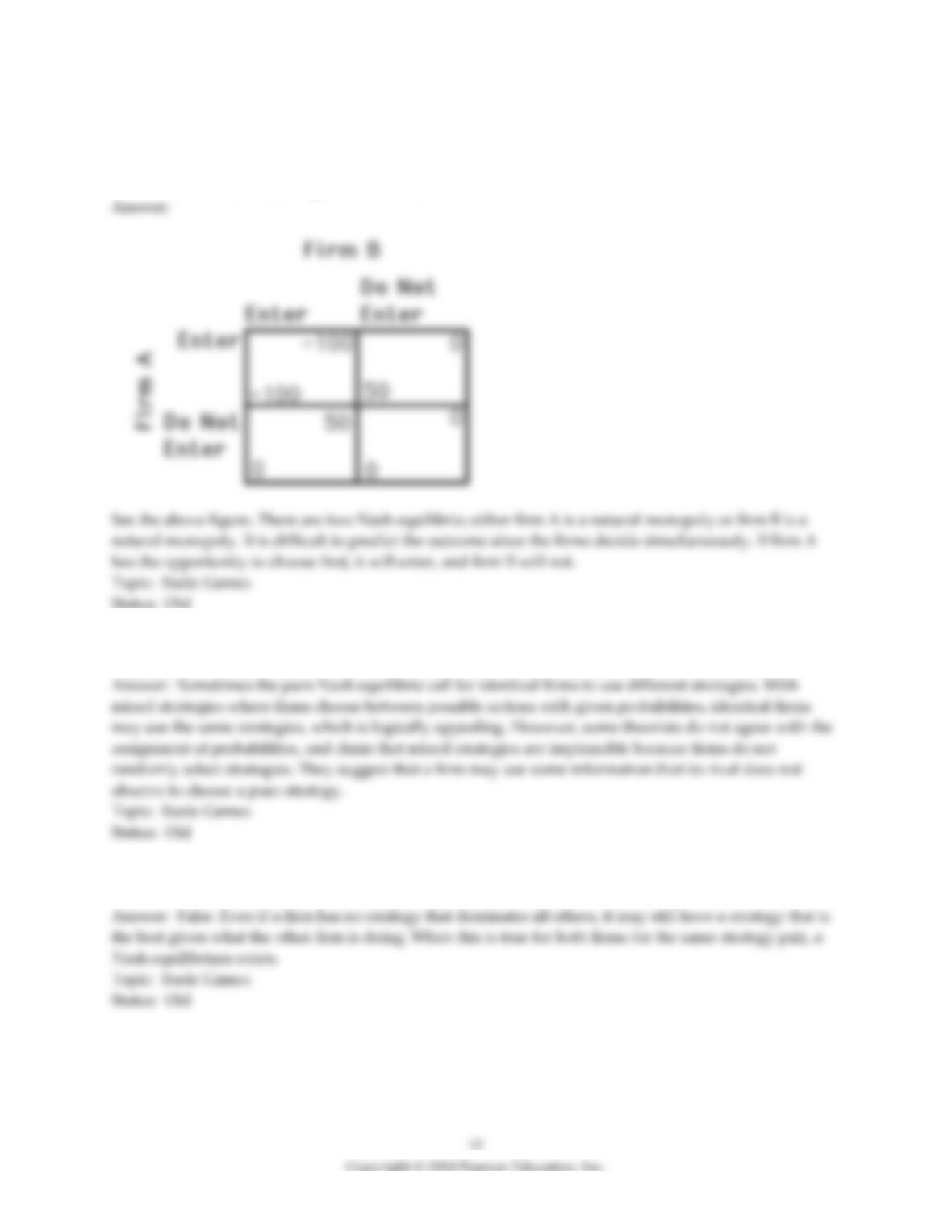
41) Suppose two firms, A and B, are simultaneously considering entry into a new market. If neither
enters, both earn zero. If both enter, they both lose 100. If one firm enters, it gains 50 while the other earns
zero. Set up the payoff matrix for this game and determine if any Nash equilibria exist. Can you predict
the outcome? What if firm A gets to decide first?
42) Explain why to some game theorists, the idea of mixed strategies is appealing, and to others it is
implausible.
For the following, please answer “True” or “False” and explain why.
43) If neither firm has a dominant strategy, a Nash equilibrium cannot exist.