CHAPTER 13: Oligopoly and Strategic Behavior
MULTIPLE CHOICE
1. Like a pure monopoly, an oligopoly is characterized by
a. free entry and exit in the long run.
b. free entry and exit in the short run.
c. significant barriers to entry.
d. all firms in the market producing the socially efficient level of output in the long run.
e. a single firm selling a product with no close substitutes.
2. Which of the following is NOT a characteristic of an oligopoly?
a. small number of firms
b. has some pricing power
c. the firms are interdependent
d. the good produced may be unique or not
e. low barriers to entry
3. Which of the following have greater incentives to collude and to form cartels in an effort to
achieve monopoly-like profits?
a. monopolists
b. workers in a competitive labor market
c. monopolistic competitors
d. firms in a perfectly competitive market
e. oligopolists
4. A monopolistically competitive market consists of many sellers, an oligopoly consists of ________
seller(s), and a monopoly consists of ________ seller(s).
a. one; one d. a few; one
b. one; two e. many; one
c. a few; many
5. A monopolistically competitive market consists of ________ seller(s), an oligopoly consists of
________ seller(s), and a monopoly consists of one seller.
a. one; many d. many; one
b. one; two e. many; a few
c. a few; many
6. A firm operating in an oligopolistic market has ________ market power compared to a ________.
a. less; firm operating in a perfectly competitive market
b. the same amount of; firm operating in a perfectly competitive market
c. less; monopolist
d. the same amount of; monopolist
e. more; monopolist
7. Economists measure oligopoly power present in an industry by using
a. capital ratios. d. inequality ratios.
b. concentration ratios. e. competition ratios.
c. reserve ratios.
8. In which industry do the four largest firms collectively have the most market power?
a. beer brewing d. adhesive manufacturing
b. breakfast cereals e. plastics product manufacturing
c. chocolate confections
9. In which industry do the four largest firms collectively have the least market power?
a. beer brewing d. adhesive manufacturing
b. breakfast cereals e. plastics product manufacturing
c. chocolate confections
10. In which two industries is market power the most concentrated?
a. beer brewing and adhesive manufacturing
b. breakfast cereals and adhesive manufacturing
c. chocolate confections and adhesive manufacturing
d. adhesive manufacturing and plastics product manufacturing
e. beer brewing and breakfast cereals
11. The four-firm concentration ratio in this industry is __________ percent.
a. 24 d. 78
b. 41 e. 94
c. 62
12. If Clear Water Island acquired Poolside Paradise, the concentration ratio would ________ and the
market price of pools would likely ________.
a. increase; fall d. decrease; fall
b. increase; rise e. decrease; rise
c. decrease; not change
13. The four-firm concentration ratio in this industry is __________ percent.
a. 20 d. 80
b. 40 e. 100
c. 60
14. If Glues R Us split into two separate companies, the concentration ratio would ________ and the
market price of adhesive would likely ________.
a. increase; fall d. decrease; fall
b. increase; rise e. decrease; rise
c. decrease; not change
15. Which of the following industries is most likely an oligopoly?
a. restaurant d. wheat growing
b. airline e. potato growing
c. gold mining
16. Which of the following industries is most likely an oligopoly?
a. wheat d. computer repair
b. construction e. house painting
c. cell phone
17. Being part of a cartel is generally good for a firm because it can reduce output while increasing
prices and profits. Yet most cartels have failed. Why is this the case?
a. Cartels lack a dominant strategy.
b. As the cartel becomes more profitable, competition increases.
c. Cartel members dislike having to equally share profits.
d. Each member of the cartel faces an incentive to cheat and produce more, while all of the other
members honor the agreement.
e. Cartel members eventually go out of business.
18. The Organization of Petroleum Exporting Countries (OPEC) is considered a cartel by economists
because the
a. firms agree to restrict output in order to increase prices and profits.
b. firms are controlled by the government.
c. firms in the cartel sell a homogenous (undifferentiated product).
d. firms sell a product with few substitutes.
e. organization is international and thus not subject to antitrust laws.
19. The levels of profits in a cartel are
a. initially high, but then decrease as substitute goods emerge.
b. initially low, but then decrease as the level of competition increases.
c. initially low, but then increase as the level of competition increases.
d. near the monopoly level of profits.
e. zero.
20. When two or more firms set prices or quantities in unison, economists refer to them as a
a. cartel.
b. monopoly.
c. monopolistically competitive market.
d. perfectly competitive market.
e. predatory pricing unit.
21. A ________ agreement among rival firms will most likely specify the price each firm will charge
and the quantity each firm will produce/sell.
a. friendly d. collusive
b. competitive e. price-quantity
c. monopolistic
22. Oligopolistic markets are socially ________ because price is ________ marginal cost.
a. efficient; equal to d. inefficient; less than
b. efficient; less than e. inefficient; greater than
c. efficient; greater than
23. In the United States, ________ laws prohibit collusion between rivals.
a. competitive arbitration d. union
b. immigration e. antitrust
c. anticompetition
24. When two or more firms form a ________ agreement and set price and quantity in unison,
economists refer to them as ________.
a. competitive; a cartel
b. collusive; social benefactors
c. collusive; a cartel
d. monopolistically competitive; social benefactors
e. monopolistically competitive; a cartel
25. When a market is characterized by mutual interdependence
a. one firm’s pricing decision does not affect the market share of any other firm.
b. one firm’s quantity decision does not affect the market share of any other firm.
c. all firms always act in unison to produce the monopoly quantity.
d. the actions of one firm have an impact on the price and output of its competitors.
e. the actions of one firm have no impact on the price and output decisions of its competitors.
26. If antitrust laws did not prohibit efforts to restrict competition in markets, then
a. no firms would attempt to collude on price and/or quantity.
b. attempts at collusion with rival firms on price and or/quantity would succeed all the time.
c. attempts at collusion with rival firms would probably often fail.
d. all firms in the economy would earn negative economic profit in the long run.
e. all firms in the market would earn zero economic profit in the long run.
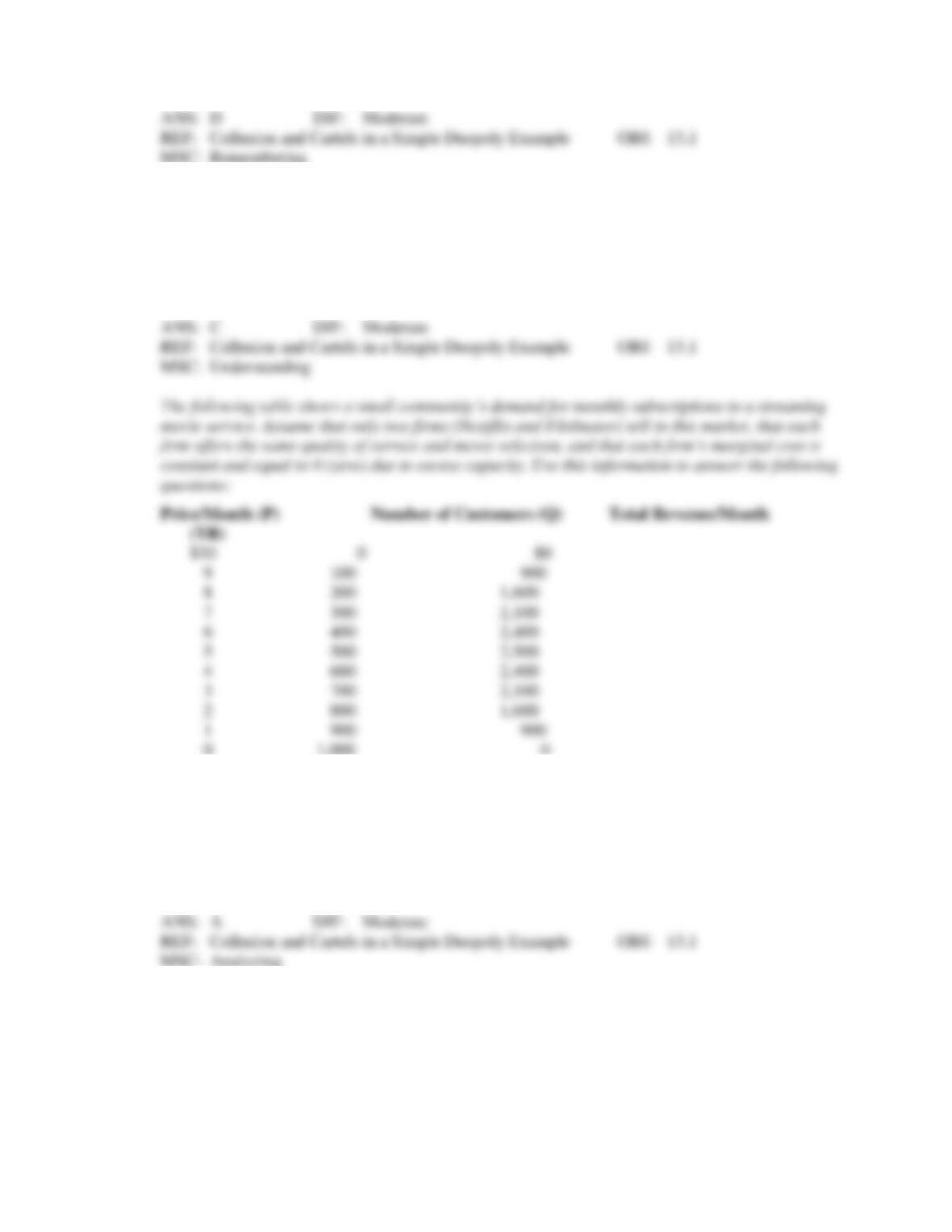
27. If this market were highly competitive instead of a duopoly, the market price would be
__________ and the quantity of streaming movie subscriptions purchased each month would be
__________.
a. $0; 1,000 d. $6; 400
b. $2; 800 e. $8; 800
c. $4; 600
28. If this market were a monopoly instead of a duopoly, the market price would be ________ and the
quantity of streaming movie subscriptions purchased each month would be ________.
a. $0; 1,000 d. $7; 300
b. $3; 700 e. $9; 100
c. $5; 500
29. If the two firms operating in this market agreed to each supply one-half of the quantity a
monopolist would supply, the contract would specify that
a. Nextflix supplies 400 subscriptions and Flixbuster supplies 100 subscriptions.
b. Flixbuster supplies 400 subscriptions and Nextflix supplies 100 subscriptions.
c. Nextflix supplies 0 (zero) subscriptions and Flixbuster supplies 500 subscriptions.
d. Flixbuster supplies 0 (zero) subscriptions and Nextflix supplies 500 subscriptions.
e. Nextflix supplies 250 subscriptions and Nextflix supplies 250 subscriptions.
30. An agreement between Nextflix and Flixbuster to each supply 250 subscriptions is an example of
a. price discrimination. d. collusion.
b. Bertrand competition. e. increasing marginal costs.
c. price leadership.
31. The following list includes four different collusive agreements that Nextflix and Flixbuster are
considering. Assuming both firms will abide by the terms, which collusive agreement(s) would
maximize total profit in the market?
I. Nextflix supplies 400 subscriptions and Flixbuster supplies 500 subscriptions.
II. Nextflix supplies 500 subscriptions and Flixbuster supplies 300 subscriptions.
III. Nextflix supplies 250 subscriptions and Flixbuster supplies 250 subscriptions.
IV. Nextflix supplies 100 subscriptions and Flixbuster supplies 400 subscriptions.
a. agreement I d. agreement IV
b. agreements I and II e. agreements III and IV
c. agreements II and III
32. Listed below are four different collusive agreements that Nextflix and Flixbuster are considering.
Assuming both firms will abide by the terms, which collusive agreement(s) would maximize total
profit in the market?
I. Nextflix supplies 50 subscriptions and Flixbuster supplies 450 subscriptions.
II. Nextflix supplies 450 subscriptions and Flixbuster supplies 50 subscriptions.
III. Nextflix supplies 300 subscriptions and Flixbuster supplies 100 subscriptions.
IV. Nextflix supplies 100 subscriptions and Flixbuster supplies 100 subscriptions.
a. agreement I d. agreement III
b. agreements I and II e. agreements III and IV
c. agreements II and III
33. Assume all markets are in long-run equilibrium. The market quantity supplied in a duopoly would
be ________ the market quantity supplied in a monopoly and ________ the market quantity
supplied in a competitive market.
a. less than or equal to; less than or equal to
b. less than or equal to; greater than or equal to
c. less than; equal to
d. greater than; equal to
e. greater than or equal to; less than or equal to
34. Assume all markets are in long-run equilibrium. Market price in a duopoly would be ________ the
market price in a monopoly, and ________ the market price in a competitive market.
a. less than or equal to; less than or equal to
b. less than or equal to; greater than or equal to
c. less than; equal to
d. greater than; equal to
e. greater than or equal to; less than or equal to
35. Firm A and Firm B are duopolists. They are choosing the price at which they will sell their
products and the quantity they will sell. Both firms make their decisions simultaneously. The
________ equilibrium in this situation occurs when Firm B chooses a pricing strategy given the
strategy that Firm A chooses, and Firm A chooses a pricing strategy given the strategy that Firm B
chooses.
a. antitrust d. Morgenstern
b. Nash e. cartel
c. Von Neumman
36. An agreement between Nike and Adidas to raise prices of the track shoes that each company
produces by 50 percent is an example of a collusive agreement, and economists generally agree
that
a. this agreement is in the best interest of society because the price of track shoes is significantly
above marginal cost.
b. this agreement is in the best interest of society because the quantity of track shoes bought and
sold is significantly less than the quantity that would be bought and sold in a perfectly competitive
market.
c. this agreement is not in the best interest of society because the price of track shoes is
significantly below marginal cost.
d. this agreement is not in the best interest of society because the price of track shoes is
significantly above marginal cost.
e. the price of track shoes does not affect societal welfare.
37. Airline A and Airline B are the two largest airlines in the country. The chief executive officer of
Airline A calls the chief executive officer of Airline B and says, “Why don’t we both raise prices
25 percent across the board next week?” This is an example of
a. spirited competition. d. a corporate merger.
b. attempted collusive behavior. e. a tying arrangement.
c. predatory pricing.
38. When a third firm enters a market that was previously categorized as a duopoly, the equilibrium
price will ________ and the equilibrium quantity will ________.
a. be lower; be lower d. be higher; be higher
b. be higher; be lower e. not change; not change
c. be lower; be higher
39. When more firms enter into a market that was previously characterized as a duopoly, it will
a. be easier for firms in the market to form a successful cartel.
b. be more difficult for firms in the market to form a successful cartel.
c. be just as difficult for firms in the market to form a successful cartel as it was before the new
firms entered.
d. be impossible for firms in the market to form a successful cartel, whereas before the new firms
entered, it would have been possible.
e. still be impossible for firms in the market to form a successful cartel.
40. The ________ effect occurs when the market price either decreases or increases by the respective
entrance or exit of a rival firm in the market.
a. competitive d. market
b. price e. oligopoly
c. output
41. Three firms are currently producing and selling in a market. When one of the three firms exits the
market, economists expect that the equilibrium price will ________ and the equilibrium quantity
will ________.
a. be lower; be lower d. be higher; be higher
b. be higher; be lower e. not change; not change
c. be lower; be higher
42. Five firms are currently producing and selling in a market. When two more firms enter the market,
economists expect that the equilibrium price will ________ and the equilibrium quantity will
________.
a. be lower; be lower d. be higher; be higher
b. be higher; be lower e. not change; not change
c. be lower; be higher
43. Six firms are currently producing and selling in a market. When two of the six firms exit the
market, economists expect that the equilibrium price will ________ and the equilibrium quantity
will ________.
a. be lower; be lower d. be higher; be higher
b. be higher; be lower e. not change; not change
c. be lower; be higher
44. Which effect best describes the likely decrease in profits experienced by each of the three original
firms due only to the lower market price?
a. competitive d. market
b. price e. oligopoly
c. output
45. Due to the entrance of two firms in 2012, total monthly profits for all firms in the market decreased
by $3,000 due to the ________ effect and increased by $1,500 due to the ________ effect.
a. price; output d. output; output
b. output; price e. competitive; noncompetitive
c. price; price
46. Firm C’s monthly profit increased by ________ due only to the output effect and decreased by
________ due only to the price effect, for a net increase of $500.
a. $2,500; $2,000 d. $1,500; $1,000
b. $3,000; $2,500 e. $3,500; $3,000
c. $500; $0
47. Due only to the price effect, profits for each firm decline by $1,000. Due only to the output effect,
profits for both Firm A and Firm B did not change, and profits for Firm C increased by $1,500. It
was in Firm C’s interest to increase output because Firm C realized only ________ of the total
$3,000 price effect, but it realized the full ________ of the total quantity effect.
a. $1,000; $1,500 d. $1,750; $1,250
b. $2,500; $1,500 e. $2,000; $1,250
c. $2,250; $1,500
48. Assume that there is an oligopoly consisting of firms of different sizes. If a small firm increases
output by 25 percent, the price effect realized by the small firm will be ________. If a large firm
increases output by 25 percent, the price effect realized by the large firm will be ________.
a. nonexistent; negligible d. substantial; nonexistent
b. negligible; nonexistent e. negligible; substantial
c. nonexistent; substantial
49. An equilibrium in a game in which players pursue their own self-interest is called
a. collusion. d. a noncooperative equilibrium.
b. a sequential equilibrium. e. a cooperative equilibrium.
c. a prisoner’s dilemma.
50. When modeling economic situations using game theory, the economic participants are generally
referred to as
a. gamers. d. players.
b. nonmovers. e. managers.
c. dominators.
51. A ________ consists of a set of players, a set of strategies available to those players, and a
specification of the payoffs to each player for each possible combination of strategies.
a. tournament d. firm
b. competitive market e. monopolistically competitive market
c. game
52. The branch of economics that studies strategic decision making is called ________ theory.
a. interdependence d. noncompetitive
b. game e. strategic
c. competitive
53. Economists use ________ theory to better understand what might happen in situations where
strategic interactions are involved.
a. complexity d. noncompetitive
b. strategic e. game
c. competitive
54. Economists are more likely to use game theory to analyze a(n)
a. competitive market.
b. monopoly.
c. monopolistically competitive market.
d. oligopoly.
e. monopsony.
55. A game where firms that pursue a dominant strategy that results in noncooperation where all
players are worse off is a
a. cartel. d. tit for tat.
b. prisoner’s dilemma. e. cooperative equilibrium.
c. sequential game.
56. When decision makers face incentives that make it difficult to achieve mutually beneficial
outcomes, we say they are in a(n) ________ dilemma.
a. oligopoly d. monopoly
b. prisoner’s e. competitive
c. prison guard’s
57. Refer to the following table. Assume that Jane confesses. John will spend ________ years in jail if
he also confesses, and ________ years in jail if he keeps quiet.
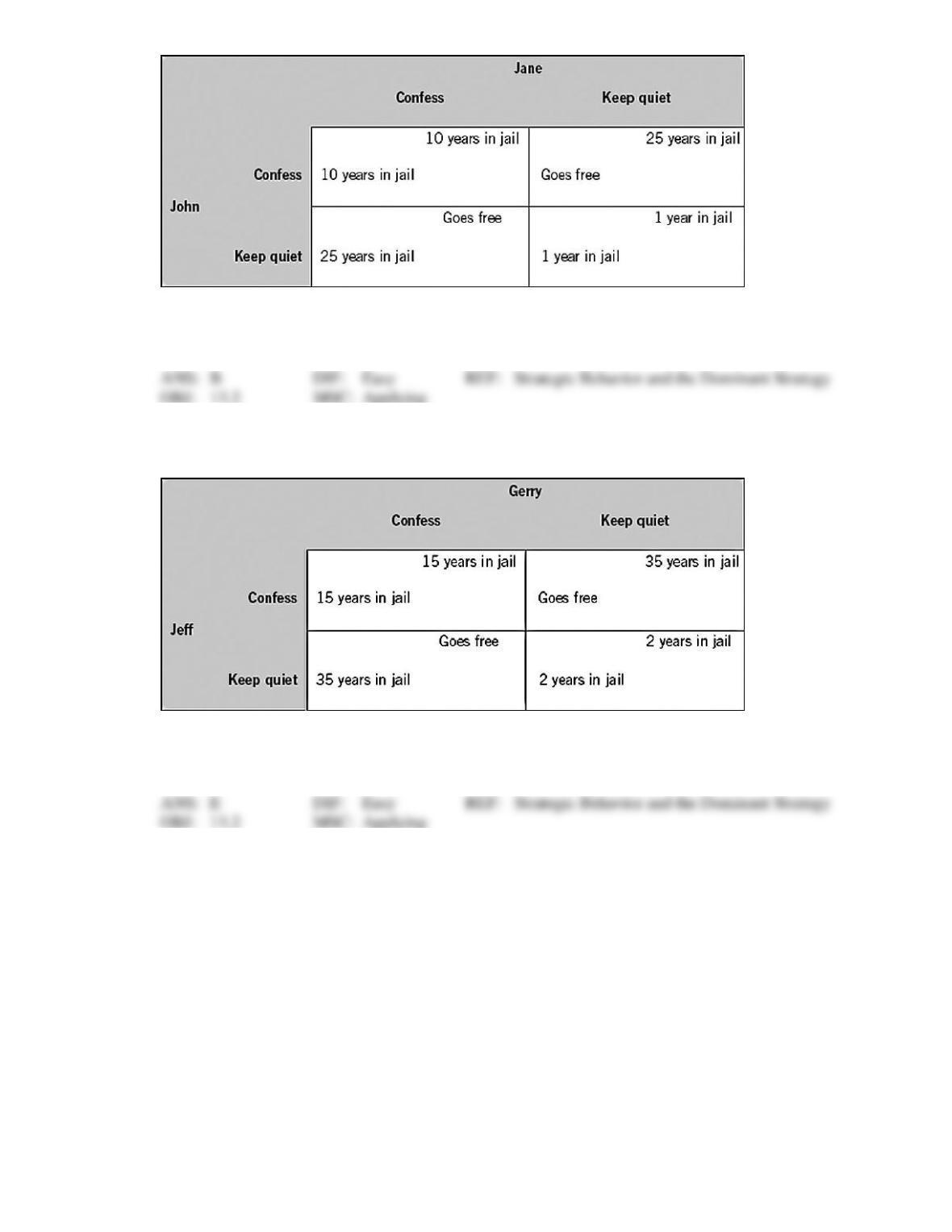
a. 10; 10 d. 0; 10
b. 10; 25 e. 25; 25
c. 10; 0
58. Refer to the following table. Assume that Jeff confesses. Gerry will spend ________ years in jail if
he also confesses, and ________ years in jail if he keeps quiet.
a. 15; 15 d. 35; 0
b. 35; 35 e. 15; 35
c. 0; 35
59. Refer to the following table. Assume that Keisha keeps quiet. Larry will spend ________ years in
jail if he confesses, and ________ years in jail if he also keeps quiet.
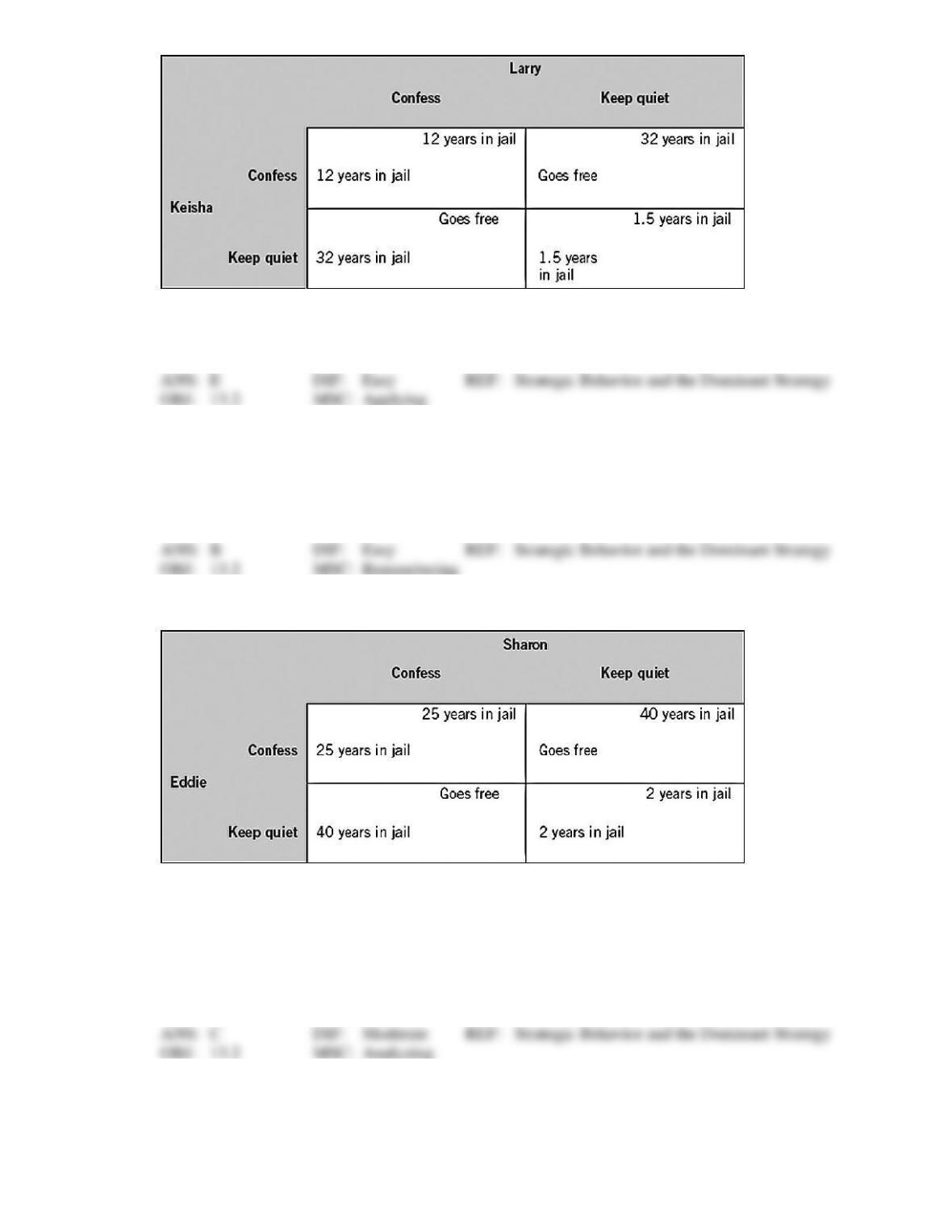
a. 12; 1.5 d. 12; 12
b. 1.5; 12 e. 0; 1.5
c. 0; 12
60. When a particular strategy produces a better outcome for a person regardless of the strategies
others choose, we say it is a(n)
a. dominated strategy. d. efficient strategy.
b. dominant strategy. e. surplus maximization strategy.
c. equilibrated strategy.
61. Refer to the following table. Confessing is Eddie’s dominant strategy because
a. Sharon’s dominant strategy is to keep quiet.
b. he spends more time in jail if he confesses, regardless of whether Sharon confesses or keeps
quiet.
c. he spends less time in jail if he confesses, regardless of whether Sharon confesses or keeps
quiet.
d. he spends the same amount of time in jail by confessing as he would by not confessing.
e. his decision does not depend on Sharon’s decision.
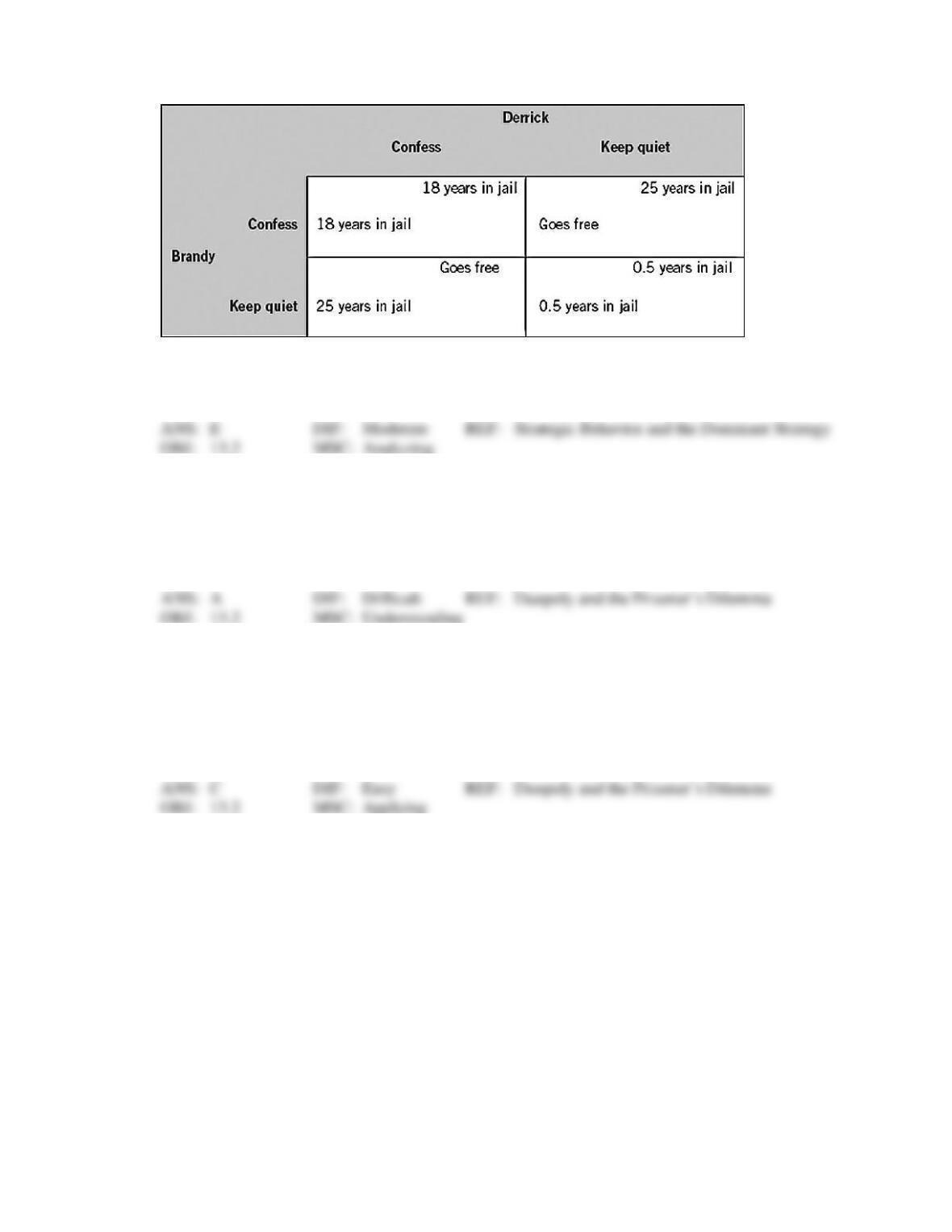
62. Refer to the following table. In the Nash equilibrium of this game, Derrick will go to jail for
________ years and Brandy will go to jail for ________ years.
a. 0.5; 0.5 d. 0.5; 25
b. 25; 25 e. 18; 18
c. 0.5; 18
63. The Nash equilibrium in an oligopolistic market is generally ________ for society than the
outcome under collusion because the price is ________ marginal cost.
a. better; closer to d. worse; further above
b. better; further above e. worse; equal to
c. worse; closer to
64. Which of the following is an example of collusion?
a. Nike and Reebok compete on price.
b. Dell and Gateway compete on quantity.
c. American Airlines and United Airlines agree to raise prices.
d. Coca-Cola and Pepsi do not attempt to fix prices.
e. Verizon builds more cell phone towers.
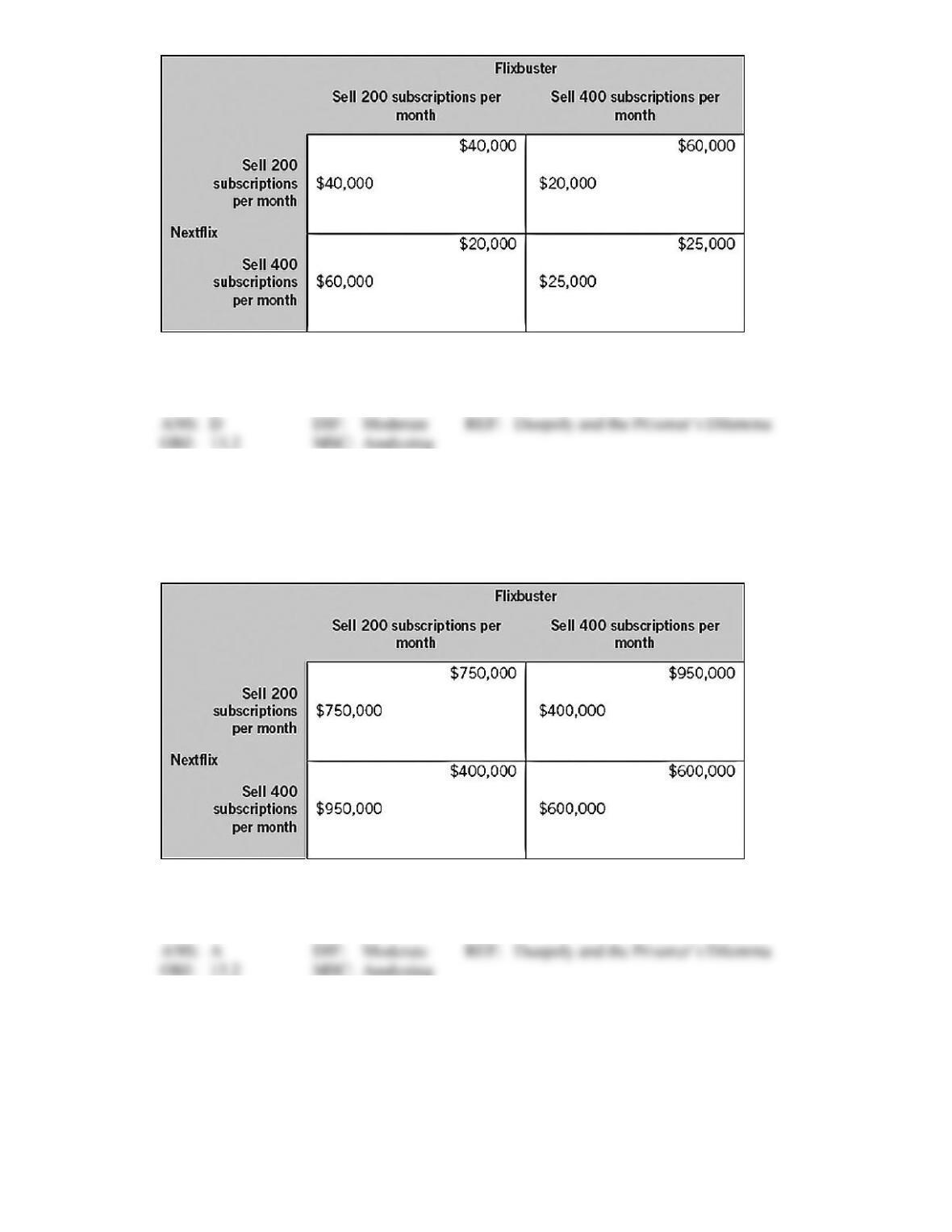
65. The following table shows two firms in a duopoly. Each firm makes its decision without
knowledge of the other firm’s decision. The payoffs for each firm represent economic profits, and
each firm strictly prefers more economic profit than less. In this game, selling ________
subscriptions a month is a dominant strategy for Flixbuster and selling ________ subscriptions a
month is a dominant strategy for Nextflix.
a. 200; 200 d. 400; 400
b. 200; 400 e. 100; 100
c. 400; 200
66. The following table shows two firms in a duopoly. Each firm makes its decision without
knowledge of the other firm’s decision. The payoffs for each firm represent economic profits, and
each firm strictly prefers more economic profit than less. If both firms were able to collude and
make their supply decisions collectively, Flixbuster would sell ________ subscriptions per month
and Nextflix would sell ________ subscriptions per month.
a. 200; 200 d. 200; 400
b. 400; 400 e. 600; 600
c. 400; 200
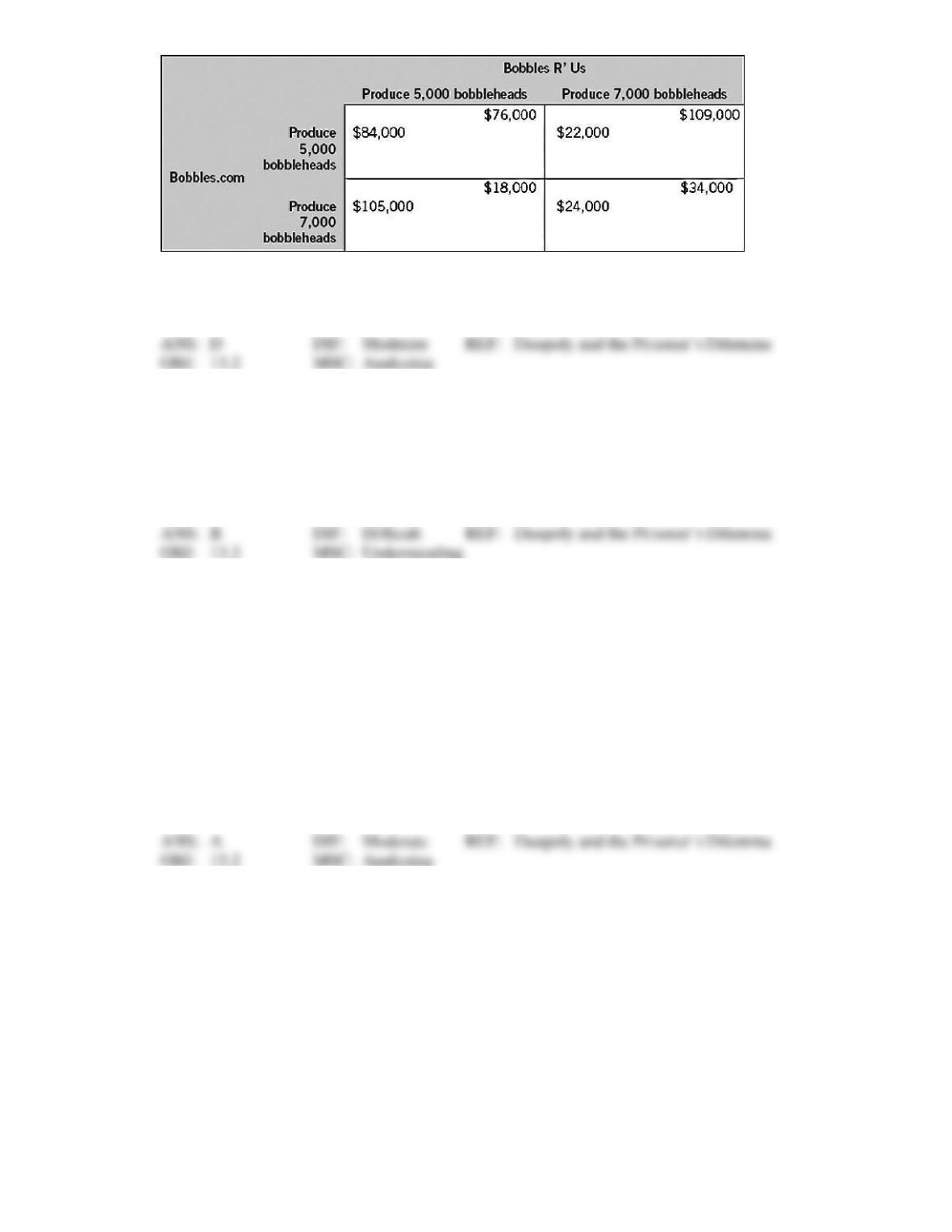
67. The following table shows two firms in a single-stage duopoly game. Each firm makes its decision
without knowledge of the other firm’s decision. The payoffs for each firm represent economic
profits, and each firm strictly prefers more economic profit than less. If both firms were able to
write a binding contract, this contract would specify that Bobbles.com agrees to produce ________
bobbleheads and Bobbles R’ Us agrees to produce ________ bobbleheads.
a. 5,000; 7,000 d. 5,000; 5,000
b. 7,000; 5,000 e. 12,000; 0
c. 7,000; 7,000
68. If two duopolists arrive at the Nash equilibrium output level, the total quantity of the good on the
market will be ________ the total quantity on the market if the market were perfectly competitive
and ________ the total quantity on the market if the market were controlled by a monopoly.
a. less than; less than d. greater than; less than
b. less than; greater than e. greater than; equal to
c. greater than; greater than
69. Walmart and Target are the only stores in a remote town that currently stock and sell the
PlayStation 5 video game console. Managers at both stores are simultaneously deciding whether to
charge a price of $1,000 or $1,500 for each console. If both stores charge $1,000, they earn a profit
of $100,000 each. If both stores charge $1,500, they earn a profit of $200,000 each. If one store
charges $1,000 and the other store charges $1,500, the store that charges $1,000 earns a profit of
$250,000 and the firm that charges $1,500 earns a profit of $50,000. If Walmart and Target
________, they can both charge $1,500 and earn the highest combined profit available.
a. collude with each other
b. privately undercut each other after making an agreement
c. engage in spirited price competition
d. compete with each other only with regard to quantity and not price
e. compete with each other only with regard to price and not quantity
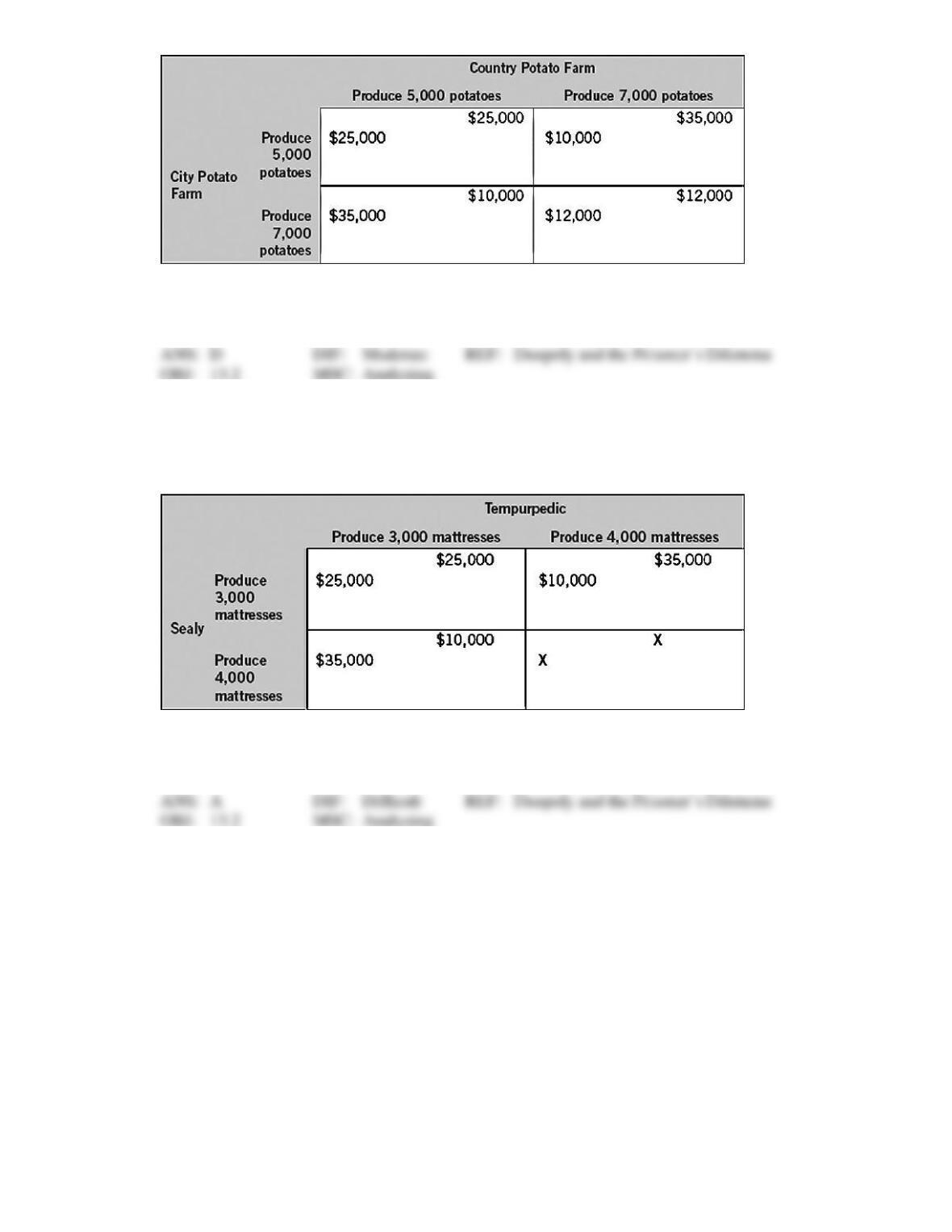
70. The following table shows two firms in a single-stage duopoly game. Each firm makes its decision
without knowledge of the other firm’s decision. The payoffs for each firm represent economic
profits, and each firm strictly prefers more economic profit than less. Assume the firms are not able
to collude. The Nash equilibrium total quantity of potatoes on the market is
a. 12,000. d. 14,000.
b. 4,000. e. 24,000.
c. 10,000.
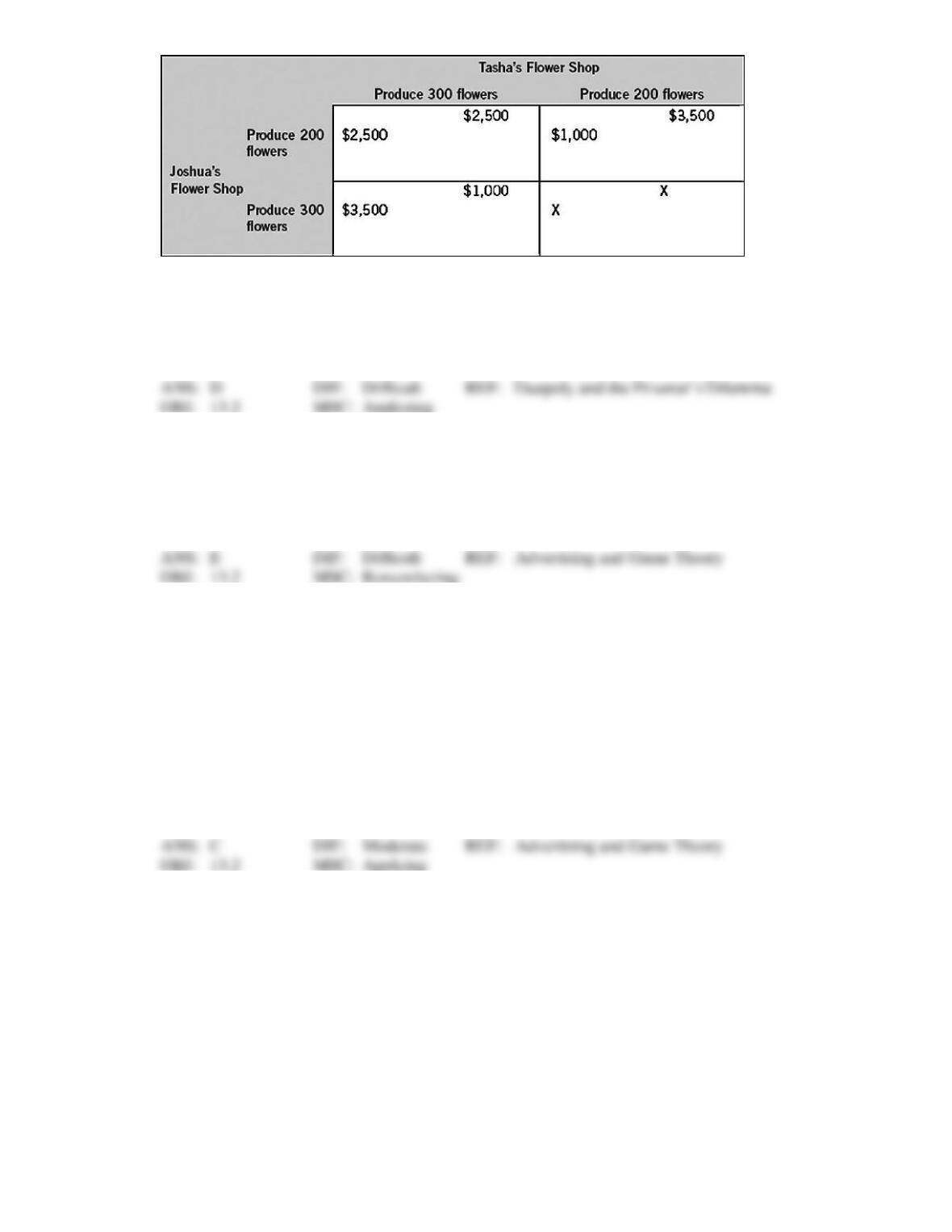
71. The following table shows two firms in a single-stage duopoly game. Each firm makes its decision
without knowledge of the other firm’s decision. The payoffs for each firm represent economic
profits, and each firm strictly prefers more economic profit than less. This game would be
considered a prisoner’s dilemma if X is between
a. $10,000 and $25,000. d. $35,000 and $70,000.
b. $25,000 and $35,000. e. $45,000 and $70,000.
c. $10,000 and $35,000.
72. The following table depicts two firms in a single-stage duopoly game. Each firm makes its
decision without knowledge of the other firm’s decision. The payoffs for each firm represent
economic profits, and each firm strictly prefers more economic profit than less. If X is greater than
$3,500, then there is/are
a. only one Nash equilibrium, and this game would be considered a prisoner’s dilemma.
b. two Nash equilibriums, and this game would be considered a prisoner’s dilemma.
c. three Nash equilibriums, and this game would be considered a prisoner’s dilemma.
d. only one Nash equilibrium, and this game would not be considered a prisoner’s dilemma.
e. two Nash equilibriums, and this game would not be considered a prisoner’s dilemma.
73. Together, Coca-Cola and Pepsi account for approximately ________ percent of the soft drink
market.
a. 35 d. 65
b. 45 e. 75
c. 55
74. In January 2011, Coca-Cola and Pepsi agreed to reduce their yearly advertising budgets by $1
million each, and neither firm reneged on the agreement throughout the year. In January 2012,
Coca-Cola and Pepsi each announced that its company 2011 profits had increased by $1 million.
Which of the following is a likely explanation for this increase?
a. A new entrant in the market caused Coca-Cola and Pepsi to lose substantial market share.
b. The government imposed a punitive tax on both firms for producing a beverage that is a
danger to public health.
c. The firms had previously been in a prisoner’s dilemma situation where one firm’s
advertisements were effectively canceling the other firm’s advertisements.
d. Coca-Cola drastically reduced the price of its soda relative to the price of Pepsi’s soda.
e. Pepsi drastically reduced the price of its soda relative to the price of Coca-Cola’s soda.
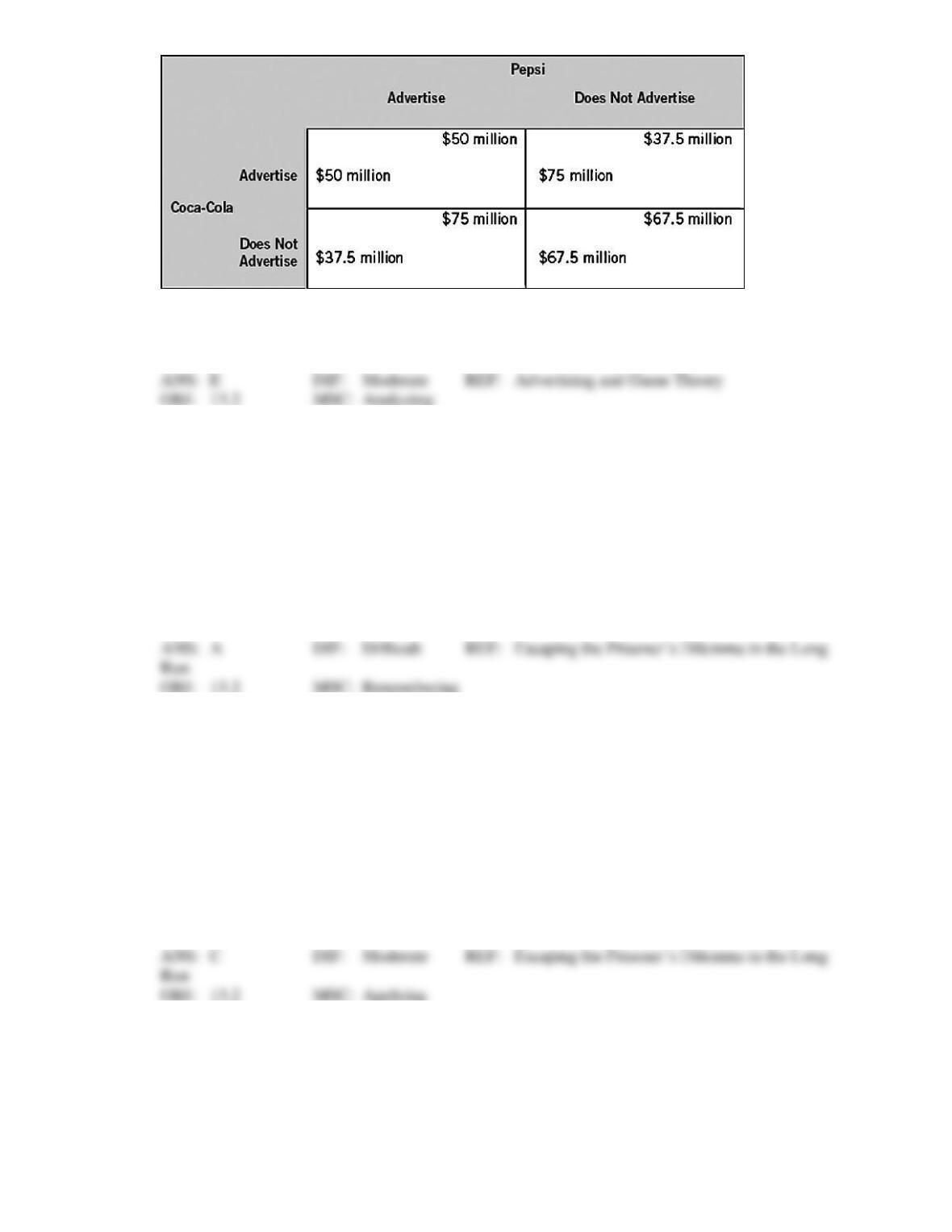
75. The following table shows two firms in a single-stage game. Each firm makes its decision without
knowledge of the other firm’s decision. The payoffs for each firm represent economic profits, and
each firm strictly prefers more economic profit than less. In the Nash equilibrium of this game,
Pepsi earns a profit of ________ and Coca-Cola earns a profit of ________.
a. $67.5 million; $67.5 million d. $75 million; $37.5 million
b. $30 million; $30 million e. $50 million; $50 million
c. $37.5 million; $75 million
76. Game theorist Robert Axelrod decided to examine the choices that participants make in a long-run
setting. He ran a sophisticated computer simulation in which he invited scholars to submit
strategies for securing points in a prisoner’s dilemma tournament over many rounds. All the
submissions were collected and paired, and the results were scored. After each simulation, he
eliminated the weakest strategy and reran the tournament with the remaining strategies. This
evolutionary approach continued until the best strategy remained. Among all strategies submitted,
which strategy dominated?
a. tit-for-tat strategy d. profit-maximization strategy
b. tit-for-two-tats strategy e. grim trigger
c. Axelrod equivalency strategy
77. Player A and Player B are playing a game involving several rounds of a prisoner’s dilemma where
their choices are to “cooperate” or “defect.” After each round ends, one player rolls a six-sided die.
If the die lands on 6, the game ends; however, if the die lands on any other number, the game
continues and players play another round. Prior to the game starting, the players formulate a
strategy that specifies what they will do in every possible round they might find themselves in. If
Player A is playing the tit-for-tat strategy, in the ________ round, Player A will ________.
a. first; definitely choose defect.
b. second; definitely choose defect.
c. second; choose whatever Player B chose in the first round.
d. second; definitely choose cooperate.
e. third; definitely choose cooperate.
78. In a repeated prisoner’s dilemma, a player who is playing tit for tat will
a. defect in the first round and defect in all subsequent rounds.
b. defect in the first round and, in any subsequent round, do what his or her opponent did in the
last round.