Chapter 12 – The Demand for Resources
107. Refer to the above data. Assuming the prices of resources a and b are $5 and $8
respectively, what is the profit-maximizing combination of resources?
108. Refer to the above data. Assuming the prices of resources a and b are $5 and $8
respectively, when the firm hires the profit-maximizing combination of resources, its
109. Refer to the above data. Assume now that the prices of a and b are $15 and $20
respectively. To maximize profits what combination of a and b should the employer hire?
Chapter 12 – The Demand for Resources
110. The equation MPL/PL = MPC/PC:
111. Assume a firm purchases resources a and b under purely competitive conditions and
combines these resources to produce X. Product X is sold in a purely competitive market. The
MP of a and b are 6 and 3 respectively and the prices of a and b are $12 and $6 respectively.
If equilibrium exists, the price of X will be:
112. Which of the following statements is correct?
Chapter 12 – The Demand for Resources
113. If MPa/Pa = MPb/Pb and MRPa/Pa = MRPb/Pb>1, this firm is:
114. Assuming pure competition, which of the following are equivalents?
115. Suppose a firm is hiring resources l and m under purely competitive conditions to
produce product Y that sells for $2 in a purely competitive market. The prices of l and m are
$10 and $4 respectively. In equilibrium the MPs of l and m, respectively, are:
Chapter 12 – The Demand for Resources
12–42
116. If a firm is hiring variable resources D and F in perfectly competitive input markets, it
will minimize the cost of producing any level of output by employing D and F in such
amounts that:
117. Assume a pencil manufacturer is employing resources C and D in such quantities that the
MRPs of the last units hired are $80 and $50 respectively. The price of resource C is $90 and
the price of D is $35. This firm:
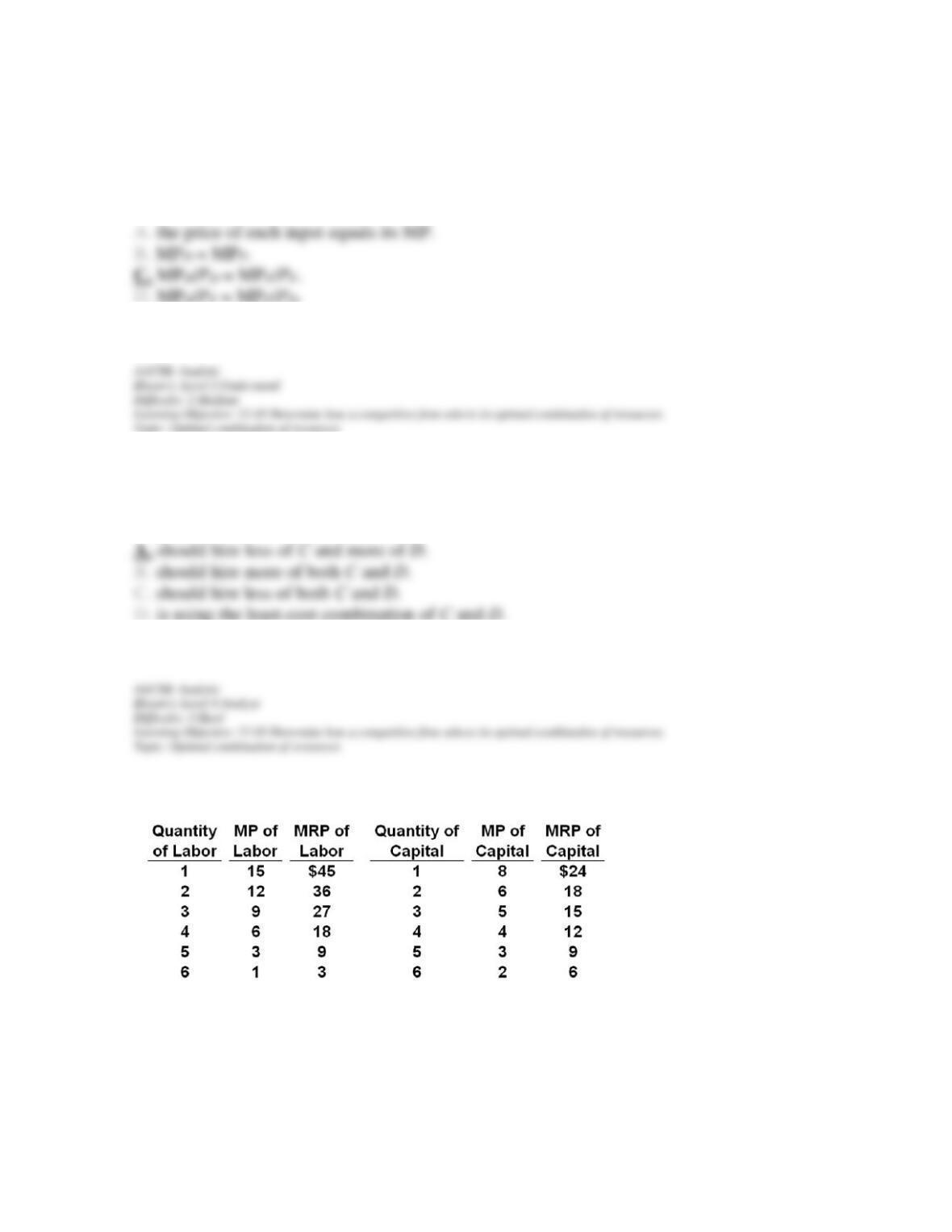
Answer the question on the basis of the following data:
Chapter 12 – The Demand for Resources
118. Refer to the above data. This firm is selling its product in:
119. Refer to the above data. If the prices of labor and capital are $9 and $15 respectively, the
profit-maximizing firm will hire:
120. Refer to the above data. If the prices of labor and capital are $9 and $15 respectively, at
the profit-maximizing level the firm’s total output will be:
Chapter 12 – The Demand for Resources
121. Refer to the above data. If the prices of labor and capital are $9 and $15 respectively, at
122. Refer to the above data. If the prices of labor and capital are $9 and $15 respectively, and
labor and capital are the only inputs, at the profit-maximizing level of output the firm’s total
123. Refer to the above data. If the prices of labor and capital are $9 and $15 respectively, and
labor and capital are the only inputs, the firm’s economic profits will be:
Chapter 12 – The Demand for Resources
124. The profit-maximizing and the least-cost combination of inputs are:
Answer the question on the basis of the following information:
Suppose a firm hires both labor (L) and capital (C) under purely competitive conditions. The
price of labor is PL and that of capital is PC. The marginal product of labor is MPL and that of
capital is MPC. The firm sells its product competitively at a price of PX.
125. Refer to the above information. Which of the following must pertain if the firm is to
minimize the cost of producing any output?
Chapter 12 – The Demand for Resources
126. Refer to the above information. If MPC/PC > MPL/PL, the firm:
127. Refer to the above information. In competitive labor markets, the marginal cost of an
additional unit of labor:
Chapter 12 – The Demand for Resources
128. Refer to the above diagram. If a firm produces output Q1 at a unit cost of c, then the:
129. Refer to the above diagram. If a firm produces output Q1 at a unit cost of b, then the:
130. Refer to the above diagram. The production of Q1 units of output at an average cost of a:
Chapter 12 – The Demand for Resources
131. The marginal productivity theory of income distribution suggests that:
132. “Income receivers should be paid in accordance with the value of output each produces.”
This statement is consistent with the:
133. The fact that monopoly and monopsony exist in resource markets means that:
Chapter 12 – The Demand for Resources
134. The marginal productivity theory of income distribution has been criticized because:
135. (Consider This) In the market for superstars:
136. (Consider This) According to the Consider This box “Superstars,” the high pay of
superstars reflects:
Chapter 12 – The Demand for Resources
137. (Last Word) “The Case of ATMs” best illustrates the:
138. (Last Word) ATMs and human bank tellers:
139. (Last Word) The rapid spread of ATMs has:
Chapter 12 – The Demand for Resources
140. The marginal revenue product curve of a purely competitive seller declines solely
because of the law of diminishing returns.
141. Producers should hire resources until the total output of each is equal.
142. It will be profitable for a firm to hire additional units of any resource up to the point at
which its MRP is equal to its MRC.
143. The more elastic the demand for a product the less elastic will be the demand for the
resources employed in producing it.
Chapter 12 – The Demand for Resources
144. The demand for a resource depends on its productivity and the market value of the
product it is producing.
145. If two resources are complementary, a decrease in the price of one will reduce the
demand for the other.
146. Other things equal, the less competitive the market in which a firm sells its product, the
less elastic will be its resource demand curve.
147. If the substitution effect outweighs the output effect, an increase in the price of a
substitute resource will increase the demand for labor.
Chapter 12 – The Demand for Resources
148. The demand for labor is a derived demand whereas the demand for capital is not.
149. The MRP of labor curve is the firm’s labor demand curve.
150. Marginal revenue product (MRP) is the change in total product (total output) associated
with hiring an additional unit of labor.
151. A firm should reduce its employment of a resource whose marginal resource cost
exceeds its marginal revenue product.
Chapter 12 – The Demand for Resources
152. Elasticity of resource demand is measured by dividing “percentage change in resource
price” by “percentage change in resource quantity.”
153. An increase in the price of capital will reduce the demand for labor if capital and labor
are complementary resources.
154. The marginal productivity theory of income distribution holds that all resources are paid
according to their marginal contribution to society’s output.
155. Hiring the least-costly combination of resources ensures that profits will be maximized.
Chapter 12 – The Demand for Resources
156. Hiring the profit-maximizing combination of resources ensures that production costs will
be minimized.