Chapter 12 – The Demand for Resources
95. In which case below will the elasticity of demand for laborers who produce yo-yos be
most inelastic? The price elasticity of demand for yo-yos is:
96. In firm X, labor costs are 85 percent of production costs, while in firm Y labor costs are
40 percent of production costs. A 20 percent increase in wages would increase production
costs by:
97. Other things being equal, a labor union will find it harder to obtain a wage increase for its
members the:
Chapter 12 – The Demand for Resources
98. A computer manufacturer’s elasticity of demand for labor is not likely to be affected by
the:
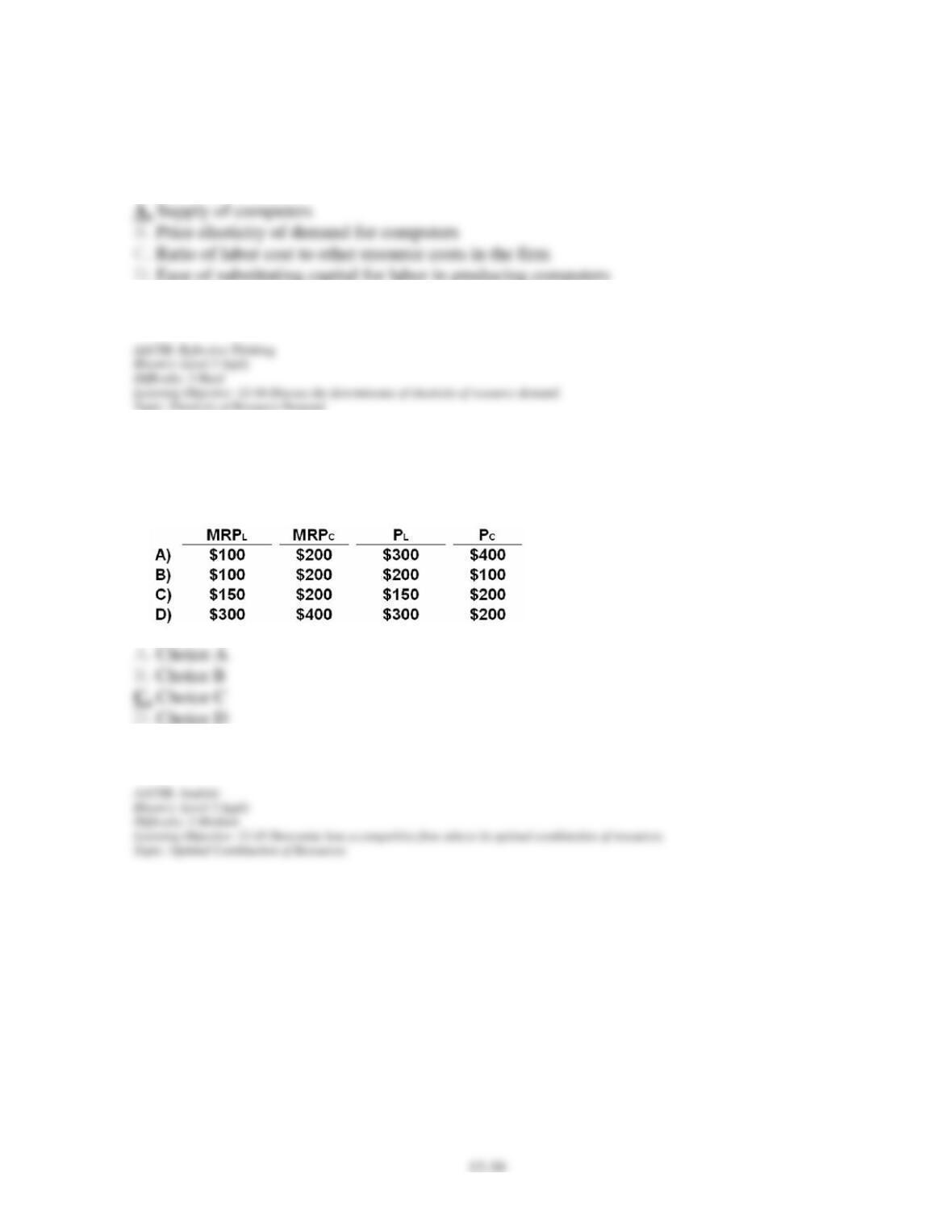
99. Assume that a purely competitive firm uses two resources, labor (L) and capital (C), to
produce a certain product. In which situation would the firm be maximizing profit?
Chapter 12 – The Demand for Resources
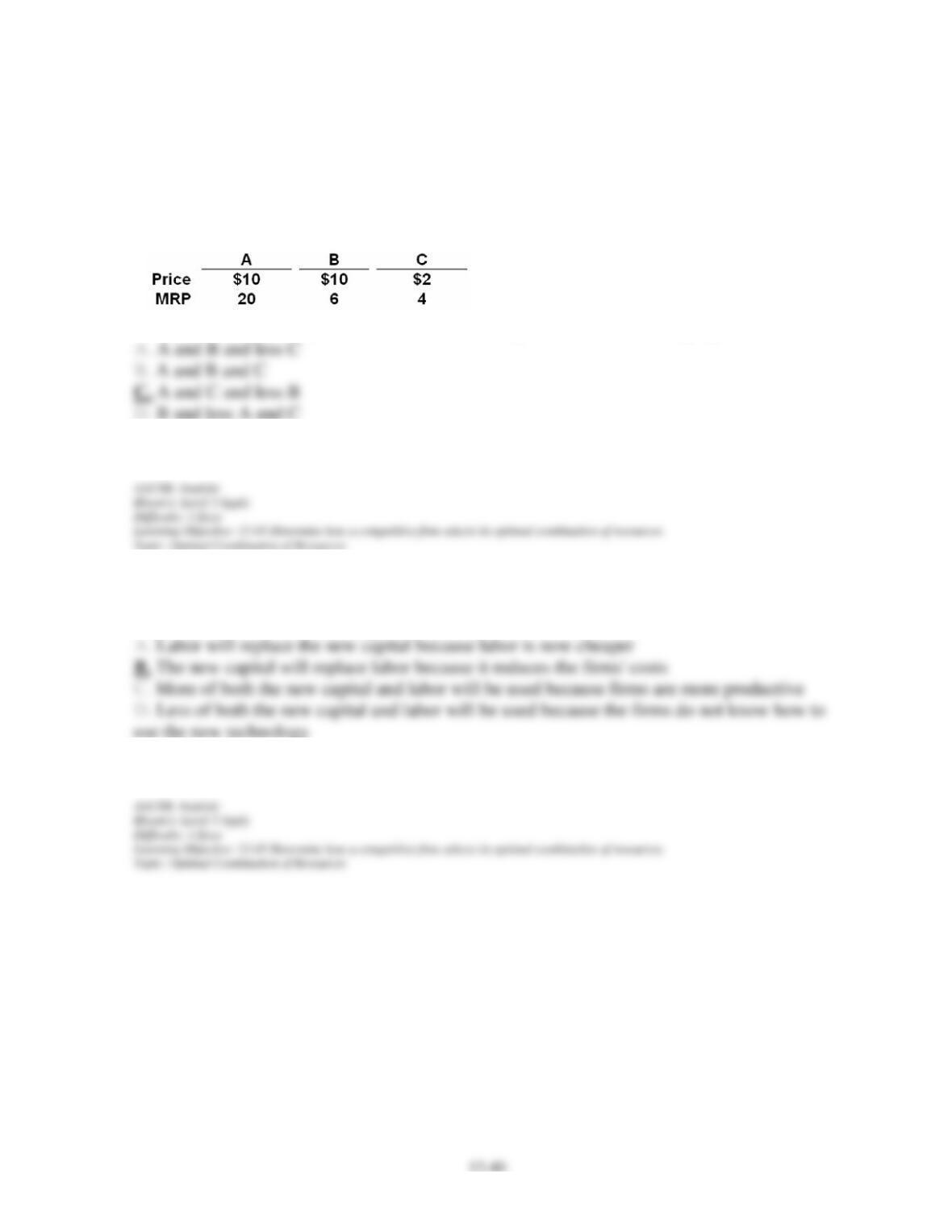
100. A firm operating in purely competitive product and resource markets uses three
resources, A, B, and C, whose prices and productivities at current output levels are given
below.
To achieve an optimal factor mix for its current output the firm should employ more:
101. What happens when technological advance makes available a new highly productive
capital good for which MP/P is greater than for the labor for which it is a substitute resource?
Chapter 12 – The Demand for Resources
102. The introduction of automatic elevator equipment allowed firms to handle the movement
of people in a multi-story building at less cost, thus decreasing the demand for elevator
operators. The best explanation for this change is that the:
103. A firm combines two resources, A and B, to produce an output Q. Their respective
marginal revenue products are $30 and $21. A costs $15 a unit and B $7 a unit. To reduce the
cost of Q:
Chapter 12 – The Demand for Resources
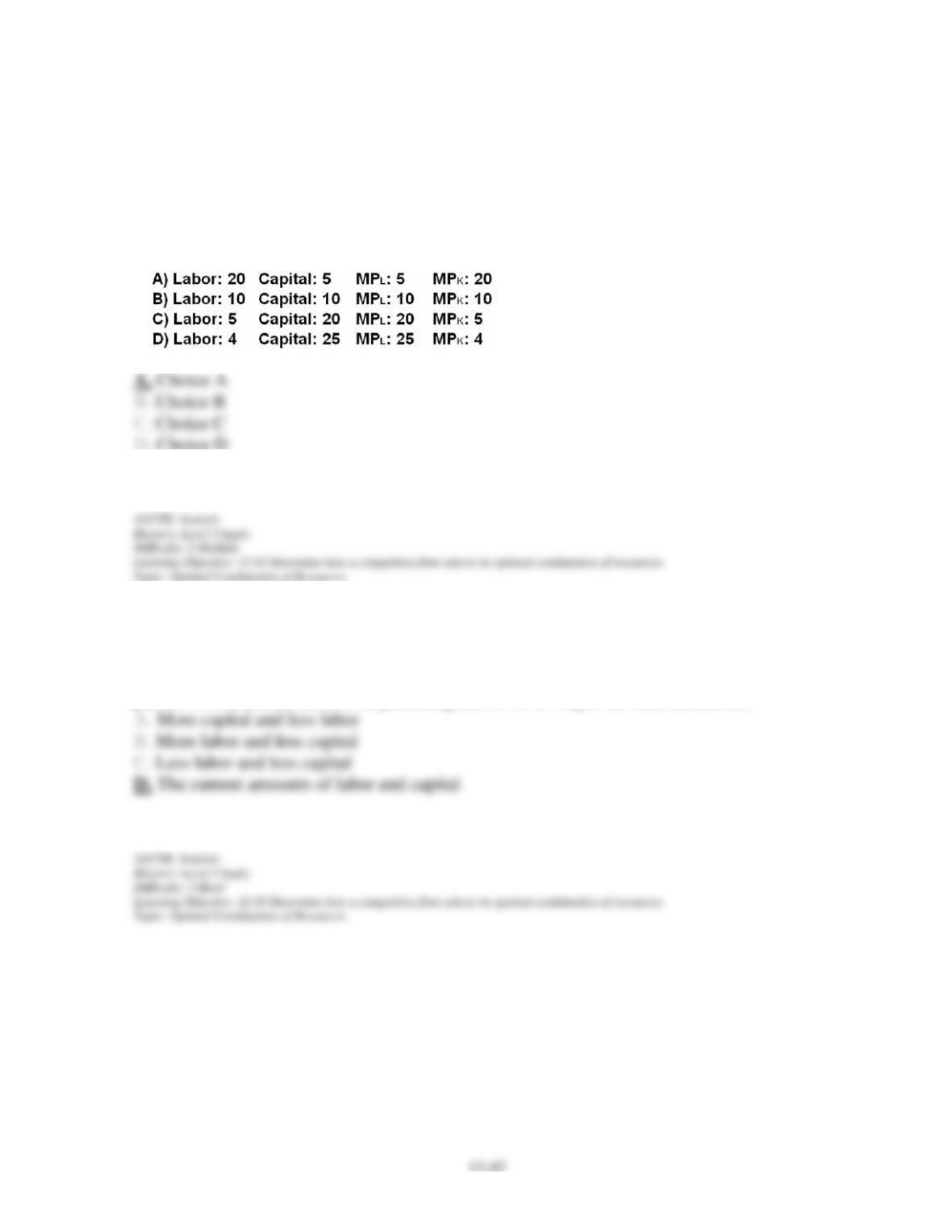
104. The price of capital is $12 per machine-hour and the price of labor is $3 per hour. Below
are production schedules for a firm showing the possible combinations of capital and labor
that will produce 100 units of output. Which combination will this cost-minimizing firm
choose?
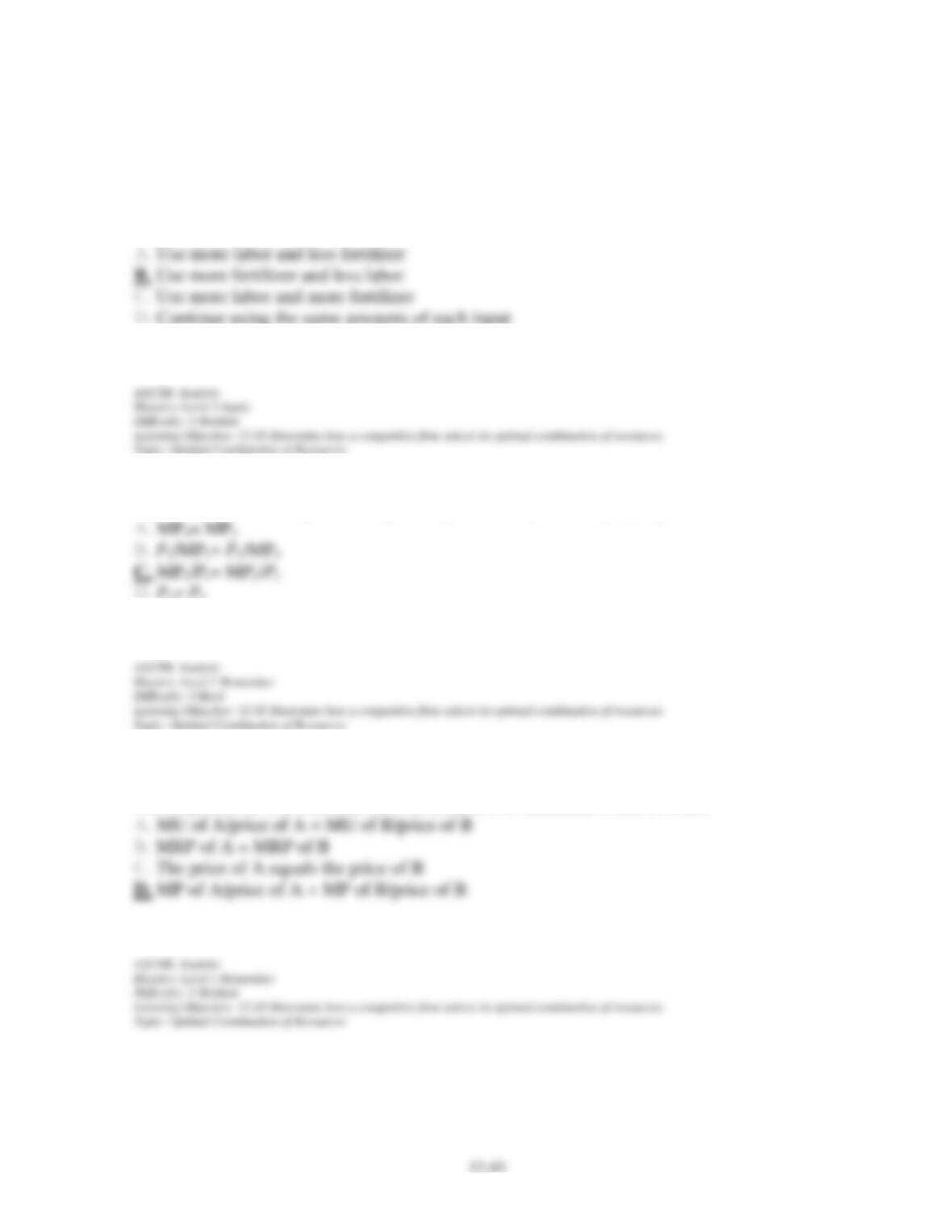
105. A firm is producing 100 pencils per week. The production process requires labor and
capital as inputs. Labor costs $6 per labor hour and capital costs $12 per machine hour.
Currently, the marginal product of labor is 18 pencils and the marginal product of capital is 36
pencils. To minimize the cost of producing this level of output the firm should use:
Chapter 12 – The Demand for Resources
106. Suppose that the production of wheat requires two inputs, labor and fertilizer. The price
of labor is $4.50 and the price of fertilizer is $3.00. A farmer is currently employing the inputs
such that the marginal product of labor is 11 and the marginal product of fertilizer is 8. If the
farmer is a cost-minimizer, he should:
107. A cost-minimizing firm using two inputs, x and y, will employ inputs so that:
108. If a firm is hiring inputs under purely competitive conditions, then any level of output
will be produced with the least-cost combination of resources A and B when:
Chapter 12 – The Demand for Resources
109. A firm is employing inputs such that the marginal product of labor is 25 and the marginal
product of capital is 40. The price of labor is $5 and the price of capital is $8. If the firm
wants to minimize costs, then it should:
110. A purely competitive firm in the factor and product markets sells its output for $1 and
pays factors PL= $4 and PC= $3. What is the profit-maximizing combination of L and C for
the firm?
Chapter 12 – The Demand for Resources
111. Suppose a competitive firm in both the factor and product markets is using inputs such
that the marginal product of labor is 16 and the price of labor is $4 per unit, while the
marginal product of capital is 12 and the price of capital is $3 per unit. At the maximum profit
equilibrium point, the price of the product is:
112. A firm will be hiring labor and capital in profit-maximizing amounts when:
113. A business is employing inputs such that the marginal product of labor is 40 and the
marginal product of capital is 90. The price of labor is $20 and the price of capital is $30. If
the business wants to minimize costs while keeping output constant, then it should:
Chapter 12 – The Demand for Resources
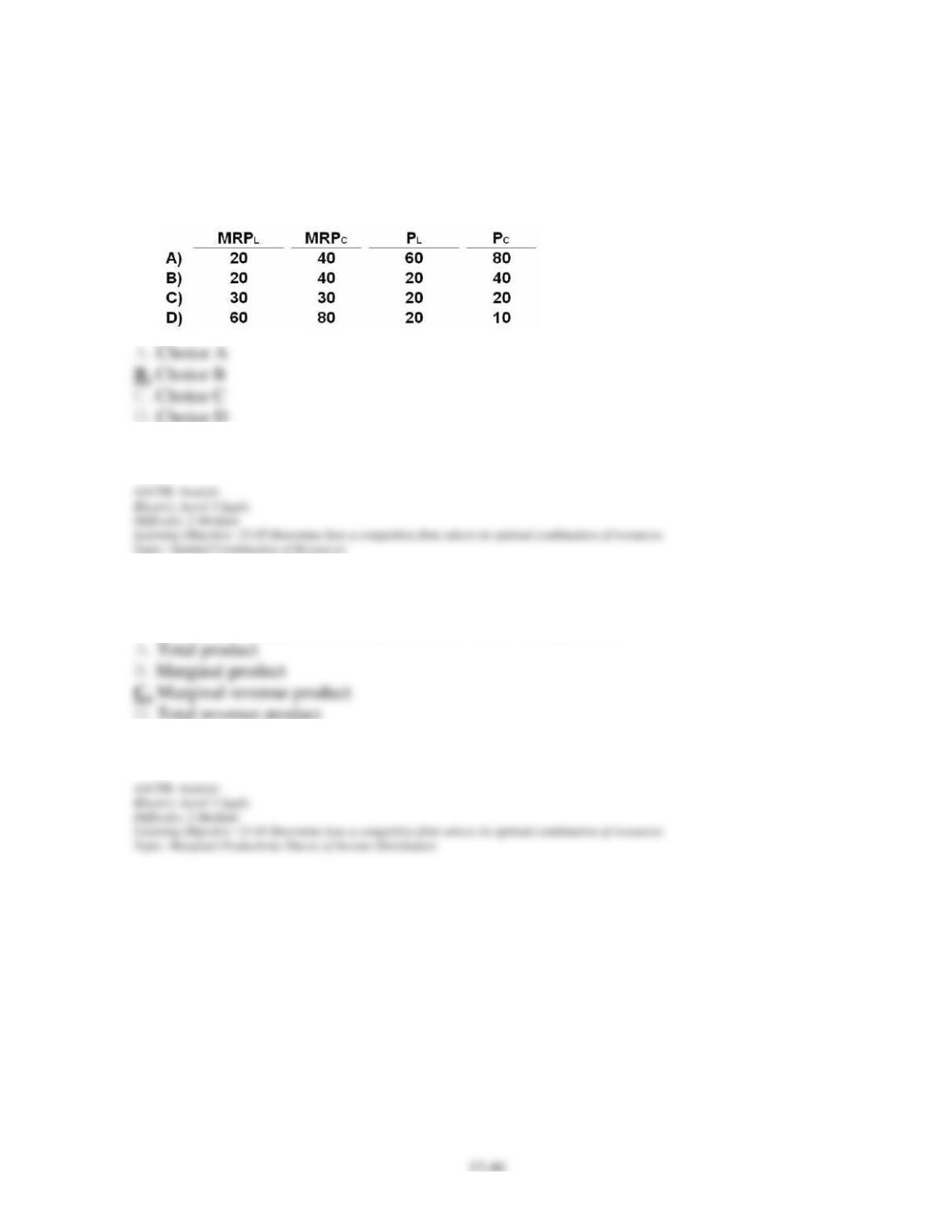
114. Assume that a purely competitive firm uses two resources—labor (L) and capital (C)—to
produce a product. In which situation would the firm be maximizing profit?
115. In the marginal productivity theory of income distribution, when all markets are purely
competitive, the payment for each unit of a resource is equal to its:
Chapter 12 – The Demand for Resources
116. Those who advocate the marginal productivity theory of income distribution argue that:
117. Critics of the marginal productivity theory of income distribution claim that the theory is
flawed due to:
118. A major criticism of the marginal productivity theory of income distribution is that:
Chapter 12 – The Demand for Resources
119. A “winner-take-all market” like that for entertainers exhibits huge differences between
the top talents and the next tier of artists in terms of the following, except:
120. The reason that superstars are highly paid is because:
121. The introduction of ATM machines has:
Chapter 12 – The Demand for Resources
122. The introduction of ATM machines allowed financial institutions to handle more
transactions at less cost, thus decreasing the demand for human tellers. The best explanation
for this change is that the:
123. What happened in the banking industry with the introduction of ATMs which had a
higher MP/P than for the substitute resource of human tellers?
124. The prices of resources are an important factor in the determination of money income.
Chapter 12 – The Demand for Resources
125. The demand for a resource is a derived demand based on the demand for the product it
helps to produce.
126. The demand for computers is derived from the demand for the capital resources that are
used to produce computers.
127. A firm’s demand schedule for a resource is the firm’s marginal product schedule for the
resource.
128. A competitive firm’s marginal revenue product of labor will fall as it employs more labor
because of the decrease in the price of labor as more of it is employed.
Chapter 12 – The Demand for Resources
129. The marginal revenue product curve for an input is downsloping because of the law of
diminishing returns.
130. If MRP of labor < wage rate, a firm should hire more workers.
131. If the demand of a product produced by an input decreases, the demand for the input will
also decrease.
132. Increased resource productivity will, ceteris paribus, increase a firm’s demand for an
input.
Chapter 12 – The Demand for Resources
133. If the price of labor increases relative to the price of capital, and as a result the quantity
of capital hired increases, the output effect of the price increase is greater than the substitution
effect.
134. If two resources are complementary, an increase in the price of one will increase the
demand for the other.
135. The less the elasticity of product demand, the greater the elasticity of resource demand.
136. The elasticity of demand for labor varies inversely with the elasticity of demand for the
product it is used to produce.
Chapter 12 – The Demand for Resources
137. To maximize profits, a competitive firm will maximize the difference between MRP and
the wage rate for the laborers it hires.
138. To achieve profit maximization, a firm must produce the profit-maximizing output with
the least amount of economic resources.
139. If a firm pays labor $5 and receives a MPLof 10, while paying capital $100 and receiving
a MPC of 100, to lower production costs it should hire more labor and less capital.
140. If MPx> MPy, a firm should hire more x and less y.