Chapter 12 – The Demand for Resources
55. Refer to the above graph. Each of the three labor demand curves shown slopes downward
because of the:
56. Refer to the above graph. Other things equal, an increase in labor productivity would
cause a:
57. Refer to the above graph. Other things equal, an increase in the price of a complementary
resource would cause a:
Chapter 12 – The Demand for Resources
58. Refer to the above graph. Other things equal, a decrease in the price of a substitute
resource would cause a:
59. Refer to the above graph. Other things equal, an increase in the price of substitute resource
would cause a:
60. Suppose the demand for strawberries rises sharply, resulting in an increased price of
strawberries. As it relates to strawberry pickers, we could expect the:
Chapter 12 – The Demand for Resources
61. Which of the following will not cause a shift in the demand for resource X?
62. A decline in the price of resource A will:
63. Assume the price of capital falls relative to the price of labor and, as a result, the demand
for labor increases. Therefore:
Chapter 12 – The Demand for Resources
64. The labor demand curve of a firm:
65. Which of the following will not shift the demand curve for labor?
66. Employers will hire more units of a resource if the:
Chapter 12 – The Demand for Resources
67. If technology dictates that labor and capital must be used in fixed proportions, an increase
in the price of capital will cause a firm to use:
68. If resources A and B are complementary and employed in fixed proportions:
69. If two resources are highly substitutable for one another:
Chapter 12 – The Demand for Resources
70. The substitution effect indicates that a profit-seeking firm will use:
71. Suppose capital and labor are used in fixed proportions so that each machine requires only
one worker. If a decline in the price of capital occurs, then the demand for labor will:
72. Assume the price of capital doubles and, as a result, firms make no change in the relative
quantities of capital and labor they employ. This implies that:
Chapter 12 – The Demand for Resources
73. The demand curve for labor would shift leftward as the result of:
74. A firm will employ more of an input whose relative price has fallen and, conversely, will
use less of an input whose relative price has risen. Thus a fall in the price of capital will
increase the relative price of labor and thereby reduce the demand for labor. This describes
the:
75. A change in an input price will alter both production costs and the profit-maximizing
output. Thus a decline in the price of capital will reduce production costs, increase the profit–
maximizing output, and thereby increase the demand for labor. This describes the:
Chapter 12 – The Demand for Resources
76. If the price of capital declines, the consequent output effect would be:
77. Suppose the productivity of labor increases and at the same time the price of capital,
which is complementary to labor, increases. As a result, the demand for labor:
78. Suppose a technological improvement increases the productivity of a firm’s capital and,
simultaneously, its workers’ union negotiates a wage increase. We can predict that:
Chapter 12 – The Demand for Resources
79. Suppose the price of the product that labor is producing increases and simultaneously the
price of capital, which is substitutable for labor, decreases. Assuming that the substitution
effect is greater than the output effect, the demand for labor:
80. Suppose there is a decline in the demand for the product labor is producing. Furthermore,
the price of capital, which is complementary to labor, increases. Thus the demand for labor:
81. Which of the following occupations is not among the ten projected fastest growing U.S.
occupations in terms of percentage increases?
Chapter 12 – The Demand for Resources
82. Which of the following occupations is among the ten projected most rapidly declining
U.S. occupations in terms of percentage increases?
83. Which of the following occupations is projected to be the fastest growing in the U.S. in
terms of percentage increases?
84. Elasticity of resource demand is measured by the:
Chapter 12 – The Demand for Resources
85. When the elasticity coefficient for resource demand is greater than one, resource demand
is:
86. When the elasticity coefficient for resource demand is less than one, resource demand is:
87. Suppose that a union successfully negotiated a 10 percent wage increase and the quantity
of labor demanded increased by 10 percent. We can conclude that:
Chapter 12 – The Demand for Resources
88. Suppose that a union successfully negotiated a 10 percent wage increase and the quantity
of labor demanded decreased by 10 percent. Given a fixed labor demand curve, we can
conclude that:
89. Resource X has many close substitutes whereas resource Y has no close substitutes. Other
things equal, we would expect:
90. The elasticity of resource demand measures the:
Chapter 12 – The Demand for Resources
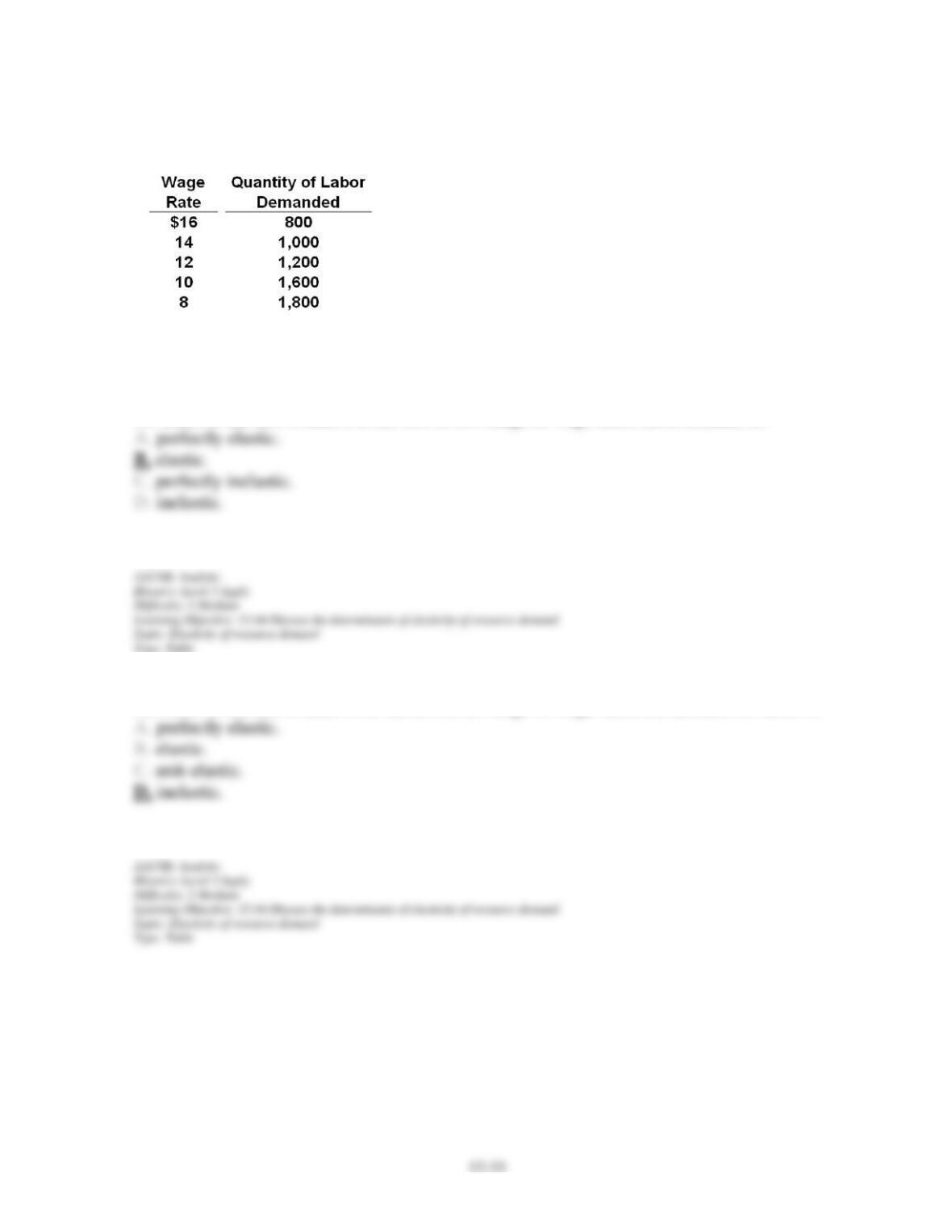
91. Refer to the above data. For the $16 to $14 range of wage rates, labor demand is:
92. Refer to the above data. Over the $10 to $8 range of wage rates, the demand for labor is:
Chapter 12 – The Demand for Resources
93. Refer to the above data. Suppose that the union that provides labor to firms in this market
successfully negotiates an increase in the wage rate from $10 to $12. As a result of the wage
increase, firms will hire:
94. Refer to the above data. Suppose that the union that provides labor to firms in this market
successfully negotiates an increase in the wage rate from $8 to $10. As a result of the wage
increase, firms will hire:
95. The elasticity of resource demand will be greater the:
Chapter 12 – The Demand for Resources
96. The relationship between the elasticity of product demand and the elasticity of demand for
labor employed in its production is such that, other things being equal:
97. Other things equal, the relationship between the relative importance of a given type of
labor in a firm’s total costs and the elasticity of demand for that labor is such that the:
98. Other things equal, if wage rates increase by 20 percent, the greatest decline in
employment will occur when labor costs are a:
Chapter 12 – The Demand for Resources
99. If a 10 percent wage increase in a particular labor market results in a 5 percent decline in
employment in that market, labor demand is:
100. Assume that the coefficient of elasticity of product demand is 0.5 in industry A and is
3.2 in industry B. Other things equal, labor demand will be:
101. Suppose that the labor cost-total cost ratio in industry A is 82 percent while in industry B
it is 21 percent. Other things equal, labor demand will be:
Chapter 12 – The Demand for Resources
102. Which of the following statements is true? Other things equal, the demand for labor will
be less elastic the:
103. Assuming a competitive resource market, a firm is hiring resources in the profit–
maximizing amounts when the:
104. Assume that an appliance manufacturer is employing variable resources X and Y in such
amounts that the MRPs of the last units of X and Y employed are $100 and $60 respectively.
Resource X can be hired at $50 per unit and resource Y at $20 per unit. The firm:
Chapter 12 – The Demand for Resources
105. A firm is hiring resources X, Y, and Z in the profit-maximizing amounts when:
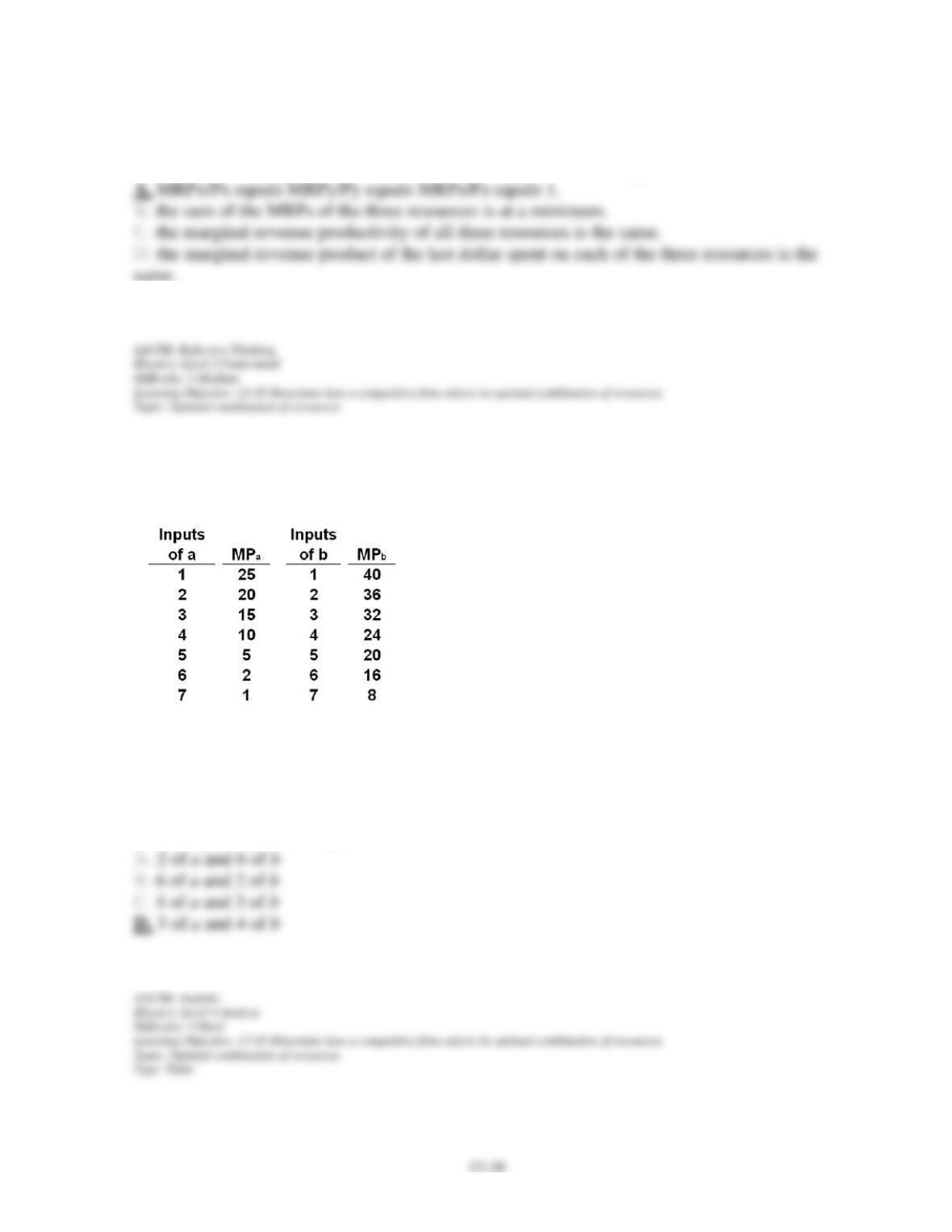
Answer the question on the basis of the following marginal product data for resources a and
b. The output of these independent resources sells in a purely competitive market at $1 per
unit.
106. Refer to the above data. Assuming the prices of resources a and b are $5 and $8
respectively, what is the least costly combination of resources for the firm to employ in
producing 192 units of output?