Chapter 12 – The Demand for Resources
48. Refer to the above table. The price of the product being produced by this resource:
49. Refer to the above table. How many units of a resource would the profit-maximizing firm
use if the price of this resource was $19.00?
50. If the price of a resource is greater than its marginal revenue product, the firm should:
Chapter 12 – The Demand for Resources
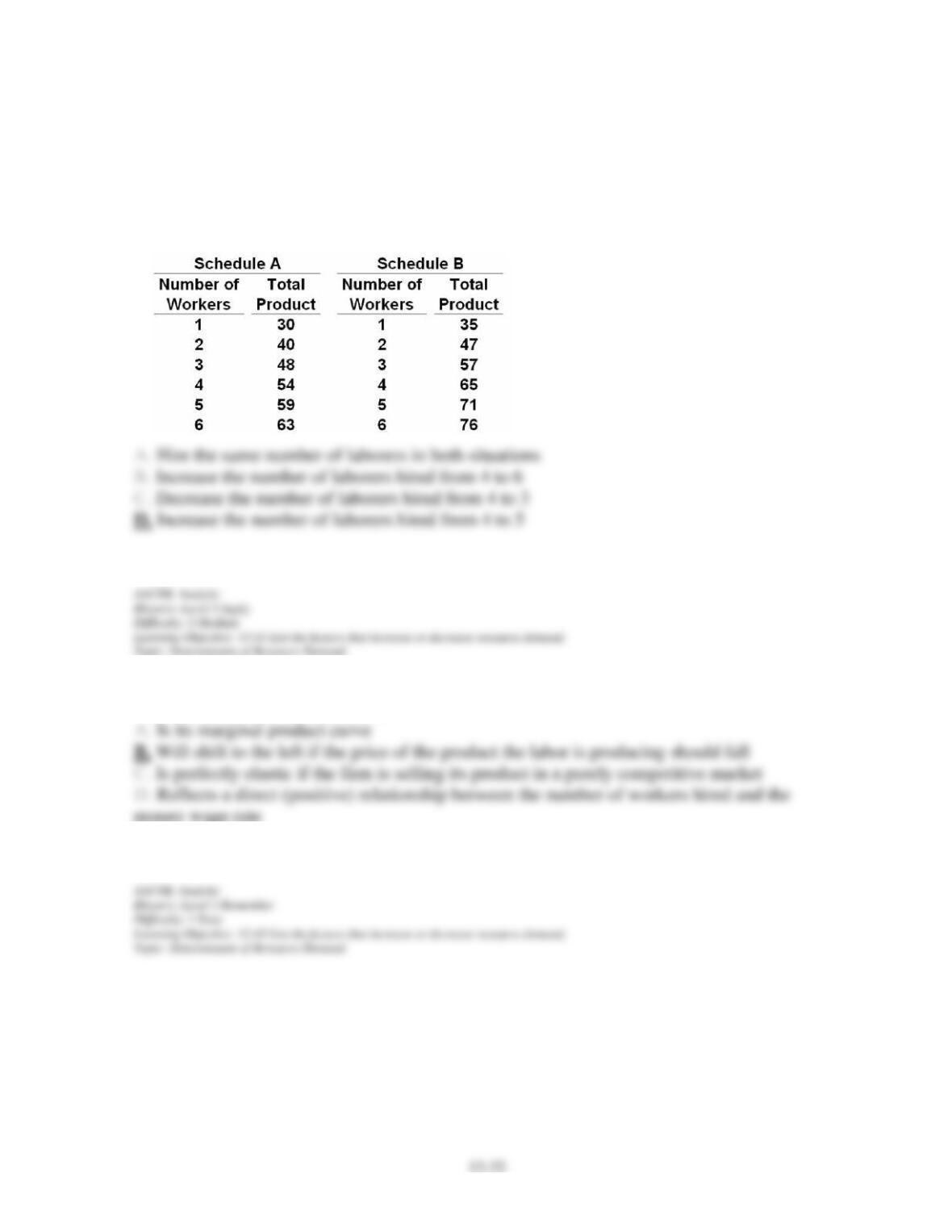
51. A firm operating in competitive input and output markets purchases new technology,
which shifts the total product schedule from A to B, as shown in the data below. At the
market wage rate of $30 and product price of $5 this firm will:
52. A firm’s demand curve for labor:
Chapter 12 – The Demand for Resources
53. Which of the following increases labor demand is due to a change in the product
demand?
54. Which of the following increases labor demand is due to a change in the price of a related
resource?
Chapter 12 – The Demand for Resources
55. Which of the following decreases labor demand is due to a change in product demand?
Chapter 12 – The Demand for Resources
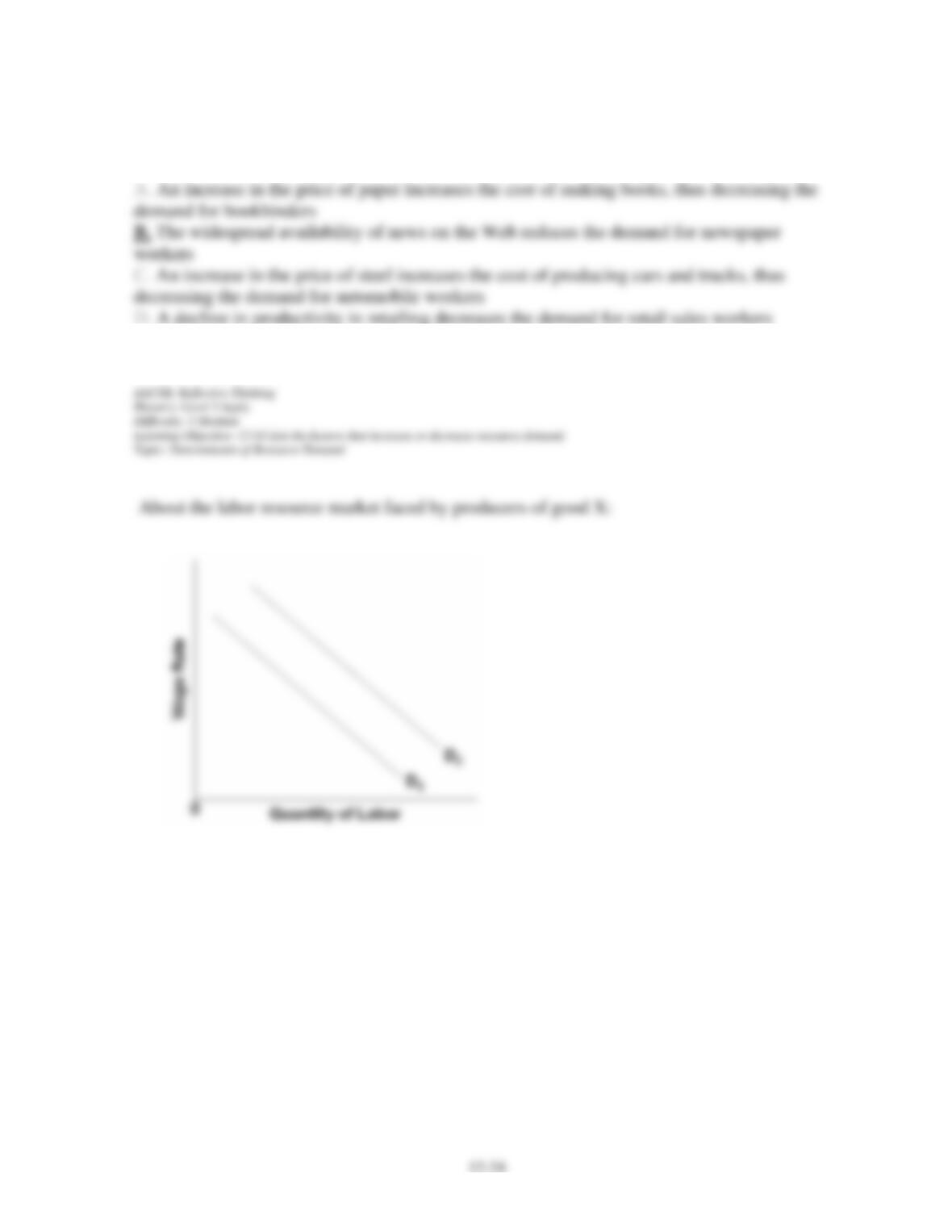
56. Refer to the above graph. What will shift D1 to D2?
57. Refer to the above graph. What will shift D1 to D2?
58. Refer to the above graph. What will shift D1 to D2?
Chapter 12 – The Demand for Resources
59. Refer to the above graph. What will shift D2 to D1?
60. Refer to the above graph. What will shift D2 to D1?
61. Which of the following decreases in labor demand is due to a change in the price of a
related resource?
Chapter 12 – The Demand for Resources
62. Gambling increases in popularity, thus increasing the demand for card dealers at casinos.
This would be an example of which determinant of labor demand?
63. If the price of a good increases, then in the market for labor which is used to produce this
product:
64. A decrease in the price of a productive resource will result in each of the following except
a(n):
Chapter 12 – The Demand for Resources
65. A technological improvement that causes an increase in the marginal product of a resource
will:
66. The demand for a resource will increase if the:
67. In a competitive resource market, a decrease in the demand for a productive resource,
ceteris paribus, will cause all of the following except a(n):
Chapter 12 – The Demand for Resources
68. A decrease in the price of a productive resource, ceteris paribus, will cause all of the
following except a(n):
69. If the price of labor falls relative to the price of capital, and as a result the quantity of
capital employed decreases, it can be concluded that:
70. If two inputs are complementary and employed in fixed proportions, an increase in the
price of one input will:
Chapter 12 – The Demand for Resources
71. Suppose capital is readily substitutable for labor and that the price of capital falls. We can
conclude that the:
72. If capital and labor are used in rigidly fixed proportions and the price of capital falls, it
can be concluded that:
73. The demand curve for labor will most likely increase when the price of a:
Chapter 12 – The Demand for Resources
74. Other things being equal, how would the market for personal computers be affected by a
large increase in productivity in the computer industry?
75. Two resource inputs, capital and labor, are complementary and used in fixed proportions.
An increase in the price of capital will:
76. In percentage terms, which of the following occupations is expected to be the fastest
growing from 2008 to 2018?
Chapter 12 – The Demand for Resources
77. Which type of occupation has the fastest growth expected from 2008 to 2018?
78. The increase in the demand for analysts of network systems and data communication and
for software engineers expected for the period 2008-2018 arises from the following factors,
except:
79. From 2008 to 2018, it is expected that there will be a fall in demand for:
Chapter 12 – The Demand for Resources
80. The more inelastic the demand for a resource the:
81. Other things being equal, a firm’s demand for labor is likely to be more elastic than its
demand for capital if:
82. A firm is both hiring labor and selling output in purely competitive markets and is
maximizing profits. It is currently operating in the elastic range of its MRP curve. If the wage
rate increases, its total spending on wages at the new equilibrium will:
Chapter 12 – The Demand for Resources
83. Which would result in a decrease in the elasticity of demand for a particular resource?
84. The demand for labor would most likely become less inelastic as a result of:
85. What will the elasticity of resource demand be if unit wages rise by 8 percent and the
number of employed workers falls by 5 percent?
Chapter 12 – The Demand for Resources
86. If a factor of production has many close substitutes, we would expect that its price
elasticity of demand would be:
87. Which will not be a determinant of the price elasticity of demand for an input?
88. A union representative observed that if the union members’ wages were increased by some
proportion, the workers would eventually suffer a greater than proportional decline in
employment. This statement could best be explained if:
Chapter 12 – The Demand for Resources
89. A firm is observed using 15 units of input X when the price of X is $2, and 6 units of X
when its price increases to $4. What is the elasticity of demand for input X in this price
range?
90. Other things being equal, if a once-competitive firm attains a high degree of monopoly
power in its product market, then its resource demand will:
91. A change in a factor’s price will have a greater effect on the quantity of the factor
demanded the:
Chapter 12 – The Demand for Resources
92. Other things being equal, the elasticity of demand for labor will be greater the:
93. Other things being the same, if the demand for labor is inelastic:
94. If labor costs are 60 percent of production costs, then a 15 percent increase in wage rates
would increase production costs by: