Chapter 12 – The Demand for Resources
1. Which of the following is equivalent to the expenditures that firms incur in acquiring
economic resources?
2. A firm that hires labor in a purely competitive resource market is a:
Chapter 12 – The Demand for Resources
3. The strength of the demand for a resource depends on the following factors, except:
4. The demand for a productive resource is said to be “derived” because the demand for the
factor:
5. The demand for capital by a firm is based on the demand for the product that the capital
produces. This relationship is referred to as:
Chapter 12 – The Demand for Resources
6. An increase in the demand for HDTV sets leads to an increase in demand for LCD and
LED TV screens. This situation arises because:
7. An example of derived demand in the auto industry is the demand for:
8. The marginal revenue product of an input in a competitive market decreases as a firm
increases the quantity of the input employed because of the:
Chapter 12 – The Demand for Resources
9. Marginal resource cost is:
10. Refer to the above graph, where TP = total product and L = labor input. The marginal
product of labor (MP):
Chapter 12 – The Demand for Resources
11. Refer to the above graph, where TP = total product and L = labor input. The marginal
revenue product of labor (MRP) for a purely competitive firm:
12. Marginal revenue product describes the:
13. The marginal revenue product of a resource depends on the following factors, except:
Chapter 12 – The Demand for Resources
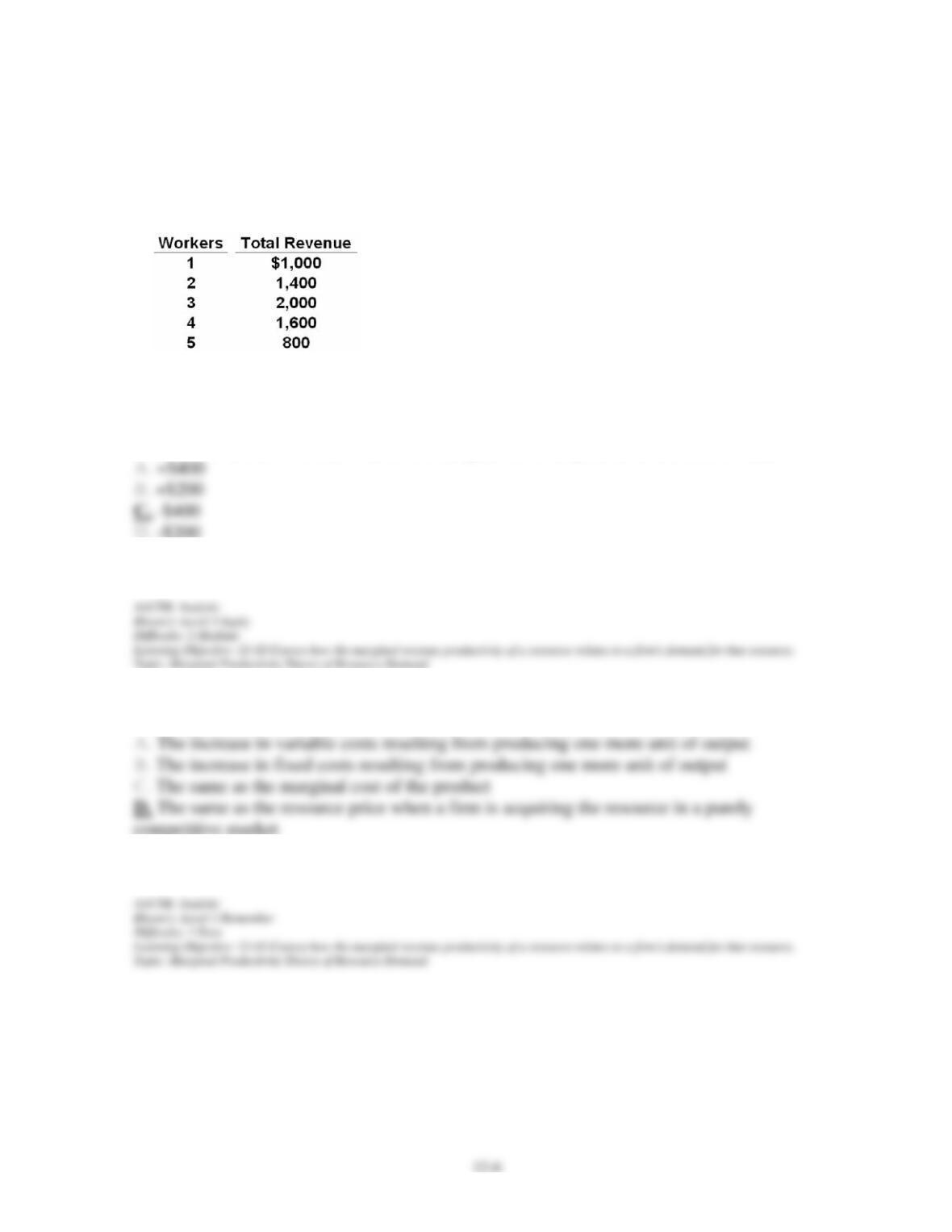
Wayne’s Jacket Shop sells Wayne’s jackets for $20 each. Wayne finds that when he hires
different numbers of workers, the corresponding total revenues are as follows:
14. Refer to the above table. What is the marginal revenue product of the fourth worker?
15. Marginal resource cost is:
Chapter 12 – The Demand for Resources
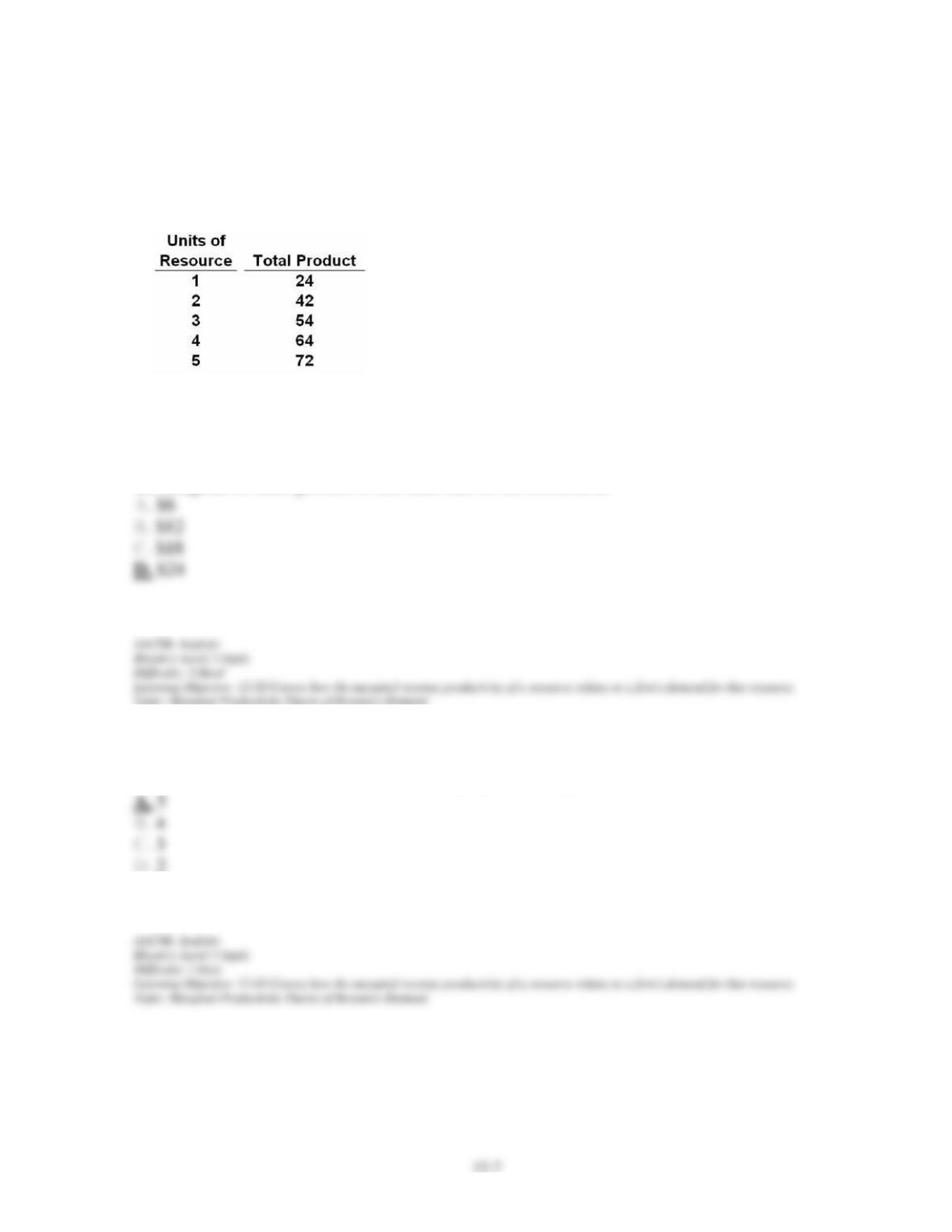
The following is a total-product schedule for a resource. Assume that the quantities of other
resources the firm employs remain constant.
16. Refer to the above table. If the product the firm produces sells for a constant $2 per unit,
the marginal revenue product of the third unit of the resource is:
17. Refer to the above table. If the firm’s product sells for a constant $2 and the price of the
resource is a constant $16, the firm will employ how many units of the resource?
Chapter 12 – The Demand for Resources
18. Refer to the above table. If the firm can sell 24 units of output at a price of $1.00 and 42
units of output at a price of $0.80, the marginal revenue product of the second unit of the
resource is:
19. Refer to the above table. If the firm can produce 24 units at a price of $1.00, 42 units at a
price of $0.80, and 54 units at a price of $0.60, then the firm is:
20. If the marginal revenue product (MRP) of labor is less than the wage rate:
Chapter 12 – The Demand for Resources
21. A profit-maximizing firm should hire an input as long as the:
22. A competitive employer will hire inputs up to the point where the:
Chapter 12 – The Demand for Resources
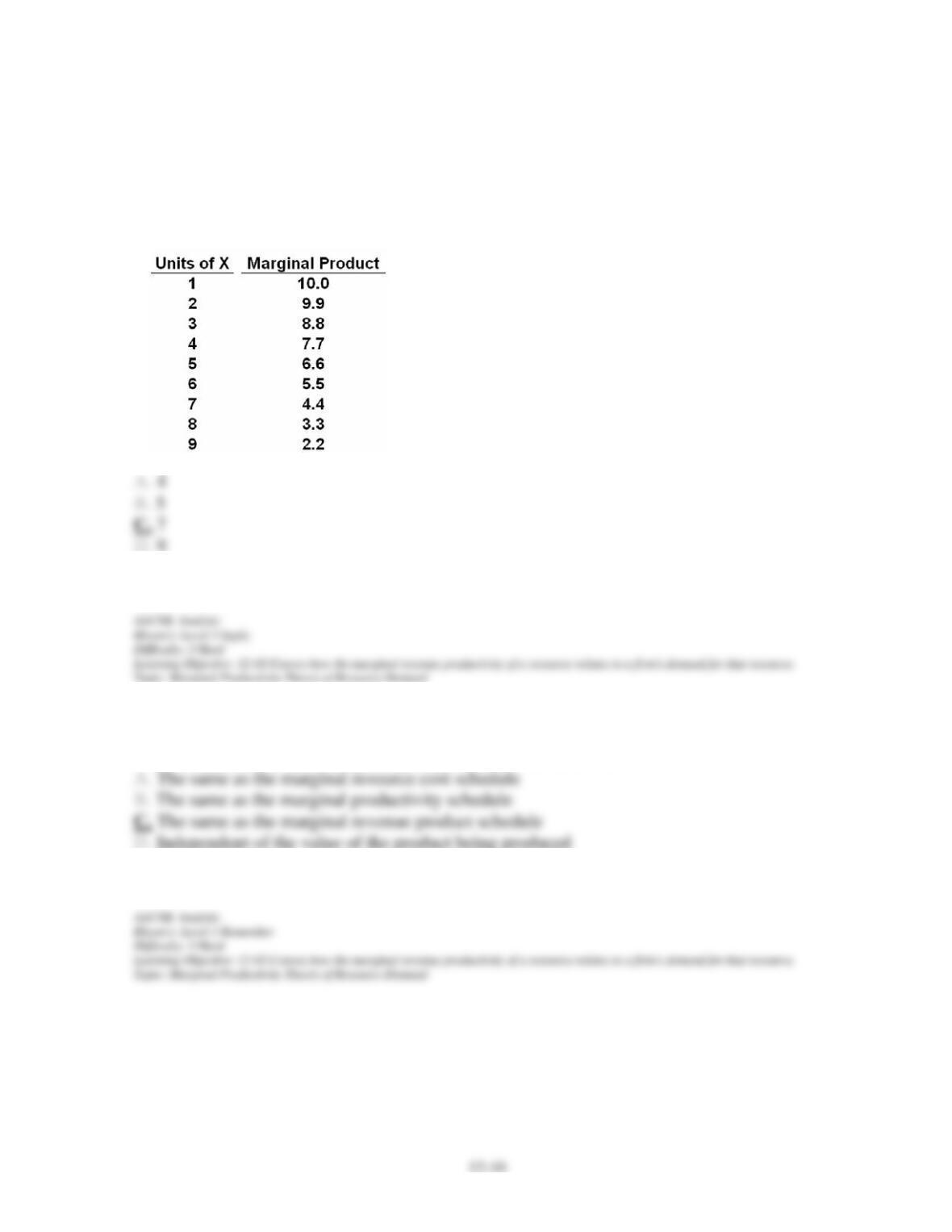
23. Under pure competition the market price of an output is $3. The output schedule of a firm
using input X is listed in the table below. If the price of input X is $12, how many units of
input X will the firm employ to maximize profits?
24. According to the marginal productivity theory of resource demand, the labor-demand
schedule for a producer selling in a purely competitive market is:
Chapter 12 – The Demand for Resources
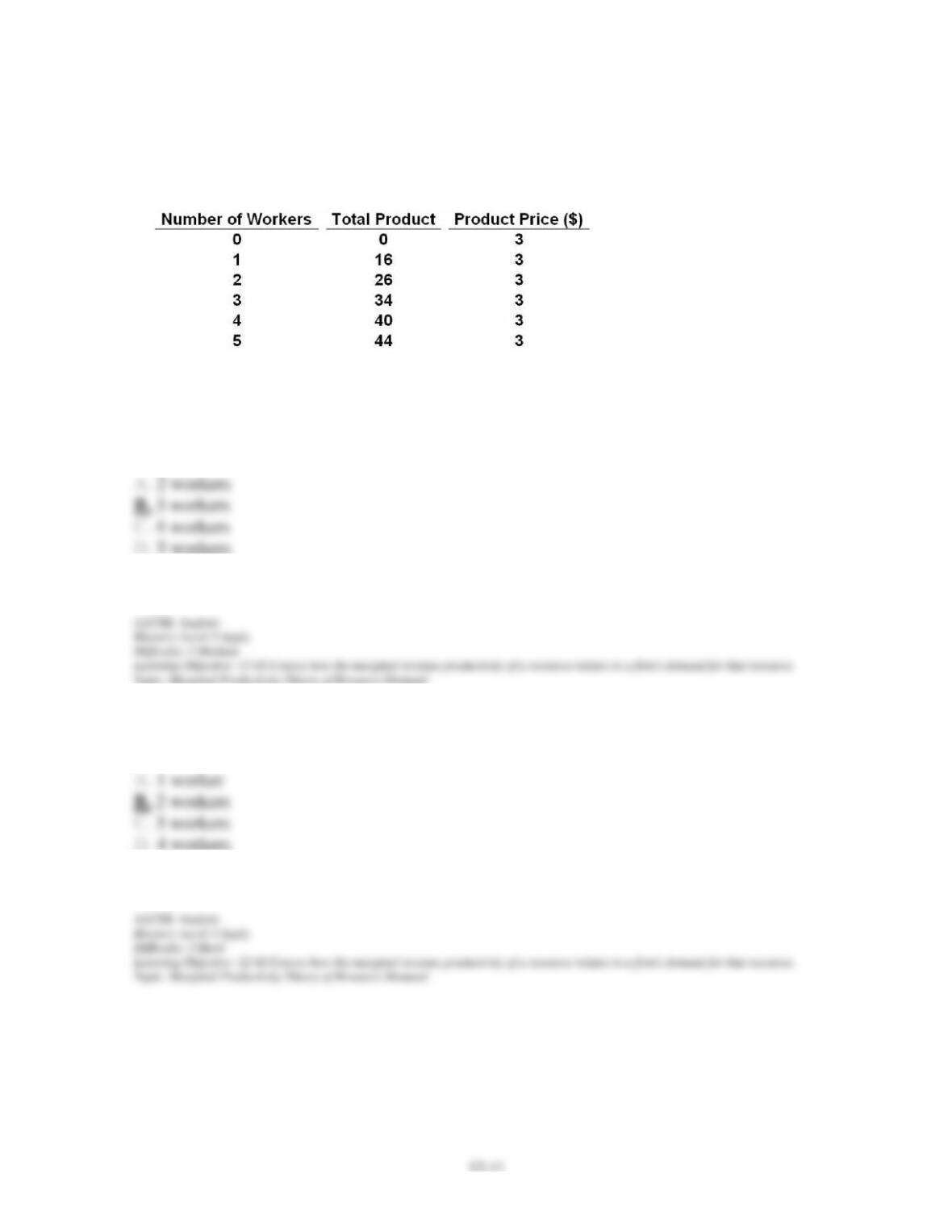
The following table is for a purely competitive market for resources.
25. Refer to the above table. At a wage rate of $23 per worker, the firm will choose to
employ:
26. Refer to the above table. How many more workers will the firm hire when the wage rate is
$15 instead of $30?
Chapter 12 – The Demand for Resources
27. Refer to the above table. If the product price increases from $3 to $4, then at the wage rate
of $15, the firm will hire:
28. The labor demand curve of a firm that sells its product in an imperfectly competitive
market:
29. The labor demand curve of a firm that sells its product in a purely competitive market:
Chapter 12 – The Demand for Resources
12–13
30. Assume that the resource market is purely competitive. If the price of the resource falls,
other factors constant, then a firm that sells its product in a purely competitive market will:
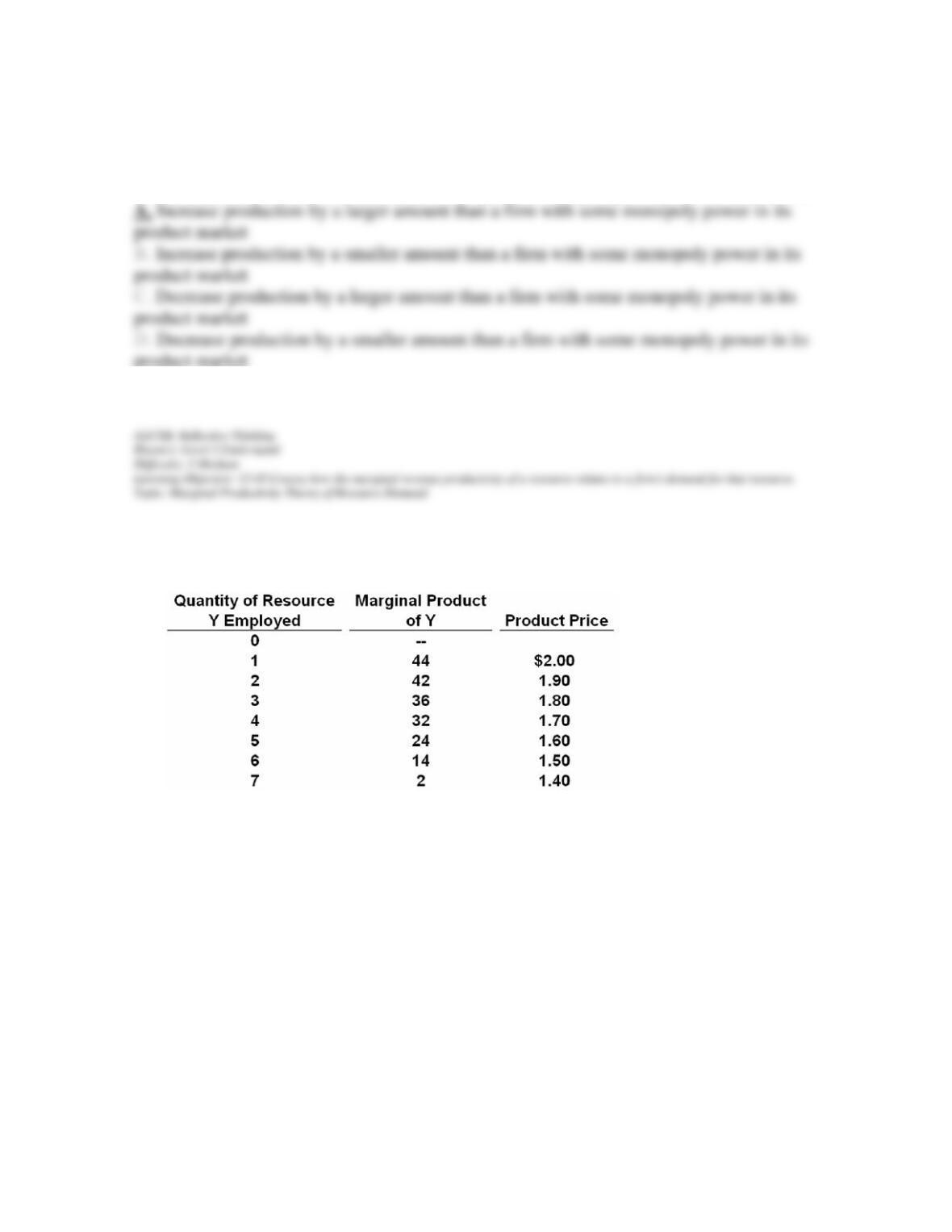
Assume that the quantities of other resources employed by the firm remain constant.
Chapter 12 – The Demand for Resources
31. Refer to the above table. How many units of resource Y would the firm employ at a price
of $50 per unit of Y?
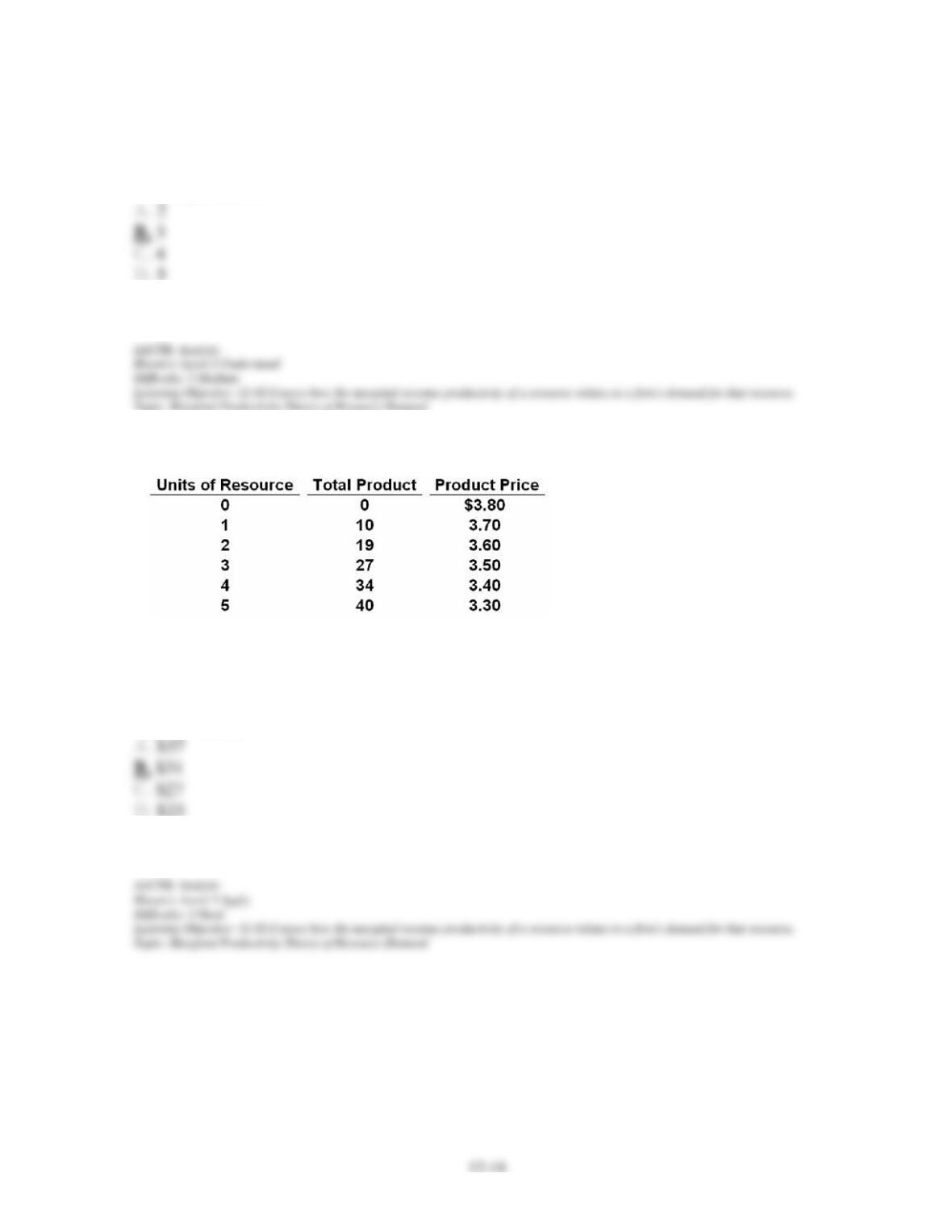
32. Refer to the above table. The marginal revenue product of the second input is
approximately:
Chapter 12 – The Demand for Resources
33. Refer to the above table. The marginal revenue product of the fourth unit of input is
approximately:
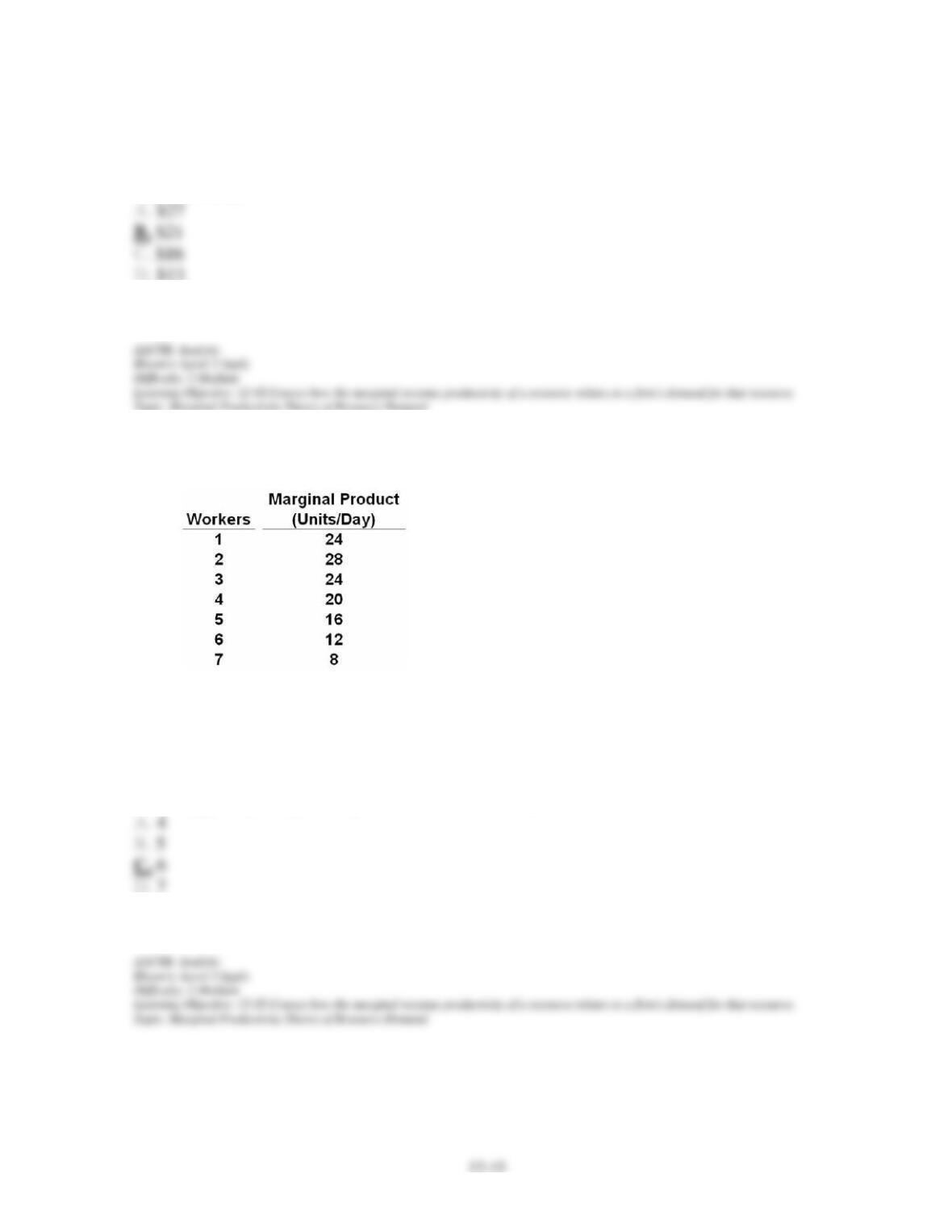
34. Refer to the above table for a profit-maximizing firm. The price of the firm’s product is
$10 per unit and the wage rate is a constant $110 a day. How many workers will the firm hire,
assuming purely competitive product and resource markets?
Chapter 12 – The Demand for Resources
35. The marginal revenue product of an economic resource for a firm operating in purely
competitive product and resource markets:
36. A profit-maximizing firm’s daily total revenue is $155 with 3 workers, $200 with 4
workers, and $230 with 5 workers. The cost of each worker is $40 per day. The firm should:
37. A profit-maximizing firm will use additional units of resources for production until:
Chapter 12 – The Demand for Resources
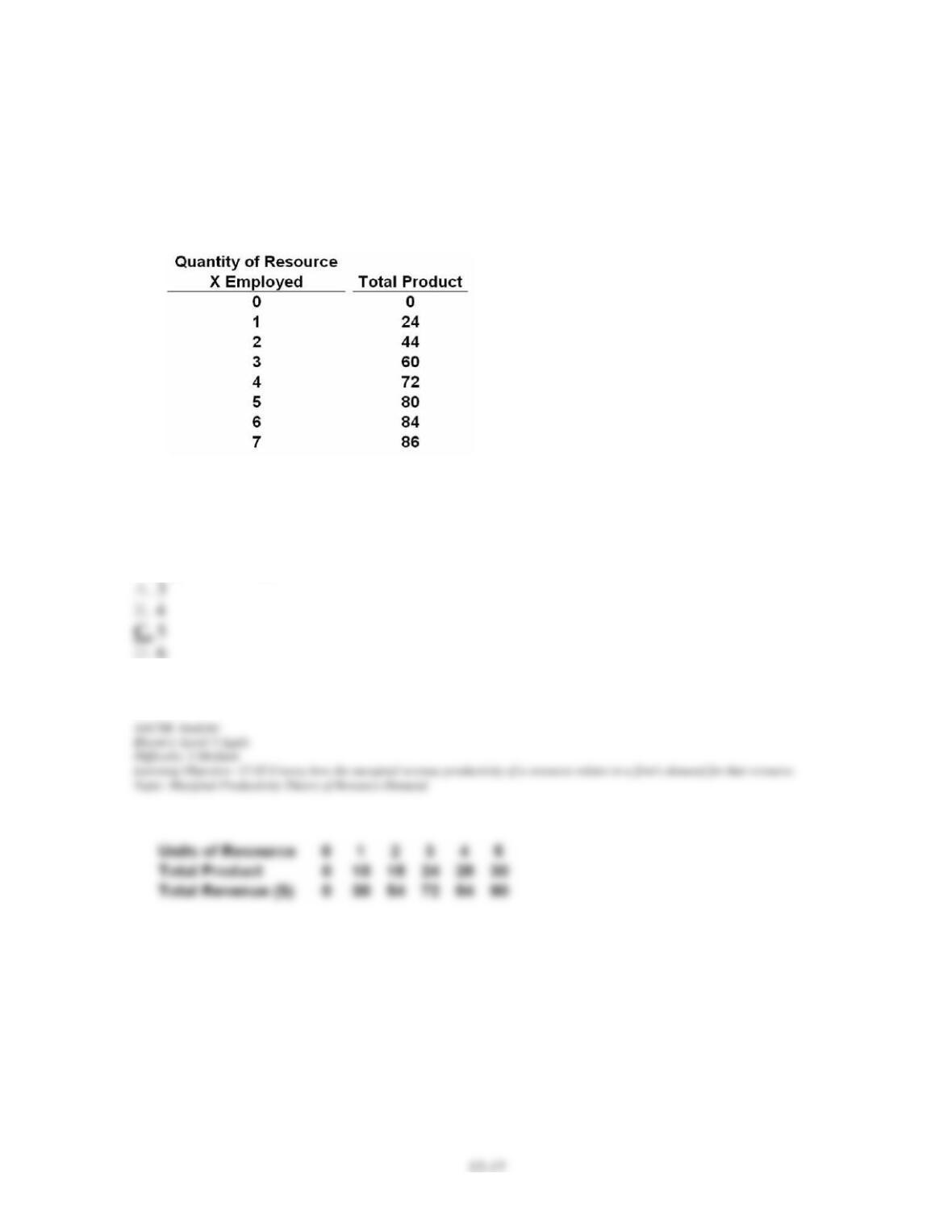
The table shows the total output a firm will be able to produce if it employs varying amounts
of resource X while holding the amounts of the other resources constant. Assume that the
product price is constant at $3.00 per unit.
38. Refer to the above table and information. How many units of resource X will be employed
if its price is $24 per unit?
Chapter 12 – The Demand for Resources
39. Refer to the above table. The marginal product of the second unit of the resource is:
40. Refer to the above table. The marginal revenue product of the third unit of resource is:
41. Refer to the above table. The price of the product being produced by this resource is:
Chapter 12 – The Demand for Resources
42. Refer to the above table. The quantity of the resource needed to produce 28 units of the
output is:
43. Refer to the above table. How many units of the resource would the profit-maximizing
firm use if the price of the resource was $18.00?
44. Refer to the above table. The resource demand data indicate that the firm is:
Chapter 12 – The Demand for Resources
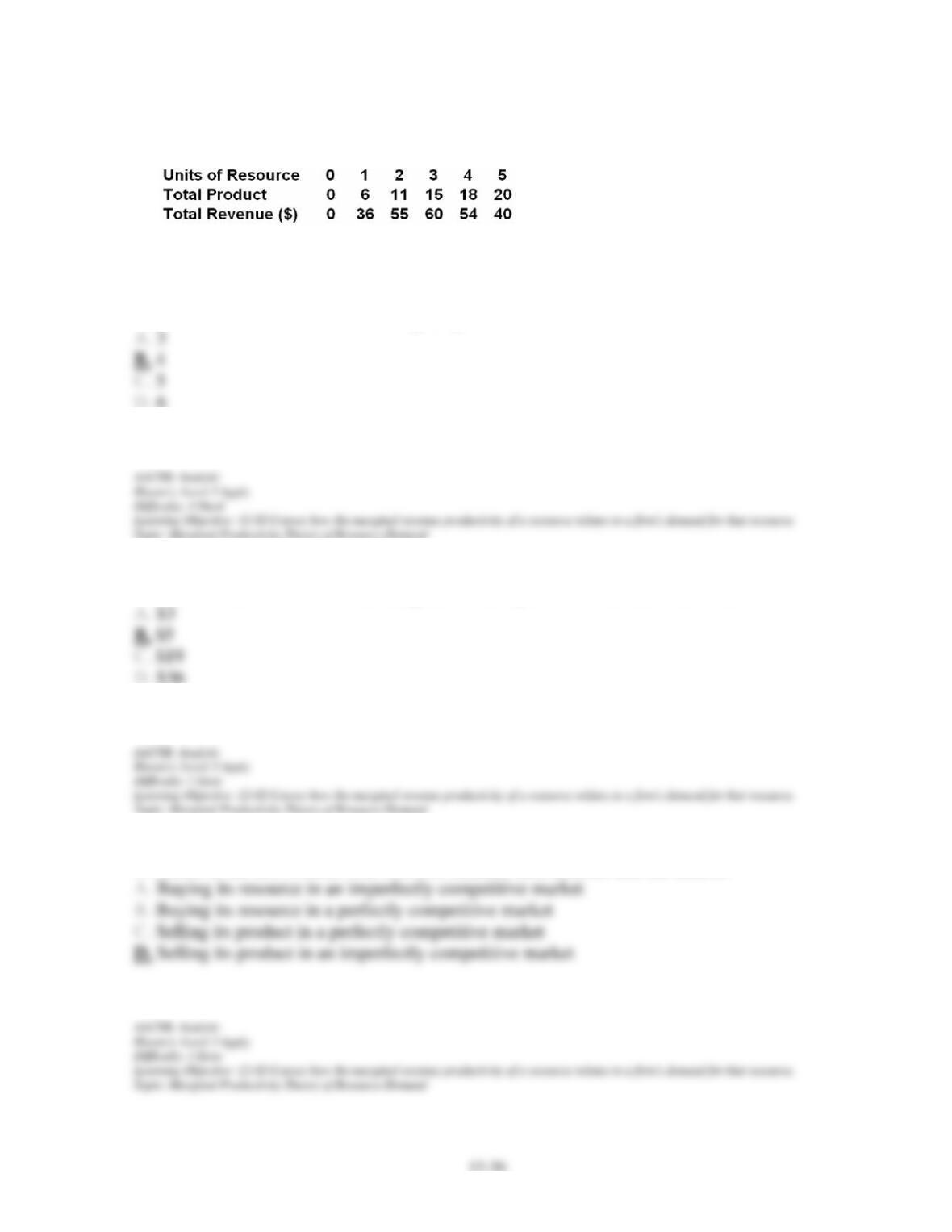
45. Refer to the above table. The marginal product of the third unit of the resource is:
46. Refer to the above table. The marginal revenue product of the third unit of the resource is:
47. Refer to the above table. The resource demand data indicate that the firm is: