Chapter 12 – The Demand for Resources
1. Resource pricing is important because:
2. Which of the following statements best illustrates the concept of derived demand?
Chapter 12 – The Demand for Resources
3. When economists say that the demand for labor is a derived demand, they mean that it is:
4. The demand for airline pilots results from the demand for air travel. This fact is an example
of:
5. We say that the demand for labor is a derived demand because:
Chapter 12 – The Demand for Resources
6. The demand for a resource depends primarily on:
7. In the United States professional football players earn much higher incomes than
professional soccer players. This occurs because:
8. Marginal revenue product measures the:
Chapter 12 – The Demand for Resources
9. The marginal revenue product schedule is:
10. The purely competitive employer of resource A will maximize the profits from A by
equating the:
11. The MRP curve for labor:
Chapter 12 – The Demand for Resources
12. Marginal product is:
13. The labor demand curve of a purely competitive seller:
14. Assume labor is the only variable input and that an additional input of labor increases total
output from 72 to 78 units. If the product sells for $6 per unit in a purely competitive market,
the MRP of this additional worker is:
Chapter 12 – The Demand for Resources
15. If one worker can pick $30 worth of grapes and two workers together can pick $50 worth
of grapes, the:
16. A competitive employer should hire additional labor as long as:
17. A firm will find it profitable to hire workers up to the point at which their:
Chapter 12 – The Demand for Resources
18. A profit-maximizing firm employs resources to the point where:
Answer the question on the basis of the following information: Harry owns a barber shop and
charges $6 per haircut. By hiring one barber at $10 per hour the shop can provide 24 haircuts
per 8-hour day. By hiring a second barber at the same wage rate the shop can now provide a
total of 42 haircuts per day.
19. Refer to the above information. The MP of the second barber is:
20. Refer to the above information. The MRP of the second barber is:
Chapter 12 – The Demand for Resources
12-8
21. Refer to the above information. Harry should:
22. The general rule for hiring any input (say, labor) in the profit-maximizing amount is MRC
= MRP. This rule takes the special form W = MRP (where W is the wage rate) when the:
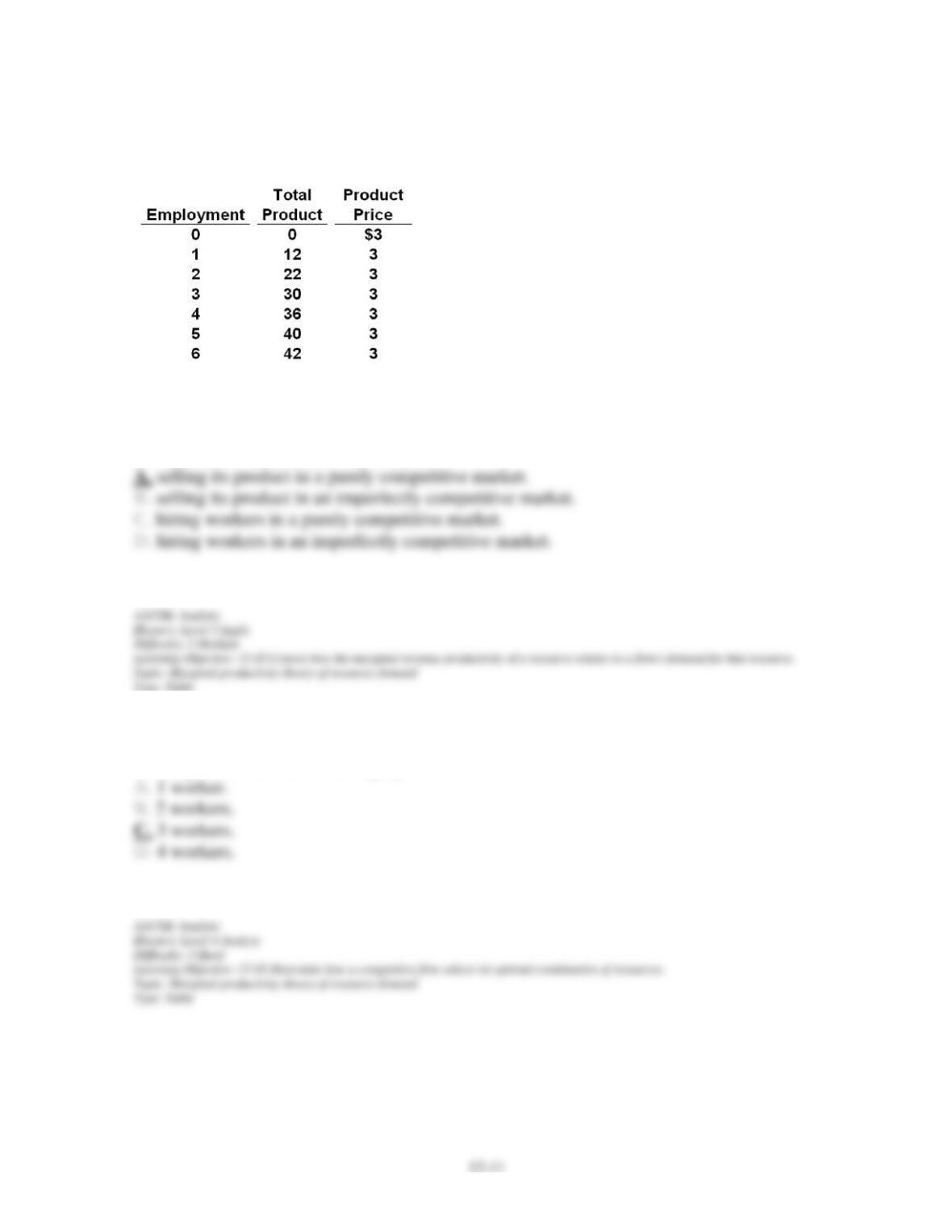
Answer the question on the basis of the following information for Manfred’s Shoe Shine
Parlor. Assume Manfred hires labor, its only variable input, under purely competitive
conditions. Shoe shines are also sold competitively.
Chapter 12 – The Demand for Resources
23. Refer to the above data. How many units of output are produced when 2 workers are
employed?
24. Refer to the above data. What is the marginal product of the sixth worker?
25. Refer to the above data. At what price does each shoe shine sell?
Chapter 12 – The Demand for Resources
26. Refer to the above data. If the wage rate is $11, how many workers will Manfred hire to
maximize profits?
27. Refer to the above data. If the wage rate is $11 and Manfred’s only fixed input is capital,
the total cost of which is $30, then what will be his economic profit?
28. Assume that a restaurant is hiring labor in an amount such that the MRC of the last worker
is $16 and her MRP is $12. On the basis of this information we can say that:
Chapter 12 – The Demand for Resources
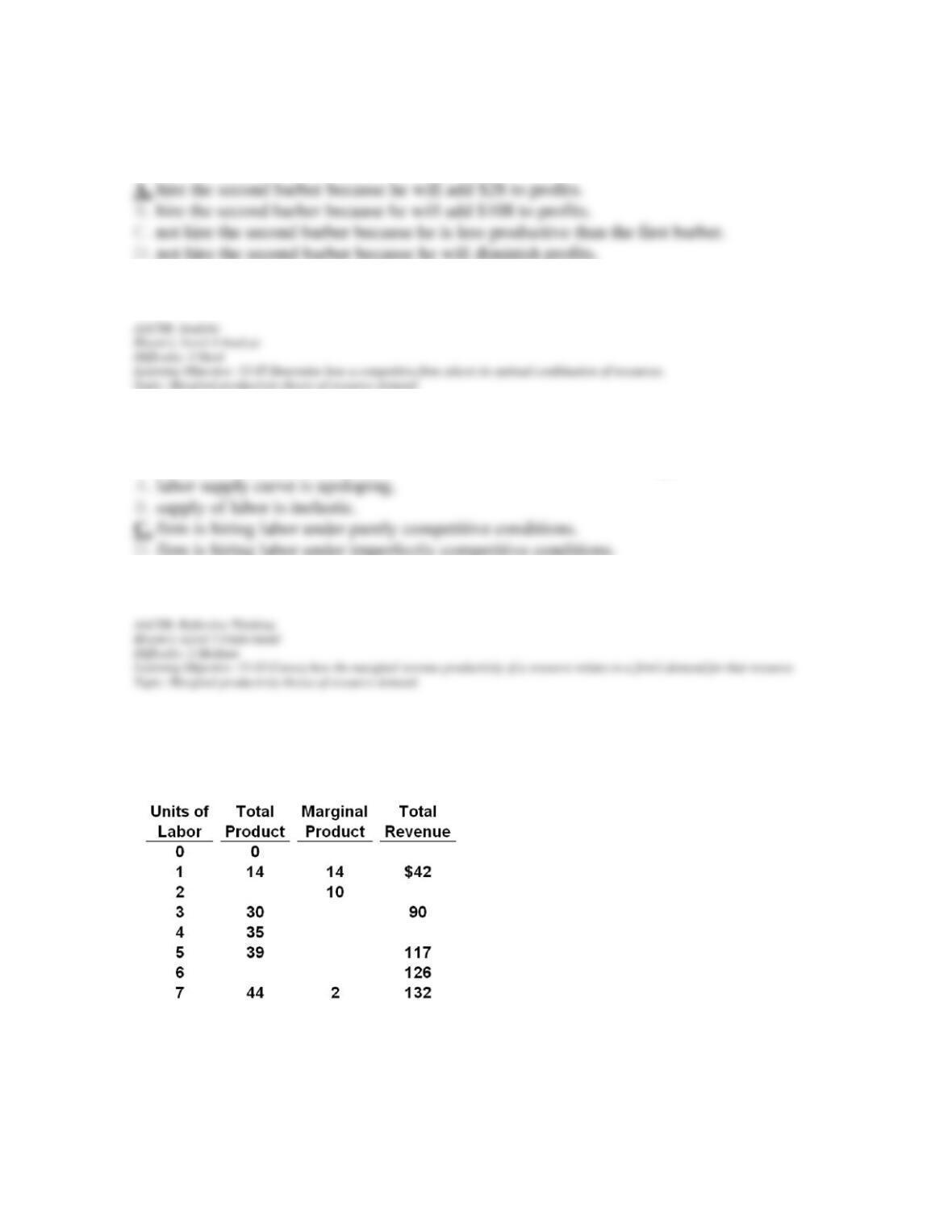
Answer the question on the basis of the information given in the following table:
29. Refer to the above data. This firm is:
30. Refer to the above data. If the firm is hiring workers under purely competitive conditions
at a wage rate of $22, it will employ:
Chapter 12 – The Demand for Resources
31. Refer to the above data. If the firm is hiring workers under purely competitive conditions
at a wage rate of $10, it will employ:
32. Refer to the above data. Which of the following best represents the labor demand schedule
for this firm?
Chapter 12 – The Demand for Resources
12–13
33. Assuming a firm is selling its output in a purely competitive market, its resource demand
curve can be determined by:
34. Marginal resource cost is:
Answer the question on the basis of the data contained in the following table. Assume that
the firm is hiring labor in a purely competitive market.
Chapter 12 – The Demand for Resources
35. Refer to the above data. If the wage rate is $20, how many workers will the firm choose to
36. Refer to the above data. If the wage rate is $11, how many workers will the firm choose to
employ?
37. The above data reveal that:
Chapter 12 – The Demand for Resources
38. Other things equal, the resource demand curve of an imperfectly competitive seller will:
39. The MRP curve is the resource demand curve for:
40. The labor demand curve of an imperfectly competitive seller is downsloping:
Chapter 12 – The Demand for Resources
41. If a firm is selling in an imperfectly competitive product market, then:
42. Other things equal, we would expect the labor demand curve of a monopolistic seller to:
43. The change in a firm’s total revenue that results from hiring an additional worker is
measured by:
Chapter 12 – The Demand for Resources
44. The labor demand curve of a purely competitive seller:
45. The MRP curve for labor:
46. If the wage rate increases:
Chapter 12 – The Demand for Resources
Answer the question on the basis of the following information. A farmer who has fixed
amounts of land and capital finds that total product is 24 for the first worker hired; 32 when
two workers are hired; 37 when three are hired; and 40 when four are hired. The farmer’s
product sells for $3 per unit and the wage rate is $13 per worker.
47. Refer to the above information. The marginal product of the second worker is:
48. Refer to the above information. The marginal revenue product of the second worker is:
49. Refer to the above information. How many workers should the farmer hire?
Chapter 12 – The Demand for Resources
50. Refer to the above information. What is the farmer’s profit-maximizing output?
51. A competitive employer is using labor in such an amount that labor’s MRP is $10 and its
wage rate is $8. This firm:
52. For a firm selling its product in a purely competitive market, the marginal revenue product
of labor can be found by:
Chapter 12 – The Demand for Resources
53. For a firm selling its product in an imperfectly competitive market, the marginal revenue
product of labor can be found by:
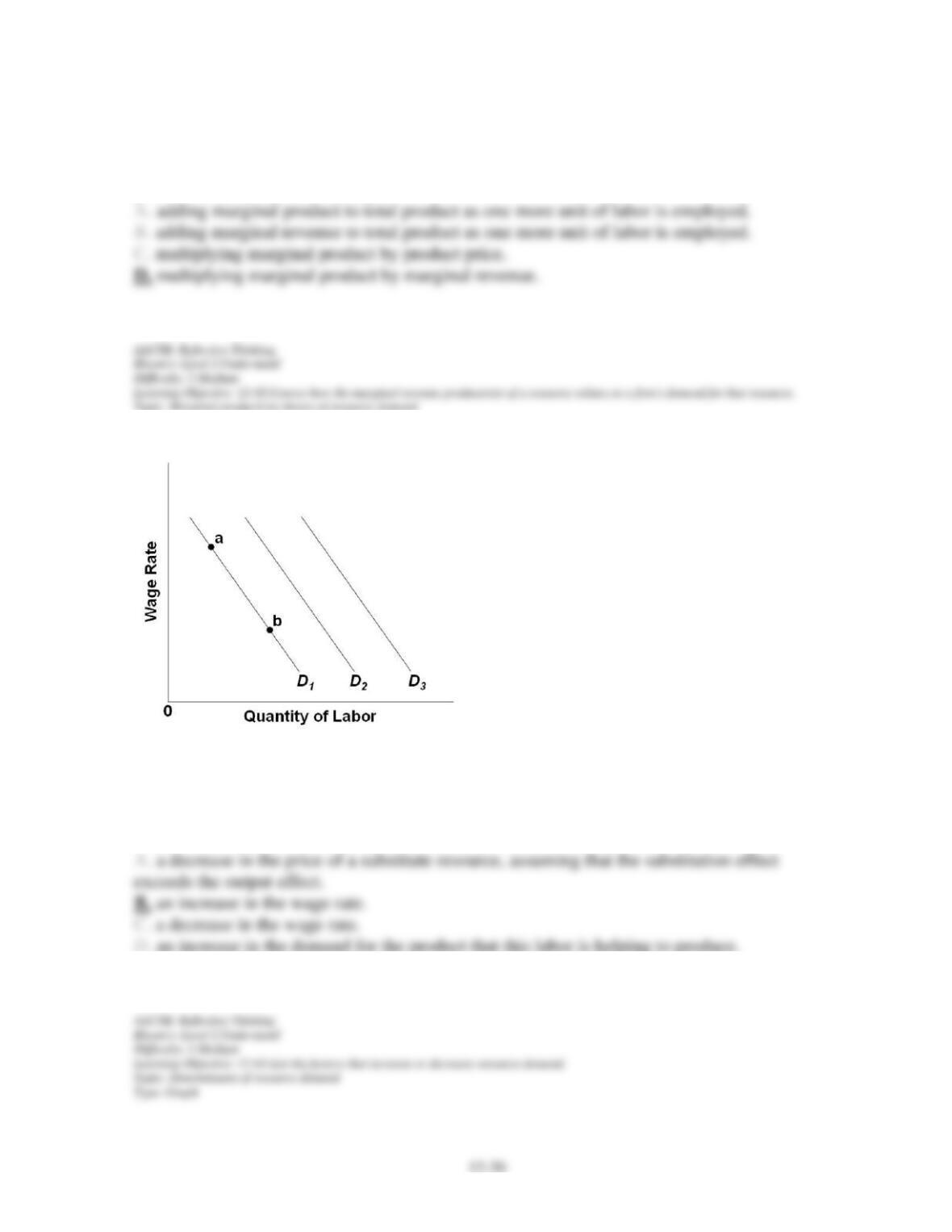
54. Refer to the above graph. A move from b to a along labor demand curve D1 would result
from: