Chapter 12: The Cost of Capital, Capital Structure, and Dividend Policy
64. Whipple Industries, Inc. is in the process of determining its optimal capital budget for next year. The
following investment projects are under consideration:
Required
Expected Rate
Project
Investment
of Return
A
$2 million
20.0%
B
3 million
15.0
C
1 million
13.5
D
4 million
13.0
E
1 million
12.5
F
3 million
12.0
G
5 million
11.5
The firm’s marginal cost of capital schedule is as follows:
Amount of
Funds Raised
Cost
$0 – $6 million
12.0%
$6 million – $12 million
12.5%
$12 million – $18 million
13.5%
Over $18 million
15.0%
Determine Whipple’s optimal capital budget (in dollars) for the coming year.
a. $11 million
b. $10 million
c. $5 million
d. $14 million
Chapter 12: The Cost of Capital, Capital Structure, and Dividend Policy
65.
American Dental Laser is selling a 10 year $1,000 face value bond with an 8% coupon rate. Interest is paid
annually. The price to the public is $820 and the issue costs per bond are $10 each. Compute the pretax cost
of debt for these bonds.
a. 11.1%
b. 11.3%
c. 11.5%
d. 11.8%
66.
Mid-States Utility Company just issued at $3.20 cumulative preferred stock at a price to the public of $30 a share.
The flotation costs were $1.50 a share and the issue will be retired in 20 years at its $30 par value. What is the
cost
of this preferred issue?
a. 11.3%
b. 10.3%
c. 10.7%
d. 11.6%
Chapter 12: The Cost of Capital, Capital Structure, and Dividend Policy
67.
Wright Express (WE) has a capital structure of30% debt and 70% equity. WE is considering a project that
requires an investment of$2.6 million. To finance this project, WE plans to issue 10-year bonds with a coupon
interest rate of 12%. Each of these bonds has a $1,000 face value and will be sold to net WE $980. If the
current risk-free rate is 7% and the expected market return is 14.5%, what is the weighted cost of capital for
WE? Assume WE has a beta of 1.20 and a marginal tax rate of 40%.
a.
14.9%
b.
12.4%
c. 13.4%
d.
16.0%
68.
California Best (CB), a sport shoe store, expects an operating income of$2.3 million this year. CB has no
long-term debt. The firm is considering as expansion project. The current risk-free rate of return is 7% and the
current market risk premium is 8.3%. If CB’s beta is 20% greater than the overall market, what is the firm’s
cost of capital? Assume that CB has a marginal tax rate of 40%.
a. 8.3%
b. 16.96%
c. 9.96%
d. 15.3%
69.
Columbia Gas Company’s (CG) current capital structure is 35% debt and 65% equity. This year CG has
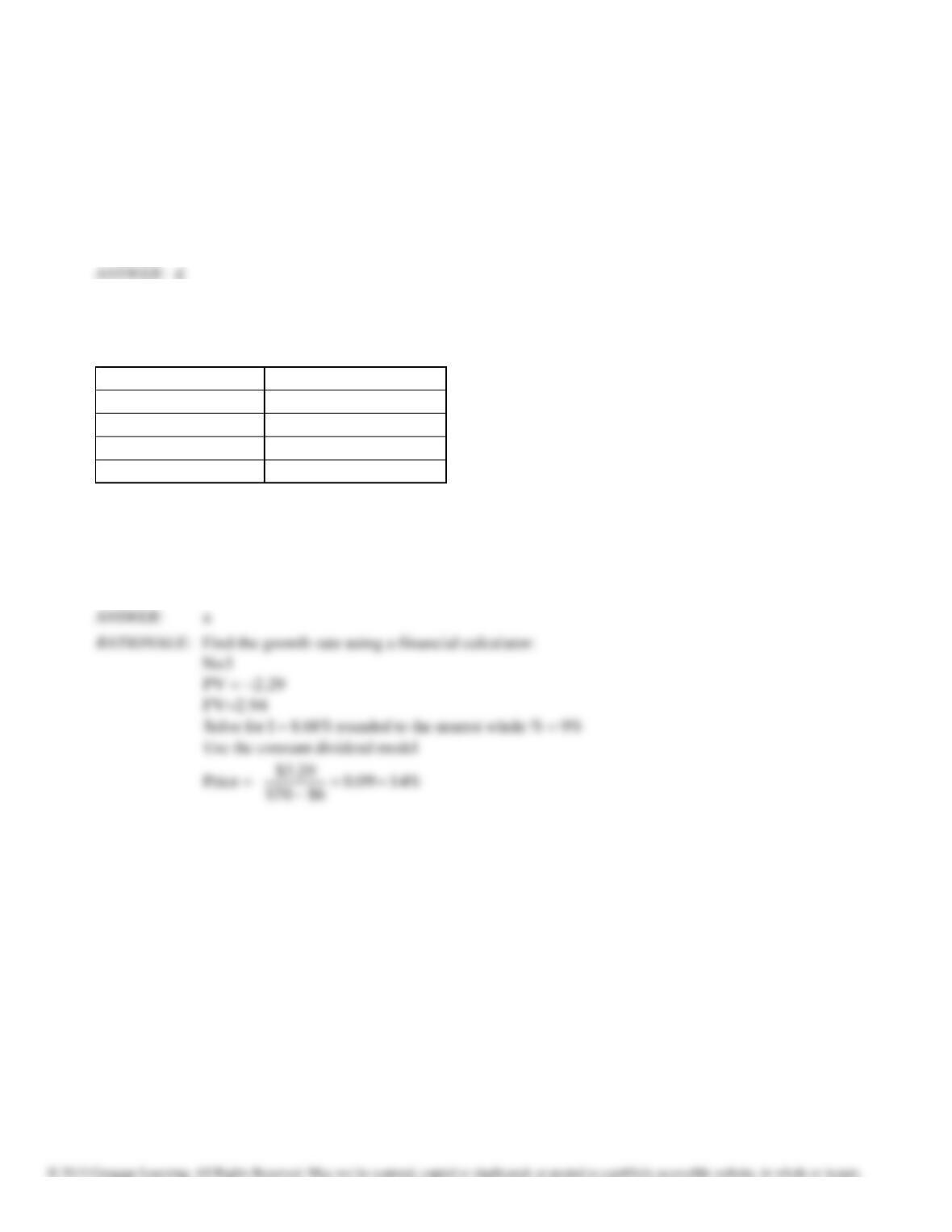
earnings after tax of $5.31 million and is paying $1.6 million in dividends. To finance a transmission pipe
line, CG can borrow $2 million at a cost of 10%, the same rate that CG is currently paying on a total of $15
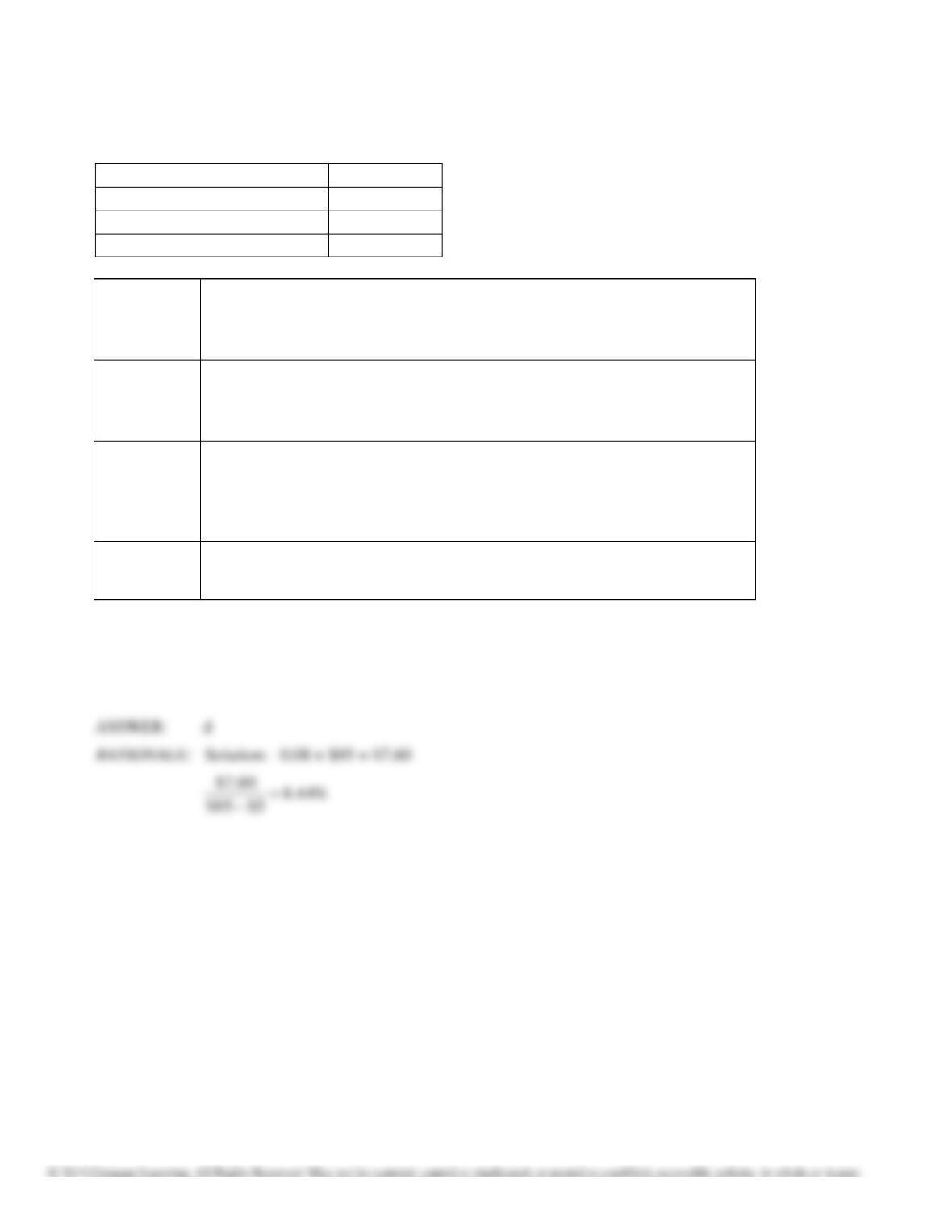
million long-term debt. CG has 1,000,000 shares outstanding and its current market price is $31. If CG’s
long-term growth rate of dividends is expected to be 8%, what is the weighted cost of capital for the firm?
Assume a marginal tax rate of 40%.
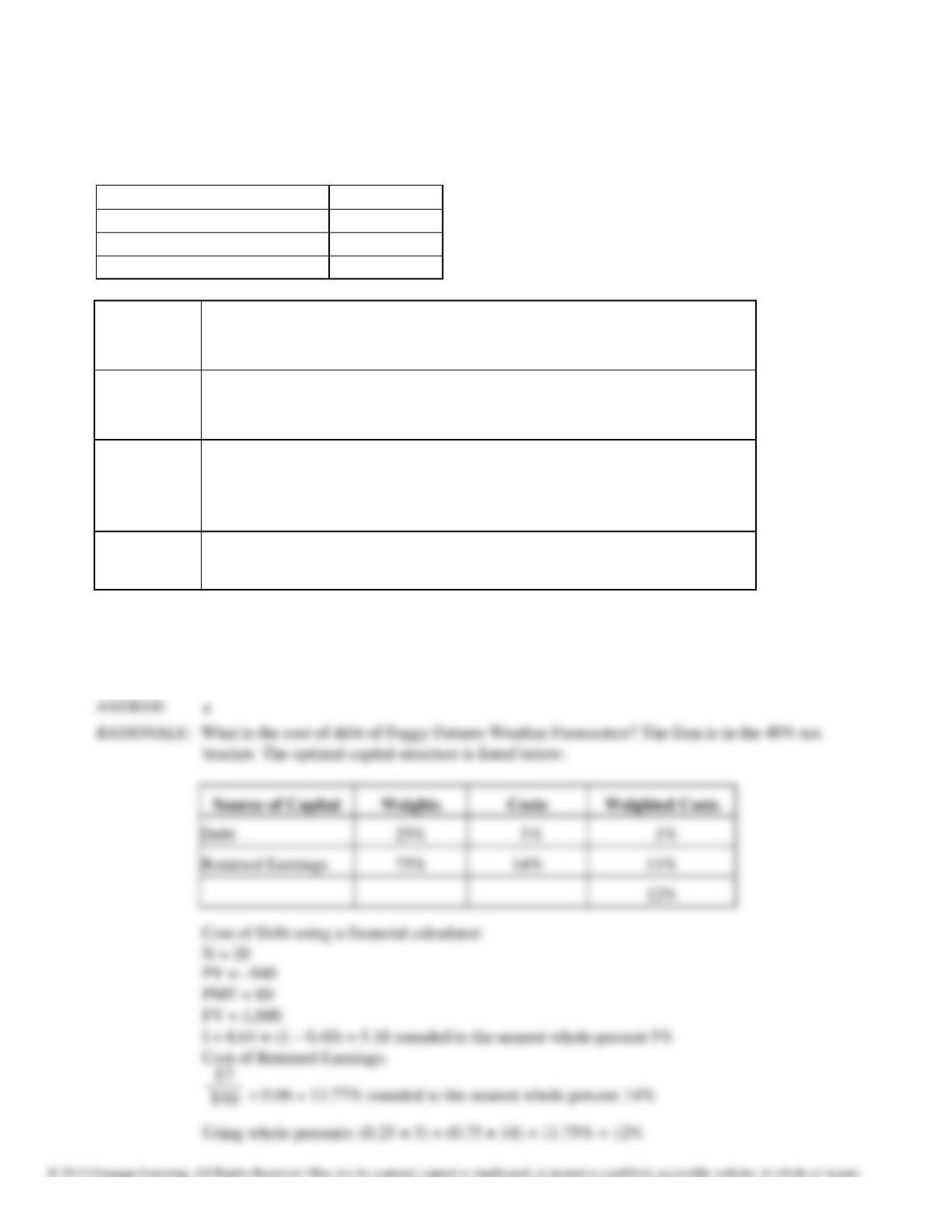
a. 10.9%
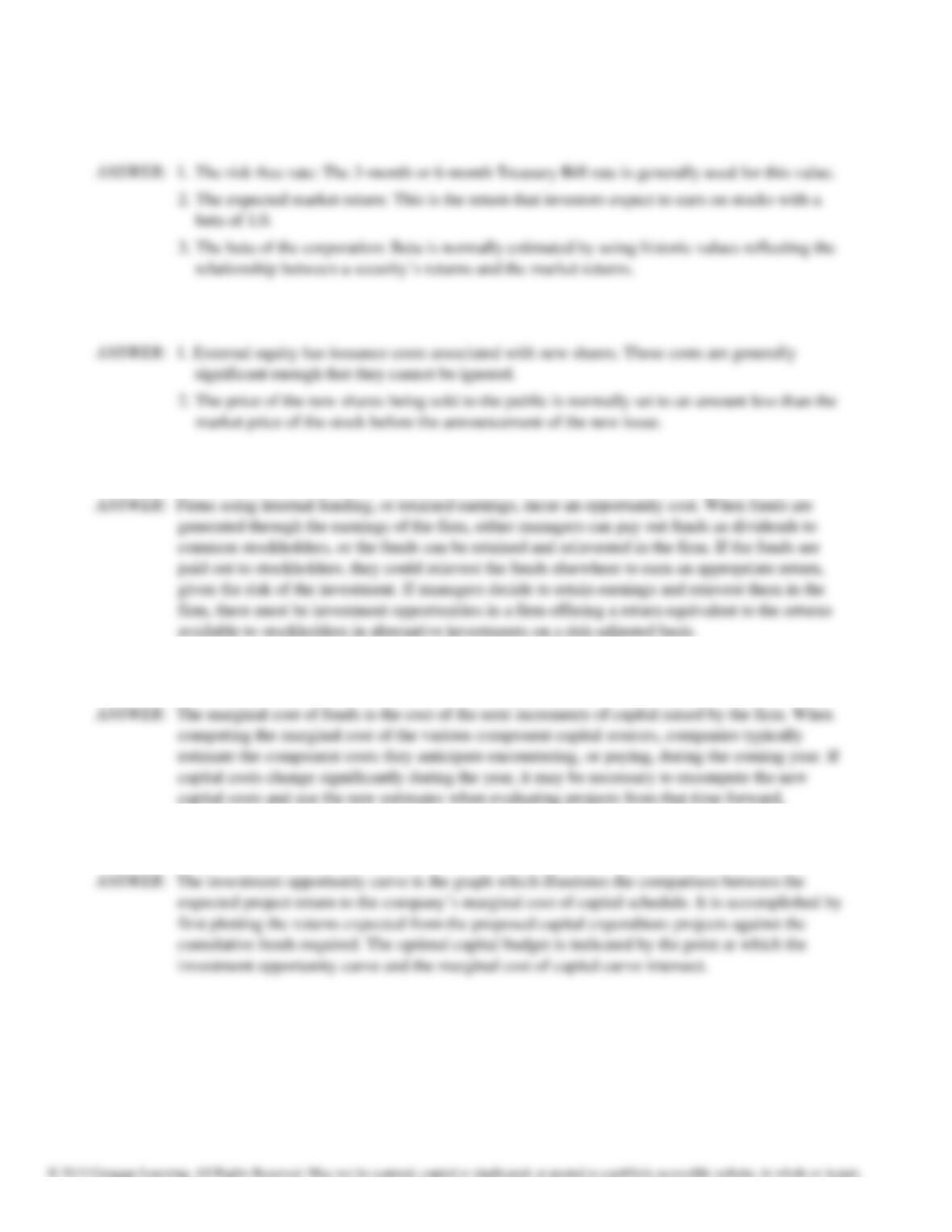
b. 13.6%
c. 19.6%
d. 16.9%
Chapter 12: The Cost of Capital, Capital Structure, and Dividend Policy
70. Heleveton Industries is 100% equity financed. Its current beta is 1.1. The expected market risk premium is
8.5% and the risk-free rate is 4.2%. If Heleveton changes its capital structure to 25% debt, it estimates its beta
will increase to 1.2. If the after-tax cost of debt will be 6%, should Heleveton make the capital structure
change?
a. Yes, cost of capital decreases by 2.52%
b. Yes, cost of capital decreases 1.67%
c. No, stock price would decrease due to increased risk
d. No, cost of capital increases by 0.85%
71. Sadaplast has a target capital structure of 65% common equity, 30% debt, and 5% preferred stock. The cost of
retained earnings is 14% and the cost of new equity is 15.5%. Sadaplast expects to have a net income of $85
million in the coming year. If the firm sells bonds, up to $25 million can be sold at par value to yield an after-
tax cost of 5.4%. An additional $20 million of debentures could be sold to yield an after-tax cost of 7.0%. The
after-tax cost of preferred stock financing is estimated to be 11%. Sadaplast has a dividend payout ratio of
25%. What is Sadaplast’s cost of capital between the first and second break points?
a. 12.25%
b. 11.27%
c. 11.75%
d. 12.73%
Chapter 12: The Cost of Capital, Capital Structure, and Dividend Policy
72. Bay State Technology has determined that its cost of equity is 15% and its after-tax cost of debt is 7.2%. Bay
State expects to earn $14 million after taxes next year and, as a new firm, does not pay any dividends. The
stock sells for $24. Bonds are currently selling at par value. Compute Bay State’s weighted cost of capital. A
partial balance sheet is shown below:
Current liabilities
$ 300,000
Long-term debt
1,000,000
Common stock at $1 par
100,000
Paid in capital
900,000
Retained earnings
3,000,000
Total liabilities and stockholders’ equity
$5,300,000
a. 13.4%
b. 13.1%
c. 11.6%
d. 12.7%
2,400,000
73. Mahlo is planning to diversify into the bakery industry. As a result, its beta should drop from 1.4 to 1.2 and
the expected long-term growth rate of dividends will drop from 12% to 9%. The risk-free rate is 4%, the
expected market risk premium is 9%, and the current dividend per share paid by Mahlo is $2.10. Should
Mahlo complete the diversification into the bakery industry?
a. No, stock price drops about $11.70
b. Yes, stock price increases about $9.40
c. Yes, stock price increases about $1.80
d. No, stock price drops about $9.40
Chapter 12: The Cost of Capital, Capital Structure, and Dividend Policy
74. Which of the following statements regarding the cost of capital is/are correct?
I. The weighted cost of capital is the discount rate used when computing the net present value.
II. The after-tax cost of capital is weighted by the proportions of the capital components in the firm’s long-
range target capital structure.
a. Only statement I is correct
b. Only statement II is correct
c. Both statements I and II are correct
d. Neither statement I nor II is correct
75. The cost of debt must account for all of the following inputs EXCEPT:
a. Bond ratings.
b. Issuance costs.
c. Flotation costs.
d. The tax rate.
76. There are two primary ways that capital is raised. Which of the following statements is/are correct?
I. Capital is raised internally by using retained earnings.
II. Capital is raised externally by selling fixed assets.
a. Only statement I is correct
b. Only statement II is correct
c. Both statements I and II are correct
d. Neither statement I nor II is correct
77. Investors can form earnings growth expectations from various sources, including
a. potential sales growth.
b. current earnings and retention rates.
c. assumed product development.
d. investors’ required rate of return.

Chapter 12: The Cost of Capital, Capital Structure, and Dividend Policy
78. What is the weighted average cost of capital for Mud Bug Corporation?
Source of Capital
Capital Components
Cost
Long Term Debt
$60,000
5.6%
Preferred Stock
$15,000
10.6%
Common Stock
a. 6.9%
$75,000
13.0%
b. 8.5%
c. 10.2%
d. 9.8%
79. Zappin’ Skeeters Corporation needs to know its cost of retained earnings. Based on the following information,
compute the cost of retained earnings: The stock sells for $25, flotation costs are $3 and the firm is in the 35%
tax bracket.
Year
Dividen
2014
$1.55
2013
$1.40
2012
$1.35
2011
a. 15.71%
$1.32
b. 9.11%
c. 12.56%
d. 10.72%
80. The cost of internal equity is cheaper than the cost of external equity. Which of the following statements is/are
correct?
I. External equity may incur expenses which are deducted from the capital received for the sale of the
security.
II. Corporations generally discount the price of the securities that are sold to the public in order to raise
capital.
a. Only statement I is correct
b. Only statement II is correct
c. Both statements I and II are correct
d. Neither statement I nor II is correct
Chapter 12: The Cost of Capital, Capital Structure, and Dividend Policy
81. What is the cost of preferred stock if the stock is selling for $208, the dividend is $35 and flotation costs are
5% of the selling price?
a. 17.7%
b. 25.2%
c. 12.5%
d. 10.8%
82. What would be the weighted average cost of capital for Limp Linguini Noodle Makers, Inc. under the
following conditions:
*The capital structure is 40% debt and 60% equity
*The before-tax cost of debt (which includes flotation costs) is 20% and the firm is in the 40% tax bracket
*The firm’s beta is 1.7
*The risk-free rate is 7% and the market risk premium is 6%
a. 15.12%
b. 18.7%
c. 17.2%
d. 12%
83. A firm has a beta of 1.2. The return in the market is 14% and the risk-free rate is 6%. The estimated cost of
common stock equity is:
a. 6%
b. 7.2%
c. 15.6%
d. 14%
84. The optimal capital budget occurs at the point where two curves intersect. Which of the following is/are one
of those curves?
I. Weighted marginal cost of capital curve
II. Investment opportunity curve
a. Only statement I is correct
b. Only statement II is correct
c. Both statements I and II are correct
d. Neither statement I nor II is correct
Chapter 12: The Cost of Capital, Capital Structure, and Dividend Policy
85. The cost of common stock equity may be estimated by using which of the following?
a. Earnings curve
b. Dupont analysis
c. Capital asset pricing model
d. Price/Earnings ratio
86.
A firm is determining its cost of common stock equity. It last paid a dividend of $.52, the dividends are
growing at 5%, flotation costs are $2 per share and the firm will net $72 per share upon the sale of the stock.
What is the firm’s cost of common equity?
a. 3.49%
b. 8.22%
c. 6.11%
d. 5.76%
87.
Surfin’ Bubba Surfboard Shop is currently selling for $34.25 a share with a current dividend of $1.00. It is
estimated that Surfin’ Bubba will have a growth rate in earnings of 10% into the foreseeable future. If Surfin’
Bubba plans to raise new capital for expansion, what is the cost of new equity if flotation costs are 8% of the
price?
a. 13.49%
b. 11.57%
c. 12.21%
d. 10.87%
88.
What is Bodacious Bodywear’s weighted average cost of capital under the following conditions:
*The firm has 30% debt, 10% preferred stock, and 60% equity
*The cost of common equity is 14% and the cost of preferred stock is 9%
*The firm’s debt has a before-tax cost of debt of 10% (including flotation costs)
*The firm is in the 40% tax bracket
a.
11.1%
b.
8.5%
c. 12.3%
d.
10.5%
Chapter 12: The Cost of Capital, Capital Structure, and Dividend Policy
89.
In determining the cost of debt, several factors must be considered. All of the following are those factors
EXCEPT:
a.
the firm’s before-tax cost of debt
b.
the firm’s tax rate
c.
flotation costs
d.
the firm’s growth rate of dividends
90.
What is the cost of equity for Fat Rat Laboratories, Inc.? The stock has the following dividends, the stock
sells for $70 with flotation costs of $6 and it expects to pay a dividend of $3.20 next year (rounded).
YEARS
DIVIDENDS
2014
$2.94
2013
2.70
2012
2.49
2011
2.29
a.
14.00%
b.
13.57%
c.
12.26%
d.
10.00%

Chapter 12: The Cost of Capital, Capital Structure, and Dividend Policy
91. What is the cost of debt for Foggy Futures Weather Forecasters? The firm is in the 40% tax bracket. The
optimal capital structure is listed below:
Source of Capital
Weight
Long-Term Debt
25%
Preferred Stock
20%
Common Stock
55%
Debt:
The firm can issue $1,000 par value, 8% coupon interest bonds with a 20 year
maturity date. The bond has an average discount of $30 and flotation costs of
$30 per bond. The selling price is $1,000.
Preferred
Stock:
The firm can sell preferred stock with a dividend that is 8% of the current price.
The stock costs $95. The cost of issuing and selling the stock is expected to be
$5 per share.
Common
Stock:
The firm’s common stock is currently selling for $90 per share. The firm
expects to pay cash dividends of $7 per share next year. The dividends have
been growing at 6%. The stock must be discounted by $7 and flotation costs are
expected to amount to $5 per share.
Retained
Earnings:
The firm expects to have enough retained earnings in the coming year to be
used in place of any new stock being issued.
a. 5.18%
b. 3.6%
c. 7.5%
d. 12.2%
Chapter 12: The Cost of Capital, Capital Structure, and Dividend Policy
92.
What is the cost of preferred stock for Foggy Futures Weather Forecasters? The firm is in the 40% tax
bracket. The optimal capital structure is listed below:
Source of Capital
Weight
Long-Term Debt
25%
Preferred Stock
20%
Common Stock
55%
Debt:
The firm can issue $1,000 par value, 8% coupon interest bonds with a 20 year
maturity date. The bond has an average discount of $30 and flotation costs of $30
per bond. The selling price is $1,000.
Preferred
Stock:
The firm can sell preferred stock with a dividend that is 8% of the current price.
The stock costs $95. The cost of issuing and selling the stock is expected to be
$5
per share.
Common
Stock:
The firm’s common stock is currently selling for $90 per share. The firm expects
to pay cash dividends of$7 per share next year. The dividends have been growing
at 6%. The stock must be discounted by $7 and flotation costs are
expected to
amount to $5 per share.
Retained
Earnings:
The firm expects to have enough retained earnings in the coming year to be used
in place of any new stock being issued.
a.
4.9%
b.
11.55%
c.
7.88%
d.
8.44%

Chapter 12: The Cost of Capital, Capital Structure, and Dividend Policy
93.
What is the cost of common stock for Foggy Futures Weather Forecasters? The firm is in the 40% tax bracket.
The optimal capital structure is listed below:
Source of Capital
Weight
Long-Term Debt
25%
Preferred Stock
20%
Common Stock
55%
Debt:
The firm can issue $1,000 par value, 8% coupon interest bonds with a 20
year maturity date. The bond has an average discount of $30 and flotation
costs of $30 per bond. The selling price is $1,000.
Preferred
Stock:
The firm can sell preferred stock with a dividend that is 8% of the current price.
The stock costs $95. The cost of issuing and selling the stock is expected to be
$5 per share.
Common
Stock:
The firm’s common stock is currently selling for $90 per share. The firm
expects to pay cash dividends of $7 per share next year. The dividends have
been growing at 6%. The stock must be discounted by $7 and flotation costs
are expected to amount to $5 per share.
Retained
Earnings:
The firm expects to have enough retained earnings in the coming year to be
used in place of any new stock being issued.
a. 12.25%
b. 19.75%
c. 14.97%
d. 13.22%

Chapter 12: The Cost of Capital, Capital Structure, and Dividend Policy
94.
What is the cost of retained earnings for Foggy Futures Weather Forecasters? The firm is in the 40% tax
bracket. The optimal capital structure is listed below:
Source of Capital
Weight
Long-Term Debt
25%
Preferred Stock
20%
Common Stock
55%
Debt:
The firm can issue $1,000 par value, 8% coupon interest bonds with a 20
year maturity date. The bond has an average discount of $30 and flotation
costs of $30 per bond. The selling price is $1,000.
Preferred
Stock:
The firm can sell preferred stock with a dividend that is 8% of the current
price. The stock costs $95. The cost of issuing and selling the stock is expected
to be $5 per share.
Common
Stock:
The firm’s common stock is currently selling for $90 per share. The firm
expects to pay cash dividends of $7 per share next year. The dividends have
been growing at 6%. The stock must be discounted by $7 and flotation costs are
expected to amount to $5 per share.
Retained
Earnings
The firm expects to have enough retained earnings in the coming year to be
used in place of any new stock being issued.
a. 10.12%
b. 19.63%
c. 13.78%
d. 12.11%
Chapter 12: The Cost of Capital, Capital Structure, and Dividend Policy
95. Using rounded whole percents for the various costs and weighted costs, what is the weighted average cost of
capital for Foggy Futures Weather Forecasters? The firm is in the 40% tax bracket. The optimal capital
structure is listed below:
Source of Capital
Weight
Long-Term Debt
25%
Preferred Stock
20%
Common Stock
55%
Debt:
The firm can issue $1,000 par value, 8% coupon interest bonds with a 20 year
maturity date. The bond has an average discount of $30 and flotation costs of
$30 per bond. The selling price is $1,000.
Preferred
Stock:
The firm can sell preferred stock with a dividend that is 8% of the current price.
The stock costs $95. The cost of issuing and selling the stock is expected to be
$5 per share.
Common
Stock:
The firm’s common stock is currently selling for $90 per share. The firm
expects to pay cash dividends of $7 per share next year. The dividends have
been growing at 6%. The stock must be discounted by $7 and flotation costs are
expected to amount to $5 per share.
Retained
Earnings:
The firm expects to have enough retained earnings in the coming year to be
used in place of any new stock being issued.
a. 12%
b. 8%
c. 15%
d. 18%
Chapter 12: The Cost of Capital, Capital Structure, and Dividend Policy
96. In considering the SML concept, the required returns for any individual security are dependent on certain
values. List and discuss those values.
97. What are the reasons that the cost of external equity is greater than the cost of internal equity?
98. Firms can raise capital in two ways. Why is it that internal funding does not have a zero cost?
99. How is the marginal cost of the various component capital sources determined?
100. What is the investment opportunity curve and how is it accomplished?
Chapter 12: The Cost of Capital, Capital Structure, and Dividend Policy
101. Sources of debt capital to small firms are limited. Generally, what are the sources of funds for the small firm?
102. What does the optimal capital budget maximize? How it is determined?
103. Explain how the investment opportunity curve is determined.
104. In many instances book value, rather than market value, may be used to determine the weighted average cost
of capital. This is because of all of the following EXCEPT:
a. market values change daily
b. the market prices of the various sources of capital are not easily estimated.
c. many firms have several different issues of debt which may not be publicly held.
d. book value is a more accurate value in determining the actual cost of capital