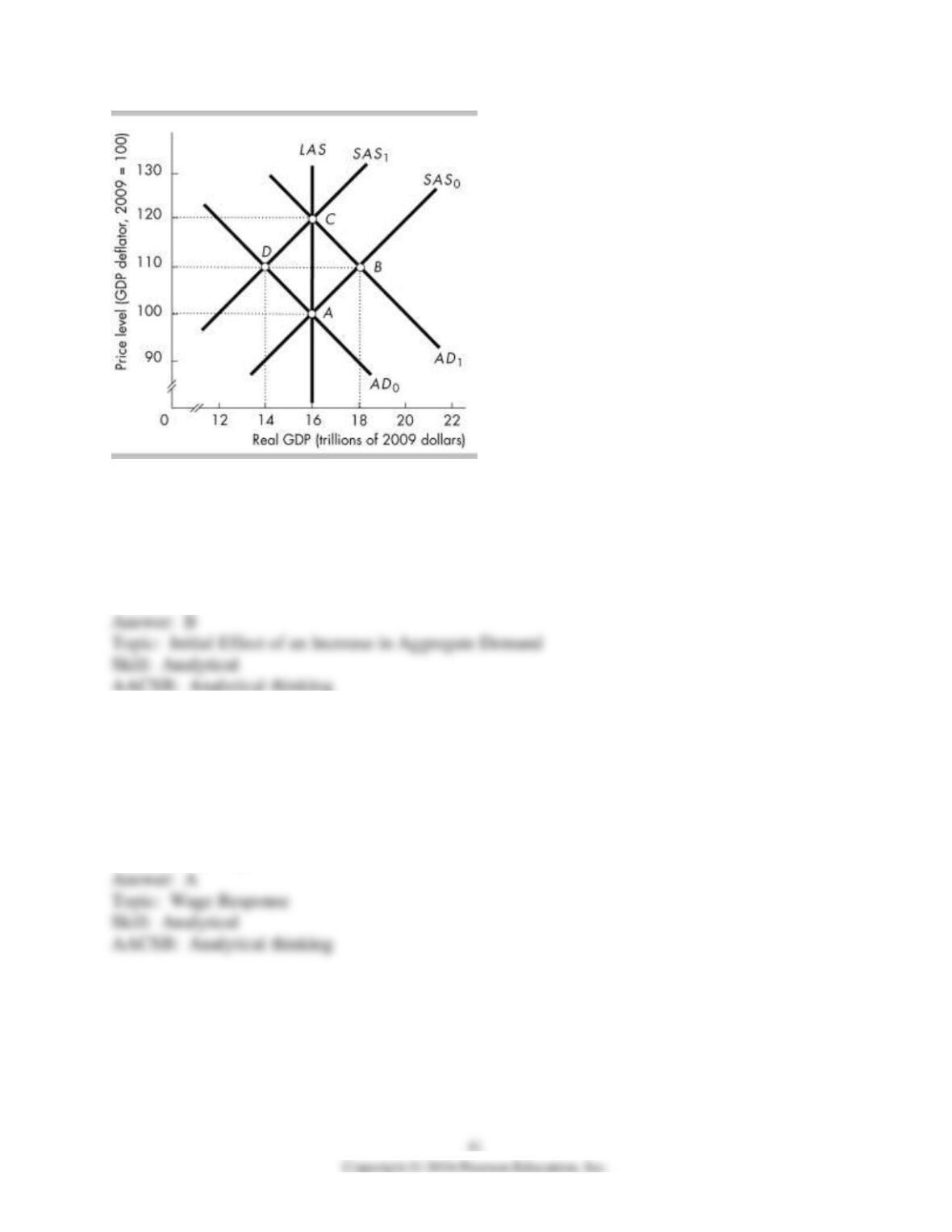
26) In the above figure, suppose that the economy is at point A when the quantity of money
increases. In the short run, the economy will move to point ________.
A) A, that is, the price level and level of real GDP will not change.
B) B
C) C
D) D
27) In the above figure, suppose that the economy is at point A when foreign countries begin an
expansion and buy more U.S.-made goods. In the short run, this change creates a movement to
point ________ and an eventual increase in ________.
A) B; money wage rates
B) D; the natural unemployment rate
C) B; the natural unemployment rate
D) D; money wage rates
28) An initial increase in aggregate demand that is NOT followed by an increase in the quantity
of money results in a long-run equilibrium with
A) a higher price level but the same real GDP.
B) a higher price level and an increased level of real GDP.
C) the same price level and a lower level of real GDP.
D) None of the above answers are correct.
29) Suppose that a shock causes the aggregate demand curve to shift rightward. If the Fed does
nothing
A) the economy will experience a temporary reduction in employment but will eventually return
to full employment.
B) output initially will exceed potential GDP, but the economy will return to potential GDP with
a higher price level.
C) the short-run aggregate supply curve will not shift leftward and there will be continued
inflation.
D) eventually the short-run aggregate supply curve will shift leftward and there will be continued
inflation.
30) For an economy at full employment, an increase in the quantity of money will lead to which
of the following sequences of shifts in aggregate demand and supply curves?
A) decreased aggregate demand, increased short-run aggregate supply, constant long-run
aggregate supply
B) decreased aggregate demand, decreased short-run aggregate supply, decreased long-run
aggregate supply
C) increased aggregate demand, increased short-run aggregate supply, increased long-run
aggregate supply
D) increased aggregate demand, decreased short-run aggregate supply, constant long-run
aggregate supply
31) A one-time rise in the price level can turn into a demand-pull inflation when ________.
A) the money wage rate continues to increase
B) the quantity of money persistently decreases
C) taxes consistently increase
D) the quantity of money persistently increases
32) A demand-pull inflation consists of ________ shifts in the AD curve and ________ shifts in
the SAS curve.
A) rightward; rightward
B) rightward; leftward
C) leftward; rightward
D) leftward; leftward
33) In a persisting demand-pull inflation
A) short-run aggregate supply decreases and aggregate demand increases.
B) aggregate demand and short-run aggregate supply both decrease.
C) aggregate demand increases and long-run aggregate supply decreases.
D) None of the above answers are correct.
34) Demand-pull inflation results from continually increasing the quantity of money, which leads
to a continually
A) decreasing long-run aggregate supply.
B) increasing aggregate supply.
C) decreasing aggregate demand.
D) increasing aggregate demand.
35) Demand-pull inflation persists because of
A) continuing increases in government expenditures.
B) continuing increases in the quantity of money.
C) continuing increases in real wage rates.
D) continuing increases in aggregate supply.
36) A demand-pull inflation requires persistent increases in
A) tax rates.
B) real wages.
C) the quantity of money.
D) government expenditures.
37) If the Fed responds to an initial increase in aggregate demand by increasing the quantity of
money
A) there will be no inflationary gap.
B) real GDP will begin to decrease more rapidly than if the quantity of money had remained
constant.
C) money wages will fall to reduce unemployment.
D) there is the risk of continued inflation.
38) In a demand-pull inflation brought about by increases in the quantity of money, real GDP
might increase at times because
A) tax rates decline.
B) real wages fall.
C) money wages fall.
D) real wages rise.
39) If the Fed responds to an increase in aggregate demand by increasing the quantity of money
A) nothing happens because aggregate demand had already increased.
B) output will begin to decrease more rapidly than in the case in which only the first increase in
aggregate demand happened.
C) money wage rates will fall to reduce unemployment.
D) there will be continued inflation.
40) If the economy is at potential GDP and the Fed increases the quantity of money, then
A) potential GDP rises.
B) real GDP rises temporarily above potential GDP.
C) real GDP rises permanently above potential GDP.
D) potential GDP and real GDP both decrease.
41) During a demand-pull inflation, if the Fed tries to maintain a level of real GDP above
potential GDP
A) there will be a one-time shift in the AD and the SAS curves.
B) the AD curve will shift rightward continuously and SAS curves will shift leftward
continuously.
C) the AD curve will shift rightward continuously and the SAS curve will not shift.
D) the SAS curve will shift leftward continuously and the AD curve will not shift.
42) In a demand-pull inflation, money wage rates rise because
A) a decrease in aggregate demand creates a labor shortage.
B) an increase in aggregate demand creates a labor surplus.
C) an increase in aggregate demand creates a labor shortage.
D) a decrease in aggregate demand creates a labor surplus.
43) As the money wage rate rises
A) the long-run aggregate supply curve shifts rightward.
B) the short-run aggregate supply curve shifts rightward.
C) both the long-run aggregate supply curve and the short-run aggregate supply curve shift
leftward.
D) the short-run aggregate supply curve shifts leftward.
44) When the AD and SAS curves intersect at a level of real GDP which exceeds potential GDP
and there is no government policy undertaken, which of the following will occur?
A) The AD curve shifts rightward because the Fed decreases the money supply.
B) The SAS curve shifts leftward because the money wage rate rises.
C) The SAS curve shifts leftward because the money wage rate falls.
D) The AD curve shifts leftward because the money wage rate rises.
45) To prevent demand-pull inflation
A) firms must refuse to increase wages.
B) the Fed must not let the quantity of money persistently rise.
C) the natural unemployment rate must increase.
D) real GDP must increase.
46) To stop a demand-pull inflation using monetary policy, you would recommend that the Fed
A) increase the quantity of money.
B) not increase the quantity of money.
C) increase tax rates.
D) purchase government bonds in the open market.
47) In a demand-pull inflation, if the Fed stops expanding the quantity of money
A) a cost-push inflation spiral will occur.
B) government expenditure will cause the demand-pull inflation to continue.
C) a deflation will occur.
D) the demand-pull inflation spiral ends.
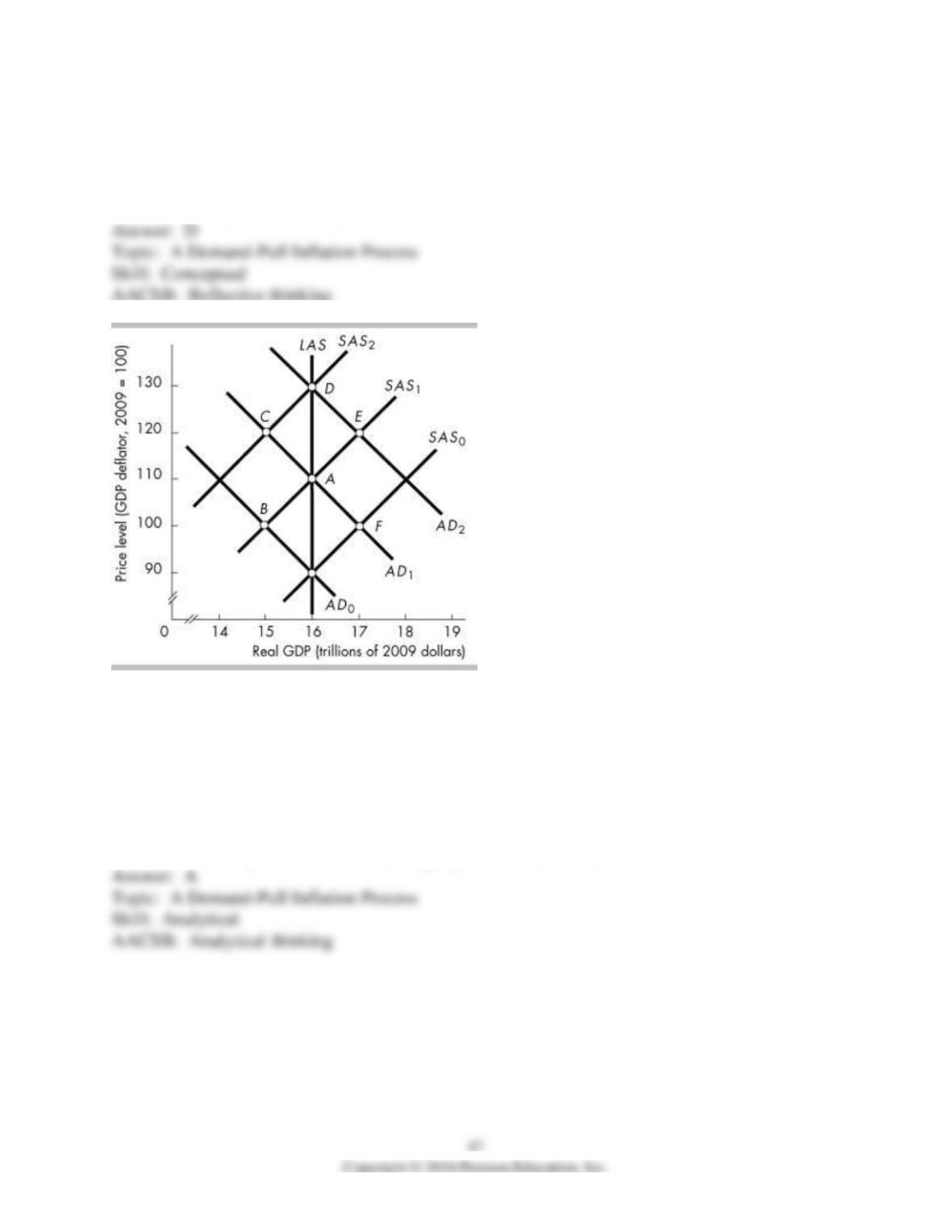
48) The figure above shows the aggregate demand, short-run aggregate supply, and long-run
aggregate supply curves for the U.S. economy. The economy is currently at point A. A demand-
pull rise in the price level will initially move the economy to point ________ and to point
________.
A) E when aggregate demand increases; D when the wage rate rises
B) B when aggregate demand decreases; C when the wage rate rises
C) E when aggregate demand increases; A when the wage rate rises
D) C when the wage rate rises; D when aggregate demand increases
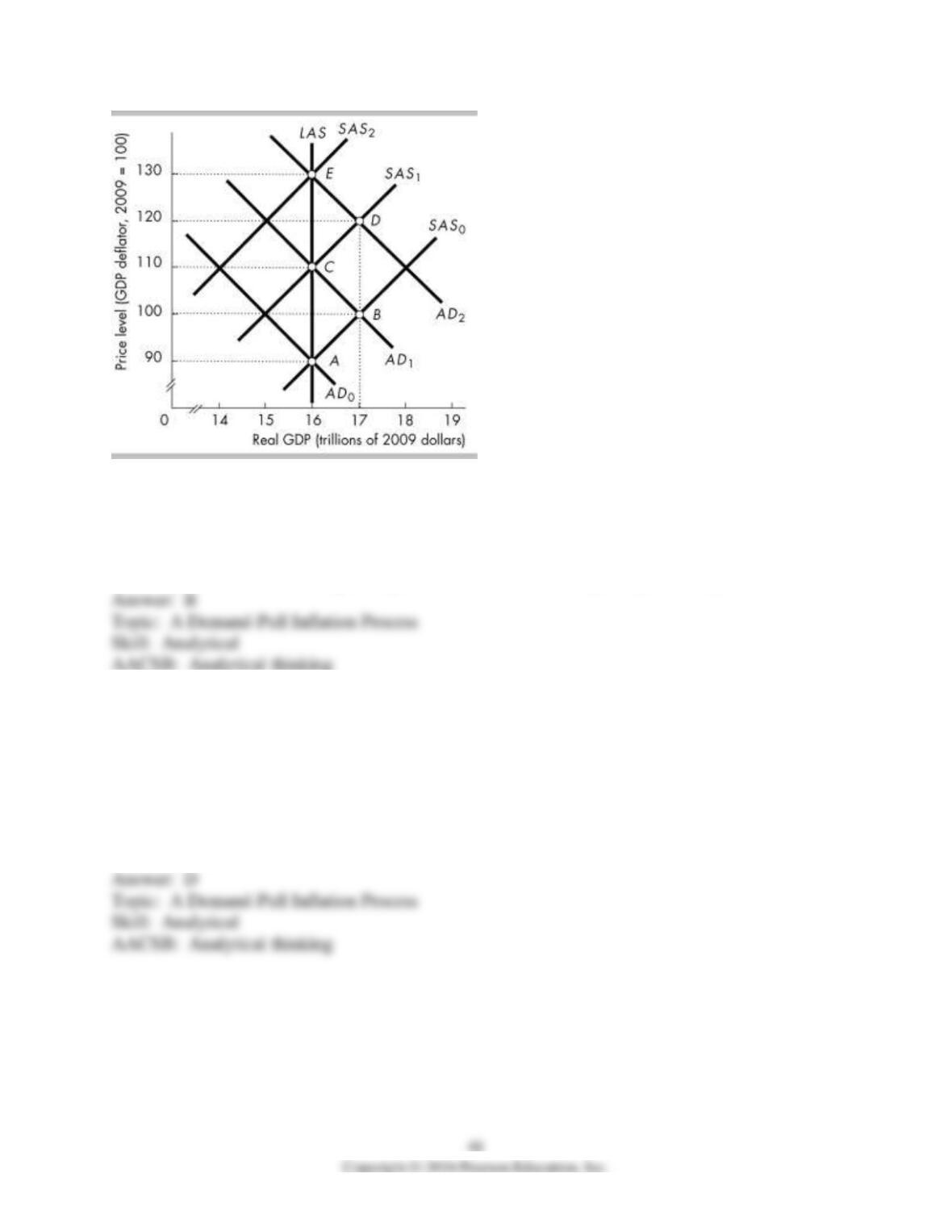
49) In the above figure, the movement from point A to B to C to D to E represents
A) demand-pull inflation resulting solely from wage responses to excess labor demand.
B) demand-pull inflation resulting from persistent increases in the quantity of money.
C) cost-push inflation resulting solely from wage responses to excess labor demand.
D) cost-push inflation resulting from persistent increases in the quantity of money.
50) In the above figure, suppose the economy is at point A initially. For real GDP to increase to
and consistently remain above $16 trillion
I. the price level must increase to above 90.
II. there must be continued increases in the quantity of money.
A) only I
B) only II
C) Both I and II are correct.
D) Neither I nor II is correct.
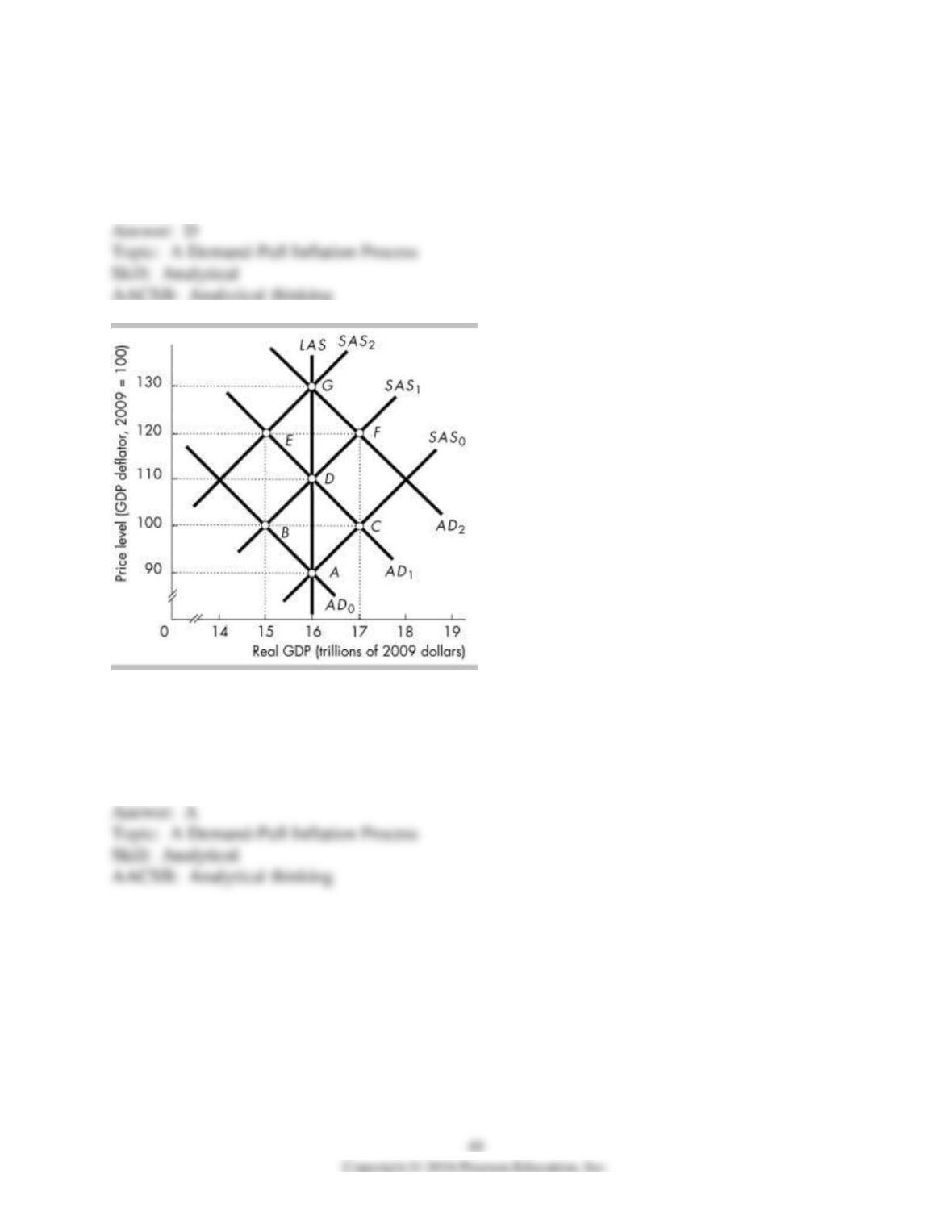
51) In the above figure, if the economy moves from point A to point E
A) money wage rates have increased.
B) there may have been demand-pull inflation.
C) there has been economic growth.
D) Both answers A and B are correct.
52) In the above figure, which path represents a demand-pull inflation?
A) point A to C to D to F to G
B) point A to B to D to E to G
C) point A to C to D to E to G
D) point A to B to D to F to G
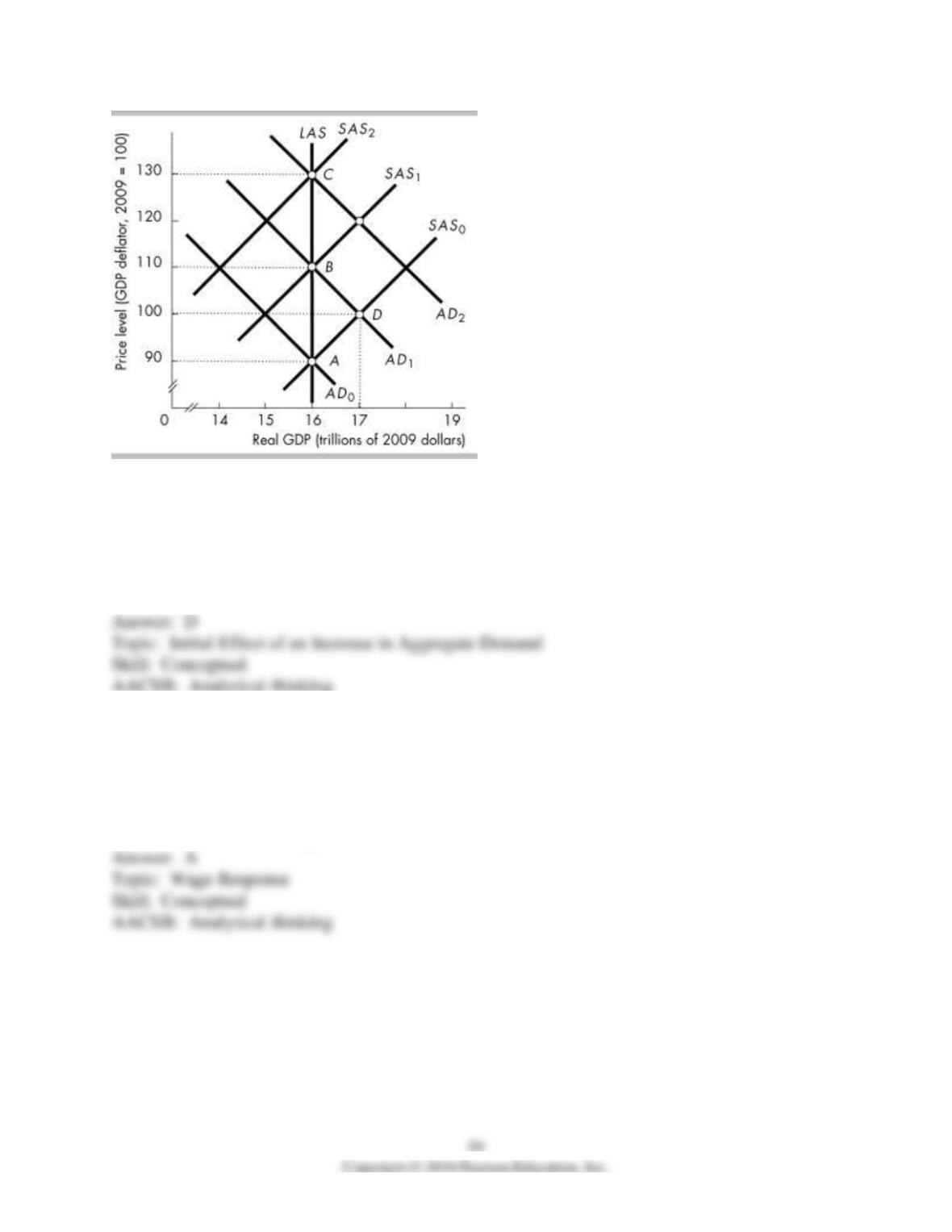
53) In the above figure, the economy initially is at point A and then an increase in the quantity of
money moves the economy to point D. At point D, the real wage rate has
A) risen by the same percentage as the price level.
B) remained constant.
C) risen.
D) fallen.
54) In the above figure, the economy initially is at point A and then an increase in the quantity of
money moves the economy to point D. The money wage rate will
A) rise because a labor shortage now exists.
B) fall because a labor shortage now exists.
C) rise because a labor surplus now exists.
D) fall because a labor surplus now exists.
55) In the above figure, the economy initially is at point A and then an increase in the quantity of
money moves the economy to point D. If the quantity of money remains constant, the economy
will adjust with
A) short-run aggregate supply shifting leftward to SAS1.
B) short-run aggregate supply shifting leftward to SAS2.
C) aggregate demand shifting back to AD0.
D) aggregate demand shifting to AD2.
56) A demand-pull inflation occurred in the United States during most of the later part of the
A) 1960s.
B) 2000s.
C) 1980s.
D) 1990s.
57) As far as demand-pull inflation goes, the United States
A) has never experienced this type of inflation.
B) experienced this type of inflation during the 1990s.
C) experienced this type of inflation during the 1960s.
D) experienced this type of inflation during the 1950s.
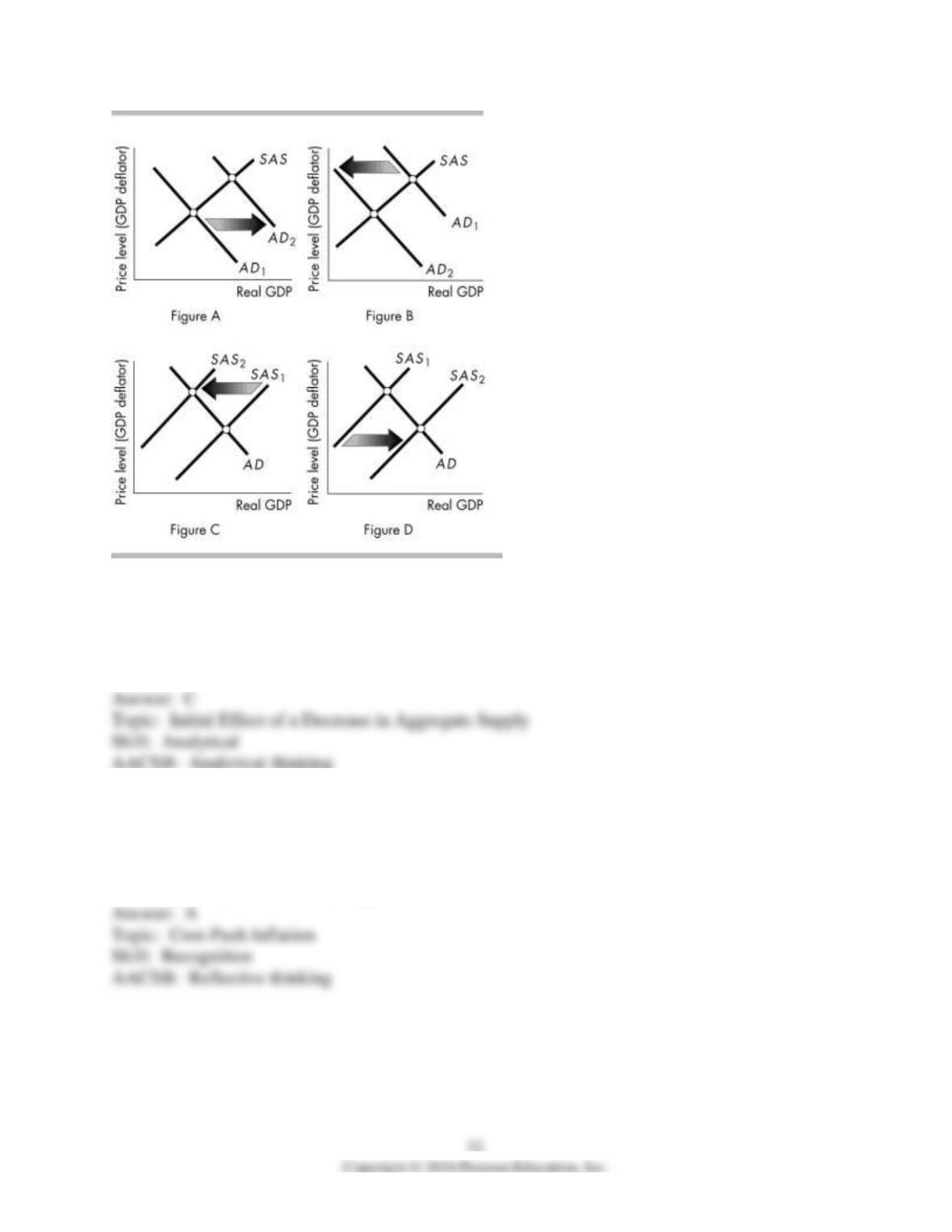
58) In the above, which figure shows the start of a cost-push inflation?
A) Figure A
B) Figure B
C) Figure C
D) Figure D
59) The main sources of cost-push inflation are increases in
A) money wage rates and the cost of raw materials.
B) real wage rates and the cost of raw materials.
C) money wage rates and aggregate demand.
D) aggregate demand and real wage rates.
60) Assuming that GDP currently equals potential GDP, a cost-push inflation could result from
which of the following?
A) a decrease in tax rates
B) an increase in the labor force
C) a large crop failure that boosts the prices of raw food materials
D) an increase in the nation’s capital stock
61) Cost-push inflation can be started by
A) a decrease in the money wage rate.
B) an increase in the money prices of raw materials.
C) an increase in the quantity of money.
D) a decrease in government expenditure on goods and services.
62) Cost-push inflation can start with
A) lower taxes.
B) an increase in government expenditure.
C) higher money wage rates.
D) an increase in transfer payments.
63) Cost-push inflation can start with
A) a decrease in investment.
B) an increase in oil prices.
C) an increase in government expenditure.
D) a decrease in the quantity of money.
64) Cost-push inflation might initially result from
A) an increase in the quantity of money.
B) the use of new technology.
C) an increase in government expenditure.
D) an increase in the cost of resources.
65) In April 2008 the price of oil was approximately $130 per barrel; in April 2015, it was
approximately $40 per barrel. This change in the price of oil could have started
A) a cost-push inflation.
B) a demand-pull inflation.
C) both a cost-push and a demand-pull inflation.
D) None of the above answers are correct.
66) Cost-push inflation is an inflation that results from an initial ________.
A) increase in money wage rates or money prices of raw materials
B) decrease in taxes
C) increase in investment
D) increase in taxes
67) The initial factors that can create a cost-push inflation do NOT include
A) increases in money wage rates.
B) increases in the money prices of raw materials.
C) increases in the quantity of money.
D) None of the above answers is correct because all of the above could be the initial cause of a
cost-push inflation.
68) At the start of a cost-push inflation
A) productivity rises.
B) real GDP increases faster than the quantity of money.
C) the short-run aggregate supply curve shifts rightward.
D) prices and unemployment are rising.
69) The start of a cost-push inflation results in
A) falling GDP and falling unemployment rate.
B) raising GDP and rising unemployment rate.
C) falling GDP and rising unemployment rate.
D) raising GDP and falling unemployment rate.
70) Cost-push inflation starts with
A) an increase in aggregate demand.
B) a decrease in aggregate demand.
C) an increase in short-run aggregate supply.
D) a decrease in short-run aggregate supply.
71) A leftward shift in the short run aggregate supply curve
A) is the result of the Fed increasing the quantity of money.
B) is the result of a rise in the price of a key resource.
C) is the result of consumer expenditures exceeding available output.
D) increases both the price level and real GDP.
72) When a cost-push inflation starts
A) the price level falls and the money wages rises.
B) real GDP rises faster than the quantity of money.
C) the short-run aggregate supply curve shifts rightward.
D) the price level rises and real GDP decreases.
73) At the start of a cost-push inflation
A) only real GDP changes while the price level remains constant.
B) the price level and real GDP both increase.
C) the price level rises and real GDP decreases.
D) the price level rises and real GDP does not change.
74) Suppose that the money prices of raw materials increase so that short-run aggregate supply
decreases. If the Federal Reserve does not respond, the higher money price of raw materials will
I. repeatedly shift the aggregate demand curve rightward and raise the price level.
II. shift the aggregate demand curve rightward and the aggregate supply curve leftward, raising
prices.
III. result initially in lower employment and a higher price level.
A) I only
B) both I and II
C) both II and III
D) III only
75) An increase in the money wage rate shifts the SAS curve ________ and an increase in the
money prices of raw materials shifts the SAS curve ________.
A) rightward; rightward
B) leftward; leftward
C) rightward; leftward
D) leftward; rightward
76) A higher price for oil shifts the
A) SAS curve leftward.
B) LAS curve leftward.
C) SAS curve rightward.
D) AD curve rightward.
77) By itself, an increase in the price of oil shifts the
A) short-run aggregate supply curve leftward and does not shift the aggregate demand curve.
B) short-run aggregate supply curve rightward and does not shift the aggregate demand curve.
C) aggregate demand curve leftward and does not shift the short-run aggregate supply curve.
D) aggregate demand curve rightward and does not shift the short-run aggregate supply curve.
78) By itself, a fall in the price of oil shifts the
A) short-run aggregate supply curve leftward and does not shift the aggregate demand curve.
B) short-run aggregate supply curve rightward and does not shift the aggregate demand curve.
C) aggregate demand curve leftward and does not shift the short-run aggregate supply curve.
D) aggregate demand curve rightward and does not shift the short-run aggregate supply curve.
79) The SAS curve shifts leftward if
A) good weather increases agricultural harvests.
B) OPEC reduces world oil prices.
C) tax cuts stimulate labor supply.
D) the money wage rate increases.
80) If the prices of crucial raw materials increase
A) the short-run aggregate supply curve shifts leftward.
B) stagflation could occur.
C) a cost-push inflation could occur depending on the behavior of the Federal Reserve.
D) All of the above answers are correct.
81) An increase in the price of a resource such as oil
I. shifts the aggregate demand curve leftward.
II. shifts the long-run aggregate supply curve rightward.
III. shifts the short-run aggregate supply curve leftward.
IV. increases the price level and decreases real GDP in the short run.
A) Only I is correct.
B) Both I and II are correct.
C) Only III is correct.
D) Both III and IV are correct.
82) If oil prices increase, then in the short run, real GDP will ________ and the price level will
________.
A) increase; rise
B) increase; fall
C) decrease; rise
D) decrease; fall
83) In the short-run, an increase in the price of raw materials will ________ the price level and
________ real GDP.
A) raise; increase
B) raise; decrease
C) lower; increase
D) lower; decrease
84) In the short run, if there is an increase in the money wage rate, then
A) short-run aggregate supply increases and the price level rises.
B) short-run aggregate supply decreases and the price level rises.
C) aggregate demand decreases and the price level falls.
D) aggregate demand increases and the price level rises.
85) By itself, a supply shock such as a hike in the price of oil, can
A) cause real GDP to permanently decrease year after year.
B) not cause inflation.
C) be inflationary as long as there is no policy response.
D) cause a wage-price spiral.
86) Stagflation occurs when the price level ________ and real GDP ________.
A) falls; increases
B) falls; decreases
C) rises; decreases
D) rises; increases
87) Stagflation is the result of
A) an increase in aggregate demand.
B) a decrease in short-run aggregate supply.
C) a decrease in aggregate demand.
D) an increase in short-run aggregate supply.
88) Stagflation is the combination of a ________ and ________.
A) falling inflation rate; an increasing real GDP
B) falling price level; an increasing real GDP
C) rising price level; a decreasing real GDP
D) rising inflation rate; a decreasing real GDP
89) Stagflation occurs when the
A) price level and real GDP are increasing at the same time.
B) price level and real GDP are decreasing at the same time.
C) price level is increasing and real GDP is decreasing.
D) price level is decreasing and real GDP is increasing.
90) The term “stagflation” refers to the situation when
A) the aggregate supply curve shifts leftward, prices increase and real GDP decreases.
B) real GDP and the price level both rise because of an increase in aggregate demand.
C) prices become stagnant and do not increase or decrease.
D) the short-run aggregate supply curve and the aggregate demand curve shift in opposite
directions.
91) Stagflation is associated with
A) cost-push inflation.
B) demand-pull inflation.
C) both types of inflation.
D) neither cost-push inflation or demand-pull inflation because it is a different concept
altogether.