92) When the price level is rising and simultaneously real GDP is decreasing
A) the natural unemployment rate increases.
B) stagflation occurs.
C) there is an expansionary gap.
D) the Fed has increased the discount rate.
93) Stagflation results from
A) a leftward shift in the short-run aggregate supply curve.
B) a rightward shift in the aggregate demand curve.
C) a rightward shift in the short-run aggregate supply curve.
D) an increase in government expenditures financed by an increase in the quantity of money.
94) Stagflation is characterized by
A) an increase in both output and the price level.
B) a decrease in output and the price level.
C) an increase in the unemployment rate and an increase in the price level.
D) an economy which is growing at a rate equal to its historical average growth rate.
95) A one-time increase in the price of oil followed by a one-time increase in aggregate demand
produce
A) continuing cost-push inflation.
B) continuing demand-pull inflation.
C) a one-time decrease in the price level.
D) a one-time increase in the price level.
96) A cost-push inflation spiral results if the Fed’s response to stagflation is to keep
A) decreasing aggregate demand.
B) decreasing aggregate supply.
C) increasing aggregate demand.
D) increasing aggregate supply.
97) During a cost-push inflation spiral, the money wage rate ________ and the quantity of
money ________.
A) increases; increases
B) increases; does not change
C) does not change; increases
D) does not change; does not change
98) For a cost-push inflation to occur, oil price increases must be accompanied by
A) decreased investment spending.
B) lower personal tax rates.
C) increases in the quantity of money.
D) increases in government expenditures.
99) Oil prices increase sharply, raising the price level and decreasing real GDP. The Fed has an
incentive to
A) increase the quantity of money in order to reduce unemployment.
B) decrease the quantity of money in order to reduce unemployment.
C) increase the quantity of money in order to reduce the price level.
D) increase the quantity of money in order to reduce the price level and unemployment.
100) Suppose oil prices rise and short-run aggregate supply decreases. If the Fed responds by
increasing the quantity of money, then in the short run
A) real GDP increases and the price level falls.
B) real GDP increases and the price level rises even higher.
C) the Fed is more concerned about fighting inflation than unemployment.
D) None of the above answers is correct.
101) Suppose oil prices rise. The Fed can ________ the quantity of money to ________ the
unemployment rate back to its natural rate.
A) increase; raise
B) increase; lower
C) decrease; raise
D) decrease; lower
102) One example of cost-push inflation is an increase in
A) the money prices of raw materials followed by no government policy.
B) the money prices of raw materials followed by increases in the quantity of money.
C) the money prices of raw materials followed by decreases in the quantity of money.
D) government expenditure followed by increases in the quantity of money.
103) In a cost-push inflation,
A) increases in AD lead to increases in SAS.
B) decreases in AD lead to increases in SAS.
C) increases in SAS lead to decreases in AD.
D) decreases in SAS lead to increases in AD.
104) If the Fed responds to repeated decreases in the short-run aggregate supply with repeated
increases in the quantity of money, the economy will be faced with
A) a one-time increase in prices.
B) continuous inflation.
C) alternating periods of inflation and deflation.
D) steady decreases in real GDP.
105) When there is a cost-push inflation
A) workers demand higher money wages because of higher price levels.
B) the short-run aggregate supply curve shifts rightward.
C) the aggregate demand curve shifts leftward because of the cost hikes.
D) None of the above answers is correct.
106) To prevent cost-push inflation
A) there must not be an excess demand for money.
B) interest rates must not rise.
C) there must not be an increase in government purchases.
D) the Fed must not let the quantity of money rise persistently.
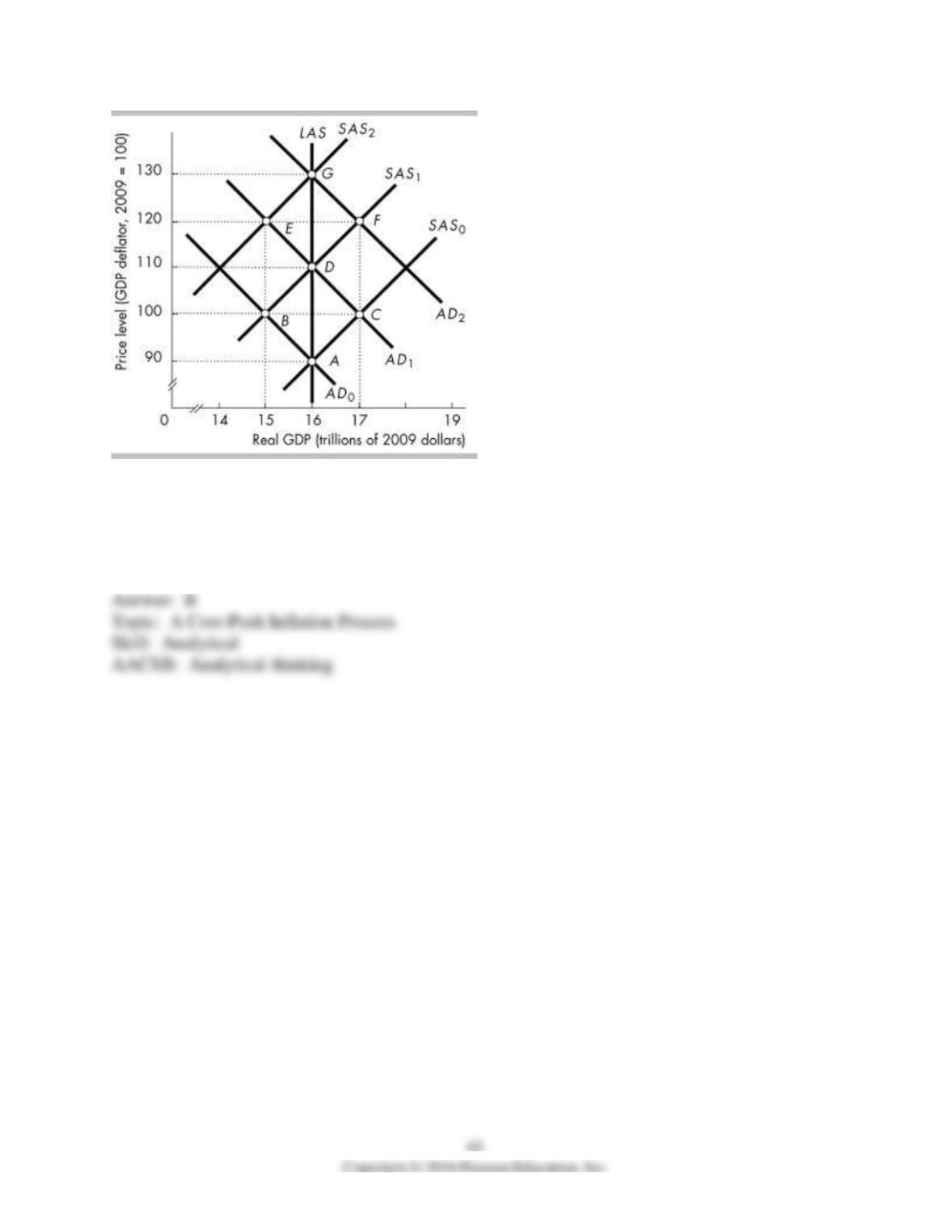
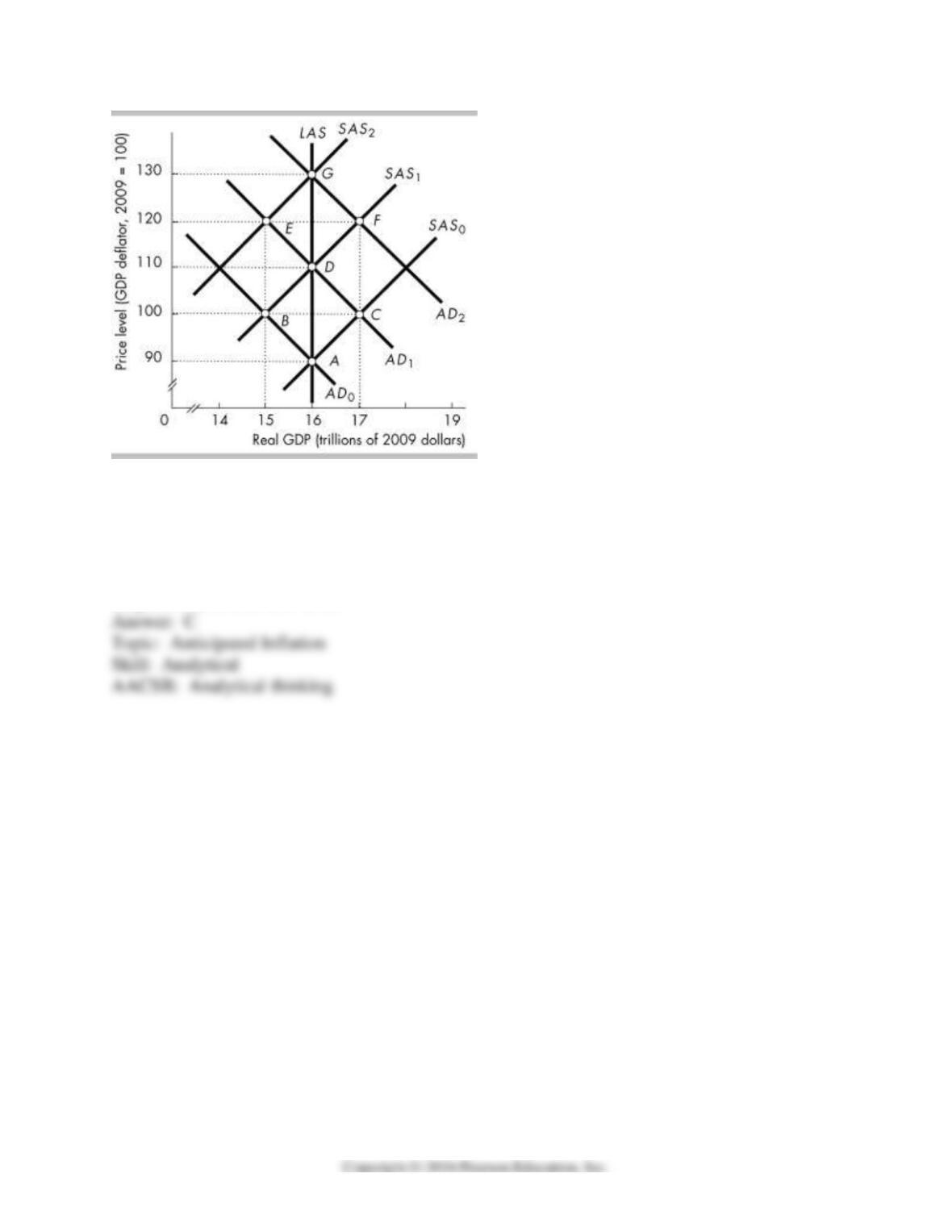
107) In the above figure, which path represents a cost-push inflation?
A) point A to C to D to F to G
B) point A to B to D to E to G
C) point A to C to D to E to G
D) point A to B to D to F to G
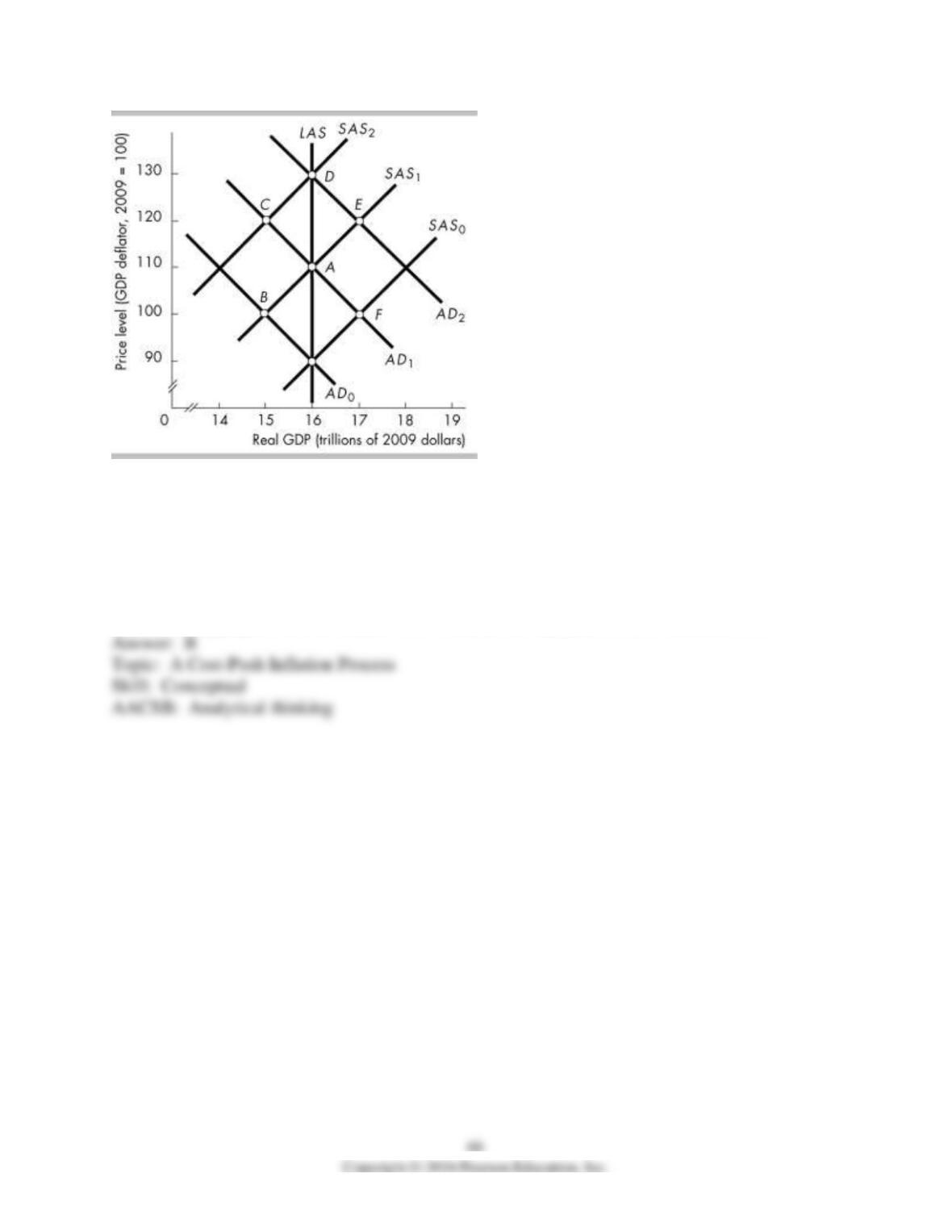
108) The figure above shows the aggregate demand, short-run aggregate supply, and long-run
aggregate supply curves for the U.S. economy. The economy is currently at point A. A cost-push
rise in the price level will initially move the economy to point ________ and to point ________.
A) E when aggregate demand increases; D when the money prices of raw materials rise
B) C when the money prices of raw materials rise; D when aggregate demand increases
C) F when the money prices of raw materials rise; E when aggregate demand increases
D) B when aggregate demand decreases; C when the money prices of raw materials rise
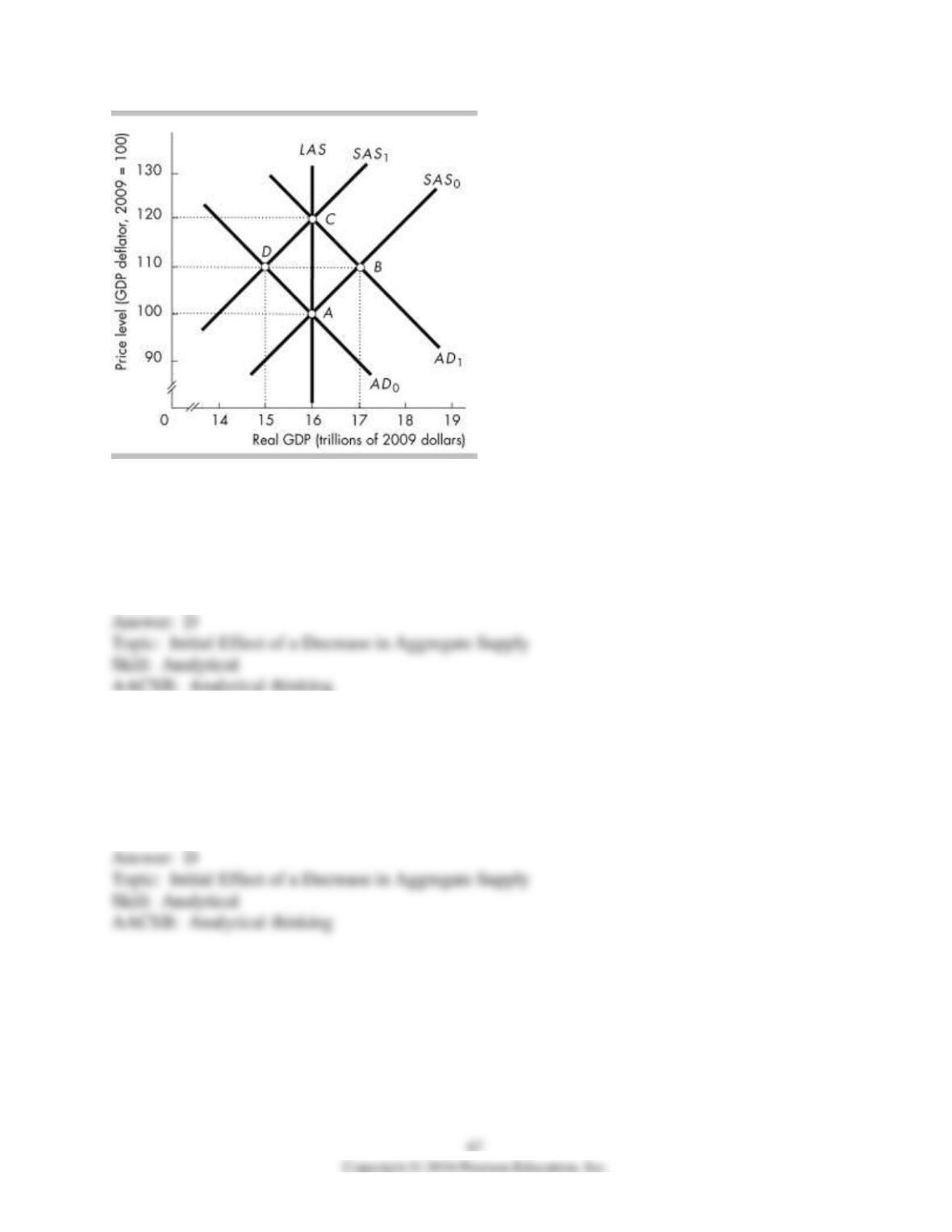
109) In the above figure, the economy is at point A. An increase in oil prices that sets off a cost-
push inflation will initially move the economy from point A to point
A) A, that is, the economy does not change.
B) B.
C) C.
D) D.
110) In the above figure, the economy is at point A. An increase in money wage rates that sets
off a cost-push inflation will initially move the economy from point A to point
A) A, that is, the economy does not change.
B) B.
C) C.
D) D.
111) In the above figure, the economy is at point A. An increase in oil prices occurs. After the
increase in oil prices, the Fed responds by increasing the quantity of money. The economy
moves from point A to
A) D to point C.
B) B to point C.
C) C to point D.
D) C to point B.
112) During which decade did the United States suffer from the worst cost-push inflation?
A) 1960s
B) 1970s
C) 1980s
D) 1990s
113) As far as cost-push inflation goes, the United States
A) has never experienced this type of inflation.
B) has experienced only this type of inflation.
C) experienced this type of inflation in the 1970s.
D) experienced this type of inflation during the 1990s.
114) If people CORRECTLY anticipate an increase in aggregate demand, a result is
A) an increase in the real value of outstanding government debt.
B) workers demanding higher money wages to keep the real wage unchanged.
C) a lower rate of inflation in the current time period.
D) there are no predictable results associated with an anticipated increase in aggregate demand.
115) The anticipated inflation rate is 5 percent. In order for purchasing power to remain constant,
the money wage rate must rise by
A) 2 percent.
B) 5 percent.
C) 7 percent.
D) 12 percent.
116) When workers and employers correctly anticipate an increase in inflation caused by an
increase in aggregate demand
A) there will be no unemployment.
B) workers will overestimate the real wage rate.
C) unemployment will be at the natural rate.
D) workers will underestimate the real wage rate.
117) The economy is at potential GDP when people correctly anticipate an increase in
government expenditure on goods and services. If the money wage rate adjusts immediately,
then
A) real GDP and the price level will increase in the short run, but the real wage rate will fall.
B) real GDP remains at potential GDP.
C) real GDP, the price level, and the real wage rate all increase in the short run.
D) real GDP remains at potential GDP, there is no change in the price level, and the real wage
rate rises in the short run.
118) If the economy is initially at potential GDP and people correctly anticipate an increase in
inflation so that their money wage rate adjusts immediately, then
A) only real GDP increases with no change in the price level.
B) only the price level rises with no change in real GDP.
C) both the price level and real GDP increase.
D) neither the price level nor real GDP increase.
119) If people correctly expect an increase in aggregate demand, their money wage rate
________ immediately, the SAS curve shifts ________.
A) rises; rightward
B) rises; leftward
C) falls; rightward
D) fall; leftward
120) Suppose aggregate demand increases by more than expected. Which of the following
describes what will occur?
A) Real GDP will be greater than potential GDP.
B) The price level will increase.
C) Unemployment will fall.
D) All of the above answers are correct.
121) Suppose aggregate demand increases by less than expected. Which of the following
describes what will occur?
A) Real GDP will be less than potential GDP.
B) The price level will fall.
C) Real GDP will be more than potential GDP.
D) Both answers A and B are correct.
71
122) In the above figure, if people correctly anticipate the increases in aggregate demand and the
resulting inflation, the path will be from
A) point A to C to D to F to G.
B) point A to B to D to E to G.
C) point A to D to G.
D) point A to B to D to F to G.
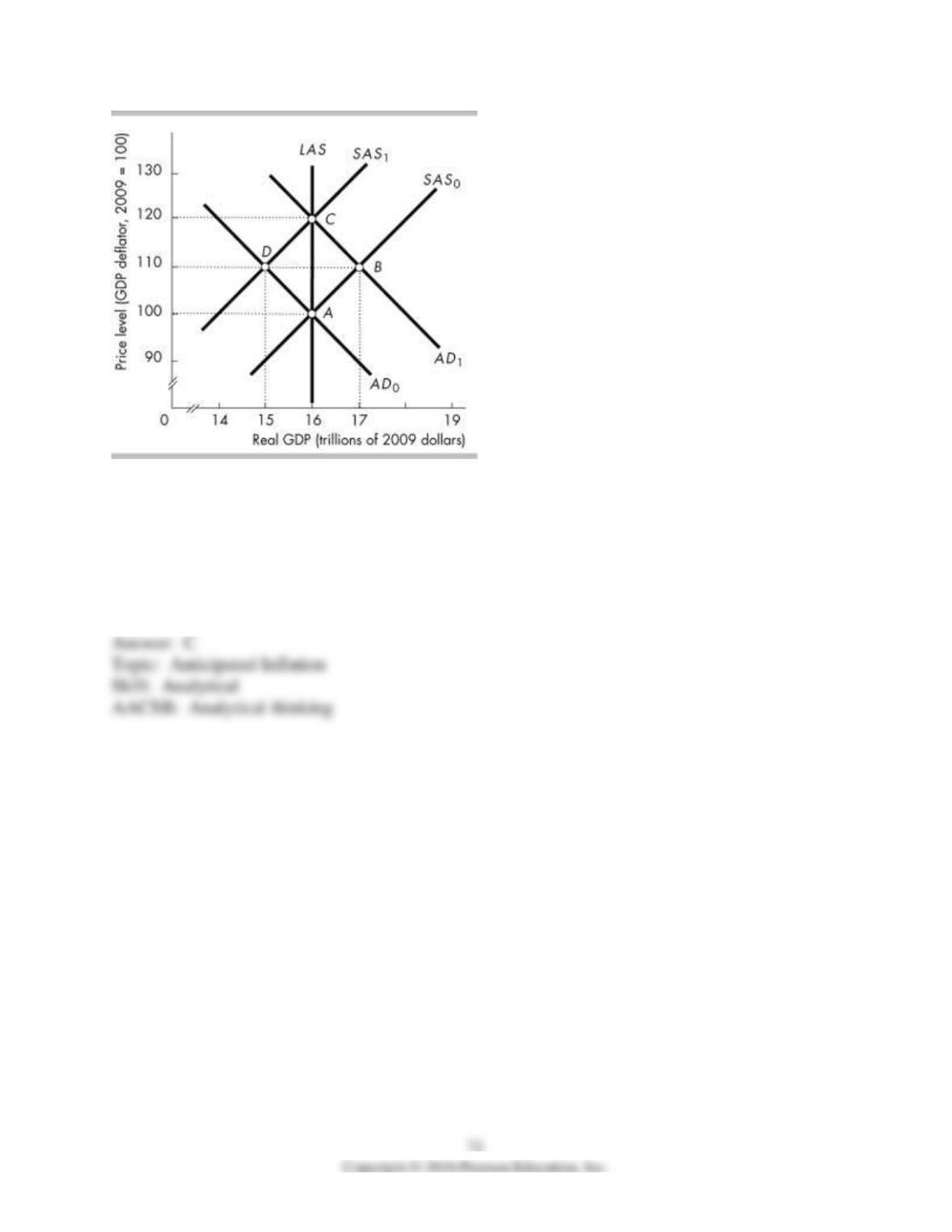
123) In the above figure, the economy is initially at point A. If workers and firms correctly
anticipate the increase in aggregate demand and the resulting inflation rate, the economy will
move to point
A) A, that is, the price level and level of real GDP will not change.
B) B.
C) C.
D) D.
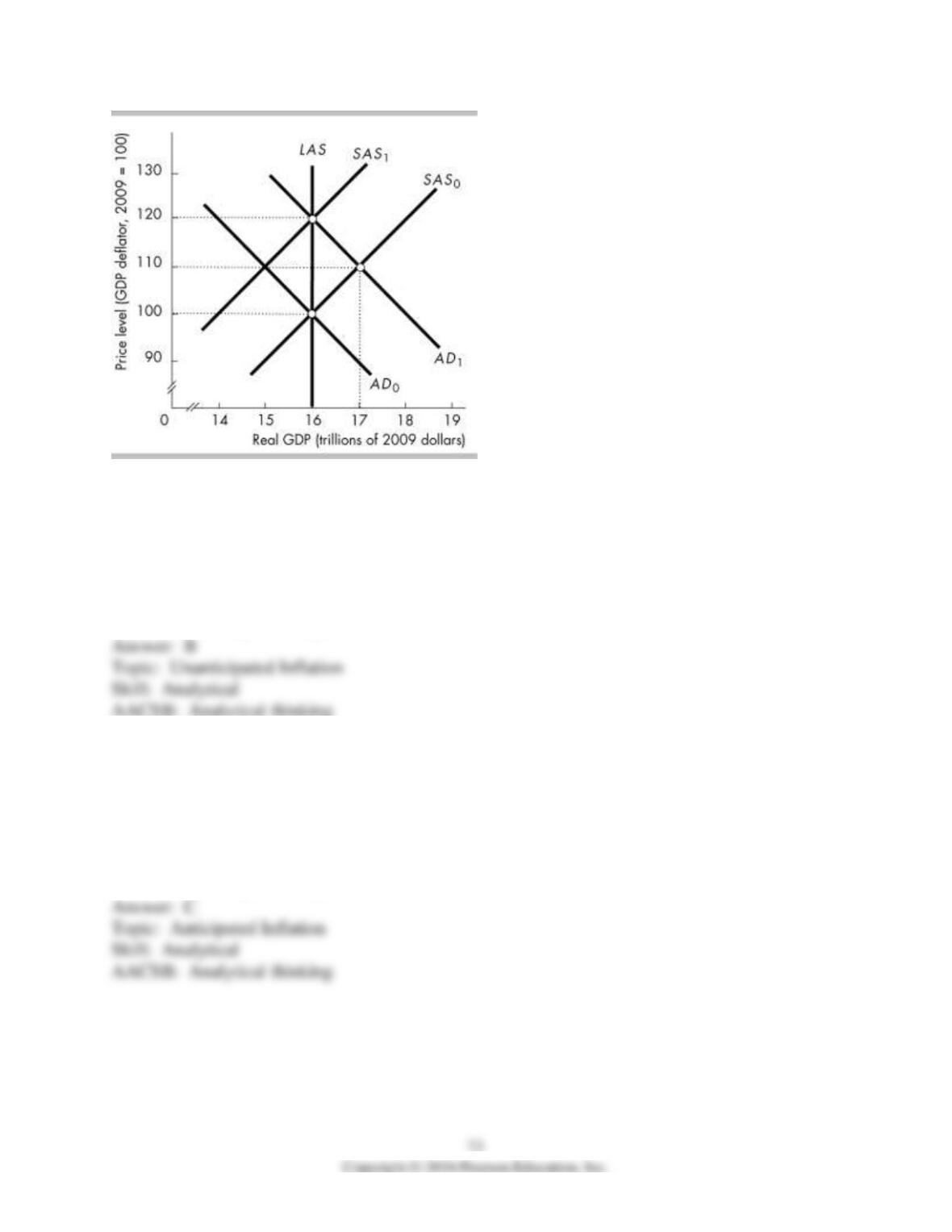
124) An economy is at potential GDP and the price level is 100 in the figure above. If aggregate
demand unexpectedly increases so that the aggregate demand curve shifts to AD1, the inflation
rate is ________.
A) 0 percent a year
B) 10 percent a year
C) 20 percent a year
D) More than 20 percent a year
125) An economy is in long-run equilibrium and the price level is 100 in the figure above.
Aggregate demand increases and the aggregate demand curve shifts to AD1. If the increase in
aggregate demand is expected, then the inflation rate is ________.
A) 0 percent a year
B) 10 percent a year
C) 20 percent a year
D) More than 20 percent a year
126) Suppose that the economy is at full employment and aggregate demand increases by more
than it is anticipated to increase. Other things remaining the same, ________.
A) long-run aggregate supply decreases
B) real GDP remains at potential GDP
C) real GDP increases above potential GDP
D) real GDP decreases below potential GDP
127) A rational expectation is
A) a forecast devoid of all emotions.
B) a forecast which perfectly foretells the future.
C) the best possible forecast based upon all relevant information.
D) the forecast that automatically carries over from past forecasts.
128) A rational expectation of inflation is
A) how economists make perfect forecasts of inflation.
B) how unexpected inflation affects the economy.
C) why unexpected inflation redistributes income.
D) a forecast of inflation that uses all relevant information.
129) A rational expectation is
A) a correct forecast but it might not be the best available forecast.
B) always an incorrect forecast.
C) not necessarily correct but is the best available forecast.
D) necessarily correct because it is the best available forecast.
130) If Samantha predicts future inflation based on rational expectations, then
A) her forecast of inflation will always be correct.
B) she uses all relevant information to forecast inflation.
C) she looks only to the past to help her predict future inflation.
D) she never under estimates inflation.
131) The Cleveland Federal Reserve Bank’s estimate of expected inflation in 2013 is 1.5 percent.
In 2013, if aggregate demand grows faster than expected, the actual inflation rate will
A) exceed 1.5 percent.
B) equal 1.5 percent because the actual inflation rate must equal the expected inflation rate.
C) be less than 1.5 percent.
D) None of the above answers are correct because there is no relationship between the actual
inflation rate and aggregate demand.
132) Which of the following would shift the aggregate demand curve leftward year after year?
A) a one-time tax cut
B) a one-time increase in government expenditures on goods and services
C) inflation
D) negative growth in the quantity of money
133) Which of the following results in the aggregate demand curve shifting rightward year after
year?
A) a one-time tax cut
B) a one-time increase in government expenditures on goods and services
C) inflation
D) growth in the quantity of money
134) Demand-pull inflation occurs when
A) aggregate demand increases persistently.
B) aggregate supply and aggregate demand decrease persistently.
C) the government increases its expenditures.
D) oil prices increase substantially.
135) In a demand-pull inflation, the AD curve shifts ________ and the SAS curve shifts
________.
A) rightward; rightward
B) rightward; leftward
C) leftward; rightward
D) leftward; leftward
136) A rise in the price level because of an increase in the money wage rate
A) definitely triggers a cost-push inflation.
B) definitely triggers a demand-pull inflation.
C) might trigger a cost-push inflation.
D) might trigger a demand-pull inflation.
137) A rise in the price level because of an increase in the price of oil
A) definitely triggers a cost-push inflation.
B) definitely triggers a demand-pull inflation.
C) might trigger a cost-push inflation.
D) might trigger a demand-pull inflation.
138) Which of the following statements about a cost-push inflation is CORRECT?
A) Cost-push inflation starts when an increase in aggregate demand “pushes” costs higher.
B) Cost-push inflation might start with a rise in the price of raw materials, but it requires
increases in the quantity of money to persist.
C) To persist, cost-push inflation needs a continual series of cost hikes with no change in
aggregate demand.
D) The United States has never experienced a cost-push inflation.
3 Deflation
1) During a deflation, the inflation rate is
A) negative.
B) positive and rising.
C) positive and falling.
D) positive and not changing.
2) During a deflation, the price level is
A) negative.
B) positive and rising.
C) positive and falling.
D) positive and not changing.
3) Deflation can start with
A) an increase in aggregate demand.
B) a decrease in aggregate demand.
C) a decrease in aggregate supply.
D) Both answers B and C are correct.
4) The price level falls if
A) aggregate demand increases more rapidly than aggregate supply.
B) aggregate demand increases more slowly than aggregate supply.
C) aggregate demand increases and aggregate supply does not change.
D) neither aggregate demand nor aggregate supply change.
5) Suppose velocity increases by 2 percent and potential GDP grows by 2 percent. The trend
inflation rate will equal zero if the quantity of money grows by
A) 0 percent.
B) 2 percent.
C) 4 percent.
D) -2 percent.
6) Suppose velocity increases by 2 percent and potential GDP grows by 4 percent. The trend
inflation rate will equal zero if the quantity of money grows by
A) 0 percent.
B) 2 percent.
C) 4 percent.
D) -2 percent.
7) Suppose velocity increases by 4 percent and potential GDP grows by 3 percent. The trend
inflation rate will equal zero if the quantity of money grows by
A) 0 percent.
B) 1 percent.
C) 4 percent.
D) 3 percent.
8) When Japan experienced deflation in the 1990s, Japan’s real GDP
A) grew more rapidly than during any decade since the 1960s.
B) grew more slowly than in decades during which Japan experienced inflation.
C) did not grow at all.
D) Both answers B and C are correct.
9) When Japan experienced deflation in the 1990s and 2000s, Japan’s
A) capital stock grew more rapidly that during the decades that Japan experienced inflation..
B) real wage rate fell.
C) investment decreased so that its capital stock grew more slowly.
D) money growth rate soared.
10) During an unanticipated deflation, the real wage rate ________ and employment ________.
A) falls; decreases
B) falls; increases
C) rises; decreases
D) rises; increases
11) During a deflation, investment ________ and the rate of capital accumulation ________.
A) decreases; decreases
B) decreases; increases
C) increases; decreases
D) increases; increases
12) During a deflation, investment ________ and the growth rate of potential GDP ________.
A) decreases; decreases
B) decreases; increases
C) increases; decreases
D) increases; increases
13) During a deflation, the nominal interest rate is ________ and the velocity of circulation
________.
A) low; decreases
B) low; increases
C) high; decreases
D) high; increases
14) To end a deflation, the government must
A) decrease government expenditures.
B) increase the quantity of money.
C) increase taxes.
D) increase the growth rate of the money stock.
4 The Phillips Curve
1) Phillips curves show the relationship between the
A) nominal interest rate and the real interest rate.
B) expected rate of inflation and the nominal interest rate.
C) real interest rate and the unemployment rate.
D) unemployment rate and the inflation rate.