b.
full information about the market among buyers and sellers
c.
product homogeneity
d.
freedom of entry into the market
c
Easy
DISC: Monopolistic competition
United States – BPROG: Analytic
Monopolistic competition
Monopolistic Competition
78. Identify the market structure characterized by many small firms selling somewhat different products.
a.
Monopoly
b.
Monopolistic competition
c.
Perfect competition
d.
Duopoly
Easy
DISC: Monopolistic competition
United States – BPROG: Analytic
Monopolistic competition
Monopolistic Competition
79. A monopolistically competitive firm
a.
tries to differentiate its product from competitors’ products.
b.
faces a perfectly elastic demand curve for its product.
c.
has more monopoly power in the long run than does a perfectly competitive firm.
d.
is always a retail establishment.
a
Easy
DISC: Monopolistic competition
United States – BPROG: Analytic
Monopolistic competition
Monopolistic Competition
80. To understand most of today’s economic activity in the U.S. economy, we should look at which of the following
models?
a.
perfect competition and pure monopoly
b.
perfect competition and oligopoly
c.
oligopoly and monopolistic competition
d.
monopolistic competition and monopoly
c
Easy
United States – BPROG: Analytic
Monopolistic Competition
81. Monopolistic competition is characterized by
a.
one firm selling several products.
b.
many firms selling the same product.
c.
many firms selling slightly different products.
d.
one firm selling one product.
c
Easy
DISC: Monopolistic competition
United States – BPROG: Analytic
Monopolistic competition
Monopolistic Competition
82. Monopolistic competition is common in
a.
retail selling.
b.
farming.
c.
basic manufacturing.
d.
electric power generation.
a
Easy
DISC: Monopolistic competition
United States – BPROG: Analytic
Monopolistic competition
Monopolistic Competition
83. Which of the following characteristics of perfect competition does not apply in monopolistic competition?
a.
free entry and exit
b.
homogeneous products
c.
numerous participants
d.
perfect information
Easy
DISC: Monopolistic competition
United States – BPROG: Analytic
Monopolistic competition
Monopolistic Competition
84. Which of the following conditions distinguishes monopolistic competition from perfect competition?
a.
number of sellers
b.
freedom of entry and exit
c.
perfect information
d.
homogeneity of the product
DISC: Monopolistic competition
United States – BPROG: Analytic
Monopolistic competition
Monopolistic Competition
85. The monopolistically competitive firm differs from monopoly in that its
a.
demand curve is flatter.
b.
demand curve slopes downward.
c.
MR curve lies below its demand curve.
d.
profit is maximized where MR = MC.
DISC: Monopolistic competition
United States – BPROG: Analytic
Monopolistic competition
Monopolistic Competition
86. Given the characteristics: (1) many buyers and sellers, (2) free entry and exit, (3) perfect information, and (4)
heterogeneity of products, monopolistic competition and perfect competition share
a.
(1) and (4).
b.
(1), (2), and (3).
c.
(2) and (4).
d.
(2), (3), and (4).
DISC: Monopolistic competition
United States – BPROG: Analytic
Monopolistic competition
Monopolistic Competition
87. Monopolistic competitors and perfect competitors are alike in
a.
having horizontal demand curves.
b.
zero economic profit in the short run.
c.
zero economic profit in the long run.
d.
relying on advertising to attract buyers to their products.
DISC: Monopolistic competition
United States – BPROG: Analytic
Monopolistic competition
Monopolistic Competition
88. There are generally, in most areas, a large number of qualified physicians whose services are highly personalized. In
addition to price, factors such as age, sex, location, and personality influence the choice of physician. Thus, the market is
best described as
a.
perfectly competitive.
b.
a differentiated oligopoly.
c.
a monopoly.
d.
monopolistically competitive.
DISC: Monopolistic competition
United States – BPROG: Analytic
Monopolistic competition
Monopolistic Competition
89. Monopolistic competition is different from perfect competition in that every manufacturer
a.
has a small monopoly, and differentiates the product.
b.
takes the product quality as given, and chooses price.
c.
takes output level as given, but must choose price.
d.
differentiates product, but cannot advertise successfully.
DISC: Monopolistic competition
United States – BPROG: Analytic
Monopolistic competition
Monopolistic Competition
90. Economic theory of market forms between pure monopoly and perfect competition was largely nonexistent until the
work of
a.
Joan Robinson and Edward Chamberlin.
b.
Adam Smith and David Ricardo.
c.
Alfred Marshall and Francis Edgeworth.
d.
Wassily Leontief and Joseph Schumpeter.
1
DISC: Monopolistic competition
United States – BPROG: Analytic
Monopolistic competition
Monopolistic Competition
91. An article in The Economist reported that prices of CDs in Britain was much higher than prices in the United States or
other European countries. There were only a few major companies, and a report from a Parliament committee said there
was no serious price competition. The best explanation for this is that
a.
the industry was a contestable market.
b.
there were entry barriers in production and distribution of CDs.
c.
firms were avoiding profit opportunities.
d.
there were substantial differentiation of product.
b
1
DISC: Monopolistic competition
United States – BPROG: Reflective Thinking – BPROG: Analysis
Monopolistic competition
Monopolistic Competition
92. In the long run the prices charged by a firm in monopolistic competition will be
a.
high enough to provide profits to the firm.
b.
so low that many firms will drop out of the industry.
c.
equal to marginal cost.
d.
equal to average cost, including the opportunity cost of capital.
d
1
DISC: Monopolistic competition
United States – BPROG: Analytic
Monopolistic competition
93. The demand curve for a monopolistic competitor slopes downward because
a.
demand drops to zero after a slight price increase.
b.
there are close but not perfect substitutes for the product.
c.
customers have no loyalty to the product.
d.
the product is undifferentiated.
Moderate
DISC: Monopolistic competition
United States – BPROG: Analytic
Monopolistic competition
Monopolistic Competition
94. The demand curve facing a monopolistically competitive firm is generally
a.
steeper than the demand curve that would face a perfectly competitive firm in the same industry.
b.
less elastic than the demand curve that would face a monopoly in the same industry.
c.
steeper and more elastic than the demand curve that would face a perfectly competitive firm in the same
industry.
d.
flatter than the demand curve that would face a monopoly in the same industry.
Moderate
DISC: Monopolistic competition
United States – BPROG: Analytic
Monopolistic competition
Monopolistic Competition
95. Unlike a perfectly competitive firm, a monopolistically competitive firm
a.
faces a perfectly inelastic demand curve.
b.
can earn positive economic profit in the short run and in the long run.
c.
cannot earn positive economic profit even in the short run.
d.
does not have the same marginal revenue at every output level.
Difficult
DISC: Monopolistic competition
United States – BPROG: Analytic
Monopolistic competition
Monopolistic Competition
96. Unlike a perfectly competitive firm, a monopolistically competitive firm
a.
faces a perfectly inelastic demand curve.
b.
can earn positive economic profit in the short run and in the long run.
c.
cannot earn positive economic profit even in the short run.
d.
has a negatively sloped demand curve.
DISC: Monopolistic competition
United States – BPROG: Analytic
Monopolistic competition
Monopolistic Competition
97. Everything else equal, the more rivals a firm has, the
a.
less kinked is its demand curve.
b.
closer is its equilibrium price to its average variable costs.
c.
more differentiated is its product from rivals’ products.
d.
more elastic is its demand curve.
DISC: Monopolistic competition
United States – BPROG: Analytic
Monopolistic competition
Monopolistic Competition
98. The key difference between monopolistic competition and perfect competition is that in monopolistic competition the
tangency of
a.
AC and the demand curve occurs along the negatively sloped part of AC.
b.
the demand curve and AC occurs at the minimum point of the AC curve.
c.
AC and the demand curve occurs along the positively sloped part of AC.
d.
MC and MR at the optimum output.
DISC: Monopolistic competition
United States – BPROG: Analytic
Monopolistic competition
Monopolistic Competition
Figure 12-1
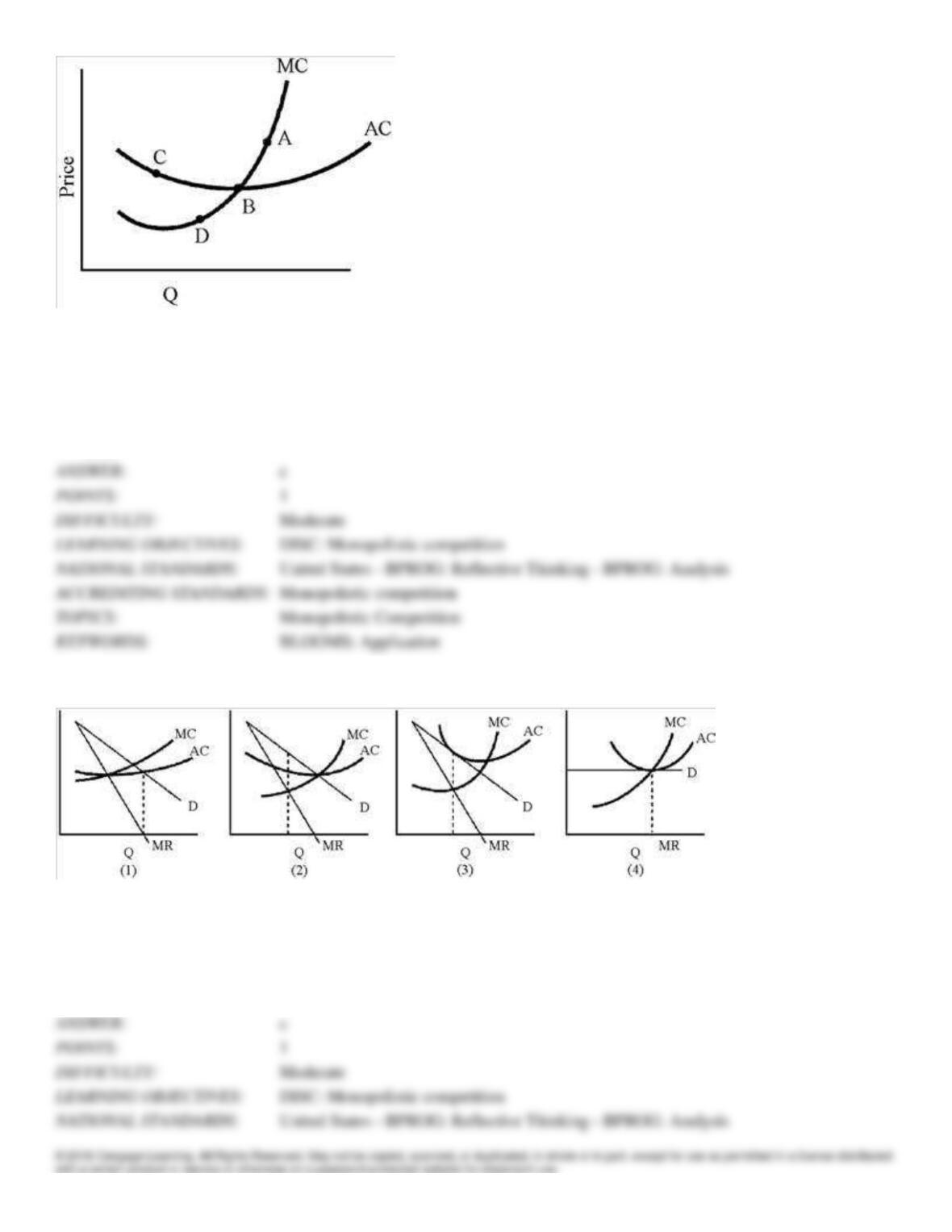
99. In Figure 12–1, for a monopolistically competitive firm, long-run equilibrium can occur only at the quantity indicated
by which point?
a.
A
b.
B
c.
C
d.
D
c
1
Moderate
Figure 12-2
100. In Figure 12–2, which of the graphs represents a monopolistic competitor in long-run equilibrium?
a.
1
b.
2
c.
3
d.
4
c
1
Moderate
Monopolistic competition
Monopolistic Competition
BLOOMS: Application
101. In Figure 12–2, which of the graphs represents a firm that is a sales revenue maximizer?
a.
1
b.
2
c.
3
d.
4
1
DISC: Monopolistic competition
United States – BPROG: Reflective Thinking – BPROG: Analysis
Monopolistic competition
Monopolistic Competition
BLOOMS: Application
102. The force that leads to zero economic profits for monopolistically competitive firms in the long run is
a.
excess capacity.
b.
price wars among firms.
c.
entry by new firms.
d.
excessive advertising.
1
DISC: Monopolistic competition
United States – BPROG: Analytic
Monopolistic competition
Monopolistic Competition
103. What is the long-run effect on the demand curve of a monopolistically competitive firm when more firms enter the
market?
a.
Demand curve shifts to left.
b.
Demand curve remains the same.
c.
Demand curve shifts to right.
d.
Demand curve become flatter.
1
DISC: Monopolistic competition
United States – BPROG: Analytic
Monopolistic competition
Monopolistic Competition
104. A firm in a monopolistically competitive market makes no economic profit in the long run because
a.
long-run marginal cost will be too high to make any economic profit.
b.
long-run price will be equal to long run marginal cost.
c.
long-run marginal cost will be equal to long run marginal revenue.
d.
long-run price will be equal to long run average cost.
DISC: Monopolistic competition
United States – BPROG: Analytic
Monopolistic competition
Monopolistic Competition
105. To maximize its profit, a monopolistically competitive firm produces at the output level at which
a.
its price elasticity of demand equals one.
b.
MR = MC.
c.
its D curve is tangent to its ATC curve.
d.
MR = AVC.
DISC: Monopolistic competition
United States – BPROG: Analytic
Monopolistic competition
Monopolistic Competition
106. A profit-maximizing, monopolistically competitive restaurant serves 60 burgers a day at a total cost of $180 and
earns a total profit of $180. In the long run, everything else equal, the
a.
restaurant will charge more than $6 per burger.
b.
restaurant’s average total cost will rise and its total revenue will fall.
c.
restaurant will sell more burgers at a lower average profit per burger.
d.
All of the above are correct.
DISC: Monopolistic competition
United States – BPROG: Analytic
Monopolistic competition
Monopolistic Competition
107. A monopolistically competitive firm in the long run will
a.
have a demand curve tangent to its AC.
b.
have a demand curve below its AC.
c.
have a demand curve above its AC.
d.
operate where excessive profit can be achieved.
DISC: Monopolistic competition
United States – BPROG: Analytic
Monopolistic competition
Monopolistic Competition
108. The monopolistically competitive firm in short-run equilibrium
a.
faces a downward-sloping demand curve.
b.
has a marginal revenue curve which lies below its demand curve.
c.
maximizes profit where MR = MC.
d.
All of the above are correct.
DISC: Monopolistic competition
United States – BPROG: Analytic
Monopolistic competition
Monopolistic Competition
109. Long-run equilibrium under monopolistic competition requires that
a.
the demand curve intersect the average cost curve.
b.
the demand curve be tangent to the average cost curve.
c.
price be equal to marginal cost.
d.
quantity produced be at the point where average cost is at a minimum.
DISC: Monopolistic competition
United States – BPROG: Analytic
Monopolistic competition
Monopolistic Competition
110. The excess capacity theorem implies that
a.
consumers would be better off if some monopolistically competitive firms left their markets.
b.
consumers would be better off with more standardization of products.
c.
monopolistic competition benefits society by eliminating excess capacity in production.
d.
monopolistic competition wastes some of society’s resources but the elimination of this waste does not
necessarily benefit consumers.
DISC: Monopolistic competition
United States – BPROG: Analytic
Monopolistic competition
Monopolistic Competition
111. The excess capacity theorem states that
a.
society is worse off with fewer monopolistic competitors.
b.
costs of production under monopolistic competition can be lowered by reducing the number of producers.
c.
lack of excess capacity leads to shortages during periods of unexpected growth in demand for goods produced
by monopolistic competition.
d.
there is too much choice in our economy.
DISC: Monopolistic competition
United States – BPROG: Analytic
Monopolistic competition
Monopolistic Competition
112. According to the excess capacity theorem, if every firm under monopolistic competition expanded its output,
a.
cost per unit of output would rise.
b.
social benefits would increase.
c.
cost per unit of output would decrease.
d.
MC and AC would remain unchanged.
DISC: Monopolistic competition
United States – BPROG: Analytic
Monopolistic competition
Monopolistic Competition
113. Monopolistic competition in long-run equilibrium is characterized by
a.
excess capacity.
b.
higher cost per unit of output than under perfect competition.
c.
inefficiency in use of resources.
d.
All of the above are correct.
DISC: Monopolistic competition
United States – BPROG: Analytic
Monopolistic competition
Monopolistic Competition
114. An oligopoly is a market
a.
with few buyers.
b.
with one buyer.
c.
dominated by a few sellers.
d.
under the control of a few politically powerful individuals.
DISC: Oligopoly
United States – BPROG: Analytic
115. All of the following are possible characteristics of oligopoly except
a.
free entry into the industry.
b.
significant economies of scale.
c.
interdependence among sellers.
d.
homogeneous product.
DISC: Oligopoly
United States – BPROG: Analytic
116. Oligopoly occurs when
a.
a few firms sell many different products.
b.
a few firms sell to a few large buyers.
c.
many firms dominate a single market.
d.
a few firms dominate a single market.
DISC: Oligopoly
United States – BPROG: Analytic
117. In oligopoly, one expects
a.
frequent introduction of new or redesigned products.
b.
aggressive advertising campaigns.
c.
intense marketing research into the impact of price changes.
d.
All of the above are correct.
Moderate
DISC: Oligopoly
United States – BPROG: Analytic
Oligopoly
Oligopoly
118. Oligopolists
a.
are price takers.
b.
rarely advertise.
c.
must take rivals’ reactions into account.
d.
offer homogeneous products.
c
Easy
DISC: Oligopoly
United States – BPROG: Analytic
Oligopoly
Oligopoly
119. The market structure that is associated with big business in developed economies is
a.
perfect competition.
b.
monopolistic competition.
c.
monopoly.
d.
oligopoly.
Moderate
DISC: Oligopoly
United States – BPROG: Analytic
Oligopoly
Oligopoly
120. Heavy advertising expenditures usually indicate
a.
oligopoly.
b.
pure competition or monopolistic competition.
c.
oligopoly or monopoly.
d.
differentiated pure competition or monopoly.
a
Moderate
DISC: Oligopoly
United States – BPROG: Analytic
Oligopoly
Oligopoly
121. Which market is most likely to witness such actions and reactions as frequent new-product introductions, free
samples, and aggressive advertising campaigns?
a.
Oligopoly
b.
Perfect competition
c.
Monopoly
d.
Monopolistic competition
a
Moderate
DISC: Oligopoly
United States – BPROG: Analytic
Oligopoly
Oligopoly
122. One indication that an industry might be oligopolistic is that prices change
a.
infrequently.
b.
frequently.
c.
in rhythmic patterns.
d.
on a regular, periodic basis.
a
Moderate
DISC: Oligopoly
United States – BPROG: Analytic
Oligopoly
Oligopoly
123. If in a given market of more than one producer, there were to exist for a long interval of time a positive gap between
price and average cost (P > AC), this would suggest that
a.
there are many sellers in the industry.
b.
there exists an oligopoly or cartel in the industry.
c.
this is a contestable market.
d.
the firm cannot be a monopolistic competitor.
Moderate
DISC: Oligopoly
United States – BPROG: Analytic
Oligopoly
Oligopoly
124. The analysis of oligopolistic behavior is difficult because
a.
there are few real-world examples of oligopolies for economists to study.
b.
oligopolists make decisions independently of each other.
c.
firms in oligopolistic industries react to each other’s behavior in many ways.
d.
economists have paid little attention to the topic in recent years and so have not yet applied to it the techniques
of modern economic theory.
c
Moderate
DISC: Oligopoly
United States – BPROG: Analytic
Oligopoly
Oligopoly
125. The difficulty in analyzing oligopolistic behavior arises from the
a.
degree of government regulation of the market structure.
b.
interdependent nature of oligopolistic decisions.
c.
large number of firms in the industry.
d.
market power of consumers.
Moderate
DISC: Oligopoly
United States – BPROG: Analytic
Oligopoly
Oligopoly
126. If a firm decides to ignore the reactions of its rivals to its policies, the appropriate model to analyze its behavior is
a.
game theory.
b.
perfect competition.
c.
monopoly.
d.
cartels.
c
DISC: Oligopoly
United States – BPROG: Analytic
127. Probably the simplest approach to the problem of oligopolistic interdependence is to
a.
conduct market experiments.
b.
assume that rivals will pursue a course most detrimental to the firm concerned.
c.
ignore the actions of rivals.
d.
increase the firm’s advertising outlay considerably.
DISC: Oligopoly
United States – BPROG: Analytic
128. If an oligopolist cuts the prices of its products,
a.
customers will switch to a rival firm.
b.
customers will remain unchanged in number.
c.
customers will switch from rival firms to buy from them.
d.
rival firms will not react.
DISC: Oligopoly
United States – BPROG: Analytic
129. A common characteristic in oligopolistic markets is
a.
consideration of rivals’ reactions.
b.
standardized products.
c.
high profits.
d.
unused capacity.
DISC: Oligopoly
United States – BPROG: Analytic
Oligopoly
130. An advertising race among oligopolists may be rational if it
a.
is defense advertising.
b.
raises entry barriers.
c.
increases cost per unit of sales.
d.
encourages new entrants.
Moderate
DISC: Oligopoly
United States – BPROG: Analytic
Oligopoly
Oligopoly
131. Where interdependence is especially pronounced, competition among oligopolists will
a.
resemble military tactics and strategies.
b.
disappear.
c.
lead to large increases in product output.
d.
entice more firms to enter the market.
a
Moderate
DISC: Oligopoly
United States – BPROG: Analytic
Oligopoly
Oligopoly
132. A cartel is
a.
a group of oligopolists who try to behave like a single monopolist and split the benefits among themselves.
b.
a government-approved organization for the exchange of technical information among firms.
c.
a form of competition among oligopolists.
d.
a regulated industry that is officially permitted to set the price of its product above long-run average total cost.
a
Moderate
DISC: Oligopoly
United States – BPROG: Analytic
Oligopoly
Oligopoly
133. A cartel is
a.
a group of firms promoting competition.
b.
most common in monopolistic competition.
c.
a collusive group of firms.
d.
no longer possible in our global economy.
c
Easy
DISC: Oligopoly
United States – BPROG: Analytic
Oligopoly
Oligopoly
134. The Organization of Petroleum Exporting Countries (OPEC) is an example of
a.
a price leadership system.
b.
a generally unsuccessful cartel.
c.
an organization devoted to tacit collusion.
d.
a successful cartel.
Easy
DISC: Oligopoly
United States – BPROG: Analytic
Oligopoly
135. The Organization of Petroleum Exporting Countries is a
a.
professional trade association for oil companies.
b.
cartel.
c.
consortium for joint ventures in oil exploration.
d.
loose collection of democracies that promote international pipelines.
Moderate
DISC: Oligopoly
United States – BPROG: Analytic
Oligopoly
Oligopoly
136. Cartels are relatively rare because
a.
they are illegal in some countries, including the United States.
b.
members find it difficult to agree on key decisions.
c.
members frequently have an incentive to cheat on the cartel.
d.
All of the above are correct.
DISC: Oligopoly
United States – BPROG: Analytic
137. Which of the following attitudes will be held by a typical firm in a typical cartel?
a.
If I alone cheat, I’m better off; if everyone cheats, I’m worse off.
b.
I can never do better for myself than by following agreed-upon cartel policies.
c.
If everyone cheats, I’m better off and so is everyone else in the cartel.
d.
If I suspect others are planning to cheat, I’ll do best for myself by deciding not to cheat.
DISC: Oligopoly
United States – BPROG: Analytic
138. In an economist’s view, a cartel usually offers to society
a.
all the cost benefits of large-scale production and none of the allocative inefficiencies of monopoly.
b.
all the cost benefits of large-scale production and all of the allocative inefficiencies of monopoly.
c.
none of the cost benefits of large-scale production and none of the allocative inefficiencies of monopoly.
d.
none of the cost benefits of large-scale production and all of the allocative inefficiencies of monopoly.
DISC: Oligopoly
United States – BPROG: Analytic
139. When oligopolists join together in a cartel, they
a.
have chosen to ignore interdependence.
b.
have admitted that their behavior is interdependent.
c.
are planning to violate the law of supply and demand.
d.
are trying to behave like perfect competitors.
DISC: Oligopoly