16
9) By the time Paul Volcker took office as the new Federal Reserve chairman in 1979, both the
inflation and unemployment rates were higher than during most of the 1950s, 60s and early 70s.
The Federal Reserve implemented an autonomous tightening of monetary policy that resulted in
the famous Volker Disinflation which was successful in bringing both problems under control.
What would have been a likely long-run result had Mr. Volker conducted an expansionary
monetary policy instead?
A) Eventually, inflation would have been made worse and unemployment would not have been
fixed.
B) Eventually, both the inflation and unemployment rates would have declined.
C) Eventually, inflation would have been fixed and unemployment would have been made
worse.
D) There would have been no effect on the unemployment and inflation rates.
E) none of the above
10) The March 2000 “tech bubble” burst caused the aggregate demand curve to shift to the left
by ________.
A) causing an upward spike in the real interest rate
B) reducing autonomous spending by households and businesses
C) reducing government spending on high-tech equipment
D) all of the above
E) none of the above
11) A likely result of the September 11, 2001 terrorist attacks was ________.
A) weaker consumer confidence
B) lower business confidence
C) a leftward shift of the AD curve
D) all of the above
E) none of the above
17
12) What was(were) the effect(s) of the Enron Bankruptcy in late 2001 and other corporate
scandals in 2002?
A) An ensuing lack of confidence in financial accounting.
B) The value of corporate bonds declined.
C) It became more expensive for firms to finance their investments.
D) all of the above
E) none of the above
13) The “tech bubble” burst of 2000, the terrorist attacks of 2001 and the corporate scandals of
2001 and 2002 all had similar qualitative effects on the economy. Which of the following is an
appropriate description of the mechanism that would have ensued?
A) Household and business spending would have been eroded shifting the AD curve to the left.
B) Unemployment would have risen and inflation would have fallen.
C) Output would have declined below potential but through shifts in the AS curve, the self-
correcting mechanism of the AD-AS framework would have brought the unemployment rate
down to the lower levels we saw by 2004.
D) all of the above
E) none of the above
14) What is the main difference between a demand shock stemming from monetary policy and a
demand shock that comes from a change in spending?
A) In the short-run, an autonomous monetary policy easing lowers real interest rates and raises
aggregate output whereas a positive spending shock has the opposite effect on both variables.
B) An autonomous monetary policy easing raises inflation permanently whereas a positive
spending shock only raises inflation temporarily.
C) An autonomous monetary policy easing has a temporary effect on the real interest rate
whereas a positive spending shock has a permanent effect on the real interest rate.
D) all of the above
E) none of the above
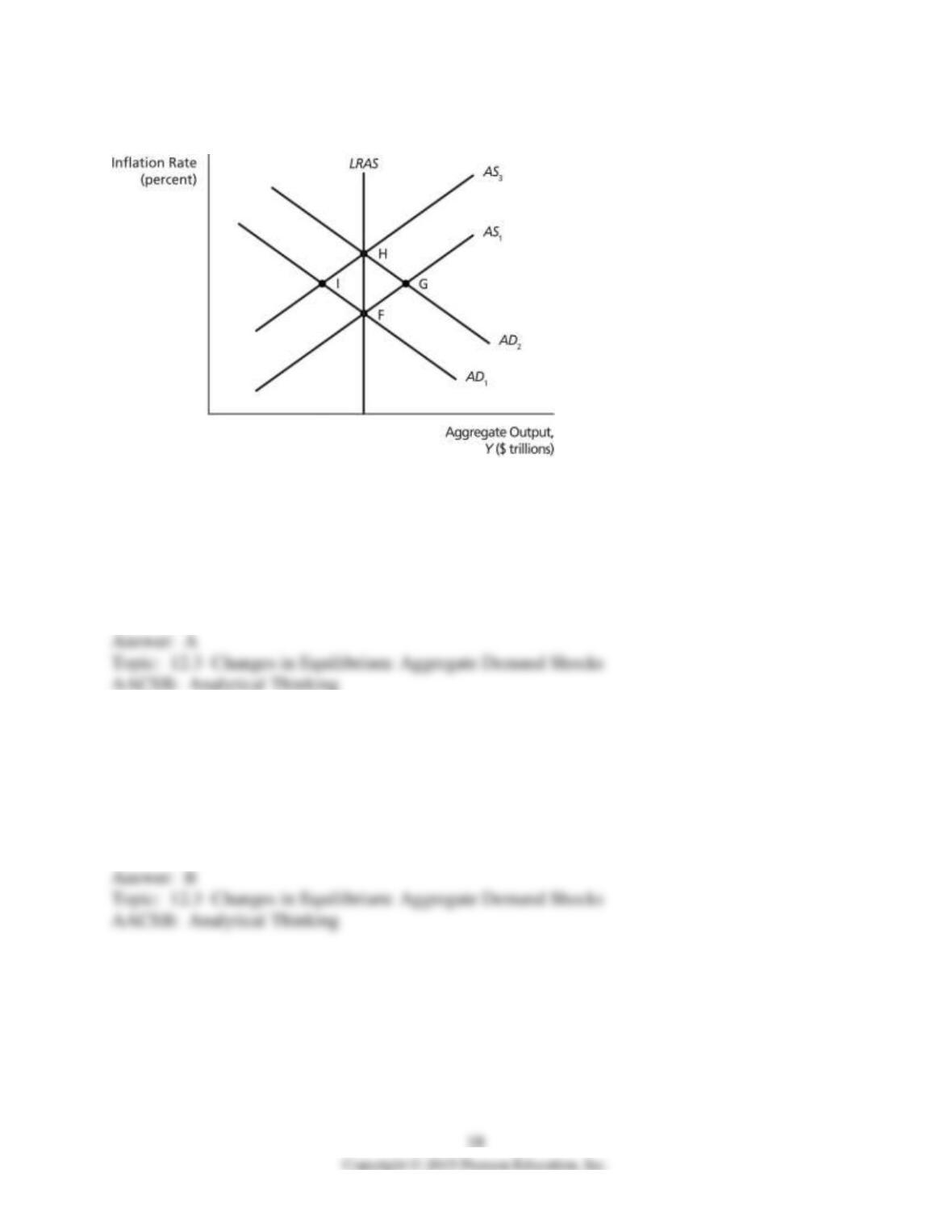
AD – AS Shocks
15) On the graph above, an example of a positive demand shock is the movement from point
________ to point ________.
A) F; G
B) H; I
C) F; H
D) H; F
E) none of the above
16) On the graph above, an example of a negative demand shock is the movement from point
________ to point ________.
A) F; G
B) H; I
C) F; H
D) H; F
E) none of the above
19
17) On the graph above, movement from point ________ to point ________ might occur if there
is a negative demand shock, followed by updating of expected inflation.
A) F; G
B) H; I
C) H; F
D) F; H
E) none of the above
18) On the graph above, suppose point G is on the short-run aggregate supply curve π = 2.5 + 2 ×
(Y – 22) and aggregate demand curve Y = 29.25 – 0.5π. If output at point G is 25, and inflation
expectations are adaptive, then the inflation rate next period will be ________.
A) 11.5
B) 14.5
C) 8.5
D) 2.5
E) none of the above
19) Consider an economy in a long-run equilibrium with Y = 40 and π = 3. A demand shock in
period one causes output to rise to 45 and inflation rises to 4. Then, the updating of expected
inflation to equal 4 causes output in period two to decline to 43.85, and inflation to rise to 4.77.
Assuming no further shocks, calculate the values of output and inflation for period three.
20
20) According to the economy’s self-correcting mechanism, how does the economy return to
potential output following a negative demand shock? How is the recovery process different, if
the government implements a policy of economic stimulus?
21) Suppose that households and businesses increase autonomous expenditures, driving output
well above potential. Describe, in detail, how monetary policy might react to minimize the
increase in inflation.
12.4 Changes in Equilibirum: Aggregate Supply (Price) Shocks
1) When a temporary shock in the economy involves a restriction in supply ________.
A) we refer to it as a negative supply shock
B) a rise in commodity prices typically follows
C) a reduction in output typically ensues
D) all of the above
E) none of the above
2) A fall in import prices or an increase in productivity ________.
A) constitute a positive supply shock
B) typically leads to a rise in commodity prices
C) typically comes with a reduction in output
D) all of the above
E) none of the above
3) Suppose there is a temporary supply shock because of a war in the Middle East, then
________.
A) this would constitute a cost push shock due to a restriction in the supply of oil
B) the AS curve would shift to the left
C) this could theoretically lead to stagflation
D) all of the above
E) none of the above
4) Suppose there is a temporary supply shock because of a war in the Middle East, then, ceteris
paribus, the ensuing cost push shock ________.
A) would lead to a temporary increase in prices but a permanent reduction in output
B) would lead to a temporary increase in output but a permanent increase in inflation
C) would lead to a temporary decrease in output but a permanent increase in inflation
D) all of the above
E) none of the above
5) Suppose there is a temporary supply shock because of a war in the Middle East, then, ceteris
paribus, the ensuing cost push shock ________.
A) would lead to a temporary increase in prices due to a restriction in the supply of oil
B) would lead to a temporary decrease in output as the AS curve would shift to the left
C) would lead to a temporary shift in the AS curve but ultimately output and inflation would
return to the original long-run values
D) all of the above
E) none of the above
6) In 1973, the Organization of Petroleum Exporting Countries (OPEC) engineered a
quadrupling of oil prices by restricting oil production. Which of the following is an appropriate
description of this negative supply shock?
A) The AS curve likely shifted to the left and output likely fell because of this adverse shock.
B) In the short-run there was a movement out of general equilibrium leading to an increase in
inflation as a likely result of this adverse shock.
C) In the short-run there was a movement out of general equilibrium leading to an increase in
unemployment as a likely result of this adverse shock.
D) all of the above
E) none of the above
7) Which of the following is (are) linked to (an) adverse supply shock(s)?
A) the terrorist attacks of 2001
B) collective bargaining that followed the termination of U.S. wage and price controls in 1973
C) the corporate scandals of 2002
D) all of the above
E) none of the above
8) Which of the following is (are) linked to (an) adverse supply shock(s)?
A) the Arab-Israeli war of 1973
B) the Iranian revolution of 1979
C) the wage renegotiations that followed the termination of U.S. wage and price controls in 1973
D) all of the above
E) none of the above
23
9) If a new government adopted some ill-advised regulations causing the economy to be less
efficient ________.
A) the ensuing negative supply shock would lead to an immediate rise in inflation
B) in the short-run this would create a negative output gap but eventually the previous general
equilibrium would be restored by subsequent rightward shifts of the AS curve
C) there would be no permanent changes in output and inflation
D) all of the above
E) none of the above
10) If the adoption of a new technology led to gains in productivity ________.
A) the ensuing positive supply shock would lead to an immediate increase in output
B) in the short-run, the ensuing increase in supply would lower inflation
C) and if this new technology permanently altered the productive capacity of the economy then
the increase in output and decrease in inflation would be permanent as well
D) all of the above
E) none of the above
11) In the mid-to-late 1990s, changes in the health care industry, substantially reduced health
care costs relative to other goods and services. Which of the following is an appropriate
description of the mechanism behind this supply shock?
A) The AS curve likely shifted to the right which likely explains the short-run fall in
unemployment.
B) The ensuing increase in productive capacity led to the rightward shift of the LRAS which is a
likely explanation for the protracted decline in the unemployment rate of the 1990s.
C) A positive output gap would have resulted in the short-run but it was eventually closed by a
rightward shift of the LRAS which is a likely explanation for the protracted decline in the
inflation rate of the 1990s.
D) all of the above
E) none of the above
24
12) In the 1960s and 1970s, research funding by the U.S. government and some universities led
to revolutionary advances in network computing. These advances in communication and network
technology remained largely isolated to governmental and academic use. By the mid-to-late
1990s, the Internet began to be widely adopted with massive increases in productivity (which
journalists dubbed the “new economy”). Which of the following is an appropriate description of
the mechanism behind this supply shock?
A) Since this “new economy” was a new paradigm, the transition from a pre-internet to an
internet economy was initially costly. Thus, the AS curve likely shifted to the left and
unemployment likely increased in the short-run.
B) The ensuing increase in productive capacity led to the rightward shift of the LRAS which is a
likely explanation for the protracted decline in the unemployment rate of the 1990s.
C) A negative output gap would have resulted in the short-run, but it was eventually closed by a
rightward shift of the LRAS which is a likely explanation for the protracted decline in the
inflation rate of the 1990s.
D) all of the above
E) none of the above
13) What is the main difference between a temporary and permanently negative supply shock?
A) The real interest rate immediately decreases after a temporary shock while it eventually
increases after a permanent shock.
B) Output increases right away after a temporary shock but the impact does not last whereas for
a permanent shock output permanently decreases.
C) A temporary shock will see a permanent increase in inflation while inflation will only rise
temporarily after a permanent shock.
D) all of the above
E) none of the above
25
AD – AS Shocks
14) On the graph above, a movement from point ________ to point ________ might represent a
positive supply shock.
A) F; I
B) H; G
C) H; F
D) F; G
E) none of the above
15) On the graph above, a movement from point ________ to point ________ might represent a
negative supply shock.
A) H; G
B) H; F
C) F; I
D) F; G
E) none of the above
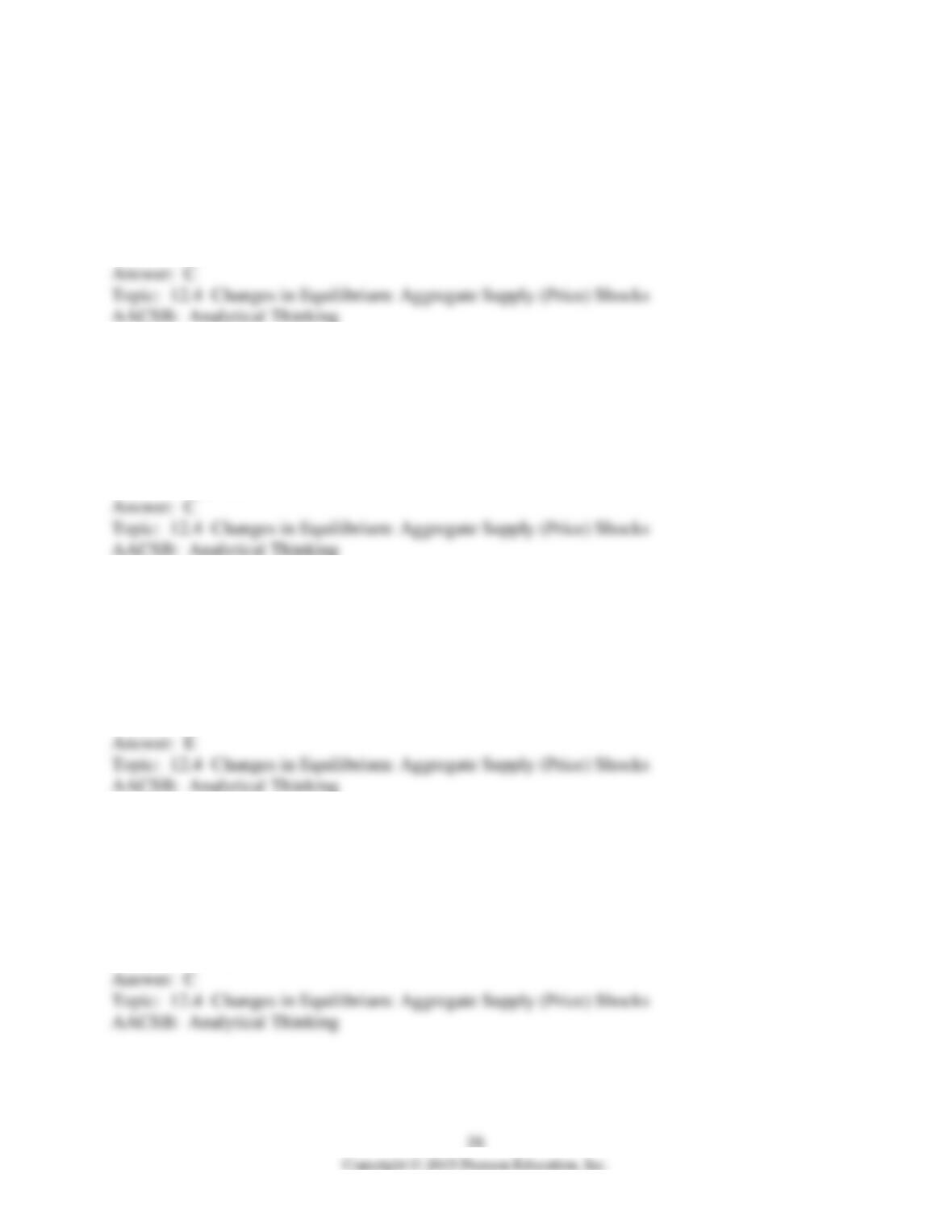
16) On the graph above, suppose the economy is at point F when there is a temporary negative
supply shock. The new long-run equilibrium is at point ________.
A) H
B) I
C) F
D) G
E) none of the above
17) On the graph above, suppose the economy is at point F when there is a temporary positive
supply shock. The new long-run equilibrium is at point ________.
A) H
B) I
C) F
D) G
E) none of the above
18) On the graph above, suppose the economy is at point F when there is a permanent positive
supply shock. The new long-run equilibrium is at point ________.
A) F
B) H
C) I
D) G
E) none of the above
19) On the graph above, suppose the economy has moved from point H to point G. If the shock
was temporary and inflation expectations are adaptive, the economy will next ________.
A) return to point H
B) move to point F
C) move to a point between points G and H
D) remain at point G
E) none of the above
20) The price of a barrel of oil doubled between 2007 and the middle of 2008. To make matters
worse, a financial crisis hit the U.S. economy starting in August of 2007. Which of the following
is an appropriate description of the mechanism that would have ensued?
A) The increase in the price of oil would have immediately shifted the AS curve to the right.
B) The financial crisis would have led to a sharp contraction in spending shifting the AD curve
to the right.
C) Shifts in both the AD and the AS curve would have ensued in the short-run but as long as
neither shock had an impact on potential output, ultimately unemployment will have been
unaffected in the long run.
D) all of the above
E) none of the above
21) Describe how changes in expected inflation impact an economy in the wake of a temporary
negative supply shock.
22) The Volcker Disinflation (1980-1986) was costly in terms of output and unemployment.
Would it not have been better to reduce inflation with a positive supply shock, rather than a
negative demand shock?
12.5 AD/AS Analysis of Foreign Business Cycle Episodes
1) The price of a barrel of oil doubled between 2007 and the middle of 2008. To make matters
worse, a financial crisis hit the U.S. economy starting in August of 2007. Which of the following
is true of the United Kingdom’s experience?
A) The increase in the price of oil immediately shifted the AS curve to the left.
B) The financial crisis did not take hold right away so the AD curve did not immediately shift.
C) Eventually, the Lehman Brothers bankruptcy caused a negative demand shock leading to a
further fall in output and an increase in the unemployment rate.
D) all of the above
E) none of the above
2) The price of a barrel of oil doubled between 2007 and the middle of 2008. To make matters
worse, a financial crisis hit the U.S. economy starting in August of 2007. Which of the following
is true of the Chinese experience?
A) The worldwide decline in demand led to a collapse of Chinese exports.
B) Instead of relying solely on the economy’s self-correcting mechanism, much more aggressive
fiscal expansions than those of the U.S. (in addition to a substantial monetary easing) served to
shift the AD curve back to general equilibrium relatively quickly.
C) The Chinese economy was better able than the U.S. economy to weather the financial crisis
with output growth starting to grow earlier and more quickly than that of the U.S.
D) all of the above
E) none of the above
3) Unlike either the United States or the United Kingdom, ________ did not occur in China’s
economy between 2007 and 2009.
A) a massive monetary and fiscal stimulus
B) a negative demand shock
C) a negative rate of inflation (i.e., deflation)
D) a sharp increase in financial frictions
E) a positive supply shock
29
4) Between 2007 and 2009, which of the following occurred in the United States, but not in the
United Kingdom?
A) an increase in unemployment
B) a negative demand shock
C) a negative rate of inflation (i.e., deflation)
D) a sharp increase in financial frictions
E) a negative supply shock
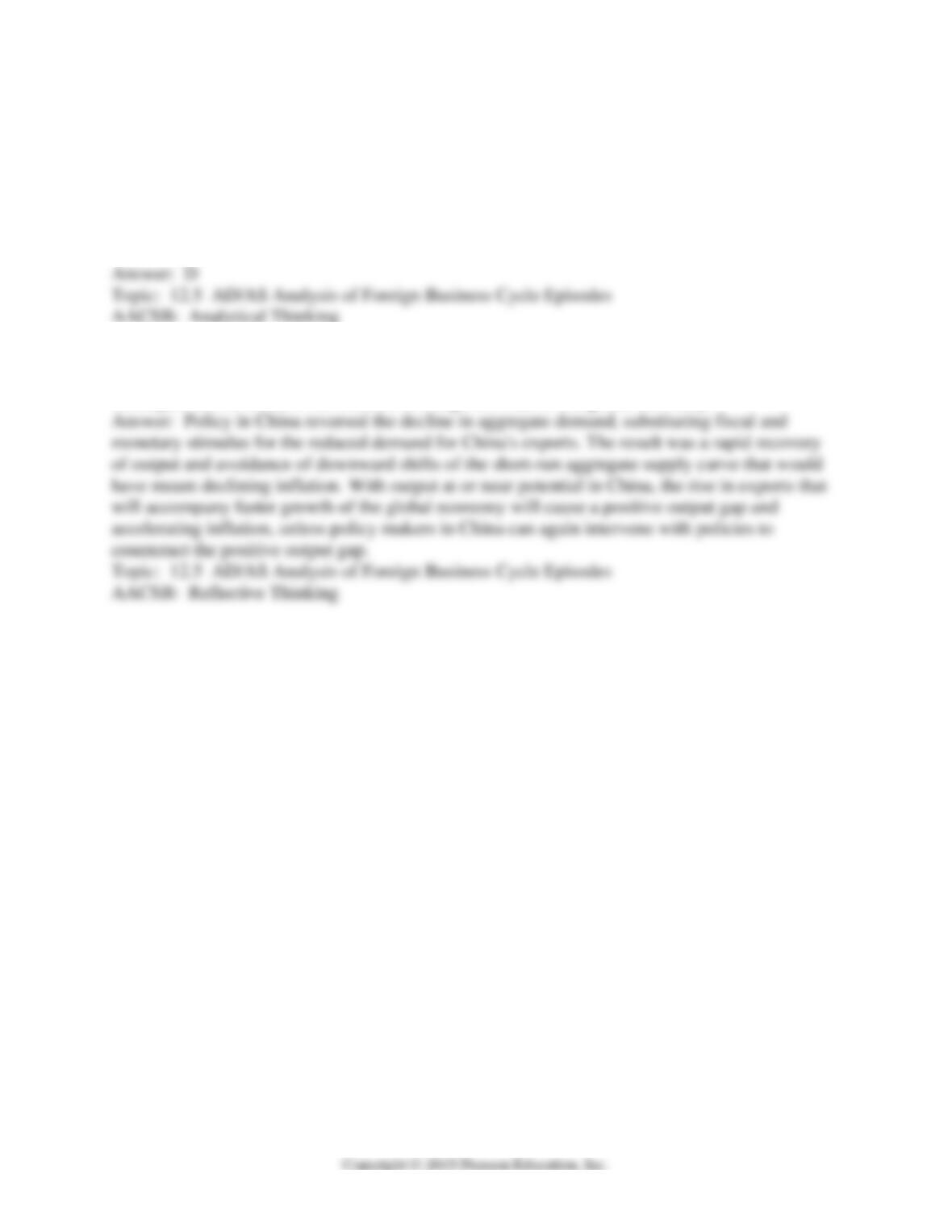
AD – AS Shocks
5) On the graph above (and considering the short run only), a combination of a negative demand
shock and a negative supply shock may be represented by the movement from point ________ to
point ________.
A) G; I
B) H; F
C) H; I
D) G; F
E) G; H
30
6) In the long run, following a combination of a negative demand shock and a temporary
negative supply shock, ________.
A) both inflation and output return to the original long-run equilibrium values
B) inflation is permanently increased, while output returns to potential output
C) output returns to potential output, while inflation may be higher or lower than its initial value
D) inflation is permanently reduced, while output returns to potential output
E) none of the above
7) As of 2009, China’s economy had recovered from the global recession that began in 2008. Use
aggregate demand and aggregate supply analysis to explain why, and to explain the likely
consequences for China of an increase in the growth rate of the global economy.