217) The relationship between planned consumption and real disposable income is referred to as
A) the wealth function.
B) the saving function.
C) the multiplier.
D) the consumption function.
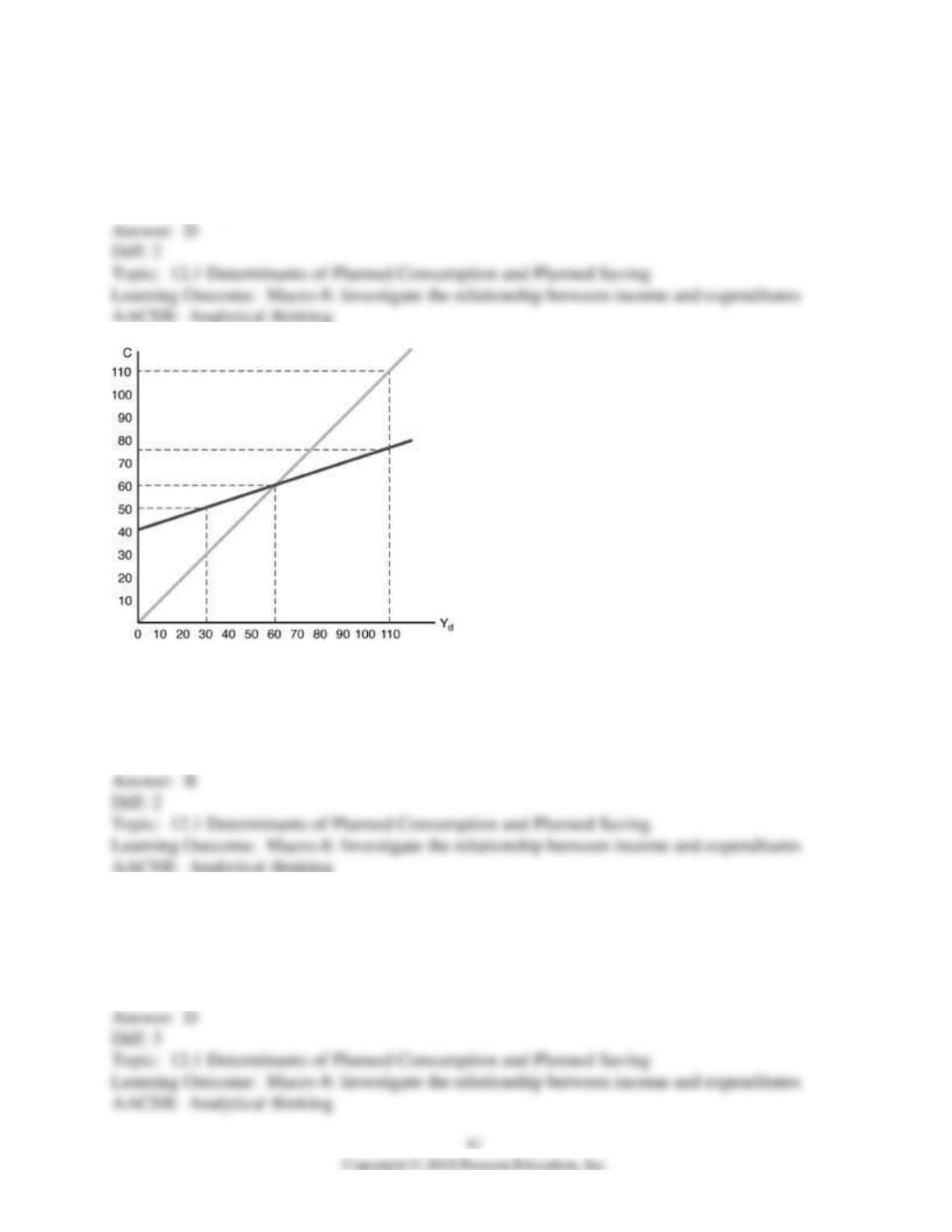
218) Consider the above figure. Autonomous consumption, in this scenario, is equal to
A) $30.
B) $40.
C) $60.
D) $80.
219) Consider the above figure. At an income of $60 we would expect saving to be equal to
A) $60.
B) $40.
C) $10.
D) $0.

220) Consider the above figure. At income level Yd = $30, the APC is equal to
A) 1.25.
B) 1.67.
C) 1.05.
D) 0.05.
221) Consider the above figure. At income level Yd = $110, the APS is equal to
A) 0.64.
B) 0.32
C) 1.10.
D) -0.36.
222) Consider the above figure. The equation for the consumption function is
A) C = 40 + 60Yd.
B) C = 40 + 50Yd.
C) C = 40 + 0.33Yd.
D) C = 40 + 0.1Yd.
223) Consider the above figure. The equation for the saving function is
A) S = 40 – 0.67Yd.
B) S = 40 + 0.33Yd.
C) S = -40 + 0.67Yd.
D) S = -40 – 0.33Yd.

224) The consumption function is the relationship between
A) real consumption spending and real taxes.
B) real consumption spending and investment spending.
C) real consumption spending and real disposable income.
D) real consumption spending and real saving.
225) If your real disposable income goes up by $200 per week, and your real consumption
spending goes up by $160 per week, you have a marginal propensity to consume of
A) 0.2.
B) 0.8.
C) 1.2.
D) 1.0.
226) If your real disposable income goes up by $200 per week, and your real consumption
spending goes up by $160 per week, you have an marginal propensity to save of
A) 0.2.
B) 0.8.
C) 1.2.
D) 1.0.
227) Which of the following changes will shift the consumption function upward?
A) an increase in wealth
B) a decrease in wealth
C) a decrease real disposable income
D) an increase in real disposable income
228) According to Keynes, real saving and real consumption spending are functions of
A) economic expectations.
B) an individual’s future earning potential.
C) current educational attainment.
D) current real disposable income.
229) The consumption function shows the relationship between planned real consumption
spending and
A) real disposable income.
B) planned real saving.
C) the average propensity to consume.
D) the marginal propensity to consume.
230) The saving function shows the relationship between planned real saving and
A) real wealth.
B) real disposable income.
C) the average propensity to save.
D) the marginal propensity to save.
231) The relationship between real consumption spending and real disposable income
A) is direct.
B) is inverse.
C) plots a vertical line.
D) plots a horizontal line.
232) If real disposable income increases, the average propensity to consume will
A) initially increase, and then decrease.
B) remain constant.
C) increase.
D) decrease.
233) If real disposable income increases, the average propensity to save will
A) initially increase, and then decrease.
B) remain constant.
C) increase.
D) decrease.
234) Autonomous consumption
A) is measured by the slope of the consumption function.
B) is the reciprocal of consumption.
C) is equal to the minimum savings.
D) is measured by the intercept of the consumption function and the Y-axis.
235) Autonomous consumption is defined as
A) the level of real consumption spending that is independent of real disposable income.
B) the real consumption spending by the autonomous government.
C) the level of real consumption spending that is equal to real disposable income.
D) the consumption of foreign-made goods independent of exchange rates.
236) With reference to the consumption function, the 45-degree line represents
A) the planned savings function.
B) all points at which planned real saving is equal to real disposable income.
C) all points at which planned real saving is equal to planned real consumption spending.
D) all points at which real disposable income is equal to real consumption spending.
237) In the consumption function model, the 45-degree line represents where
A) the real disposable income is equal to zero.
B) planned real saving is equal to zero.
C) planned real consumption spending is equal to zero.
D) planned real saving is greater than actual real savings.
238) The average propensity to consume (APC) is
A) the rate at which real consumption spending changes over time.
B) the percentage of real disposable income saved.
C) the percentage of real disposable income consumed.
D) the percentage of additional real disposable income that will go toward additional
consumption spending.
239) The average propensity to save (APS) is
A) the rate at which real savings changes over time.
B) the percentage of real disposable income saved.
C) the difference between the amounts of real disposable income consumed and saved.
D) the percentage of additional real disposable income that will go toward real saving.
240) The marginal propensity to consume (MPC) is
A) the rate at which real consumption spending changes over time.
B) the percentage of real disposable income saved.
C) the percentage of real disposable income consumed.
D) the percentage of an additional dollar of real disposable income that will go toward additional
real consumption spending.
241) The marginal propensity to save (MPS) is
A) the rate at which real savings changes over time.
B) the percentage of real disposable income saved.
C) the difference between the amounts of real disposable income consumed and saved.
D) the percentage of an additional dollar of real disposable income that will go toward additional
real savings.
242) The slope of the consumption function is the
A) MPC.
B) APC.
C) APS.
D) MPS.
243) The slope of the saving function is the
A) MPC.
B) APC.
C) MPS.
D) APS.
244) Dissaving occurs when
A) households deposit unusually large amounts of money into their savings account.
B) households reduce their planned monthly saving.
C) consumption spending exceeds real disposable income.
D) the average saving rate for the nation unexpectedly falls.
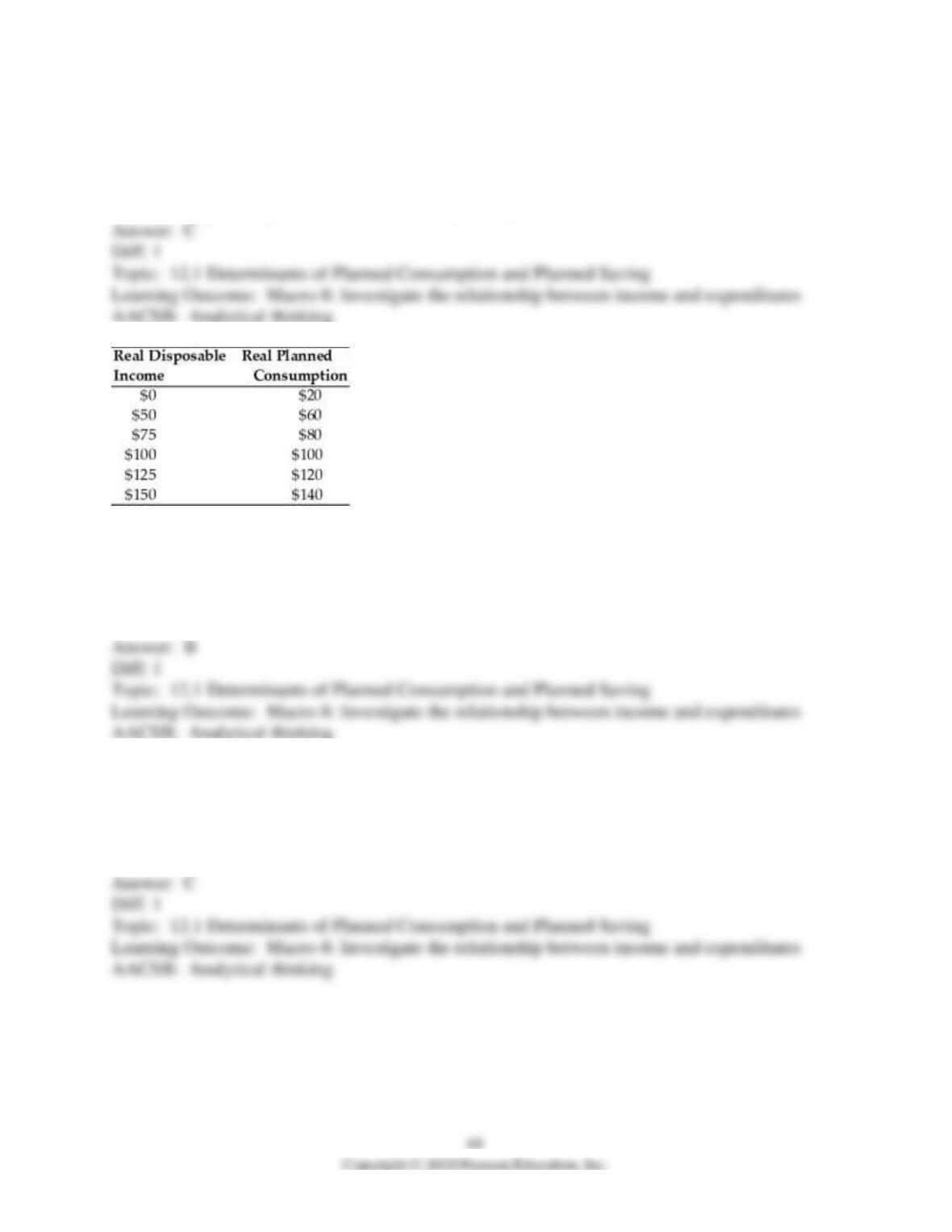
245) Use the above table. The autonomous consumption in this table is
A) $140.
B) $20.
C) $0.
D) $50.
246) Use the above table. Dissaving occurs up to a disposable income level of
A) $0.
B) $50.
C) $100.
D) $150.
247) Use the above table. Which of the following is TRUE if real disposable income is $150?
A) APC is less than MPC.
B) APC = 0.8.
C) APS = 0.2.
D) APS is less than MPS.
248) Use the above table. When real disposable income is $125
A) APC = 0.96.
B) APC = 0.80.
C) APS = 0.20.
D) MPS = 0.96.
249) Use the above table. We can infer from the table that when real disposable income is $175
A) APC = 0.91.
B) APC = 0.80.
C) APC = 0.20.
D) APC = 0.09.
250) Use the above table. The MPC is
A) 0.91.
B) 0.80.
C) 0.20.
D) 0.09.

251) Use the above table. The MPS is
A) 0.91.
B) 0.80.
C) 0.20.
D) 0.09.
252) Use the above table. At an income of $50
A) real saving is $20.
B) real dissaving is $10.
C) real saving is $10.
D) real dissaving is $50.
253) Use the above table. At an income of $150
A) real saving is $20.
B) real dissaving is $10.
C) real saving is $10.
D) real dissaving is $50.
254) When graphing the consumption function, what purpose is served by the 45-degree line?
A) It identifies all the points at which saving and consumption spending are equal.
B) It identifies all the points at which real disposable income and planned real consumption
spending are equal.
C) It identifies all the points at which real planned investment expenditure and real autonomous
consumption spending are equal.
D) It identifies all the points where real dissaving and saving are equal.
255) Autonomous consumption is the level of consumption that is
A) consistent with the average standard of living.
B) observed at the poverty line.
C) independent of real income.
D) available to someone earning the minimum wage.
256) At the point at which the consumption function intersects the 45 degree reference line
A) planned real consumption equals real disposable income.
B) equilibrium output is supply determined equilibrium output is determined by both.
C) planned real saving equals real disposable income.
D) planned real consumption of real disposable income equals zero.
257) Distinguish between saving and savings. How does investment relate to this distinction, if at
all?
258) According to the Keynesian model, what are the two components of consumption
spending? What determines how consumption changes when real disposable income changes?
Explain.
259) What is the primary determinant of real saving and real consumption according to Keynes?
Explain.
260) Suppose the marginal propensity to consume is 0.75. What does this mean? What do we
know about the marginal propensity to save? What do we know about the average propensity to
consume?
12.2 Determinants of Investment
1) Compared to consumption spending, investment historically has tended to be
A) greater.
B) more stable.
C) stagnant.
D) more variable.
2) Which of the following would increase the level of planned real investment?
A) an increase in the interest rate
B) an expectation of higher future profits
C) an expectation of higher future costs
D) an increase in business taxes

3) Which of the following is NOT included in the flow of investment spending that is part of
total planned expenditures in the economy?
A) purchases of corporate stock
B) spending on capital goods
C) inventory investment
D) fixed investment
4) The planned investment function shows that
A) real gross investment falls as real NNP increases.
B) a negative relationship exists between the level of planned investment and the interest rate.
C) a positive relationship exists between planned consumption and planned investment.
D) at higher levels of planned saving, planned investment increases.
5) A decrease in the interest rate will cause
A) planned investment spending to decrease.
B) planned investment spending to increase.
C) the investment function to shift out.
D) the investment function to shift in.
6) The investment function is represented by
A) an inverse relationship between the interest rate and the value of planned investment.
B) the direct relationship between the interest rate and the value of planned investment.
C) the direct relationship between planned investment and real GDP (gross domestic product).
D) the inverse relationship between planned investment and unplanned investment.

7) What happens as the interest rate rises?
A) The number of profitable investment opportunities declines.
B) The opportunity cost of using retained earnings to finance investment spending rises.
C) Planned investment spending also rises.
D) Planned investment spending remains constant since it depends on profit projections not
interest rates.
8) In the Keynesian model, planned investment is
A) negatively related to the interest rate.
B) negatively related to the level of income.
C) positively related to the wage rate.
D) positively related to household consumption.
9) If business people become more pessimistic about the future, we would expect that
A) the investment curve would shift inward to the left.
B) the saving function would shift up.
C) the consumption function would shift up.
D) investment spending would increase.
10) The investment function would shift outward to the right if
A) real disposable income decreased.
B) interest rates decreased.
C) there was a decrease in business taxes.
D) there was more uncertainty about future economic conditions.
11) A decrease in the interest rate results in
A) a smaller opportunity cost of investment and so planned investment spending increases.
B) a smaller opportunity cost of investment and so planned investment spending decreases.
C) a greater opportunity cost of investment and so planned investment spending decreases.
D) a greater opportunity cost of investment and so planned investment spending increases.
12) Which of the following will cause an inward shift of the investment function?
A) innovation that improves production efficiency at every level of output
B) an increase in business taxes
C) business people becoming optimistic about the future
D) a decrease in the interest rate
13) The planned investment function will shift upward if
A) real disposable income decreases.
B) the interest rate rises.
C) business expectations become more optimistic.
D) the existing stock of capital falls.
14) Technological progress should lead to
A) a rightward shift in the investment function.
B) a downward movement along the investment function.
C) an unchanged investment function.
D) less saving.

15) Which of the following would cause a leftward shift in the investment function?
A) technological progress
B) an increase in the rate of interest
C) optimistic expectations about business conditions
D) a decrease in business taxes
16) For an investment to be considered autonomous, it must
A) be negatively related to the interest rate.
B) increase as the level of income increases.
C) include fixed components.
D) be independent of the level of real disposable income.
17) In Keynesian analysis, if investment does NOT change when disposable income increases,
the investment is called
A) irrational.
B) autonomous.
C) unplanned.
D) discretionary.
18) Of the following economic variables, which is the least stable over time?
A) consumption
B) saving
C) investment
D) net exports

19) A firm will invest in a project if
A) the interest rate exceeds the opportunity cost of the project.
B) the firm’s level of capital is at the desired level.
C) the firm’s level of capital is higher than the desired level.
D) the rate of return of the project is greater than the opportunity cost of the investment.
20) Investment spending is
A) directly related to the interest rate.
B) inversely related to the interest rate.
C) directly related to real disposable income.
D) inversely related to real disposable income.
21) Which of the following is a TRUE statement relative to retained earnings and investment?
A) Lower interest rates stimulate borrowing for investment, but have no effect on the use of
retained earnings for investment spending.
B) Lower interest rates stimulate borrowing for investment, but discourage the use of retained
earnings for investment.
C) Lower interest rates reduce the opportunity cost of retained earnings, stimulating the use of
these funds in investment.
D) Lower interest rates have no effect on investment spending at all because investment
spending is autonomous.
22) The investment function will shift when there is a change in
A) the interest rate.
B) firms’ profit expectations.
C) the cost of borrowing.
D) the opportunity cost of retained earnings.
23) Which of the following will NOT lead to a shift in the investment function?
A) A firm is more certain about its future profitability.
B) A new discovery leads to a technological advancement.
C) The government just lowered business taxes.
D) The cost of borrowing funds has decreased.
24) Which one of the following statements is TRUE?
A) Over the years, real consumption spending has been more volatile than real investment
spending.
B) Over the years, real investment spending has been more volatile than real consumption
spending.
C) Domestic real investment in the United States was highest during the Great Depression.
D) In the Keynesian model, changes in the volume of real investment spending are fully
explained by changes in the real interest rate.
25) Changes in real planned investment spending have
A) a direct relationship to changes in interest rates.
B) an inverse relationship to changes in the interest rate.
C) no identifiable relationship to changes in the interest rate.
D) a direct relationship to changes in the level of household savings.
26) Which one of the following statements is TRUE?
A) The investment function is positively sloped to reflect the fact that higher interest rates cause
more people to invest their funds.
B) The investment function is positively sloped to reflect the fact that lower interest rates cause
more firms to expand their operations.
C) Along a given investment function, higher interest rates result in more investment projects
being undertaken.
D) Along a given investment function, lower interest rates result in more investment projects
being undertaken.
27) Aging baby-boomers, predisposed to hearing loss because of years of listening to loud music,
are now approaching the age range in which hearing loss starts to become apparent. What effect
does this have on investment spending within the hearing aid industry?
A) There will no longer be an opportunity cost associated with investment spending.
B) There will be no change in real investment spending, because hearing aid manufacturers will
look only at the interest rate in determining whether to expand production.
C) The investment function relating planned real investment spending to the interest rate can be
expected to shift rightward.
D) The investment function relating planned real investment spending to the interest rate can be
expected to shift leftward.
28) At a given interest rate, the investment function shows
A) how many funds people will invest in the stock market.
B) how many funds people will earn on their stock market investments.
C) how profitable it will be for firms to expand.
D) how much businesses will spend on the capital stock.
29) Based on historical data, which of the following tended to be most unstable over time?
A) real consumption spending
B) real saving
C) real investment spending
D) the average propensity to save
30) One of the primary determinants of planned real investment spending is the
A) firm expectation of future business profits.
B) rate of real consumption spending.
C) rate of real government spending.
D) rate of real saving.
31) What would happen to the planned investment function if business taxes were decreased?
A) It would shift to the left.
B) It would shift to the right.
C) There would be a upward movement along the function.
D) There would be no change.
32) Which would decrease real planned investment demand?
A) a increase in new technologies available
B) a increase in profit expectations
C) an increase in business taxes
D) a decrease in nominal interest rates