International Economics, 9e (Husted/Melvin)
Chapter 12 The Foreign-Exchange Market
12.1 Multiple-Choice Questions
1) The most common type of transaction in the foreign exchange market is a
A) forward transaction.
B) spot transaction.
C) swap transaction.
D) None of the above.
2) If the bank is selling euros for $0.89, then what is the implied euro price of the dollar?
A) 2.00
B) 1.99
C) 2.32
D) 1.12
3) The difference between bid (buying) rates and ask (selling) rates is called the
A) profit.
B) arbitrage.
C) spread.
D) forward transaction.
4) Riskless transactions to take advantage of profit opportunities due to a price differential or a
yield differential in excess of transaction costs are called
A) differential actions.
B) cash transactions.
C) arbitrage.
D) forward transactions.
5) Suppose in London £/$ = 0.5 while in New York £/SF = 0.2. The corresponding cross rate
(SF/$) is
A) 2.5.
B) 0.1.
C) 0.4.
D) 0.3.
6) The essential feature of a ________ is that it immediately fixes the rate at which a specified
amount of one currency is to be delivered in exchange for a specific amount of another at a
future date.
A) forward contract
B) spot contract
C) money contract
D) bid contract
7) The euro is said to be selling at a ________ if the spot dollar price is $1.18 and the nine-
month forward rate is $1.16.
A) forward discount
B) forward premium
C) forward spread
D) none of the above
8) In the case where the spot and forward rates are equal, the currency is said to be selling
A) profitably.
B) flat.
C) normal.
D) risky.
9) A ________ is a transaction in which both a spot transaction and a forward transaction are
agreed upon simultaneously.
A) arbitrage
B) call
C) swap
D) put
10) The ________ rate represents the difference between the spot and forward price.
A) profit
B) swap
C) spread
D) risk
11) The exchange rate is kept the same across geographically-separate markets by
A) hedging.
B) speculation.
C) government regulation.
D) arbitrage.
12) The reduction or covering of a foreign exchange risk is called
A) hedging.
B) speculation.
C) intervention.
D) arbitrage.
13) In the ________ markets all profits and losses must be settled on a daily basis.
A) futures
B) forward
C) spot
D) swap
14) An important feature of a ________ is that the holder has the right, but not the obligation, to
buy or sell currency.
A) swap
B) foreign exchange arbitrage
C) foreign exchange option
D) futures market contract
15) A gain can be made by the holder of a call option when the current exchange rate
A) exceeds the exercise price.
B) exceeds the forward price.
C) is less than the futures price.
D) falls to zero.
16) Central banks intervene in the foreign exchange market
A) to smooth out currency fluctuations.
B) to facilitate the transfer of goods and services internationally.
C) to conduct foreign exchange operations for central governments.
D) All of the above.
17) Suppose that in the free market, where the supply of the foreign currency is equal to demand
for that currency, the peso-dollar exchange rate is 4 pesos = $1. Assume the central bank sets an
official exchange rate at 3 pesos = $1, we can say that in the official market the dollar is
A) overvalued.
B) undervalued.
C) appreciated.
D) None of the above.
18) A European option differs from an American option in that it may be exercised
A) only on the spot date.
B) only on the expiration date.
C) only on the future date.
D) on any date.
19) An increase in the exchange rate from $2.00 = 1 € to $2.20 = 1 € is a
A) 10% depreciation of the euro with respect to the dollar.
B) 10% depreciation of the dollar with respect to the euro.
C) 10% appreciation of the dollar with respect to the euro.
D) None of the above.
20) If a foreign exchange speculator expects the spot rate of the dollar nine months from today to
be lower than today’s forward rate on the dollar for delivery in nine months, she may
A) buy dollars in the spot market nine months from today.
B) sell dollars in the spot market nine months from today.
C) sell dollars forward today and buy them in the spot market nine months from today.
D) buy dollars forward today and resell them in the spot market nine months from today.
21) In swap transactions, the trader is interested in
A) the difference between spot and forward rates.
B) only the spot rate.
C) only the forward rate.
D) both the spot and deposit interest rate.
22) In general, the lower the exercise price relative to the current spot rate price of the currency,
the more valuable
A) the put option.
B) the call option.
C) the arbitrage operation.
D) the triangular arbitrage.
23) The most common tool of analysis in international finance for measuring the average value
of a currency relative to several other currencies is
A) bilateral exchange rates.
B) cross exchange rates.
C) exchange rate indexes.
D) All of above.
24) Which of the following is not true regarding “exchange rate indexes?”
A) They will all show the same general trends (i.e., appreciation or depreciation).
B) Neither economic theory nor practice gives a clear indication of which exchange rate is best.
C) For short-term movements, there can be large differences across exchange rate indexes.
D) Exchange rate indexes are used to measure the average value of a currency relative to several
other currencies.
25) The size of the spread that a dealer will quote for a foreign exchange transaction will vary
depending on
A) the degree of market volatility at the time.
B) the degree of risk associated with a particular currency.
C) the size of the market for the currency being traded.
D) All of above.
26) If the spot exchange rate between dollars and pounds is equal to 2 dollars for one pound and
the forward exchange rate equals 2.10 dollars for one pound, then
A) the dollar is trading at a forward premium.
B) the pound is trading at a forward discount.
C) the pound is trading at a forward premium.
D) the market presents an opportunity for arbitrage.
27) A pair of shoes manufactured in Milan, Italy cost 195 euros. What is the dollar value of the
shoes if the exchange rate is $0.89 per euro?
A) $173.55
B) $195.00
C) $219.00
D) $890.00
28) The market where currencies may be bought and sold for delivery in a future period is
known as
A) the forward exchange market.
B) the spot exchange market.
C) the purchasing power market.
D) the futuristic exchange market.
29) The market where currencies may be bought and sold for immediate delivery is known as
A) the forward exchange market.
B) the spot exchange market.
C) the purchasing power market.
D) the futuristic exchange market.
30) A bottle of wine manufactured in Paris, France cost 45 euros. What is the dollar value of the
wine if the exchange rate is $0.80 per euro?
A) $36.00
B) $56.25
C) $40.00
D) None of these dollar values is correct.
31) If the exchange rate goes from $2.00 = 1 € to $1.80 = 1 €, the result is a
A) 10% depreciation of the euro with respect to the dollar.
B) 10% depreciation of the dollar with respect to the euro.
C) 10% appreciation of the euro with respect to the dollar.
D) None of the above.
32) If the bank is selling euros for $0.74, then what is the implied euro price of the dollar?
A) 1.35 €
B) 1.74 €
C) 2.48 €
D) None of these values are correct.
12.2 True or False Questions
1) Today’s forward rate must equal the future spot rate.
2) Exchange rates (for instance, the dollar price of yen) tend to be different worldwide at any
point in time because of different tastes for currencies in each country.
3) Speculation is the opposite of hedging.
4) There is no limit for domestic central bank intervention.
5) In the foreign exchange market, a broker reveals the names of the banks making bids or offers
to the trading banks before the trade has been agreed upon.
7
6) An investor can write any size contract in both forward and futures markets as long as the
other party involved is in agreement.
7) A European option can only be exercised on the final day, the expiration date.
8) Both a parallel market and a black market are free markets permitted to coexist with the
official market.
9) In the case of an appreciating domestic currency, central banks often sell foreign currencies in
exchange for domestic currency to stop the appreciation.
10) Foreign exchange activity is dominated by the spot and swaps markets.
11) Because of the threat of arbitrage, the forward rate must equal the spot rate at all times.
12) If one dollar buys 10 pesos, then one peso buys ten cents of a dollar.
13) The U.S. and the Canadian currencies are the only two in the world that are called “dollars.”
12.3 Essay Questions
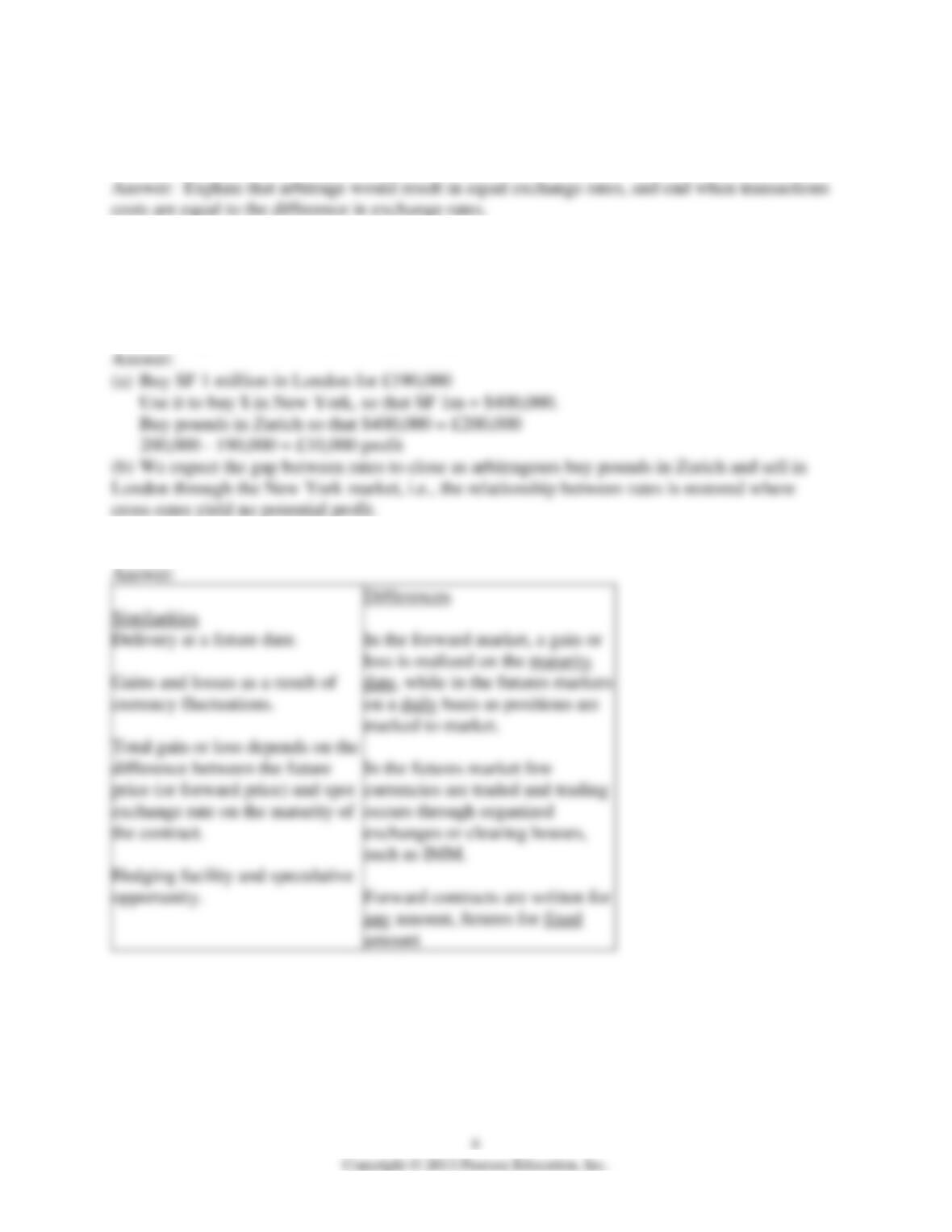
1) Why is it true that exchange rates tend to be equal worldwide? Briefly explain.
2) Suppose in Zurich £/$ = 0.5, while in New York SF/$ = 2.5, but in London £/SF = 0.1.
(a) Is there any arbitrage profit that could be made with a triangular arbitrage action?
Describe an example of how such a profit may be earned.
(b) What would you guess about the relationship between the dollar rates and cross-rates
after arbitrageurs notice this profit opportunity?
3) Explain the similarities and differences between the forward and futures markets.
9
4) Briefly answer the following questions.
(a) What is a foreign currency option? Is there any difference between a European and
American option?
(b) Why might you prefer an option over a futures or forward contract?
(c) When can a gain be made by the holder of a call option? A put option?
5) What is the difference between black and parallel markets for foreign exchange? How are
these created?