Macroeconomics, 12e (Parkin)
Chapter 12 The Business Cycle, Inflation, and Deflation
1 The Business Cycle
1) Business cycle events that arise solely from aggregate demand shifts are emphasized by the
A) Keynesian and real business cycle theories.
B) monetarist and real business cycle theories.
C) Keynesian and monetarist cycle theories.
D) none of the major theories.
2) Which of the following are business cycle theories that regard fluctuations in aggregate
demand as the factor that is creating business cycles?
I. Keynesian cycle theory
II. real business cycle theory
III. monetarist cycle theory
A) I only
B) I and II
C) I and III
D) I, II and III
3) Which of the following is NOT an aggregate demand, mainstream theory of the business
cycle?
A) Keynesian cycle theory
B) monetarist cycle theory
C) new Keynesian cycle theory
D) real business cycle theory
4) In 2008, when a recession started, the growth of government expenditures on goods and
services doubled compared to its growth in 2007. According to the aggregate demand theories of
the business cycle
A) government expenditure was at least a partial cause of the recession.
B) government expenditure was not a cause of the recession.
C) government expenditure was definitely the cause of the recession.
D) None of the above answers are correct because aggregate demand theories of the business
cycle focus only on investment and consumption expenditure.
5) In the Keynesian business cycle theory, business cycles begin with changes in
A) inflation expectations.
B) consumer sentiment.
C) business confidence.
D) the public’s expectations about Fed policies.
6) The ________ states that the main source of economic fluctuations is volatile business
confidence.
A) real business cycle theory
B) new classical cycle theory
C) Keynesian cycle theory
D) monetarist cycle theory
7) Fluctuations in business confidence is the factor leading to business cycles in the ________.
A) Keynesian cycle theory
B) new Keynesian cycle theory
C) new classical cycle theory
D) monetarist cycle theory
8) The factor leading to business cycles in the Keynesian model is ________.
A) changes in business confidence
B) a speed up in money growth
C) unanticipated changes in aggregate demand
D) unanticipated changes in aggregate supply
9) The Keynesian explanation of the business cycle is based on
A) the inability of government policy-makers to predict the future course of the economy.
B) shifts in monetary policy undertaken by the Federal Reserve.
C) fluctuations in business confidence.
D) unstable inflationary expectations.
10) The factor that leads to business cycles within the Keynesian cycle theory is
A) the growth rate of labor productivity.
B) the growth rate of the quantity of money.
C) adverse shocks to international trade.
D) fluctuations in business confidence.
11) Keynes used the term “animal spirits” to represent
A) changes in people’s consumption expenditures.
B) the ease of forecasting.
C) fluctuations in business confidence.
D) investment based on hard facts about the future.
12) Which theory emphasizes frequent changes in investment because of “animal spirits” as the
main source of economic fluctuations?
A) real business cycle theory
B) new classical cycle theory
C) Keynesian cycle theory
D) monetarist cycle theory
13) One model of the business cycle claims that volatile business confidence is the primary
factor in starting a business cycle. This model is the
A) real business cycle model.
B) Keynesian cycle theory.
C) aggregate supply model.
D) new classical theory.
14) Which theory assumes that business cycles occur because of changes in business confidence?
A) monetarist cycle theory
B) real business cycle theory
C) new classical cycle theory
D) Keynesian cycle theory
15) Which of the following describes the Keynesian approach to the business cycle?
I. Unanticipated shocks to aggregate supply drive expansions and recessions.
II. The Keynesian theory is a real business cycle model of the economy.
III. A decrease in business confidence can trigger a recession.
A) I only
B) III only
C) I and II
D) II and III
16) Suppose that managers forecasted a large decline in expected sales and profits and so their
confidence plummets. According to the ________, this forecast might start a business cycle.
A) Keynesian cycle theory
B) circular flow theory
C) monetarist cycle theory
D) new classical cycle theory
17) Keynesians believe that
A) money wage rate adjustments will quickly eliminate unemployment.
B) aggregate demand changes tend to induce aggregate supply changes, offsetting any effect
from changes in government expenditures.
C) the economy will normally operate at full employment.
D) a change in business confidence can affect the amount of investment in the economy.
18) The Keynesian explanation of the business cycle rests on several concepts, including
A) rigid money wage rates.
B) unstable monetary policy by the Fed.
C) shocks to the rate of technological change.
D) the desire of politicians to be re-elected.
19) Based on the Keynesian theory of the business cycle, if the economy is at its full-
employment equilibrium and aggregate demand increases then
A) the price level and real GDP both increase.
B) the price level rises but real GDP remains unchanged.
C) the price level and GDP both decrease.
D) real GDP decreases and the price level remains unchanged.
20) For monetarists, the main cause of economic fluctuations is represented by changes in
A) investment.
B) consumption expenditure.
C) the growth rate of the quantity of money.
D) the levels of household debt.
21) The monetarist theory of the business cycle regards ________ as the factor that leads to
business cycles.
A) unexpected increases in aggregate demand
B) changes in the growth rate of the quantity of money
C) volatility in the interest rate
D) volatility in the demand for money
22) What, according to the monetarist theory of the business cycle, leads to changes in real
GDP?
A) a change in profit expectations
B) a change in the growth rate in tax revenue
C) a change in the growth rate of the quantity of money
D) an unanticipated change in aggregate demand
23) In monetarist business cycle theory, the factor leading to a business cycle is represented by
changes in
A) consumer spending.
B) investment spending.
C) the growth rate of the quantity of money.
D) net exports.
24) In monetarist business cycle theory, decreasing the growth rate of the quantity of money
________ and increasing the growth rate of the quantity of money ________.
A) increases real GDP; decreases the inflation rate
B) decreases real GDP; decreases the inflation rate
C) causes the economy to enter a recession; causes the economy to enter an expansion
D) causes the economy to enter an expansion; causes the economy to enter a recession
25) In monetarist business cycle theory, increases in money growth temporarily ________ real
GDP and ________ the price level.
A) increase; rise
B) increase; lower
C) decrease; rise
D) decrease; lower
26) Using the monetarist model, place the following events in the order in which they occur in a
business cycle.
I. Money wages fall and the SAS curve shifts rightward.
II. The Federal Reserve decreases the growth rate of the quantity of money.
III. The AD curve shifts leftward.
A) II, III, I
B) III, II, I
C) I, III, II
D) The events are not part of a monetarist model of the business cycle.
27) Suppose the growth rate of the quantity of money increased from 5 percent per year to 8
percent per year. According to the ________, this event would trigger a business cycle
expansion.
A) Keynesian cycle model
B) real business cycle model
C) aggregate supply cycle model
D) monetarist cycle model
28) Which of the following is TRUE regarding the monetarist theory of the business cycle?
I. Monetarists assume that the quantity of money increases at a constant rate.
II. Fluctuations in interest rates cause business cycles.
III. Changes in the growth rate of the quantity of money affect aggregate demand.
A) I only
B) III only
C) I and II
D) II and III
29) Which of the following pieces of evidence is most consistent with the monetarist theory?
A) Labor supply decisions do not seem to depend on real interest rates.
B) Changes in real GDP and the quantity of money move closely together.
C) Money wage rates take some time to adjust to price changes.
D) Productivity and GDP move closely together.
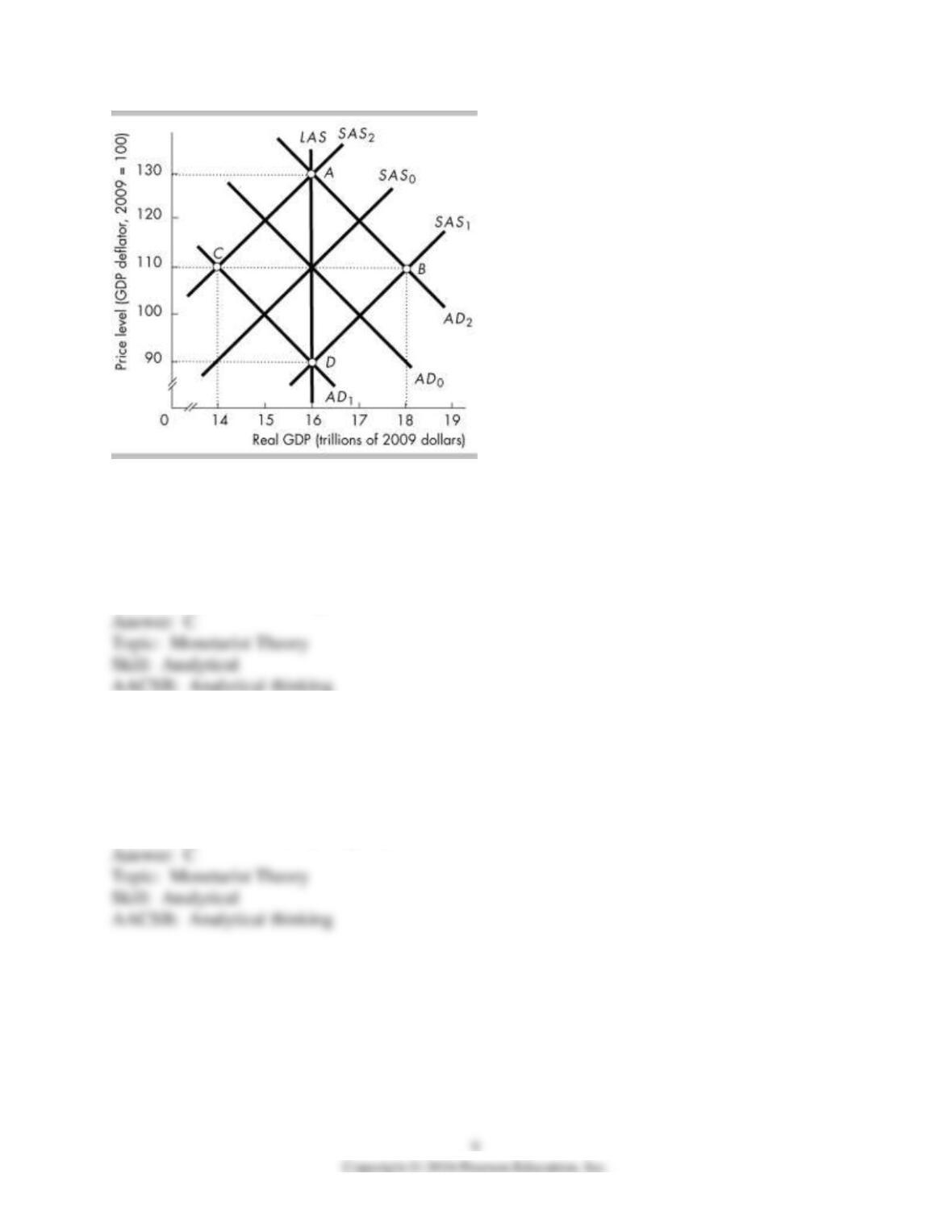
30) In the above figure, suppose that the economy has moved from point A to point C. According
to the monetarist theory of the business cycle, what could have caused this movement?
A) an increase in the money wage rate
B) an increase in the growth rate of the quantity of money
C) a decrease in the growth rate of the quantity of money
D) an increase in uncertainty
31) In the above figure, suppose that the economy has moved from point D to point B. According
to the monetarist theory of the business cycle, what could have caused this movement?
A) a decrease in the money wage rate
B) an increase in uncertainty about future sales and profits
C) an increase in the growth rate of the quantity of money
D) an increase in the money wage rate
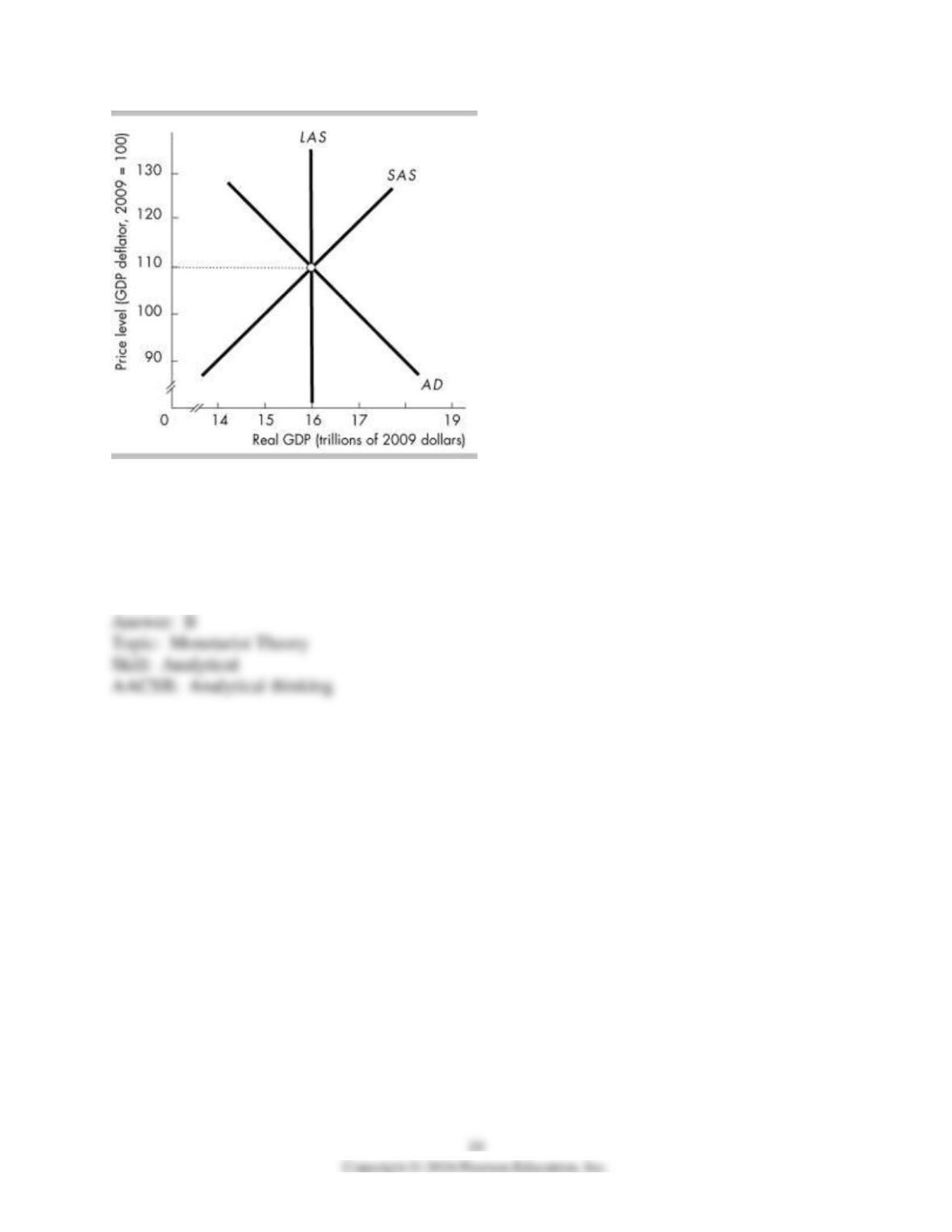
32) Using the above figure as a starting point, a recession in the monetarist model would begin
with a
A) rightward shift in the AD curve.
B) leftward shift in the AD curve.
C) leftward shift in the SAS curve.
D) leftward shift in the LAS curve.
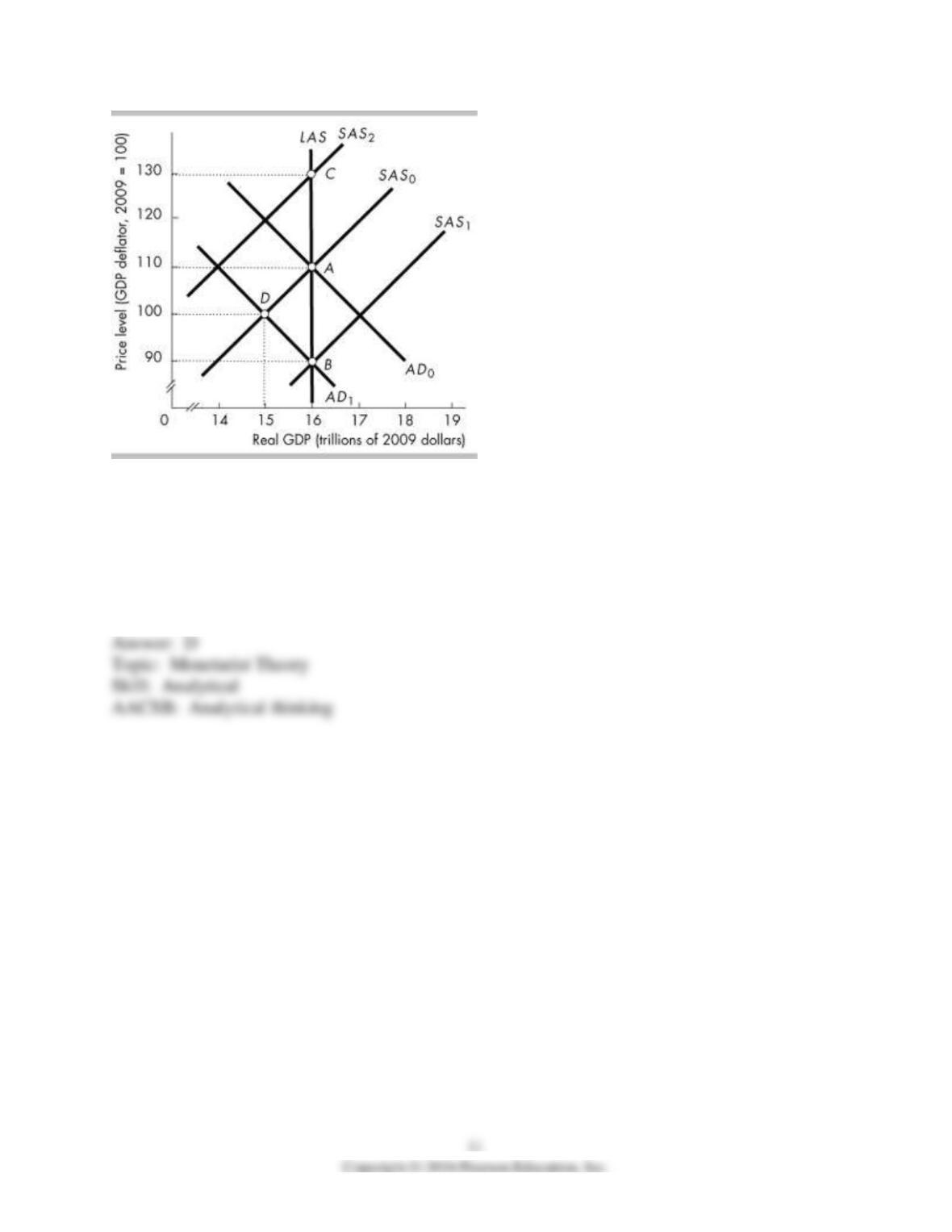
33) In the above figure, the economy is initially at point A. According to the monetarists, which
point best represents the consequence of a short-run response to a decrease in the growth rate of
the quantity of money?
A) A, that is, there is no change.
B) B
C) C
D) D
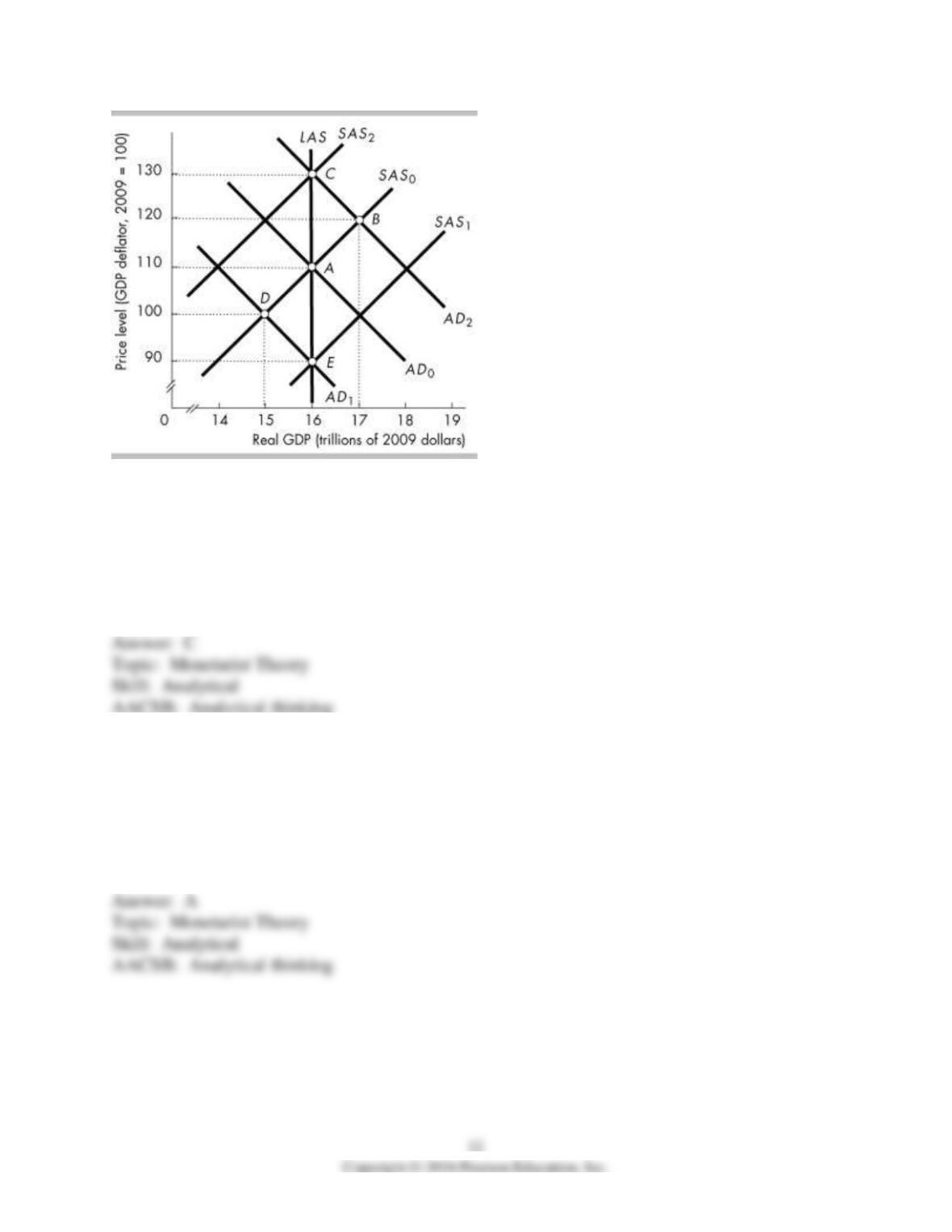
34) In the above figure, suppose the economy starts at point A. The short-run response to a
decrease in the growth rate of the quantity of money in the monetarist business cycle theory
moves the economy to point
A) B.
B) C.
C) D.
D) E.
35) In the above figure, suppose the economy starts at point A. The short-run response to an
increase in the growth rate of the quantity of money in the monetarist business cycle theory
moves the economy to point
A) B.
B) C.
C) D.
D) E.
36) In the above figure, suppose the economy starts at point A. The short-run response to an
increase in the growth rate of the quantity of money in the monetarist business cycle theory is for
the price level to ________ and real GDP to ________.
A) fall to 90; remain at $16 trillion
B) rise to 120; increase to $17 trillion
C) rise to 130; remain at $16 trillion
D) remain at 110; remain at $16 trillion
37) The new classical cycle theory predicts that an unexpected increase in aggregate demand
________ create a business cycle and an expected increase in aggregate demand ________
create a business cycle.
A) will; will
B) will; will not
C) will not; will
D) will not; will not
38) The ________ cycle theory states that only unexpected fluctuations in aggregate demand are
the main source of business cycles.
A) new Keynesian
B) new classical
C) Keynesian
D) monetarist
39) The business cycle impulse in the new classical theory of the business cycle is
A) unexpected changes in aggregate demand.
B) expected changes in aggregate demand.
C) fluctuations in money growth with rigid wages.
D) fluctuations in investment coupled with rigid wages.
40) The new classical theory argues that the primary factor leading to business cycles are
A) expected changes in aggregate demand.
B) expected changes in aggregate supply.
C) unexpected changes in aggregate demand.
D) unexpected changes in aggregate supply.
41) Which theory distinguishes between expected and unexpected fluctuations in aggregate
demand and argues that only unexpected changes can affect real GDP?
A) new classical cycle theory
B) Keynesian cycle theory
C) monetarist cycle theory
D) real business cycle theory
42) According to the new classical model, changes in aggregate demand change real GDP
A) all of the time.
B) only when the short-run aggregate supply curve is vertical.
C) only when the changes in aggregate demand are expected.
D) only when the changes in aggregate demand are unexpected.
43) Suppose that forecasters have incorrectly estimated aggregate demand. According to the
________, this mistake could trigger a business cycle.
A) Keynesian cycle model
B) monetarist cycle model
C) new classical cycle model
D) real business cycle model
44) A larger than expected increase in aggregate demand will lead to ________ in the ________
of the business cycle.
A) a recession; new Keynesian cycle theory
B) a recession; Keynesian cycle theory
C) an expansion; new classical cycle theory
D) an expansion; real business cycle theory
45) Which of the following CORRECTLY describes the new classical cycle theory of the
business cycle?
A) An unexpected change in the quantity of money can trigger a business cycle.
B) An expected tax rate change can trigger a business cycle.
C) An unexpected change in the price of oil can trigger a business cycle.
D) Rational expectations keep the money wage from changing quickly.
46) One assumption of the new classical model is that
A) money wage rates are rigid.
B) prices are “sticky” upward.
C) people make rational expectations about aggregate demand.
D) markets are not purely competitive.
47) Both new Keynesian and new classical cycle theories claim that ________.
A) animal spirits can trigger a business cycle
B) shifts in the SAS curve are the main impulse for a business cycle
C) unexpected changes in aggregate demand trigger a business cycle
D) expected changes in the quantity of money can trigger a business cycle
48) Both the new classical and new Keynesian business cycle theories agree that
A) expected changes in aggregate demand lead to the business cycle.
B) unexpected changes in aggregate demand cannot result in a business cycle.
C) the money wage rate is influenced by rational expectations of the price level.
D) the long-term nature of wage contracts allow expected changes in the price level to cause
business cycles.
49) A key difference between the new classical and the new Keynesian views of the business
cycle is the role played by
A) unexpected changes in aggregate demand.
B) government expenditure on goods and services.
C) expected changes in aggregate demand.
D) the growth rate of the quantity of money.
50) The key difference between the new classical theory of the business cycle and the new
Keynesian theory of the business cycle is that the new classical theory believes that ________
while the new Keynesian theory believes that ________.
A) expected changes in aggregate demand will change real GDP; expected changes in aggregate
demand will not change real GDP
B) only unexpected changes in aggregate demand will change real GDP; only expected changes
in aggregate demand will change real GDP
C) only unexpected changes in aggregate demand will change real GDP; both expected and
unexpected changes in aggregate demand will change real GDP
D) the short-run aggregate supply curve is horizontal; the short-run aggregate supply curve is
vertical
51) The factor leading to business cycles in the ________ cycle theory is unexpected fluctuations
in aggregate demand while in the ________ cycle theory both unexpected and expected
fluctuations in aggregate demand are factors that lead to business cycles.
A) new classical; monetarist
B) new classical; new Keynesian
C) new Keynesian; Keynesian
D) monetarist; new Keynesian
52) According to the new classical theory, ________ policy changes have no effect on real GDP
and according to the new Keynesian theory, ________ policy changes have an effect on real
GDP.
A) expected; expected
B) unexpected; expected
C) fiscal; monetary
D) fiscal; fiscal
53) According to the new classical theory, ________ policy changes have NO effect on real GDP
and according to the new Keynesian theory, ________ policy changes have an effect on real
GDP.
A) only expected; expected and unexpected
B) only unexpected; expected and unexpected
C) only expected; only unexpected
D) only unexpected; only expected
54) An unexpected decrease in aggregate demand will trigger a recession in the ________ theory
of the business cycle.
A) new Keynesian cycle
B) new classical cycle
C) real business cycle
D) Both answers A and B are correct.
55) The new Keynesian cycle theory of the business cycle regards ________ as the main source
of economic fluctuations.
A) only unexpected fluctuations in aggregate demand
B) expected and unexpected fluctuations in aggregate demand
C) only expected fluctuations in aggregate demand
D) changes in business confidence
56) New Keynesian economists believe that ________ is influenced by ________.
A) yesterday’s money wage rate; today’s rational expectations of the money wage
B) today’s money wage rate; yesterday’s rational expectations of the price level
C) yesterday’s rational expectations of the price level; today’s money wage rate
D) today’s money wage rate; today’s rational expectations of the price level
57) Which business cycle theory emphasizes that, because of long-term wage agreements, both
expected and unexpected fluctuations in aggregate demand can change real GDP?
A) the new classical cycle theory
B) the new Keynesian cycle theory
C) monetarist cycle theory
D) Keynesian cycle theory
58) The ________ theory of the business cycle asserts that expected and unexpected changes in
aggregate demand lead to fluctuations in real GDP.
A) real business cycle
B) new classical cycle
C) new Keynesian cycle
D) None of the above answers are correct.
59) According to the new Keynesian cycle theory of the business cycle, which of the following
can trigger a business cycle expansion?
I. an unexpected increase in the quantity of money
II. an expected increase in the quantity of money
III. an expected increase in government expenditure
A) I only
B) II and III
C) I, II and III
D) None of the three will trigger an expansion.
60) In the new Keynesian business cycle theory, ________ can effect real GDP.
A) only expected changes in aggregate demand
B) expected and unexpected changes in aggregate demand
C) only unexpected changes in aggregate demand
D) only unexpected changes in the money wage rate
61) Suppose that the Federal Reserve is expected to expand the quantity of money by 5 percent
but ends up expanding it by only 2 percent. If the new Keynesian theory is CORRECT, which of
the following describes the effect on the economy?
A) The economy experience a boom because the quantity of money is still growing.
B) Inflation will be higher than expected.
C) Workers’ decisions about when to work will be affected.
D) A recession will ensue.
62) Suppose the data show that an unexpected change in tax rates caused a recent recession.
These data support which model of the business cycle?
A) new classical cycle theory
B) new Keynesian cycle theory
C) real business cycle theory
D) Both answers A and B are correct.
63) Which of the following are TRUE?
I. New Keynesian economists believe that money wage rates are influenced by rational
expectations of the price level.
II. New classical economists believe that money wage rates are influenced by rational
expectations of the price level.
III. New classical economists believe expected changes in aggregate demand trigger business
cycles.
A) I and II
B) I and III
C) II and III
D) I, II and III
64) Real business cycle theory says that the factor leading to the business cycle is represented by
changes in
A) animal spirits.
B) the growth rate of the quantity of money.
C) only aggregate demand.
D) productivity.
65) The real business cycle theory asserts that changes in ________ lead to changes in
________.
A) the quantity of money; real GDP
B) technology; productivity
C) animal spirits; real GDP
D) consumption expenditure; real GDP
66) The factor leading to business cycles according to the real business cycle theory is changes in
A) the growth rate of the quantity of money.
B) technological change caused by changes in productivity.
C) productivity caused by changes in technology.
D) investment caused by changes in business confidence.