b.
increases from 3,000 to 10,000.
c.
decreases from 10,000 to 3,000.
d.
decreases from 6,000 to 3,000.
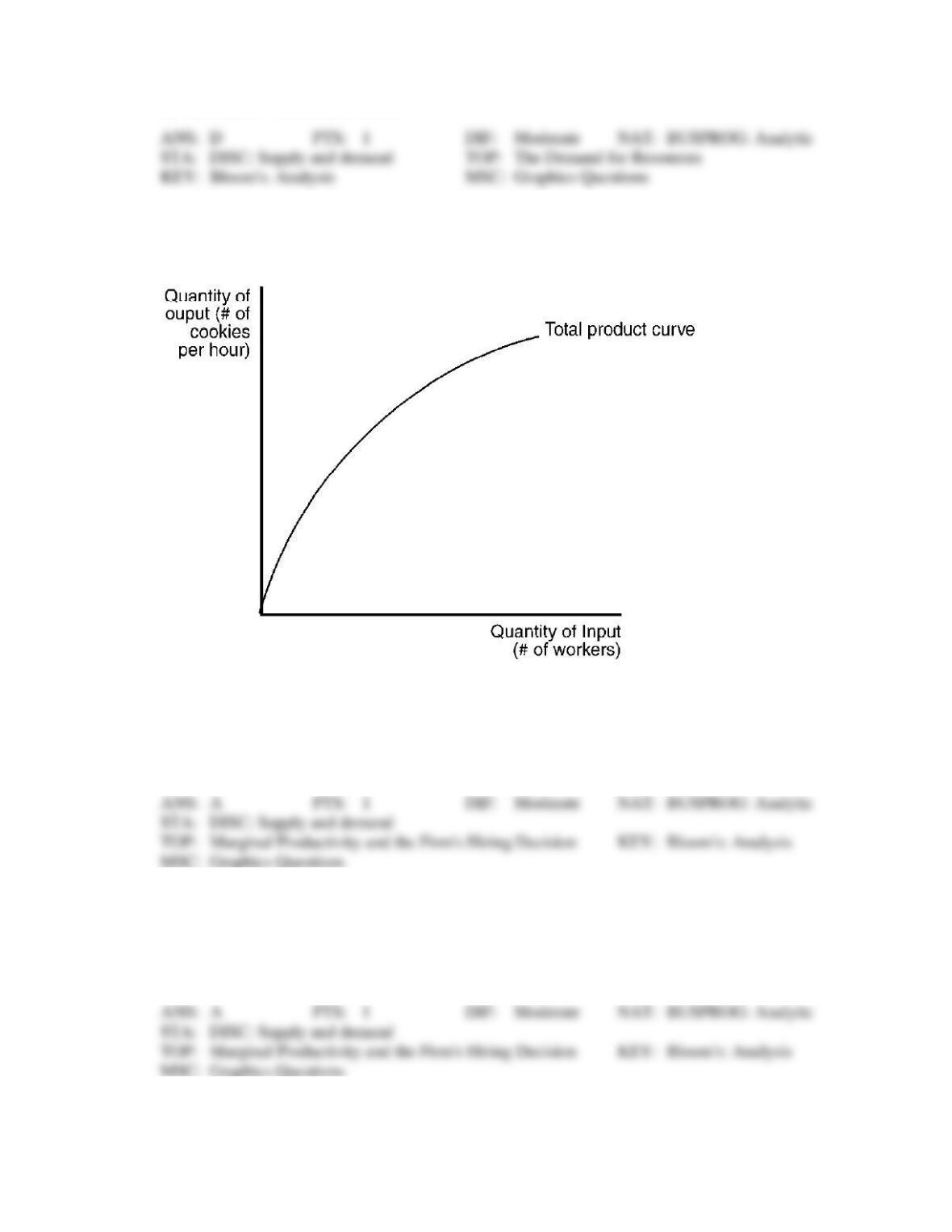
The figure below depicts a production function for a firm that produces cookies.
Figure 12-4
150. Refer to Figure 12-4. As the number of workers increases,
a.
total output increases, but at a decreasing rate.
b.
marginal product increases, but at a decreasing rate.
c.
marginal product increases at an increasing rate.
d.
total output decreases.
151. Refer to Figure 12-4. With regard to cookie production, the figure implies
a.
diminishing marginal product of workers.
b.
diminishing marginal cost of cookie production.
c.
decreasing cost of cookie production.
d.
increasing marginal product of workers.
152. The short-run supply of a human resource will be more elastic the
a.
more elastic the demand for the product to be produced.
b.
more inelastic the demand for the product to be produced.
c.
lower the skill level necessary to perform the job.
d.
harder it is to acquire the skill and knowledge necessary to provide the resource.
153. A decrease in the demand for a final product will cause
a.
a decrease in demand for the resources used to produce the good.
b.
an increase in demand for the resources used to produce the good.
c.
firms to expand production of the good.
d.
an increase in the supply of resources used to produce the good.
154. The more elastic the demand for a final product,
a.
the more elastic will be the demand for the productive resources used.
b.
the less elastic the supply of resources used in producing the product.
c.
the less firms will reduce their usage of resources when the price of the resources
increases.
d.
the higher the MRP of the resources used to produce the product.
155. Which of the following expresses the correct decision-making rule for a profit-maximizing firm hiring
units of labor?
a.
If the MRP was rising, less labor would be employed as time passed.
b.
The firm should continue to hire workers as long as their MRP is greater than the wage
rate.
c.
The firm should continue to hire workers until the total costs of all workers equals the total
revenue from the output of the workers.
d.
The firm should continue to hire workers until the wage rate equals the price of the
product.
156. Because the demand for a resource is highly dependent upon the demand for the final goods that the
resource helps produce, the demand for a resource is called a(n)
a.
derived demand.
b.
independent demand.
c.
declining proportions demand.
d.
elastic demand.
157. Compared to the short-run demand, the long-run demand for a resource is
a.
less elastic.
b.
more elastic.
c.
equally elastic.
d.
either more or less elastic; we cannot predict which.
158. In a price-taker industry, the marginal revenue derived from the sale of an additional unit of the
product is equal to the market price of the product. In these circumstances,
a.
value of marginal product is less than marginal revenue product.
b.
value of marginal product is greater than marginal revenue product.
c.
value of marginal product equals marginal revenue product.
d.
marginal product equals marginal cost.
159. If the cost of using skilled labor was twice the cost of using unskilled labor, and both were used by a
profit-maximizing firm, the firm would adjust the quantity of each type of labor until
a.
the marginal product of each was the same.
b.
twice as much unskilled labor was used.
c.
half as much unskilled labor was used.
d.
the marginal product of skilled labor was twice that of unskilled labor.
160. If a firm used only two factors of production, labor (L) and capital (K), which of the following
conditions would be present if the firm was minimizing its cost of production?
a.
MPL PL = MPK PK
b.
MPL PL = MPK PK
c.
MRPL = MRPK
d.
MPL = MPK
161. A change in the demand for a resource can be caused by which of the following?
a.
a change in the demand for the final product that uses the resource as a factor of
production
b.
a change in the productivity of the resource
c.
a change in the price of other resources that could be used as substitutes for the resource in
question
d.
all of the above
162. A firm currently employs 80 units of labor and 50 units of capital equipment to produce 3,000 hamster
cages. Given the current input levels utilized, the marginal product of labor is 40 and the marginal
product of capital is 10. If we assume that labor costs $20 per unit and capital costs $10 per unit,
a.
the firm is using the appropriate mix of labor and capital to minimize its costs.
b.
the firm could lower its costs for the same level of output by using more labor and less
capital.
c.
the firm could lower its costs for the same level of output by using more capital and less
labor.
d.
the current MRP of capital exceeds the current MRP of labor.
163. Which of the following would be the most likely result from a new government program that provided
significant financial aid for children of low– and middle-income families to attend college?
a.
Starting salaries for new college graduates would rise because of an increase in the
number of high-quality graduates.
b.
Starting salaries for college graduates would be unaffected.
c.
The productivity of the labor force would be permanently lower because more young
people would choose to be students instead of workers.
d.
Starting salaries of new college graduates would fall as the supply of graduates increased.
164. If a college education did not increase worker productivity,
a.
no one would go to college.
b.
wages would tend to be the same for workers with and without a college education.
c.
wages would still be higher for workers with college degrees because of the cost of going
to college.
d.
the total lifetime earnings of workers who go to college and those who do not would tend
to be the same.
165. Economists refer to expenditures on training, education, and skill development designed to increase
the productivity of an individual as
a.
overhead expenditures.
b.
investments in human capital.
c.
sunk expenditures.
d.
social capital.
166. If steel workers obtain a substantial wage increase, employment in the steel industry will be likely to
fall the most if
a.
the demand curve for steel is highly inelastic.
b.
the demand curve for steel is highly elastic.
c.
the demand curve for steel workers is highly inelastic.
d.
there are no good substitutes for steel.
Use the information given in the table below to answer the following question(s). Assume the firm
hires labor competitively and sells its product in a competitive price-taker market at a price of $2 per
unit.
Table 12-7
Units of Labor
Total Output
1
6
2
11
3
15
4
18
5
20
6
21
167. Refer to Table 12-7. What is the marginal revenue product of the fifth unit of labor?
a.
$2
b.
$4
c.
$20
d.
$100
168. Refer to Table 12-7. If the market wage rate is $5 per day, how many workers should the firm employ
if it wants to maximize profits?
a.
three
b.
four
c.
five
d.
six
169. Refer to Table 12-7. If the market wage rate rose to $7 per day, how many workers should the firm
employ if it wants to maximize profits?
a.
three
b.
four
c.
five
d.
six
170. Jim Smith runs a company that sells encyclopedia sets for $200 each. When he employs 5 workers,
they can sell 20 sets per week, whereas only 17 sets are sold when 4 workers are employed. What is
the weekly marginal revenue product of the fifth worker?
a.
$3
b.
$200
c.
$600
d.
$4,000
171. Firms should hire additional units of a resource as long as the
a.
marginal product of the resource exceeds the price of the resource multiplied by the
quantity of output produced.
b.
marginal product of the resource is less than the price of the resource.
c.
price of the output produced is positive.
d.
marginal revenue product of the resource exceeds the cost of employing an additional unit
of the resource.
172. The marginal revenue product of a resource is best described as the
a.
selling price of the last unit of output produced.
b.
increment of total cost resulting from the use of an additional unit of the resource.
c.
marginal product of the resource divided by the unit price of the good produced.
d.
change in total revenue resulting from employing an additional unit of the resource.
173. For a price searcher, marginal revenue product (MRP) differs from the value of marginal product
(VMP) because
a.
MRP equals MP times product price (P), while VMP equals MP times marginal revenue
(MR).
b.
VMP equals MP times product price (P), while MRP equals MP times marginal revenue
(MR).
c.
VMP equals MP times marginal cost (MC), while MRP equals MP times marginal revenue
(MR).
d.
They do not differ; they are the same for every firm.
174. An increase in the demand for a resource
a.
will cause the price of that resource to fall.
b.
may be the result of a decrease in the demand for products utilizing this resource.
c.
will cause the price of the resource to fall by a smaller amount in the short run than in the
long run.
d.
will increase the price of the resource and thereby increase the incentive of potential
suppliers to provide the resource in the future.
175. Generally, the supply of a resource in the short run will be
a.
more elastic than in the long run.
b.
less elastic than in the long run.
c.
equally elastic as the supply of the resource in the long run.
d.
directly related to the elasticity of demand for the product that the resource helps produce.
176. A convenience store is considering renting a surveillance camera from a security company that would
prevent $100 in shoplifting per year. The yearly rental rate for the camera is $150. To maximize
profits, the firm should
a.
rent the camera because the firm wants to completely eliminate shoplifting.
b.
not rent the camera because the rental rate exceeds the value of shoplifting prevented.
c.
rent the camera if VMP exceeds MRP, but not rent the camera if VMP is less than MRP.
d.
Without knowing the rate of diminishing marginal returns, there is not enough information
to answer the question.
177. Which of the following is an example of an investment in human capital?
a.
a law student who works as a waiter in the summer
b.
on-the-job training received by an apprentice welder
c.
payments into a retirement pension plan by a skilled laborer
d.
all of the above are correct.
178. Economists refer to expenditures on training, education, and skill development designed to increase
the productivity of an individual as
a.
overhead expenditures.
b.
investments in human capital.
c.
non-exhaustive expenditures.
d.
social capital.
179. Profit-maximizing firms will expand their employment of each variable resource until
a.
the Marginal Revenue Product (MRP) of the resource is just equal to the price of the
resource.
b.
other firms realize they can’t compete.
c.
the MRP of the resource is below the cost of the resource.
d.
the MRP of the resource is above the cost of the resource.
180. The marginal product of labor is the
a.
value marginal product of labor multiplied by the price of the good produced.
b.
total output of labor divided by the quantity of labor used.
c.
additional output resulting from employing one additional unit of labor.
d.
same as the marginal revenue product of labor in price-taker markets.
181. Which of the following resources will have the most inelastic supply in the short run?
a.
dentists
b.
receptionists
c.
waiters
d.
flight attendants
182. Relative to a mobile factor of production, economic theory suggests that the price elasticity of supply
for a highly immobile factor of production (for example, land) will be
a.
more elastic.
b.
less elastic.
c.
of unitary elasticity.
d.
this is a trick question; the price elasticity of supply for factors of production is not
affected by factor mobility.
183. If the price of cotton increases
a.
consumers will buy more cotton clothes.
b.
consumers will increase their purchases of clothing made of other materials.
c.
clothing producers will stop making cotton clothes.
d.
clothing producers will not be able to adjust their output.
184. In the short run, the supply of a resource will generally be
a.
less elastic than in the long run.
b.
more elastic than in the long run.
c.
equally elastic as the supply of the resource in the long run.
d.
inversely related to the elasticity of demand for the product that the resource helps
produce.
185. If the United Auto Workers’ Union obtained a 15 percent increase in the wages of its workers,
employment in the auto industry would most likely fall if
a.
the demand for American-made automobiles was highly inelastic.
b.
American consumers considered foreign automobiles a poor substitute for American-made
automobiles.
c.
the demand for American-made automobiles was highly elastic.
d.
the demand for American-made automobiles was increasing.
186. The derived demand curve for a resource is downward sloping because
a.
the demand for products that utilize the resource is directly related to the price of the
resource.
b.
the marginal productivity of resources will decline as their price increases.
c.
as the price of a resource rises, other resources will be less desirable than the higher priced
resource.
d.
other resources will be substituted for a resource that increases in price.
187. Ceteris paribus, a decrease in the demand for automobiles will
a.
increase the price of automobiles.
b.
increase the quantity supplied of automobiles.
c.
decrease the demand for automobile workers.
d.
increase the demand for automobile workers.
188. Harold Brown runs a company that sells encyclopedia sets for $250. The following schedule indicates
the number of sets per week that are sold as employment increases.
Number of employees
4
5
6
7
8
9
Total Sets Sold
25
32
38
43
47
50
If Brown’s costs increase by $1,300 per week as additional workers are employed, how many workers
should be employed in order to maximize profit?
a.
five
b.
six
c.
seven
d.
eight
189. If skilled labor costs three times as much as unskilled labor, a profit-maximizing firm will vary the
quantity of each type of labor used until the
a.
amount of unskilled labor used is three times the quantity of skilled labor used.
b.
amount of unskilled labor used is one-third the quantity of skilled labor used.
c.
marginal product of skilled labor is one-third that of unskilled labor.
d.
marginal product of skilled labor is three times as great as that of unskilled labor.
190. Which of the following labor resources will likely have the most elastic supply schedule in the short
run?
a.
nuclear physicists
b.
surgeons
c.
retail cashiers
d.
graduate-level math professors
191. When the price of a resource is set below equilibrium,
a.
excess demand for the resource will occur.
b.
excess supply of the resource will result.
c.
the supply of the resource will be inelastic.
d.
the demand for the resource will be inelastic.
ESSAY
192. The Hardboard Construction Company hired Bob at $10 an hour, but its output of doll houses only
increased by three units a day. Two weeks later, the company purchased an $8 hammer for Bob and
output increased by twelve units. Since the hammer increased the marginal product more than Bob did,
and at less cost, Hardboard fired Bob. Is this consistent with the theory of marginal productivity? Why
or why not?
ANS:
193. A new government study reveals that daily consumption of peanut butter increases life expectancy by
10 years. What will this do to the input markets for peanuts and peanut butter factory workers?
Assuming bologna is a substitute for peanut butter, what will happen in the market for bologna factory
workers?
194. The Alpha Car Wash is known for the quality way in which every car is hand cleaned. The Beta Car
Wash uses machines, so consumers are generally willing to pay a higher price for Alpha’s services.
The Auto Washers union at Alpha has just succeeded in obtaining a substantial wage increase. What
will likely happen as a result?
195. Developments in the computer software industry have made it extremely easy for firms to keep their
books, conduct their own audits, and fill out the various tax forms. If accountants are an input in the
accounting services industry, what will likely happen in the market for accountants? Is there a
difference between the short run and the long run?
196. Cattle manure is an input often used in making fertilizer. Suppose a technique is discovered that can
transform cattle manure into quality gasoline. What would happen in the fertilizer industry?
197. Assume the average salary for a college philosophy professor is $50,000. Suppose businesses decide
they need in-house instructors to teach ethics to employees, and they begin hiring philosophy
professors at a salary of $75,000. What are the short-term and long-term effects of this supposition?
198. Why is it more expensive to acquire a new house in an urban area than in a rural area if the costs of
labor and building materials are the same?
199. Why is a college graduate more likely to get a job in management than is someone with only a high
school diploma, even when the job has nothing to do with a specific type of education?
200. There is an Italian soccer player who makes more than $10 million a year. Why?