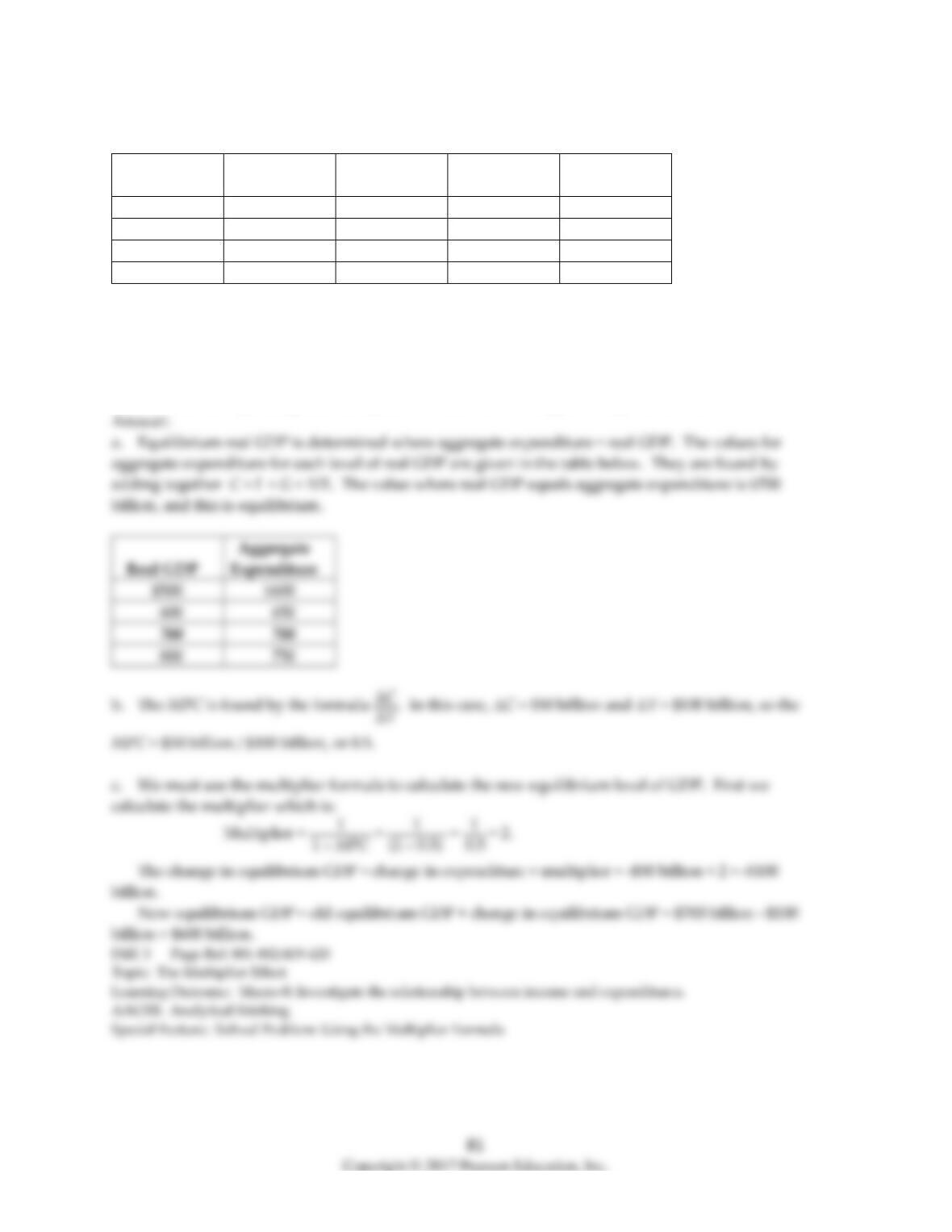
Table 12-13
Real GDP
Consumption
Planned
Investment
Government
Purchases
Net Exports
$500
$400
$100
$150
–$50
600
450
100
150
–50
700
500
100
150
–50
800
550
100
150
–50
43) Refer to Table 12-13. Using the table above, answer the following questions. The numbers in the
table are in billions of dollars.
a. What is the equilibrium level of real GDP?
b. What is the MPC?
c. If investment spending declines by $50 billion, what will happen to equilibrium GDP?
Real GDP
600
650
800
750
82
Table 12-14
Real GDP
Consumption
Planned
Investment
Government
Purchases
Net Exports
$1,000
$1,000
$100
$150
–$50
2,000
1,900
100
150
–50
3,000
2,800
100
150
–50
4,000
3,700
100
150
–50
44) Refer to Table 12-14. Using the table above, answer the following questions. The numbers in the
table are in billions of dollars.
a. What is the equilibrium level of real GDP?
b. What is the MPC?
c. If potential GDP is $4,000 billion, is the economy at full employment? If not, what is the condition of
the economy?
d. If the economy is not at full employment, by how much should government spending increase so
that the economy can move to the full employment level of GDP?
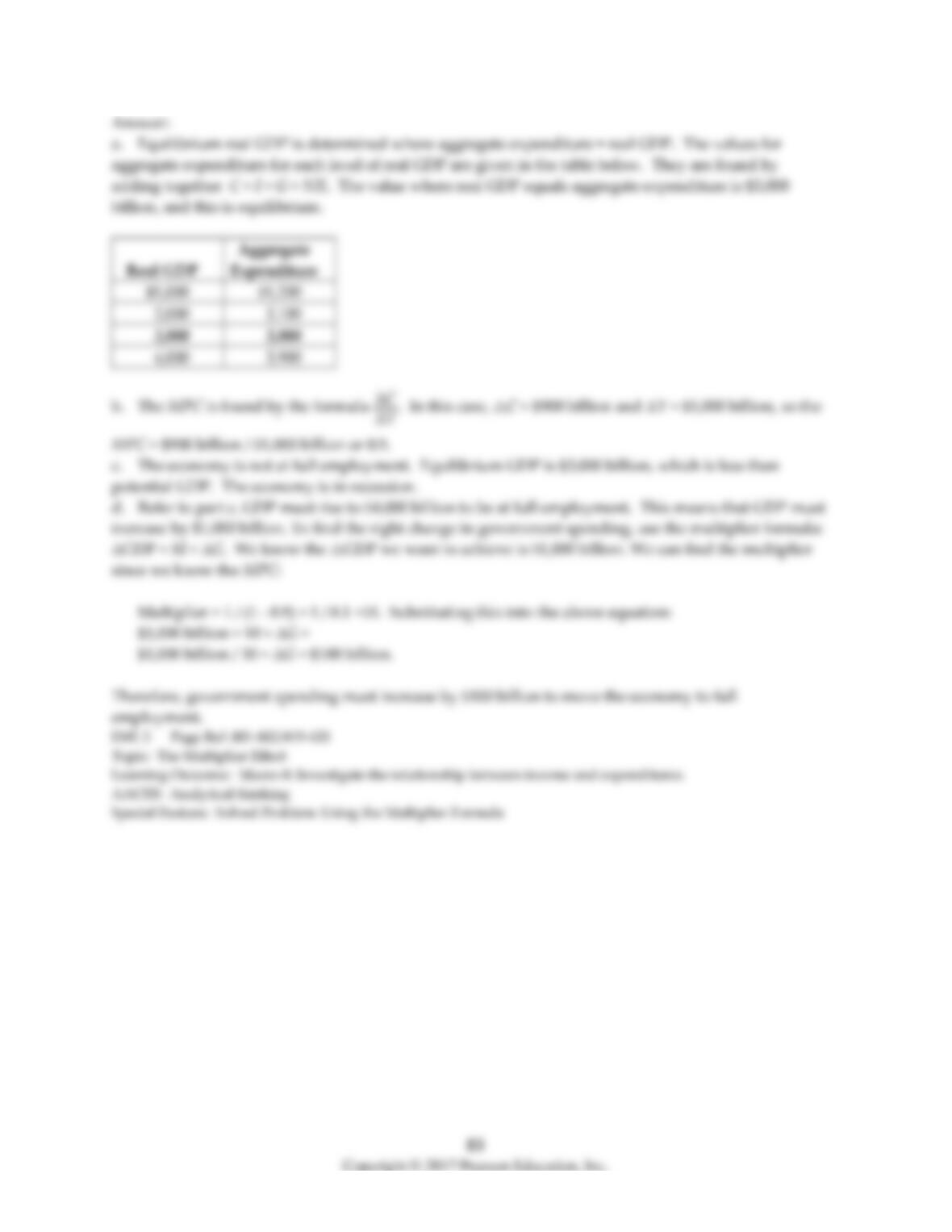
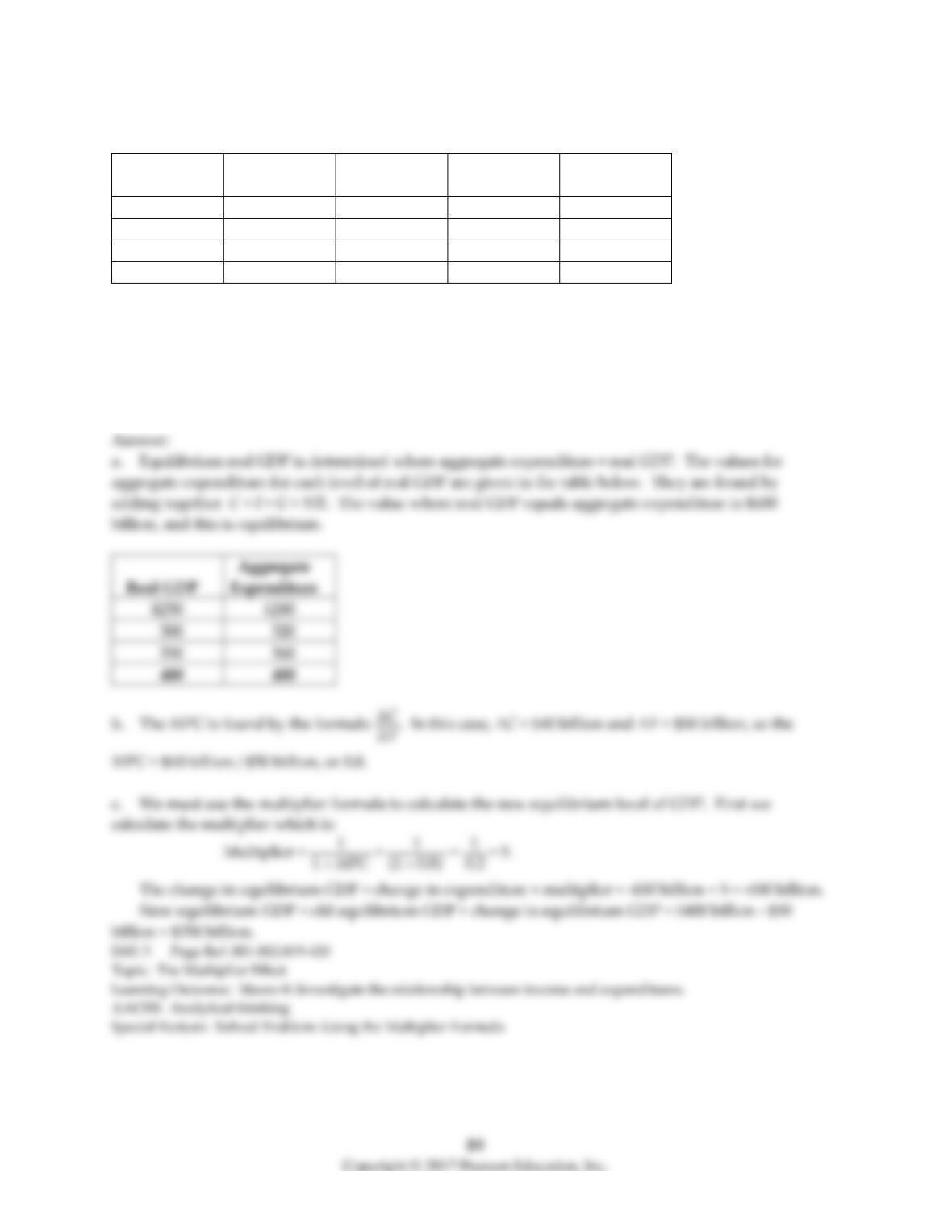
Table 12-15
Real GDP
Consumption
Planned
Investment
Government
Purchases
Net Exports
$250
$200
$40
$60
–$20
300
240
40
60
–20
350
280
40
60
–20
400
320
40
60
–20
45) Refer to Table 12-15. Using the table above, answer the following questions. The numbers in the
table are in billions of dollars.
a. What is the equilibrium level of real GDP?
b. What is the MPC?
c. If investment spending declines by $10 billion, what will happen to equilibrium GDP?
Real GDP
300
320
12.5 The Aggregate Demand Curve
1) The aggregate demand curve illustrates the relationship between ________ and the ________, holding
constant all other factors that affect aggregate expenditure.
A) the price level; quantity of planned aggregate expenditure
B) the inflation rate; quantity of planned aggregate expenditure
C) the price level; quantity of planned investment expenditure
D) the price level; quantity of consumption expenditure
2) Which of the following is a reason why decreases in the price level result in a rise in aggregate
expenditure?
A) Price level decreases cause firms and consumers to hold less money, which lowers the interest rate.
Lower interest rates raise consumption and planned investment expenditures, which raises aggregate
expenditure.
B) Price level decreases reduce real wealth, which causes consumption spending and aggregate
expenditure to rise.
C) As the price level falls, government spending rises, which raises aggregate expenditure.
D) Price level decreases in the United States relative to other countries‘ lower net exports, which raises
aggregate expenditure.
3) Which of the following correctly describes how an increase in the price level affects consumption
spending?
A) An increase in the price level raises real wealth, which causes consumption to increase.
B) An increase in the price level decreases the amount of money a household needs to buy goods and
raises the interest rate, which causes consumption to increase.
C) An increase in the price level increases the amount of money a household needs to buy goods and
raises the interest rate, which causes consumption to increase.
D) An increase in the price level lowers real wealth, which causes consumption to decrease.
4) An increase in the price level results in a(n) ________ in household consumption spending and a(n)
________ in investment spending.
A) increase; decrease
B) increase; increase
C) decrease; decrease
D) decrease; increase
5) What impact does a decrease in the price level in the United States have on net exports and why?
A) A decrease in the price level increases net exports because lower prices increase the value of the
dollar.
B) A decrease in the price level increases net exports by reducing the relative cost of American goods.
C) A decrease in the price level reduces net exports because lower prices raise the value of the dollar.
D) A decrease in the price level reduces net exports because lower prices increase American spending
on imports.
6) A decrease in the price level in the United States will have what effect on the aggregate expenditure
line?
A) Aggregate expenditure will shift downward.
B) Aggregate expenditure will become steeper.
C) Aggregate expenditure will shift upward.
D) Aggregate expenditure will not be affected by a decrease in the price level in the United States.
7) An increase in aggregate expenditure has what result on equilibrium GDP?
A) Equilibrium GDP rises.
B) Equilibrium GDP is not affected by an increase in aggregate expenditure.
C) Equilibrium GDP falls.
D) Equilibrium GDP may rise or fall depending on the size of the increase in aggregate expenditure
relative to the initial level of GDP.
8) The ________ illustrates the relationship between the price level and the quantity of planned
aggregate expenditure, holding constant all other factors that affect aggregate expenditure.
A) aggregate demand curve
B) savings line
C) 45-degree line
D) consumption function
9) Which of the following is a reason why increases in the price level result in a decline in aggregate
expenditure?
A) Price level increases raise real wealth, which causes consumption spending and aggregate
expenditure to decline.
B) Price level increases cause firms and consumers to hold more money, which raises the interest rate.
Higher interest rates lower consumption and planned investment expenditures, which lowers aggregate
expenditure.
C) Price level increases in the United States relative to other countries raise net exports, which lowers
aggregate expenditure.
D) As the price level rises, government spending falls, which lowers aggregate expenditure.
10) An increase in the price level ________ real wealth, which causes consumption to ________.
A) lowers; increase
B) lowers; decrease
C) raises; increase
D) raises; decrease
11) A decrease in the price level results in a(n) ________ in household consumption spending and a(n)
________ in investment spending.
A) increase; decrease
B) increase; increase
C) decrease; decrease
D) decrease; increase
12) What impact does an increase in the price level in the United States have on net exports and why?
A) An increase in the price level decreases net exports because higher prices decrease the value of the
dollar.
B) An increase in the price level decreases net exports by increasing the relative cost of American goods.
C) An increase in the price level increases net exports because higher prices lower the value of the
dollar.
D) An increase in the price level increases net exports because higher prices decrease American
spending on imports.
13) An increase in the price level in the United States will have what effect on the aggregate expenditure
line?
A) Aggregate expenditure will shift downward.
B) Aggregate expenditure will become steeper.
C) Aggregate expenditure will shift upward.
D) Aggregate expenditure will not be affected by an increase in the price level in the United States.
14) A decrease in aggregate expenditure has what result on equilibrium GDP?
A) Equilibrium GDP rises.
B) Equilibrium GDP is not affected by a decrease in aggregate expenditure.
C) Equilibrium GDP falls.
D) Equilibrium GDP may rise or fall depending on the size of the decrease in aggregate expenditure
relative to the initial level of GDP.
15) An increase in the price level in the United States will shift the aggregate expenditure line upward.
16) The aggregate demand curve shows the relationship between the price level and the level of
planned aggregate expenditure in the economy.
17) A rising price level decreases consumption by decreasing the real value of household wealth.
18) An decrease in the price level in the United States will shift the aggregate expenditure line
downward.
19) Why is the aggregate demand curve downward sloping while the aggregate expenditure line is
upward sloping?
20) What is the difference between aggregate expenditure and aggregate demand?
21) What impact does a higher price level have on interest rates, wealth, and investment spending?
12.6 Appendix: The Algebra of Macroeconomic Equilibrium
1) Equilibrium GDP is equal to
A) autonomous expenditure times the marginal propensity to consume.
B) autonomous expenditure times the marginal propensity to save.
C) autonomous expenditure times the multiplier.
D) autonomous expenditure.
2) Given the equations for C, I, G, and NX below, what is the equilibrium level of GDP?
C = 2,000 + 0.9Y
I = 2,500
G = 3,000
NX = 400
A) $4,333
B) $7,100
C) $8,778
D) $79,000
3) Given the equations for C, I, G, and NX below, what is the marginal propensity to consume?
C = 2,000 + 0.9Y
I = 2,500
G = 3,000
NX = 400
A) -0.1
B) 0.1
C) 0.9
D) 2000
92
4) If the consumption function is defined as C = 5,500 + 0.9Y, what is the autonomous level of
consumption expenditure?
A) $4,950
B) $5,500
C) $6,050
D) $6,111
5) If the consumption function is defined as C = 5,500 + 0.9Y, what is the value of the multiplier?
A) 0.1
B) 0.9
C) 9
D) 10
6) If the consumption function is defined as C = 7,250 + 0.8Y, what is the marginal propensity to save?
A) 0.2
B) 0.8
C) 5.8
D) 9.1
7) If the consumption function is defined as C = 7,250 + 0.8Y, what is the value of the multiplier?
A) 0.2
B) 0.8
C) 1.25
D) 5
8) If the consumption function is defined as C = 5,500 + 0.9Y, what is the value of the multiplier?
A) 0.l
B) 0.9
C) 6.1
D) 10
9) Equations for C, I, G, and NX are given below. If the equilibrium level of GDP is $32,000, what is the
marginal propensity to consume?
C = 5,000 + (MPC)Y
I = 1,500
G = 2,000
NX = -500
A) 0.67
B) 0.75
C) 0.8
D) 0.9
10) Equations for C, I, G, and NX are given below. If the equilibrium level of GDP is $32,000, what will
the new equilibrium level of GDP be if government spending increases to 2,500?
C = 5,000 + (MPC)Y
I = 1,500
G = 2,000
NX = -500
A) $32,500
B) $34,000
C) $38,000
D) $42,000
11) Autonomous expenditure times the multiplier equals
A) autonomous saving.
B) autonomous consumption.
C) equilibrium GDP.
D) planned autonomous investment.
12) Given the equations for C, I, G, and NX below, what is the equilibrium level of GDP?
C = 1,000 + 0.8Y
I = 1,500
G = 1,250
NX = 100
A) $3,080
B) $3,850
C) $6,930
D) $19,250
13) Given the equations for C, I, G, and NX below, what is the marginal propensity to consume?
C = 1,000 + 0.8Y
I = 1,500
G = 1,250
NX = 100
A) 0.2
B) 0.8
C) 1.8
D) 10
95
14) Given the equations for C, I, G, and NX below, what is the marginal propensity to save?
C = 1,000 + 0.8Y
I = 1,500
G = 1,250
NX = 100
A) 0.2
B) 0.8
C) 1.8
D) 10
15) If the consumption function is defined as C = 7,250 + 0.8Y, what is the autonomous level of
consumption expenditure?
A) $5,800
B) $7,250
C) $9,062.50
D) $9,700
16) If the consumption function is defined as C = 7,250 + 0.8Y, what is the marginal propensity to save?
A) 0.2
B) 0.8
C) 5.8
D) 7.25
96
17) If the consumption function is defined as C = 7,250 + 0.8Y, what is the multiplier?
A) 0.2
B) 0.8
C) 1.25
D) 5
18) If the consumption function is defined as C = 5,500 + 0.9Y, what is the marginal propensity to
consume?
A) 0.1
B) 0.9
C) 5.5
D) 6.1
19) Equations for C, I, G, and NX are given below. If the equilibrium level of GDP is $21,500, what is the
marginal propensity to consume?
C = 1,500 + (MPC)Y
I = 1,000
G = 2,000
NX = -200
A) 0.67
B) 0.75
C) 0.8
D) 0.9
20) If consumption is defined as C = 2,000 + 0.8Y, then the marginal propensity to save is 0.8.
97
21) If consumption is defined as C = 1,350 + 0.6Y, then the marginal propensity to consume is 0.6.
22) If consumption is defined as C = 2,400 + 0.9Y, then the marginal propensity to consume is 0.9.
23) If consumption is defined as C = 4,500 + 0.75Y, then the marginal propensity to save is 0.25.
24) C = 2,800 + 0.9Y
I = 750
G = 1,200
NX = 150
Given the equations for C, I, G, and NX above, what is the equilibrium level of GDP (Y)?
98
25) C = 3,600 + (MPC)Y
I = 1,200
G = 1,400
NX = -200
If the equilibrium level of GDP is $30,000, using the equations for C, I, G, and NX shown above, find the
26) C = 4,000 + 0.5Y
I = 1,500
G = 2,250
NX = -150
Given the equations for C, I, G, and NX above, what is the equilibrium level of GDP (Y)?
99
27) C = 2,550 + (MPC)Y
I = 800
G = 1,100
NX = 50
If the equilibrium level of GDP is $11,250, using the equations for C, I, G, and NX shown above, find the
value of the marginal propensity to consume.