
CHAPTER 12: THE COST OF CAPITAL, CAPITAL STRUCTURE, AND
DIVIDEND POLICY
1. The Institutional Brokers’ Estimate Service (IBES) summarizes analysts’ .
a. short-term earnings forecasts
b. long-term earnings growth rates
c. bankruptcy forecasts
d. short-term earnings forecasts and long-term earnings growth rates
2. Studies analyzing the historical returns earned by common stock investors have found that the returns from
average risk common stock investments over the years have averaged (arithmetically) percentage points
than the returns on Treasury bills.
a. 6 to 8, higher
b. 1 to 2, lower
c. 3 to 4, higher
d. 8 to 9, higher
3. The cost of equity capital for non-dividend paying stocks can be determined by
a. using the Capital Asset Pricing Model
b. estimating ke for comparable dividend-paying stocks in their industry
c. forecasting the liquidation proceeds from the sale of the company’s assets.
d. using the CAPM and by estimating ke for comparable dividend-paying stocks in their industry
4. For a company that is not planning to change its target capital structure, the proportions of debt and equity
used in calculating the weighted cost of capital should be based on the current weights of the individual
components.
a. book value
b. market value
c. replacement value
d. accounting value
5. The cost of capital is
a. the rate of return required by investors in the firm’s securities
b. the minimum rate of return required on new investments of high risk undertaken by the firm
c. approximately 10 percent for most firms
d. concerned with plant and equipment only

Chapter 12: The Cost of Capital, Capital Structure, and Dividend Policy
6. A firm can raise up to $700 million for investment from a mixture of debt, preferred stock and retained equity.
Above $700 million, the firm must issue new common stock. Assuming that debt costs and preferred stock
costs remain unchanged, the marginal cost of capital for amounts up to $700 million will be the marginal
cost of capital for amounts over $700 million.
a. less than
b. equal to
c. greater than
d. cannot be determined from the information given
7. The CAPM assumes that the only risk of concern to the investor is , which is measured by .
a. Unsystematic risk, beta
b. Systematic risk, the return to the market portfolio
c. Systematic risk, beta
d. Unsystematic risk, the return to the market portfolio
8. If a firm adopts a large proportion of above-average-risk investment projects that are not offset by below-
average-risk investment projects
a. its cost of capital will rise
b. the average risk premium for the firm will decline
c. the risk-free rate will increase as more risk is added
d. its cost of capital will fall
9. The most appropriate weights to use in calculating a firm’s cost of capital are the proportions of the
components in the firm’s capital structure.
a. historical average
b. long-range target
c. current
d. industry average
10. For firms subject to the 34% marginal tax rate, the after-tax cost of is roughly two-thirds the cost of
preferred stock.
a. retained earnings
b. new common stock
c. long-term debt
d. retained earnings and new common stock

Chapter 12: The Cost of Capital, Capital Structure, and Dividend Policy
11. There are four major components that determine the risk premium. They include all the following except
a. interest rate risk
b. business risk
c. reinvestment rate risk
d. financial risk
12. The required rate of return on any security consists of a
a. risk premium plus an expected inflation rate
b. risk free rate plus a risk premium
c. inflation rate plus a marketability premium
d. risk free rate plus an inflation premium
13. All of the following are true EXCEPT:
a. The claims of preferred stockholders on the firm’s earnings are junior to those of debt-holders.
b. The risk of recapitalization increases a firm’s required rate of return.
c. Long-term state government securities are always less risky than corporate long-term securities of the same
maturity.
d. The cost of capital to the firm is equal to the equilibrium rate of return demanded by investors in the capital
markets for securities with that degree of risk
14. Break points can be determined by dividing the amount of funds available from each financing source at a
fixed cost by the proportion for that financing source.
a. weighted capital structure
b. target capital structure
c. economic capital structure
d. divisional capital structure
15. If a preferred stock is callable, then the calculation of the cost of preferred stock financing is
a. similar to that for bonds
b. equal to Dp/Pn
c. equal to Dp less flotation costs
d. less than Dp/Pn

Chapter 12: The Cost of Capital, Capital Structure, and Dividend Policy
16. The constant growth valuation model approach to calculating the cost of equity assumes that
a. earnings and dividends grow at a constant rate, but stock price growth is indeterminate
b. the growth rate is greater than or equal to ke
c. dividends are constant
d. earnings, dividends, and stock price will grow at a constant rate
17. The total return to stockholders, ke, is composed of the
a. opportunity cost plus a risk premium
b. dividend yield plus the price appreciation of the security
c. opportunity cost plus an inflation premium
d. dividend yield minus the risk premium
18. If a firm is losing money then the after-tax cost of debt is
a. equal to kd(1 – T)
b. found by trial and error
c. equal to the pretax cost of debt
d. equal to the yield to first call date
19. The historic beta of a firm is of little use as a forecast of the firm’s future systematic risk characteristics when
a. the firm is growing at a rate of 7-10 percent a year
b. the firm is expanding an existing product line
c. the firm is expanding into a new product line
d. all of these answers are correct
20. All of the following methods may be used to determine the cost of equity capital (ke) for a non-dividend-
paying stock except
a. the risk premium on debt approach
b. the Capital Asset Pricing Model approach
c. comparing with similar dividend-paying stocks in the industry
d. the simulation with growth expectations approach

Chapter 12: The Cost of Capital, Capital Structure, and Dividend Policy
21. The cost of external equity is greater than the cost of internal equity because
a. it decreases the earnings per share
b. it increases the market price of the stock
c. of the flotation costs
d. dividends are increased
22. Retained earnings are a cheaper source of funds than the sale of new equity because
a. retention defers the payment of taxable dividends to shareholders
b. there are no flotation costs
c. new shares are usually priced below current market price
d. all these
23. Historic average capital costs are new (marginal) resource allocation decisions.
a. not relevant for making
b. very useful when making
c. necessary for making
d. the relevant costs for making
24. Which of the following is not a typical source of debt funds for a small firm?
a. investment banking firms
b. commercial finance companies
c. Small Business Administration
d. leasing companies
25. If a firm will use only equity funds during the current capital budgeting period then the is the correct
capital cost to use for computing the cost of funds for the firm.
a. cost of equity capital
b. weighted cost of funds
c. historical cost of funds
d. all of these answers are correct

Chapter 12: The Cost of Capital, Capital Structure, and Dividend Policy
26. The optimal capital budget is determined by comparing the expected project returns to the company’s
a. computed break points
b. cost of equity schedule
c. marginal cost of capital schedule
d. optimal opportunity curve
27. The cost of depreciation-generated funds is equal to
a. the cost of equity capital
b. zero, because depreciation is a non-cash expense
c. the investment opportunity cost
d. the weighted cost of capital
28. refers to the variability in the firm’s operating earnings.
a. Business risk
b. Financial risk
c. Marketability risk
d. Interest rate risk
29. The major components that determine the risk premium on a specific security at any point in time include all
of the following except
a. business risk
b. financial risk
c. interest rate risk
d. real rate of return risk
30. Rank in ascending order (lowest to highest) the relative riskiness of the various types of corporate and
government securities.
a. common stock, preferred stock, corporate debt, long-term government debt
b. corporate debt, long-term government debt, preferred stock, common stock
c. long-term government debt, corporate debt, preferred stock, common stock
d. corporate debt, preferred stock, long-term government debt, common stock

Chapter 12: The Cost of Capital, Capital Structure, and Dividend Policy
31. Rank in ascending order (lowest to highest) investors’ required rates of return on the various types of
corporate securities.
a. preferred stock, corporate debt, common stock
b. common stock, preferred stock, corporate debt
c. preferred stock, common stock, corporate debt
d. corporate debt, preferred stock, common stock
32. Which of the following statements (if any) is (are) true concerning companies that do not pay dividends?
a. The cost of equity capital can be estimated using the Capital Asset Pricing Model.
b. The cost of equity capital is equal to the growth short-term rate of earnings per share.
c. The dividend capitalization model can be used to determine an accurate cost of equity capital.
d.
The cost of equity capital cannot be determined by using the CAPM, the risk premium on debt approach, or
by estimating k e for comparable dividend-paying stocks in their industry.
33. The optimal capital budget is indicated by the point at which the and the intersect.
a. depreciation schedule; investment opportunity schedule
b. investment opportunity curve; marginal cost of capital curve
c. investment opportunity curve; average cost of capital curve
d. efficient portfolio curve; marginal cost of capital curve
34. During the 1980s, the cost of capital for U.S. firms averaged about 3.3 percentage points higher than Japanese
firms. During 1990 this disadvantage may have disappeared due to:
a. higher exports to the U.S.
b. higher real interest rates in Japan
c. larger shareholder interest
d. higher Japanese stock market
35. If a firm sells assets, generating cash flows, the cost of these funds is .
a. the firm’s cost of equity
b. the firm’s cost of cash flows
c. the firm’s weighted cost of capital
d. zero
Chapter 12: The Cost of Capital, Capital Structure, and Dividend Policy
36. Small firms are reluctant to obtain capital through the sale of common stock because of:
a. potential loss of voting control
b. high issuance costs
c. high cost of debt
d. both the potential loss of voting control and the high issuance costs
37. Determine the (after-tax) percentage cost of a $50 million debt issue that the Mattingly Corporation is
planning to place privately with a large insurance company. Assume that the company has a 40% marginal tax
rate. This long- term debt issue will yield 12% to the insurance company.
a. 4.8%
b. 7.2%
c. 12.0%
d. 10.6%
38. Calculate the after-tax cost of preferred stock for Ohio Valley Power Company, which is planning to sell $100
million of $3.25 cumulative preferred stock to the public at a price of $25 per share. Flotation costs are $1.00
per share. Ohio Valley has a marginal income tax rate of 40%.
a. 13.0%
b. 7.8%
c. 8.12%
d. 13.54%
39. The Allegheny Valley Power Company common stock has a beta of 0.80. If the current risk-free rate is 6.5%
and the expected return on the stock market as a whole is 16%, determine the cost of equity capital for the
firm (using the CAPM).
a. 14.1%
b. 7.6%
c. 6.5%
d. 13.0%
Chapter 12: The Cost of Capital, Capital Structure, and Dividend Policy
40. The following financial information is available on Rawls Manufacturing Company:
Current per share market price $48.00
Current (t = 0) per share dividend $3.50
Expected long-term growth rate 5.0%
Rawls can issue new common stock to net the company $44 per share. Determine the cost of internal equity
capital using the dividend capitalization model approach. (Compute answer to the nearest 0.1%.)
a. 12.3%
b. 13.4%
c. 13.0%
d. 12.7%
41. The following financial information is available on Rawls Manufacturing Company:
Current per share market price
$48.00
Beta
1.1
Expected rate of return on market
12.0%
Risk-free rate
6.0%
Rawls can issue new common stock to net the company $44 per share. Determine the cost of internal equity
capital using the capital asset pricing model approach. (Compute answer to the nearest 0.1%.)
a. 12.9%
b. 12.6%
c. 13.0%
d. 11.8%
Chapter 12: The Cost of Capital, Capital Structure, and Dividend Policy
42. The following financial information is available on Rawls Manufacturing Company:
Current per share market price
$48.00
Current per share dividend
$3.50
Current per share earnings
$6.00
Beta
1.1
Expected rate of return on market
12.0%
Risk-free rate
6.0%
Expected long-term growth rate
5.0%
Rawls can issue new common stock to net the company $44 per share. Determine the cost of external equity
capital using the dividend capitalization model approach. (Compute answer to the nearest 0.1%.)
a. 12.7%
b. 14.4%
c. 12.6%
d. 11.4%
43. Determine the weighted cost of capital for the Mills Company that will finance its optimal capital budget with
$120 million of long-term debt (kd = 12.5%) and $180 million in retained earnings (ke = 16.0%). Mills’
present capital structure is considered optimal. The company’s marginal tax rate is 40%. (Compute answer to
nearest 0.1%.)
a. 14.3%
b. 12.6%
c. 14.6%
d. 11.9%
44. What is the cost of a preferred stock with a $100 par value that pays a $9.60 dividend per year? The security
has a flotation cost of $3.37 and will be retired at its par value in 20 years.
a. 9.6%
b. 9.9%
c. 10.0%
d. 10.6%
Chapter 12: The Cost of Capital, Capital Structure, and Dividend Policy
45. What is the cost of equity for East Roon, if the firm is expected to always pay a constant dividend of $2.22?
The firm’s common stock is presently selling for $18.50.
a. 8.3%
b. 12.0%
c. 10.2%
d. cannot be determined from the information given
46. According to Value Line, Bestway has a beta of 1.15. If 3-month Treasury bills currently yield 7.9 percent and
the market risk premium is estimated to be 8.3 percent, what is Bestway’s cost of equity capital?
a. 17.45%
b. 8.36%
c. 9.55%
d. 16.2%
47. Northeast Airlines (NA) has a current dividend of $1.80. Dividends are expected to grow at a rate of 7 percent
a year into the foreseeable future. What is NA’s cost of external equity if its stock can be sold to net $46 a
share?
a. 10.9%
b. 11.2%
c. 7.2%
d. 21.0%
48. A firm with a 40 percent marginal tax rate has a capital structure of $60,000,000 in debt and $140,000,000 in
equity. What is the firm’s weighted cost of capital if the marginal pretax cost of debt is 12 percent, the firm’s
average pretax cost of debt outstanding is 8%, and the cost of equity is 14.5 percent?
a. 13.75%
b. 11.59%
c. 12.31%
d. 10.45%
Chapter 12: The Cost of Capital, Capital Structure, and Dividend Policy
49. Crickentree has a target capital structure of 30 percent debt and 70 percent equity. If the firm expects to have a
net income of $1.7 million and a dividend payout ratio of 40 percent, what will be its equity break point?
a. $2,428,571
b. $1,457,143
c. $3,400,000
d. $971,429
50. Easy Slider Inc. sold a 15 year $1,000 face value bond with a 10 percent coupon rate. Interest is paid annually.
After flotation costs, Easy Slider received $928 per bond. Compute the after-tax cost of debt for these bonds if
the firm’s marginal tax rate is 40 percent.
a. 6.0%
b. 7.2%
c. 7.8%
d. 6.6%
51. Alpha Products maintains a capital structure of 40 percent debt and 60 percent common equity. To finance its
capital budget for next year, the firm will sell $50 million of 11 percent debentures at par and finance the
balance of its $125 million capital budget with retained earnings. Next year Alpha expects net income to grow
7 percent to $140 million, and dividends also are expected to increase 7 percent to $1.40 per share and to
continue growing at that rate for the foreseeable future. The current market value of Alpha’s stock is $30. If
the firm has a marginal tax rate of 40 percent, what is its weighted cost of capital for the coming year?
a. 9.64%
b. 8.63%
c. 9.84%
d. 11.67%
Chapter 12: The Cost of Capital, Capital Structure, and Dividend Policy
52. Wellington Gas has a target capital structure of 50 percent common equity, 40 percent debt, and 10 percent
preferred stock. The cost of retained earnings is 16 percent, and the cost of new equity (external) is 16.7
percent. Wellington can sell debentures that will have an after-tax cost of 8.3 percent and the after-tax cost of
preferred stock will be 11.9 percent. What is the marginal cost of capital before and after the break point?
a. 12.51% and 12.86%
b. 11.18% and 11.53%
c. 14.23% and 14.68%
d. 12.51% and 11.53%
53. GQ earned $740,000 before taxes this year. The firm has a debt ratio of 30 percent, a marginal tax rate of 35
percent, and a dividend payout ratio of 40 percent. GQ has no preferred stock. What is GQ’s break point for
equity?
a. $634,286
b. $962,000
c. $412,286
d. $288,600
54. Groves, Inc. pays an annual dividend of $1.22. This dividend is expected to continue growing at a rate of
about 5 percent each year. The firm is in a fairly risky business and has a beta of 1.45. The expected market
rate of return is 13.5 percent, and the risk-free rate is 9.3 percent. What is the cost of equity for Groves?
a. 19.6%
b. 13.5%
c. 15.4%
d. 6.1%
Chapter 12: The Cost of Capital, Capital Structure, and Dividend Policy
55. PDQ Inc. has a weighted cost of capital of 14.6 percent and has an opportunity to invest in the following
average risk projects:
Project Cost Annual Cost Flow Project life
1
$10,000
$1,992.43
10 years
2
$21,000
$4,526.84
8 years
3
$18,500
$4,580.34
7 years
In which projects should PDQ invest? Assume no capital rationing.
a. 1 & 2
b. 2 & 3
c. 1 & 3
d. cannot be determined from the information provided
56. Mid-South Utilities will sell $10 million of $100 par value preferred stock that will pay an annual dividend of
$9.75. Mid-South will receive $93.98 per share after flotation costs. If the issue must be retired in 20 years,
what is the cost of the preferred issue?
a. 10.37%
b. 10.50%
c. 10.23%
d. 9.75%
57.
Witin’s stock price is currently $34.25 and the current quarterly dividend is $0.25. Consensus estimates for
Witin indicate a growth rate in earnings of 10% into the foreseeable future. If Witin plans to sell 1 million
shares to raise new capital for expansion, what is the cost of new equity if the issuance costs are 8%?
a. 13.49%
b. 10.87%
c. 13.21%
d. 13.17%
51.31
Chapter 12: The Cost of Capital, Capital Structure, and Dividend Policy
58.
Weltron has a target capital structure of 35% debt and 65% equity. If the firm expects net income of $12.3
million
and an annual dividend of $0.12 per share, what is the expected equity break point? There are 12
million shares outstanding.
a. $18,923,076
b. $16,707,692
c. $10,061,538
d. $2,215,385
59.
Pluega Inc. issued a $100 million 8.27% coupon debenture bond due in the next 20 years. The bonds each
sold for $996. If the bonds pay interest semi-annually, what is Pluega’s after cash cost of debt? Assume 40%
tax rate.
a. 4.96%
b. 8.30%
c. 4.99%
d. 3.32%
60.
Haulsee Inc. pays no dividend currently but is expected to start paying a small dividend next year. The 5-year
old firm has a beta of 1.25 and current earnings of $0.90 per share. The current Treasury bill rate is 6.10% and
the market risk premium is 8.8%. Determine Haulsee’s cost of equity if the firm’s tax rate is 40%.
a. 9.48%
b. 17.1%
c. 14.9%
d. cannot determined from the information provided
Chapter 12: The Cost of Capital, Capital Structure, and Dividend Policy
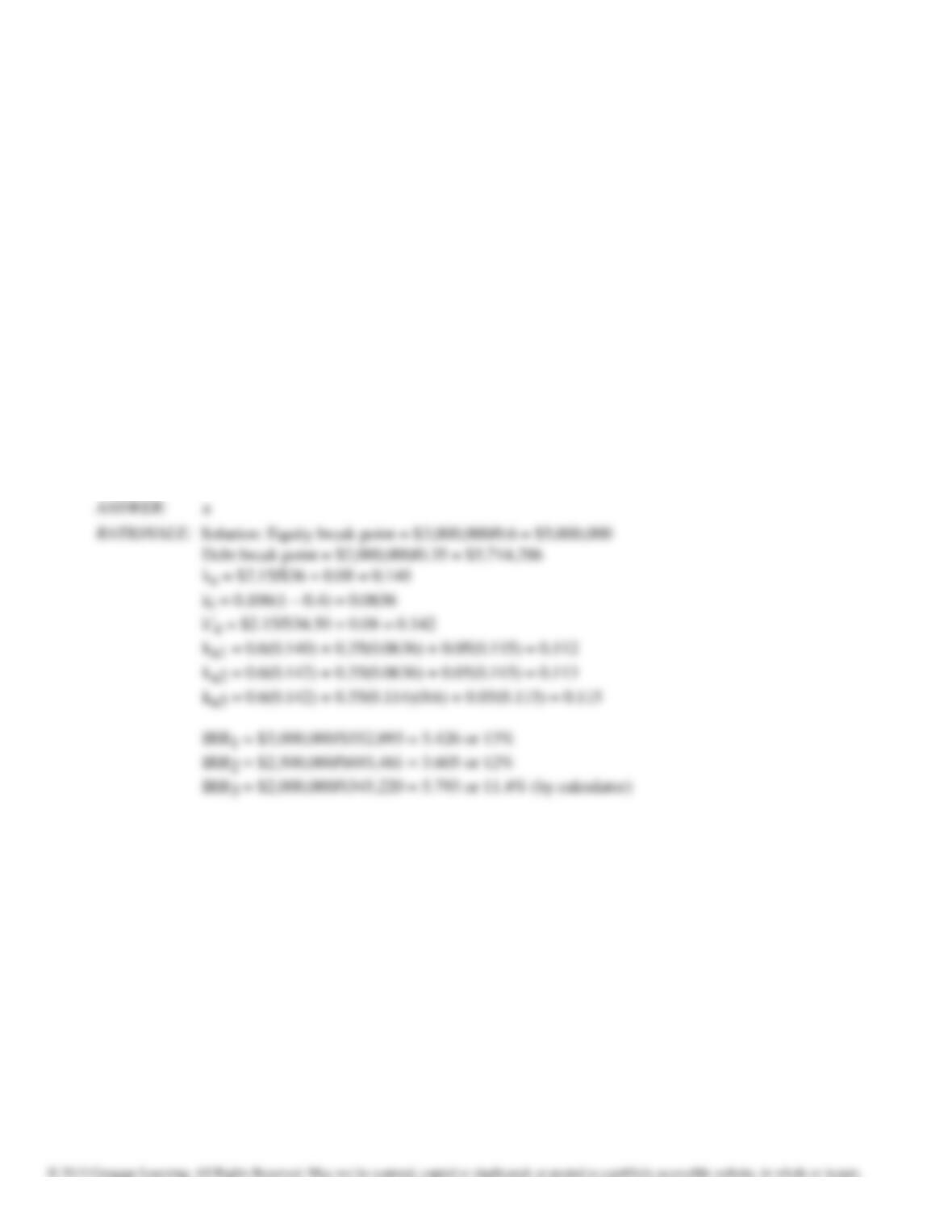
61. Sharp’s current capital structure of 60 percent equity, 35 percent debt, and 5 percent preferred stock is
considered optimal. This year Sharp expects to have earnings after tax of $3.6 million and to pay out $600,000
in dividends. Sharp can also raise up to $2 million in long-term debt at a pretax interest rate of 10.6 percent
(all debt over $2 million will cost 11.4% pretax), and sell preferred stock at a cost of 11.5 percent. Sharp’s
marginal tax rate is 40 percent. The current value of Sharp’s common stock is $36 and a dividend of $2.15 is
expected to be paid during the coming year. Dividends have been growing at an annual compound rate of 8
percent a year and are expected to continue growing at that rate. New shares can be sold to net the firm
$34.50. Sharp has an opportunity to invest in the following capital projects. Which one(s) should be accepted?
Project Cost Annual Cash Flow Project Life
1
$3.0 million
$552,893
10 years
2
$2.5 million
$693,481
5 years
3
a. 1 and 2
$2.0 million
$345,220
10 years
b. 1 and 3
c. 1, 2, and 3
d. cannot be determined from the information provided
Chapter 12: The Cost of Capital, Capital Structure, and Dividend Policy
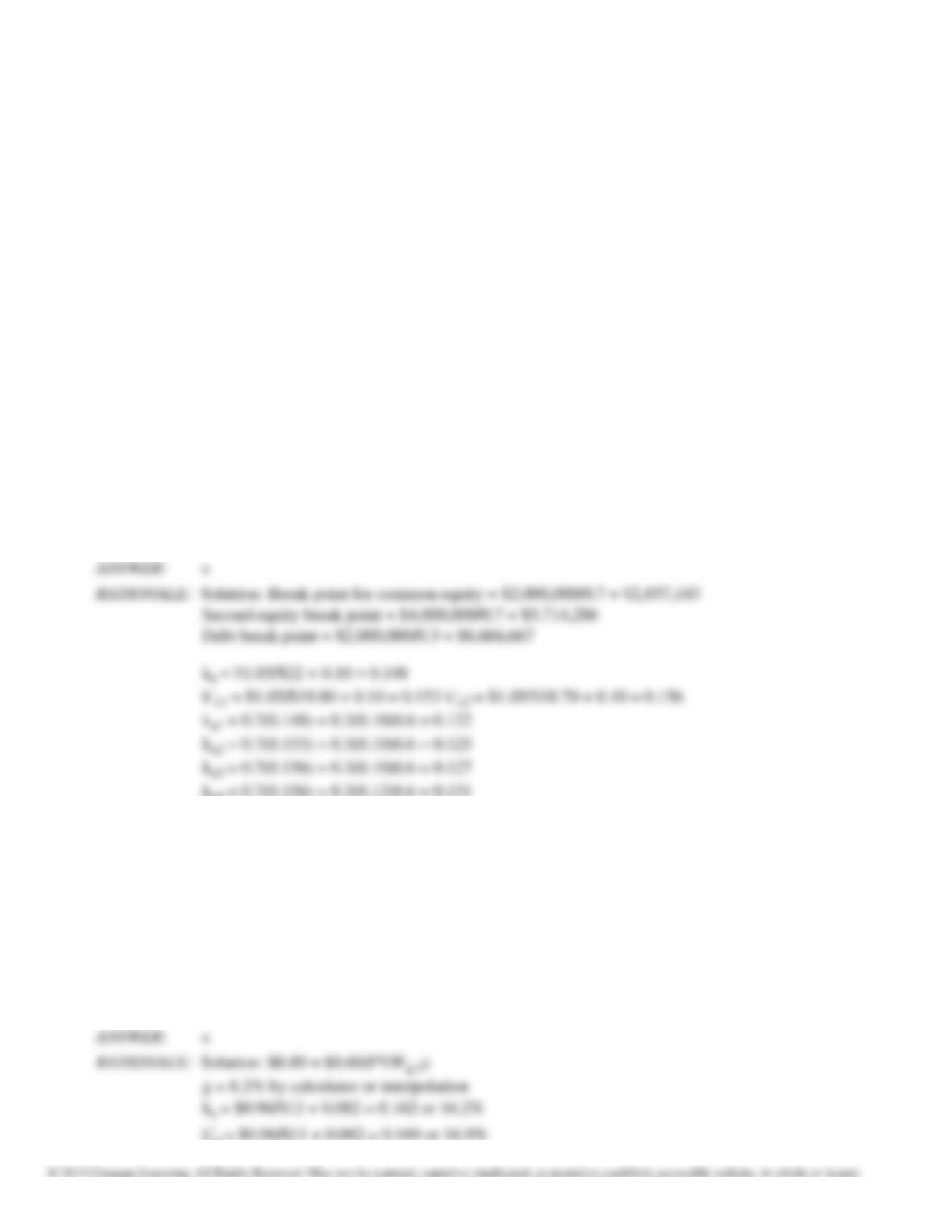
62. Far Out Tech (FOT) has a debt ratio of 0.3 and it considers this to be its optimal capital structure. FOT has no
preferred stock. FOT has analyzed four capital projects for the coming year as follows:
Project
Net Investment
IRR
1
$3,000,000
13.5%
2
$1,500,000
18.0%
3
$2,000,000
12.6%
4
$1,600,000
16.0%
FOT expects to earn $2.7 million after tax next year and pay out $700,000 in dividends. Dividends are
expected to be $1.05 a share during the coming year and are expected to grow at a constant rate of 10 percent
a year for the foreseeable future. The current market price of FOT stock is $22 and up to $2 million in new
equity can be raised for a flotation cost of 10 percent. If more than $2 million is sold then the flotation cost
will be 15 percent. Up to $2 million in debt can be sold at par with a coupon rate of 10 percent. Any debt over
$2 million will carry a 12 percent coupon rate and be sold at par. If FOT has a marginal tax rate of 40 percent,
in which projects should it invest?
a. 1, 2, 3, & 4
b. 2
c. 1, 2, and 4
d. 2 and 4
63. Temple Company’s common stock dividends have grown over the past 5-year period from $0.60 per share to
$0.89 (today). Assume that Temple’s dividends are expected to grow at this rate for the foreseeable future.
Temple’s stock is currently selling for $12 per share. New common stock can be sold to net the company $11
per share. Determine the costs of internal and external equity to Temple.
a. 18.1%; 18.9%
b. 15.9%; 16.6%
c. 16.2%; 16.9%
d. 15.9%; 18.9%