b.
3
c.
4
d.
5
94. A decrease in the marginal product of labor would be represented by
a.
increase in labor demand.
b.
decrease in labor demand.
c.
increase in the quantity demanded of labor.
d.
decrease in the quantity demanded of labor.
e.
an increase in wages.
95. Suppose a change in technology increases the marginal product of labor. The result is
a.
a downward movement along the demand for labor curve.
b.
a rightward shift in the demand for labor curve.
c.
a leftward shift in the demand for labor curve.
d.
an upward movement along the demand for labor curve.
96. A technological advance that increases labor productivity will
a.
lower wages.
b.
decrease the demand for labor as fewer workers are needed.
c.
decrease the supply of labor as fewer workers are needed.
d.
increase the demand for labor as MP rises.
e.
decrease the demand for labor as MP falls.
97. The value marginal product of a resource is
a.
the marginal product of the resource multiplied by the price of the product it helps to
produce.
b.
the price of the product times the price of the resource.
c.
larger when the product price is smaller.
d.
larger when the marginal product is smaller.
98. The marginal revenue product of a resource is equal to the value of marginal product when the product
produced by the resource is sold in
a.
a competitive price-taker market.
b.
a competitive price-searcher market.
c.
an oligopolistic market.
d.
a monopolistic industry.
Use the information in the table below to answer the following question(s). The firm hires labor
competitively and sells its product in a competitive price-taker market.
Table 12-6
Units of Labor
Total Output
Product
(per day)
(dollars)
Price
1
15
6
2
30
6
3
40
6
4
48
6
5
54
6
6
59
6
7
62
6
99. Refer to Table 12-6. What is the marginal revenue product of the fifth unit of labor?
a.
$6
b.
$36
c.
$54
d.
$324
100. Refer to Table 12-6. If the market wage rate is $25 per day, how many workers should the firm hire if
it wants to maximize profits?
a.
4
b.
5
c.
6
d.
7
101. Harold Brown runs a company that sells encyclopedia sets for $250 each. When he employs 10
workers, they can sell 60 sets per week, while only 54 sets are sold when 9 workers are employed.
What is the weekly marginal revenue product of the tenth worker?
a.
$250
b.
$1,250
c.
$1,500
d.
$15,000

102. Jim Smith runs a company that sells encyclopedia sets for $200 each. When he employs 5 workers,
they can sell 20 sets per week, while only 17 sets are sold when 4 workers are employed. If the wage
of workers in this skill category is $500 per week, should the fifth worker be hired?
a.
No, because the MRP of the fifth worker is less than $500 per week.
b.
No, because the MRP of the fifth worker is more than $500 per week.
c.
Yes, because the MRP of the fifth worker is less than $500 per week.
d.
Yes, because the MRP of the fifth worker is more than $500 per week.
103. The following schedule shows how many jars of Jaynie’s Jam can be produced daily with various
amounts of labor (assume that the jam is sold in a competitive price-taker market).
Workers per Day
1
2
3
4
5
6
7
8
Total Output per Day
11
23
36
47
56
63
69
74
If Jaynie must pay each worker $65 per day and she can sell her jam for $10 per jar, how many
workers should she hire if she wants to maximize profits?
a.
3
b.
4
c.
5
d.
6
104. Use the table to answer the following question.
Number of
Marginal Physical
Product
Workers
Product
Price
1
55
5
2
49
5
3
43
5
4
37
5
5
31
5
6
25
5
If the market wage rate is $150 per worker, how many workers should be employed if the firm wants
to maximize profit?
a.
3
b.
4
c.
5
d.
6
105. Use the table to answer the following question.
Number of
Marginal Product
Product
Workers
of Labor (per week)
Price
1
60
4
2
54
4
3
48
4
4
42
4
5
37
4
6
32
4
If the market wage rate is $130 per week, how many workers should be employed if the firm wants to
maximize profit?
a.
3
b.
4
c.
5
d.
6 or more
106. The following figure indicates the reductions in total losses due to theft if a jewelry store hires
additional security guards.
Number
Dollar Value of
of Guards
Thefts Prevented
1
150
2
240
3
310
4
360
5
400
6
430
If the security guards can be hired for $45 per day, how many guards should the shop hire?
a.
2
b.
3
c.
4
d.
5
e.
6
107. The following table indicates the reductions in total losses due to theft if a jewelry store hires
additional security guards.
Number
Dollar Value of
of Guards
Thefts Prevented
1
150
2
240
3
310
4
370
5
420
6
460
If the security guards can be hired for $65 per day, how many guards should the shop hire?
a.
3
b.
4
c.
5
d.
6
108. The following table provides information for Harry’s Hammers, a firm that hires labor competitively
and sells hammers for $50 each in a competitive price-taker market.
Units
Output of
of Labor
Hammers (per week)
1
14
2
26
3
37
4
46
5
53
6
58
7
62
If the market wage rate is $225 per week, how many units of labor would a profit-maximizing firm
employ?
a.
4
b.
5
c.
6
d.
7
109. Assume that skilled labor costs twice as much as unskilled labor, a profit-maximizing firm will
a.
always hire more skilled labor because it is more productive.
b.
always hire more unskilled labor because it is cheaper.
c.
hire until it equalizes the two marginal products.
d.
hire until the marginal product of unskilled labor is one-half that of skilled labor.
e.
hire until the marginal product of unskilled labor is two times that of skilled labor.
110. A profit-maximizing farmer will apply additional units of fertilizer until the marginal revenue product
(MRP) of fertilizer is half the MRP of skilled labor when a unit of fertilizer
a.
costs twice as much as a unit of skilled labor.
b.
costs half as much as a unit of skilled labor.
c.
is half as productive, on average, as a unit of skilled labor.
d.
is twice as productive, on average, as a unit of skilled labor.
111. Suppose a U.S. automotive manufacturer was considering moving to Mexico to take advantage of the
lower wage rates for unskilled Mexican labor. The typical Mexican worker could produce 20 cars per
day, while the firm’s typical U.S. worker can produce 50 cars per day. If the firm currently pays its
U.S. workers an hourly wage of $25, economic theory suggests that the firm should
a.
move to Mexico if the Mexican hourly wage is less than $25.
b.
move to Mexico if the Mexican hourly wage is $15.
c.
move to Mexico if the Mexican hourly wage is $12.
d.
only move to Mexico if the Mexican hourly wage is less than $10.
112. The labor supply curve is fundamentally a representation of the trade-off people face between which of
the following?
a.
work and wage
b.
work and leisure
c.
wage and productivity
d.
technology and wage
113. What happens to labor supply in the pear-picking market when the wage paid to apple pickers
increases?
a.
The labor supply will stay unchanged until the wages paid to pear pickers change.
b.
The labor supply will decrease.
c.
The labor supply will increase.
d.
The labor supply may fall or rise, depending on the price of pears.
114. The labor supply curve reflects how
a.
workers’ decisions about the labor-leisure tradeoff respond to a change in the wage.
b.
workers’ decisions about the opportunity cost of labor respond to a change in the quantity
of labor supplied.
c.
firms’ decisions about the labor-leisure tradeoff respond to the quantity of labor demanded.
d.
firms’ decisions about how the quantity of labor they hire respond to changes in their
opportunities to earn profits.
115. At a low wage rate,
a.
there is no substitution effect.
b.
there is no income effect.
c.
the substitution effect usually outweighs the income effect.
d.
the income effect usually outweighs the substitution effect.
e.
the disutility of market work is usually high.
116. Unions often attempt to obtain stricter certification requirements and/or longer apprenticeships. These
changes will tend to raise union workers’ wages because they
a.
create unnecessary unemployment.
b.
shift the labor supply curve leftward.
c.
decrease the marginal product of labor.
d.
increase the demand for the product.
117. Generally, the supply of a resource in the short run will be
a.
more elastic than in the long run.
b.
less elastic than in the long run.
c.
equally elastic as the supply of the resource in the long run.
d.
directly related to the elasticity of demand for the product that the resource helps produce.
118. The supply of a resource, such as oil, is likely to be
a.
equally elastic in both the short and long run.
b.
more elastic in the long run than in the short run.
c.
more elastic in the short run than in the long run.
d.
determined by the demand for the resource.
119. The supply curve of a human resource will be more elastic the
a.
easier it is to obtain the skill and knowledge necessary to provide the resource.
b.
more elastic the demand for the product.
c.
more inelastic the demand for the product.
d.
higher the skill level necessary to perform the job.
120. The supply of human capital to a particular use is
a.
perfectly inelastic in the short run.
b.
perfectly elastic in the long run.
c.
more inelastic in the short run since it takes time for persons to acquire a particular skill.
d.
more elastic in the short run since individuals who already possess the particular skill can
be attracted into the labor force in the short run.

121. The supply of both physical and human resources in the long run is determined primarily by
a.
the presence or absence of economies of scale.
b.
investment choices and resource depreciation.
c.
sunk costs; what happens in the present cannot change the future.
d.
the law of diminishing marginal returns.
122. An increase in the demand for a resource
a.
will cause the price of that resource to fall.
b.
may be the result of a decrease in the demand for products utilizing this resource.
c.
will cause the price of the resource to fall by a smaller amount in the short run than in the
long run.
d.
will increase the price of the resource and, thereby, increase the incentive of potential
suppliers to provide the resource in the future.
123. The supply curve of truck drivers is upward sloping and demand curve is downward sloping. A
reduction in the price of hauling freight by truck relative to the price of hauling freight by rail will
____ the equilibrium wage of truck drivers and ____ the number of drivers employed.
a.
decrease; decrease
b.
decrease; increase
c.
increase; decrease
d.
increase; increase
124. Consider the labor market for nurses, which initially is in equilibrium. Suppose the output price for
nursing services increases. Holding all else equal, what effect will this have on the labor market for
nurses?
a.
The equilibrium wage will increase, and the equilibrium quantity of nurses will increase.
b.
The equilibrium wage will increase, and the equilibrium quantity of nurses will decrease.
c.
The equilibrium wage will decrease, and the equilibrium quantity of nurses will increase.
d.
The equilibrium wage will decrease, and the equilibrium quantity of nurses will decrease.
125. Suppose that workers immigrate to Minnesota from Canada. Which of the following correctly
describes what would happen in the market for labor in Minnesota?
a.
The equilibrium wage would increase, as would the quantity of labor. With more workers,
the added output from an extra worker is larger.
b.
The equilibrium wage would decrease, as would the quantity of labor. With fewer
workers, the added output from an extra worker is smaller.
c.
The equilibrium wage would decrease, and the quantity of labor would increase. With
more workers, the added output from an extra worker is smaller.
d.
The equilibrium wage would decrease, and the quantity of labor would increase. With
more workers, the added output from an extra worker is larger.
126. When the supply of workers is plentiful, one would predict that market wages would be
a.
determined solely by factors that affect supply.
b.
determined solely by factors that affect demand.
c.
low, other things equal.
d.
high, other things equal.
127. Other things equal, when the supply of workers is scarce, one would predict that market wages would
be
a.
relatively high.
b.
relatively low.
c.
determined solely by factors that affect demand.
d.
determined outside the domain of economic theory.
128. When a resource price is below equilibrium,
a.
excess supply will be present.
b.
excess demand will be present.
c.
the supply of the resource will be inelastic.
d.
the demand for the resource will be inelastic.
129. If there is a shortage of nurses, it is expected that
a.
wages for nurses will go up as hospitals try to fill these positions.
b.
wages for nurses will go down because of the increased competition between hospitals.
c.
the return on the human capital investment of current nursing majors will decline.
d.
wages for nurses currently practicing will increase, but new nurses will experience lower
wages in the future.
130. An unanticipated decline in the demand for legal services will
a.
increase both the wages of lawyers and the rate of return they can expect to derive from
their legal education.
b.
lead to a shortage in the market for legal services.
c.
reduce the wages of lawyers but not the quantity of legal services supplied.
d.
reduce the wages of lawyers and the rate of return on a legal education..
131. An unexpected decrease in the demand for accountants will lead to
a.
an increase in the earnings of accountants.
b.
an increase in the incentive of students to prepare for a career in accounting.
c.
a reduction in the future supply of accountants.
d.
an increase in the employment opportunities of accountants.
132. An unexpected increase in the demand for accountants will lead to
a.
an increase in their earnings and an expansion in the future supply of accountants.
b.
a decrease in the incentive of students to prepare for a career in accounting.
c.
a reduction in the current earnings of accountants, followed by a reduction in the future
supply of accountants.
d.
a reduction in the employment of accountants but not their wage rates.
133. Which of the following is most likely to result from an increase in the demand for computer
technicians?
a.
an increase in the wages of computer technicians, which will attract additional technicians
in the long run
b.
an increase in the employment of computer technicians, which will depress current wage
rates but eventually lead to higher wage rates for technicians
c.
a decline in the number of persons preparing themselves for careers as computer
technicians
d.
lower wage rates and a shortage of computer technicians
134. Other things constant, if the demand for computer scientists rises,
a.
the wages of computer scientists will tend to fall.
b.
employment of computer scientists will tend to rise.
c.
there will be a surplus of computer scientists.
d.
there will be a shortage of computer scientists.
135. If the demand for computer scientists increases relative to their supply,
a.
the wages of computer scientists will decline.
b.
a computer science major will be more attractive to college students.
c.
the employment of computer scientists will fall.
d.
there will be a surplus of computer scientists.
136. Prices in resource markets
a.
provide users with information concerning the relative scarcity of resources.
b.
encourage the use of a resource now if its price is expected to rise in the future.
c.
provide suppliers with little incentive to develop more of those resources that are intensely
demanded by users.
d.
have little impact on productive decisions unless they are closely regulated by the
government.
137. Suppose a new oxygen-enrichment process will cut in half the energy required to smelt copper. The
firm selling licenses for this patented process will experience a greater demand for its product when
a.
the price of copper falls and smelters become more desperate to economize.
b.
energy prices are expected to fall.
c.
energy prices are expected to rise.
d.
the price of steel, a substitute for copper, declines.
138. If the price of crude oil fell significantly, which of the following would be most likely to happen?
a.
The price of air travel would increase.
b.
The demand for large cars would increase.
c.
The price of gasoline would increase.
d.
The wages of workers in the automobile industry would fall.
139. If a construction boom leads to an increase in the price of lumber, how will the higher lumber prices
influence the wood furniture market?
a.
The demand for wood furniture will decline, and furniture prices will fall.
b.
There will be a shortage of wood furniture.
c.
There will be a surplus of wood furniture.
d.
The supply of wood furniture will decline, and furniture prices will increase.
140. A decrease in resource prices will increase the incentive of
a.
users to purchase the resource.
b.
suppliers to provide more of the resource.
c.
firms to find and develop substitutes for the resource.
d.
consumers to look for alternatives that do not contain the resource.
141. A decrease in the price of a resource would cause
a.
producers to substitute other inputs for the resource.
b.
the cost of products made from the resource to fall.
c.
producers to use more of the resource.
d.
none of the above.
e.
both b and c above.
142. If an advance in computer technology reduces the need for businesses to hire accountants, students
majoring in accounting should expect
a.
a lower rate of return on their human capital investment.
b.
an increase in their employment prospects.
c.
a higher wage rate than they were expecting when they selected their major.
d.
an increase in the demand for accountants.
143. If businesses found that changing economic conditions made it attractive for them to hire a larger
number of economics majors, we would expect
a.
economics majors to receive a greater return on their human capital investment.
b.
a decrease in the employment opportunities for economics majors.
c.
lower wages for economics majors.
d.
fewer students to major in economics.
Use the figure to answer the following question(s).
Figure 12-1
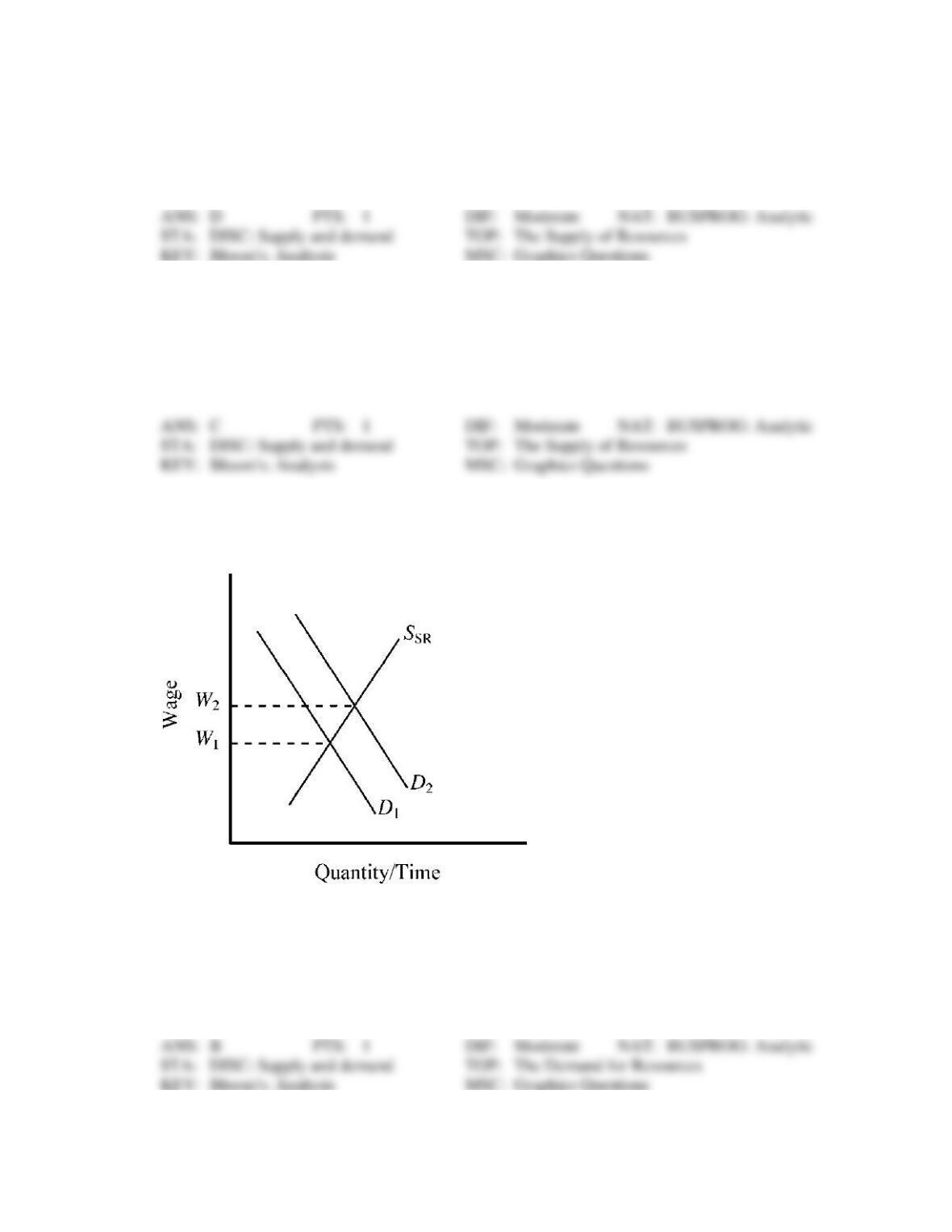
144. If Figure 12-1 indicated the short-run and long-run supply curves for a resource, which of the
following would probably be the long-run supply curve of the resource?
a.
Q2
b.
Q3
c.
Sb
d.
Sa
145. If one short-run supply curve in Figure 12-1 was for truck drivers and the other was for nuclear
physicists (also short-run), which one would probably be the supply curve for physicists?
a.
Q2
b.
Q3
c.
Sb
d.
Sa
Use the figure to answer the following question(s).
Figure 12-2
146. The demand D1 and short-run supply SSR of accountants is indicated in Figure 12-2. Which of the
following would most likely shift the demand for accountants from D1 to D2?
a.
an increase in the number of accounting majors in college
b.
enacting legislation that increases the complexity of personal and business tax returns
c.
high wages for accountants
d.
a reduction in the wages of bookkeepers, a substitute resource for accountants
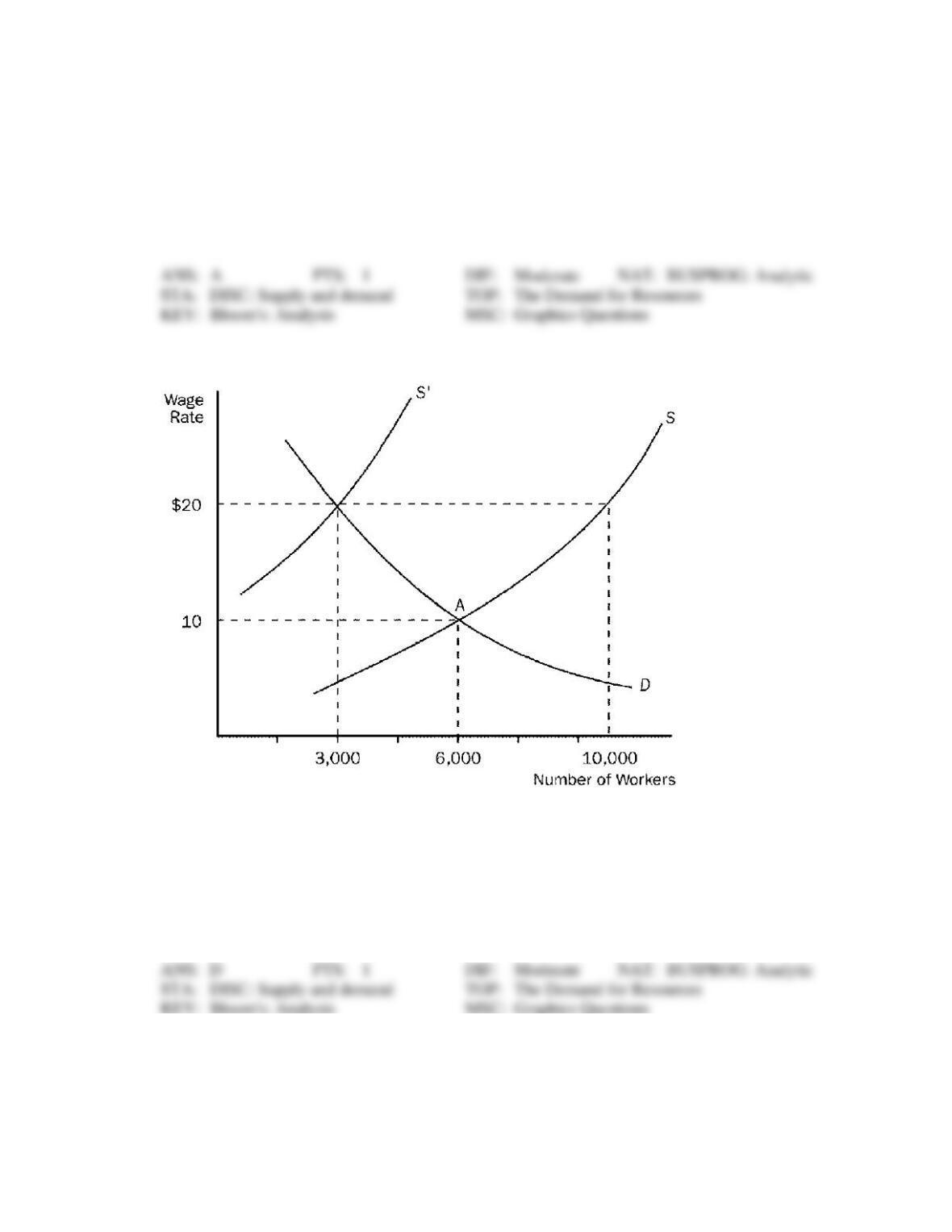
147. If an unanticipated increase in demand in Figure 12-2 shifts the demand for accountants from D1 to D2,
how will the higher level of demand influence the wages of accountants in the short run and the long
run?
a.
In the short run, wages will increase to W2, but the wage increase will be smaller in the
long run.
b.
In the short run, wages will be less than W2, but in the long run, they will rise to W2.
c.
In the short run, wages will increase to W2, and in the long run, they will be even higher
than W2.
d.
Employment will increase, but the higher level of demand will not alter the wages of
accountants.
Figure 12-3
148. Refer to Figure 12-3. This figure depicts labor demand and supply in a nonunionized labor market.
The original equilibrium is at point A. If a labor union subsequently establishes a union shop and
negotiates an hourly wage of $20, then there will be an excess
a.
supply of 3,000 workers.
b.
demand of 7,000 workers.
c.
supply of 4,000 workers.
d.
supply of 7,000 workers.
149. Refer to Figure 12-3. This figure depicts labor demand and supply in a nonunionized labor market.
The original equilibrium is at point A. If a labor union subsequently establishes a union shop and
negotiates an hourly wage of $20, then the employment level
a.
increases from 6,000 to 10,000.