Macroeconomics 2017 (Hubbard)
Chapter 12 Aggregate Expenditure and Output in the Short Run
12.1 The Aggregate Expenditure Model
1) The aggregate expenditure model focuses on the relationship between ________ and ________ in the
short run, assuming ________ is constant.
A) total production; total income; real GDP
B) total spending; real GDP; total income
C) total spending; real GDP; the price level
D) total income; real GDP; the price level
2) As a result of slow economic growth following the recession of 2007-2009, companies including Intel
and Worthington Industries cut production and employment in 2015 as a result of the sluggish growth
in the total amount of spending in the economy. The total amount of spending in the economy is known
as
A) deficit spending.
B) planned investment spending.
C) aggregate expenditure.
D) equilibrium spending.
3) The key idea of the aggregate expenditure model is that in any particular year, the level of GDP is
determined mainly by
A) investment spending.
B) export spending.
C) government spending.
D) the level of aggregate expenditure.
4) Each of the following is one of the four main categories of spending identified by John Maynard
Keynes except
A) consumption.
B) net exports.
C) government purchases.
D) taxes.
5) A decrease in consumer confidence can put your job at risk if
A) aggregate expenditures fall.
B) consumers expect their incomes to rise in the future.
C) aggregate expenditures rise.
D) consumers expect firms to increase investment in the future.
6) Economists first began studying the relationship between changes in aggregate expenditures and
changes in GDP
A) in the 1950s.
B) during the Great Depression.
C) at the end of the Civil War.
D) during the Industrial Revolution.
7) Household spending on goods and services is known as
A) consumption spending.
B) planned investment spending.
C) government purchases.
D) net exports.
8) All of the following are components of aggregate expenditure except
A) consumption spending.
B) net export spending.
C) actual investment spending.
D) government spending.
9) The aggregate expenditure model focuses on the ________ relationship between real spending and
________.
A) short-run; real GDP
B) short-run; inflation
C) long-run; real GDP
D) long-run; inflation
10) The formula for aggregate expenditure is
A) AE = C + I + G.
B) AE = C + I + G – NX.
C) AE = C + I + G + NX.
D) AE = C + I + depreciation – NX.
11) Actual investment spending does not include
A) spending on consumer durable goods.
B) spending on new capital equipment.
C) spending on new houses.
D) changes in inventories.
12) Inventories refer to
A) goods which have been presold before they are produced.
B) goods that have been produced but not yet sold.
C) goods that have been planned but not yet produced.
D) goods that have been produced and sold in the same year.
13) An unplanned increase in inventories results from
A) an increase in planned investment.
B) a decrease in planned investment.
C) actual investment that is greater than planned investment.
D) actual investment that is less than planned investment.
14) If inventories decline by more than analysts predict they will decline, this implies that
A) actual investment spending was greater than planned investment spending.
B) actual investment spending was less than planned investment spending.
C) actual investment spending was equal to than planned investment spending.
D) there is no relationship between actual investment spending and planned investment spending.
15) When aggregate expenditure = GDP,
A) macroeconomic equilibrium occurs.
B) the federal budget is balanced.
C) net exports equal zero.
D) saving equals zero.
16) Consumption is $5 million, planned investment spending is $8 million, government purchases are
$10 million, and net exports are equal to $2 million. If GDP during that same time period is equal to $27
million, what unplanned changes in inventories occurred?
A) There was an unplanned increase in inventories equal to $2 million.
B) There was no unplanned change in inventories.
C) There was an unplanned decrease in inventories equal to $2 million.
D) There was an unplanned decrease in inventories equal to $19 million.
17) Consumption spending is $16 million, planned investment spending is $4 million, unplanned
investment spending is $2 million, government purchases are $6 million, and net export spending is $1
million. What is aggregate expenditure?
A) $22 million
B) $26 million
C) $27 million
D) $29 million
18) Consumption spending is $5 million, planned investment spending is $8 million, unplanned
investment spending is $2 million, government purchases are $10 million, and net export spending is $2
million. What is GDP?
A) $15 million
B) $23 million
C) $25 million
D) $27 million
19) Consumption spending is $22 million, planned investment spending is $7 million, actual investment
spending is $7 million, government purchases are $9 million, and net export spending is $3 million.
Based on this information, which of the following is true?
A) There was an unplanned change in inventories.
B) Aggregate expenditure is equal to GDP.
C) Aggregate expenditure is greater than GDP.
D) Aggregate expenditure is less than GDP.
20) At macroeconomic equilibrium,
A) total investment equals total inventories.
B) total spending equals total production.
C) total consumption equals total production.
D) total taxes equal total transfers.
21) When aggregate expenditure is more than GDP, which of the following is true?
A) There was an unplanned decrease in inventories.
B) Firms spent less on capital goods than they planned.
C) Households bought fewer new homes than they planned.
D) All of the above must be true when aggregate expenditure is more than GDP.
22) In a small economy in 2016, aggregate expenditure was $800 million while GDP that year was $850
million. Which of the following can explain the difference between aggregate expenditure and GDP
that year?
A) Aggregate expenditure is always less than GDP in developed countries.
B) Firm investment in inventories was less than anticipated in 2016.
C) Firm investment in inventories was greater than anticipated in 2016.
D) Aggregate expenditure is always less than GDP in developing countries.
23) Firms in a small economy planned that inventories would grow over the past year by $300,000.
Over that year, inventories actually grew by $400,000. This implies that
A) aggregate expenditure that year was less than GDP that year.
B) there was an unplanned decrease in inventories that year.
C) there was a planned decrease in inventories that year.
D) aggregate expenditure that year was equal to GDP that year.
24) Firms in a small economy planned that inventories would grow over the past year by $500,000.
Over that year, inventories did grow by exactly $500,000. This implies that
A) aggregate expenditure that year was equal to GDP that year.
B) there was an unplanned increase in inventories that year.
C) there was an unplanned decrease in inventories that year.
D) aggregate expenditure that year was greater than GDP that year.
25) If aggregate expenditure is less than GDP, how will the economy reach macroeconomic equilibrium?
A) Inventories will decline, and GDP and employment will decline.
B) Inventories will rise, and GDP and employment will decline.
C) Inventories will decline, and GDP and employment will rise.
D) Inventories will rise, and GDP and employment will rise.
26) If firms find that consumers are purchasing more than expected, which of the following would you
expect?
A) Aggregate expenditure will likely be greater than GDP.
B) Aggregate expenditure will likely be less than GDP.
C) The economy will adjust to macroeconomic equilibrium as inventories rise, and production and
employment fall.
D) The economy will adjust to macroeconomic equilibrium as inventories fall, and production and
employment fall.
27) If firms sell exactly what they expected to sell, all of the following will be true except
A) aggregate expenditure will be greater than GDP.
B) there is no unplanned change in inventories.
C) inventories will not change, and GDP and employment will remain stable.
D) aggregate expenditure will be equal to GDP.
28) If economists forecast a decrease in aggregate expenditure, which of the following is likely to occur?
A) GDP will rise.
B) GDP will fall.
C) Wages will rise.
D) Inventories will fall.
29) The ________ model focuses on the relationship between total spending and real GDP in the short
run, assuming the price level is constant.
A) supply and demand
B) national income
C) aggregate expenditure
D) business cycle
30) Intel is the world’s largest semiconductor manufacturer and a major supplier of the microprocessors
and memory chips found in most personal computers. During the recession of 2007-2009, Intel’s
revenues ________ and it ________ the size of its workforce.
A) fell; increased
B) fell; decreased
C) rose; increased
D) rose; decreased
31) The key idea of the aggregate expenditure model is that in any particular year, the level of ________
is determined mainly by the level of aggregate expenditure.
A) frictional unemployment
B) export spending
C) government spending
D) GDP
32) Which of the following is not one of the four main categories of spending identified by John
Maynard Keynes?
A) consumption
B) planned investment
C) government purchases
D) transfer payments
33) A decrease in ________ can put your job at risk if aggregate expenditures fall.
A) consumer confidence
B) the natural rate of unemployment
C) the inflation rate
D) the length of a business cycle
34) During the Great Depression, economists first began studying the relationship between
A) changes in GDP and changes in interest rates.
B) changes in aggregate expenditures and changes in GDP.
C) changes in nominal GDP and changes in real GDP.
D) changes in stock prices and changes in price controls.
35) Consumption spending refers to ________ spending on goods and services.
A) household
B) business
C) government
D) foreign
36) Which of the following is not a component of aggregate expenditure?
A) consumption spending
B) planned investment spending
C) actual investment spending
D) government spending
37) The aggregate expenditure model focuses on the short-run relationship between ________ and
________.
A) real spending; real GDP
B) unemployment; inflation
C) nominal spending; nominal GDP
D) planned inventories; unplanned inventories
38) Aggregate expenditure includes spending on
A) C + I + G.
B) C + I + G – NX.
C) C + I + G + NX.
D) C + I + depreciation – NX.
39) Actual investment spending includes spending by consumers on
A) durable goods.
B) nondurable goods.
C) new houses.
D) services.
40) Goods that have been produced but not yet sold are referred to as
A) understocks.
B) inventories.
C) pre-sold goods.
D) capital goods.
41) An unplanned decrease in inventories results in
A) a decrease in planned investment.
B) an increase in planned investment.
C) actual investment that is greater than planned investment.
D) actual investment that is less than planned investment.
42) Macroeconomic equilibrium occurs when
A) aggregate expenditure = GDP.
B) aggregate expenditure = C+ I + G + net transfers.
C) aggregate income = planned inventories.
D) aggregate expenditure = planned inventories.
43) Consumption is $5 million, planned investment spending is $8 million, government purchases are
$10 million, and net exports are equal to $2 million. If GDP during that same time period is equal to $23
million, what unplanned changes in inventories occurred?
A) There was an unplanned increase in inventories equal to $2 million.
B) There was no unplanned change in inventories.
C) There was an unplanned decrease in inventories equal to $2 million.
D) There was an unplanned decrease in inventories equal to $19 million.
44) Consumption spending is $5 million, planned investment spending is $8 million, unplanned
investment spending is $2 million, government purchases are $10 million, and net export spending is $2
million. What is aggregate expenditure?
A) $15 million
B) $23 million
C) $25 million
D) $27 million
45) Consumption spending is $5 million, planned investment spending is $8 million, unplanned
investment
spending is -$2 million, government purchases are $10 million, and net export spending is $2 million.
What is GDP?
A) $15 million
B) $23 million
C) $25 million
D) $27 million
46) Consumption spending is $5 million, planned investment spending is $8 million, actual investment
spending is $8 million, government purchases are $10 million, and net export spending is $2 million.
Based on this information, which of the following is true?
A) There was an unplanned change in inventories.
B) Aggregate expenditure is equal to GDP.
C) Aggregate expenditure is greater than GDP.
D) Aggregate expenditure is less than GDP.
47) At macroeconomic equilibrium, total ________ equals total ________.
A) spending; production
B) investment; inventories
C) consumption; production
D) taxes; transfers
48) When aggregate expenditure is less than GDP, which of the following is true?
A) There was an unplanned increase in inventories.
B) Firms spent more on capital goods than they anticipated.
C) Households bought more new homes than they anticipated.
D) All of the above must be true when aggregate expenditure is less than GDP.
49) In a small economy in 2016, aggregate expenditure was $850 million while GDP that year was $800
million. Which of the following can explain the difference between aggregate expenditure and GDP
that year?
A) Aggregate expenditure is always less than GDP in developed countries.
B) Firm investment in inventories was less than anticipated in 2016.
C) Firm investment in inventories was greater than anticipated in 2016.
D) Aggregate expenditure is always less than GDP in developing countries.
50) Firms in a small economy anticipated that inventories would grow over the past year by $500,000.
Over that year, inventories actually grew by only $400,000. This implies that
A) aggregate expenditure that year was greater than GDP that year.
B) there was an unplanned increase in inventories that year.
C) there was a planned increase in inventories that year.
D) aggregate expenditure that year was equal to GDP that year.
51) Firms in a small economy anticipated that inventories would grow over the past year by $750,000,
and over that year, inventories grew by exactly $750,000. This implies that
A) aggregate expenditure and GDP were equal that year.
B) there was an unplanned increase in inventories that year.
C) there was an unplanned decrease in inventories that year.
D) aggregate expenditure was greater than GDP that year.
52) If aggregate expenditure is greater than GDP, how will the economy reach macroeconomic
equilibrium?
A) Inventories will decline, and GDP and employment will decline.
B) Inventories will rise, and GDP and employment will decline.
C) Inventories will decline, and GDP and employment will rise.
D) Inventories will rise, and GDP and employment will rise.
53) If firms find that consumers are purchasing less than expected, which of the following would you
expect?
A) Aggregate expenditure will likely be greater than GDP.
B) Aggregate expenditure will likely be less than GDP.
C) The economy will adjust to macroeconomic equilibrium as inventories rise, and production and
employment rise.
D) The economy will adjust to macroeconomic equilibrium as inventories fall, and production and
employment rise.
54) If firms sell what they expected to sell, which of the following will be true?
A) Aggregate expenditure will be greater than GDP.
B) There is no unplanned change in inventories.
C) Inventories will rise, and GDP and employment will fall.
D) Aggregate expenditure will be less than GDP.
55) If economists forecast an increase in aggregate expenditure, which of the following is likely to occur?
A) GDP will rise.
B) GDP will fall.
C) Wages will fall.
D) Inventories will rise.
56) If planned investment is greater than actual investment, then aggregate expenditure is less than
GDP.
57) Aggregate expenditure includes consumption spending, unplanned investment spending,
government purchases, and net exports.
58) If aggregate expenditure is more than GDP, then inventories fall and GDP rises.
59) If planned investment is equal to actual investment, then aggregate expenditure is equal to GDP.
60) Aggregate expenditure includes consumption spending, planned investment spending, government
purchases, and net exports.
61) If aggregate expenditure is less than GDP, then inventories rise and GDP falls.
62) Explain, in detail, how the adjustment to macroeconomic equilibrium occurs when spending is less
than production. Be sure to discuss how inventories play a crucial role in the adjustment process. State
what happens to GDP and employment during the adjustment process.
63) What are inventories? What usually happens to inventories at the beginning of a recession, and
what usually happens to inventories at the beginning of an expansion?
64) Why do economists care about aggregate expenditures?
65) What is the main reason for changes in GDP in the short run?
66) Into which category of aggregate expenditure would each of the following transactions fall?
a. Sandra MacMillian purchases a new Ford Focus.
b. The city of Richardson buys 5 new garbage trucks.
c. Adrian Garcia buys a newly constructed townhome.
d. A consumer in Latvia orders an iPhone from Apple.
e. Ford Motor Company buys 300 new iPhones from Apple.
Table 12-1
Real GDP
Consumption
Planned
Investment
Government
Purchases
Net Exports
$4,000
$2,800
$550
$600
$250
4,500
3,200
550
600
250
5,000
3,600
550
600
250
5,500
4,000
550
600
250
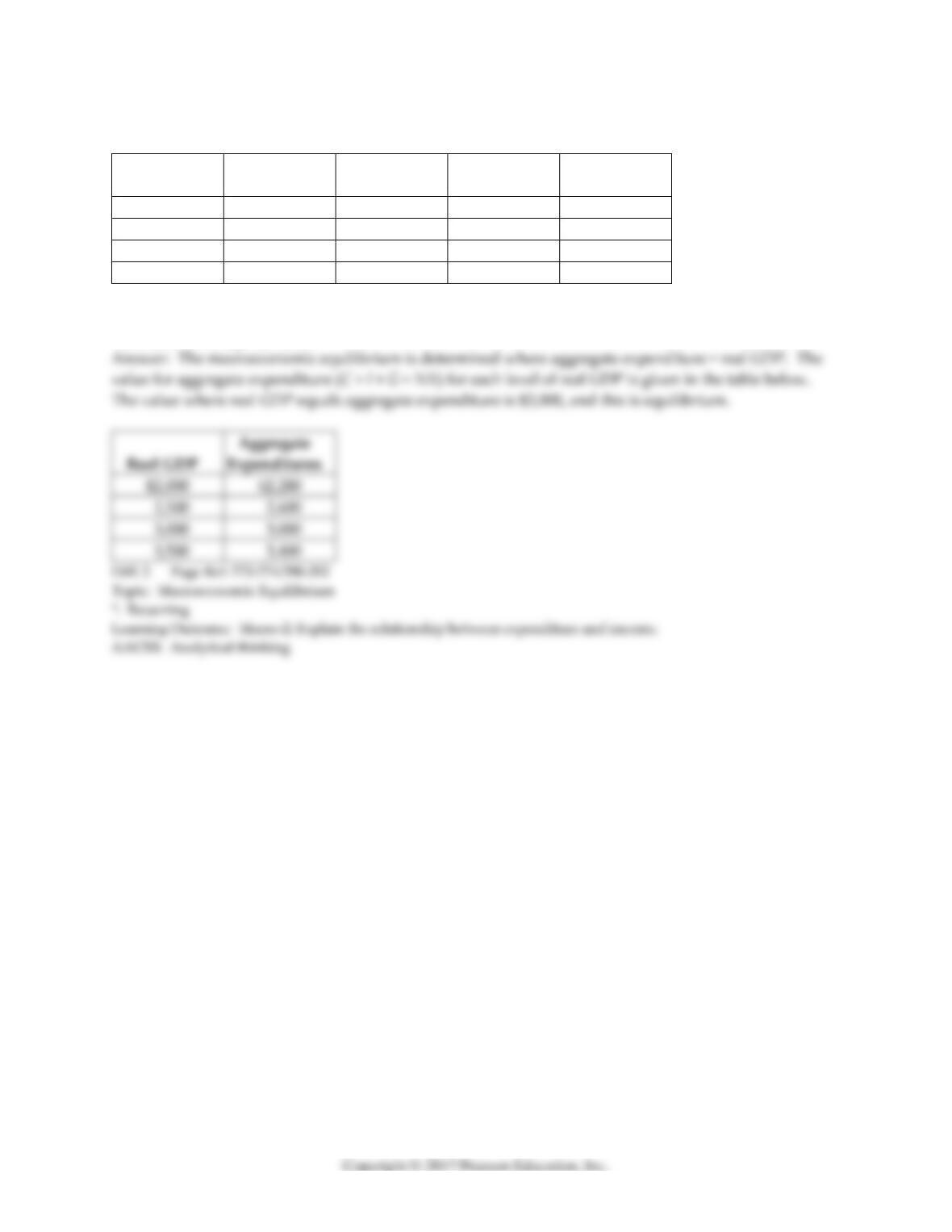
67) Refer to Table 12-1. Using the table above, compute aggregate expenditure and identify the
macroeconomic equilibrium.
Real GDP
$4,000
$4,200
4,500
4,600
5,000
5,000
5,500
5,400
19
Table 12-2
Real GDP
Consumption
Planned
Investment
Government
Purchases
Net Exports
$2,000
$1,600
$250
$250
$100
2,500
2,000
250
250
100
3,000
2,400
250
250
100
3,500
2,800
250
250
100
68) Refer to Table 12-2. Using the table above, compute aggregate expenditure and identify the
macroeconomic equilibrium.
Real GDP
2,500
2,600
3,000
3,000
3,500
3,400
12.2 Determining the Level of Aggregate Expenditure in the Economy
1) Which is the largest component of aggregate expenditure?
A) planned investment expenditures
B) consumption expenditures
C) government expenditures
D) net export expenditures
2) Which of the following will cause a direct increase in consumption spending?
A) an increase in planned investment
B) an increase in government spending
C) an increase in disposable income
D) a decrease in net export spending
3) The five most important variables that determine the level of consumption are
A) disposable income, wealth, expected future income, price level, and interest rate.
B) wealth, savings account balances, checking account balances, stock portfolio balances, and bond
portfolio balances.
C) government purchases, interest rates, income, taxes, and transfers.
D) government purchases, saving account balances, wealth, interest rates, portfolio balances.