48. Monopoly Regulation. The Redwood Cable Company, a CATV utility serving customers in Eugene,
Oregon, is currently engaged in a rate case with the regulatory commission under whose jurisdiction it operates.
At issue is the monthly rate the company will charge for basic hookup service. The demand curve for monthly
service is P = $37.50 – $0.0005Q. This implies annual demand and marginal revenue curves of:
P
= $450 – $0.006Q
MR
= TR/ Q = $450 – $0.012Q
where P is service price in dollars and Q is the number of customers served. Total and marginal costs per year (before investment return) are
described by the function:
TC
= $4,275,000 + $75Q + $0.0015Q2
MC
= TC/ Q = $75 + $0.003Q
The company has assets of $1.5 million and the utility commission has authorized a 15% return on investment.
A.
Calculate Redwood’s profit-maximizing price (monthly and annually), output, and rate-of-return levels.
B.
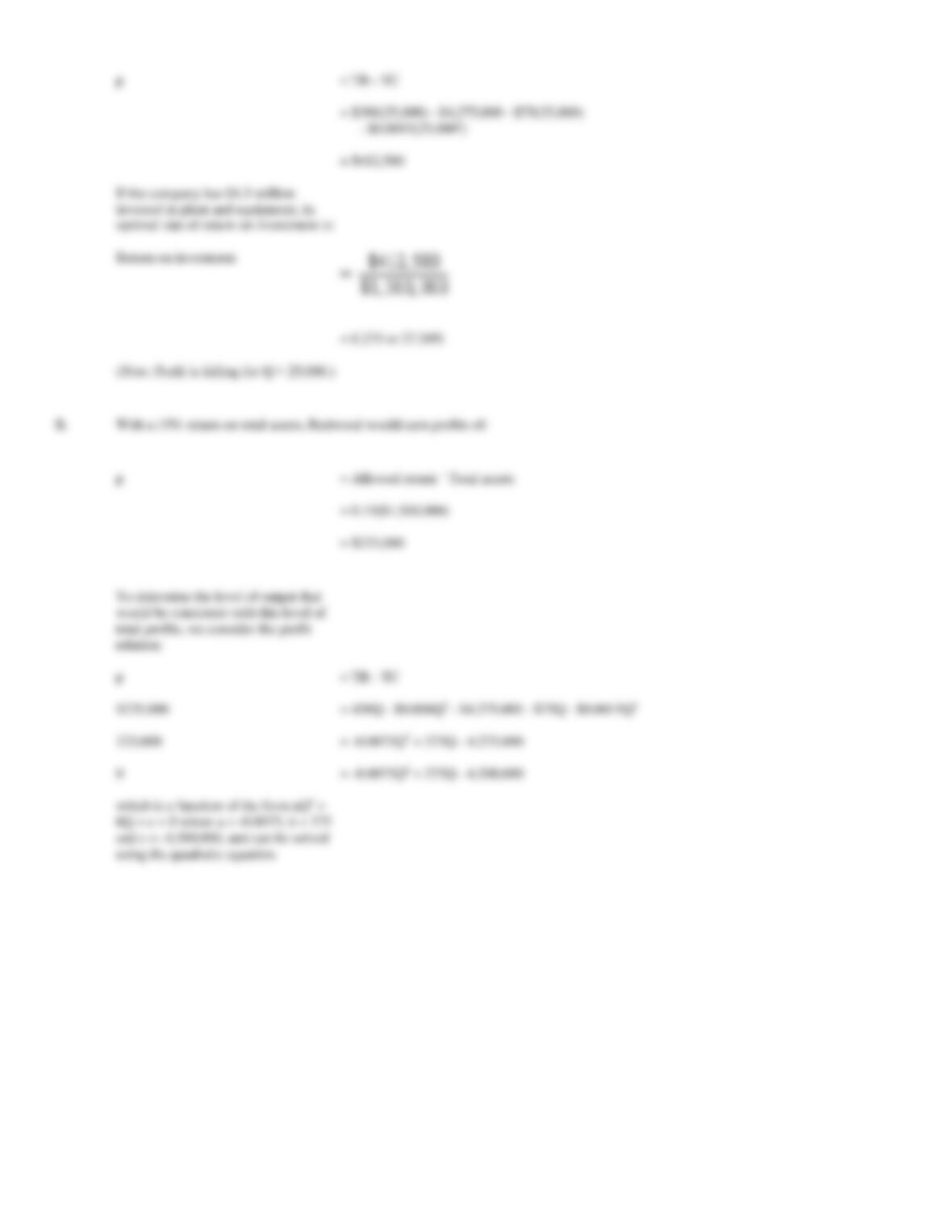
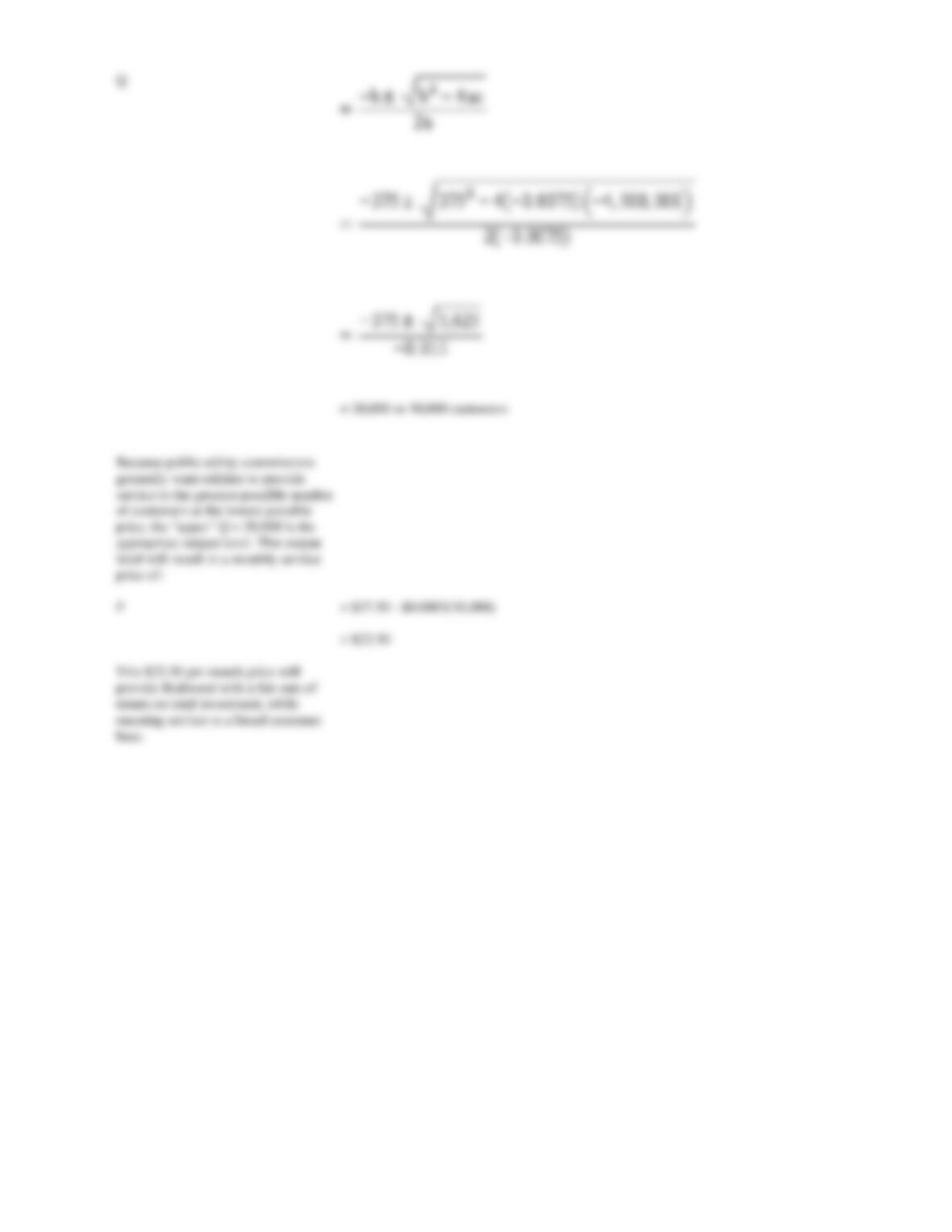
What monthly price should the commission grant to limit Redwood to a 15% rate of return?
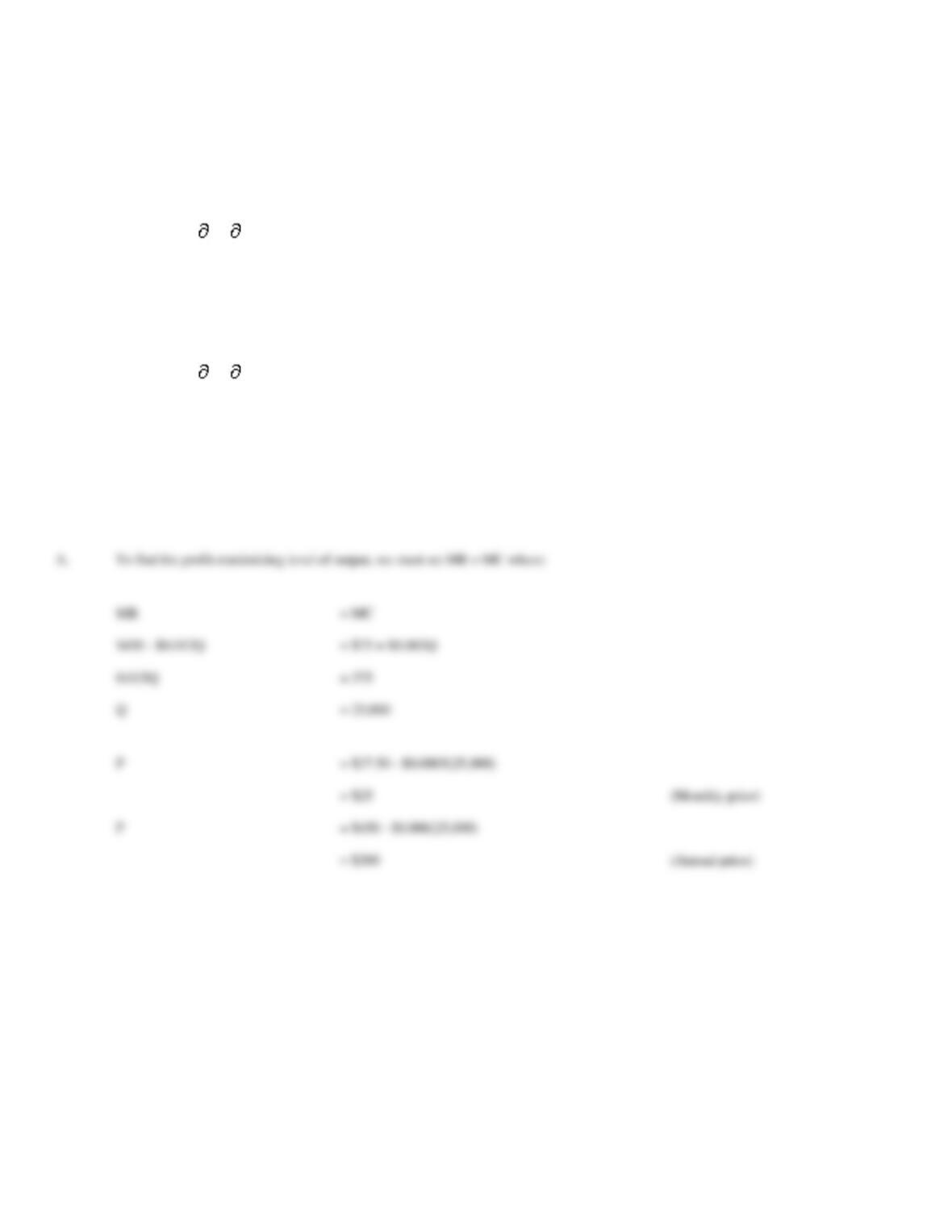
A.
To find the profit-maximizing level of output, we must set MR = MC where:
= MC
0.015Q
= 375
Q
= 25,000
= $25
(Monthly price)
= $300
(Annual price)
49. Pollution Regulation. Porky Pig, Inc., processes hogs at a large facility in Iowa City, Iowa. Each hog
processed yields both pork and a render by-product in a fixed 1:1 ratio. Although the render by-product is unfit
for human consumption, some can be sold to a local pet food company for further processing. Relevant annual
demand and cost relations are:
PP
= $125 – $0.0005QP
(Demand for pork)
MRP
= $125 – $0.001QP
(Marginal revenue from pork)
PB
= $25 – $0.001QB
(Demand for render by-product)
MRB
= $25 – $0.002QB
(Marginal revenue from render by-product)
TC
= $1,156,250 + $75Q
(Total cost)
MC
= $75
(Marginal cost)
= 20,000 or 30,000 customers
P
= $37.50 – $0.0005(30,000)
= $22.50
Here P is price in dollars, Q is the number of hogs processed (with an average weight of 100 pounds), QP and QB are pork and rendered by-product
per hog, respectively; both total and marginal costs are in dollars. Total costs include a risk-adjusted normal return of 15% on a $2 million investment
in plant and equipment.
Currently, the city allows the company to dump excess by-product into its sewage treatment facility at no charge, viewing the service as an attractive
means of keeping a valued employer in the area. However, the sewage treatment facility is quickly approaching peak capacity and must be expanded
at an expected operating cost of $500,000 per year. This is an impossible burden on an already strained city budget.
A.
Calculate the profit-maximizing price/output combination and optimal total profit level for Porky.
B.
How much by-product will the company dump into the Iowa City sewage treatment facility at the profit-maximizing activity level?
C.
Calculate output and total profits if the city imposes a $25 per unit charge on the amount of B Porky dumps.
D.
Calculate output and total profits if the city imposes a fixed $500,000-per-year tax on Porky to pay for the sewage treatment facility
expansion.
E.
Will either tax alternative permit Porky to survive in the long-run? In your opinion, what should Iowa City do about its sewage
treatment problem?
A.
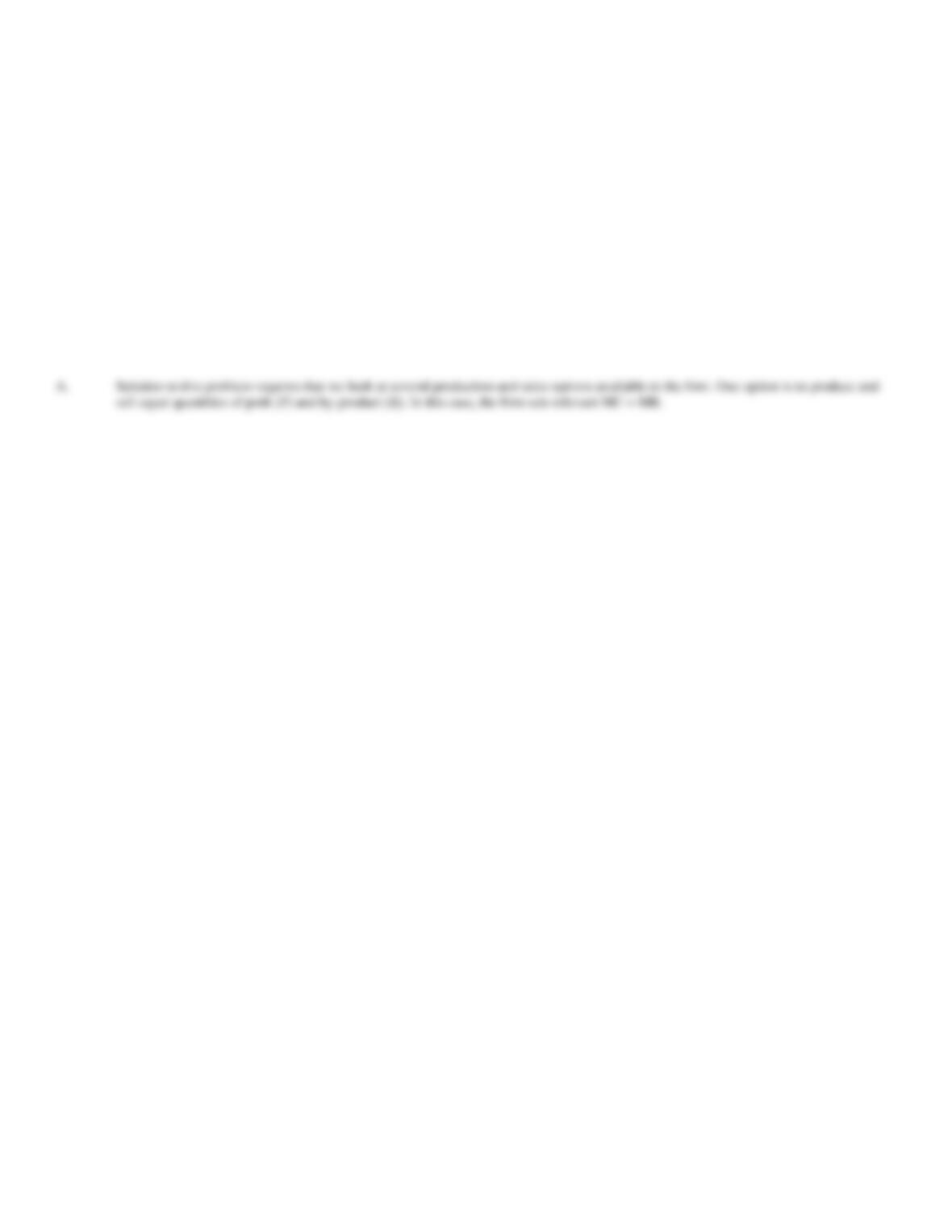
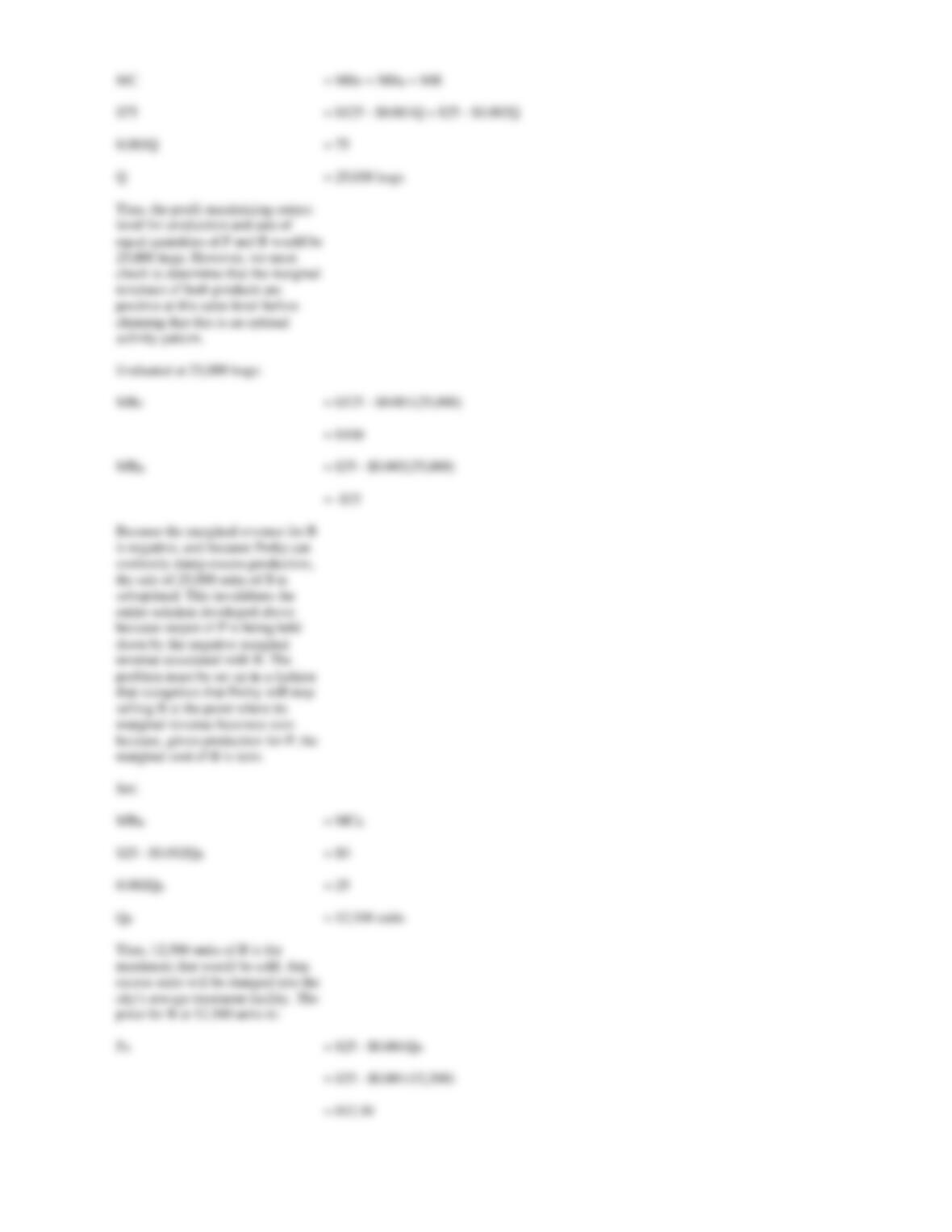
Solution to this problem requires that we look at several production and sales options available to the firm. One option is to produce and
sell equal quantities of pork (P) and by-product (B). In this case, the firm sets relevant MC = MR.
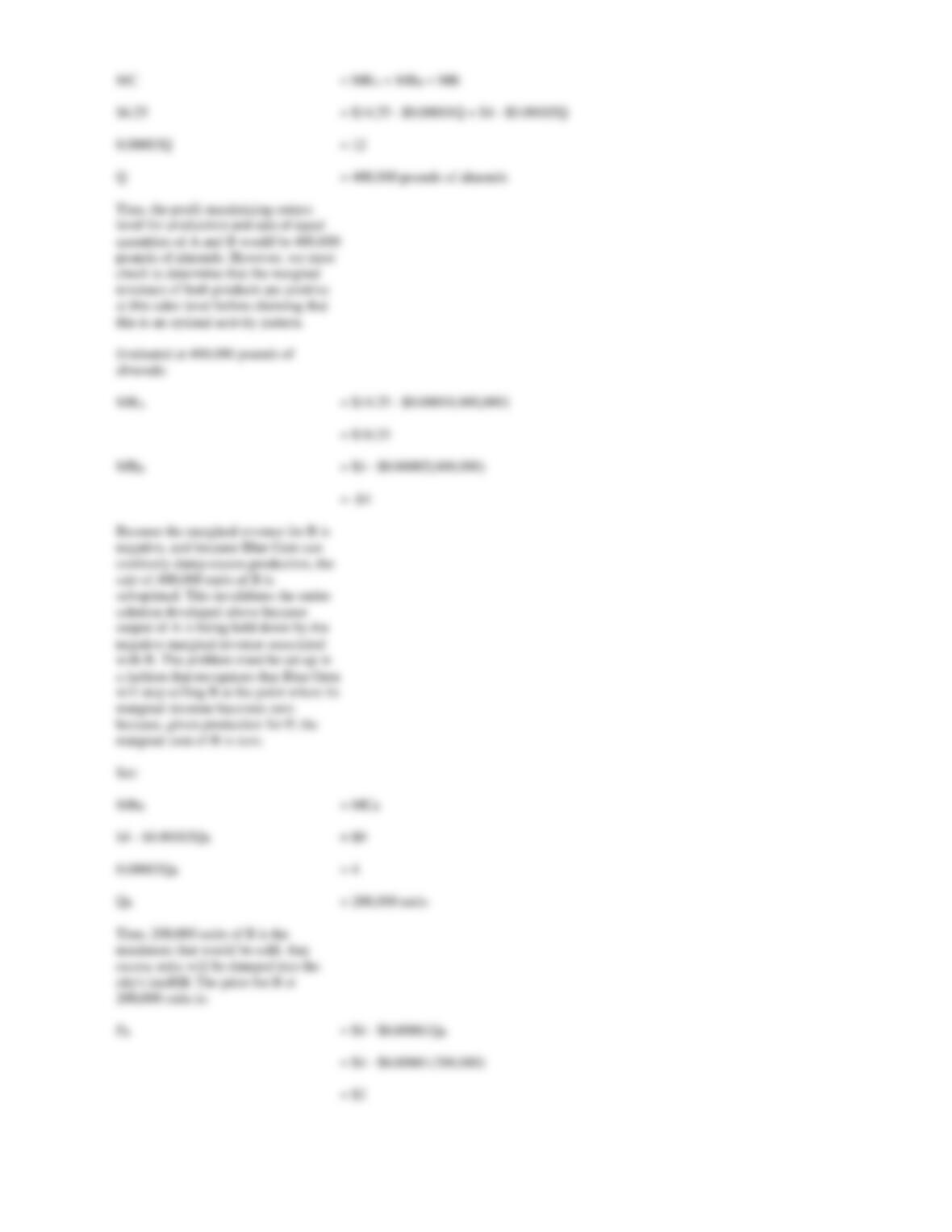
50. Pollution Regulation. Blue Gem, Inc., processes almonds at a large facility in Redding, California. Each
pound of almonds processed yields both shelled almonds and shell by-product in a fixed 1:1 ratio. Although the
by-product is unfit for human consumption, some can be sold to a regional manufacturer of stone-washed denim
garments (the shells are crushed and used as abrasives). Relevant annual demand and cost relations are:
PA
= $14.25 – $0.000005QA
(Demand for shelled almonds)
MRA
= $14.25 – $0.00001QA
(Marginal revenue from shelled almonds)
PB
= $4 – $0.00001QB
(Demand for shell by-product)
MRB
= $4 – $0.00002QB
(Marginal revenue from shell by-product)
TC
= $3,000,000 + $6.25Q
(Total cost)
MC
= $6.25
(Marginal cost)
Excess profits
= TRP + TRB – TC
= $112.5(25,000) + $0(25,000) – $1,156,250 – $75(25,000)
This means that total profits will be:
Total profits
= Required return + Excess profits
= 0.15($2,000,000) + (-$218,750)
for the new sewage system treatment facility.
Here P is price in dollars, Q is the number of pounds of almonds processed, QA and QB are shelled almonds and shell by-product per pound of
almonds, respectively; both total and marginal costs are in dollars. Total costs include a risk-adjusted normal return of 15% on a $10 million
investment in plant and equipment.
Currently, the city allows the company to dump excess by-product into its landfill at no charge, viewing the service as an attractive means of keeping
a valued employer in the area. However, the landfill is quickly approaching peak capacity and must be expanded at an expected operating cost of
$750,000 per year. This is an impossible burden on an already strained city budget.
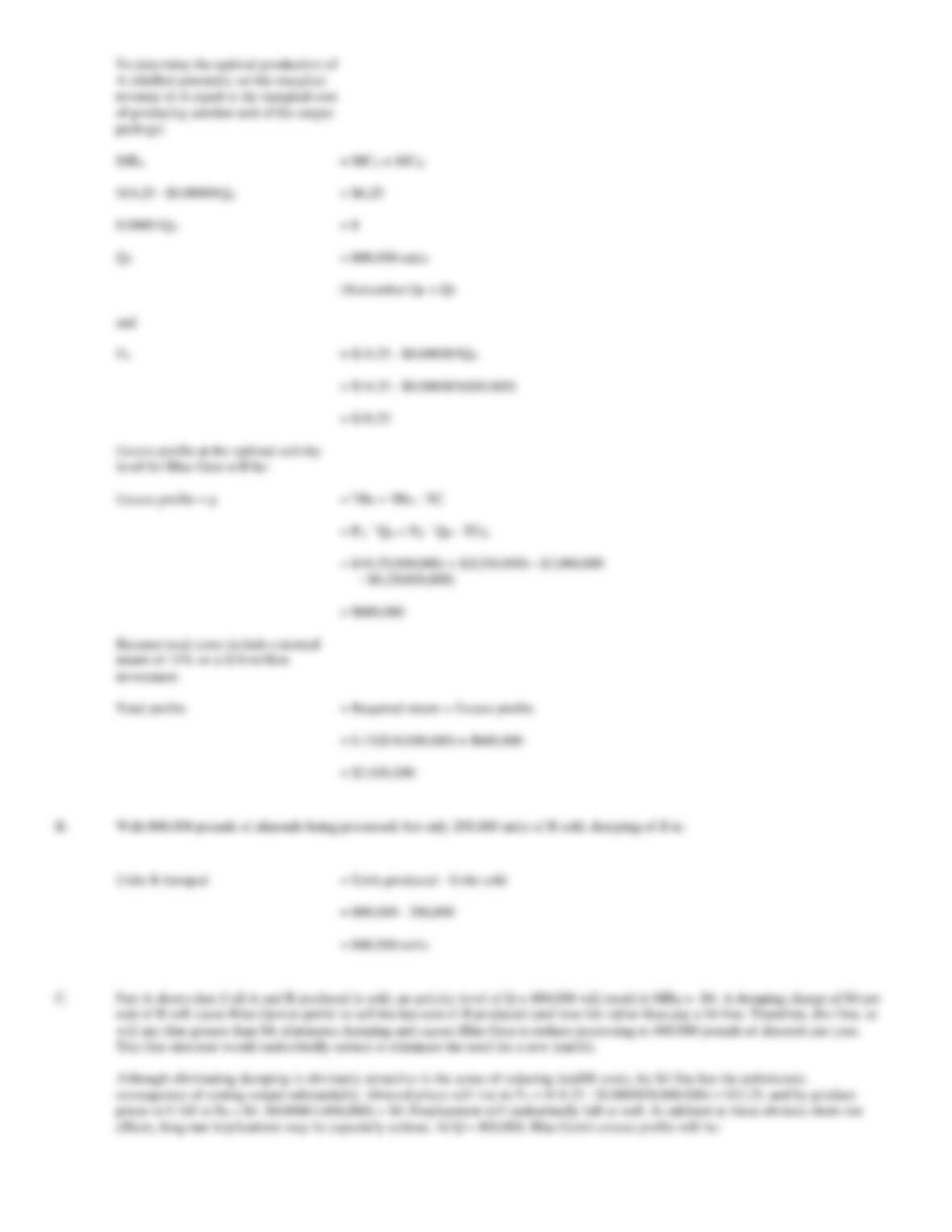
A.
Calculate the profit-maximizing price/output combination and optimal total profit level for Blue Gem.
B.
How much by-product will the company dump into the Redding, California landfill at the profit-maximizing activity level?
C.
Calculate output and total profits if the city imposes a $4 per unit charge on the amount of shell by-product Blue Gem dumps.
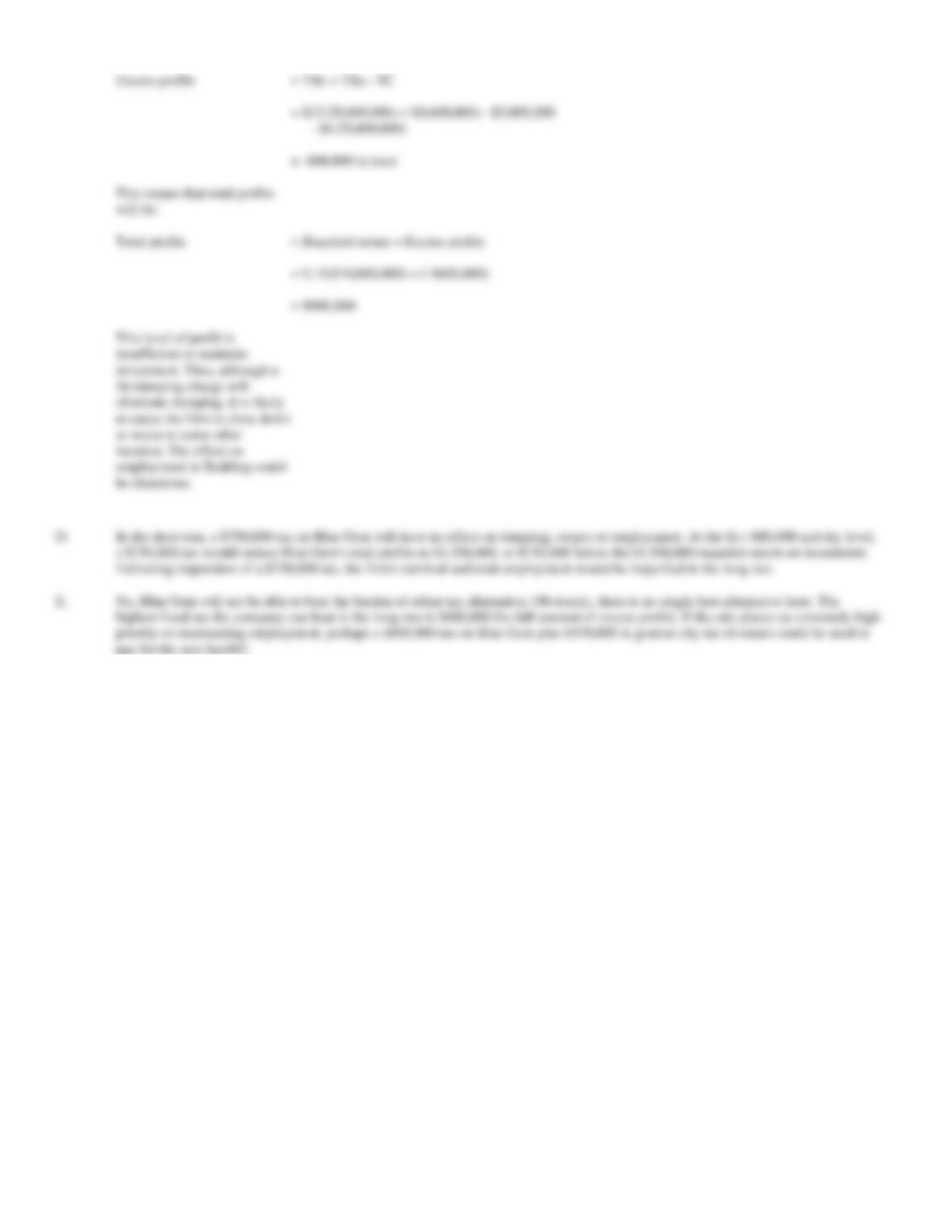
D.
Calculate output and total profits if the city imposes a fixed $750,000-per-year tax on Blue Gem to pay for the landfill expansion.
E.
Will either tax alternative permit Blue Gem to survive in the long-run? In your opinion, what should Redding do about its landfill
problem?
sell equal quantities of shelled almonds (A) and shell by-product (B). In this case, the firm sets relevant MC = MR.