2) Phillips curves describe the relationship between
A) aggregate expenditures and aggregate demand.
B) the quantity of money and interest rates.
C) unemployment and inflation.
D) aggregate demand and the price level.
3) A Phillips curve measures the relationship between
A) the unemployment rate and inflation.
B) the level of money wage rates and GDP.
C) unemployment and GDP.
D) inflation and GDP.
4) A Phillips curve shows the relationship between the
A) price level and real GDP.
B) unemployment rate and real GDP.
C) inflation rate and the unemployment rate.
D) inflation rate and real GDP.
5) For a given level of anticipated inflation and natural unemployment rate, the short-run Phillips
curve shows the relationship between
A) potential GDP and real GDP.
B) real GDP growth and the unemployment rate.
C) inflation and money growth.
D) inflation and the unemployment rate.
6) In 2012 the Cleveland Federal Reserve estimated that the expected inflation rate was 1.5
percent, the actual inflation rate was 2.1 percent, and the unemployment rate was 8.1 percent. A
point on the short-run Phillips curve is the
A) difference between the actual and expected inflation rates (0.6 percent) and the
unemployment rate of 8.1 percent.
B) inflation rate of 2.1 percent and the expected inflation rate of 1.5 percent.
C) expected inflation rate of 1.5 percent and the unemployment rate of 8.1 percent.
D) inflation rate of 2.1 percent and the unemployment rate of 8.1 percent.
7) The short-run Phillips curve
A) slopes downward.
B) slopes upward.
C) is horizontal.
D) is vertical.
8) Moving along a short-run Phillips curve
A) the price level is constant.
B) unemployment is constant.
C) the expected inflation rate is constant.
D) the inflation rate is constant.
9) Which of the following is held constant when moving along a short-run Phillip’s curve?
A) the inflation rate
B) the unemployment rate
C) the expected inflation rate
D) the growth rate of the quantity of money
10) The short-run Phillips curve shows the tradeoff between ________, holding the expected
inflation rate and the natural unemployment rate constant.
A) the price level and real GDP
B) inflation and unemployment
C) the price level and unemployment
D) inflation and employment
11) The short-run Phillips curve shows a
A) positive relationship between the quantity of money and interest rates.
B) positive relationship between the price level and real GDP.
C) negative relationship between interest rates and the price level.
D) negative relationship between the unemployment rate and the inflation rate.
12) In the short run, an unexpected increase in the inflation rate leads to
A) a higher unemployment rate.
B) a decrease in aggregate demand.
C) a lower unemployment rate.
D) workers thinking the money wage rate has fallen.
13) Moving along the short-run Phillips curve indicates
A) that higher inflation leads to a higher unemployment rate.
B) that higher unemployment leads to a higher inflation rate.
C) a tradeoff between inflation and unemployment so that higher inflation is related to lower
unemployment.
D) that the natural unemployment rate falls when the inflation rate rises.
14) Movements upward along the short-run Phillips curve result from
A) expected increases in the inflation rate.
B) unexpected increases in the inflation rate.
C) expected decreases in the inflation rate.
D) unexpected decreases in the inflation rate.
15) If the unemployment rate initially equals its natural rate, then if the inflation rate rises above
its expected rate, the unemployment rate ________.
A) equals the natural rate
B) remains constant
C) falls below its natural rate
D) rises above its natural rate
16) Along a short-run Phillips curve, suppose the expected inflation rate is 6 percent. If the
inflation rate turns out to be 8 percent instead
A) there is a movement upward along the short-run Phillips curve.
B) there is a movement downward along the short-run Phillips curve.
C) there is a downward shift of the short-run Phillips curve.
D) None of the above answers are correct.
17) Suppose that the expected inflation rate is 8 percent and the unemployment rate is 3 percent.
If the actual inflation rate rises to 10 percent and the expected inflation rate does not change, then
A) the short-run Phillips curve will shift upward.
B) the short-run Phillips curve will shift downward.
C) there will be a movement along the short-run Phillips curve.
D) the natural unemployment rate will rise.
18) Suppose that last year the economy of Suffera was experiencing an expected inflation rate of
8 percent and unemployment rate of 12 percent. An unexpected increase in the inflation rate
would
A) increase the unemployment rate.
B) increase the inflation rate and decrease the unemployment rate.
C) increase the inflation rate but have no effect on the unemployment rate.
D) None of the above answers is correct.
19) Which of the following leads to a rightward shift in the short-run Phillips curve?
I. a reduction in the expected inflation rate
II. an increase in the natural unemployment rate
A) I only
B) II only
C) I and II
D) neither I nor II
20) An increase in the expected inflation rate shifts the
A) short-run Phillips curve downward.
B) short-run Phillips curve upward.
C) long-run Phillips curve upward.
D) long-run Phillips curve downward.
21) An increase in the expected inflation rate leads to ________ the short-run Phillips curve.
A) a movement upward along
B) a movement downward along
C) an upward shift of
D) a downward shift of
22) Which of the following leads to a downward shift in the short-run Phillips curve?
A) People expected inflation to be 5 percent last year and now expect inflation to be 3 percent
this year.
B) People expect the unemployment rate to increase.
C) The long-run Phillips curve shifts rightward.
D) Unexpected inflation increases.
23) Suppose that the expected inflation rate is 12 percent and the unemployment rate is 5
percent. If the expected inflation rate increases to 13 percent, then
A) the short-run Phillips curve will shift upward.
B) the short-run Phillips curve will shift downward.
C) there will be a movement along the short-run Phillips curve.
D) the natural unemployment rate will rise.
24) The Cleveland Federal Reserve Bank’s estimate of expected inflation has fallen from 3.5
percent in 2000 to 1.5 percent in 2013. This fall means that
A) the short-run Phillips curve shifted upward.
B) the short-run Phillips curve shifted downward.
C) there was a movement along the short-run Phillips curve.
D) the natural unemployment rate increased.
25) The government estimates that the natural unemployment rate has increased from 4.8 percent
in 2006 to 5.2 percent in late 2012. If these estimates are accurate, the short-run Phillips curve
has ________.
A) shifted rightward
B) shifted leftward
C) not shifted
D) None of the above answers are correct because the effect on the short-run Phillips curve is
ambiguous.
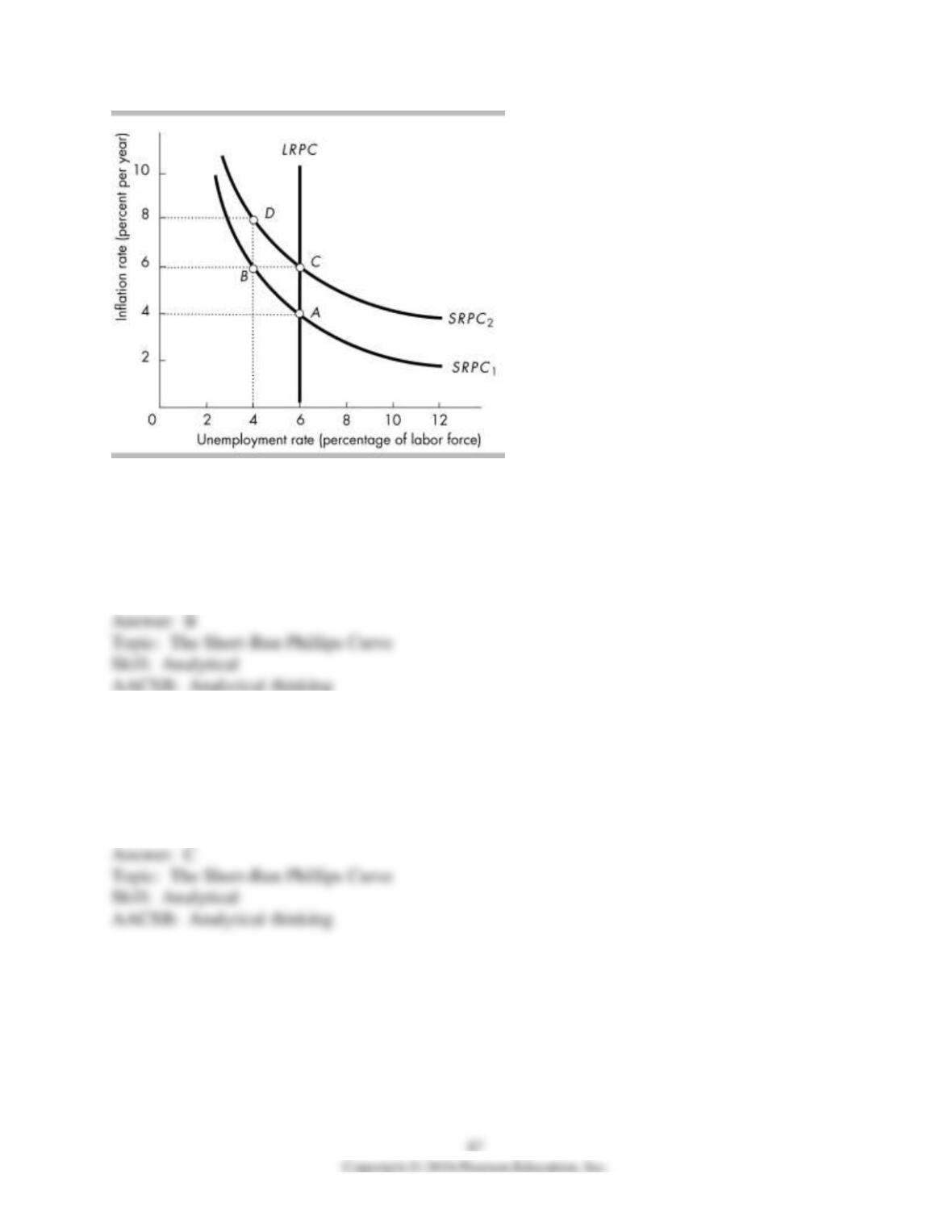
26) In the above figure, suppose that the economy is at point A. An unexpected increase in the
inflation rate to 6 percent will result in a movement to point
A) A, that is, there is no movement.
B) B.
C) C.
D) D.
27) In the above figure, suppose that the economy is at point A. An expected increase in the
inflation rate to 6 percent will result in a movement to point
A) A, that is, there is no movement.
B) B.
C) C.
D) D.
28) The long-run Phillips curve shows the relationship between the inflation rate and the
unemployment rate when the
A) real interest rate equals the nominal interest rate.
B) real interest rate is zero.
C) actual inflation rate equals the expected inflation rate.
D) inflation rate is zero.
29) The long-run Phillips curve is
A) vertical at potential GDP.
B) the horizontal sum of the short-run Phillips curves.
C) vertical at the natural unemployment rate.
D) the vertical sum of the short-run Phillips curves.
30) The long-run Phillips curve is ________.
A) horizontal at the expected inflation rate
B) vertical at the natural unemployment rate
C) horizontal at the actual inflation rate
D) vertical at the actual inflation rate
31) Along the long-run Phillips curve
A) actual inflation is greater than expected inflation.
B) actual inflation is equal to expected inflation.
C) actual inflation is less than expected inflation.
D) None of the above answers is correct.
32) The long-run Phillips curve shows that in the long run, policymakers can
A) lower unemployment if they are willing to accept more inflation forever.
B) lower inflation if they are willing to accept higher unemployment forever.
C) choose the unemployment rate but not the inflation rate.
D) lower inflation without increasing unemployment.
33) The position of the long-run Phillips curve is determined by
A) the quantity of money.
B) the natural unemployment rate.
C) the inflation rate.
D) the expected inflation rate.
34) The Cleveland Federal Reserve Bank’s estimate of expected inflation has fallen from 3.5
percent in 2000 to 1.5 percent in 2013. This fall means that
A) the long-run Phillips curve shifted leftward.
B) the long-run Phillips curve shifted rightward.
C) the long-run Phillips curve shifted downward.
D) None of the above answers are correct because a change in the expected inflation rate does
not shift the long-run Phillips curve.
35) Which of the following statements about the long-run Phillips curve is CORRECT?
A) The long-run Phillips curve is horizontal.
B) The long-run Phillips curve shifts leftward if the natural unemployment rate decreases.
C) The long-run Phillips curve shifts rightward and upward if the expected inflation rate
increases.
D) The long-run Phillips curve shifts leftward if the natural unemployment rate increases.
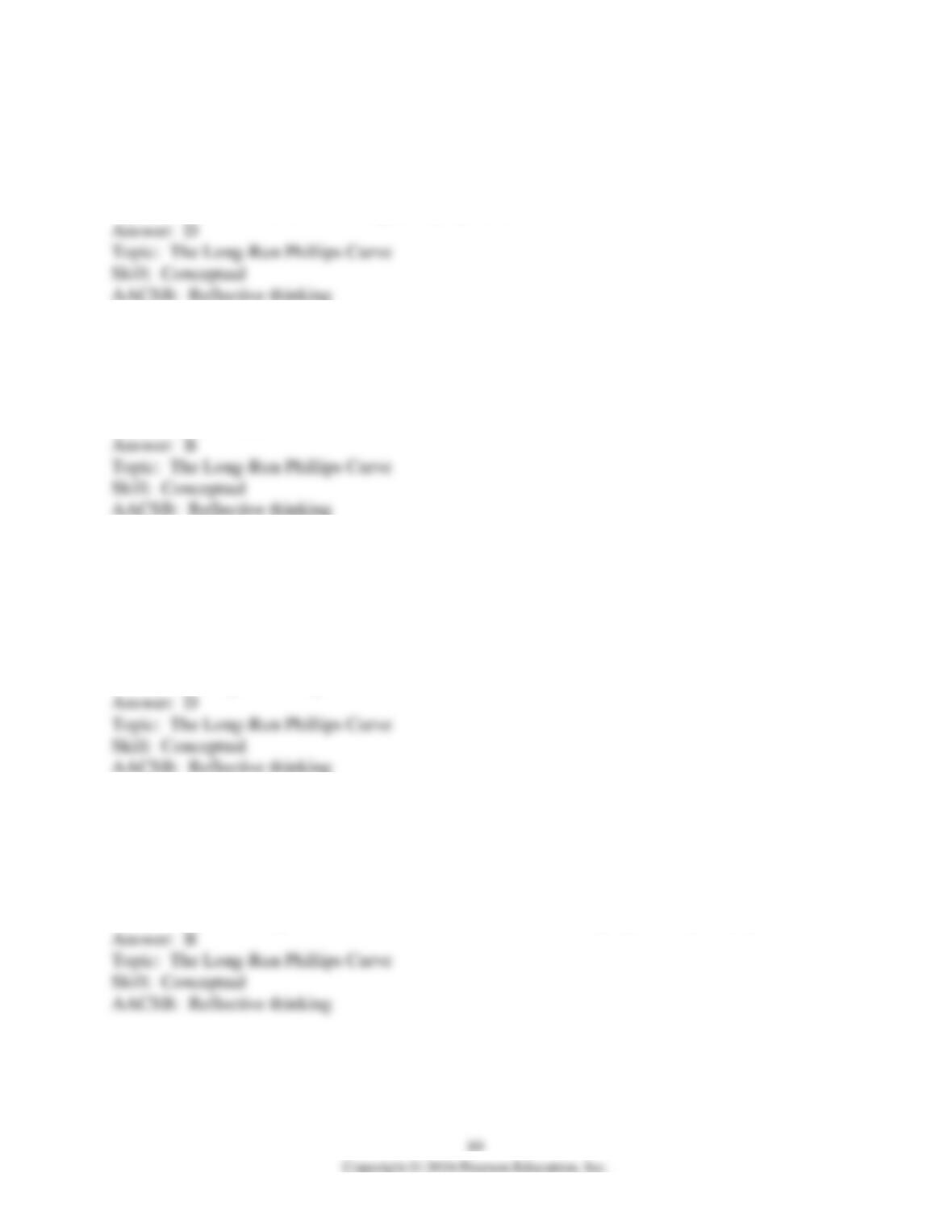
36) In the above figure, which of the following curves represents the long-run Phillips curve?
A) 1
B) 2
C) 3
D) 4
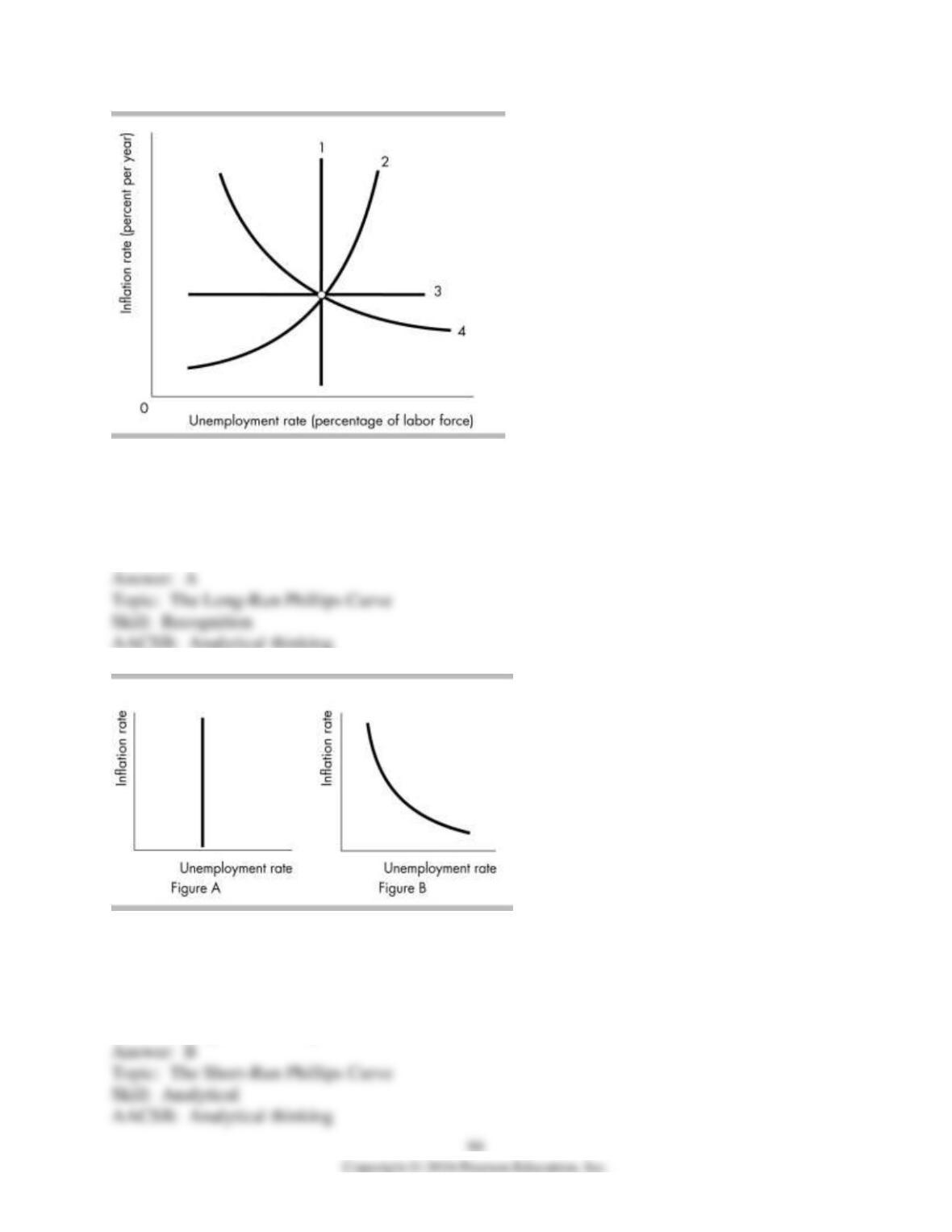
37) Which of the diagrams in the above figure best illustrates a short-run Phillips curve?
A) Figure A
B) Figure B
C) both Figure A and Figure B
D) neither Figure A nor Figure B
38) In Figure B above, which of the following are being held constant while moving along the
curve in the figure?
A) the expected inflation rate
B) the natural unemployment rate
C) the AD curve
D) Both answers A and B are correct.
39) Which of the diagrams in the above figure best illustrates a long-run Phillips curve?
A) Figure A
B) Figure B
C) both Figure A and Figure B
D) neither Figure A nor Figure B
40) The short-run Phillips curve intersects the long-run Phillips curve at the
A) natural interest rate.
B) nominal interest rate.
C) natural inflation rate.
D) expected inflation rate.
41) The Cleveland Federal Reserve Bank estimates the expected inflation rate is 1.5 percent in
2013. This estimate means that
A) the long-run and short-run Phillips curve cross at an inflation rate of 1.5 percent.
B) the long-run Phillips curve is vertical at 1.5 percent.
C) the short-run Phillips curve is vertical at 1.5 percent.
D) the short-run Phillips curve shifts upward by 1.5 percentage points per year.
42) The short-run Phillips curve and the long-run Phillips curve intersect at the ________ and
________.
A) expected inflation rate; the expected unemployment rate
B) expected inflation rate; the natural unemployment rate
C) natural inflation rate; the expected employment rate
D) expected inflation rate; the expected employment rate
43) An increase in the expected inflation rate shifts
A) both the short-run and the long-run Phillips curves upward.
B) the short-run but not the long-run Phillips curve upward.
C) the long-run but not the short-run Phillips curve upward.
D) neither the short-run nor the long-run Phillips curve.
44) A decrease in the expected inflation rate shifts the short-run Phillips curve
A) downward and shifts the long-run Phillips curve leftward.
B) upward and shifts long-run Phillips curve rightward.
C) downward and creates a movement downward along the long-run Phillips curve.
D) upward and creates a movement upward along the long-run Phillips curve.
45) An increase in the natural unemployment rate shifts
A) both the short-run and the long-run Phillips curves rightward.
B) the short-run but not the long-run Phillips curve rightward.
C) the long-run but not the short-run Phillips curve rightward.
D) neither the short-run nor the long-run Phillips curve.
46) A change in the natural unemployment rate ________.
A) shifts only the short-run Phillips curve
B) causes a movement along the short-run Phillips curve
C) shifts only the long-run Phillips curve
D) shifts both the short-run and long-run Phillips curves
47) If the natural unemployment rate increases, then the short-run Phillips curve shifts ________
and the long-run Phillips curve shifts ________.
A) rightward; rightward
B) rightward; leftward
C) leftward; rightward
D) leftward; leftward
48) The government estimates that the natural unemployment rate has increased from 4.8 percent
in 2006 to 5.2 percent in late 2012. If these estimates are accurate, the short-run Phillips curve
has shifted ________ and the long-run Phillips curve has shifted ________.
A) rightward; rightward
B) rightward; leftward
C) leftward; rightward
D) leftward; leftward
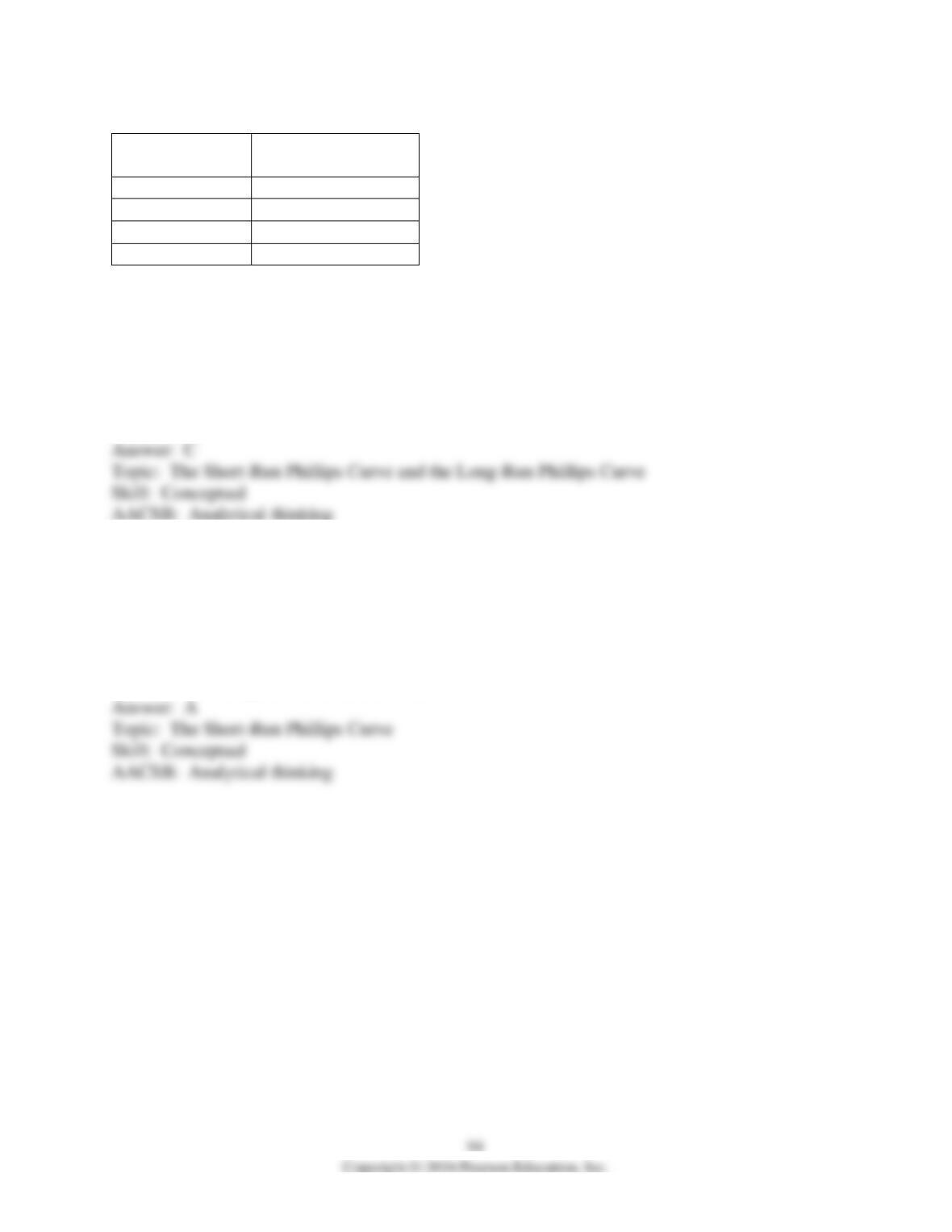
Inflation rate
(percent per year)
Unemployment rate
(percent)
8
3
6
4
4
5
2
6
49) An economy’s natural unemployment rate is 4 percent. The table above gives some points on
the economy’s short-run Phillips curve. When the unemployment rate is 4 percent ________.
A) actual inflation is greater than expected inflation
B) actual inflation is less than expected inflation
C) and the inflation rate is 6 percent a year, the short-run and long-run Phillips curves intersect
D) and the expected inflation rate is 8 percent a year, the short-run Phillips curve shifts
downward
50) An economy’s natural unemployment rate is 4 percent. The table above gives some points on
the economy’s short-run Phillips curve. If the expected inflation rate becomes 8 percent per year,
then the ________.
A) short-run Phillips curve shifts upward
B) long-run Phillips curve shifts rightward
C) long-run Phillips curve shifts leftward
D) short-run Phillips curve shifts downward
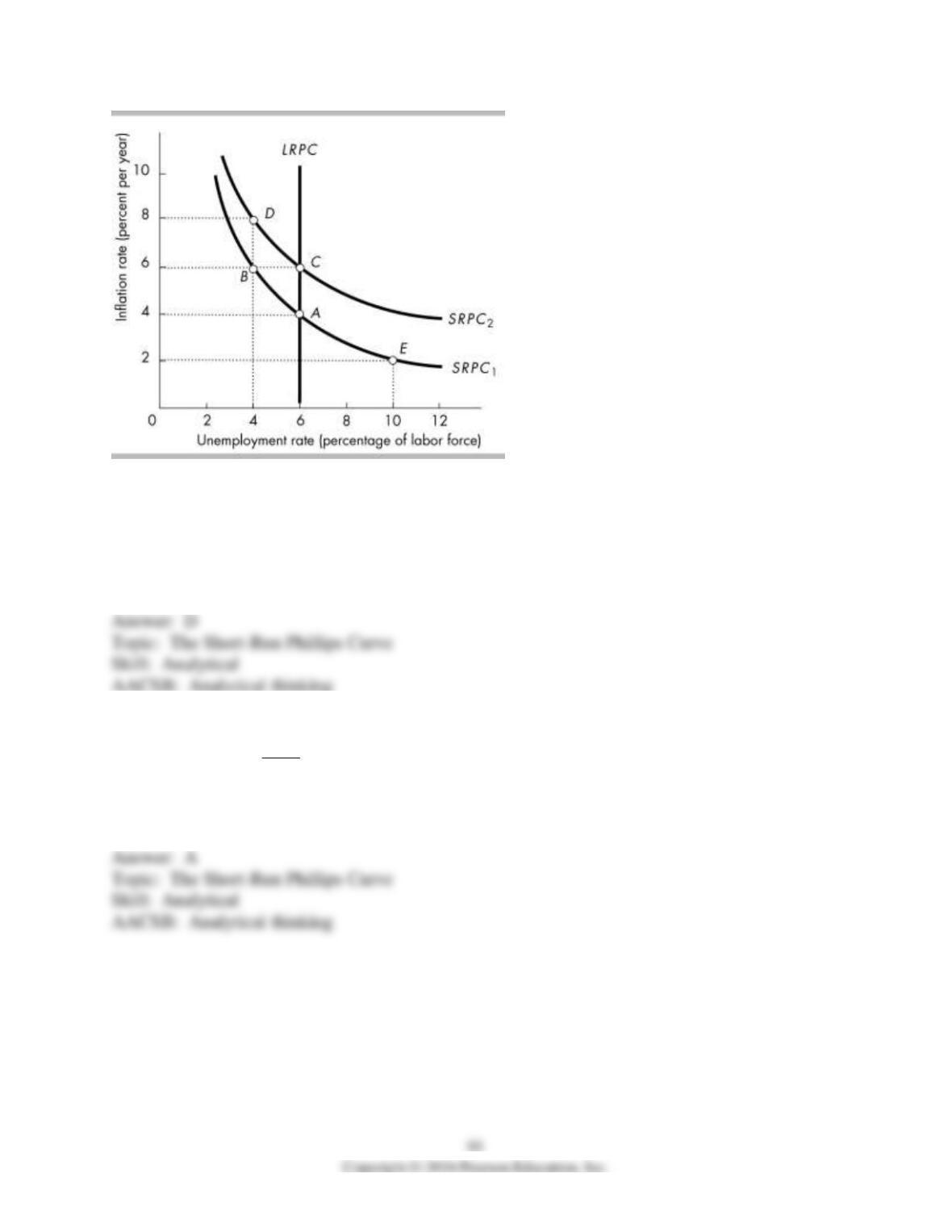
51) In the above figure, suppose that the economy currently is at point A. If the inflation rate falls
and this fall is unanticipated by the public, the economy moves to a point such as point
A) B.
B) C.
C) D.
D) E.
52) In the above figure, suppose that the economy currently is at point A. If the inflation rate
rises and this rise is NOT expected by the public, the economy moves to a point such as point
A) B.
B) C.
C) D.
D) E.
53) In the above figure, what might have shifted the short-run Phillips curve from SRPC1 to
SRPC2 while leaving the long-run Phillips curve unchanged at LRPC?
A) The natural unemployment rate increased.
B) The natural unemployment rate decreased.
C) The expected inflation rate increased.
D) The expected inflation rate decreased.
54) In the above figure, suppose that the economy currently is at point A. If the inflation rate
rises and this rise is anticipated by the public, the economy moves to a point such as point
A) B.
B) C.
C) D.
D) E.
55) In the above figure, suppose that the economy is at point C. If the inflation rate is lower than
expected,
A) the LRPC will shift rightward.
B) the SRPC will shift downward.
C) the SRPC will shift upward.
D) Neither the LRPC nor the SRPC will shift.
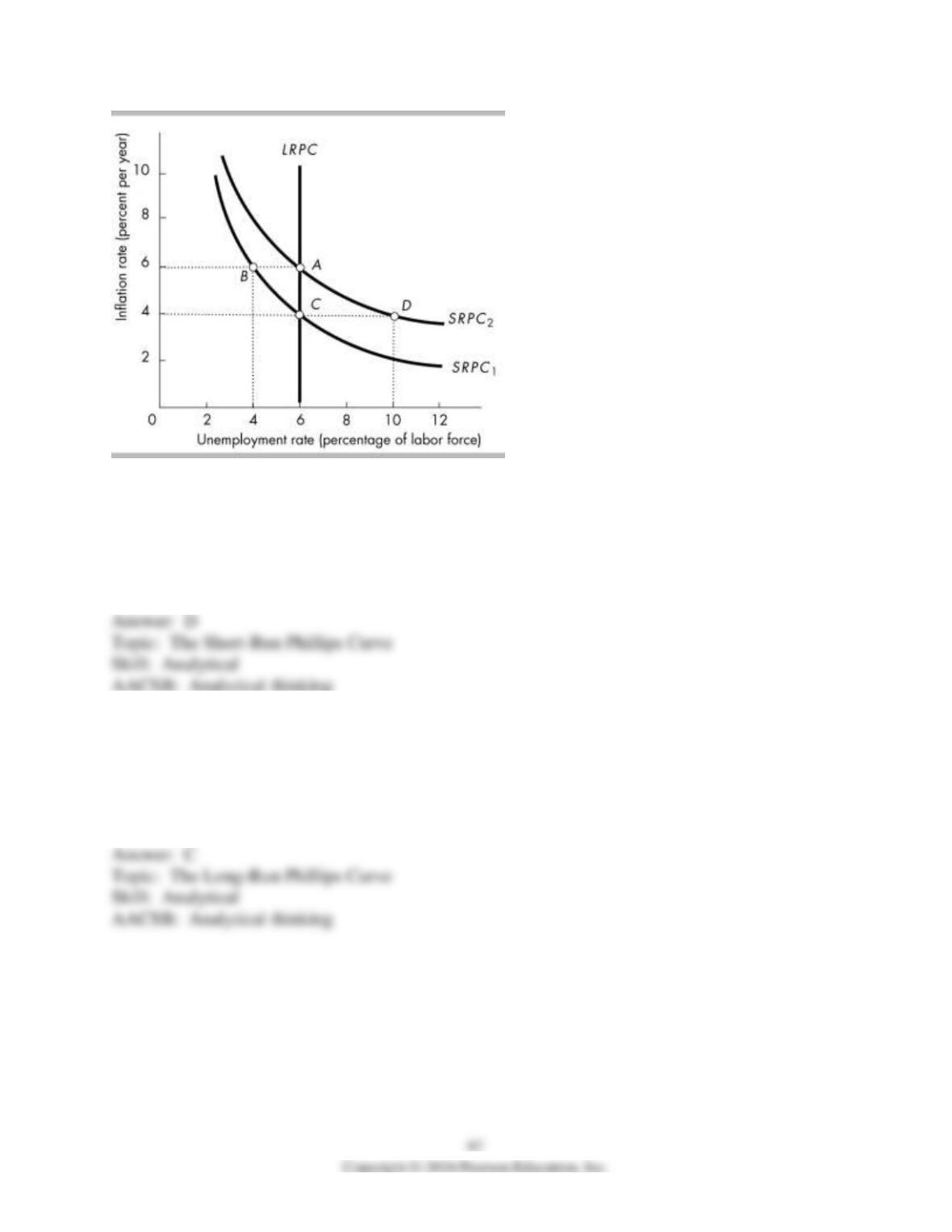
56) In the above figure, the economy is at point A. The inflation rate unexpectedly falls by two
percentage points. As a result, the economy moves to point
A) A, that is, there is no movement.
B) B.
C) C.
D) D.
57) In the above figure, the economy is at point A. The inflation rate falls by two percentage
points and people correctly expected the fall. As a result, the economy moves to point
A) A, that is, there is no movement.
B) B.
C) C.
D) D.
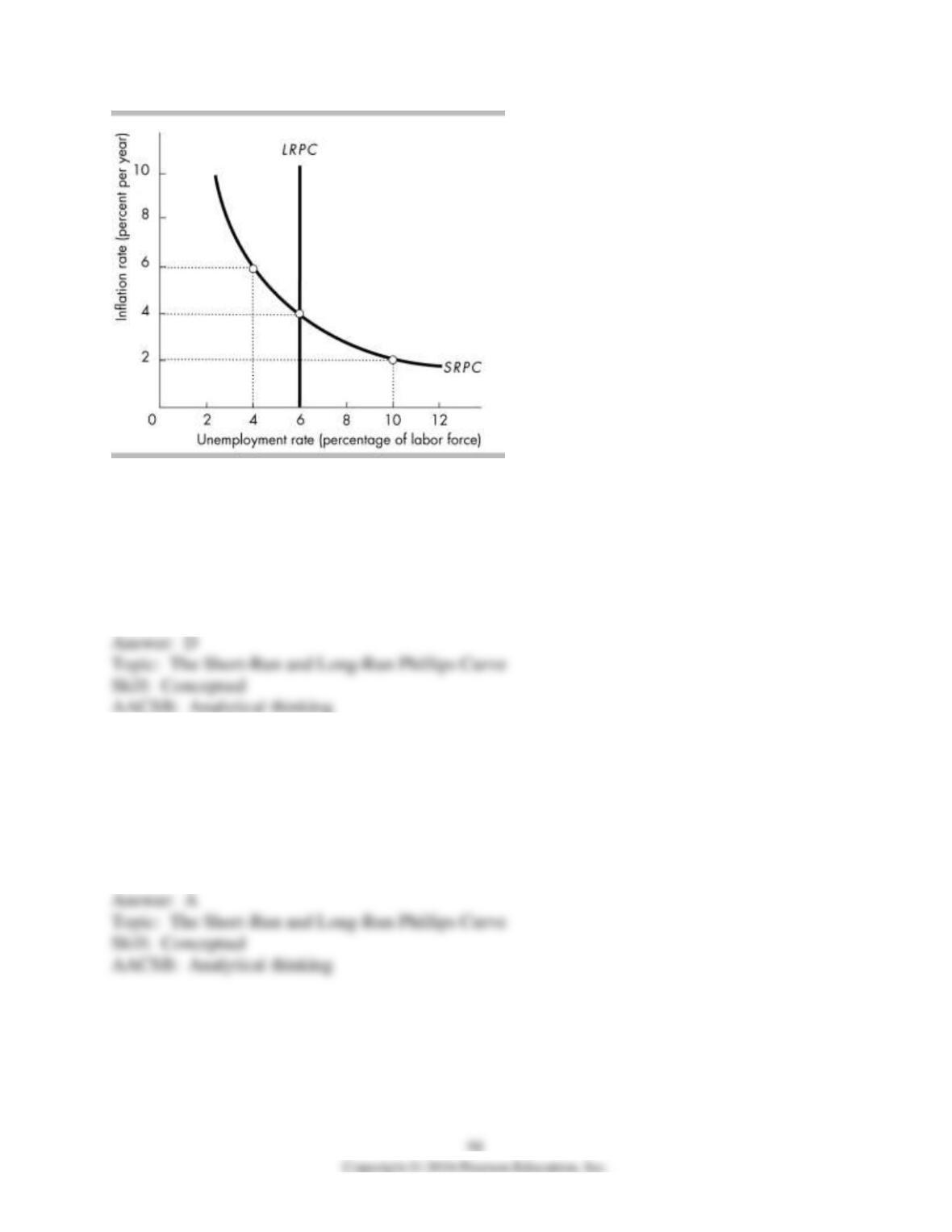
58) The figure above shows an economy’s Phillips curves. Currently, the inflation rate is 6
percent a year. The natural unemployment rate is ________ percent and the expected inflation
rate is ________ percent a year.
A) 6; 6
B) 6; 10
C) 4; 6
D) 6; 4
59) The figure above shows an economy’s Phillips curves. Currently, the inflation rate is 6
percent a year. If inflation expectations remain unchanged, the current unemployment rate is
________.
A) less than the natural rate
B) greater than the natural rate
C) equal to the natural rate
D) 6 percent
60) The short-run Phillips curve shows the relationship between
A) the price level and real GDP in the short run.
B) the price level and unemployment in the short run.
C) inflation and unemployment when expected inflation equals the actual inflation.
D) inflation and unemployment when expected inflation does not change.
61) The short-run Phillips curve shows the ________ relationship between ________.
A) negative; unemployment and real GDP
B) positive; unemployment and real GDP
C) negative; inflation and unemployment
D) positive; real GDP and inflation
62) The long-run Phillips curve shows the relationship between
A) the price level and real GDP in the long run.
B) the price level and unemployment in the long run.
C) inflation and unemployment when expected inflation equals the actual inflation.
D) inflation and unemployment when expected inflation does not change.
63) A decrease in the natural unemployment rate shifts the long-run Phillips curve ________ and
________ the short-run Phillips curve.
A) rightward; does not shift
B) leftward; shifts rightward
C) rightward; shifts rightward
D) leftward; shifts leftward
64) A rise in the expected inflation rate leads to ________ in the long-run Phillips curve and
________ in the short-run Phillips curve.
A) an upward shift; no shift
B) a leftward shift; an upward shift
C) no shift; no shift
D) no shift; an upward shift
65) A decrease in the expected inflation rate leads to ________ in the long-run Phillips curve and
________ in the short-run Phillips curve.
A) an upward shift; no shift
B) a leftward shift; an upward shift
C) no shift; no shift
D) no shift; a downward shift
5 News Based Questions
1) The data below show data for Germany including real GDP (in billions of euros) and the price
level.
Real GDP
Price Level
2002
2088
102.6
2003
2083
103.6
2004
2105
106
2005
2121
108.2
2006
2182
109.7
2007
2237
109.5
In which of the following year(s) did Germany experience inflation?
A) 2003, 2004, 2005 and 2006
B) 2006 and 2007
C) 2007
D) 2002, 2005 and 2006 only