CHAPTER 12—MONOPOLY AND MONOPSONY Key
1. In long-run equilibrium, monopoly prices are set a level where:
2. For a monopoly in equilibrium:
3. The level of competition in a given market tends to increase if:
4. A monopsony is a market with:
5. Government-mandated wage arbitration for employers can enhance efficiency when the labor market
involves:
6. In monopoly competitive markets, profits are maximized when:
7. A market with one buyer is called:
8. The demand curve for a unique product without substitutes is:
9. A monopolist maximizes profits by producing a level of output where:
10. In the short run, a monopolist will:
11. At the profit maximizing level of output for a monopolist:
12. Economic agents that have countervailing power in transactions with monopolists are:
13. Holding supply conditions constant, the costs of regulation fall wholly on producers when:
14. Utility price and profit regulation is based on the perception of:
15. A natural monopoly exists if:
16. Government seeks to aid economic efficiency in the case of natural monopoly through:
17. Windfall profit is economic profit due to:
18. The Sherman Act specifically prohibits:
19. The Clayton Act specifically prohibits:
20. The Celler-Kefauver Act specifically prohibits:
21. The F.T.C. enforces antitrust laws by:
22. The capture theory states that:
23. To the extent that costs exceed benefits, a given mode of regulation is:
24. The view of regulation as a government-imposed means of private-market control is called:
25. In monopoly markets, market demand is:
26. Price/Output Determination. Sun City, Arizona, a retirement community that features full-service living
arrangements, is considering two proposals to provide lawn-care to elderly residents. First, a national lawn-care
firm has offered to purchase the city’s lawn-care equipment at an attractive price in return for an exclusive
franchise on residential service. A second proposal would allow several small companies to enter the business
without any exclusive franchise agreement or competitive restrictions. Under this plan, individual companies
would bid for the right to provide service in a given neighborhood. The city would then allocate business to the
lowest bidder.
The city has conducted a survey of Sun City residents to estimate the amount they would be willing to pay for
various amounts of lawn service. The city has also estimated the total cost of service per resident. Service costs
are expected to be the same whether or not an exclusive franchise is granted.
A.
Use the indicated price and total cost data to complete the following table.
Hours of Lawn Care
per Month
Price per Hour
Total Revenue
Marginal Revenue
Total Cost
Marginal Cost
0
$22.50
$ 0.00
1
21.75
21.00
2
21.00
40.50
3
20.25
58.50
4
19.50
75.75
5
18.75
92.25
6
18.00
107.25
7
17.25
120.75
8
16.50
132.00
9
15.75
150.00
10
15.00
180.00
B.
Determine price and the level of service if competitive bidding results in a perfectly competitive price/output combination.
C.
Determine price and the level of service if the city grants a monopoly franchise.
27. Price/Output Determination. Tallahassee Cars Unlimited, Inc., a rapidly expanding new entrant to this
metropolitan area, is considering two proposals for the provision of its cosmetic detailing of cars (washing,
waxing, polishing, engine cleaning, etc.). First, a large janitorial agency with some experience in the detailing of
cars has offered to purchase the business detailing equipment in return for an exclusive franchise. A second
proposal would allow several small contractors to enter the business without any exclusive franchise agreement
or competitive restrictions. Under this plan, individuals would bid for the right to provide service on groups of
cars as they were delivered to the lot, presumably based on how busy they were at the time. The car lot would
then allocate business to the lowest bidder.
TCU has conducted a study of its past sales records and the amount of detailing spent on each car, and the
premium over book value recouped in the sale to estimate the amount they would be willing to pay for various
amounts of detailing. The car lot has also estimated the total cost of service per car. Service costs are expected
to be the same whether or not an exclusive franchise is granted. To instigate bidding, TCU guarantees the
winner of any bid a minimum per car, whether or not the service is used.
A.
Use the indicated price and cost data to complete the following table.
Hours of Detailing per
Car
Price per Hour
Total Revenue
Marginal Revenue
Total Cost
Marginal Cost
0
$24.00
$ 0.00
1
23.40
18.00
2
22.80
36.00
3
22.20
54.00
4
21.60
72.00
5
21.00
90.00
6
20.40
108.00
7
19.80
126.00
8
19.20
144.00
9
18.60
162.00
10
18.00
180.00
0
$22.50
0.00
$ 0.00
1
21.75
$ 21.75
$21.75
21.00
21.00
2
21.00
42.00
20.25
40.50
19.50
3
20.25
60.75
18.75
58.50
18.00
4
19.50
78.00
17.25
75.75
17.25
5
18.75
93.75
15.75
92.25
16.50
6
18.00
108.00
14.25
107.25
15.00
7
17.25
120.75
12.75
120.75
13.50
8
16.50
132.00
11.25
132.00
11.25
9
15.75
141.75
9.75
150.00
18.00
15.00
150.00
8.25
180.00
30.00
B.
Determine price and the level of service if competitive bidding results in a perfectly competitive price/output combination.
C.
Determine price and the level of service if the car lot grants a monopoly franchise.
28. Price/Output Determination. The City of Ithaca, New York is considering two proposals to provide its
city government the service of computer maintenance. First, a national computer maintenance and sales
franchise has offered to purchase the city’s computer equipment at an attractive price in return for an exclusive
franchise on computer maintenance. A second proposal would allow several small companies to provide the
service without any exclusive franchise agreement or competitive restrictions. Under this plan, individual
companies would bid for the right to provide service in a given department. The city would then allocate
business to the lowest bidder.
The city has conducted a survey of its department to estimate the amount they would be willing to pay for
various amounts of computer maintenance. The city has also estimated the total cost of service per department.
Service costs are expected to be the same whether or not an exclusive franchise is granted.
A.
Use the indicated price and cost data to complete the following table.
A.
0
$24.00
$ 0.00
$ 0.00
1
23.40
23.40
$23.40
18.00
$18.00
2
22.80
45.60
22.20
36.00
18.00
3
22.20
66.60
21.00
54.00
18.00
4
21.60
86.40
19.80
72.00
18.00
5
21.00
105.00
18.60
90.00
18.00
6
20.40
122.40
17.40
108.00
18.00
7
19.80
138.60
16.20
126.00
18.00
8
19.20
153.60
15.00
144.00
18.00
9
18.60
167.40
13.80
162.00
18.00
18.00
180.00
12.60
180.00
18.00
Hours of Computer
Maintenance per
Month
Price per Hour
Total Revenue
Marginal Revenue
Total Cost
Marginal Cost
0
$75.00
$ 0
—
1
72.50
$50.00
2
70.00
50.00
3
67.50
50.00
4
65.00
50.00
5
62.50
50.00
6
60.00
50.00
7
57.50
50.00
8
55.00
50.00
9
52.50
50.00
10
50.00
50.00
B.
Determine price and the level of service if competitive bidding results in a perfectly competitive price/output combination.
C.
Determine price and the level of service if the city grants a monopoly franchise.
0
$75.00
—
$ 0
—
1
72.50
72.50
72.50
50.00
$50.00
2
70.00
140.00
67.50
100.00
50.00
3
67.50
202.50
62.50
150.00
50.00
4
65.00
260.00
57.50
200.00
50.00
5
62.50
312.50
52.50
250.00
50.00
6
60.00
360.00
47.50
300.00
50.00
7
57.50
402.50
42.50
350.00
50.00
8
55.00
440.00
37.50
400.00
50.00
9
52.50
472.50
32.50
450.00
50.00
10
50.00
500.00
27.50
500.00
50.00
29. Price/Output Determination. Orange Freight, Inc., an over-the-road common carrier, is considering two
proposals for truck maintenance service. First, a national diesel service franchise has offered to purchase the
business’ overhaul facilities at an attractive price in return for an exclusive franchise on diesel service. A second
proposal would allow several small companies to enter the business without any exclusive franchise agreement
or competitive restrictions. Under this plan, individual companies would bid for the right to provide service in a
given region. Orange Freight would then allocate business to the lowest bidder.
Orange Freight has conducted a survey of regional service hubs to estimate the amount they would be willing to
pay for various amounts of diesel service. Orange Freight has also estimated the total cost of service per truck.
Service costs are expected to be the same whether or not an exclusive franchise is granted.
A.
Use the indicated price and cost data to complete the following table.
Hours for each Diesel
Truck Service per
Month
Price per Hour
Total Revenue
Marginal Revenue
Total Cost
Marginal Cost
0
$80
$ 0
—-
1
78
72
2
76
72
3
74
70
4
72
68
5
70
66
6
68
60
7
66
54
8
64
68
9
62
90
10
60
130
B.
Determine price and the level of service if competitive bidding results in a perfectly competitive price/output combination.
C.
Determine price and the level of service if Orange Freight grants a monopoly franchise.
A.
0
$80
$ 0
—-
$ 0
—-
1
78
78
$78
72
72
2
76
152
74
144
72
3
74
222
70
214
70
4
72
288
66
282
68
5
70
350
62
348
66
6
68
408
58
408
60
7
66
462
54
462
54
8
64
512
50
530
68
9
62
558
46
620
90
10
60
600
42
750
130
30. Monopoly Equilibrium. Quick Tax, Inc., enjoys pricing power in the Daytona Beach market for tax
preparation services. Total and marginal revenue relations for small business customers are:
TR = $280Q – $0.005Q2
MR = TR/ Q = $280 – $0.01Q
Marginal costs are stable at $100 per unit. All other costs have been fully amortized.
A.
As a monopoly, calculate Quick Tax’s output, price, and profits at the profit-maximizing activity level.
B.
What price and profit levels would prevail based on the assumption that perfectly competitive pricing emerges in the local market?
Set MR = MC to find the profit-maximizing activity level:
= MC
$280 – $0.01Q
= $100
0.01Q
= 180
Q
= 18,000
P
= TR/Q
= ($280Q – $0.005Q2)/Q
= $280 – $0.005Q
= $280 – $0.005(18,000)
= $190
p
= TR – TC
= $190(18,000) – $100(18,000)
= $1,620,000
31. Monopoly Equilibrium. Paradox Dental, Ltd., enjoys a local monopoly in the provision of oral
examination services in Tuskegee, Alabama. Total and marginal revenue relations for the standard procedure
are:
TR = $250Q – $0.001Q2
MR = TR/ Q = $250 – $0.002Q
Marginal costs for the process are stable at $150 per unit. Fixed costs are nil.
A.
As a monopoly, calculate Paradox Dental’s output, price, and profits at the profit-maximizing activity level.
B.
What price and profit levels would prevail based on the assumption that new entry into the local market results in competitive market
pricing?
32. Monopoly Equilibrium. The Athletic Medicine Center in Madison, Wisconsin, enjoys pricing power in the
practice of medicine. Market demand and marginal revenue relations for a standard medical procedure to repair
damaged knee cartilage are:
P
= $5,000 – $0.05Q
MR
= TR/ Q = $5,000 – $0.1Q
= MC
0.002Q
= 100
P
= TR/Q
= ($250Q – $0.001Q2)/Q
= $250 – $0.001Q
= $250 – $0.001(50,000)
= $200
p
= TR – TC
= $200(50,000) – $150(50,000)
= $2,500,000
B.
In a perfectly competitive industry, P = MR = MC in equilibrium. Thus, after the emergence of competitive market pricing, P = MC =
$150 would result. Because MC = AC, P = MC implies that p = 0.
Fixed costs are nil, and average variable costs are constant at $4,000 per unit.
A.
Calculate the profit-maximizing price/output combination and economic profits if the Athletic Medicine Center enjoys an effective
monopoly.
B.
Calculate the price/output combination and total economic profits that would result if new entrants create a perfectly competitive
market.
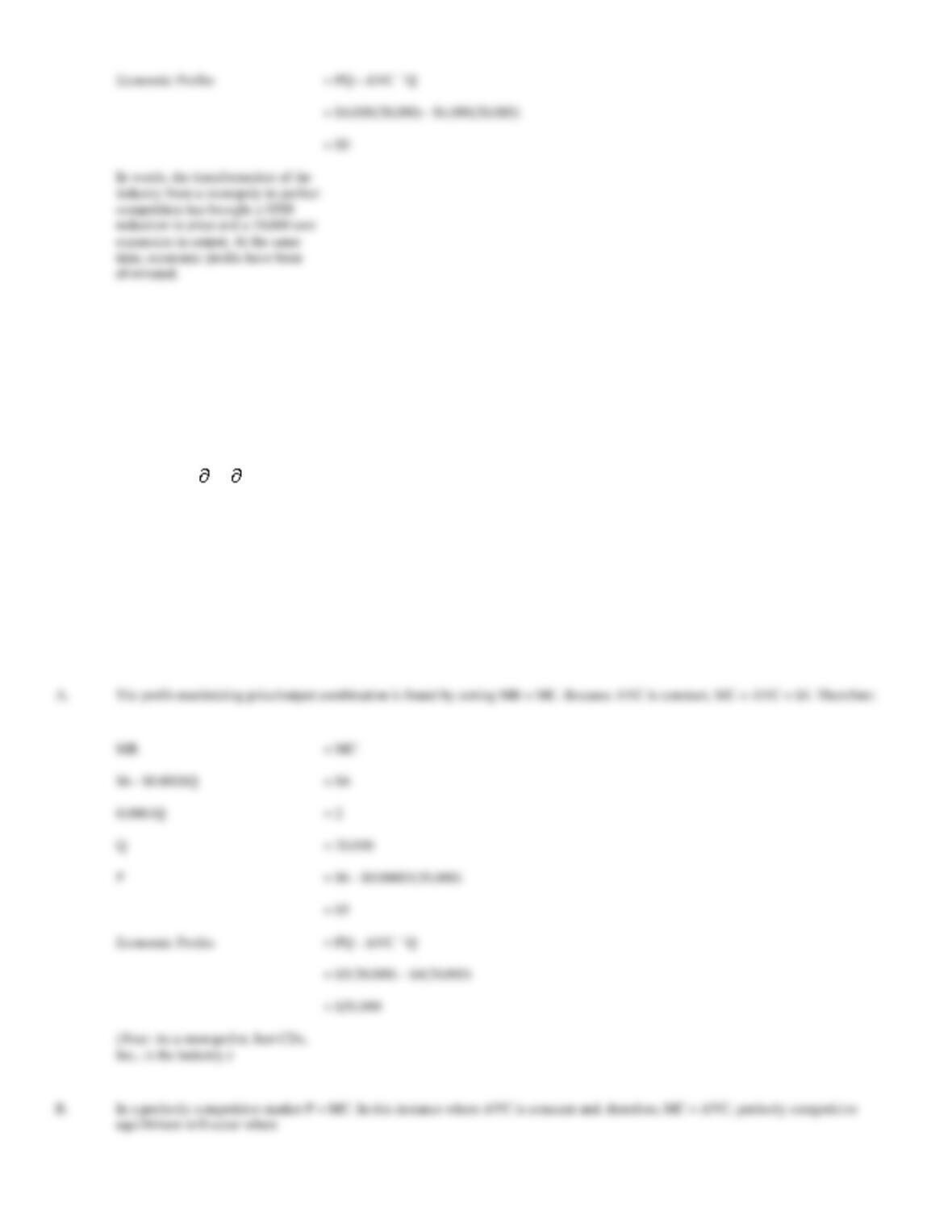
B.
In a perfectly competitive market P = MC. In this instance where AVC is constant and, therefore, MC = AVC, perfectly competitive
equilibrium will occur when:
33. Monopoly Equilibrium. Just CDs, Inc., has developed a booming business in the purchase and sale of used
CDs and used DVDs. Demand and marginal revenue relations for the local college student market are:
P
= $6 – $0.00005Q
MR
= TR/ Q = $6 – $0.0001Q
Fixed costs are nil, and average variable costs are constant at $4 per unit.
A.
Calculate the profit-maximizing price/output combination and economic profits if Just CDs enjoys an effective monopoly in the local
market.
B.
Calculate the price/output combination and total economic profits that would result if Internet competition makes the used CD and used
DVD market perfectly competitive.
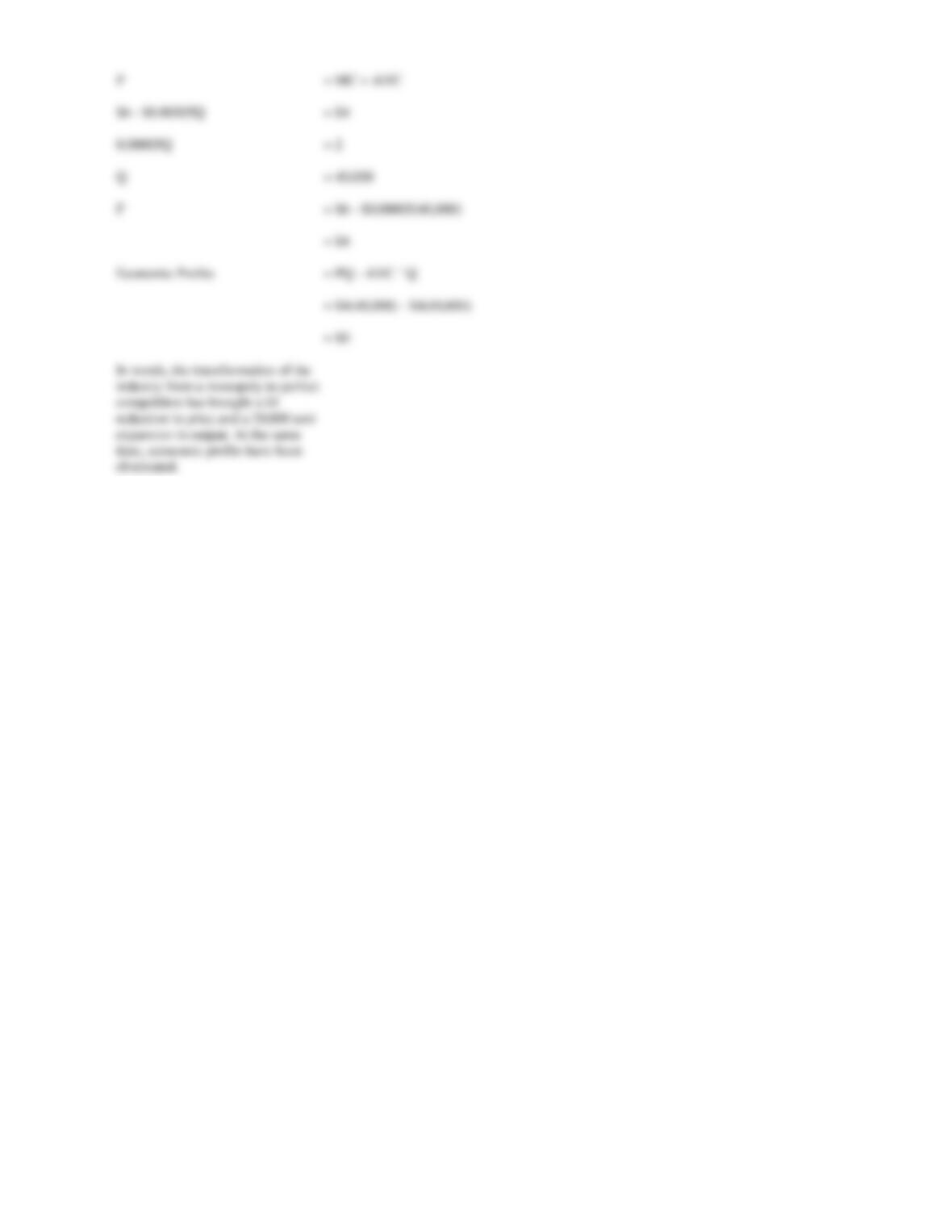
The profit-maximizing price/output combination is found by setting MR = MC. Because AVC is constant, MC = AVC = $4. Therefore:
= MC
= $4
0.0001Q
= 2
Q
= 20,000
P
= $6 – $0.00005(20,000)
= $5
Economic Profits
= PQ – AVC ´ Q
= $5(20,000) – $4(20,000)
= $20,000
Inc., is the industry.)
Economic Profits
= PQ – AVC ´ Q
= $4,000(20,000) – $4,000(20,000)
= $0
34. Price Fixing. From 1989 through 1991, the Department of Justice (DOJ) investigated a number of private,
selective colleges for price fixing. The investigation eventually settled on an “overlap group,” comprised of
about one-half of the most selective private colleges in the United States. The group included 23 colleges, from
small liberal arts schools like Colby, Vassar, and Middlebury to larger universities like Princeton and MIT.
Some students applied to more than one of the 23 schools and, each spring, officials from these institutions met
to coordinate the exact calculation of such students’ financial need. The case broke new ground in antitrust
theory.
The DOJ alleged that the meetings enabled the colleges to collude on higher tuition and to increase their tuition
revenue. The colleges defended their meetings by saying that they had to have some coordination in order to
successfully implement their commitment to fully cover the need of any student they admitted. The colleges
wanted to pull needy, able students into the pool of students who applied to selective private colleges because
they saw such students as a “public good” for all their students. Yet, no college wanted to end up with a
disproportionate share of the needy students simply because it had unintentionally made more generous need
calculations than the other colleges. (All of the colleges attempted to use the same formula for need, but varying
and difficult-to-interpret information from parents introduced some actual variation in their calculations.)
Although the colleges denied the price-fixing allegation, they discontinued their annual meetings in 1991. Nor
did they resume, even after a federal Court of Appeals rendered a decision in their favor.
A.
How would you determine if the “financial-aid overlap” meeting is an example of price fixing?
B.
If price fixing did indeed occur at these meetings, which laws in particular might be violated?
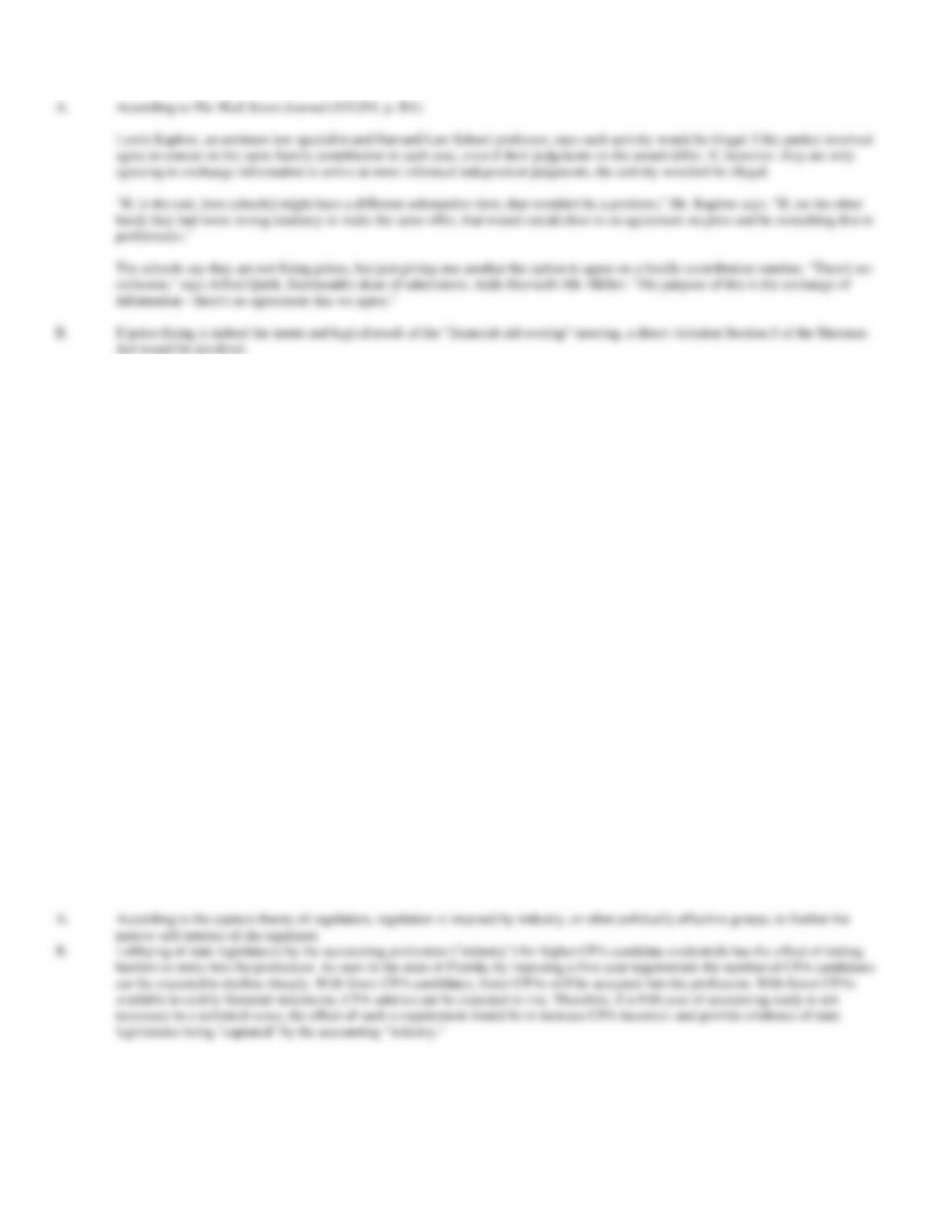
P
= MC = AVC
= $4
0.00005Q
= 2
Q
= 40,000
P
= $6 – $0.00005(40,000)
= $4
Economic Profits
= PQ – AVC ´ Q
= $4(40,000) – $4(40,000)
= $0
35. Theory of Regulation. On November 21, 1986, The Wall Street Journal (p. 29) carried a short article titled
“It’ll Mean Another Two Semesters in the Red, But Who’s Counting?” This article described efforts by the
American Institute of Certified Public Accountants (AICPA) to require a fifth (graduate) year of study in
accounting for joining the institute. The following is an excerpt from that article:
“Technical demands have become so great on accountants that they can’t get five pounds of education in a four-pound bag.” explains
James MacNeil, director of the AICPA’s education division. He says the extra year “would help graduates understand such new
complexities as leveraged leases and buyouts and new types of securities being devised by Wall Street.” (Hawaii, Utah and Florida
already require five years of study before taking the CPA exam, and several other states are giving the matter independent
consideration.)
Such arguments, however, have failed to sway many educators. “Most of the deans of the nation’s 650 business schools oppose going to
five years from four,” says Charles Hickman, projects director for the American Assembly of Collegiate Schools of Business, based in
St. Louis. “The big question raised by most deans is whether another roadblock should be raised to becoming a working accountant.”
Some opponents point out that because Florida imposed its five-year rule in 1983, the number of applicants for the CPA exam there has declined
sharply each year. The argue that the new education requirements reflect the regulators being “captured” by the CPA lobby.
Briefly explain:
A.
The causes and consequences of regulation according to the “capture” theory of regulation.
B.
How the preceding article supports this theory.
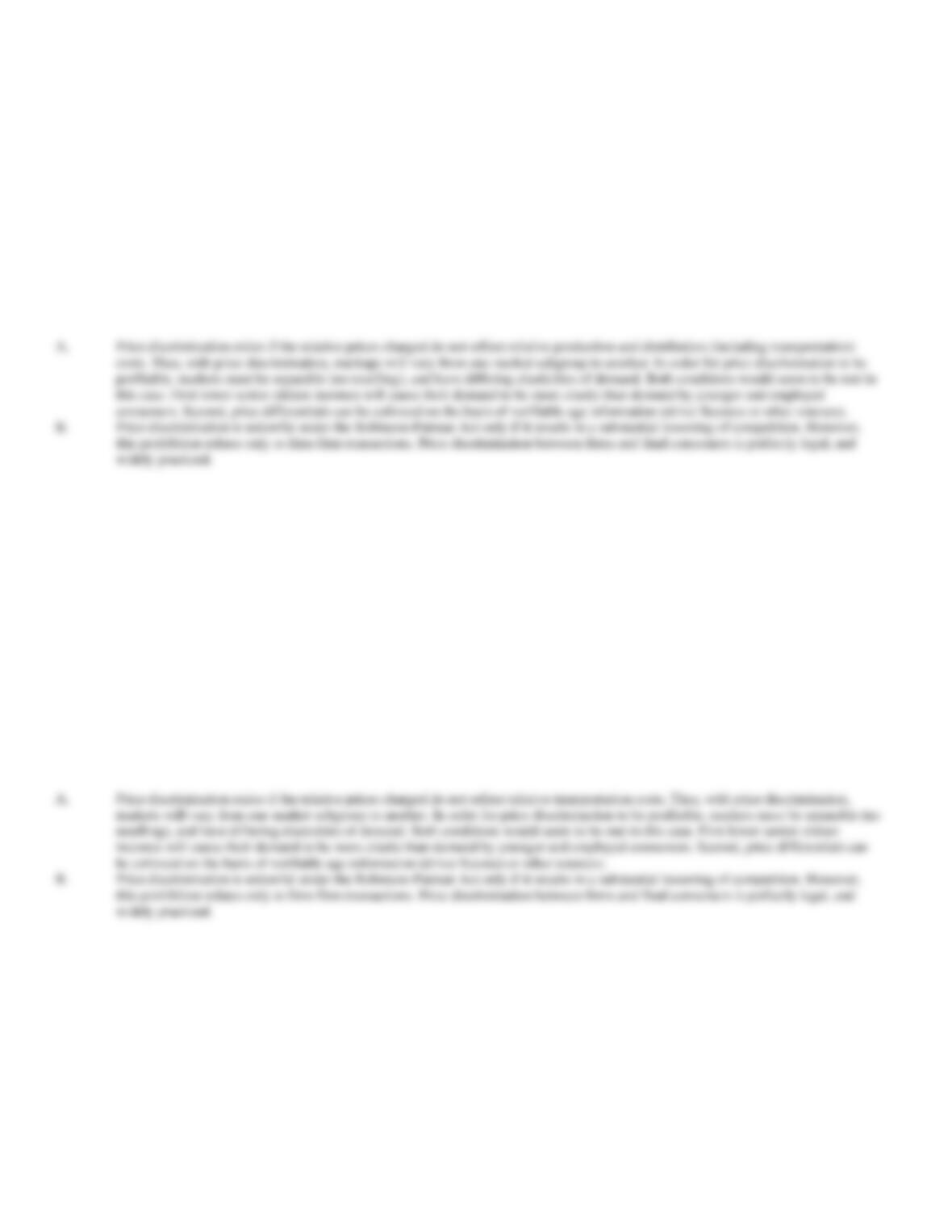
According to the capture theory of regulation, regulation is imposed by industry, or other politically effective groups, to further the
narrow self-interest of the regulated.
available to certify financial statements, CPA salaries can be expected to rise. Therefore, if a fifth year of accounting study is not
A.
According to The Wall Street Journal (5/12/91, p. B1):
Lewis Kaplow, an antitrust-law specialist and Harvard Law School professor, says such activity would be illegal if the parties involved
agreeing to exchange information to arrive at more informed independent judgments, the activity wouldn’t be illegal.
“If, in the end, [two schools] might have a different substantive view, that wouldn’t be a problem,” Mr. Kaplow says. “If, on the other
hand, they had some strong tendency to make the same offer, that would sound close to an agreement on price and be something that is
The schools say they are not fixing prices, but just giving one another the option to agree on a family-contribution number. “There’s no
collusion,” says Alfred Quirk, Dartmouth’s dean of admissions. Adds Harvard’s Mr. Miller: “The purpose of this is the exchange of
36. Price Discrimination. During recent years, national hotel and restaurant chains in the United States have
charged lower lodging and meal prices to senior citizens in an effort to profitably segment the market for their
services. Thus, senior citizens have come to enjoy discounts of 10-25% off the prices paid by other (younger)
full-price customers. This two-tier pricing scheme has raised the ire of some consumers who view it as
discriminatory and a violation of antitrust laws.
A.
Is this pricing scheme discriminatory in the economic sense? What conditions would be necessary for it to be profitable to the hotel and
restaurant industry?
B.
Carefully describe how price discrimination could violate U.S. antitrust laws and be sure to mention which laws in particular might be
violated.
37. Price Discrimination. Metropolitan bus service companies in the United States have charged lower fares to
senior citizens in an effort to profitably segment the market for their services. Thus, senior citizens have come
to enjoy discounts of 25-50% off the prices paid by other (younger) full-price customers. This two-tier pricing
scheme has raised the ire of some consumers who view it as discriminatory and a violation of antitrust laws.
A.
Is this pricing scheme discriminatory in the economic sense? What conditions would be necessary for it to be profitable to the bus
service industry?
B.
Carefully describe how price discrimination could violate U.S. antitrust laws and be sure to mention which laws in particular might be
violated.
be enforced on the basis of verifiable age information (driver licenses or other sources).
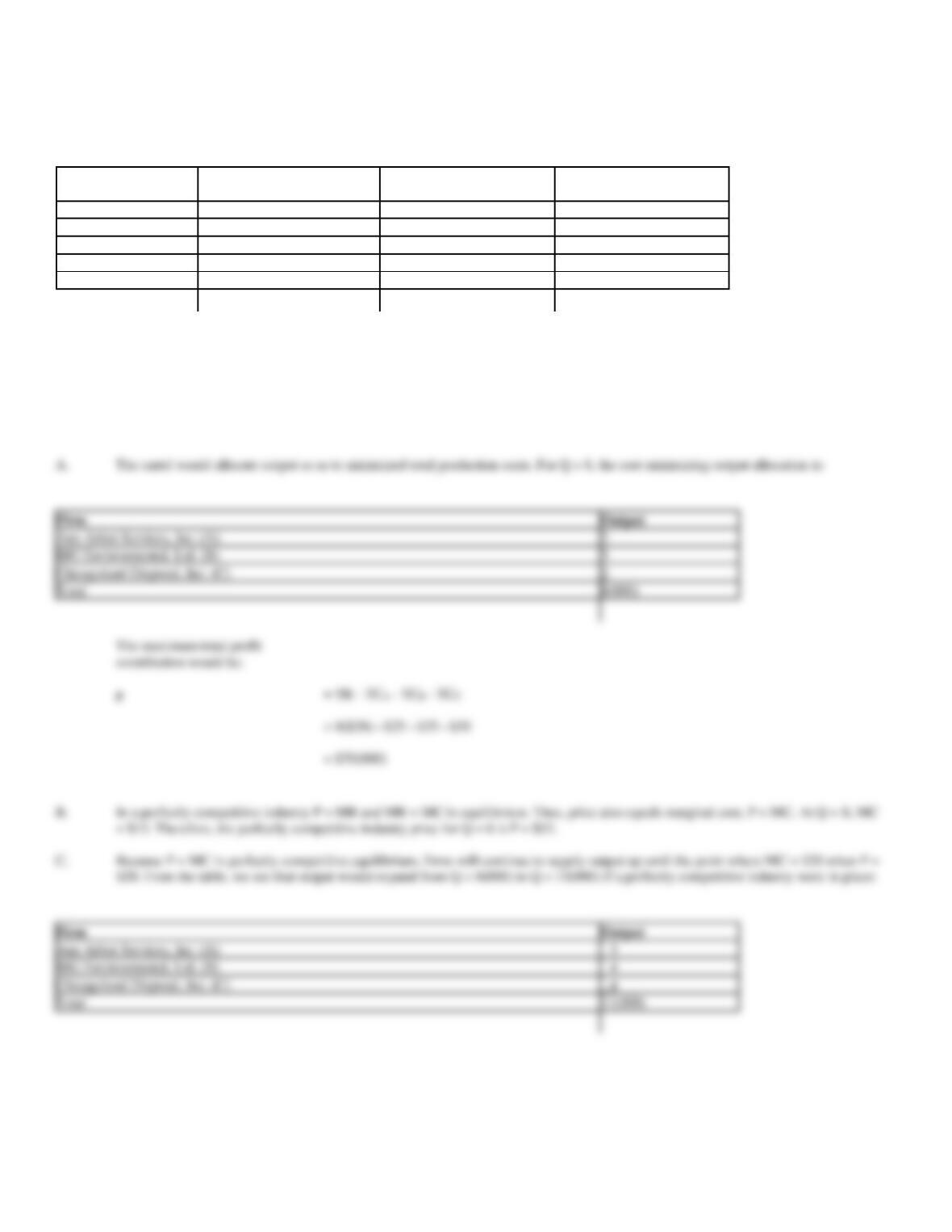
38. Price Fixing. Three leading toxic waste disposal companies have entered into a secret cartel to fix prices
and allocate business in the upper Midwest. The marginal costs per unit for toxic waste disposal services are as
follows:
Toxic Waste (000)
Ann Arbor Services, Inc. (A)
BIG Environmental, Ltd.
(B)
Chicago land Disposal, Inc.
(C)
1
$10
$10
$ 5
2
15
10
10
3
20
15
15
4
25
20
20
5
30
25
25
A.
Determine the cartel’s optimal allocation of output and maximum profit contribution if it sets Q = 8(000) and P = $20.
B.
Calculate the perfectly competitive industry price for Q = 8.
C.
How much output would a perfectly competitive industry supply at P = $20?
D.
Describe the value to society of breaking up the cartel.
A.
The cartel would allocate output so as to minimized total production costs. For Q = 8, the cost minimizing output allocation is:
Ann Arbor Services, Inc. (A)
2
BIG Environmental, Ltd. (B)
3
Chicagoland Disposal, Inc. (C)
3
Total
8(000)
p
= TR – TCA – TCB – TCC
= 8($20) – $25 – $35 – $30
= $70(000)
Ann Arbor Services, Inc. (A)
3
BIG Environmental, Ltd. (B)
4
Chicagoland Disposal, Inc. (C)
4
Total
11(000)
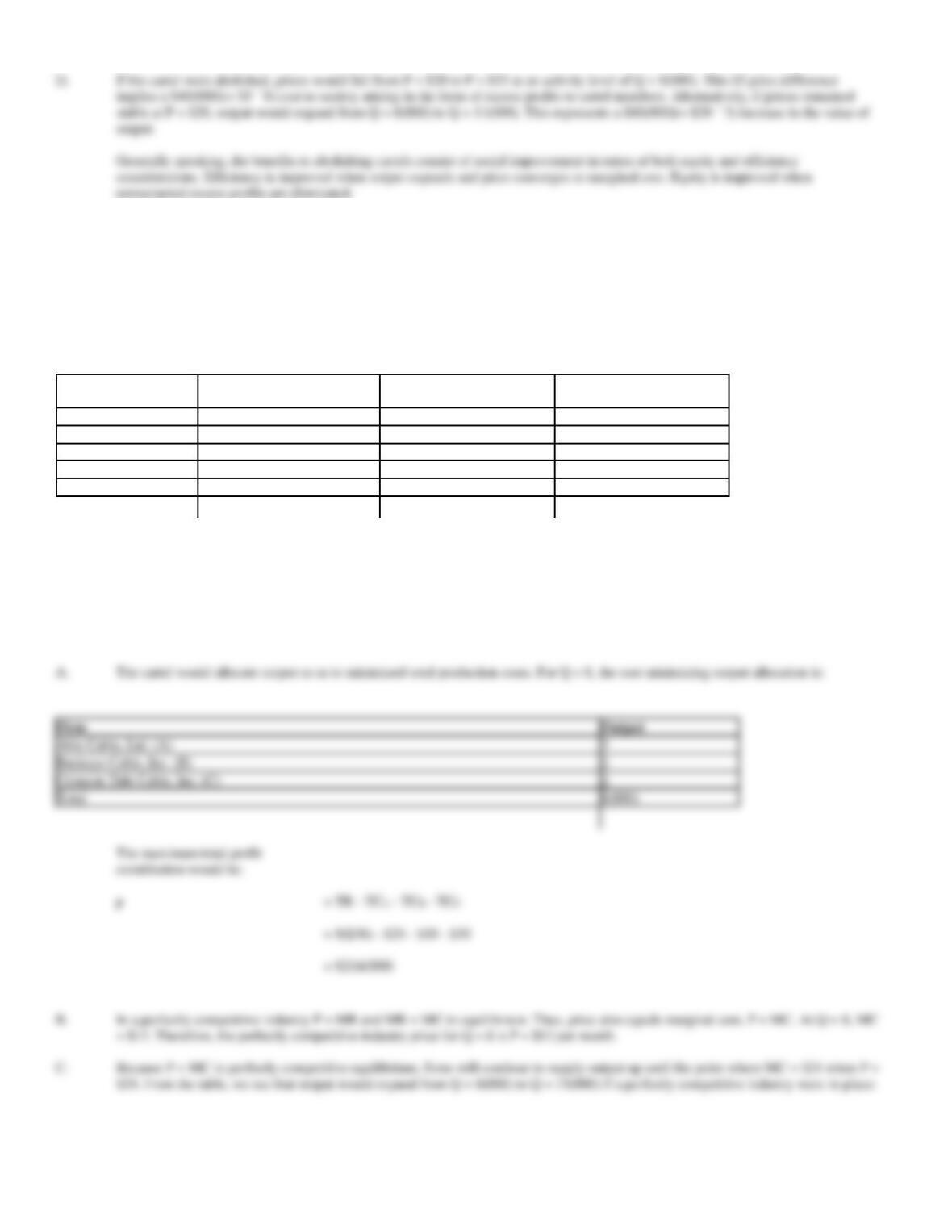
39. Price Fixing. Three leading CATV companies have entered into a secret cartel to fix prices and allocate
business in rural southeastern markets. The marginal costs per unit for CATV service (basic hook-up) are as
follows:
Hook-ups (000)
Able Cable, Ltd. (A)
Buckeye Cable, Inc. (B)
Crimson Tide Cable, Inc.
(C)
1
$ 4
$ 6
$ 8
2
8
12
10
3
12
20
12
4
24
29
24
5
31
40
37
A.
Determine the cartel’s optimal allocation of output and maximum profit contribution if it sets Q = 8(000) and P = $36 per month.
B.
Calculate the perfectly competitive industry price for Q = 8.
C.
How much output would a perfectly competitive industry supply at P = $24 per month?
D.
Describe the value to society of breaking up the cartel.
A.
The cartel would allocate output so as to minimized total production costs. For Q = 8, the cost minimizing output allocation is:
Able Cable, Ltd. (A)
3
Buckeye Cable, Inc. (B)
2
Crimson Tide Cable, Inc. (C)
3
Total
8(000)
p
= TR – TCA – TCB – TCC
= 8($36) – $24 – $18 – $30
= $216(000)
40. Costs of Regulation. Glove-Box, Inc., produces glove boxes designed to allow workers to safely handle
hazardous materials used in a wide variety of products. Market demand and marginal revenue relations for the
Glove-Box units are:
P
= $500,000 – $250Q
MR
= TR/ Q = $500,000 – $500Q
Assume the Occupational Health and Safety Administration (OSHA) has recently ruled that Glove-Box must install expensive new shielding
equipment to further guard against worker injuries. This will increase the $200,000 marginal cost of manufacturing by $250,000 per unit.
Glove-Box’s fixed expenses of $50 million per year, which include a required return on investment, will be unaffected.
A.
Calculate Glove-Box’s profit-maximizing price/output combination and economic profit level before installation of the
OSHA-mandated shielding equipment.
B.
Calculate the profit-maximizing price/output combination and economic profit level after Glove-Box has met OSHA guidelines.
C.
Compare your answers to parts A and B. Who pays the economic burden of meeting OSHA guidelines?
Glove-Box will maximize profits by setting MR = MC. Before the OSHA-mandated increase in costs, MC = $200,000. Therefore,
= MC
$500,000 – $500Q
= $200,000
= 300,000
Q
= 600
P
= $500,000 – $250(600)
= $350,000
Total Economic Profits
= PQ – TC
= $350,000(600) – $200,000(600) – $50,000,000
Able Cable, Ltd. (A)
3
Buckeye Cable, Inc. (B)
4
Crimson Tide Cable, Inc. (C)
4
Total
11(000)
41. Costs of Regulation. Biosystems Technology, Inc., manufacturers equipment used by the biotechnology
industry in the analysis of protein and DNA. Market demand and marginal revenue relations for the Biosystems
units are:
P
= $50,000 – $25Q
MR
= TR/ Q = $50,000 – $50Q
Suppose the Occupational Health and Safety Administration (OSHA) has recently ruled that Biosystems must install expensive new shielding
equipment to further guard against worker injuries. This will increase the $10,000 marginal cost of manufacturing by $15,000 per unit. Biosystems’
fixed expenses of $15 million per year, which include a required return on investment, will be unaffected.
A.
Calculate Biosystems’ profit-maximizing price/output combination and economic profit level before installation of the OSHA-mandated
shielding equipment.
B.
Calculate the profit-maximizing price/output combination and economic profit level after Biosystems has met OSHA guidelines.
C.
Compare your answers to parts A and B. Who pays the economic burden of meeting OSHA guidelines?
Biosystems will maximize profits by setting MR = MC. Before the OSHA-mandated increase in costs, MC = $10,000. Therefore,
= MC + $50,000
$500,000 – $500Q
= $250,000
= 250,000
Q
= 500
P
= $500,000 – $250(500)
= $375,000
Total Economic Profits
= PQ – TC
= $375,000(500) – $250,000(500) – $50,000,000
= $12,500,000