78) Which of the following will increase aggregate expenditure in the United States?
A) an increase in the value of the dollar
B) an increase in the price level
C) an increase in interest rates
D) an increase in government purchases
79) Higher interest rates increase both consumption and investment spending.
80) The marginal propensity to consume is the slope of the consumption function.
81) When Jack’s income increases by $1,000, he spends an additional $850 dollars. This implies that his
marginal propensity to consume is 0.85.
82) When Jack’s income increases by $5,000, he spends an additional $4,000 dollars. This implies that
his marginal propensity to consume is 1.25.
83) An increase in the price level in the United States will reduce exports and increase imports.
84) The marginal propensity to consume measures the average amount of wealth that a consumer
spends in a given period of time.
85) When Javier’s income increases by $5,000, he spends an additional $3,750 dollars. This implies that
his marginal propensity to consume is 0.75.
86) When Jack’s income increases by $1,000, he spends an additional $850 dollars. This implies that his
marginal propensity to save is 0.85.
87) An increase in the price level in the United States will reduce imports and increase exports.
88) You review a salesman’s income over a 5-year period. You note it fluctuates tremendously from
year to year, yet his consumption of goods and services remains consistently at the same level, year
after year. Does this mean that income is not a determinant of consumption, or could something else
explain his behavior?
89) Ceteris paribus, how does a recession in the United States affect U.S. net exports?
90) Explain how a stock market crash has the potential to lead to a recession in an economy.
91) Suppose the United States experiences a long period of inflation relative to other countries. How
will this affect U.S. net exports?
92) What are the four categories of aggregate expenditure?
93) Ceteris paribus, how does an expansion in the United States affect U.S. net exports?
94) What are the five main determinants of consumption spending? Which of these is the most
important?
95) Suppose the United States experiences a long period of relatively stable prices while other countries
experience long periods of inflation. How will this affect U.S. net exports?
45
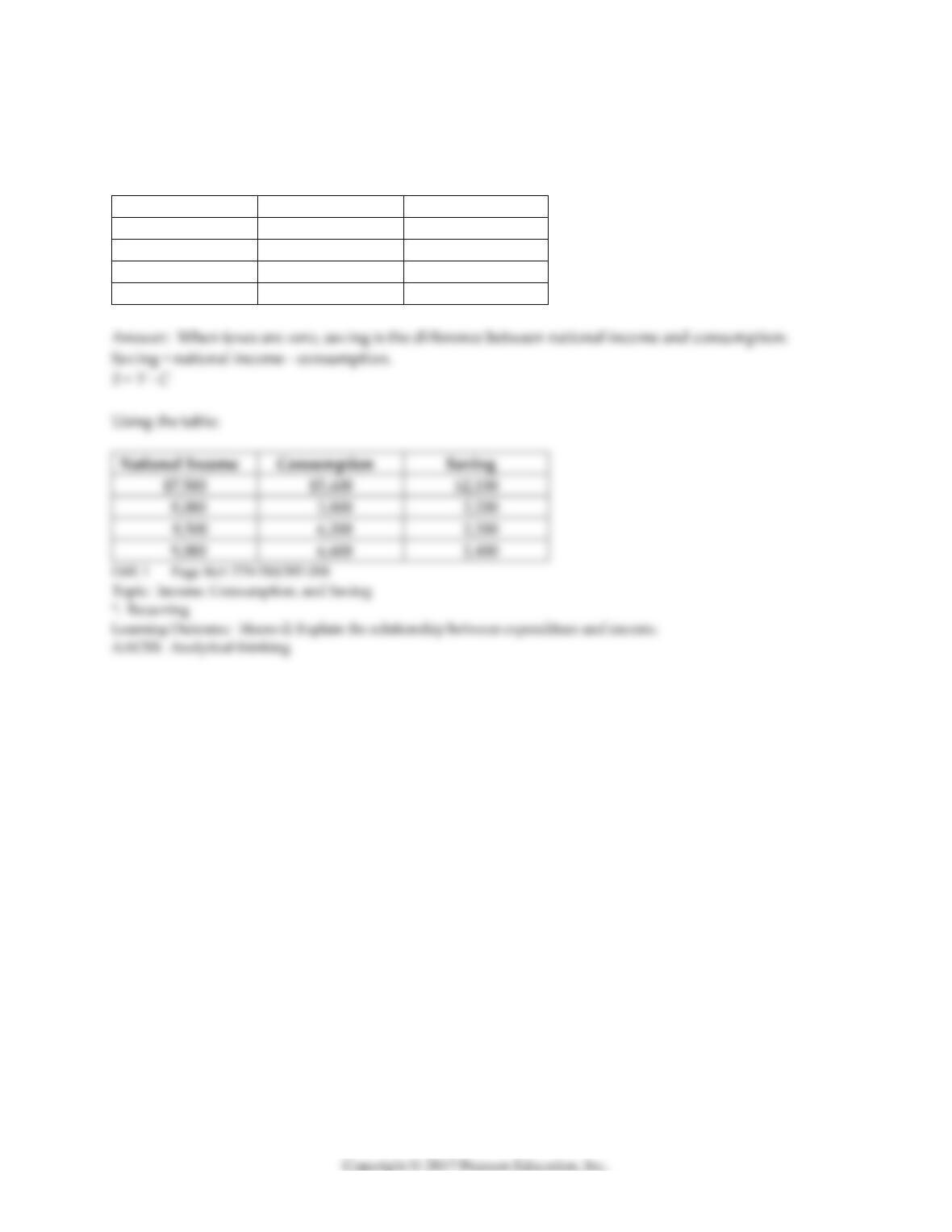
96) Given Table 12-5 below, fill in the values for saving. Assume there are no taxes.
Table 12-5
National Income
Consumption
Saving
$7,500
$5,400
8,000
5,800
8,500
6,200
9,000
6,600
46
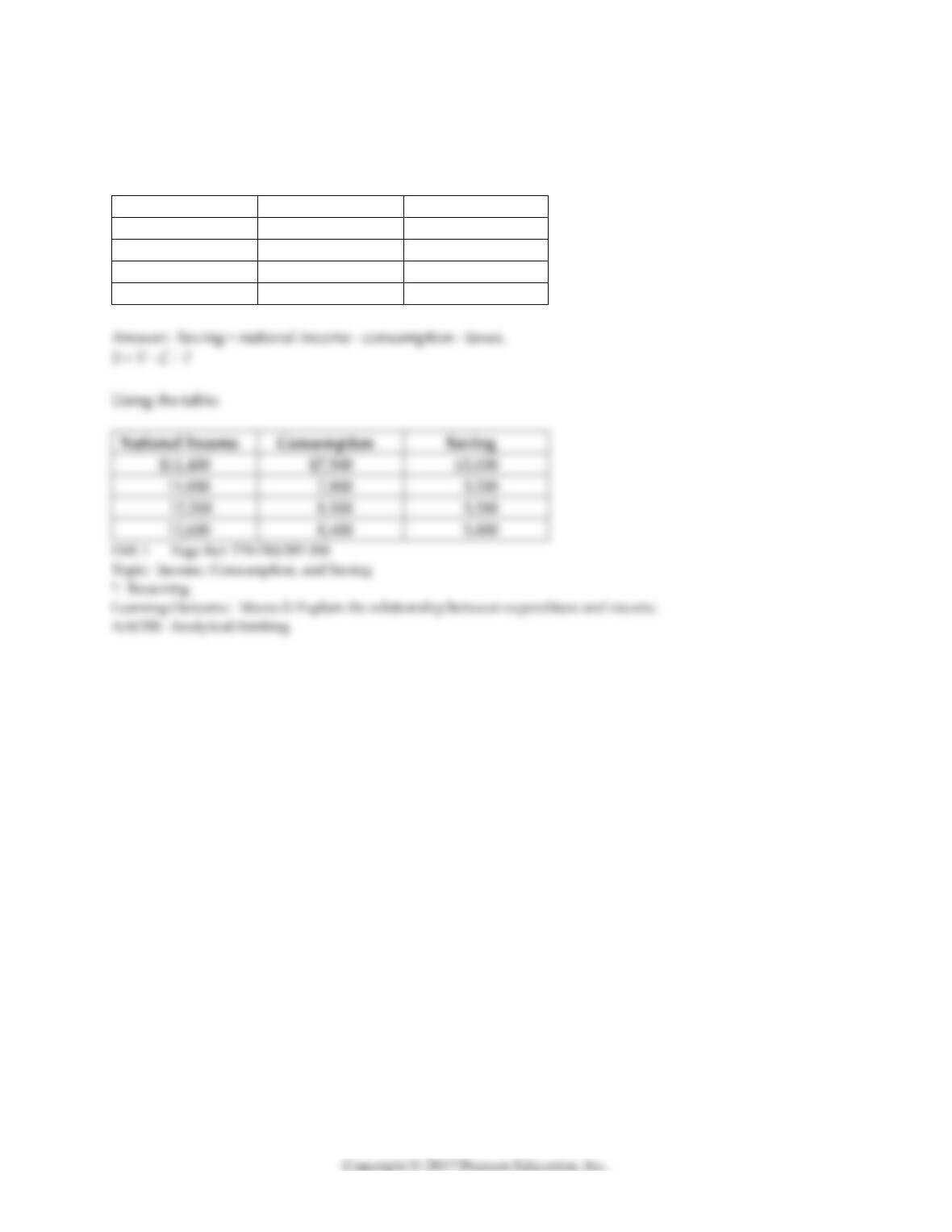
97) Given Table 12-6 below, fill in the values for saving. Assume taxes = $800.
Table 12-6
National Income
Consumption
Saving
$11,400
$7,500
11,800
7,800
12,200
8,100
12,600
8,400
12,200
47
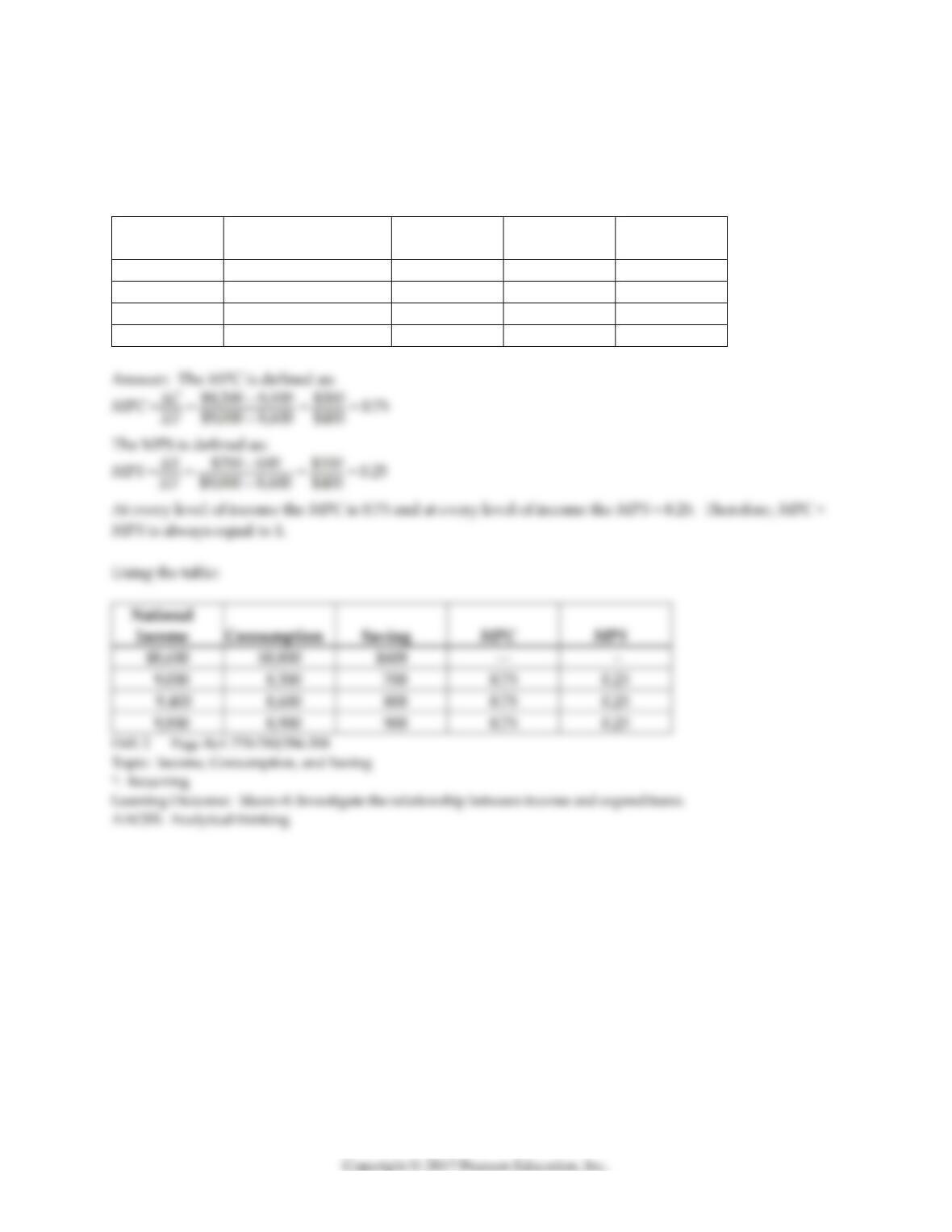
98) Given Table 12-7 below, fill in the values of the marginal propensity to save (MPS) and the marginal
propensity to consume (MPC). Show that MPC + MPS = 1.
Table 12-7
National
Income
Consumption
Saving
MPC
MPS
$8,600
$8,000
$600
9,000
8,300
700
9,400
8,600
800
9,800
8,900
900
National
Income
Saving
MPC
MPS
$8,600
$8,000
9,000
8,300
8,600
9,800
8,900
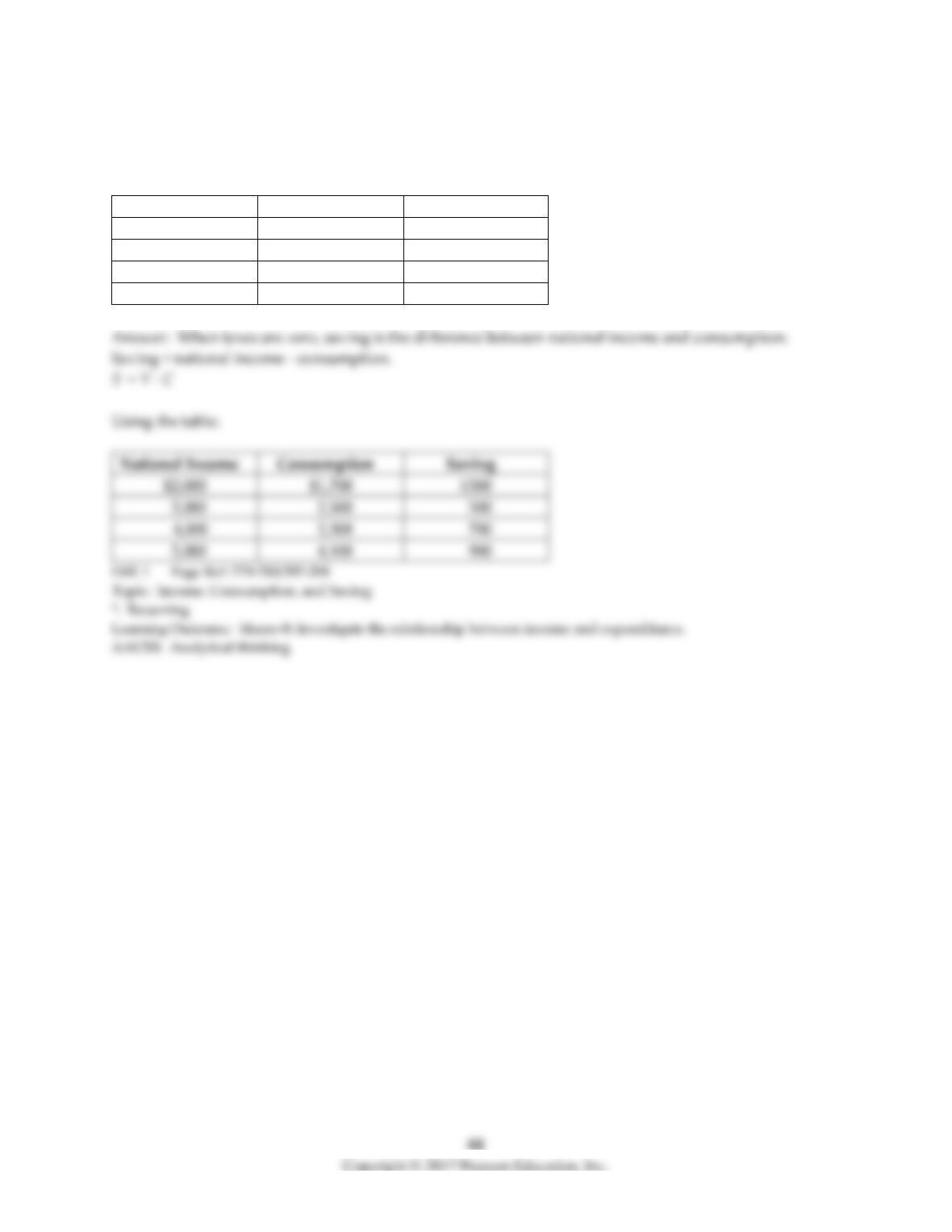
99) Given Table 12-8 below, fill in the values for saving. Assume there are no taxes.
Table 12-8
National Income
Consumption
Saving
$2,000
$1,700
3,000
2,500
4,000
3,300
5,000
4,100
100) Given Table 12-9 below, fill in the values of the marginal propensity to save (MPS) and the
marginal propensity to consume (MPC). Show that MPC + MPS = 1.
Table 12-9
National
Income
Consumption
Saving
MPC
MPS
$2,000
$1,900
$100
3,000
2,700
300
4,000
3,500
500
5,000
4,300
700
National
Income
Saving
MPC
MPS
$2,000
$1,900
3,000
2,700
3,500
5,000
4,300
12.3 Graphing Macroeconomic Equilibrium
1) On the 45-degree line diagram, the 45-degree line shows points where
A) real income equals real GDP.
B) real aggregate expenditure equals C + I.
C) real aggregate expenditure equals real GDP.
D) real aggregate output equals the quantity produced.
2) On the 45-degree line diagram, for points that lie below the 45-degree line,
A) planned aggregate expenditure is greater than GDP.
B) planned aggregate expenditure is less than GDP.
C) planned aggregate expenditure is equal to GDP.
D) planned aggregate expenditure is less than aggregate income.
3) If planned aggregate expenditure is less than total production,
A) actual inventories will equal planned inventories.
B) firms will experience an unplanned increase in inventories.
C) GDP will increase.
D) the economy is in equilibrium.
4) If planned aggregate expenditure is less than total production,
A) actual inventories will equal planned inventories.
B) firms will experience an unplanned decrease in inventories.
C) GDP will decrease.
D) the economy is in equilibrium.
5) If the economy is currently in equilibrium at a level of GDP that is below potential GDP, which of the
following would move the economy back to potential GDP?
A) an increase in wealth
B) an increase in interest rates
C) a decrease in business confidence
D) an increase in the value of the dollar relative to other currencies
Figure 12-1
6) Refer to Figure 12-1. According to the figure above, at what point is aggregate expenditure greater
than GDP?
A) J
B) K
C) L
D) none of the above
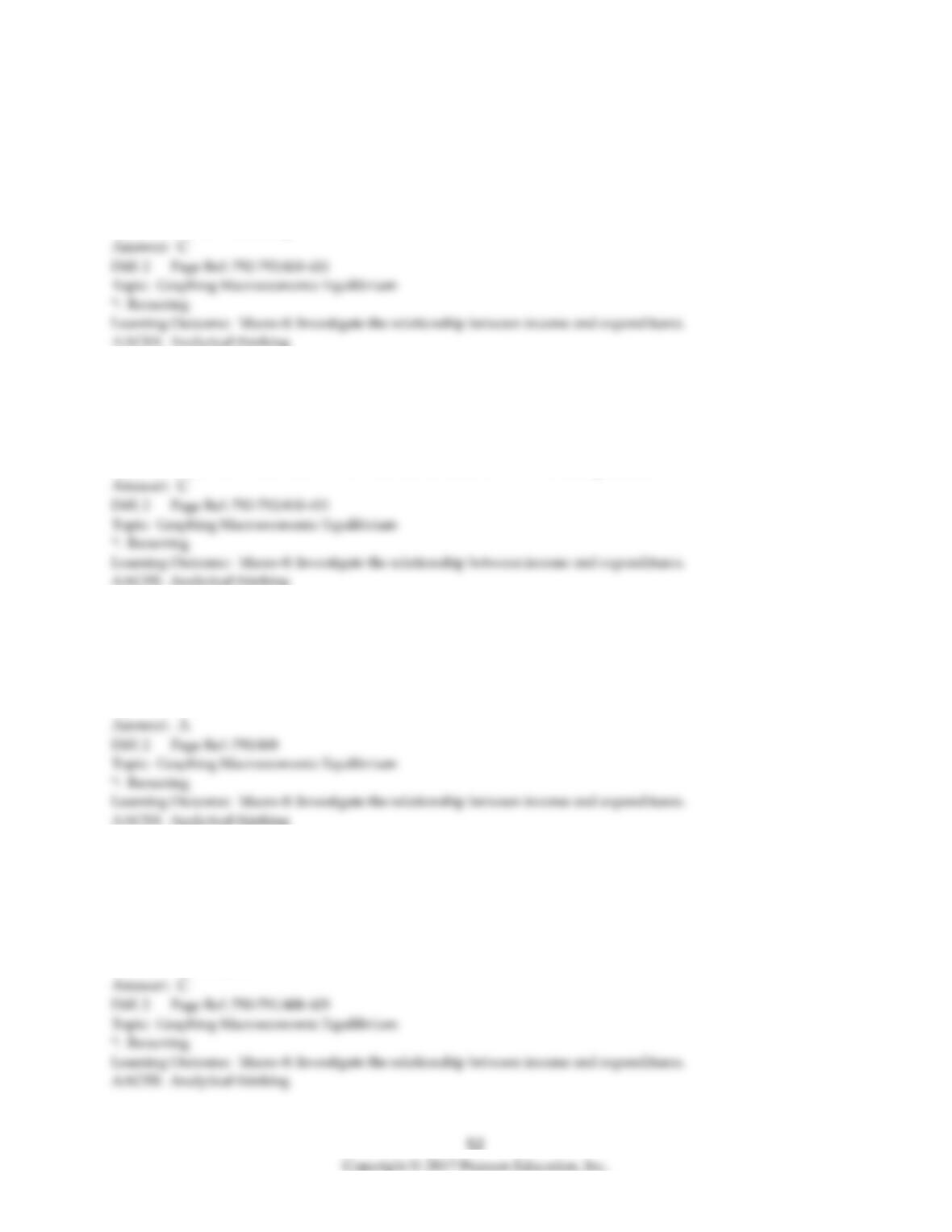
7) Refer to Figure 12-1. At point L in the figure above, which of the following is true?
A) Aggregate expenditure is greater than GDP.
B) The economy has achieved macroeconomic equilibrium.
C) Actual inventories are greater than planned inventories.
D) GDP will be increasing.
8) Refer to Figure 12-1. If the economy is at point L, what will happen?
A) Inventories have fallen below their desired level, and firms decrease production.
B) Inventories have fallen below their desired level, and firms increase production.
C) Inventories have risen above their desired level, and firms decrease production.
D) Inventories have risen above their desired level, and firms increase production.
9) Refer to Figure 12-1. If the economy is at a level of aggregate expenditure given by point K,
A) the economy is in equilibrium.
B) production is greater than spending.
C) production is less than spending.
D) inventories will increase above their desired level.
10) Refer to Figure 12-1. According to the figure above, at what point is aggregate expenditure less than
GDP?
A) J
B) K
C) L
D) none of the above
11) Refer to Figure 12-1. At point J in the figure above, which of the following is true?
A) Aggregate expenditure is less than GDP.
B) The economy has achieved macroeconomic equilibrium.
C) Actual inventories are less than planned inventories.
D) GDP will be decreasing.
12) Refer to Figure 12-1. If the economy is at point J, what will happen?
A) Inventories have fallen below their desired level, and firms decrease production.
B) Inventories have fallen below their desired level, and firms increase production.
C) Inventories have risen above their desired level, and firms decrease production.
D) Inventories have risen above their desired level, and firms increase production.
13) Refer to Figure 12-1. If the economy is in equilibrium, it is at a level of aggregate expenditure given
by point
A) J.
B) K.
C) L.
D) Points J, K and L all represent equilibrium.
14) Which of the following leads to an increase in real GDP?
A) a decrease in government spending
B) a decrease in the inflation rate in other countries relative to the inflation rate in the United States
C) a decrease in interest rates
D) Households have increasingly pessimistic expectations about future income.
15) If planned aggregate expenditure is below potential GDP and planned aggregate expenditure equals
GDP, then
A) actual inventory investment will be less than planned inventory investment.
B) actual inventory investment will be greater than planned inventory investment.
C) the economy is in a recession.
D) the economy is at full employment.
16) Assume that inventories declined by more than analysts predicted. This implies that
A) planned aggregate expenditure was greater than real GDP.
B) planned aggregate expenditure was equal to real GDP.
C) planned aggregate expenditure was less than real GDP.
D) planned aggregate expenditure is unrelated to real GDP.
17) How does a decrease in government spending affect the aggregate expenditure line?
A) It shifts the aggregate expenditure line upward.
B) It shifts the aggregate expenditure line downward.
C) It increases the slope of the aggregate expenditure line.
D) It decreases the slope of the aggregate expenditure line.
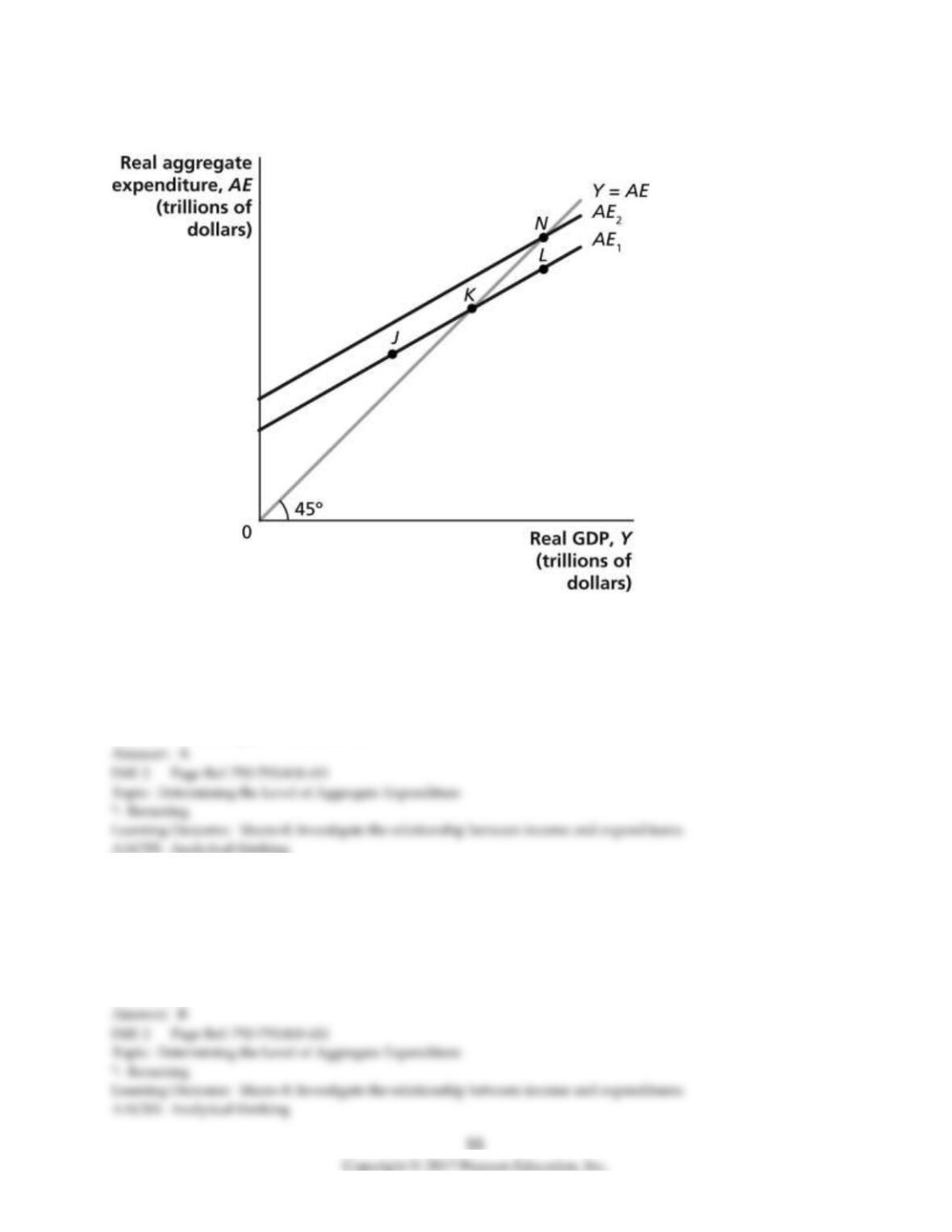
Figure 12-2
18) Refer to Figure 12-2. If the U.S. economy is currently at point N, which of the following could cause
it to move to point K?
A) Households expect future income to decline.
B) Household wealth rises.
C) The firm’s cash flow rises as profits rise.
D) Government expenditures increase.
19) Refer to Figure 12-2. If the U.S. economy is currently at point K, which of the following could cause
it to move to point N?
A) The price level in the United States rises relative to the price level in other countries.
B) Congress passes investment tax incentives.
C) The interest rate rises.
D) Household wealth declines.
20) Refer to Figure 12-2. Suppose that the level of GDP associated with point N is potential GDP. If the
U.S. economy is currently at point K,
A) firms are operating above capacity.
B) the economy is at full employment.
C) the economy is in recession.
D) the level of unemployment is equal to the natural rate.
21) Refer to Figure 12-2. If the U.S. economy is currently at point N, which of the following could cause
it to move to point K?
A) Households expect future income to rise.
B) Household wealth falls.
C) Firm’s cash flows rise as profits rise.
D) Government expenditures increase.
22) Refer to Figure 12-2. If the U.S. economy is currently at point K, which of the following could cause
it to move to point N?
A) The price level in the United States falls relative to the price level in other countries.
B) Congress abolishes investment tax incentives.
C) The interest rate rises.
D) Household wealth declines.
23) Refer to Figure 12-2. Suppose that the level of GDP associated with point K is potential GDP. If the
U.S. economy is currently at point N,
A) firms are operating below capacity.
B) the economy is at full employment.
C) the economy is in an expansion.
D) the level of unemployment is above the natural rate.
24) Planned aggregate expenditure is equal to
A) consumption spending only.
B) consumption spending plus planned investment spending.
C) planned investment spending only.
D) consumption spending plus planned investment spending plus government purchases plus net
exports.
25) On the 45-degree line diagram, the 45-degree line shows points where real aggregate expenditure
equals
A) unplanned investment.
B) planned investment.
C) real GDP.
D) nominal GDP.
26) On the 45-degree line diagram, for points that lie above the 45-degree line,
A) planned aggregate expenditure is greater than GDP.
B) planned aggregate expenditure is less than GDP.
C) planned aggregate expenditure is equal to GDP.
D) planned aggregate expenditure is less than aggregate income.
27) If planned aggregate expenditure is greater than total production,
A) actual inventories will equal planned inventories.
B) firms will experience an unplanned decrease in inventories.
C) GDP will decrease.
D) the economy is in equilibrium.
28) If planned aggregate expenditure is greater than total production,
A) actual inventories will equal planned inventories.
B) firms will experience an unplanned increase in inventories.
C) GDP will increase.
D) the economy is in equilibrium.
29) If the economy is currently in equilibrium at a level of GDP that is above potential GDP, which of
the following would move the economy back to potential GDP?
A) a decrease in wealth
B) a decrease in interest rates
C) an increase in business confidence
D) a decrease in the value of the dollar relative to other currencies
30) Which of the following leads to a decrease in real GDP?
A) an increase in government spending
B) an increase in the inflation rate in other countries, relative to the inflation in the United States
C) an increase in interest rates
D) Households have increasingly optimistic expectations about future income.
31) If planned aggregate expenditure is above potential GDP and planned aggregate expenditure equals
GDP, then
A) actual inventory investment will be less than planned inventory investment.
B) actual inventory investment will be greater than planned inventory investment.
C) the economy is in an expansion.
D) the economy is at full employment.
32) How does an increase in government spending affect the aggregate expenditure line?
A) It shifts the aggregate expenditure line upward.
B) It shifts the aggregate expenditure line downward.
C) It increases the slope of the aggregate expenditure line.
D) It decreases the slope of the aggregate expenditure line.
33) ________ is equal to consumption spending plus planned investment spending plus government
purchases plus net exports.
A) Full employment GDP
B) Short-run aggregate supply
C) Planned inventory investment
D) Planned aggregate expenditure
34) When net exports equal zero, the economy is in macroeconomic equilibrium.
35) Macroeconomic equilibrium can occur at any point on the 45-degree line.
36) For all points below the 45-degree line, planned aggregate expenditure will be less than GDP.
37) If planned aggregate expenditure equals GDP, the economy is in macroeconomic equilibrium.
38) For all points above the 45-degree line, planned aggregate expenditure will be less than GDP.
39) If planned aggregate expenditure is less than real GDP, some firms will experience unplanned
increases in inventories.
40) What is the difference between aggregate expenditure and consumption spending?
41) What is the macroeconomic consequence if firms accumulate large amounts of unplanned inventory
at the beginning of a recession?