International Economics, 6e (Gerber)
Chapter 12 International Financial Crises
12.1 Introduction: The Challenge of Financial Integration
1) There are no questions for this section.
Topic: Introduction: The Challenge to Financial Integration
12.2 Definition of a Financial Crisis
1) An exchange rate crisis is caused by
A) a sudden and an unexpected collapse in the value of a nation’s currency.
B) the inability of the IMF to predict the immediate collapse of the currency of a country.
C) the adoption of a flexible exchange rate system by a country or group of countries.
D) the adoption of a fixed exchange rate system by a country or group of countries.
E) Both C and D are correct.
2) All of the following are possible outcomes of a banking crisis EXCEPT
A) depositors, but not banks, may lose all or a portion of their assets.
B) a recession due to decreases in consumption by households.
C) decreases in lending practices by banks.
D) decreases in investment.
E) a contagion effect of the crisis from vulnerable banks to financial institutions on sound basis.
3) A fixed exchange rate system crisis may be accompanied or followed by
A) unexpected gains of international reserves.
B) revaluation of a currency.
C) devaluation of a currency.
D) gains in comparative advantage.
E) deflationary pressures within the country.
4) A flexible exchange rate system crisis involves
A) a revaluation of the currency.
B) a rapid and uncontrolled depreciation of the currency.
C) a decrease in the dollar value of the country’s international debt.
D) a sure political collapse of the ruling government.
E) All of the above.
5) All of the following are possible outcomes of a financial crisis EXCEPT
A) bank failings and disintermediation.
B) decreases in investment.
C) a recession.
D) a sure competitive advantage accompanied by a comparative advantage.
E) depreciation or devaluation of a currency.
6) Which of the following is NOT likely to occur when a bank fails?
A) Everyone that deposits money in the bank loses all or a portion of their money, unless the
country has a functioning deposit insurance system.
B) The loss of savings (or the feared loss of savings) causes households to cut back on
consumption, which spreads the recessionary effect wider through the country.
C) Unaffected banks may stop making loans as they take a cautious approach, slowing or
stopping new investment.
D) Layoffs occur and the economy falls deeper into a downward spiraling inflation.
E) Other banks make too many loans to make up for the loans not made by the failed bank,
kicking off a cycle of stimulation and inflation.
7) When expansionary fiscal and monetary policies are joined with a ________ exchange rate
system, the various components of economic policy often interact in ways that lead to a crisis
followed by a steep recession.
A) fixed
B) floating
C) crawling peg
D) flexible
8) Which of the following does not occur in resolving a debt crisis?
A) Debts are restructured
B) Repayment periods are shortened
C) Interest rates are reduced
D) Some partial debt forgiveness
9) A flexible exchange rate system guarantees a country will not experience an exchange rate
crisis.
10) Current research suggests that countries that adopt a pegged exchange rate may be more
vulnerable to an exchange rate crisis.
11) Exchange rate crises are only associated with fixed exchange rate systems.
12) Disintermediation is a problem associated with a banking crisis.
13) Exchange rates and banking systems are often the variables through which the contagion
effects of a crisis are spread from one country to another.
14) Unlike a banking crisis, an exchange rate crisis rarely results in a deep recession.
15) An exchange rate crisis may lead to a banking crisis and disintermediation.
16) The most common type of macroeconomic imbalance is overly expansionary fiscal policies
that create large government budget deficits, often financed by a high growth rate of the money
supply.
17) Many developing countries make the government budget one of the primary tools of long-
run industrial development, with the government owning and operating industries such as steel
mills, airlines, and phone companies.
18) Tax systems in developing countries tend to be efficient and reliable.
19) Deficits financed by borrowed money lead to inflation, and in a fixed or crawling peg
exchange rate system, this leads to the real exchange rate being undervalued.
20) Small devaluations are usually sufficient to stem capital flight.
21) A large and growing current account deficit can be an indicator of a potential crisis.
22) It is normal and typical in a debt crisis for debtors to completely repudiate all their debts.
23) A debt crisis may lead to a banking crisis.
24) If the banking sector borrows internationally and lends locally, how does this intensify a
financial crisis?
12.3 Sources of International Financial Crises
1) One characteristic of a financial crisis caused by macroeconomic imbalances is that it
A) may or may not be predictable.
B) will occur eventually even though its timing is unpredictable.
C) may be caused by expansionary fiscal policies accompanied by high budget deficits.
D) may be caused by high deficits financed by increases in the money supply.
E) All of the above.
5
2) All of the following are symptoms of definite and indefinite macroeconomic imbalances
EXCEPT
A) large budget deficits.
B) an overvalued currency.
C) a current account deficit.
D) the discovery of emerging markets by financial investors who want to diversify their
portfolios.
E) inflationary pressures.
3) An austerity policy is
A) an increase in the money supply.
B) an expenditure reduction and expenditure switching policy.
C) an expansionary fiscal policy accompanied by decreases in taxes, increases in expenditures,
or both.
D) an exchange rate switching policy from a fixed to a flexible exchange rate system.
E) None of the above.
4) Which of the following was NOT a cause or a characteristic of the 1994/95 Mexican peso
crisis?
A) An overvalued exchange rate
B) An inflow of large foreign portfolio capital
C) The inability of the IMF, the world bank, and the NAFTA member countries (i.e., the United
States and Canada) to predict the looming financial crisis
D) Shifts by the world capital markets toward more conservative and risk-averse investments
because of interest and exchange rate movements around the world
E) High domestic investments with insufficient domestic savings
5) The Mexican peso crisis of 1994 and 1995 was directly related to
A) the start of NAFTA.
B) a large capital account surplus.
C) a large capital account deficit.
D) an undervalued peso.
E) a large current account surplus.
6) Describe the Mexican peso crisis in terms of the imbalances that caused it, the policies
Mexico used to respond, and the lessons learned.
12.4 Domestic Issues in Crisis Avoidance
1) Which of the following may NOT help avoid a financial crisis?
A) Maintaining credible and sustainable fiscal policies
B) Regulation and supervision of the financial system
C) Disclosure of timely information to lenders, investors, and depositors about key economic
variables such as the central bank’s holding of international reserves
D) Immediately bailing out financial intermediaries and standing ready to bail out others in case
a financial crisis occurs
E) Maintaining credible and sustainable monetary policies
2) All of the following involve a moral hazard problem EXCEPT
A) an individual driving carelessly after buying a comprehensive insurance policy for a Ford
Pinto.
B) the IMF bailing Mexico out of a financial crisis, with promises to do the same for other
nations that might face financial problems.
C) making regular visits to your doctor because you know that you have full healthcare coverage.
D) the requirement of banking institutions that owners invest a substantial portion of their own
capital in their bank.
E) membership in FDIC (Federal Deposit Insurance Corporation) by your local bank.
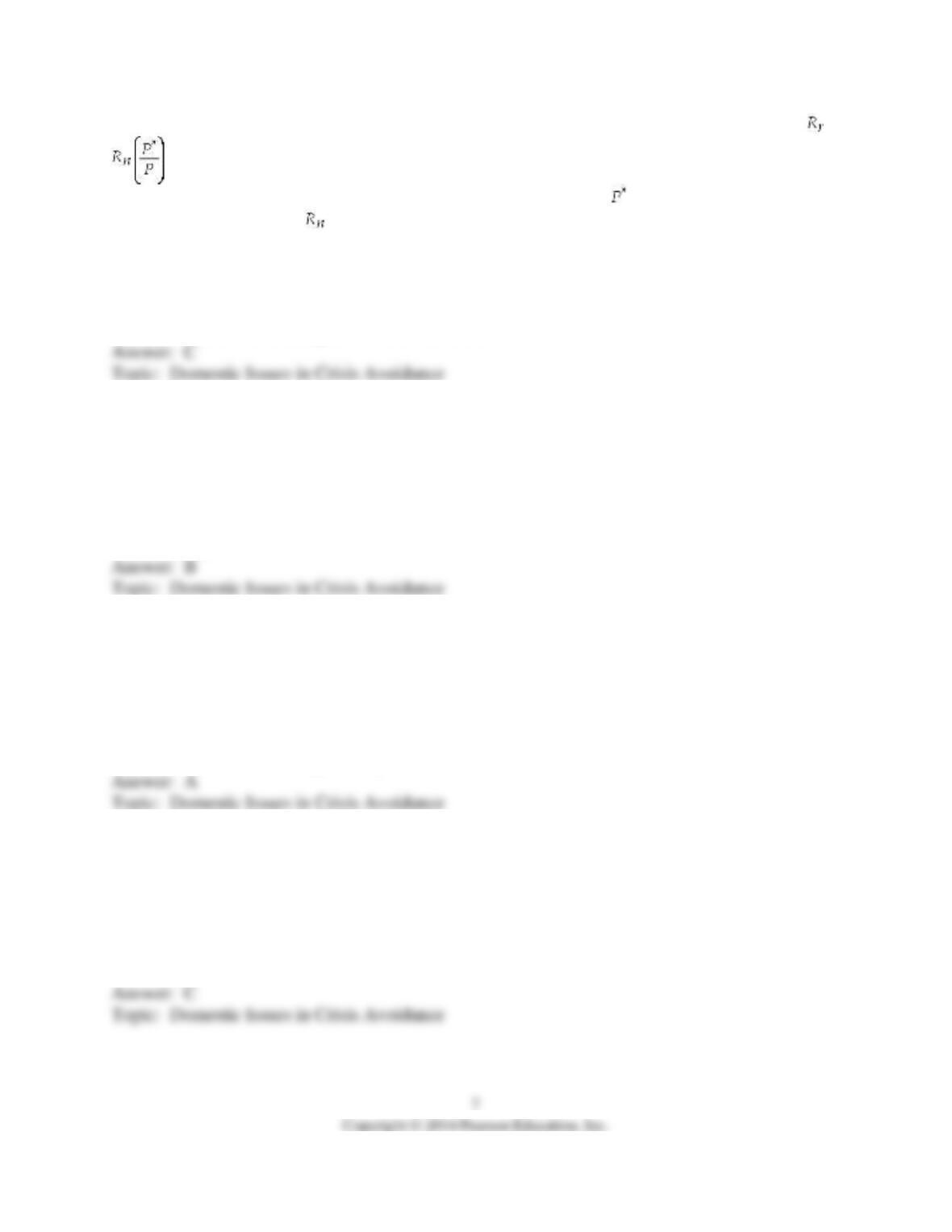
3) All of the following statements are true about the real exchange rate, given by the relation =
, EXCEPT
A) a greater change in P (domestic price) compared to a change in (foreign price) necessitates
a rise in the nominal rate, , to keep the real rate unchanged.
B) a pegged exchange rate system requires tight control of the money supply.
C) there is a one-to-one correspondence between the real and nominal exchange rates.
D) an expansionary monetary policy raises the real exchange rate.
E) the real exchange rate would be the same as the nominal exchange rate only if the difference
between domestic and foreign inflation rates is zero.
4) Which of the following was NOT one of the causes of the Asian financial crises of 1997 and
1998?
A) A current account deficit and financial account surpluses
B) The use of exports as an engine of economic growth by the countries involved
C) China’s 1994 devaluation of its fixed exchange rate
D) The appreciation of the U.S. dollar and depreciation of the Japanese yen
E) Crony capitalism
5) The main policy advice given by the IMF to East Asian countries facing the financial crises of
1997/1998 was
A) raising their domestic interest rates to stabilize the collapsing currencies.
B) using their monetary and fiscal policies alone.
C) use capital controls.
D) adopting a flexible exchange rate system.
E) adopting a fixed exchange rate system.
6) Which one of the following countries refused to accept the IMF conditions during the East
Asian financial crisis?
A) South Korea
B) Indonesia
C) Malaysia
D) Thailand
E) Singapore
7) The Basel Capital Accord does NOT include
A) requiring bank owners to invest into and have some capital ownership in the banks they own.
B) supervision of banks by an oversight board.
C) information disclosure designed to encourage market discipline.
D) denying access to foreign capital by a country that defaults on its international loans.
E) None of the above.
8) International financial flows changed in meaningful ways, and these changes were brought to
the attention of policy makers by the Asian financial crisis. Describe three changes.
9) If governments promise to bail out the financial system in the event of a crisis, this creates a
moral hazard problem. Describe this problem.
10) Describe the background factors that contributed to the Asian financial crisis.
11) What agreement has been reached to reduce the moral hazard problem and what does it
require?
12.5 Domestic Policies for Crisis Management
1) There are no questions for this section.
Topic: Domestic Policies for Crisis Management
12.6 Reform of the International Financial Architecture
1) The international institution that serves as a lender of last resort is called the
A) IBRD.
B) WTO.
C) IMF.
D) World Bank.
E) GATT.
2) A lender of last resort
A) makes loans when no one else will.
B) makes loans without regard for risk.
C) is a firm that is forced to make loans for its own survival.
D) Both A and B.
E) None of the above.
3) All of the following issues were discussed as options for reforming the international financial
architecture EXCEPT
A) how high an interest rate the lender of last resort should charge when it makes loans.
B) the length of the payback period.
C) the size of the loans.
D) the moral hazard problem associated with a lender of last resort.
E) if the lender of last resort (i.e., the IMF) should consult and collaborate with other
international institutions such as the United Nations and the WTO.
4) The IMF conditionality may include
A) changes in the fiscal and monetary policies of the country facing the financial crisis.
B) changes in the exchange rate policies.
C) regulating and restructuring the financial sector of the economy of the country in crisis.
D) structural policies affecting international trade and public enterprises.
E) All of the above.
5) Which of the following is a macroeconomic factor that contributed to the financial crisis in
2007?
A) Global saving and investment imbalances
B) Financial market innovation
C) Deeper levels of integration across financial markets
D) Challenges and failures in financial regulation
6) The financial crisis that started in 2007 was unusual because it started in an advanced
economy, the United States.
7) Financial capital is highly volatile, and technological advances have reinforced this volatility.
8) The two main types of economies generating current account surpluses from 2000 to 2007
were Asian exporters and oil producers.
9) What three critical factors or preconditions turned a national, U.S. problem into a global
financial crisis in 2007. Be sure to address the role securitization played and how it affected
regulators.
10) What are the benefits of capital mobility?
11
11) What are the costs of capital mobility?
12) How were macroeconomic balances different in the period from 2000 to 2007 from past
financial crises?
13) How did the global supply of savings impact the formation of the housing bubble?