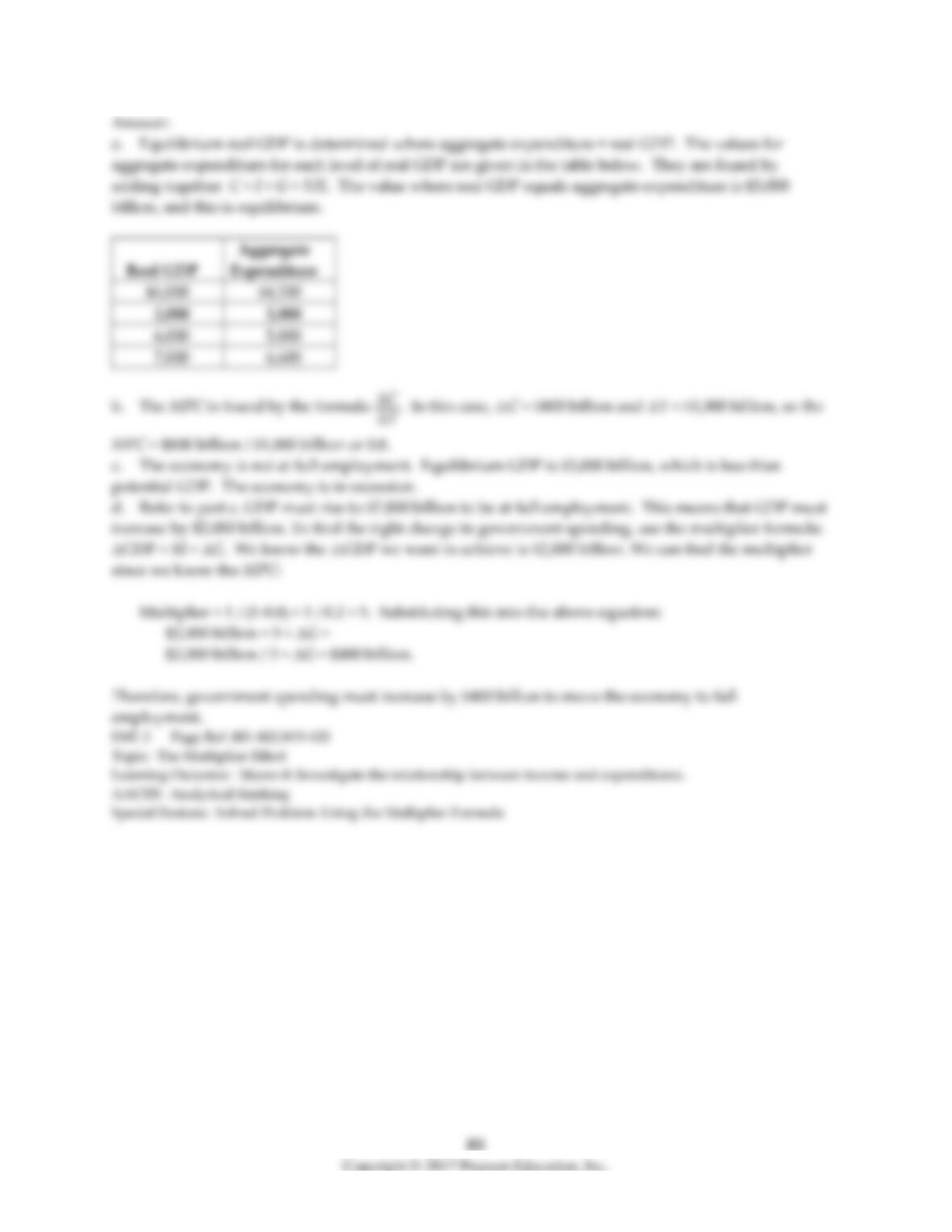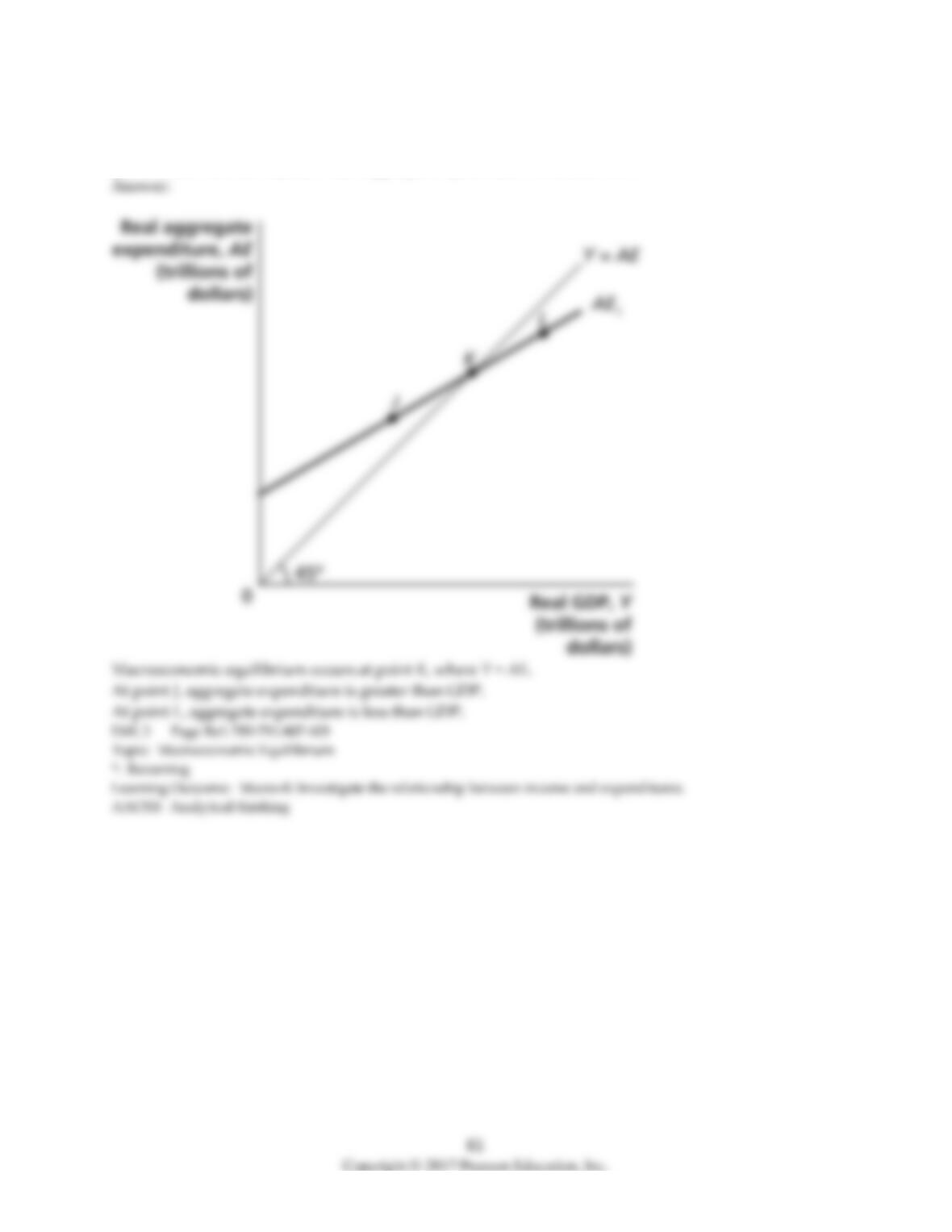
42) Use a 45-degree diagram to illustrate macroeconomic equilibrium. Make sure your diagram shows
the aggregate expenditure function. Include in your diagram a point where aggregate expenditure is
greater than GDP and a point where aggregate expenditure is less than GDP.
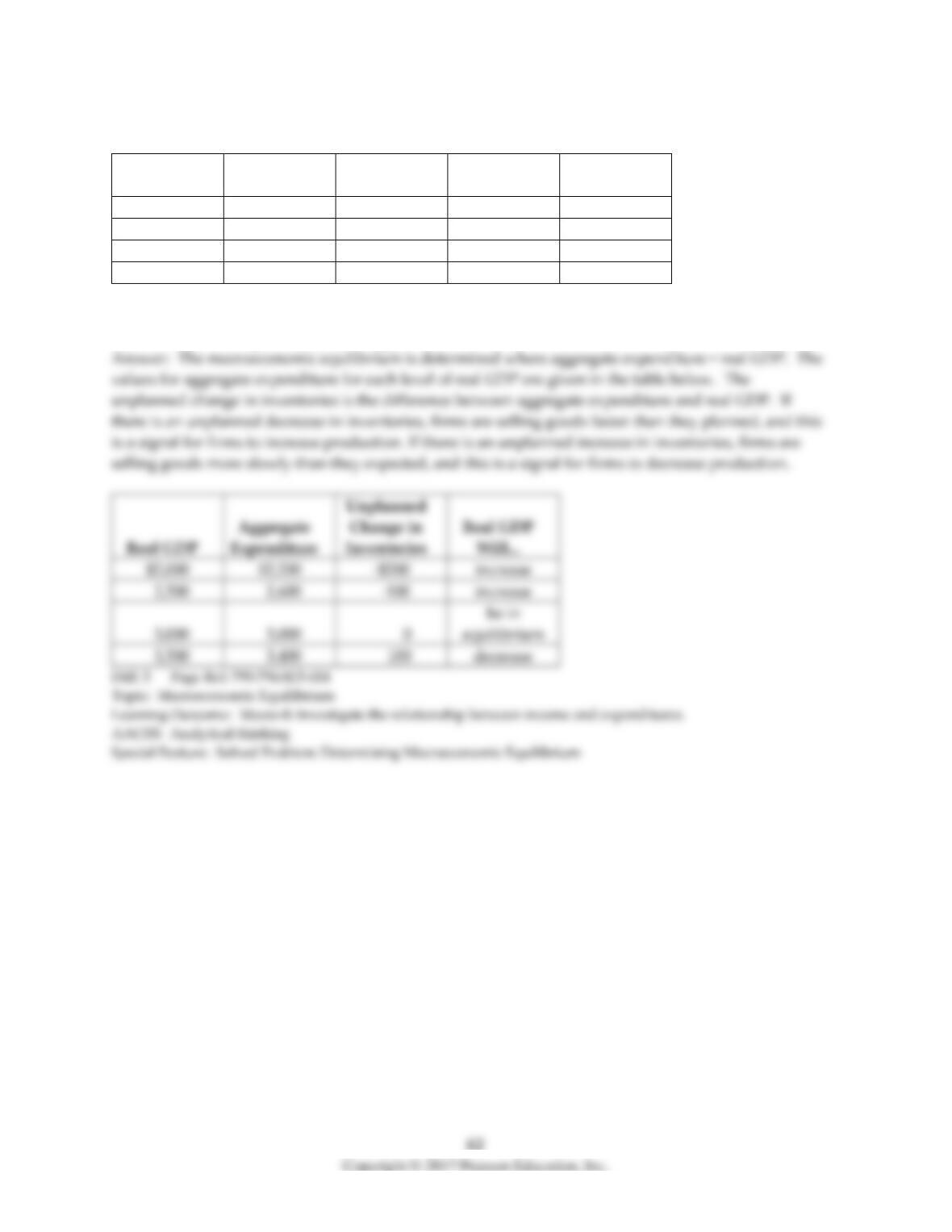
Table 12-10
Real GDP
Consumption
Planned
Investment
Government
Purchases
Net Exports
$2,000
$1,600
$250
$250
$100
2,500
2,000
250
250
100
3,000
2,400
250
250
100
3,500
2,800
250
250
100
43) Refer to Table 12-10. Using the table above, calculate the unplanned change in inventories for each
level of GDP, and explain what will happen to GDP?
Real GDP
2,500
2,600
3,000
3,000
3,500
3,400
63
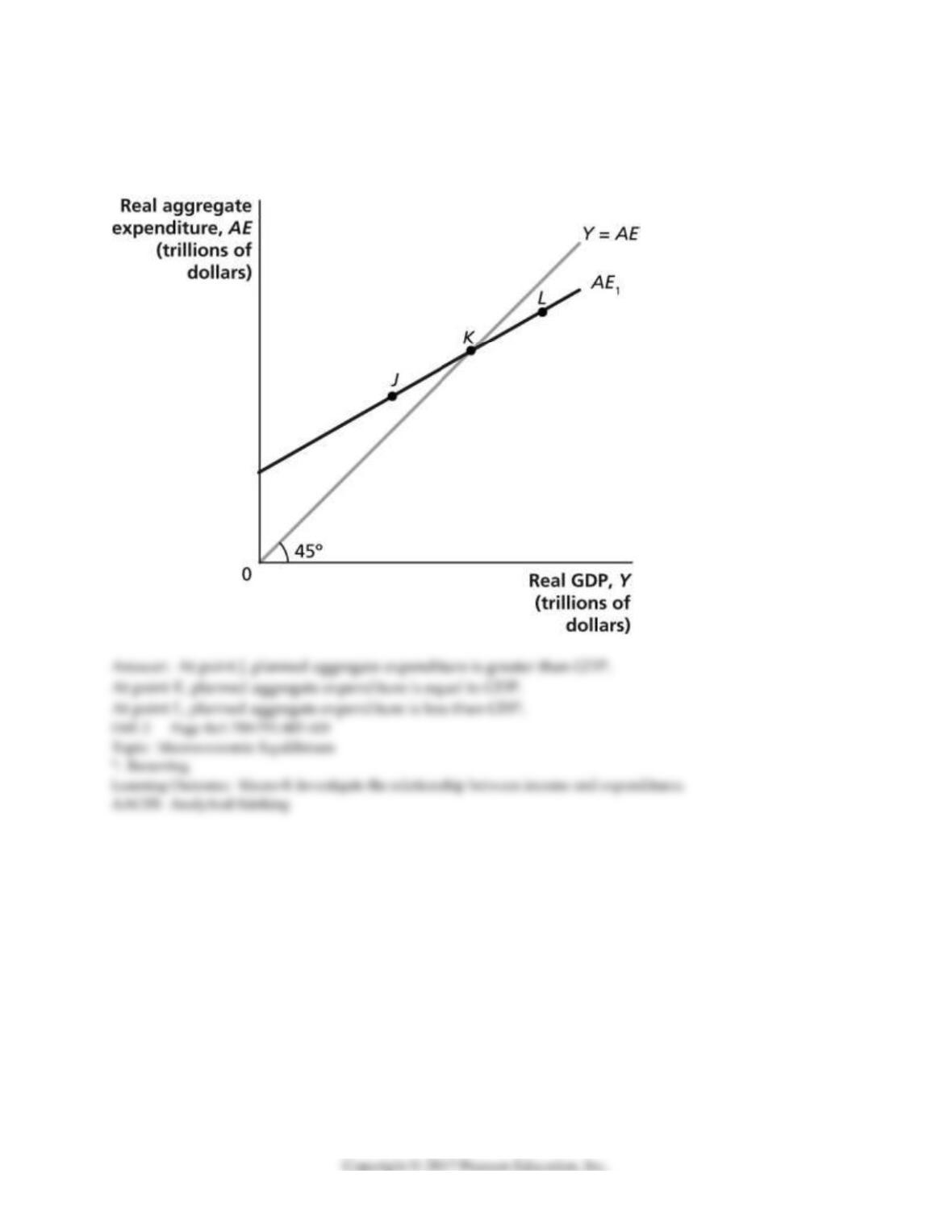
44) At each of the three points in the following graph, indicate whether planned aggregate expenditure
is greater than, equal to, or less than GDP?
Table 12-11
Real GDP
Consumption
Planned
Investment
Government
Purchases
Net Exports
$5,000
$4,500
$350
$300
$50
6,000
5,300
350
300
50
7,000
6,100
350
300
50
8,000
6,900
350
300
50
45) Refer to Table 12-11. Using the table above, calculate the unplanned change in inventories for each
level of GDP, and explain what will happen to GDP.
Real GDP
6,000
6,000
7,000
6,800
8,000
7,600
12.4 The Multiplier Effect
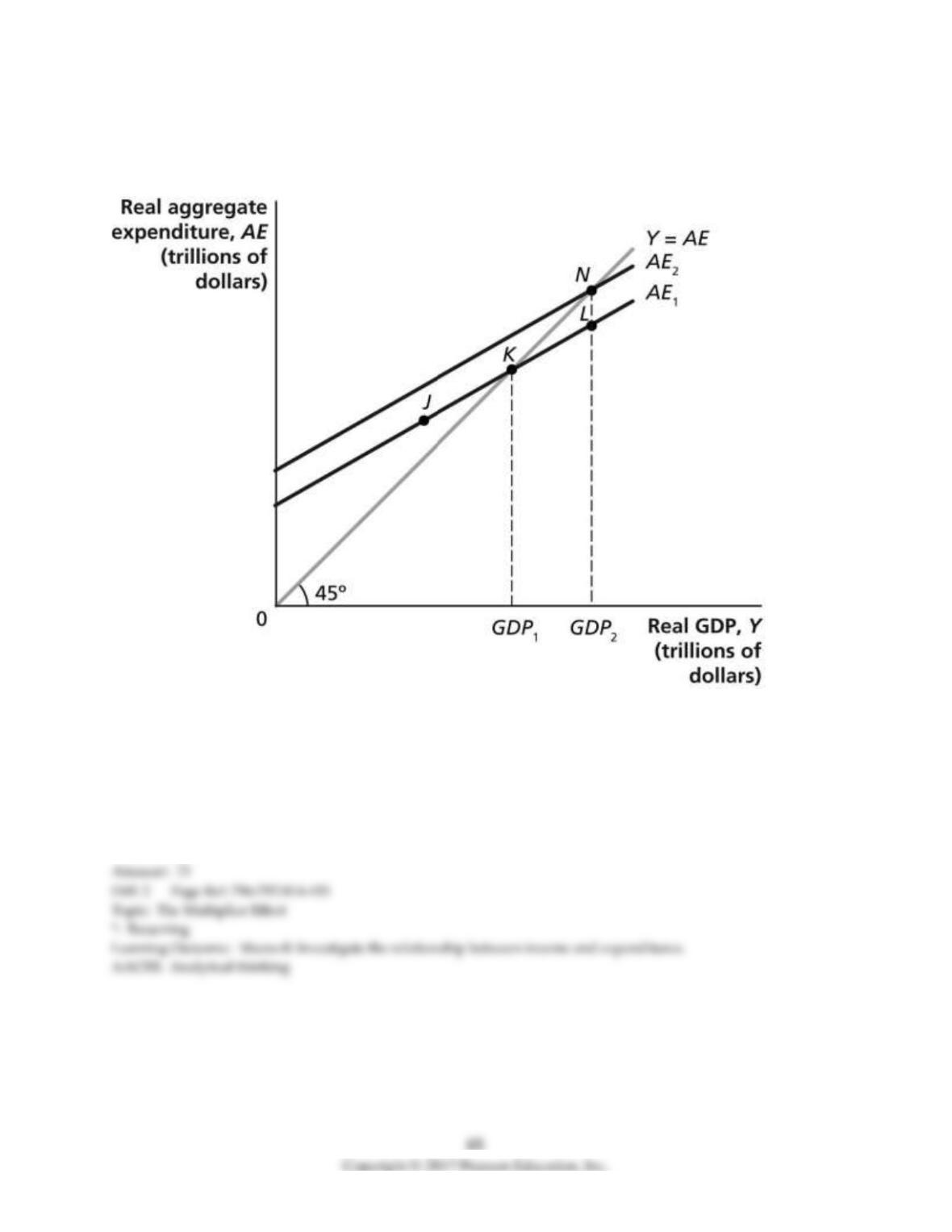
Figure 12-3
1) Refer to Figure 12-3. Suppose that investment spending increases by $10 million, shifting up the
aggregate expenditure line and GDP increases from GDP1 to GDP2. If the MPC is 0.9, then what is the
change in GDP?
A) $9 million
B) $10 million
C) $90 million
D) $100 million
2) Refer to Figure 12-3. Suppose that government spending increases, shifting up the aggregate
expenditure line. GDP increases from GDP1 to GDP2, and this amount is $400 billion. If the MPC is
0.75, then what is the distance between N and L or by how much did government spending change?
A) $10 billion
B) $100 billion
C) $200 billion
D) $300 billion
3) Refer to Figure 12-3. Suppose that investment spending decreases by $5 million, decreasing
aggregate expenditure and decreasing real GDP from GDP2 to GDP1. If the MPC is 0.8, then what is the
change in GDP?
A) -$4 million
B) -$5 million
C) -$25 million
D) -$40 million
4) Refer to Figure 12-3. Suppose that government spending increases, shifting up the aggregate
expenditure line. GDP increases from GDP1 to GDP2, and this amount is $200 billion. If the MPC is 0.8,
then what is the distance between N and L or by how much did government spending change?
A) $16 billion
B) $40 billion
C) $200 billion
D) $1,000 billion
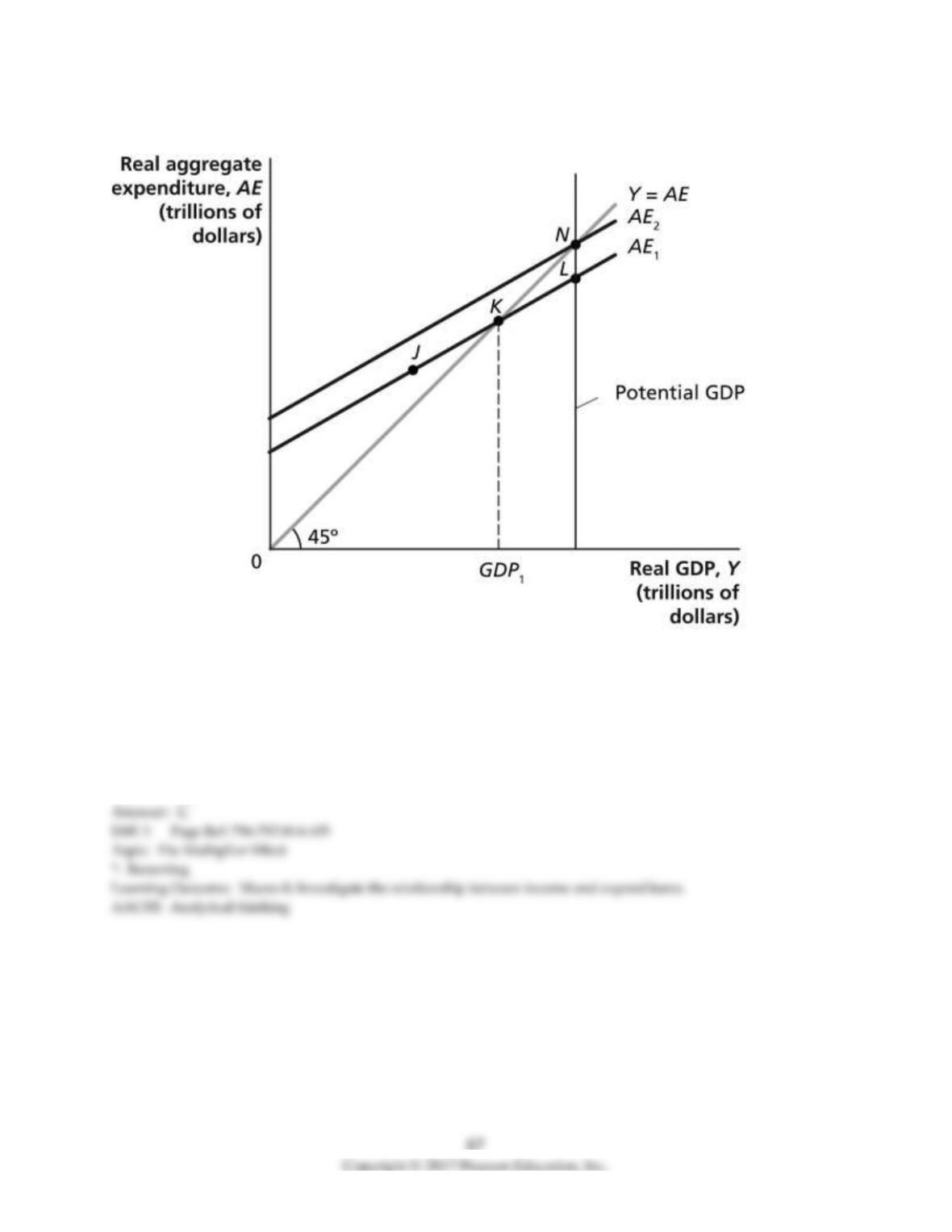
Figure 12-4
5) Refer to Figure 12-4. Potential GDP equals $100 billion. The economy is currently producing GDP1
which is equal to $90 billion. If the MPC is 0.8, then how much must autonomous spending change for
the economy to move to potential GDP?
A) -$18 billion
B) -$2 billion
C) $2 billion
D) $18 billion
6) Refer to Figure 12-4. Potential GDP equals $500 billion. The economy is currently producing GDP1
which is equal to $450 billion. If the MPC is 0.8, then how much must autonomous spending change for
the economy to move to potential GDP?
A) -$40 billion
B) -$10 billion
C) $10 billion
D) $40 billion
7) In the aggregate expenditure model, ________ has both an autonomous component and an induced
component.
A) planned investment spending
B) consumption spending
C) government spending
D) net export spending
8) The ratio of the increase in ________ to the increase in ________ is called the multiplier.
A) equilibrium nominal GDP; autonomous expenditure
B) equilibrium real GDP; autonomous expenditure
C) autonomous expenditure; equilibrium real GDP
D) induced expenditure; equilibrium real GDP
9) If an increase in investment spending of $50 million results in a $400 million increase in equilibrium
real GDP, then
A) the multiplier is 0.125.
B) the multiplier is 3.5.
C) the multiplier is 8.
D) the multiplier is 50.
10) If an increase in autonomous consumption spending of $10 million results in a $50 million increase
in equilibrium real GDP, then
A) the MPC is 0.5.
B) the MPC is 0.75.
C) the MPC is 0.8.
D) the MPC is 0.9.
11) ________ consumption is consumption that does not depend upon the level of GDP.
A) Autonomous
B) Induced
C) Voluntary
D) Disposable
12) The multiplier is calculated as the
A) change in real GDP/ change in autonomous expenditure.
B) change in autonomous expenditure/ change in real GDP.
C) change in nominal GDP/ change in autonomous expenditure.
D) change in real GDP/ change in induced spending.
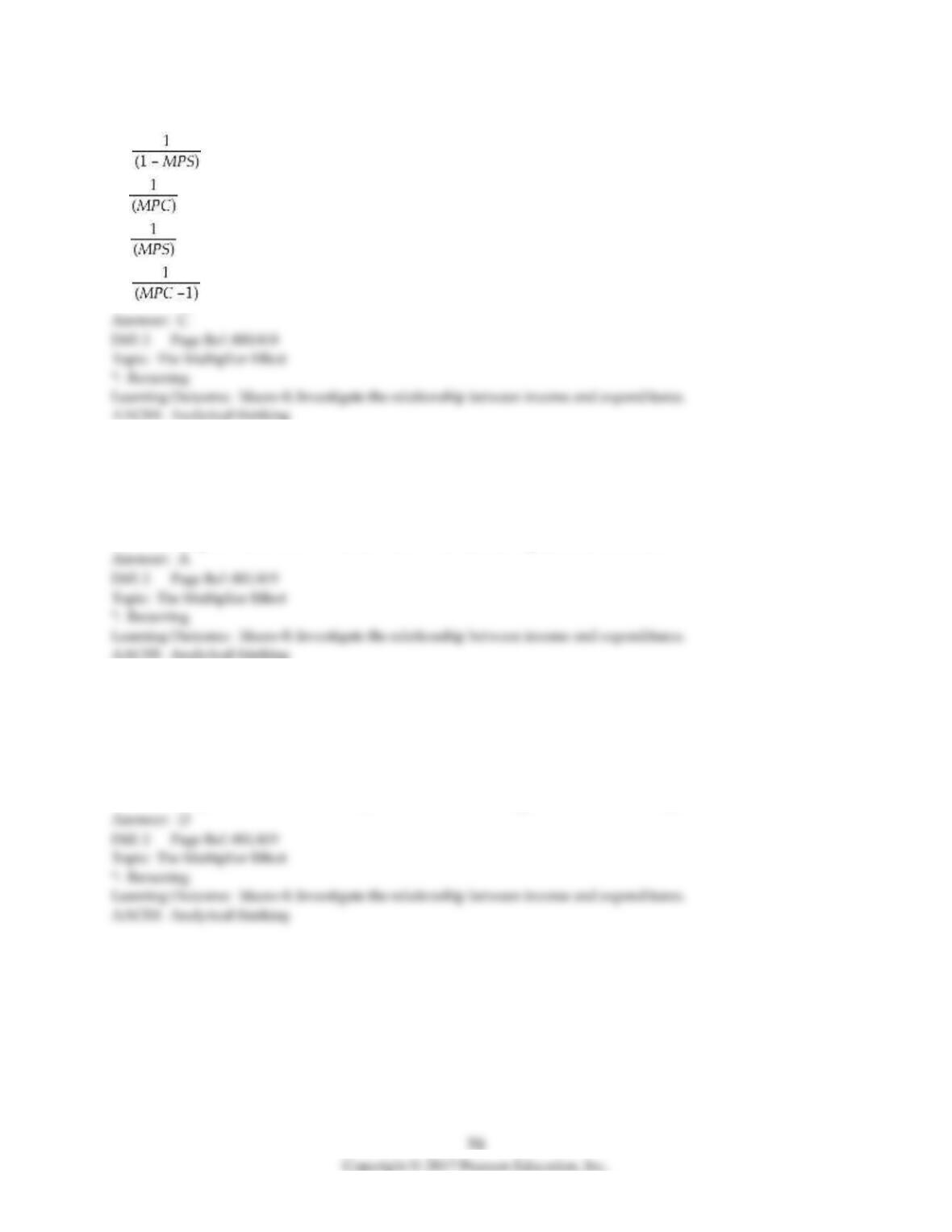
13) A general formula for the multiplier is
A) .
B) .
C) .
D) .
14) Which of the following is a true statement about the multiplier?
A) The multiplier rises as the MPC rises.
B) The smaller the MPC, the larger the multiplier.
C) The multiplier is a value between zero and one.
D) The multiplier effect does not occur when autonomous expenditure decreases.
15) All of the following are true statements about the multiplier except
A) The formula for the multiplier overstates the real world multiplier when we take into account the
impact of changes in GDP on imports, inflation and the interest rate.
B) The larger the MPC, the larger the multiplier.
C) The multiplier is the ratio of the change in real GDP to the change in autonomous expenditure.
D) The multiplier makes the economy less sensitive to changes in autonomous expenditure.
16) The passage of the Smoot-Hawley Tariff in 1930 sparked a trade war that caused net exports to
________ and real GDP to ________.
A) increase; increase
B) decrease; increase
C) increase; decrease
D) decrease; decrease
17) John Maynard Keynes argued that if many households decide at the same time to increase saving
and reduce spending,
A) this may benefit the economy in the short run, but not in the long run.
B) the economy will benefit in the short run and benefit by an even greater amount in the long run.
C) this will have a major negative impact on the economy in both the short run and in the long run.
D) this may benefit the economy in the long run, but could be counterproductive in the short run.
18) Autonomous expenditure is a type of expenditure that does not depend on
A) wealth.
B) expectations.
C) rates.
D) GDP.
19) The ratio of the increase in equilibrium real GDP to the increase in autonomous expenditure is called
the
A) MPC.
B) multiplier.
C) MPS.
D) consumption function.
20) If an increase in investment spending of $20 million results in a $200 million increase in equilibrium
real GDP, then
A) the multiplier is 0.1.
B) the multiplier is 1.
C) the multiplier is 10.
D) the multiplier is 100.
21) If an increase in autonomous consumption spending of $25 million results in a $100 million increase
in equilibrium real GDP, then
A) the MPC is 0.25.
B) the MPC is 0.75.
C) the MPC is 0.8.
D) the MPC is 2.5.
22) ________ consumption is consumption that depends upon the level of GDP and ________
consumption is consumption that does not depend upon the level of GDP.
A) Autonomous; induced
B) Induced; autonomous
C) Voluntary; autonomous
D) Autonomous; voluntary
23) The multiplier is calculated as the change in ________ divided by the change in ________.
A) real GDP; autonomous expenditure
B) autonomous expenditure; real GDP
C) nominal GDP; autonomous expenditure
D) real GDP; induced spending
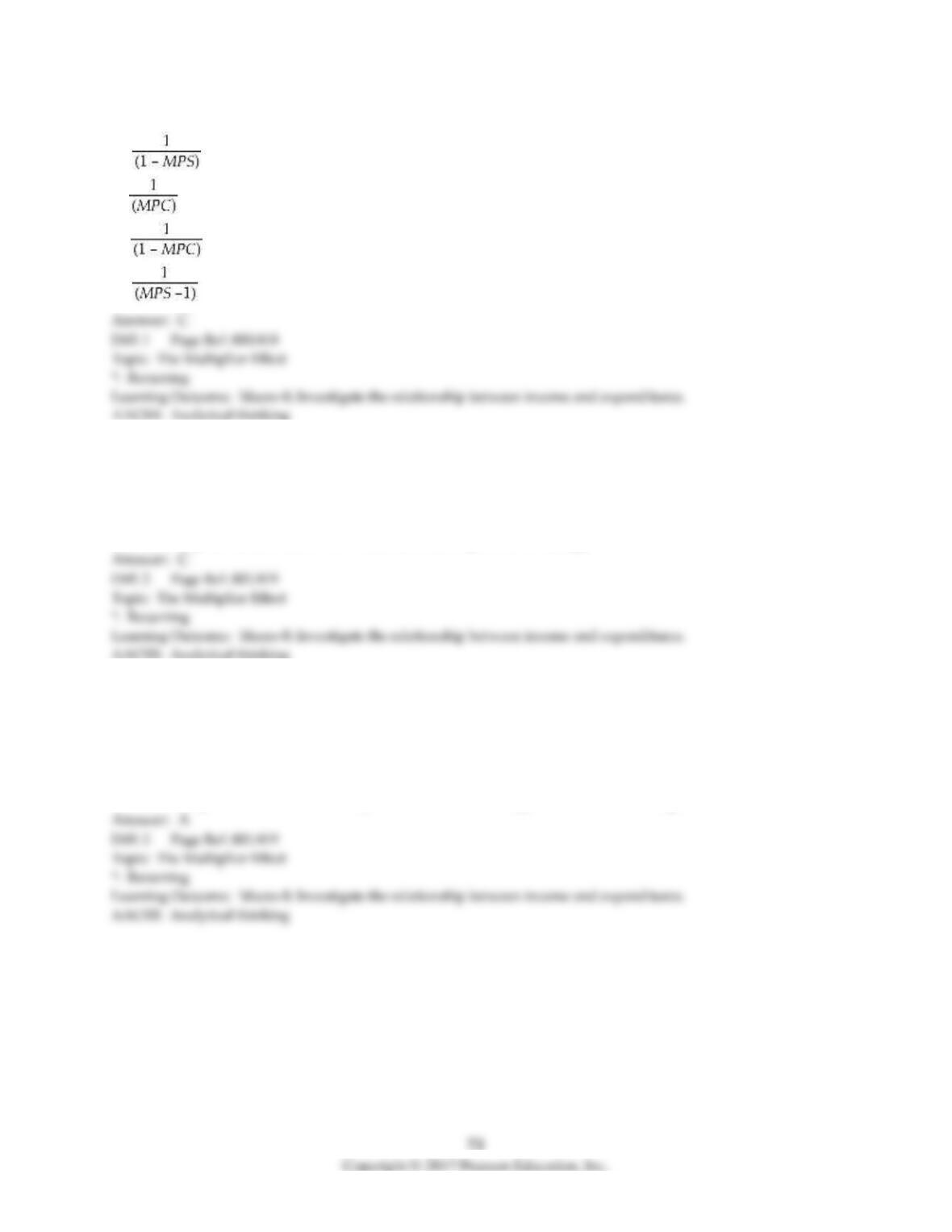
24) A general formula for the multiplier is
A) .
B) .
C) .
D) .
25) All of the following are true statements about the multiplier except
A) the multiplier rises as the MPC rises.
B) the smaller the MPS, the larger the multiplier.
C) the multiplier is a value between zero and one.
D) the multiplier effect occurs when autonomous expenditure changes.
26) Which of the following is a true statement about the multiplier?
A) The formula for the multiplier overstates the real world multiplier when we take into account the
impact of changes in GDP on imports, inflation and the interest rate.
B) The larger the MPC, the smaller the multiplier.
C) The multiplier is the ratio of the change in spending to the change in GDP.
D) The multiplier makes the economy less sensitive to changes in autonomous expenditure.
27) The National Restaurant Association states that the restaurant industry has an economic effect of
more than $1.7 trillion annually in the United States, with every dollar spent in restaurants generating
an estimated total of $2.05 in spending in the economy. This indicates that the spending multiplier for
the restaurant industry is equal to
A) 1.21.
B) 1.70.
C) 2.05.
D) 4.25.
28) The passage of the ________ in 1930 sparked a trade war that caused net exports to decrease and real
GDP to decrease.
A) Cellar-Kefauver Act
B) Sherman Antitrust Act
C) Clayton Act
D) Smoot-Hawley Tariff
29) John Maynard Keynes argued that if many households decide at the same time to increase saving
and reduce spending,
A) this will increase investment spending in the short run and expand the economy in the long run.
B) the economy will benefit in the short run but the effect will not last into the long run.
C) this will have a major negative impact on the economy in both the short run and in the long run.
D) they may make themselves worse off by causing aggregate expenditure to fall, thereby pushing the
economy into a recession.
Article Summary
Gains in consumer spending and construction gave GDP a bigger boost than was forecast in the
second quarter of 2015, growing at an annualized rate of 3.9 percent. Declining energy prices, rising
home prices, and increased employment are being credited for much of the gain in consumer
spending, which grew at an annualized rate of 3.6 percent. Increases in commercial and residential
construction boosted business investment spending, which grew at an annual rate of 5.2 percent.
Government spending also grew at an annual rate of 2.6 percent for the quarter. Economists cited the
primary obstacle for continuing this growth pace in the third quarter is the need to reduce excess
inventories.
Source: Shobhana Chandra, “Economy in U.S. Picked Up on Consumer Spending, Construction,”
bloomberg.com, September 25, 2015.
30) Refer to the Article Summary. The increase in GDP discussed in the article summary was due in part
to increases in commercial and residential construction. Increases in commercial and residential
construction will cause a(n) ________ the aggregate expenditure curve.
A) movement up along
B) movement down along
C) downward shift of
D) upward shift of
31) The formula for the multiplier is (1 – MPC).
32) The larger the MPC, the smaller the value of the multiplier.
33) If the marginal propensity to save is 0.4, the multiplier is 2.5.
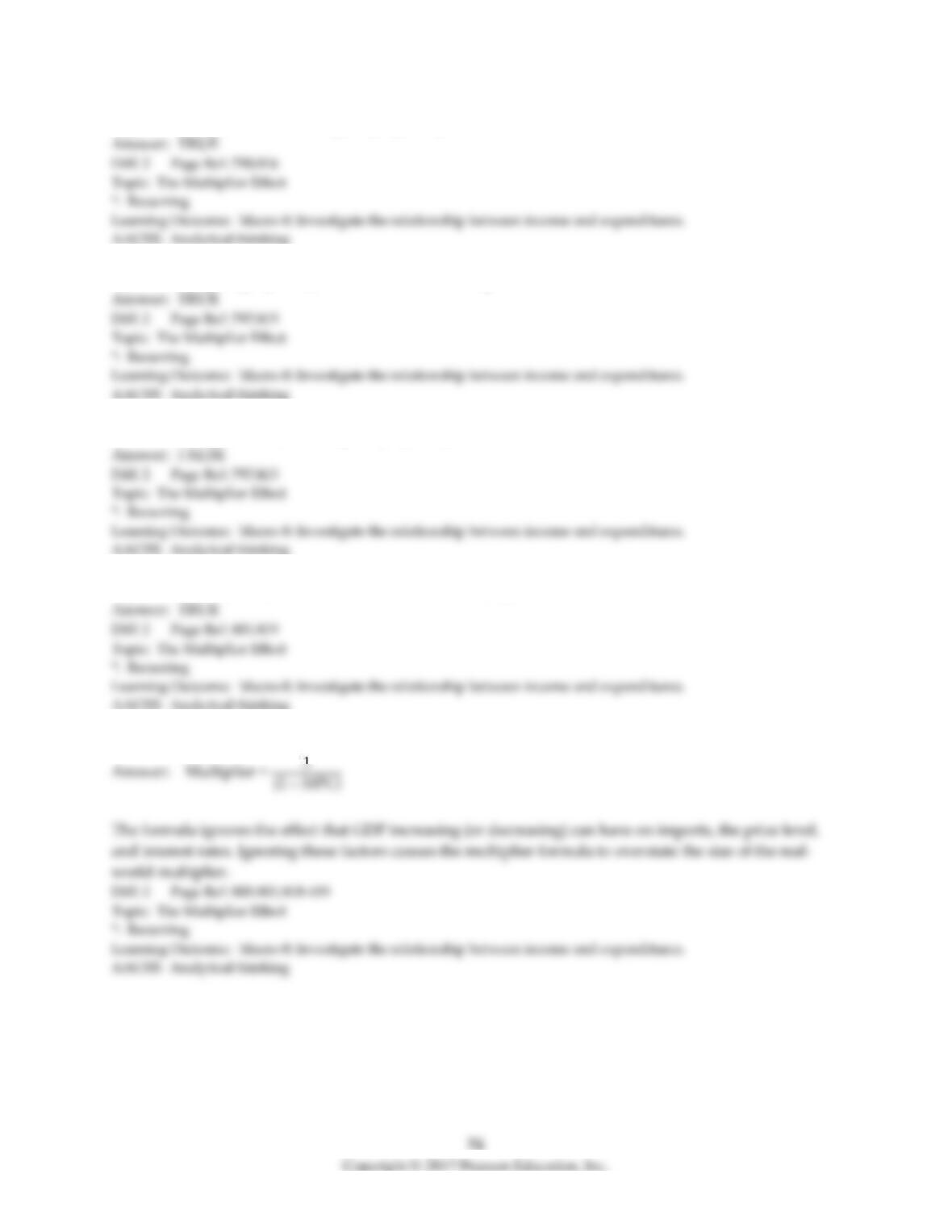
34) If the multiplier is 5, the marginal propensity to consume must be 0.8.
35) If the marginal propensity to save is 0.35, the multiplier is 2.86.
36) If the multiplier is 10, the marginal propensity to consume must be 0.1.
37) The larger the MPS, the smaller the value of the multiplier.
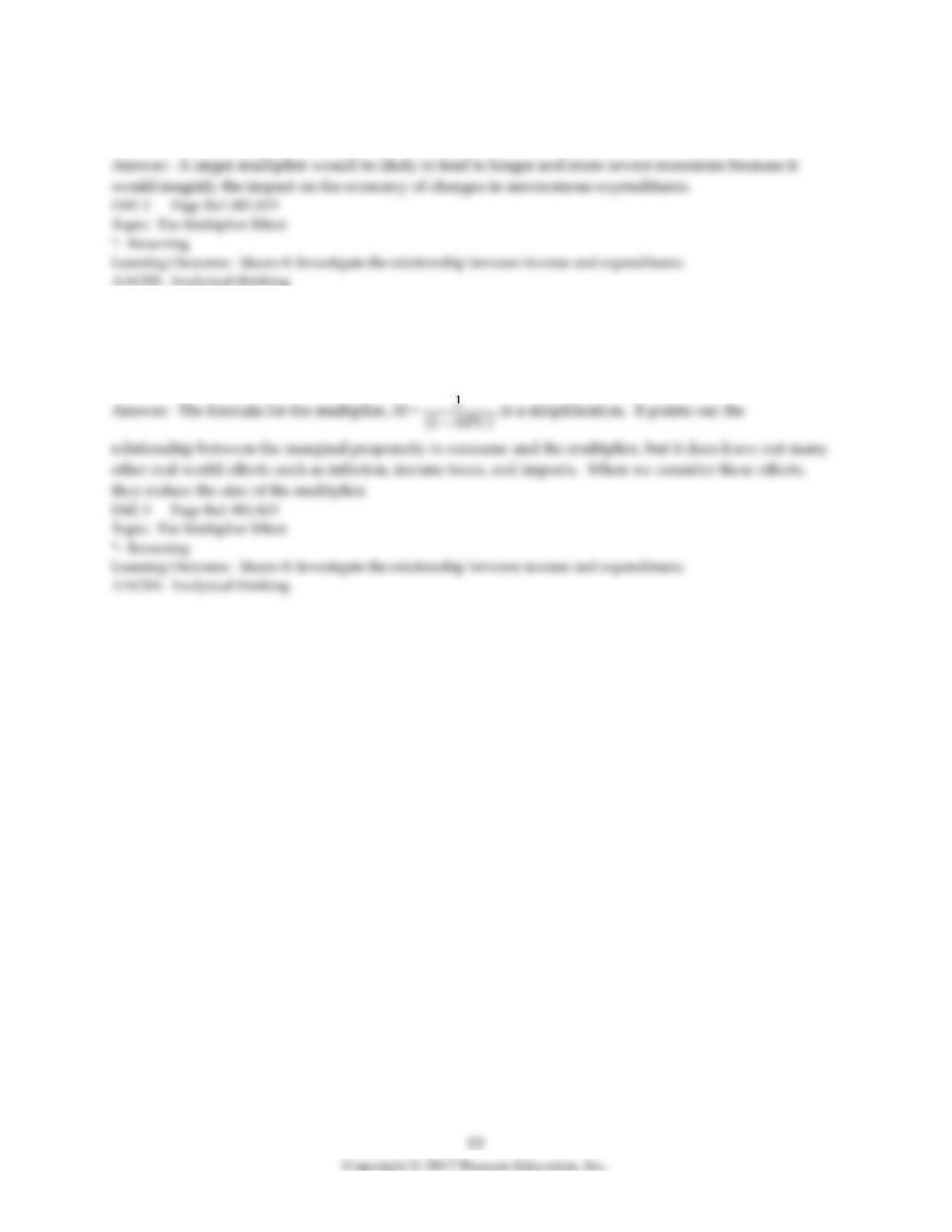
38) What is the formula for the multiplier? Explain why this formula is considered to be too simple.
39) Would a larger multiplier lead to longer and more severe recessions or shorter and less severe
recessions? Briefly explain.
40) Economists think that the marginal propensity to consume for the U.S. economy is somewhere
around 0.9. Based on our simple multiplier formula, this would imply that the multiplier for the United
States should be around 10. However, economists agree that the spending multiplier is closer to 2.
What might explain this supposed anomaly?
41) Discuss the leading causes of the Great Depression. Use the 45-degree line diagram to show how
they caused a decline in GDP.
79
Table 12-12
Real GDP
Consumption
Planned
Investment
Government
Purchases
Net Exports
$4,000
$3,500
$350
$450
-$100
5,000
4,300
350
450
-100
6,000
5,100
350
450
-100
7,000
5,900
350
450
-100
42) Refer to Table 12-12. Using the table above, answer the following questions. The numbers in the
table are in billions of dollars.
a. What is the equilibrium level of real GDP?
b. What is the MPC?
c. If potential GDP is $7,000 billion, is the economy at full employment? If not, what is the condition of
the economy?
d. If the economy is not at full employment, by how much should government spending increase so
that the economy can move to the full employment level of GDP?