
Name:
Class:
Date:
Chapter 12: Labor Markets and Labor Unions
True / False
1. Every individual has a labor supply curve in each market where there is a possible use for his or her labor.
a.
True
b.
False
True
2. If Dian chooses a job with a lower income over one with a higher income, she cannot be maximizing utility.
a.
True
b.
False
False
3. Jason can maximize his satisfaction by allocating time among market work, nonmarket work, and leisure so that the
final marginal utilities per hour spent in each activity are identical.
a.
True
b.
False
True
4. The amount of time an individual is willing to sell on the labor market varies positively with the value of leisure time.
a.
True
b.
False
False
5. A worker’s labor supply depends on, among other things, his ability, his preference for the task, and the opportunity
cost of his time.
a.
True
b.
False
True
6. Leisure time is not subject to diminishing marginal utility.
a.
True
b.
False
False
7. A consumer maximizes utility by allocating time so that the expected marginal utilities of the last unit of time spent in
each activity are identical.
a.
True
b.
False
True
8. As the wage rate increases, the income effect tends to reduce the quantity of labor supplied to the market.
a.
True
b.
False
True
9. The demand for labor curve bends backward whenever the income and substitution effects work in opposite directions.

Name:
Class:
Date:
Chapter 12: Labor Markets and Labor Unions
a.
True
b.
False
False
10. If a person’s labor supply curve is positively sloped, the income effect outweighs the substitution effect.
a.
True
b.
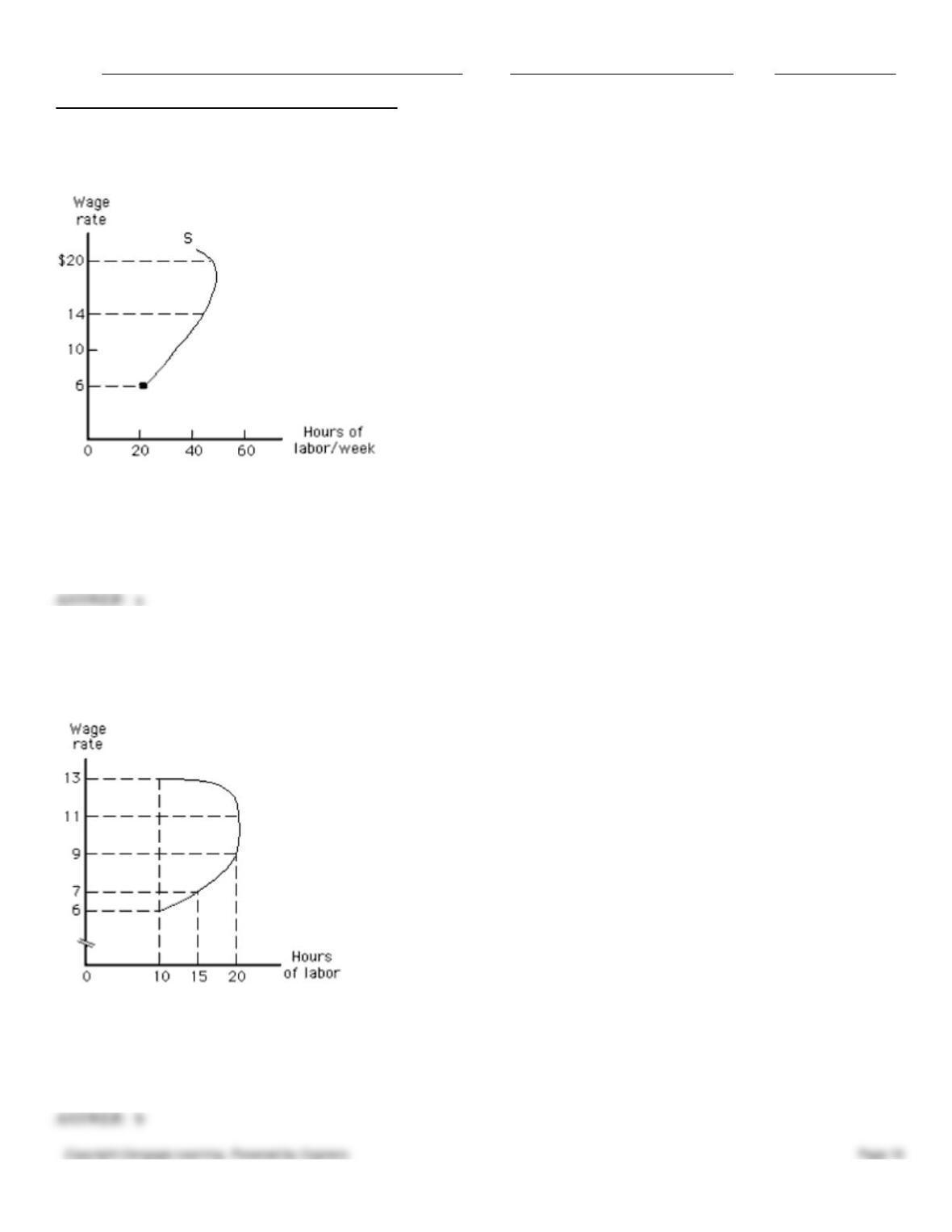
False
False
11. If the substitution effect dominates the income effect, then an increase in the wage rate will increase the quantity of
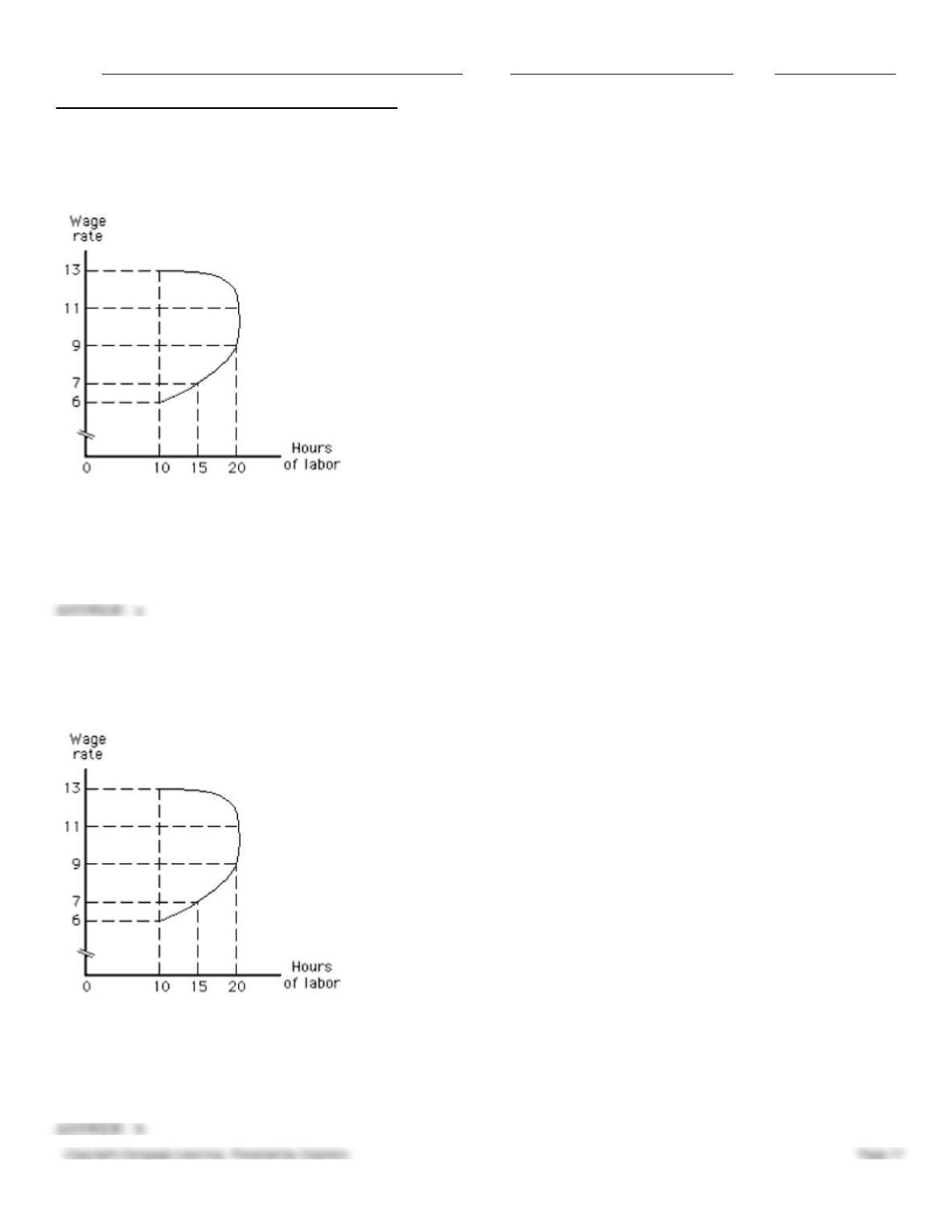
labor supplied by an individual.
a.
True
b.
False
False
12. As the wage rate increases, the substitution effect causes workers to supply more time to market work and the income
effect causes them to supply less time to market work.
a.
True
b.
False
True
13. The individual supply curve of labor is backward bending because the substitution effect offsets the income effect at
higher wage rates.
a.
True
b.
False
False
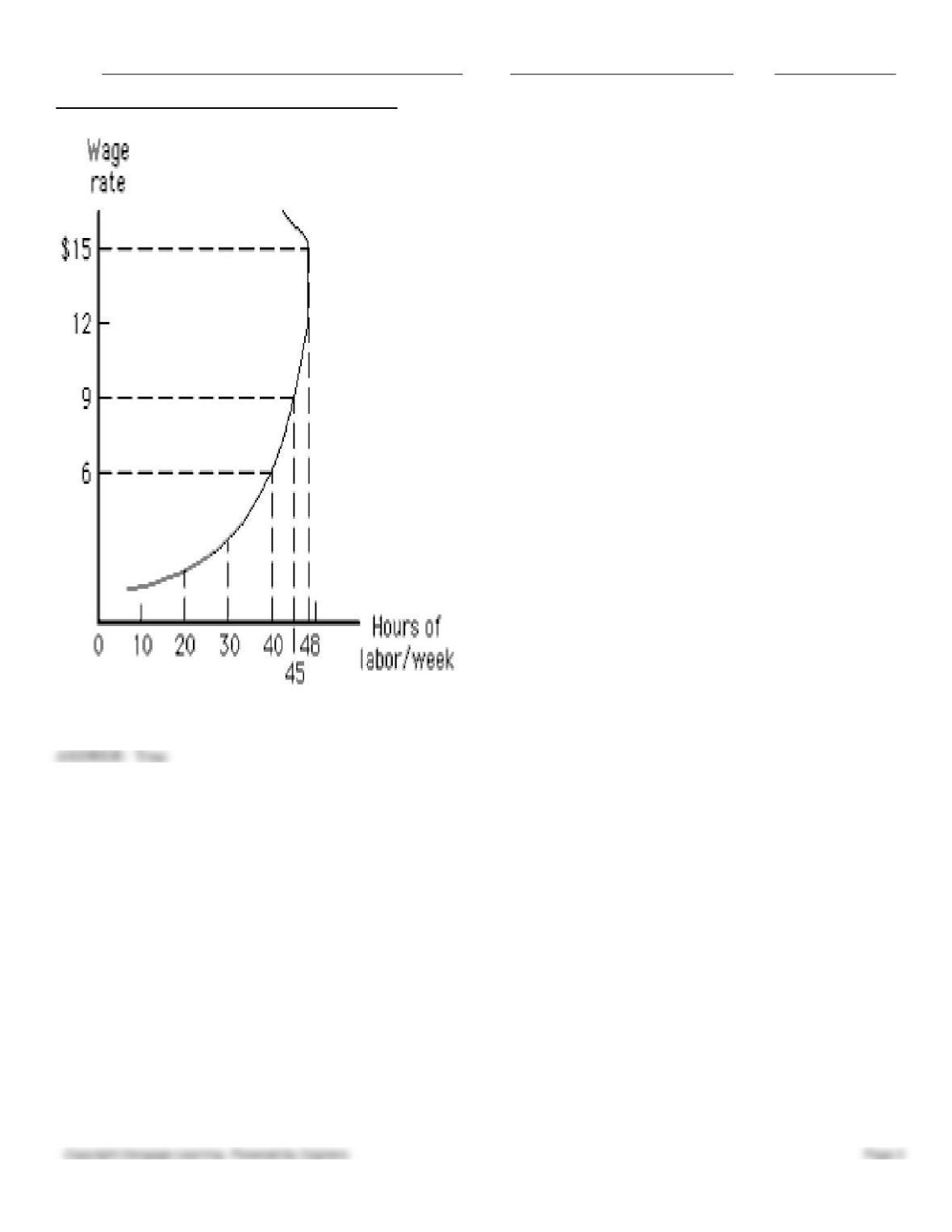
14. The figure given below shows a backward-bending labor supply curve for an individual. In the figure below, when the
wage rate increases from $9 to $12, the substitution effect outweighs the income effect.
Figure 12.5
Name:
Class:
Date:
Chapter 12: Labor Markets and Labor Unions
a.
True
b.
False
True
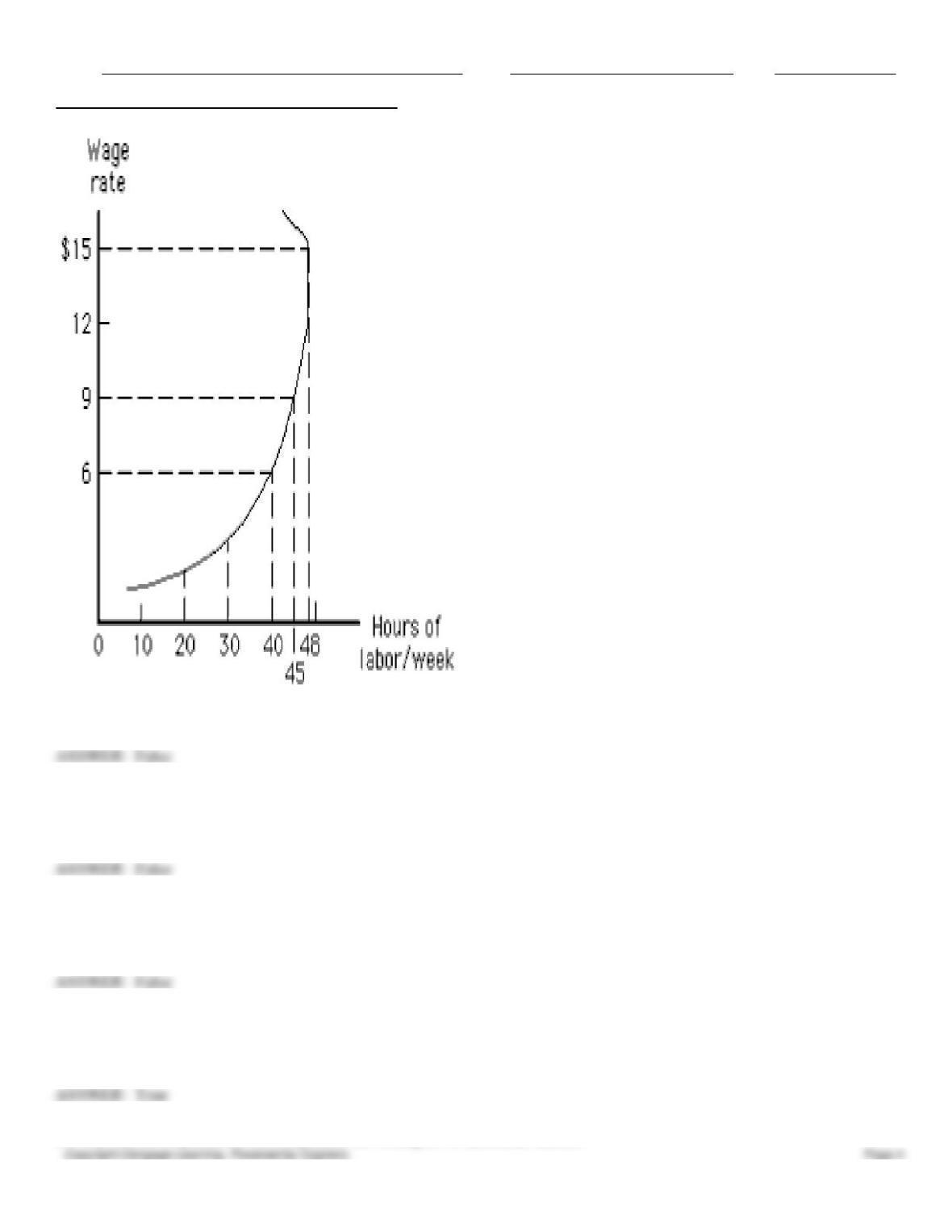
15. The figure given below shows a backward-bending labor supply curve for an individual. In the figure below, when the
wage rate rises above $12, the substitution effect outweighs the income effect.
Figure 12.5
Name:
Class:
Date:
Chapter 12: Labor Markets and Labor Unions
a.
True
b.
False
False
16. An increase in labor supply will increase the equilibrium wage rate.
a.
True
b.
False
False
17. An increase in the wage rate will decrease the demand for labor.
a.
True
b.
False
False
18. Most labor negotiations in the United States end without a strike.
a.
True
b.
False
True
19. The unions of plumbers and carpenters are examples of industrial unions.

Name:
Class:
Date:
Chapter 12: Labor Markets and Labor Unions
a.
True
b.
False
False
20. A labor union is a group of business owners who join together to improve working conditions.
a.
True
b.
False
False
21. Collective bargaining is the process by which a labor union and a firm negotiate an employment contract.
a.
True
b.
False
True
22. In order for a strike to be successful, the union must decrease the supply of both union and nonunion labor.
a.
True
b.
False
True
23. If a union negotiates a wage greater than the competitive wage, the total union wage bill will necessarily decrease.
a.
True
b.
False
False
24. If an industrial union is able to negotiate a wage above the competitive market-clearing wage, employment in the
industry will increase.
a.
True
b.
False
False
25. If a union raises initiation fees significantly and if employers in the industry hire only union workers, the supply of
union labor curve will shift to the left.
a.
True
b.
False
True
26. If a professional association restricts membership and firms cannot employ non-association workers, the equilibrium
wage will increase.
a.
True
b.
False
True
27. Unions can affect the demand for, but not the supply of, labor.
a.
True
b.
False

Name:
Class:
Date:
Chapter 12: Labor Markets and Labor Unions
False
28. Featherbedding refers to union efforts to force employers to hire more workers than demanded at a particular wage.
a.
True
b.
False
True
Multiple Choice
29. The quantity of labor an individual supplies to the labor market:
a.
always increases as the market wage rate rises.
b.
is contingent upon the wage rate offered in the labor markets.
c.
always decreases as the market wage rate rises.
d.
could never be zero over the realistic range of wage rates.
e.
depends only on the opportunity cost of the individual’s time in other labor markets.
30. Over the realistic range of wages, under which of the following circumstances will Sam be supplying a quantity of
labor greater than zero to the labor market?
a.
When he is either unwilling or unable to perform the job
b.
When he has not been hired to do the job
c.
When he is willing and able to perform the job at the going market wage rate
d.
When he is unable to perform the job
e.
When he is unwilling to perform the job
c
31. Nonmarket work includes:
a.
time spent producing goods and services for your employer.
b.
time spent pursuing hobbies and crafts.
c.
time spent engaging in strenuous physical exercise to reduce your weight.
d.
time spent producing goods and services for your own consumption.
e.
time spent managing your own firm.
32. Market work includes activities such as:
a.
practicing your golf game.
b.
studying for an economics exam.
c.
teaching a college economics course.
d.
picking up empty cans for the bottle deposit.
e.
picking strawberries for your own use.
c
33. Leisure is:
a.
not subject to the law of diminishing utility because you can never have enough leisure time.

Name:
Class:
Date:
Chapter 12: Labor Markets and Labor Unions
b.
not subject to the law of diminishing utility because you can derive utility only from goods and services.
c.
subject to the law of diminishing utility, just like the consumption of goods and services.
d.
subject to the law of diminishing utility only if it involves the consumption of goods and services.
e.
not considered in maximizing utility.
34. Leisure includes activities such as:
a.
practicing your golf game.
b.
studying for a final exam.
c.
teaching a college economics course.
d.
working on your car at home.
e.
babysitting for a fee.
35. Which of the following is not a form of nonmarket work?
a.
Working on your car at home
b.
Doing your laundry in a laundromat
c.
Making bread for a dinner party at your sister’s house
d.
Caring for your sister’s children as a favor
e.
Babysitting for a fee
36. Which of the following lists the three ways people use their time?
a.
Market work, selling labor in the labor market, and leisure
b.
Producing their own goods and services, nonmarket work, and market work
c.
Nonwork, work, and leisure
d.
Market work, nonmarket work, and leisure
e.
Market work, nonwork, and leisure
37. Work is an attractive use of your time:
a.
if the utility of consumption made possible by work exceeds the disutility of work itself.
b.
whenever you are paid a wage equal to or greater than the minimum wage.
c.
whenever you derive utility from the consumption made possible through work.
d.
unless time spent working is a source of disutility.
e.
only when marginal utility is negative for an additional unit of leisure.
38. Abby maximizes utility by allocating her time among leisure, market work, and nonmarket work so that the:
a.
total utility of each is equal.
b.
average utility of each is equal.
c.
total utility per hour of each is equal.
d.
marginal utility per hour of each is equal.

Name:
Class:
Date:
Chapter 12: Labor Markets and Labor Unions
e.
maximum amount of goods and services can be acquired.
39. Individuals achieve maximum utility in the allocation of their time when:
a.
any change in their use of time reduces their total satisfaction.
b.
they consciously and carefully weigh the expected marginal utilities per unit.
c.
they consciously and carefully weigh the actual marginal utilities per unit of time spent in each activity.
d.
the expected average utility of each activity is equal.
e.
people make a concerted effort to measure satisfaction.
40. Jamal maximizes utility by allocating his time among leisure, market work, and household work so that:
a.
expected marginal utility is equal among all three.
b.
expected total utility per hour is equal among all three.
c.
expected marginal utility per hour is equal among all three.
d.
the maximum amount of goods and services can be acquired.
e.
expected total utility of each use is equal.
41. People make mistakes in allocating their time:
a.
because they always act irrationally.
b.
despite always having expectations fulfilled.
c.
only when leisure is a normal good.
d.
because acquiring information is costly.
e.
more often when the cost of making a mistake is high.
42. People make mistakes in allocating their time:
a.
only when leisure time is an inferior good.
b.
because the future is uncertain.
c.
more often when the cost of making a mistake is high.
d.
only when economists remove the assumption that individuals are rational.
e.
because information is free and readily available.
43. People who earn higher market wages, other things constant, will:
a.
provide more labor to nonmarket work.
b.
be more inclined to supply their labor to market work than to nonmarket work.
c.
be more inclined to supply their labor to nonmarket work than to market work.
d.
provide more labor to nonmarket work even if the market can provide the services more cheaply.
e.
provide less labor to market work and more labor to nonmarket work.
44. People who gain greater enjoyment from leisure activities:

Name:
Class:
Date:
Chapter 12: Labor Markets and Labor Unions
a.
allocate more time to leisure.
b.
allocate more time to market work.
c.
allocate more time to nonmarket work.
d.
generally earn higher market wages.
e.
generally earn lower market wages.
45. People who are more productive in nonmarket work:
a.
produce more for themselves.
b.
spend less time engaged in nonmarket work.
c.
work fewer hours in market work and enjoy more leisure.
d.
spend more time engaged in market work.
e.
are attracted to market employment at lower wages.
46. People who earn higher market wages:
a.
have a greater net utility associated with nonmarket work.
b.
supply more hours to market work than people with lower wages.
c.
are less likely to perform nonmarket work.
d.
are more likely to view leisure as an inferior good.
e.
experience less disutility associated with market work.
47. A college dean has a _____ opportunity cost of _____ than a college student working in a minimum-wage job.
a.
lower; leisure
b.
lower; nonmarket work
c.
lower; market work
d.
higher; nonmarket work
e.
higher; market work
48. A college student working in a minimum-wage job has a _____ opportunity cost of _____ than a college dean.
a.
lower; market work
b.
lower; leisure
c.
higher; market work
d.
higher; nonmarket work
e.
higher; leisure
49. If leisure is a normal good, then a decrease in income _____ the time allocated to _____.
a.
decreases; market work
b.
decreases; leisure
c.
decreases; nonmarket work and market work

Name:
Class:
Date:
Chapter 12: Labor Markets and Labor Unions
d.
increases; leisure
e.
increases; market work, nonmarket work, and leisure time
50. If nonmarket work is a normal good, then those earning a higher income allocate _____ time to _____.
more; market work
a.
less; market work
b.
less; leisure
c.
more; market work
d.
more; leisure
e.
more; nonmarket work
51. People generally view leisure as _____.
a.
an inferior good
b.
a normal good
c.
a source of disutility
d.
being more valuable per unit, the more they have of it
e.
being unrelated to utility maximization
52. Because leisure is a normal good, an increase in income:
a.
decreases the demand for leisure time and reduces the amount of time allocated to market work.
b.
decreases the demand for leisure time and increases the amount of time allocated to market work and
nonmarket work.
c.
increases the demand for leisure time and reduces the amount of time allocated to market work and nonmarket
work.
d.
increases the demand for leisure time and increases the amount of time allocated to market work and
nonmarket work.
e.
has no impact on the demand for leisure time.
53. The substitution effect of an increase in the wage rate will:
a.
always lead to an increase in the quantity of labor supplied.
b.
always lead to a decrease in the quantity of labor supplied.
c.
lead to an increase in the quantity of labor supplied only if leisure is a normal good.
d.
lead to an increase in the quantity of labor supplied only if leisure is not a normal good.
e.
lead to an increase in the quantity of labor supplied only if the income effect works in the same direction.
54. The income and substitution effects of a change in the wage rate:
a.
always work in the same direction.
b.
always work in opposite directions.
c.
work in opposite directions only if the wage decreases.

Name:
Class:
Date:
Chapter 12: Labor Markets and Labor Unions
d.
work in the same direction only if the wage increases.
e.
work in the same direction only if the wage decreases.
55. The substitution effect in the labor supply decision refers to:
a.
substituting leisure for work as the wage rate rises.
b.
substituting market work for nonmarket work as the wage rate falls.
c.
working more hours as the wage rate falls.
d.
working fewer hours as the wage rate rises.
e.
substituting market work for leisure or nonmarket work as the wage rate rises.
e
56. The income effect of a decrease in the wage rate causes the quantity of labor supplied to:
a.
increase.
b.
increase only if the individual desires more leisure time.
c.
increase only if the substitution effect outweighs the income effect.
d.
decrease.
e.
decrease only if the substitution effect is weaker than the income effect.
a
57. The substitution effect of a decrease in the wage rate causes the quantity of labor supplied to:
a.
increase.
b.
increase only if the individual desires more leisure time.
c.
increase only if the substitution effect outweighs the income effect.
d.
decrease.
e.
decrease only if the individual lowers the value of leisure time.
58. For a typical person who is currently earning a low wage rate, the:
a.
substitution effect of a wage rate increase usually is stronger than the income effect.
b.
substitution effect of a wage rate increase usually is weaker than the income effect.
c.
income effect of a wage rate increase usually is zero.
d.
substitution effect of a wage rate increase usually is zero.
e.
substitution and income effects of a wage rate increase tend to work in the same direction.
a
59. As the wage rate decreases, the amount of time spent on market work:
a.
increases if the income effect dominates the substitution effect.
b.
increases because of the substitution effect.
c.
decreases because of the income effect.
d.
decreases if the income effect dominates the substitution effect.
e.
decreases if the substitution effect dominates the income effect.
e

Name:
Class:
Date:
Chapter 12: Labor Markets and Labor Unions
60. At a low wage rate, _____.
a.
usually there is no substitution effect
b.
usually there is no income effect
c.
the substitution effect usually outweighs the income effect
d.
the income effect usually outweighs the substitution effect
e.
the disutility of market work is usually high
61. An increase in the wage rate will lead to a reduction in the quantity of labor supplied if:
a.
the substitution effect outweighs the income effect.
b.
the income effect outweighs the substitution effect.
c.
the opportunity cost of leisure does not increase.
d.
the opportunity cost of working always increases.
e.
workers are irrational because otherwise they would be violating the law of supply.
62. The average work week in the United States has declined to fewer than 40 hours even though wage rates have been
increasing. The best explanation for this phenomenon is that:
a.
the labor supply curve shifted to the right.
b.
the labor demand curve shifted to the right.
c.
the income effect of rising wages outweighed the substitution effect.
d.
the substitution effect of rising wages outweighed the income effect.
e.
the labor supply curve is linear and upward slopping.
63. Along a backward-bending labor supply curve, the:
a.
income effect always dominates the substitution effect.
b.
substitution effect always dominates the income effect.
c.
substitution effect is always equal to the income effect.
d.
substitution effect dominates the income effect at high wage rates.
e.
substitution effect dominates the income effect at low wage rates.
64. If the substitution effect is always greater than the income effect, then an individual’s labor supply curve will _____.
a.
bend backward
b.
always have a positive slope
c.
always have a negative slope
d.
be vertical
e.
be horizontal
65. Which of the following statements would be represented by a backward-bending labor supply curve?
a.
A $50,000-a-year professor works more hours than a $20,000-a-year professor.
b.
The CEO of a major computer manufacturer works more hours than the union workers.
Name:
Class:
Date:
Chapter 12: Labor Markets and Labor Unions
c.
The owners of a successful business work fewer days than do their employees.
d.
Hospital janitors work fewer hours than the chief of obstetrics.
e.
High-ranking executives are more likely to work past 5:00 p.m. than middle level managers.
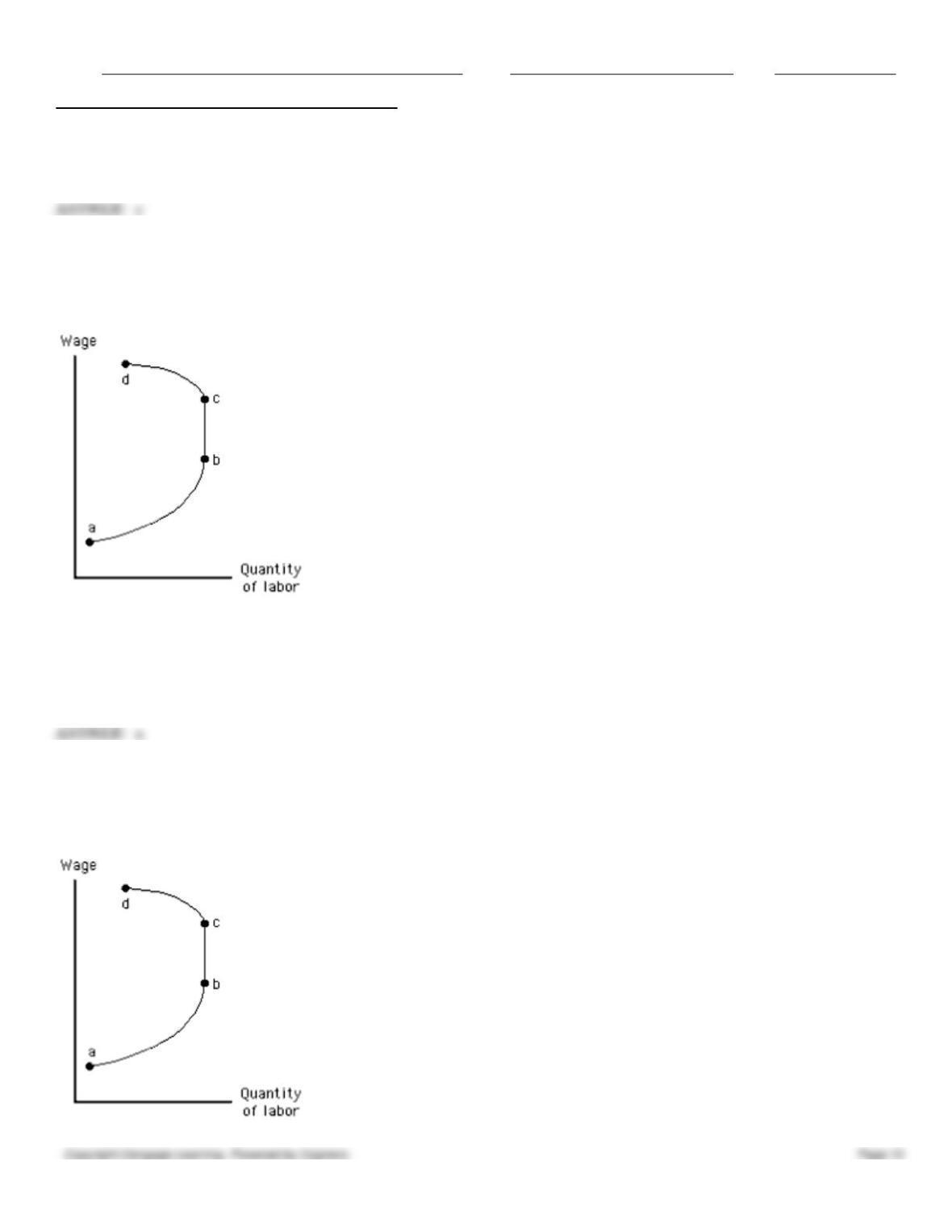
66. The figure given below shows a backward-bending labor supply curve for an individual. Along which part of the labor
supply curve in the figure below does the substitution effect of a wage change outweigh the income effect?
Figure 12.1
a.
Between points a and b
b.
Between points a and c
c.
Between points b and c
d.
Between points b and d
e.
Between points c and d
67. The figure given below shows a backward-bending labor supply curve for an individual. Along which part of the labor
supply curve in the figure below does the income effect of a wage change outweigh the substitution effect?
Figure 12.1

Name:
Class:
Date:
Chapter 12: Labor Markets and Labor Unions
a.
Between points a and b
b.
Between points a and c
c.
Between points b and c
d.
Between points b and d
e.
Between points c and d
68. The figure given below shows a backward-bending labor supply curve for an individual. Along which part of the labor
supply curve in the figure below does the income effect of a wage change just equal the substitution effect?
Figure 12.1
a.
Between points a and b
b.
Between points a and c
c.
Between points b and c
d.
Between points b and d
e.
Between points c and d
69. Which of the following statements is not true of labor supply?
a.
Jerry’s labor supply curve can bend backward if the income effect of a higher wage rate outweighs the
substitution effect.
b.
Bob’s labor supply curve will not bend backward if the wage rate is never so high that the income effect
outweighs the substitution effect.
c.
If there is a wage rate above which the income effect is at least as great as the substitution effect, the labor
supply curve will be vertical or bend backward.
d.
The labor supply curve will slope upward if the income effect dominates the substitution effect.
e.
Hayden’s offer to work more hours as a result of a wage increase suggests that the substitution effect
dominates the income effect.
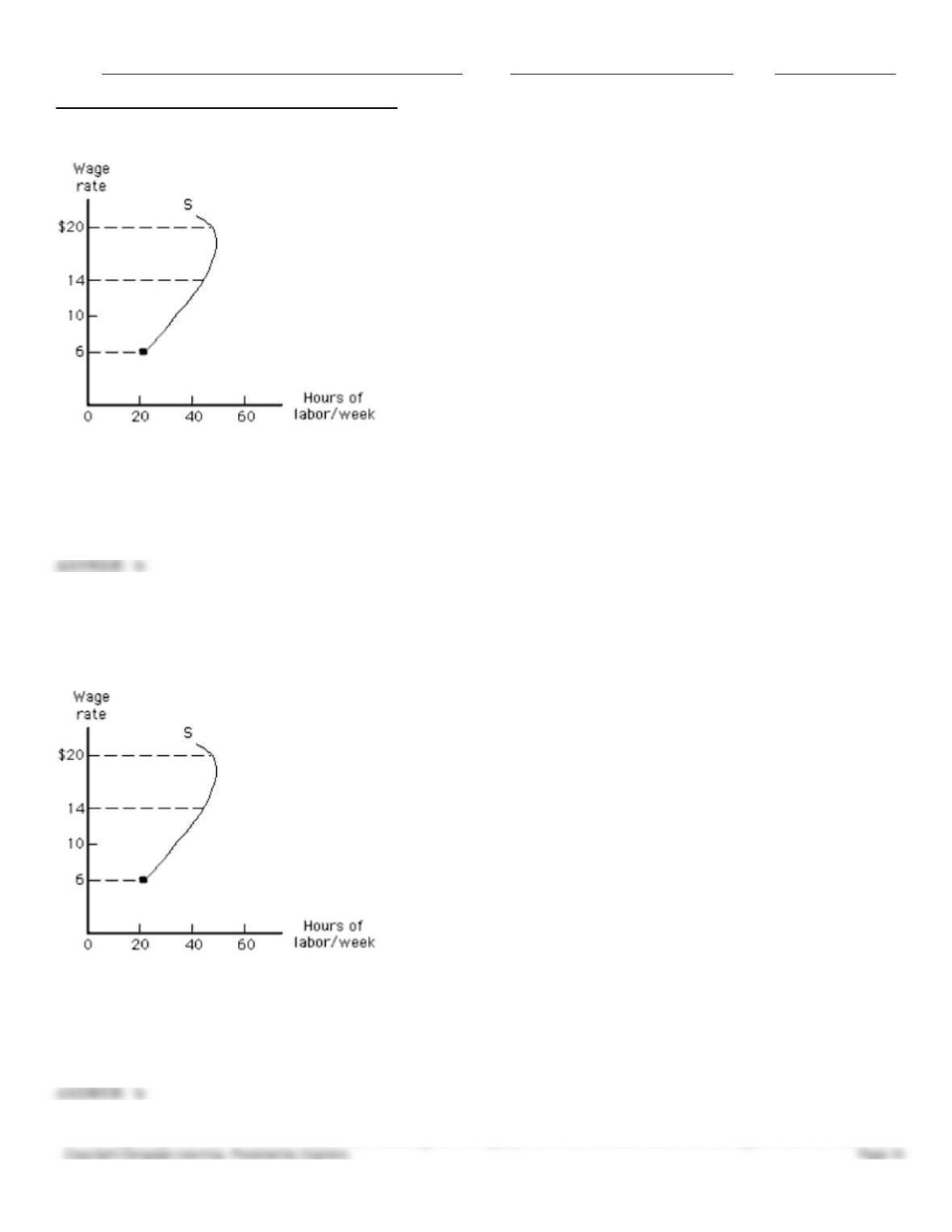
70. The figure given below shows a backward-bending labor supply curve for an individual. In the figure below, which of
the following is true if the wage rate decreases from $14 to $6 per hour?
Name:
Class:
Date:
Chapter 12: Labor Markets and Labor Unions
Figure 12.2
a.
The income effect dominates the substitution effect.
b.
The substitution effect dominates the income effect.
c.
No labor is supplied.
d.
The income effect equals the substitution effect.
e.
The supply curve is horizontal.
71. The figure given below shows a backward-bending labor supply curve for an individual. In the figure below, which of
the following is true at a wage rate of $14?
Exhibit 12.2
a.
The income effect dominates the substitution effect.
b.
The substitution effect dominates the income effect.
c.
No labor is supplied.
d.
The income effect equals the substitution effect.
e.
The supply curve is horizontal.
72. The figure given below shows a backward-bending labor supply curve for an individual. In the figure below, which of
Name:
Class:
Date:
Chapter 12: Labor Markets and Labor Unions
the following is true at a wage rate of $20?
Figure 12.2
a.
The income effect dominates the substitution effect.
b.
The substitution effect dominates the income effect.
c.
No labor is supplied.
d.
The income effect equals the substitution effect.
e.
The supply curve is horizontal.
73. The figure given below shows a backward-bending labor supply curve for an individual. In the figure below, which of
the following is true at a wage rate of $7?
Figure 12.3
a.
The income effect dominates the substitution effect.
b.
The substitution effect dominates the income effect.
c.
The income effect exactly offsets the substitution effect.
d.
No labor is supplied.
e.
The individual will supply 30 hours of labor.
Name:
Class:
Date:
Chapter 12: Labor Markets and Labor Unions
74. The figure given below shows a backward-bending labor supply curve for an individual. In the figure below, which of
the following is true when the wage rate increases from $9 to $11?
Figure 12.3
a.
The substitution effect will cancel out the income effect.
b.
The income effect will cause the person to work more hours.
c.
The substitution effect will cause the person to work fewer hours.
d.
The income effect will cause the person to work the same number of hours.
e.
The substitution effect will cause the person to work the same number of hours.
75. The figure given below shows a backward-bending labor supply curve for an individual. In the figure below, which of
the following is true when the wage rate increases from $11 to $13?
Figure 12.3
a.
The substitution effect will cause the person to work more hours.
b.
The income effect will cause the person to work less hours.
c.
The substitution effect will cause the person to work fewer hours.
d.
The income effect will cause the person to work the same number of hours.
e.
The substitution effect will cause the person to work the same number of hours.