14) If the MPC equals 0.75, then
A) for every $100 increase in consumption, real Gross Domestic Product (GDP) increases by
$75.
B) consumption is always more than real Gross Domestic Product (GDP).
C) for every $100 increase in real Gross Domestic Product (GDP), saving increases by $75.
D) for every $100 increase in real Gross Domestic Product (GDP), saving increases by $25.
15) In the Keynesian model, government spending is considered
A) a positive function of real GDP.
B) a negative function of real GDP.
C) to be a negative function of the real interest rate.
D) to be autonomous.
16) The following would cause an upward shift in the C + I + G + X curve EXCEPT
A) an increase in disposable income.
B) an increase in export spending.
C) a decrease in import spending
D) an increase in household wealth.
17) A lump-sum tax, such as a $1000 tax that every family must pay one time, is
A) a type of income tax.
B) an autonomous tax.
C) negatively related to real GDP.
D) a regressive tax.
18) Which of the following does NOT occur when the economy is operating at the equilibrium
level of GDP?
A) Total planned expenditures equal real GDP.
B) Real GDP tends to rise over time.
C) Planned investment equals actual investment.
D) Inventory investment equals zero.
19) When the economy is operating at the equilibrium level of GDP, we know that
A) total planned real consumption expenditures equal real GDP.
B) planned real investment spending equals real net exports of zero.
C) total planned real expenditures equal real GDP.
D) real net exports equal inventory changes.
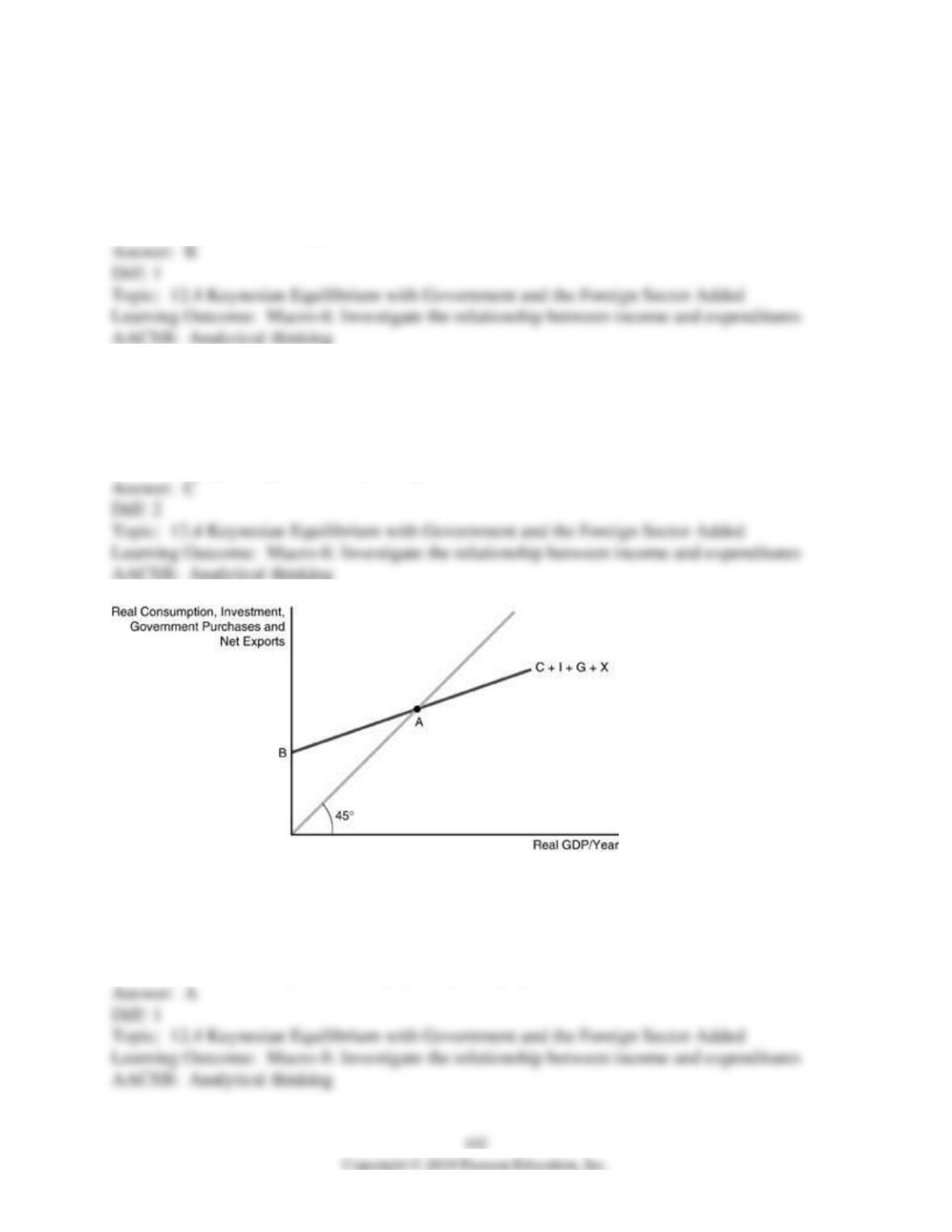
20) Refer to the above figure. The equilibrium level of real GDP occurs
A) at point A.
B) to the right of point A.
C) to the left of point A.
D) at the undetermined point on the graph depending upon the level of investment.
103
21) Refer to the above figure. Point B
A) equals autonomous consumption.
B) equals autonomous consumption plus planned investment plus autonomous government
spending plus autonomous net exports.
C) has no special significance.
D) equals government expenditures.
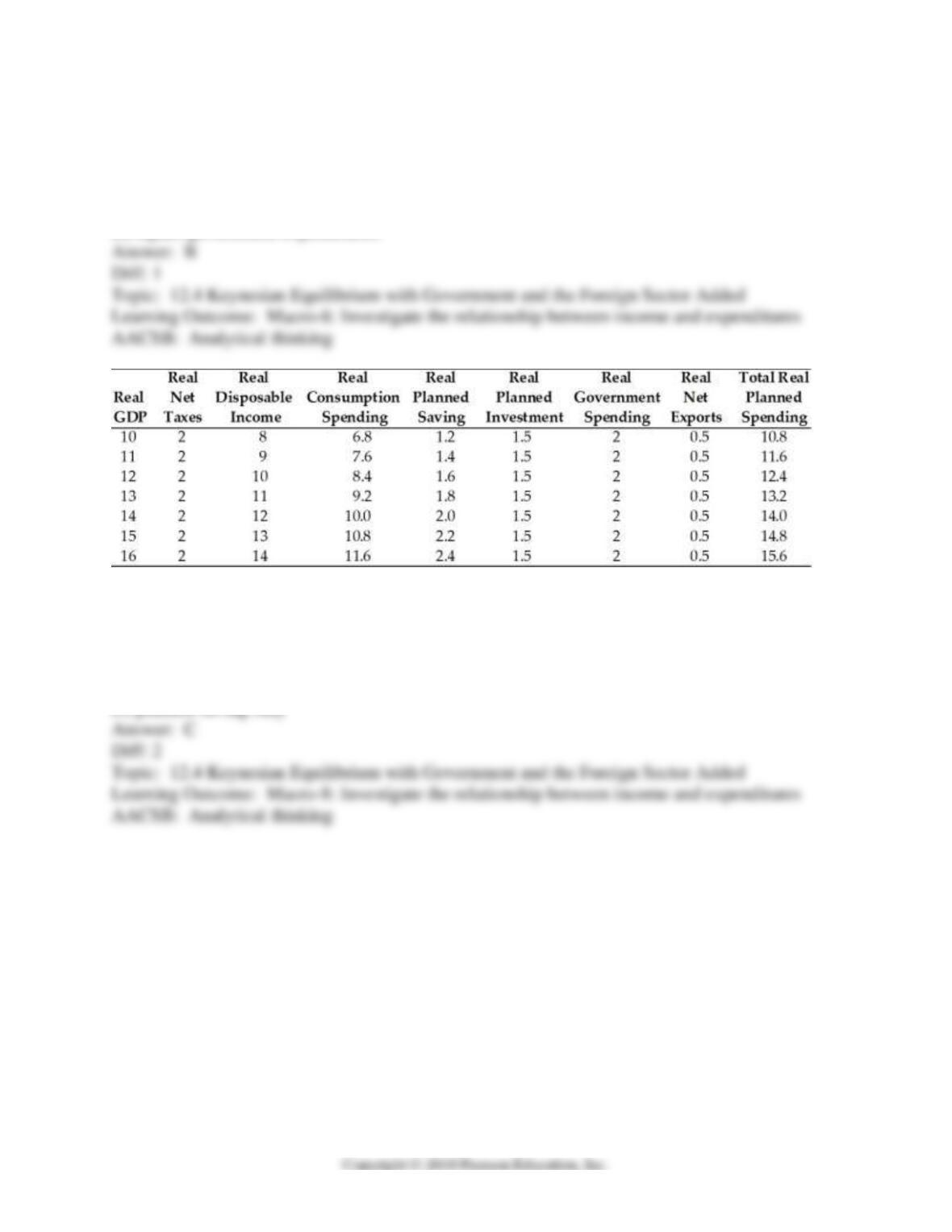
Note: Amounts in $ trillions
22) Refer to the above table. Which variables in the table are NOT autonomous?
A) taxes, government spending, and saving
B) planned investment, net exports, and government spending
C) planned consumption and planned saving
D) planned saving only
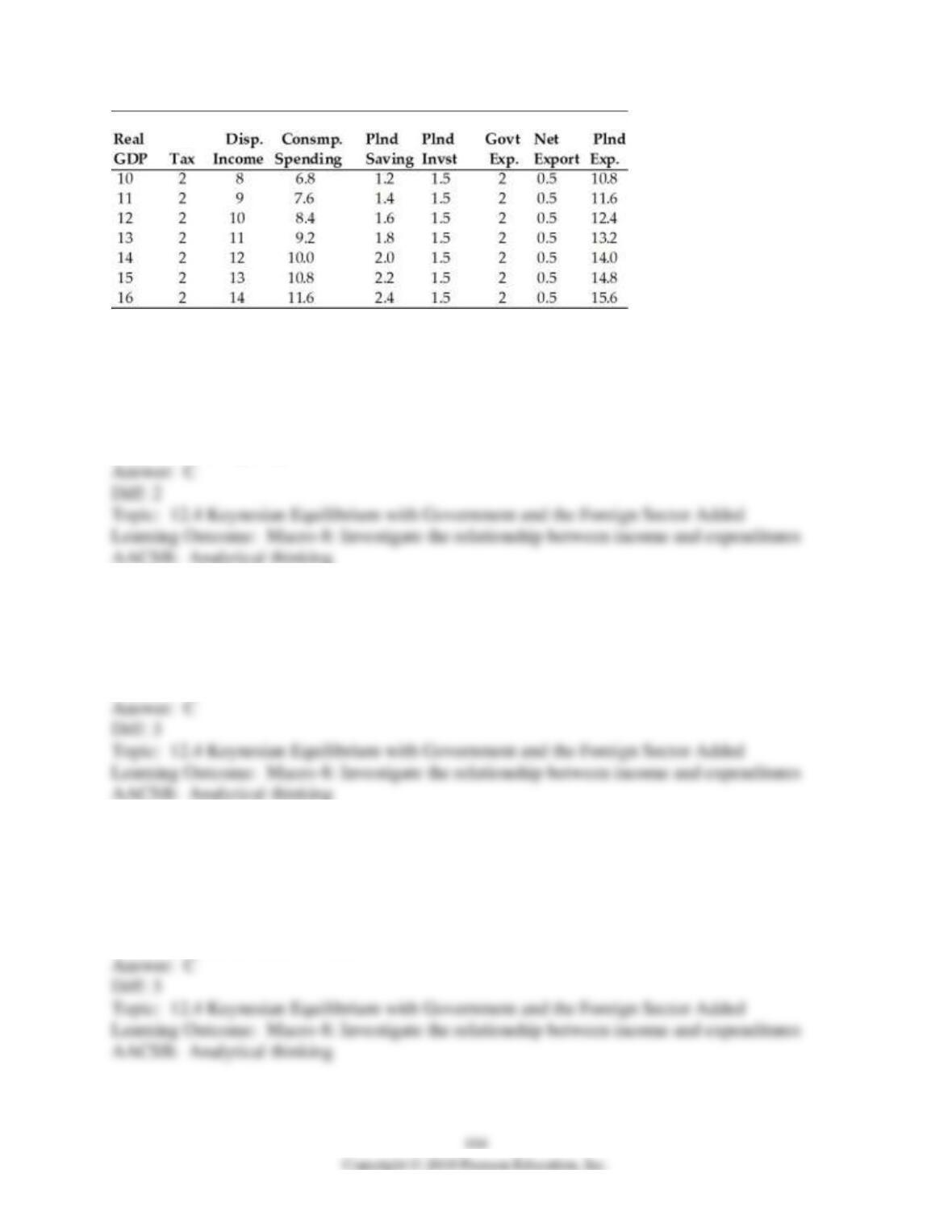
Note: Amounts in billions.
23) Refer to the above table. Which variables in the table are NOT autonomous?
A) taxes, government spending, and saving
B) planned investment, net exports, and government spending
C) planned consumption and planned saving
D) planned saving only
24) Refer to the above table. The equilibrium real GDP is
A) $12 billion.
B) $13 billion.
C) $14 billion.
D) $15 billion.
25) Refer to the above table. If real GDP is $12 billion, total planned expenditures and unplanned
inventory changes are respectively
A) $0 and $14 billion.
B) $13.2 billion and -$0.8 billion.
C) $12.4 billion and -$0.4 billion.
D) $12.4 billion and $0.4 billion.
26) Refer to the above table. When real GDP equals $11 billion
A) government expenditures will increase.
B) the economy is in equilibrium.
C) unplanned inventories will increase.
D) unplanned inventories will decrease.
27) Refer to the above table. When real GDP equals $15 billion
A) government expenditures will increase.
B) the economy is in equilibrium.
C) unplanned inventories will increase.
D) unplanned inventories will decrease.
28) Whenever total planned expenditures differ from real GDP
A) unplanned inventories will remain unchanged.
B) unplanned inventories will change.
C) government spending will adjust.
D) tax revenues will move the economy back to equilibrium.
29) In equilibrium, real GDP is equal to
A) C + I + G – X.
B) C + I + X – G.
C) C + I + G + X.
D) C + I + G + X + S.
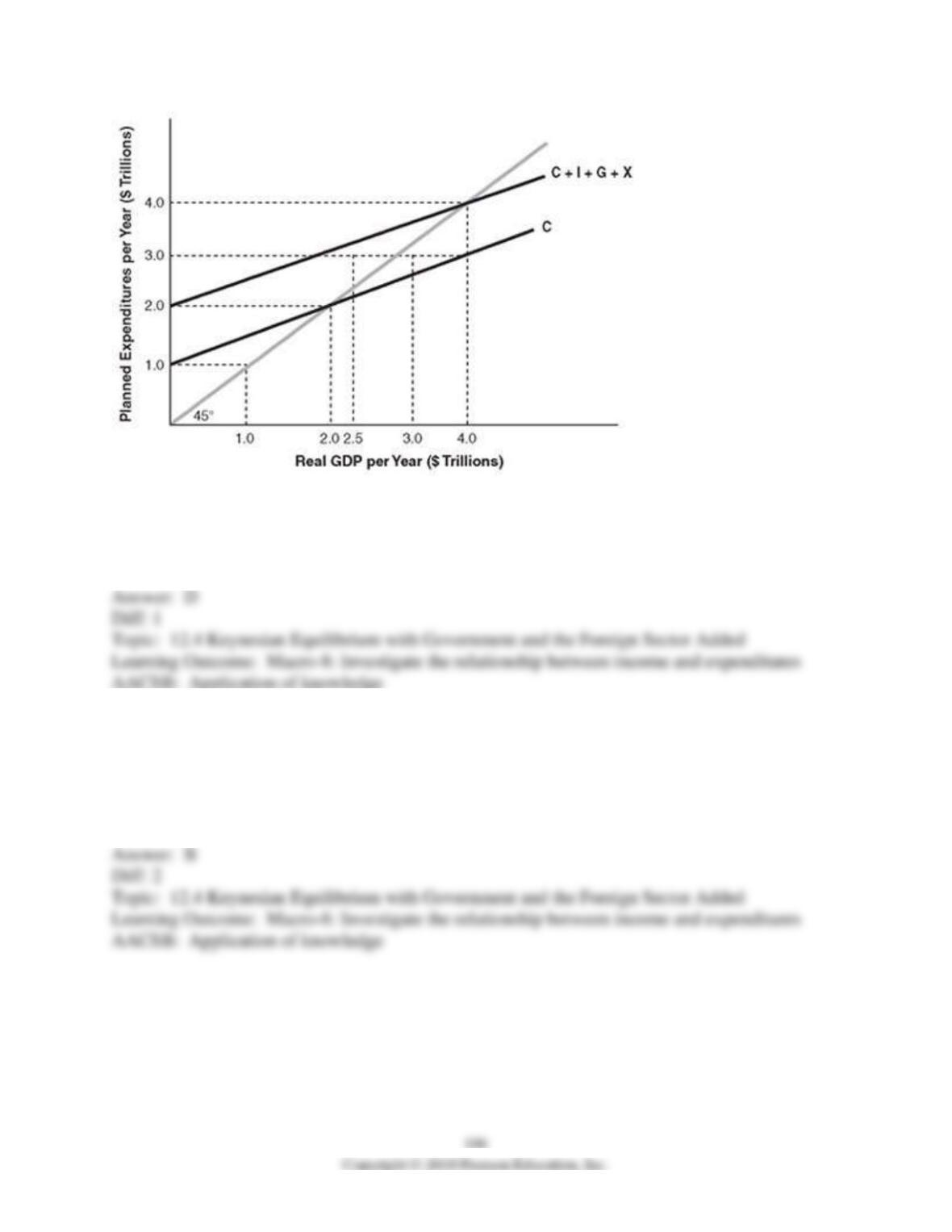
30) In the above figure, the equilibrium level of real GDP per year is
A) $1.0 trillion.
B) $2.0 trillion.
C) $3.0 trillion.
D) $4.0 trillion.
31) In the above figure, the sum of real planned investment spending, government expenditures,
and net export spending is equal to
A) $0.5 trillion.
B) $1.0 trillion.
C) $1.5 trillion.
D) $2.0 trillion.
32) In the above figure, the equilibrium level of planned saving plus net taxes is
A) $1.0 trillion.
B) $2.0 trillion.
C) $3.0 trillion.
D) $4.0 trillion.
33) Which one of the following is TRUE in an open economy with a government sector?
A) The equilibrium level of real GDP occurs when real net export spending equals zero.
B) The equilibrium level of real GDP occurs when planned real saving equals government
spending.
C) The equilibrium level of real GDP occurs when total planned real expenditures equal real
GDP.
D) The equilibrium level of real GDP occurs when planned real investment spending is zero.
34) What effect would taxation have on real consumption spending when government spending
is autonomous?
A) Taxation reduces real consumption spending.
B) Taxation increases real consumption spending.
C) Taxation causes both real consumption spending and planned real saving to increase.
D) None of the above is correct.
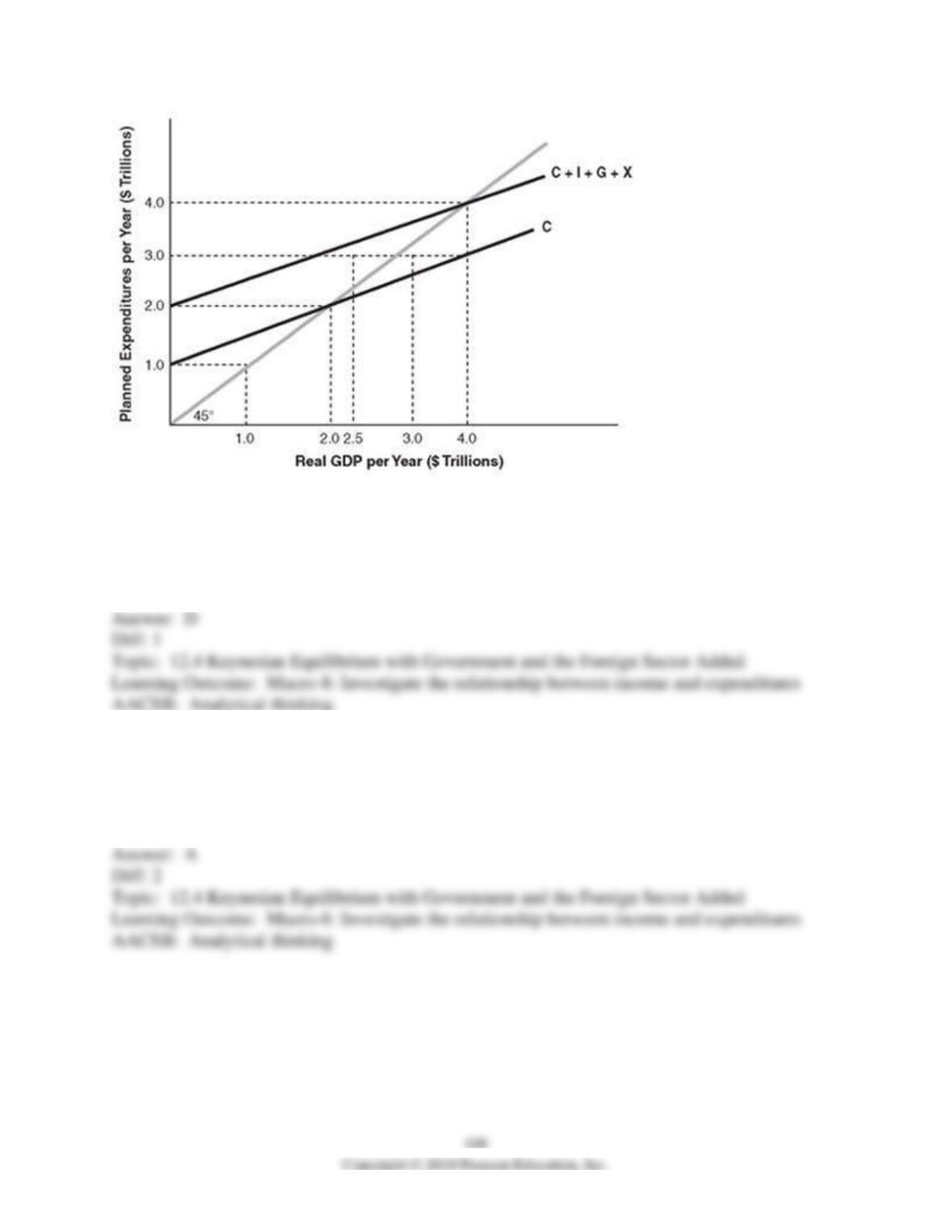
35) In the above figure, what is the equilibrium level of real GDP with government and the
foreign sector?
A) $2.0 trillion
B) $2.5 trillion
C) $3.0 trillion
D) $4.0 trillion
36) In the above figure, at the equilibrium level of real GDP, there is
A) positive saving.
B) negative saving.
C) zero saving.
D) a negative tax rate.
37) In the above figure, if real GDP is $1 trillion, there is
A) dissaving.
B) positive saving.
C) negative investment.
D) negative consumption.
38) In a closed economy, real Gross Domestic Product (GDP) is at equilibrium occurs where
A) the C + I + G line crosses the 45-degree line.
B) planned expenditures exceed national income.
C) saving exceeds planned investment.
D) all of these.
39) If real Gross Domestic Product (GDP) is at an equilibrium level in a closed economy,
A) real GDP equals the sum of consumption, investment, and government purchases.
B) saving will be less than planned investment.
C) unplanned inventory accumulation will equal planned inventory accumulation.
D) real GDP equals the sum of consumption and investment minus government purchases.
40) In the Keynesian model with government and the foreign sector added, what are the
components of spending? Which of these components are autonomous and which are NOT?
How is the equilibrium found? When the economy is NOT at an equilibrium, what adjustments
are made?
110
41) Explain how the aggregate demand curve is related to the C + I + G + X curve.
12.5 The Multiplier, Total Expenditures, and Aggregate Demand
1) One divided by the marginal propensity to save (MPS) is the formula for
A) one minus the multiplier.
B) the inverse of the multiplier.
C) the multiplier.
D) autonomous consumption.
2) Suppose that the marginal propensity to save (MPS) equals 0.4. The value of the multiplier
would be
A) 0.25.
B) 0.4.
C) 2.5.
D) 4.
3) Suppose that the marginal propensity to consume (MPC) is .8 and there is an increase in
investment spending of $100,000. As a result, equilibrium real Gross Domestic Product (GDP)
would increase by
A) $20,000.
B) $100,000.
C) $500,000.
D) $800,000.
4) The smaller is the marginal propensity to consume (MPC)
A) the smaller is the multiplier.
B) the larger is the multiplier.
C) the larger is the slope of the consumption function.
D) the smaller is the slope of the saving function.
5) If the marginal propensity to consume (MPC) increases, then
A) the marginal propensity to save (MPS) increases.
B) the multiplier increases.
C) the multiplier decreases.
D) MPC + MPS is less than 1.
6) If the marginal propensity to consume (MPC) is 0.95, then the multiplier for a change in
autonomous spending will be
A) 0.05.
B) 95.
C) 20.
D) 100.
7) If the marginal propensity to save (MPS)decreases, the multiplier
A) increases.
B) decreases.
C) stays the same.
D) can either increase or decrease, depending on what happens to the marginal propensity to
consume (MPC).
8) If the multiplier is 20 and income increases by $1000, then saving will increase by
A) $80.
B) $800.
C) $200.
D) $1000.
9) If the multiplier is 50, then the marginal propensity to consume (MPC) is
A) 0.98.
B) 0.05.
C) 0.5.
D) 9.
10) If the marginal propensity to consume (MPC) is 0.9, the multiplier will be
A) 0.1.
B) 9.
C) 90.
D) 10.
11) If the marginal propensity to save (MPS) is 0.25, the multiplier will be
A) 0.75.
B) 2.5.
C) 4.
D) 40.
12) If the multiplier in the economy is 3, the marginal propensity to save (MPS) must be
A) 0.33.
B) 0.67.
C) 1.
D) 3.
13) If the multiplier is 2, the marginal propensity to consume (MPC) must be
A) 0.25.
B) 0.4.
C) 0.5.
D) 1.
14) The multiplier effect tends to
A) generate instability.
B) promote stability of the general price level.
C) magnify small changes in spending into much larger changes in real Gross Domestic Product
(GDP).
D) increase the MPC.
114
15) If an economy saves 20 percent of any increase in real Gross Domestic Product (GDP), then
an increase in investment of $1 billion can produce an increase in real Gross Domestic Product
(GDP) of as much as
A) $2 billion.
B) $5 billion.
C) $8 billion.
D) $10 billion.
16) If initial equilibrium real Gross Domestic Product (GDP) is $500 billion, MPC = 0.9, and
autonomous investment increases $40 billion, equilibrium real Gross Domestic Product (GDP)
will be
A) $540 billion.
B) $600 billion.
C) $800 billion.
D) $900 billion.
17) Other things being constant, if the marginal propensity to save (MPS) is 0.2, and private
investment spending falls by $100 million, then real Gross Domestic Product (GDP)
A) decreases by $50 million.
B) increases by $80 million.
C) decreases by $500 million.
D) increases by $1 billion.
18) If an increase of $5 million in investment is associated with an increase of $20 million in real
Gross Domestic Product (GDP), the multiplier is
A) 1.
B) 2.
C) 4.
D) 5.
19) The multiplier helps explain
A) why a rise in government expenditures causes real Gross Domestic Product (GDP) to rise by
more than the amount of the increase in government spending.
B) why an increase in disposable income causes real Gross Domestic Product (GDP) to rise by
less than the amount of the increase in disposable income.
C) why a decrease in taxes causes real Gross Domestic Product (GDP) to fall by more than the
amount of the decrease in taxes.
D) why a fall in investment cause real Gross Domestic Product (GDP) to rise by more than the
amount of the decrease in investment.
20) If the marginal propensity to consume (MPC) is 0.75 and government purchases increase by
$100 billion, then
A) equilibrium real Gross Domestic Product (GDP) will increase by $400 billion.
B) equilibrium real Gross Domestic Product (GDP) will increase by $200 billion.
C) equilibrium real Gross Domestic Product (GDP) will increase by $40 billion.
D) the effect on equilibrium real Gross Domestic Product (GDP) cannot be determined from the
given information.
21) If the marginal propensity to save (MPS) is 0.5 and net exports falls by $10 million, then
A) real Gross Domestic Product (GDP) will increase by $5 million.
B) real Gross Domestic Product (GDP) will fall by $20 million.
C) real Gross Domestic Product (GDP) will not change.
D) the effect on real Gross Domestic Product (GDP) cannot be determined from the given
information.
22) If autonomous investment increases by $100 million and the marginal propensity to consume
(MPC) is 0.75, then
A) real Gross Domestic Product (GDP) will rise by $400 million.
B) real Gross Domestic Product (GDP) will rise by $100 million.
C) real Gross Domestic Product (GDP) will rise by $200 million.
D) real Gross Domestic Product (GDP) will fall by $200 million.
23) A decrease in autonomous investment of $200 that occurs when the marginal propensity to
save (MPS) equals 0.25 will lead to a decrease in real Gross Domestic Product (GDP) of
A) $25.
B) $50.
C) $800.
D) $80.
24) Suppose the marginal propensity to consume (MPC) equals 0.80, an increase in autonomous
investment of $200 will lead to an increase in real Gross Domestic Product (GDP) by
A) $400.
B) $500.
C) $800.
D) $1,000.