Macroeconomics: Policy and Practice, 2e (Mishkin)
Chapter 12 The Aggregate Demand and Supply Model
12.1 Recap of the Aggregate Demand and Supply Curves
1) Which equation is a plausible aggregate demand curve?
A) π = 2 + 0.3Y
B) Y = 50 – 1.25π
C) Y = 250 – 80r
D) π = 5 – 0.4 (U – 6)
E) none of the above
2) The endogenous variable in the aggregate demand curve is ________.
A) the real interest rate
B) output
C) inflation
D) planned expenditure
E) none of the above
3) Rising inflation causes quantity demanded to decline, because ________.
A) the central bank raises the nominal interest rate by more than the increase in expected
inflation
B) households and businesses are reluctant to spend when prices rise
C) higher inflation causes the IS curve to shift to the left
D) all of the above
E) none of the above
4) The aggregate demand curve has a negative slope, because households and businesses respond
to an increase in ________ by reducing their expenditures.
A) the inflation rate
B) output
C) the real interest rate
D) all of the above
E) none of the above
5) If the Federal Reserve raises the real interest rate for any given inflation rate ________.
A) investment spending would increase
B) it would lead to higher consumption spending and net exports
C) the aggregate demand curve would shift to the left
D) all of the above
E) none of the above
6) The aggregate demand curve shifts to the left when there is ________.
A) autonomous tightening of monetary policy
B) an increase in the nominal interest rate
C) an increase in inflation
D) all of the above
E) none of the above
7) The aggregate demand curve shifts to the right when there is ________.
A) a negative price shock
B) a decrease in the nominal interest rate
C) a decrease in inflation
D) all of the above
E) none of the above
8) If for any given inflation rate, the federal government lowered taxes, ________.
A) it would have a similar qualitative result on output as an increase in government purchases
B) it would raise disposable income leading to higher consumption spending
C) the aggregate demand curve would shift to the right
D) all of the above
E) none of the above
9) An autonomous increase in net exports for any given inflation rate ________.
A) would add directly to planned expenditures
B) would raise the equilibrium level of output
C) causes the aggregate demand curve to shift to the right
D) all of the above
E) none of the above
10) The effect on the aggregate demand curve of which of the following is most similar to the
effect of a decrease in the barriers to efficient functioning of financial markets?
A) a decrease in autonomous investment
B) a decrease in the inflation rate
C) an autonomous loosening of monetary policy
D) a decrease in expected inflation
E) a negative price shock
11) If consumers suddenly became more optimistic ________.
A) they would spend more at any given inflation rate
B) planned expenditures would decline
C) the aggregate demand curve would shift to the left
D) all of the above
E) none of the above
12) Under a favorable business environment and if the economic outlook of the future looked
promising ________.
A) firms might spend more for any given inflation rate
B) planned investment might increase leading to a higher equilibrium level of output
C) the aggregate demand curve would likely shift to the right
D) all of the above
E) none of the above
13) Which equation is a plausible aggregate supply curve?
A) Y = 50 – 1.25π
B) π = 2 + 0.3 (Y – 75)
C) Y = 250 – 80r
D) π = 5 – 0.4 (U – 6)
E) none of the above
14) The endogenous variable in the aggregate supply curve is ________.
A) output
B) the real interest rate
C) inflation
D) planned expenditure
E) none of the above
15) The assumption that in the long run prices and wages are fully flexible implies that the long-
run aggregate supply curve is determined by ________.
A) capital and labor inputs
B) technology
C) the natural rate of unemployment
D) all of the above
E) none of the above
16) The short-run aggregate supply curve shows how ________ cause output to rise.
A) increases in inflation
B) decreases in unemployment
C) decreases in nominal interest rates
D) all of the above
E) none of the above
17) A change in the output gap is likely to lead to ________.
A) a change in inflation
B) a change in expected inflation
C) a shift of the short-run aggregate supply curve
D) all of the above
E) none of the above
18) In the long run, we typically assume that ________.
A) capital, labor, and technology are independent of the level of inflation
B) the natural rate of unemployment is independent of the level of inflation
C) aggregate supply is fixed and independent of the level of inflation
D) all of the above
E) none of the above
19) In the short run, as output rises above potential ________.
A) inflation will fall from its current level which explains the upward-sloping nature of the
Phillips curve
B) inflation will rise from its current level which explains the upward-sloping nature of the
aggregate supply curve
C) unemployment will rise above the natural rate which explains the upward-sloping nature of
both the Phillips curve and the AS curve
D) all of the above
E) none of the above
20) In the short run, ________.
A) cost push shocks can cause firms to raise prices
B) workers pushing for higher wages may lead to increases in inflation
C) the aggregate supply curve may shift to the left with increases in expected inflation
D) all of the above
E) none of the above
6
21) In the short run, ________.
A) when expected inflation rises, there is a movement up along the AS curve
B) workers pushing for higher wages causes output to rise
C) the aggregate supply curve may shift to the right with increases in output
D) all of the above
E) none of the above
22) How does the aggregate demand curve differ from a demand curve for, say, bananas?
23) How does the aggregate supply curve differ from a supply curve for, say, bananas?
12.2 Equilibrium in Aggregate Demand and Supply Analysis
AD – AS Equilibrium
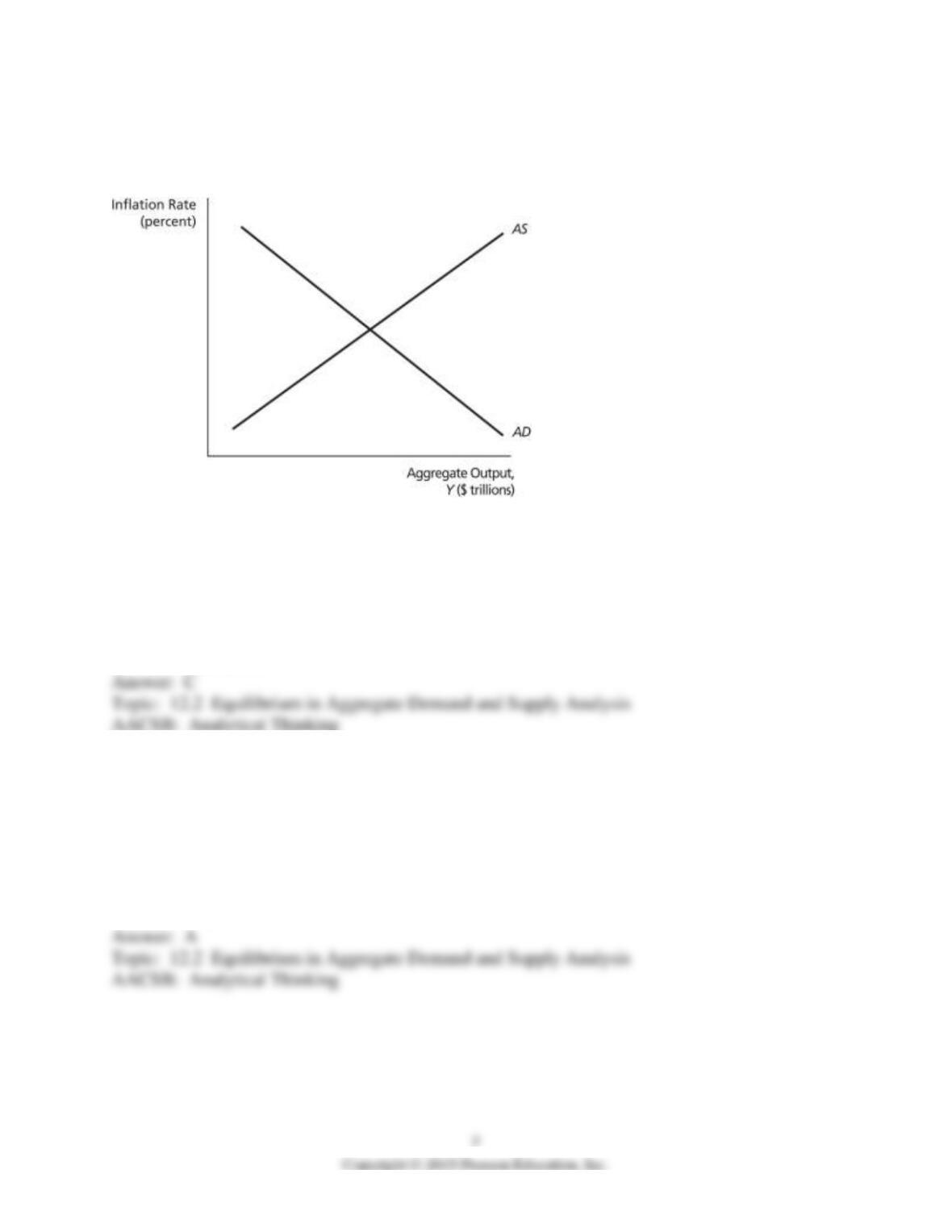
1) On the graph above, at the point where quantity demanded equals quantity supplied (let’s call
it point A), the economy has reached its ________.
A) general equilibrium, and barring any shocks, it will not move from A
B) long-run equilibrium, and barring any shocks, it will not move from A
C) short-run equilibrium, and even without any shocks, it may move away from A
D) short-run equilibrium, and barring any shocks, it will not move from A
E) none of the above
2) On the graph above, consider a point A on the aggregate demand curve and above the
aggregate supply curve. At this point, ________.
A) quantity demanded equals output, but the inflation rate will fall, so output will rise
B) quantity demanded is greater than quantity supplied, so the inflation rate will rise
C) output is greater than the quantity demanded, so output will fall
D) the aggregate demand curve will shift to the right until quantity demanded is equal to quantity
supplied
E) none of the above
3) On the graph above, consider a point A on the aggregate supply curve and above the aggregate
demand curve. At this point, ________.
A) quantity demanded equals output, but the inflation rate will fall, so output will rise
B) quantity demanded is greater than quantity supplied, so the inflation rate will rise
C) output is greater than the quantity demanded, so output will fall
D) the aggregate demand curve will shift to the right until quantity demanded is equal to quantity
supplied
E) none of the above
4) On the graph above, consider a point A at which output is greater than potential output. At this
point, ________.
A) the inflation rate will rise
B) output will rise
C) potential output will rise
D) the aggregate demand curve will shift to the left
E) none of the above
5) On the graph above, if output is falling, while the quantity demanded is rising, the economy
may be at a point on ________.
A) the aggregate supply curve above the aggregate demand curve
B) the aggregate supply curve below the aggregate demand curve
C) the aggregate demand curve above the aggregate supply curve
D) the aggregate demand curve below the aggregate supply curve
E) none of the above
6) On the graph above, if inflation is falling, while the quantity demanded and output are rising,
the economy may be at a point on ________.
A) the aggregate supply curve above the aggregate demand curve
B) the aggregate supply curve below the aggregate demand curve
C) the aggregate demand curve above the aggregate supply curve
D) the aggregate demand curve below the aggregate supply curve
E) none of the above
7) On the graph above, if inflation is rising, while the quantity demanded and output are rising,
the economy may be at a point on ________.
A) the aggregate supply curve above the aggregate demand curve
B) the aggregate supply curve below the aggregate demand curve
C) the aggregate demand curve above the aggregate supply curve
D) the aggregate demand curve below the aggregate supply curve
E) none of the above
8) In the AD-AS framework, long-run equilibrium implies that ________.
A) quantity demanded equals quantity supplied at a moderate level of equilibrium inflation
B) quantity demanded equals quantity supplied at a point consistent with the short-run
equilibrium level of inflation
C) quantity demanded equals quantity supplied at a point consistent with the natural rate of
unemployment
D) all of the above
E) none of the above
9) According to the “self-correcting mechanism” in the AD-AS framework, ________.
A) the aggregate demand curve shifts up or down as needed to bring the economy to full
employment
B) the inflation rate changes as needed to move the economy along the short-run aggregate
supply curve until output is at potential output
C) the long-run aggregate supply curve shifts until it intersects both the aggregate demand and
short-run aggregate supply curves at a single point
D) inflation and expected inflation are unaffected by deviations of output from potential output
E) none of the above
10) If the unemployment rate is below its natural rate, then ________.
A) output is above its potential level
B) there is excess tightness in the labor market
C) wages and prices will rise more rapidly and the AS curve will shift to the left
D) all of the above
E) none of the above
11) If the unemployment rate is below its natural rate, then ________.
A) output is below its potential level
B) there is excess tightness in the labor market
C) the AS curve will shift to the right
D) all of the above
E) none of the above
12) If the unemployment rate is above its natural rate, then ________.
A) output is below its potential level
B) there is excess tightness in the labor market
C) wages and prices will rise more rapidly and the AS curve will shift to the left
D) all of the above
E) none of the above
13) If the unemployment rate is above its natural rate, then ________.
A) output is below its potential level
B) there is excess slack in the labor market which will dive down wages
C) inflation will decline until equilibrium output reaches its potential level
D) all of the above
E) none of the above
14) Picture an economy that is in general equilibrium. What would happen if the natural rate of
unemployment were to experience an increase?
A) according to the Phillips curve, the ensuing negative unemployment gap would exert
inflationary pressures
B) according to Okun’s Law, the ensuing negative unemployment gap would be consistent with a
positive output gap
C) according to the AD-AS framework, the LRAS curve would shift to the left and the ensuing
positive output gap would be closed by subsequent leftward shifts in the AS curve to higher
equilibrium levels of inflation
D) all of the above
E) none of the above
11
15) Picture an economy that is in general equilibrium. What would happen if the natural rate of
unemployment were to experience a decrease?
A) according to the Phillips curve, the ensuing negative unemployment gap would exert
inflationary pressures
B) according to Okun’s Law, the ensuing negative unemployment gap would be consistent with a
positive output gap
C) according to the AD-AS framework, the LRAS curve would shift to the right and the ensuing
output gap would have to be closed by subsequent rightward shifts in the AS curve to a lower
equilibrium level of inflation
D) all of the above
E) none of the above
16) An economy is in long-run equilibrium when output equals potential output. Why is there no
long-run equilibrium rate of “potential inflation”?
17) The aggregate demand curve is Y = 75 – 3π, and the short–run aggregate supply curve is π =
6.2 + 0.8(Y – 70). Assuming adaptive expectations, calculate the inflation rate and output for the
next period.
12
12.3 Changes in Equilibrium: Aggregate Demand Shocks
1) By the time Paul Volcker took office as the new Federal Reserve chairman in 1979, the
inflation rate exceeded 10%. By the end of 1986 the inflation rate had been brought down to
1.9%. Which of the following is true about the Volcker Disinflation?
A) lower inflation resulted from a tightening of monetary policy
B) by raising the federal funds rate to over 20%, the Federal Reserve stimulated the economy
resulting in lower levels of both inflation and the unemployment rate by the early 1980s
C) the unemployment rate was brought down by 1982 but it took longer to reach lower inflation
rates
D) all of the above
E) none of the above
2) By the time Paul Volcker took office as the new Federal Reserve chairman in 1979, the
inflation rate exceeded 10%. By the end of 1986 the inflation rate had been brought down to
1.9%. Which of the following is true about the Volcker Disinflation?
A) lower inflation resulted from a tightening of monetary policy
B) by raising the federal funds rate to over 20%, the Federal Reserve slowed the economy and
was able to cut inflation in half by 1982 at the cost of a substantial hike in the unemployment
rate causing a recession
C) this policy induced a substantial negative output gap
D) all of the above
E) none of the above
13
3) By the time Paul Volcker took office as the new Federal Reserve chairman in 1979, the
inflation rate exceeded 10%. By 1982 the unemployment rate soared to 9.7% and inflation was
cut to 6.2%. By the end of 1986 the unemployment rate was brought down to 7% and the
inflation rate was brought further down to 1.9%. Which of the following is an appropriate
description of the mechanism behind the Volcker Disinflation?
A) The AD curve shifted right due to the autonomous tightening of monetary policy which
explains the lowering of the unemployment rate between 1982 and 1986.
B) With the Federal Reserve raising interest rates, the AD curve shifted to the left lowering the
equilibrium level of inflation but inducing a negative output gap, which explains the lower
inflation rate between 1979 and 1982 at the cost of a higher unemployment rate over the same
period.
C) The LRAS curve shifted left due to the tightening of monetary policy generating a positive
output gap or a negative unemployment gap which explains the lowering of the unemployment
rate between 1982 and 1986.
D) all of the above
E) none of the above
4) By the time Paul Volcker took office as the new Federal Reserve chairman in 1979, the
inflation rate exceeded 10%. By 1982 the unemployment rate soared to 9.7% and inflation was
cut to 6.2%. By the end of 1986 the unemployment rate was brought down to 7% and the
inflation rate was brought further down to 1.9%. Which of the following is an appropriate
description of the mechanism behind the Volcker Disinflation?
A) The AD curve likely shifted left due to the autonomous tightening of monetary policy which
explains the lowering of the inflation rate between 1979 and 1982.
B) Due to the autonomous tightening of monetary policy, a negative output gap ensued which
explains the increase in the unemployment rate between 1979 and 1982.
C) By 1982, it is likely that equilibrium output was lower than potential leading the AS curve to
shift to the right to close the output gap toward a general equilibrium which explains the
reduction in the unemployment rate and the further reduction in inflation between 1982 and
1986.
D) all of the above
E) none of the above
14
5) By the time Paul Volcker took office as the new Federal Reserve chairman in 1979, both the
inflation and unemployment rates were higher than during most of the 1950s, 60s and early 70s.
The Federal Reserve implemented an autonomous tightening of monetary policy that resulted in
the famous Volker Disinflation which was successful in bringing both problems under control.
Which of the following is an appropriate description had Mr. Volker conducted an expansionary
monetary policy instead?
A) The AD curve would have likely shifted right due to the Federal Reserve lowering of interest
rates which might have resulted in a temporary decline in the unemployment rate but at the cost
of skyrocketing inflation.
B) Due to the autonomous expansion of monetary policy, a temporary positive output gap might
have ensued thereby decreasing the unemployment rate while exerting huge inflationary
pressures in the economy.
C) Due to the autonomous expansion of monetary policy the unemployment rate might have
artificially declined. However, the AS curve would then have shifted left to close the ensuing
positive output gap thereby returning the unemployment rate to the levels prior to the Fed’s
action while, likely, making inflation even worse than before Mr. Volker took office.
D) all of the above
E) none of the above
6) By the time Paul Volcker took office as the new Federal Reserve chairman in 1979, both the
inflation and unemployment rates were higher than during most of the 1950s, 60s and early 70s.
The Federal Reserve implemented an autonomous tightening of monetary policy that resulted in
the famous Volker Disinflation which was successful in bringing both problems under control.
What would have been a likely result had Mr. Volker conducted an expansionary monetary
policy instead?
A) Inflation would have been made worse right away but unemployment would have been
permanently lowered.
B) In the long run the unemployment problem would not have been fixed and the inflation
problem would have been made much worse.
C) In the short-run both inflation and unemployment would have declined but in the long-run
unemployment would have been worse than before the Fed’s action.
D) In the short-run both inflation and unemployment would have been made worse but both
would have been lowered in the long-run.
E) none of the above
15
7) By the time Paul Volcker took office as the new Federal Reserve chairman in 1979, both the
inflation and unemployment rates were higher than during most of the 1950s, 60s and early 70s.
The Federal Reserve implemented an autonomous tightening of monetary policy that resulted in
the famous Volker Disinflation which was successful in bringing both problems under control.
What would have been a likely short-run result had Mr. Volker conducted an expansionary
monetary policy instead?
A) Inflation would have been made worse right away but unemployment would have been
lowered.
B) Both inflation and unemployment would have declined.
C) Both inflation and unemployment would have been made worse.
D) There would have been no effect on the unemployment and inflation rates.
E) none of the above
8) By the time Paul Volcker took office as the new Federal Reserve chairman in 1979, both the
inflation and unemployment rates were higher than during most of the 1950s, 60s and early 70s.
The Federal Reserve implemented an autonomous tightening of monetary policy that resulted in
the famous Volker Disinflation which was successful in bringing both problems under control.
What would have been a likely long-run result had Mr. Volker conducted an expansionary
monetary policy instead?
A) Eventually, inflation would have been made worse but unemployment would have been
lowered.
B) Eventually, both the inflation and unemployment rates would have declined.
C) Eventually, both inflation and unemployment would have been made worse.
D) There would have been no effect on the unemployment and inflation rates.
E) none of the above