33) A decrease in interest rates will
A) shift the investment function relating planned investment to the interest rate to the right.
B) shift the investment function relating planned investment to the interest rate to the left.
C) be a movement along the investment function relating planned investment to the interest rate.
D) have no impact on the investment function relating planned investment to the interest rate.
34) All of the following would cause the investment function relating investment to the interest
rate to shift EXCEPT
A) a change in the real interest rate.
B) a change in producer expectations of future profit.
C) a change in planned capital goods expenditure.
D) a change in productive technology.
35) If businesses expect the economic activity to expand
A) the planned investment function relating investment to the interest rate will shift to the left.
B) the planned investment function relating investment to the interest rate will remain
unchanged, but will move downward along the curve.
C) the planned investment function relating investment to the interest rate will steepen.
D) the planned investment function relating investment to the interest rate will shift to the right.
36) Real planned investment spending is positively related to all of the following EXCEPT
A) real disposable income.
B) wealth.
C) the interest rate.
D) producer expectations of future profit.
37) The relationship between planned real investment spending and the interest rate is
A) inverse.
B) direct.
C) constant.
D) positive.
38) If we observe that interest rates rise but real investment spending still increases, what must
have happened to the function relating investment to the interest rate?
A) It shifted to the right.
B) It shifted to the left.
C) There was a movement up the function relating investment to the interest rate.
D) There was a movement down the function relating investment to the interest rate.
12.3 Determining Equilibrium Real GDP
1) If firms’ unplanned inventories are increasing, then in a closed, private economy
A) the level of real national income will rise.
B) the level of real national income will not change in the foreseeable future.
C) actual consumption is greater than planned consumption.
D) consumers are saving more than businesses anticipated.
2) Ignoring the government and foreign sectors, equilibrium real Gross Domestic Product (GDP)
is determined by
A) the intersection of the planned saving and planned investment schedules.
B) the intersection of the planned saving and planned consumption schedules.
C) the intersection of the consumption function with the 45-degree line.
D) finding the real Gross Domestic Product (GDP) for which real savings are zero.
3) Ignoring the government and foreign sectors, if planned investment spending is $50 billion,
planned saving is $80 billion, and real Gross Domestic Product (GDP) is $130 billion, then
unplanned inventories will
A) decrease $30 billion.
B) increase $30 billion.
C) increase $80 billion.
D) not change.
4) Ignoring the government and foreign sectors, there is an unplanned decrease in inventories of
$100 billion at the current level of real national income of $20 trillion. From this information, we
know that
A) saving equals $100 billion.
B) consumption expenditures equal $20 trillion less saving less $100 billion.
C) planned investment is $100 billion more than planned saving.
D) planned investment is $100 billion less than planned saving.
5) A permanent increase in autonomous investment causes
A) a more than proportional increase in real Gross Domestic Product (GDP).
B) a proportional increase in real Gross Domestic Product (GDP).
C) a less than proportional increase in real Gross Domestic Product (GDP).
D) an offsetting change in saving that leaves real Gross Domestic Product (GDP) at the same
level.
6) Using real GDP on the horizontal axis instead of real disposable income implies that a
marginal propensity to consume 0.8 generates for every additional $100 of real GDP
A) $80 of additional real disposable income.
B) $18 of additional saving.
C) $80 of additional consumption spending.
D) $20 of additional saving and taxes.
7) The 45-degree reference line indicates all points at which
A) planned real consumption expenditures and planned real saving are equal.
B) planned real saving and planned real investment are equal.
C) planned real consumption expenditures and real GDP are equal.
D) planned real saving and planned real saving are equal.
8) Investment is
A) a positive function of real GDP.
B) a negative function of real GDP.
C) autonomous with respect to real GDP.
D) a positive function of interest rates.
9) The investment function intersects the saving schedule at an interest rate of 8 percent and a
level of investment of $1.5 trillion a year. If the consumption curve intersects the 45-degree
reference line at $3 trillion, then
A) the C + I curve will intersect the 45-degree reference line at $1.5 trillion.
B) the C + I curve will intersect the 45-degree line at $1.8 trillion.
C) the equilibrium level of real GDP is $3 trillion.
D) the equilibrium level of real GDP is $4.5 trillion.
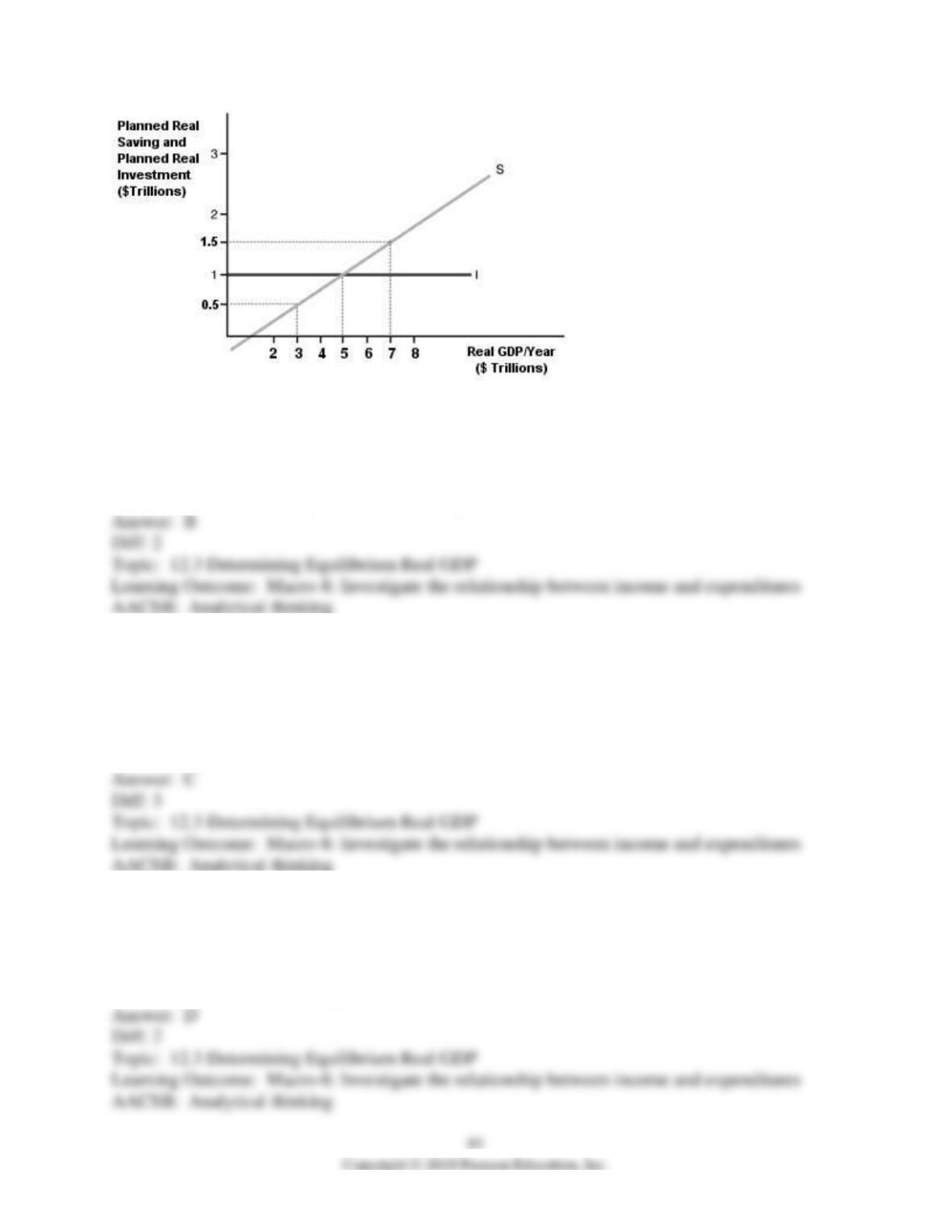
10) Refer to the above figure. Which variable is autonomous with respect to real GDP?
A) real saving
B) real investment spending
C) real consumption spending
D) the sum of real consumption and real saving
11) Refer to the above figure. If real GDP is $4 trillion, then
A) consumption expenditures are too low.
B) unplanned inventories will decrease.
C) unplanned inventories will increase.
D) actual investment spending equals $1 trillion as planned investment spending plus unplanned
inventory increases equal $1 trillion.
12) Refer to the above figure. At real GDP of $3 trillion, actual investment equals
A) planned investment of $0.5 trillion.
B) planned saving of $1 trillion.
C) actual saving of $1 trillion.
D) unanticipated inventory adjustments of $0.5 trillion.
13) For a closed economy with no government, we know that at every level of GDP actual
investment equals
A) planned investment.
B) planned saving.
C) the difference between planned saving and actual saving.
D) the difference between planned investment and actual saving.
14) Supposed actual investment is greater than planned investment at the current level of output
in a given year. Given this information, we know that
A) GDP will tend to increase over time.
B) firms’ stock of inventories must have increased unexpectedly in that year.
C) saving must be less than planned investment in that year.
D) saving must be equal to planned investment in that year.
15) In the Keynesian model, whenever planned investment is greater than planned saving
A) the amount of planned investment will decrease, and real GDP will decrease.
B) the amount of planned investment will decrease, and real GDP will remain unchanged.
C) there will be an unplanned inventory decrease, and GDP will eventually increase.
D) there will be an unplanned inventory increase, and GDP will eventually decrease.
16) In the Keynesian model, whenever planned investment is less than planned saving
A) the amount of planned investment will decrease, and real GDP will decrease.
B) the amount of planned investment will decrease, and real GDP will remain unchanged.
C) there will be an unplanned inventory decrease, and real GDP will eventually increase.
D) there will be an unplanned inventory increase, and real GDP will eventually decrease.
87
17) In the Keynesian model, whenever planned saving exceeds planned investment
A) there will be unplanned inventory accumulation.
B) there will be unplanned inventory depletion.
C) real GDP will not be influenced.
D) the interest rate will remain unchanged.
18) In the Keynesian model, whenever planned saving is more than planned investment
A) there will be unplanned inventory accumulation.
B) there will be unplanned inventory depletion.
C) real GDP will not be influenced.
D) the interest rate will remain unchanged.
19) Along the 45-degree reference line
A) total planned real expenditures = real GDP.
B) total planned real expenditures = planned nominal expenditures.
C) total planned nominal expenditures = consumption.
D) total planned investment spending = planned real expenditures.
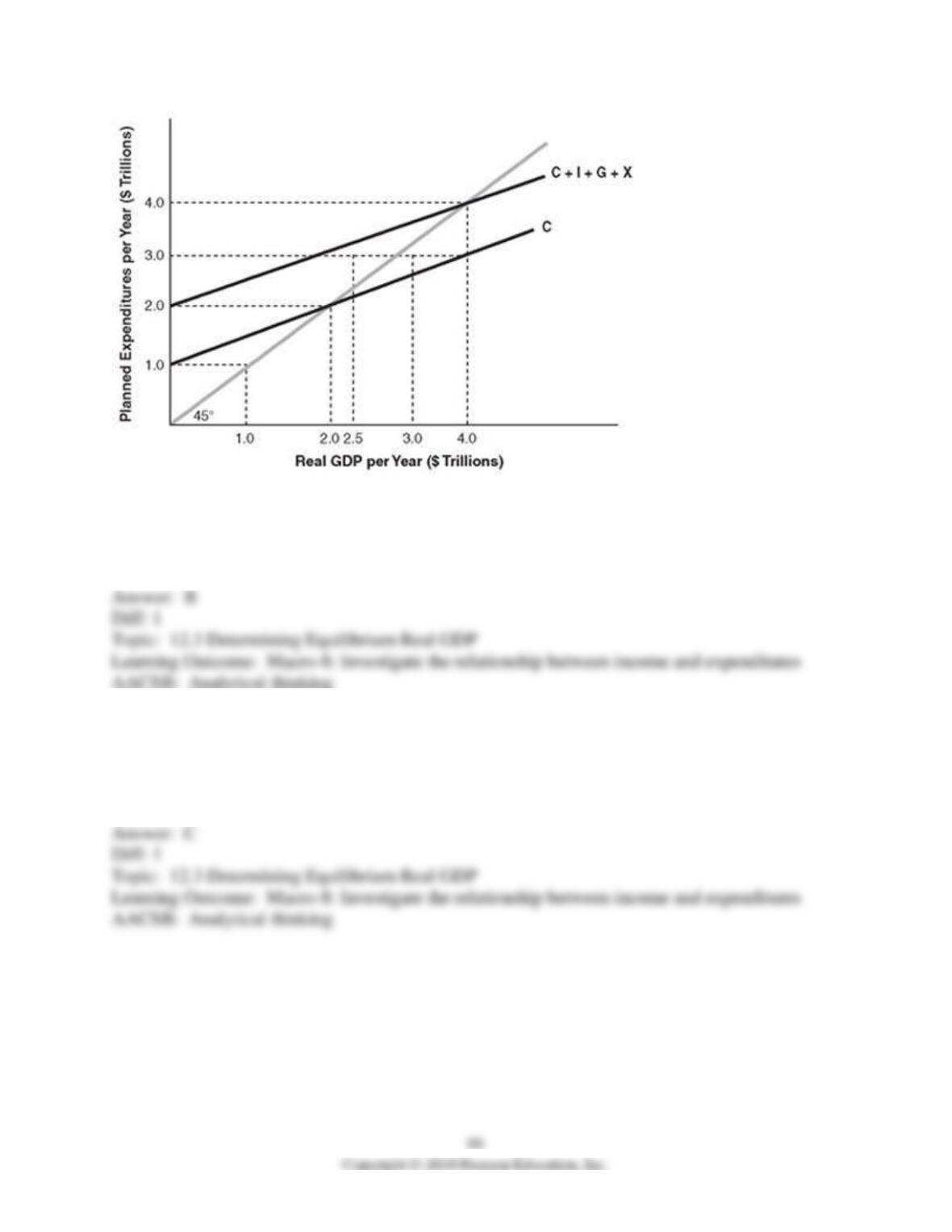
20) In the above figure, what is autonomous consumption?
A) $0.0 trillion
B) $1.0 trillion
C) $2.0 trillion
D) $3.0 trillion
21) In the above figure, what is the equilibrium level of real consumption spending?
A) $0.0 trillion
B) $1.0 trillion
C) $2.0 trillion
D) $3.0 trillion
22) When graphing the consumption function, we include a 45-degree reference line. What is
TRUE at the points at which the consumption function crosses this line?
A) Planned real saving is zero.
B) Planned real consumption spending is zero.
C) Real disposable income is zero.
D) Real GDP is zero.
23) Suppose that there is no government and no international trade. When C + I is less than the
level of real GDP
A) unplanned inventories decrease, and real GDP expands.
B) unplanned inventories increase, and real GDP contracts.
C) unplanned inventories equal zero, and there is no change in the level of real GDP.
D) real planned investment spending equals real planned saving.
24) Autonomous real investment spending is
A) the level of investment expenditure required to keep the economy expanding at its current
growth rate.
B) the level of investment expenditure that is independent of real GDP.
C) the level of investment expenditure required to replace capital lost to depreciation.
D) the level of investment expenditure that would prevail if interest rates were zero.
25) When real GDP is in equilibrium with no government and no international trade
A) real planned investment spending equals real planned saving.
B) real planned investment equals real planned consumption spending.
C) unplanned inventories are increasing.
D) unplanned inventories are decreasing.
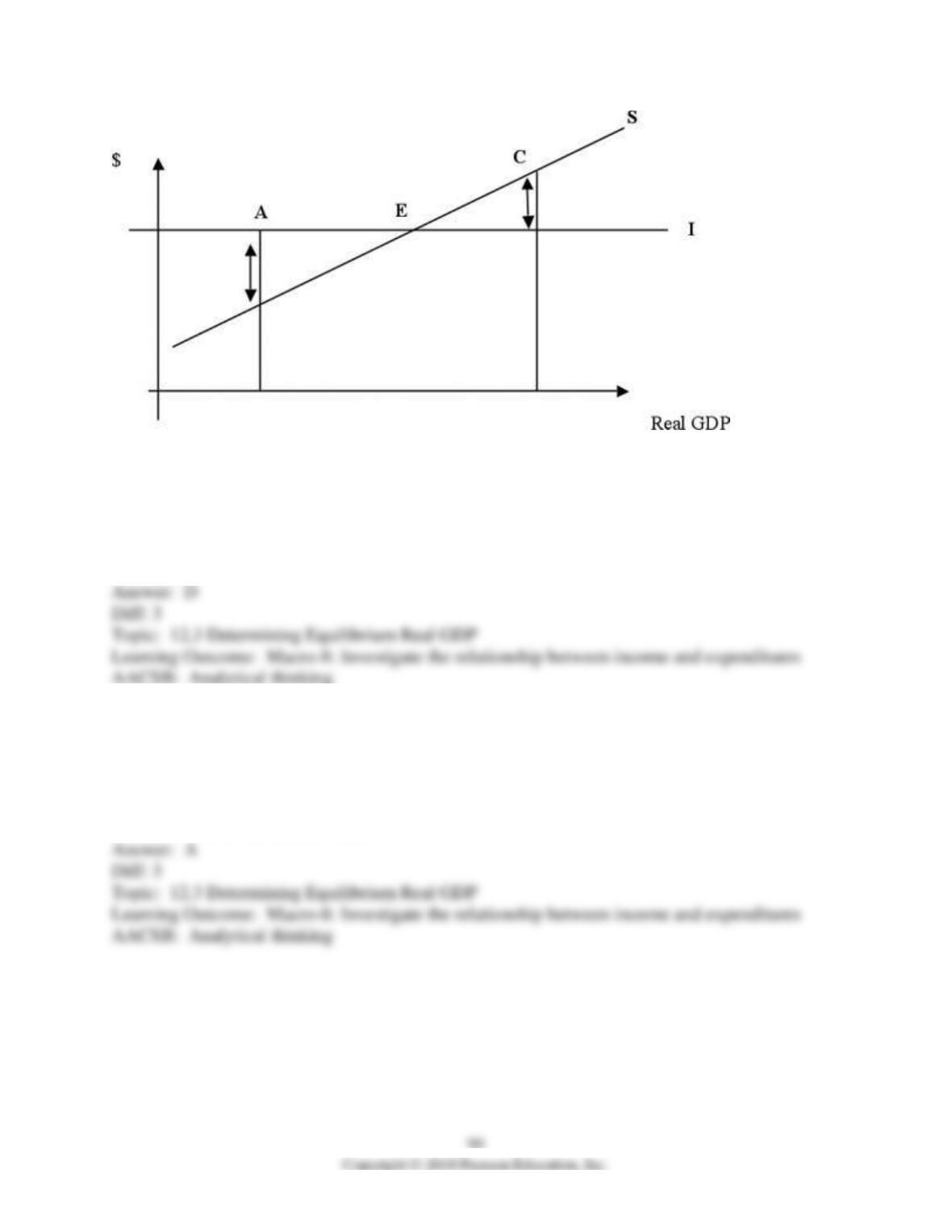
26) In the above figure, point E represents the level of real GDP at which planned saving equals
planned investment. At point A
A) unplanned inventories increase.
B) changes in inventories cannot be determined.
C) unused industrial capacity exists in the economy.
D) unplanned inventories decrease.
27) In the above figure, point E represents the level of real GDP at which planned saving equals
planned investment. At point C
A) unplanned inventories increase.
B) changes in inventories cannot be determined.
C) unused industrial capacity exists in the economy.
D) unplanned inventories decrease.
28) When real planned saving is greater than real planned investment spending
A) the interest rate will increase.
B) the interest rate will decrease.
C) real GDP will increase.
D) real GDP will decrease.
29) What is the result when real planned saving is lower than real planned investment spending?
A) The economy is in equilibrium.
B) There is unplanned accumulation of business inventories.
C) There is unplanned depletion of business inventories.
D) Employment decreases.
30) Consider a closed economy without a government and without international trade. What will
be TRUE when this economy is in equilibrium?
A) Total planned real investment spending will exceed total planned real expenditures.
B) Planned real investment spending will exceed real planned saving.
C) Planned real consumption spending equals real GDP.
D) Planned real consumption spending plus planned real investment spending equals real GDP.
31) Real consumption is a function of real disposable income, but the simple Keynesian model
uses real GDP instead of real disposable income. This is appropriate since
A) real disposable income tends to move proportionately with real GDP.
B) real disposable income is a fixed percentage of real GDP.
C) real GDP is a fixed percentage of real disposable income.
D) we cannot measure either exactly and the purpose of the exercise is theoretical only.
92
32) When the investment is graphed as a function of real GDP
A) it graphs as a vertical straight line.
B) it graphs as a 45-degree line starting at the indicated level of investment.
C) it graphs as a negatively sloped line indicating the inverse relationship between interest rates
and investment.
D) it graphs as a horizontal straight line at the level of investment.
33) In the simple Keynesian model, why does actual investment spending have to equal saving in
the absence of the government and foreign sectors? Is this TRUE only for the equilibrium?
Explain.
93
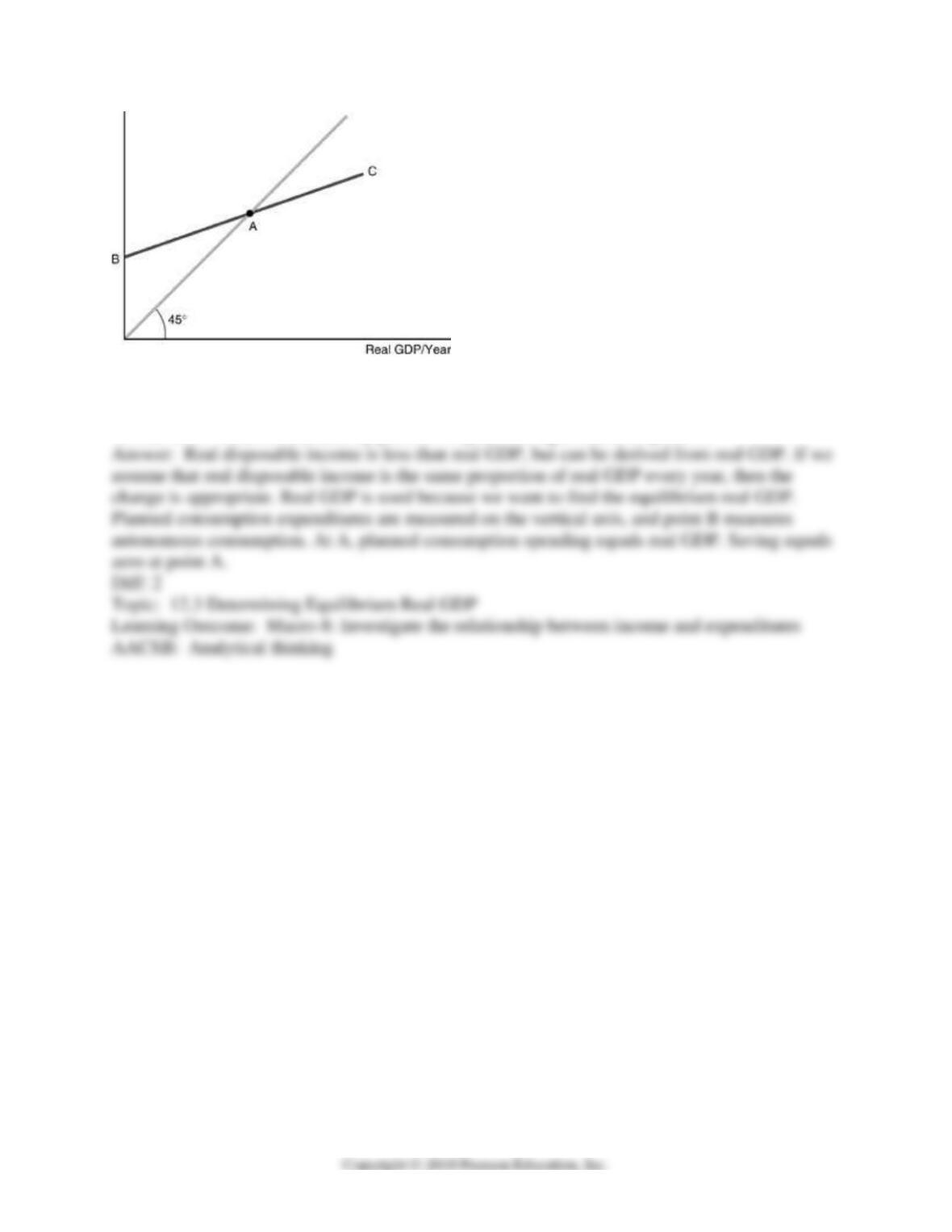
34) The above figure shows a consumption function and a 45-degree line. Real consumption is a
function of disposable income. Why is real GDP used here instead? What is measured along the
vertical axis? What is measured by point B? Explain the significance of point A.
94
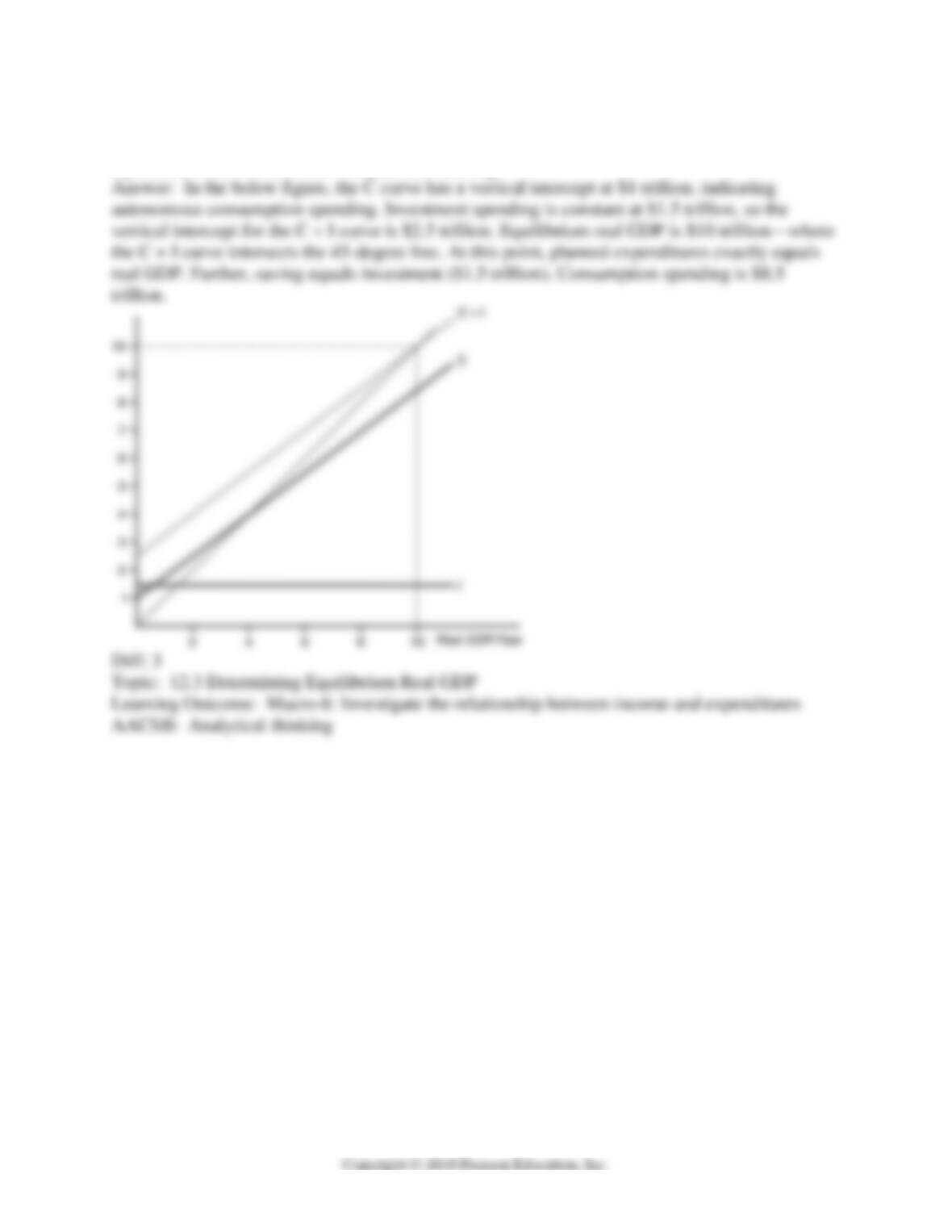
35) Suppose autonomous consumption is $1 trillion, investment spending is $1.5 trillion, and the
marginal propensity to consume is 0.75. Show the graph for the C + I curve. What is the
equilibrium level of real GDP? Explain its meaning.
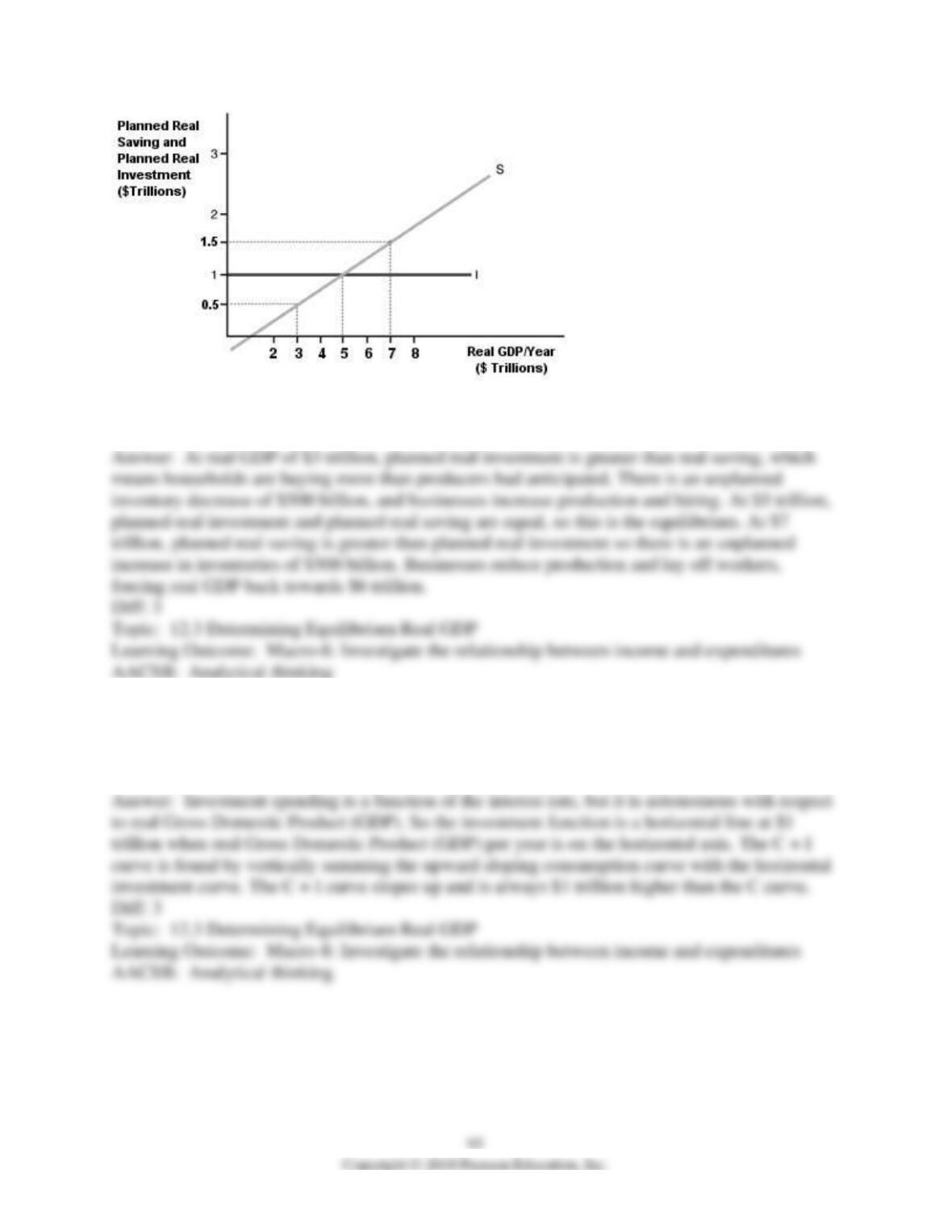
36) In the above diagram, what happens if the real GDP is $3 trillion? $5 trillion? $7 trillion?
What is the equilibrium level of real GDP? Why?
37) The investment schedule is downward sloping and the saving schedule is upward sloping
with respect to the interest rate. Suppose the equilibrium real investment per year at the market
rate of interest is $1 trillion. How is this represented when real national income per year is on the
horizontal axis? How is this incorporated into the consumption-function graph?
96
38) What determines investment in the Keynesian framework? How is investment related to real
Gross Domestic Product (GDP)?
12.4 Keynesian Equilibrium with Government and the Foreign Sector Added
1) Government purchases
A) are determined by the public.
B) are determined by the political process.
C) are determined by taxpayers.
D) are determined by suppliers.
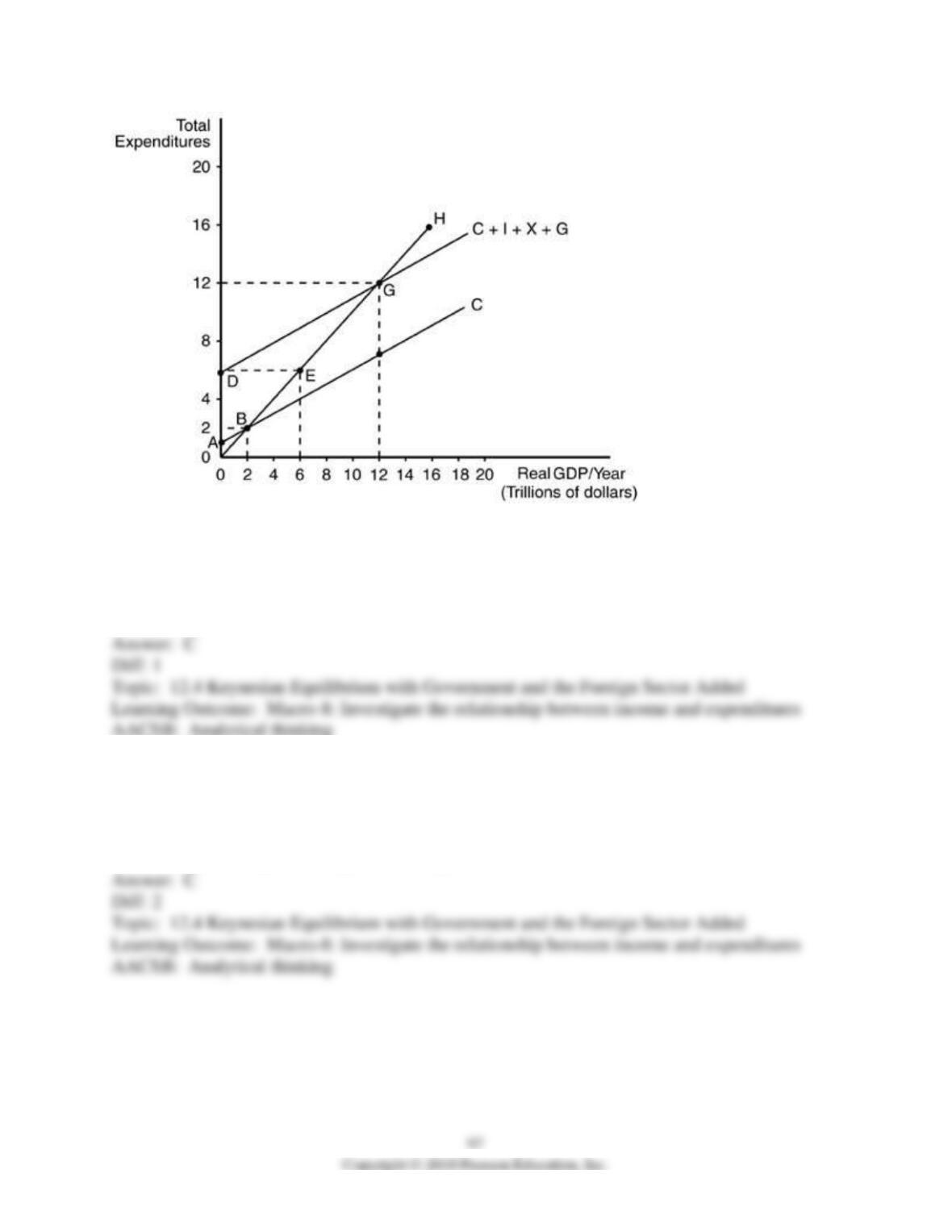
2) Refer to the above figure. The equilibrium level of real Gross Domestic Product (GDP) is
A) $6 trillion.
B) $7 trillion.
C) $12 trillion.
D) $20 trillion.
3) Refer to the above figure. If real Gross Domestic Product (GDP) is $2 trillion, then
A) the level of total planned expenditures is less than real GDP.
B) the level of total planned expenditures equals real GDP.
C) the level of total planned expenditures is greater than real GDP.
D) the level of total planned expenditures equals zero.
4) Refer to the above figure. If real Gross Domestic Product (GDP) is $6 trillion, then unplanned
business inventories will
A) rise.
B) be zero.
C) fall.
D) be equal to planned inventories.
5) When real Gross Domestic Product (GDP) is below total planned real expenditures
A) there will be unplanned increases in inventories.
B) the circular flow will increase.
C) a lower level of equilibrium real Gross Domestic Product (GDP) will occur.
D) a higher level of equilibrium real Gross Domestic Product (GDP) will occur.
6) A higher level of real Gross Domestic Product (GDP) will result if
A) total planned real expenditures exceed real Gross Domestic Product (GDP).
B) aggregate supply exceeds aggregate demand.
C) aggregate demand exceeds aggregate supply.
D) leakage exceeds injections.
7) If, at some level of output, total planned real expenditures are greater than real Gross
Domestic Product (GDP)
A) real GDP will fall.
B) real GDP remains unchanged.
C) real GDP will either fall or remain unchanged, depending on the MPC.
D) unplanned inventories will decrease.
8) Suppose the economy is at an equilibrium when C + I + G + X = $12 trillion. If the economy
is currently at a real national income level of $14 trillion, then total planned real expenditures
A) exceed real Gross Domestic Product (GDP), and real Gross Domestic Product (GDP) will
increase.
B) are less than real Gross Domestic Product (GDP), and real Gross Domestic Product (GDP)
will decline.
C) are equal to real Gross Domestic Product (GDP), and there will be no change in real Gross
Domestic Product (GDP).
D) are less than real Gross Domestic Product (GDP), and real Gross Domestic Product (GDP)
will increase.
9) Suppose equilibrium for an economy occurs when C + I + G + X = $14 trillion. If the real
Gross Domestic Product (GDP) is $13 trillion, then unplanned inventories are
A) increasing, and real Gross Domestic Product (GDP) will expand.
B) increasing, and real Gross Domestic Product (GDP) will contract.
C) decreasing, and real Gross Domestic Product (GDP) will expand.
10) If real Gross Domestic Product (GDP) is above its equilibrium level
A) firms are not maximizing their profits.
B) planned investment is greater than planned saving.
C) firms accumulate unplanned inventories.
D) planned consumption is less than actual consumption.
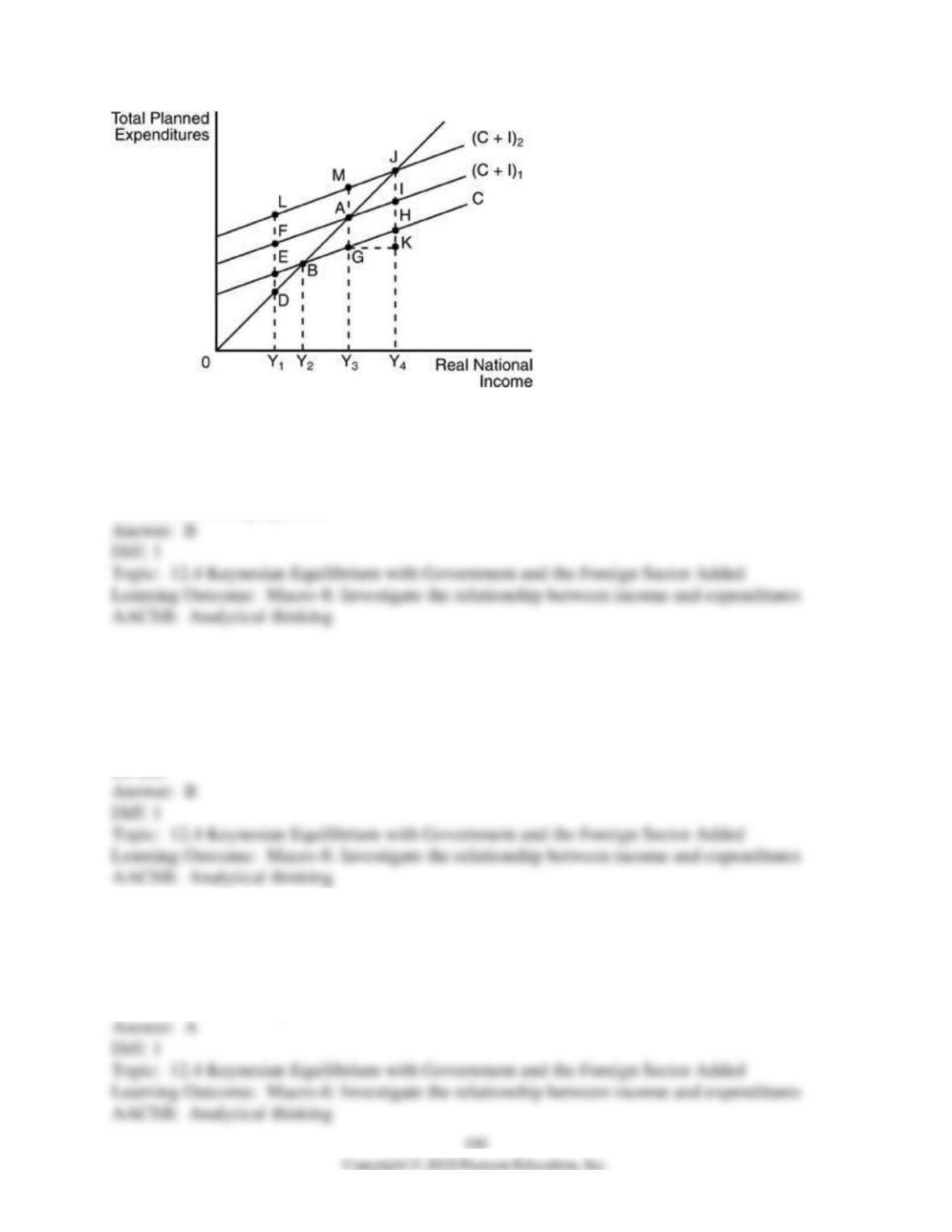
11) In the above figure, at an income level of Y3 and planned expenditures of (C + I)1
A) planned saving exceeds planned investment.
B) the economy is in equilibrium.
C) the quantity of aggregate demand exceeds real Gross Domestic Product (GDP).
D) there is full employment.
12) In the above figure, at an income level of Y1 and planned expenditures of (C + I)1, the level
of autonomous investment is
A) ED.
B) EF.
C) JK.
D) GK.
13) Total planned expenditures in a closed economy are equal to
A) consumption + investment + government expenditures.
B) consumption + savings + transfers + investment.
C) saving + investment + government expenditures.
D) investment + saving + transfers.