Economics Today, 19e (Miller)
Chapter 12 Consumption, Real GDP, and the Multiplier
12.1 Determinants of Planned Consumption and Planned Saving
1) Which of the following is NOT a simplifying assumption in the simple Keynesian model?
A) Net investment and gross investment are equal.
B) All profits are distributed to the business owners.
C) Real disposable income equals government purchases of goods and services.
D) There is no foreign trade.
2) Which of the following represents the relationship between disposable income (DI),
consumption (C), and saving (S)?
A) DI + C = S
B) DI = C + S
C) DI = C * S
D) DI = C – S
3) Which of the following is a simplifying assumption associated with the short-run Keynesian
model of equilibrium real Gross Domestic Product (GDP) determination?
A) Gross private domestic investment exceeds net private domestic investment.
B) Most business profits are distributed to shareholders.
C) Businesses pay indirect taxes.
D) There is no depreciation.
4) Which of the following would NOT be considered a consumption good?
A) a new sweater
B) a tool used to make coffee in a restaurant
C) a jar of peanut butter
D) a can of soda
5) The terms “saving” and “savings” differ in that
A) saving is a stock, and savings are a flow.
B) saving always exceeds savings.
C) savings are a stock, and saving is a flow.
D) savings can be negative, but saving cannot.
6) When you purchase a new Samsung smartphone
A) you are buying consumption goods.
B) you are buying capital goods.
C) you are consuming intermediate goods.
D) you are buying physical capital.
7) The difference between “saving” and “savings” is that
A) saving is done by households and savings are done by businesses.
B) saving is undertaken as a precaution against unemployment and savings are undertaken to
increase investment spending.
C) savings are cumulation of past and current saving.
D) saving is placed in financial institutions such as banks, while savings are kept at home by
people.
8) Which of the following is a stock variable?
A) consumption
B) investment
C) savings
D) saving
9) Saving is a ________ concept and savings are a ________ concept.
A) stock; stock
B) flow; flow
C) flow; stock
D) stock; flow
10) At a level of real disposable income of $5,000, suppose consumption is $6,000. Given this
information, we know with certainty that saving equals
A) $0.
B) $11,000.
C) $1,000.
D) -$1,000.
11) Which of the following statements is FALSE?
A) disposable income – saving = consumption
B) consumption + saving = disposable income
C) saving = disposable income – consumption
D) consumption = saving – disposable income
12) Thinking as an economist would, which is TRUE of investment?
A) It is the portion of disposable income that is not used for consumption or saving.
B) Investment represents spending on capital goods.
C) Investment is putting money into stocks and bonds.
D) Investment is a stock concept.
13) The income-expenditure model of real GDP determination is due to the work of
A) Adam Smith.
B) Janet Yellen
C) John Maynard Keynes.
D) Roger Miller.
14) Which of the following is considered investment?
A) Maina purchases a new van for commuting to and from work.
B) Jane purchases a new truck for commuting to and from school.
C) Johnny buys a new car for his wife as an anniversary gift.
D) James purchases a new car to replace an old car in his food delivery business.
15) Saving differs from savings in that
A) saving is a flow while savings is a stock.
B) saving is a stock while savings is a flow.
C) saving is both a flow and a stock while savings is a stock.
D) saving is a stock while savings is both a flow and a stock.
16) Consumption expenditures include all of the following EXCEPT
A) buying a pizza.
B) watching a movie.
C) having your house cleaned by a cleaning maid.
D) purchasing a government bond.
17) Consumption goods
A) include goods such as CDs that a music store holds in inventory.
B) are only the goods bought by households for immediate satisfaction.
C) include spending on machines and buildings so that goods can be produced in the future.
D) are goods that are used to make other goods.
18) Keynes thought that the key to determining the broader economic effects of investment
fluctuations
A) was to examine how businesses react to flexible prices and wages.
B) was to closely regulate the real interest rate.
C) was to understand the relationship between how much people earn and their willingness to
engage in personal consumption spending.
D) was to understand how changes in the money supply influences consumption decisions.
19) Saving is
A) the amount one does not consume in a given period of time while savings is the accumulation
of past periods of saving.
B) the accumulation of past periods of savings while savings is the amount of disposable income
that is not consumed in a given period of time.
C) the difference between real GDP and disposable income while savings is the difference
between disposable income and consumption spending.
D) the difference between disposable income and spending on goods and services while savings
is the difference between real GDP and disposable income.
20) Spending on new goods and services out of a household’s current income is
A) consumption.
B) saving.
C) savings.
D) investment.
21) Consumption goods are
A) a form of investment.
B) goods purchased from savings.
C) a form of capital goods.
D) goods purchased by households for immediate use.
22) The difference between a stock and a flow is
A) a stock is something measured at one point in time while a flow is something that is expressed
per unit of time.
B) a stock is something measured at one point in time while a flow is something that is fixed.
C) a stock is expressed per unit of time while a flow is measured at one point in time.
D) a stock refers to the solid inventory firms have on hand while a flow refers to the liquid
inventory firms have on hand.
23) The difference between savings and saving
A) is called money illusion.
B) is that savings occurs when consumption does not and saving is used to purchase
consumption goods.
C) is that savings is a stock concept and saving is a flow concept.
D) is that savings is measured in real terms while saving is measured in nominal terms.
24) Which of the following is a flow variable?
A) savings
B) wealth
C) consumption
D) debt
25) All of the following are flow variables EXCEPT
A) consumption.
B) saving.
C) investment.
D) capital goods.
26) Which of the following statements is TRUE?
A) consumption + saving = disposable income
B) consumption + saving = personal income
C) consumption – investment = disposable income
D) consumption – saving = personal income
27) Which of the following statements is TRUE?
A) investment = disposable income + consumption
B) saving = personal income – consumption
C) saving = disposable income – consumption
D) saving = personal income + consumption
28) Investment is
A) the purchasing of stocks and mutual funds.
B) spending by consumers on items that account for large shares of their budgets.
C) spending by businesses on things which can be used to produce goods and services in the
future.
D) the production of goods for immediate satisfaction.
29) Spending by businesses on things such as machines and buildings which can be used to
produce goods and services in the future is
A) investment.
B) consumption.
C) consumption goods.
D) savings.
30) Expenditures by firms on new machines and buildings that are expected to yield a future
stream of income is known as
A) consumer durable.
B) consumption goods.
C) fixed investment.
D) inventory investment.
31) Changes in business inventories are known as
A) consumer durable.
B) consumption goods.
C) fixed investment.
D) inventory investment.
32) Fixed investment is
A) when a firm adds to its inventories of goods.
B) when a firm accumulates profits.
C) dissavings.
D) an expenditure by firms on new machines that are expected to produce income in the future.
33) Investment is
A) a flow concept and is made up of fixed investment and inventory investment.
B) a flow concept and is made up of fixed investment.
C) a stock concept and is made up of fixed investment and inventory investment.
D) a stock concept and is made up of fixed investment.
34) Nonconsumable goods that firms use to make other goods are
A) consumption goods.
B) capital.
C) dissaving.
D) savings
35) How is investment defined as an economic concept?
A) Investment is primarily the market value of all shares of stock held by the public.
B) Investment is primarily the market value of all equipment, buildings, and inventories held by
corporations, partnerships, and proprietorships.
C) Investment is primarily the sum of expenditures by businesses on new capital goods that will
yield a future stream of income.
D) Investment is primarily the portion of your savings held in an interest-earning account.
36) Savings are an example of
A) a flow concept.
B) a stock concept.
C) a bounded rationality concept.
D) an investment concept.
37) Saving is an example of
A) a flow concept.
B) a stock concept.
C) a planned investment concept.
D) a physical capital concept.
38) By definition, disposable income is equal to
A) consumption plus saving.
B) consumption plus investment.
C) investment plus saving.
D) consumption minus saving.
39) Investment includes spending on
A) capital goods, buildings, and consumer durable goods.
B) capital goods, buildings, and changes in business inventories.
C) capital goods, consumer durable goods, and changes in business inventories.
D) capital goods, buildings, and changes in business savings.
40) Which formula is correct?
A) Yd = S + C
B) Yd + S = C
C) Yd × S = C
D) Yd + C = S
41) Your real disposable income is your real income after you have paid
A) rent and food expenses.
B) taxes less subsidies.
C) depreciation expenses.
D) consumption expenses.
42) Keynesian theory is based on the hypothesis that
A) saving is influenced primarily by real current disposable income.
B) saving is influenced primarily by the interest rate.
C) planned savings equal planned investment only at full employment.
D) saving is always equal to savings.
43) Suppose that when disposable income increases by $1,000, consumption spending increases
by $750. Given this information, we know that the marginal propensity to consume (MPC) is
A) 0.25.
B) 0.75.
C) 1.33.
D) 4.
44) Suppose that when disposable income increases by $1,000, consumption spending increases
by $750. Given this information, we know that the marginal propensity to save (MPS) is
A) 0.25.
B) 0.75.
C) 1.33.
D) 4.
45) Suppose that when disposable income increases by $2,000, consumption spending increases
by $1,500. Given this information, we know that the marginal propensity to consume (MPC) is
A) 0.25.
B) 0.75.
C) 1.33.
D) 4.
46) Suppose that when disposable income increases by $2,000, consumption spending increases
by $1,800. Given this information, we know that the marginal propensity to consume (MPS) is
A) 0.1.
B) 0.2.
C) 0.8.
D) 0.9.
47) Which of the following is TRUE?
A) MPC = 1+ MPS
B) MPC = 1 – MPS
C) MPC * MPS = 1
D) MPC / MPS = 1
48) According to Keynesian theory, the most important determinant of saving and consumption
is
A) the level of real disposable income.
B) the stock of liquid assets.
C) the returns on stocks and bonds
D) the level of consumer indebtedness.
49) The Keynesian model is based on the idea that
A) saving depends only on the interest rate.
B) both consumption and saving are positively related to real disposable income.
C) consumption is unrelated to the level of real Gross Domestic Product (GDP).
D) both consumption and saving are unrelated to the level of real Gross Domestic Product
(GDP).
50) The consumption function shows
A) a positive relationship between an individual’s stock of wealth and his level of planned
consumption.
B) a positive relationship between disposable income and planned consumption.
C) a negative relationship between planned consumption and aggregate saving.
D) a negative relationship between disposable income and planned consumption.
51) The relationship between planned consumption expenditures and the level of real disposable
income is called
A) the consumption function.
B) the savings function.
C) the investment function.
D) the aggregate demand function.
52) According to Keynes, planned consumption
A) decreases as disposable income increases.
B) is unstable and fluctuates widely with changes in disposable income.
C) is positively related to real disposable income.
D) is positively related to the interest rate.
53) The consumption function shows the relationship
A) between households’ disposable income and their consumption spending.
B) between the relative prices of goods and the total amount of household consumption
spending.
C) between consumption spending and capital gains.
D) between government spending and tax collection.
54) When Monica spends more than her disposable income, Monica is
A) saving.
B) investing.
C) dissaving.
D) unemployed.
55) Along a linear consumption function
A) the average propensity to consume rises with a decrease in income.
B) the marginal propensity to consume rises with an increase in income.
C) the average propensity to consume rises with income, but the marginal propensity to consume
falls with an increase in income.
D) both the average propensity to consume and the marginal propensity to consume rise with an
increase in income.
56) Dissaving occurs when
A) disposable income exceeds consumption.
B) consumption exceeds disposable income.
C) the marginal propensity to save is greater than 1.
D) the marginal propensity to consume is less than 0.5.
57) Saving equals
A) disposable income minus taxes.
B) disposable income minus consumption spending.
C) disposable income minus savings.
D) consumption spending minus savings.
58) According to Keynes, the primary determinant of a person’s saving is NOT
A) the person’s level of income but the desired real income of the person.
B) the person’s level of savings but the expected interest rate in the near future.
C) the interest rate but the level of savings the person has.
D) the interest rate but the level of the person’s real disposable income.
59) According to Keynes, an individual’s level of saving is primarily determined by
A) the interest rate.
B) the individual’s current level of real disposable income.
C) the individual’s expectation about the stock market.
D) real Gross Domestic Product (GDP) for the economy.
60) Which of the following theories predicts that current consumption increases when a person
expects an increase in future income?
A) the life-cycle theory of consumption
B) the permanent income hypothesis
C) the Keynesian theory of consumption
D) all of the above
61) According to the permanent income hypothesis, a temporary and relatively small increase in
income would
A) cause a large increase in consumption.
B) cause no change in consumption.
C) cause an increase in consumption and saving by the same amount.
D) cause a decrease in consumption and saving by the same amount.
62) According to the permanent income hypothesis, Lisa’s consumption increases only when
A) her average lifetime income increases.
B) she saves more.
C) her income increases unexpectedly.
D) her current income increases.
63) The life-cycle theory of consumption predicts that when Jason anticipates a higher income in
the future, then Jason will
A) consume more and save less in the current period.
B) consume less and save more in the current period.
C) consume less and save less in the current period.
D) not change the amount of consumption or saving in the current period.
64) The consumption function shows how much
A) households plan to consume per year at each level of real disposable income.
B) households plan to consume per year at each possible interest rate.
C) real disposable income people will earn at each income tax bracket.
D) households plan to consume per year at each level of savings.
65) According to Keynes
A) consumption is positively related to the interest rate.
B) consumption is directly related to income but saving is inversely related to income.
C) both consumption and saving are positively related to real disposable income.
D) consumption is directly related to income but saving has no relationship with income.
66) According to the consumption function, if the level of real disposable income increases, then
A) both the levels of consumption and savings will increase.
B) the level of consumption will increase but the level of saving will decrease.
C) the level of consumption will decrease but the level of saving will increase.
D) both the levels of consumption and savings will decrease.
67) If consumption spending is greater than disposable income, then there is
A) dissaving.
B) excess thrift.
C) positive savings.
D) negative net investment.
68) Suppose real disposable income increases by $500. Given this information, we know that
A) consumption will generally increase by exactly $500.
B) consumption will generally increase by less than $500.
C) consumption will generally increase by more than $500.
D) saving will generally increase by exactly $500.
69) Suppose when real disposable income is $5000, planned real consumption is $4000. When
real disposable income increases to $6000, planned real saving increases by $500. The new
planned real consumption expenditures is
A) $5,000.
B) $4,500.
C) $6,000.
D) $3,500.
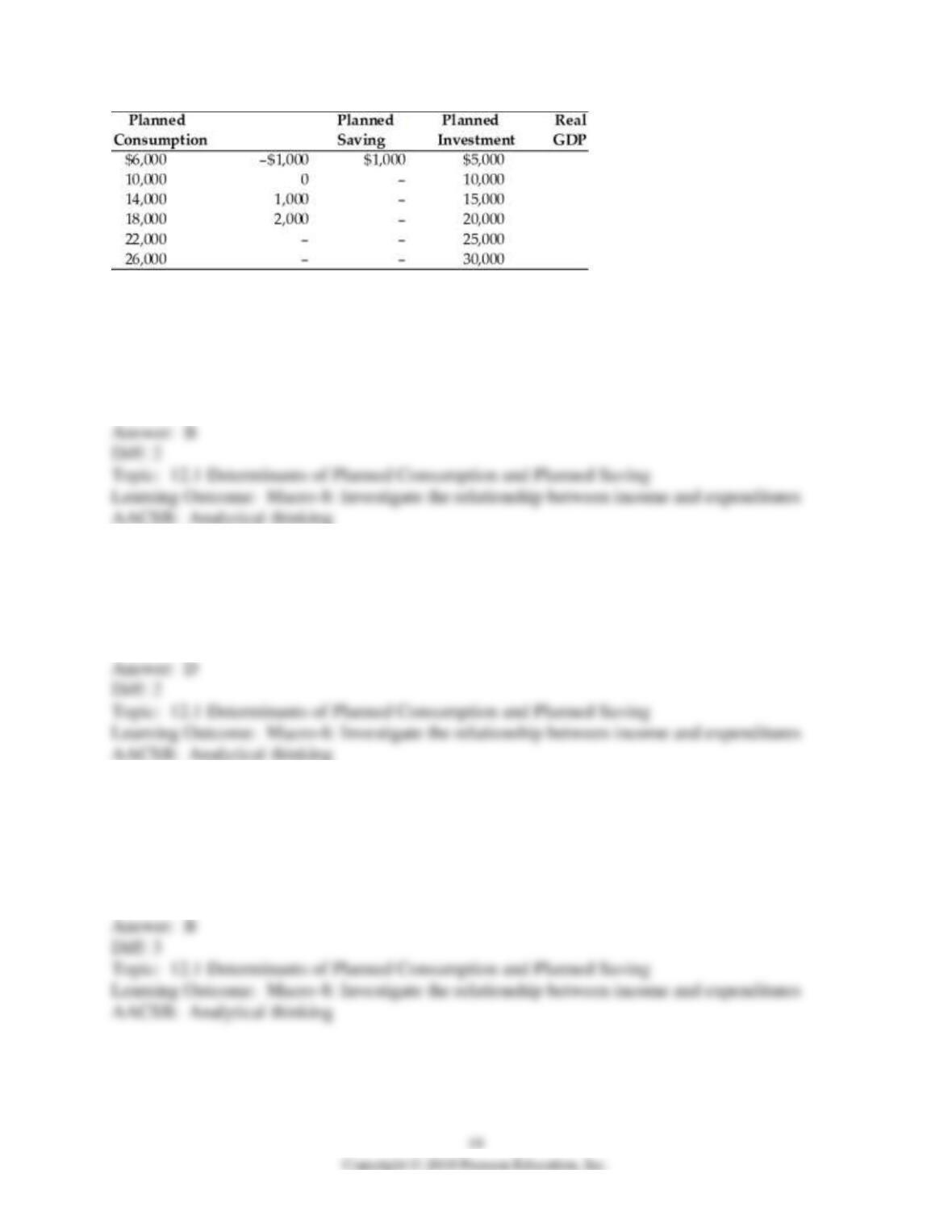
70) According to the above table, if real Gross Domestic Product (GDP) is $25,000, planned
saving equals
A) $2,000.
B) $3,000.
C) $4,000.
D) $5,000.
71) According to the above table, the marginal propensity to consume is
A) 0.6.
B) 0.5.
C) 0.75.
D) 0.8.
72) According to the above table, if real Gross Domestic Product (GDP) equals $30,000, what is
the average propensity to consume?
A) 0.67
B) 0.75
C) 0.8
D) 0.87
73) According to the above table, if real Gross Domestic Product (GDP) equals $25,000, what is
the average propensity to save?
A) 0.0
B) 0.12
C) 0.56
D) 0.88
74) According to the above table, if real Gross Domestic Product (GDP) equals $30,000, planned
saving equals
A) $2,000.
B) $3,000.
C) $4,000.
D) $5,000.
75) The break-even point on the consumption function represents the point where
A) consumption equals spending.
B) income equals consumption plus spending.
C) consumption is zero.
D) consumption equals income.
76) In the graph for the consumption function, the 45-degree line
A) contains only a consumption component.
B) represents both planned consumption and planned investment.
C) shows various combinations where planned consumption equals real disposable income.
D) reflects a decreasing APC as real disposable income rises.