67) Real business cycle (RBC) theory predicts that the main source of economic fluctuations is
represented by
A) sticky money wage rates.
B) rational expectations based on complete information.
C) changes in the growth rate of productivity.
D) None of the above answers is correct.
68) Real business cycle theory explains the business cycle as the result of
A) excess growth of the quantity of money.
B) unstable investment demand.
C) shocks to consumer spending habits.
D) fluctuations in productivity.
69) The factor that leads to business cycle events within real business cycle theory is represented
by
A) changes in growth rate in productivity.
B) changes in the growth rate in the quantity of money.
C) adverse shocks to international trade.
D) changes in expected future sales and profits of firms.
70) In real business cycle theory, the factor leading to a business cycle is represented by
A) changes in investment.
B) changes in the quantity of money.
C) unexpected changes in aggregate demand.
D) fluctuations in the pace of technological change.
71) The factor leading to business cycles in the real business cycle theory is represented by
changes in the growth rate of
A) the quantity of money.
B) productivity.
C) labor supply.
D) the money wage rate.
72) According to the real business cycle (RBC) theory, recessions are the result of
A) a fall in growth rate of productivity.
B) an increase in growth rate of the quantity of money.
C) an increase in investment.
D) a decrease in growth rate of the quantity of money.
73) The theory that regards random fluctuations in productivity as the main source of economic
fluctuations is the ________ of the business cycle.
A) real business cycle theory
B) productivity theory
C) dynamic general equilibrium theory
D) Keynesian cycle theory
74) Which theory views fluctuations in productivity as the main source of business cycle
fluctuations?
A) real business cycle theory
B) Keynesian cycle theory
C) monetarist cycle theory
D) new classical cycle theory
75) When the recession started in 2008, the government estimated that labor productivity for the
year was -2.8 percent. This result is most in line with which theory of business cycle
fluctuations?
A) real business cycle theory
B) Keynesian cycle theory
C) monetarist cycle theory
D) new classical cycle theory
76) According to the real business cycle theory, technological change
A) occurs at a constant rate.
B) happens only occasionally.
C) happens at an uneven pace.
D) has been rising in recent years at an increasing rate.
77) According to the real business cycle theory, technological change
A) always increases productivity.
B) never increases productivity.
C) can initially decrease productivity.
D) is caused by changes in productivity.
78) The real business cycle (RBC) theory argues that the impact of technological change on real
GDP is
A) always positive.
B) usually positive but occasionally negative.
C) always negative.
D) nonexistent.
79) According to the ________ theory, technological change can be so rapid that some existing
capital becomes obsolete and ________.
A) real business cycle; aggregate demand increases
B) new classical; productivity falls
C) new classical; aggregate demand increases
D) real business cycle; productivity falls
80) Evidence indicates that a recession occurs at about the same time as a decrease in
investment. According to the real business cycle theory, the decrease in investment is attributable
to
A) a fall in animal spirits.
B) a decrease in productivity.
C) a decrease in the growth rate of the quantity of money.
D) intertemporal substitution in working decisions.
81) Which of the following pieces of evidence is most consistent with the real business cycle
theory?
A) Labor supply decisions do not seem to depend on real interest rates.
B) Real GDP and the quantity of money move closely together.
C) Money wage rates take some time to adjust to price changes.
D) Productivity and GDP move closely together.
82) Looking at U.S. economic history between 1964 and 2009, we see that growth in real GDP
A) was not correlated with fluctuations in productivity growth.
B) falls following an increase in productivity growth.
C) rises following an increase in productivity growth.
D) rises following a decrease in productivity growth.

83) The key ripple effect in real business cycle theory is the ________ decision and it depends
on the ________.
A) when-to-invest; real interest rate
B) when-to-work; real interest rate
C) what-to-save; nominal interest rate
D) where-to-work; real wage rate
84) According to the real business cycle theory, the immediate effects from a change in
productivity include which of the following?
I. Investment demand changes.
II. Demand for labor changes.
III. Government expenditures change.
A) I
B) I and II
C) I and III
D) II and III
85) “Intertemporal substitution” in labor supply describes changes in labor supply in response to
changes in
A) personal tax rates.
B) investment spending.
C) the real interest rate.
D) consumer demand for goods.
86) Which theory maintains that the money wage rate always adjusts freely?
A) Keynesian cycle theory
B) monetarist cycle theory
C) both the new classical cycle theory and the new Keynesian cycle theory
D) real business cycle theory

87) In real business cycle theory, a decrease in productivity leads to all of the following events
EXCEPT ________.
A) a decrease in the demand for labor
B) a decrease in investment demand
C) a rise in the real wage rate
D) a fall in the real interest rate
88) In a real business cycle model, labor supply
A) increases if the nominal interest rate rises.
B) is independent of the real interest rate.
C) decreases if the real interest rate rises.
D) decreases if the real interest rate falls.
89) In the real business cycle framework, a technology shock that increases investment demand
and the demand for loanable funds leads to a ________ quantity of saving and a ________ real
interest rate.
A) higher; higher
B) higher; lower
C) lower; higher
D) lower; lower
90) Suppose that a severe shock that decreases the demand for loanable funds hits the United
States. Which of the following can we expect to occur according to the real business cycle
model?
A) The real interest rate will fall.
B) People will work fewer hours.
C) The real wage rate will fall.
D) All of the above are true.
91) According to the real business cycle theory, an increase in the price of a resource (such as
oil), that decreases the demand for loanable funds will ________ employment and ________ real
GDP.
A) increase; increase
B) increase; decrease
C) decrease; increase
D) decrease; decrease
92) According to real business cycle theory proponents, an increase in productivity ________ the
demand for loanable funds, ________ the demand for labor, and ________ the supply of labor.
The real interest rate will ________.
A) increases; increases; there is no change in; fall
B) increases; increases; there is no change in; rise
C) decreases; decreases; decreases; fall
D) increases; increases; increases; rise
93) According to the real business cycle (RBC) theory, during a recession the demand for labor
________ and the supply of labor ________.
A) increases; decreases
B) decreases; does not change
C) does not change; decreases
D) decreases; decreases
94) According to real business cycle theory, a fall in the real interest rate ________ current labor
supply and ________ current employment.
A) increases; increases
B) increases; decreases
C) decreases; increases
D) decreases; decreases
95) Real business cycle economists claim that the intertemporal substitution effect
A) plays a small role in the labor market.
B) depends on the real interest rate.
C) plays a large role in the economy only during expansions.
D) has unpredictable effects on the economy.
96) According to real business cycle theory, workers’ decisions to work now versus later depend
on
A) the real wage rate today but not the real wage rate in the future.
B) the money wage rate.
C) the real interest rate.
D) labor productivity.
97) Suppose that in response to a decrease in real interest rates, a person decides to reduce his
labor supply today and increase it in the future. This behavior is most consistent with the
A) new classical theory of the business cycle.
B) Keynesian theory of the business cycle.
C) new Keynesian theory of the business cycle.
D) real business cycle theory.
98) If the real interest rate is 4 percent and workers expect real wages to be 2 percent year higher
next year, according to real business cycle theory, workers will work
A) more this year and less next year.
B) less this year and less next year.
C) more this year and more next year.
D) less this year and more next year.
99) If the real interest rate is 2 percent and workers expect real wages to be 4 percent higher next
year, according to real business cycle theory, workers will work
A) more this year and less next year.
B) less this year and less next year.
C) more this year and more next year.
D) less this year and more next year.
100) In the real business cycle model, the quantity of money
A) can change the real wage rate.
B) can increase the real interest rate.
C) has no effect on real GDP.
D) can decrease the effect from technology shocks.
101) According to real business cycle (RBC) theory, a change in the quantity of money leads to
A) a change in the price level and in real GDP.
B) a change in the price level but no change in real GDP.
C) a change in investment and real GDP.
D) a change in the real wage rate and the money wage rate.
102) According to which theory of the business cycle do changes in the quantity of money never
play a role in helping to explain fluctuations in real variables?
A) Keynesian
B) monetarist
C) new Keynesian
D) real business cycle
103) In real business cycle models, in order to increase real GDP after a negative technology
shock, the government can
I. increase the quantity of money.
II. decrease the quantity of money.
A) only I
B) only II
C) both I and II
D) neither I nor II
104) Critics of the real business cycle model argue that
A) investment spending is strongly related to the real interest rate.
B) labor supply is only weakly related to the real interest rate.
C) investment spending is only weakly related to the real interest rate.
D) labor supply is very strongly related to the real interest rate.
105) Which of the following is NOT one of the criticisms of real business cycle theory?
A) The money wage rate is sticky in the short run.
B) Inter-temporal substitution is too weak.
C) Productivity fluctuations are the result of the business cycle, not the cause of business cycles.
D) The theory is built on weak microeconomic foundations.
106) Critics of the real business cycle theory claim that
A) both real and nominal variables change during the business cycle.
B) the intertemporal substitution effect is too weak to account for changes in labor supply.
C) changes in technology cannot cause economic growth.
D) Both answers B and C are correct.
107) Suppose that an economist finds that real interest rates are extremely high in most recession
(which are times when employment is low).. This finding would pose the biggest problem for the
A) new classical theory of the business cycle.
B) real business cycle theory.
C) new Keynesian theory of the business cycle.
D) Keynesian theory of the business cycle.
108) A criticism of the real business cycle (RBC) theory is that
A) the money wage rate is flexible.
B) potential GDP does not vary with changes in the quantity of money.
C) productivity fluctuations might be caused by the business cycle.
D) All of the above answers are correct.
109) Which of the following is a criticism of the real business cycle theory?
A) Real business cycle theory fails to explain the phenomenon of economic growth.
B) Real business cycle theory assumes that money wage rates are sticky.
C) Real business cycle theory believes that productivity changes are caused by technology
changes when in fact they are caused by changes in aggregate demand.
D) None of the above are criticisms of real business cycle theory.
110) Which of the following theories is criticized for assuming the money wage rate is not
sticky?
A) monetarist cycle theory
B) real business cycle theory
C) Keynesian cycle theory
D) new Keynesian cycle theory
111) Which of the following is the factor that creates business cycles in the real business cycle
theory?
A) an unexpected change in aggregate demand
B) a change by the Fed in the growth rate of the quantity of money
C) a change in expectations about future sales and profits
D) a change in the growth rate of productivity
112) By itself, an increase in aggregate demand increases GDP by the least amount in the
________.
A) Keynesian theory
B) monetarist theory
C) new Keynesian theory
D) real business cycle theory
113) Which of the following is the factor that leads to business cycles in the Keynesian business
cycle theory?
A) an unexpected change in aggregate demand
B) a change by the Fed in the growth rate of the quantity of money
C) a change in business confidence
D) a change in the growth rate of productivity
114) Which of the following is the factor that leads to business cycles in the monetarist business
cycle theory?
A) an unexpected change in aggregate demand
B) a change by the Fed in the growth rate of the quantity of money
C) a change in business confidence
D) a change in the growth rate of productivity
115) Which of the following is the factor that leads to business cycles in the new classical
business cycle theory?
A) an unexpected change in aggregate demand
B) a change by the Fed in the growth rate of the quantity of money
C) a change in business confidence
D) a change in the growth rate of productivity
1) Which of the following can start an inflation?
A) an increase in aggregate demand
B) an increase in aggregate supply
C) a decrease in aggregate supply
D) Both answers A and C are correct.
2) Inflation can be started by
A) a decrease in aggregate supply or a decrease in aggregate demand.
B) a decrease in aggregate supply or an increase in aggregate demand.
C) an increase in aggregate supply or an increase in aggregate demand.
D) an increase in aggregate supply or a decrease in aggregate demand.
3) Demand-pull inflation starts with
A) an increase in aggregate demand.
B) a decrease in aggregate demand.
C) an increase in short-run aggregate supply.
D) a decrease in short-run aggregate supply.
4) Demand-pull inflation is an inflation that results from an initial ________.
A) increase in aggregate demand
B) decrease in aggregate demand
C) increase in wage rates
D) increase in natural resource prices
5) Demand-pull inflation starts with a shift of the
A) SAS curve rightward.
B) AD curve rightward.
C) SAS curve leftward.
D) AD curve leftward.
6) Demand-pull inflation starts as the
A) LAS curve shifts leftward.
B) LAS curve shifts rightward.
C) AD curve shifts rightward.
D) AD curve shifts leftward.
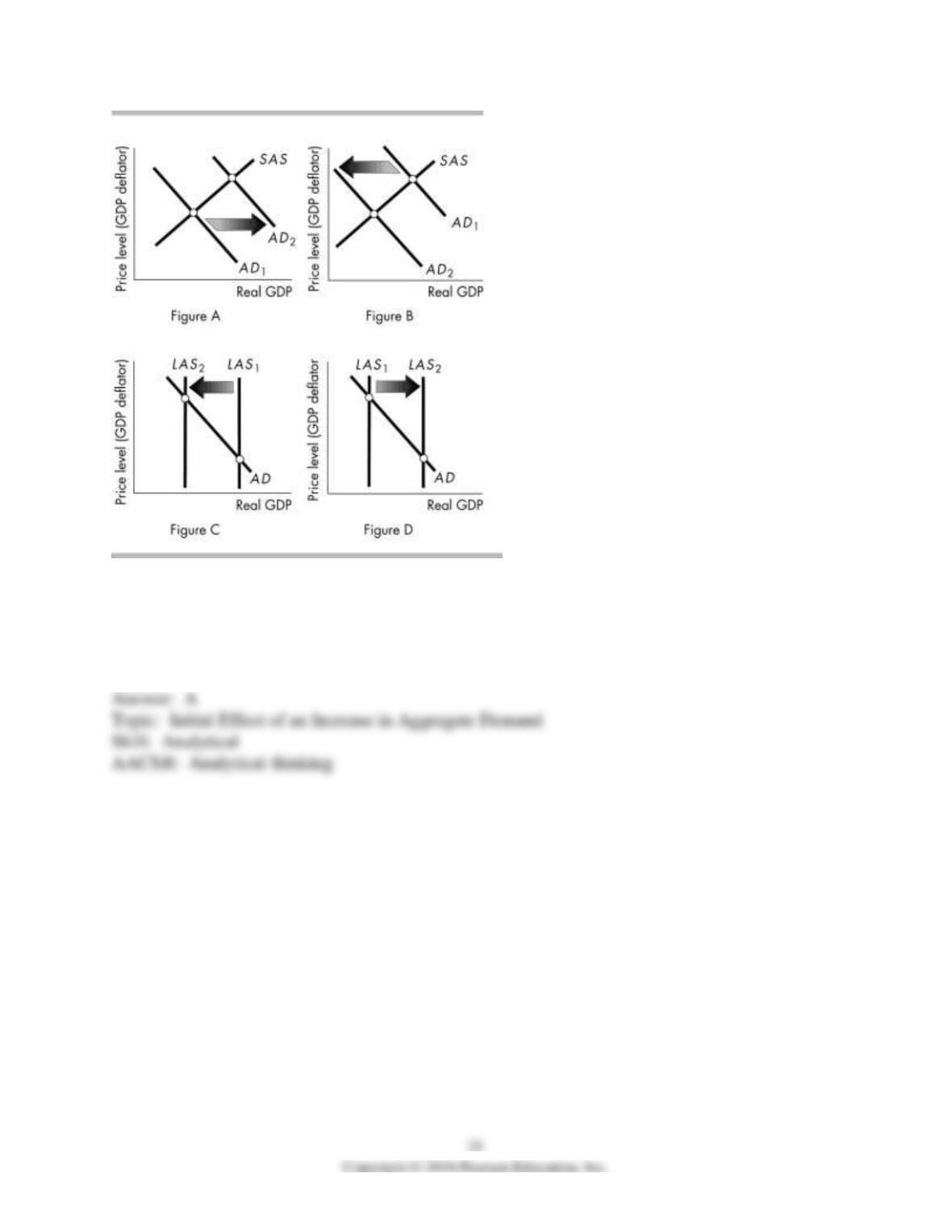
7) Which of the above figures best shows the start of a demand-pull inflation?
A) Figure A
B) Figure B
C) Figure C
D) Figure D
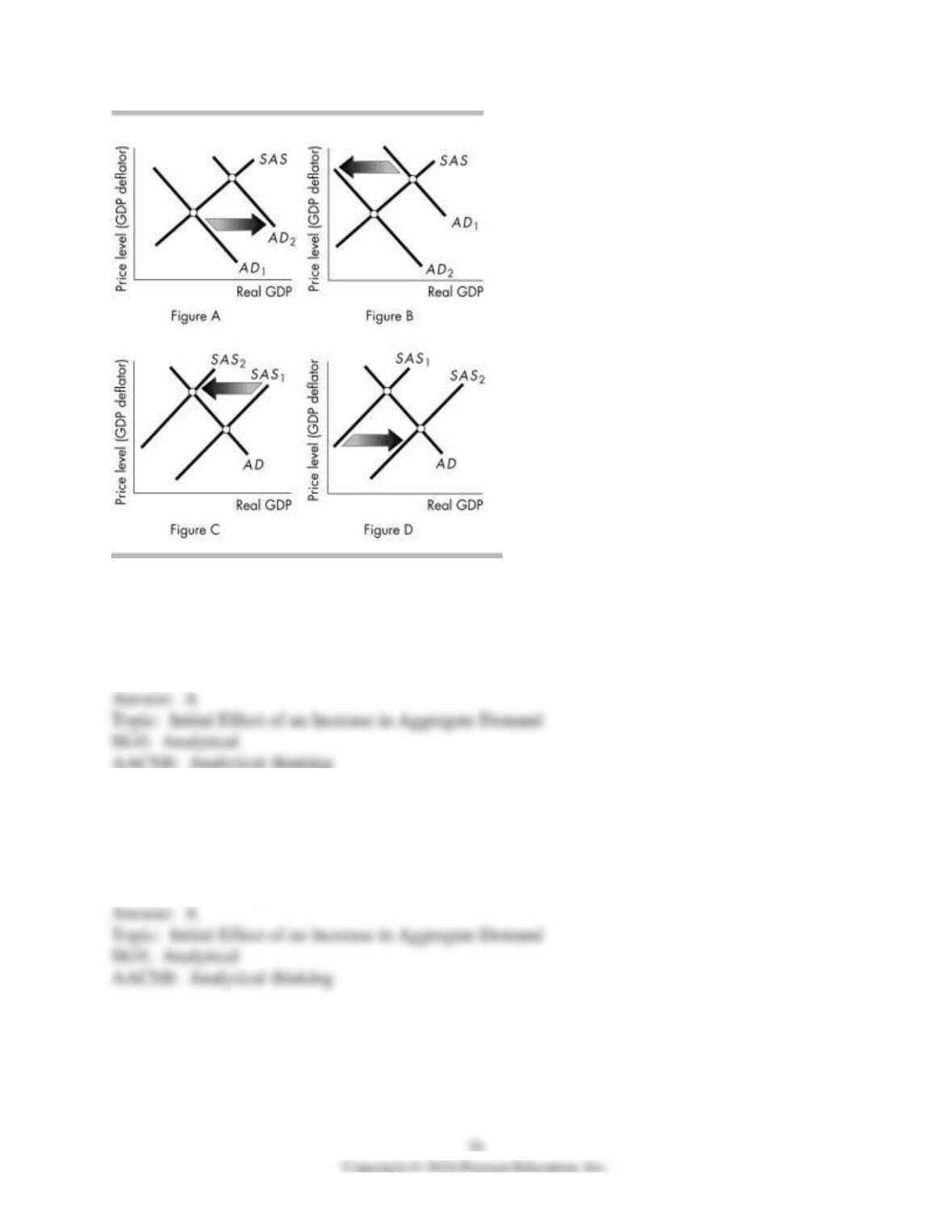
8) Which of the above figures best shows the start of a demand-pull inflation?
A) Figure A
B) Figure B
C) Figure C
D) Figure D
9) Which of the above figures show how inflation can start in an economy?
A) Figure A and Figure C
B) Figure A and Figure D
C) Figure B and Figure C
D) Figure B and Figure D
10) Demand-pull inflation can start when
A) money wage rates rise but the price level does not change.
B) money wage rates rise faster than prices.
C) the short-run aggregate supply curve shifts rightward.
D) the aggregate demand curve shifts rightward.
11) Demand pull inflation can be started by
A) a decrease in the quantity of money.
B) an increase in government expenditure.
C) a decrease in net exports.
D) an increase in the price of oil
12) Which of the following factors could start a demand-pull inflation ?
A) an increase in tax rates
B) a decrease in government expenditure
C) a decrease in wage rates
D) an increase in exports
13) Which of the following could lead to demand-pull inflation?
A) an increase in the money wage rate
B) an increase in the quantity of money
C) a decrease in exports
D) an increase in oil prices
14) Which of the following could start a demand-pull inflation?
A) an increase in government expenditure
B) an increase in imports
C) a decrease in the quantity of money
D) an increase in the money prices of raw materials
15) Increases in the quantity of money can start a ________ inflation and an increase in
government expenditure can start a ________ inflation.
A) demand-pull; demand-pull
B) demand-pull; cost-push
C) cost-push; cost-push
D) cost-push; demand-pull
16) Which of the following can start a demand-pull inflation?
A) an improvement in technology
B) a decrease in productivity
C) an increase in imports
D) None of the above can start a demand-pull inflation.
17) Demand-pull inflation could start with
A) an increase in government expenditure followed by an increase in the money wage rate.
B) an increase in the quantity of money followed by a decrease in the money wage rate.
C) a rise in prices of raw materials followed by an increase in the quantity of money.
D) a decrease in exports followed by a decrease in the quantity of money.
18) Which of the following is NOT a potential start of a demand-pull inflation?
A) an increase in the money wage rate
B) an increase in the quantity of money
C) an increase in government expenditure
D) an increase in exports
19) Which of the following is NOT a potential start of a demand-pull inflation?
A) an increase in the quantity of money
B) an increase in government expenditure
C) an increase in taxes
D) an increase in exports
20) Which of the following is a change that would NOT start a demand-pull inflation?
A) an increase in exports
B) an increase in labor productivity
C) an increase in government expenditure on goods and services
D) an increase in the quantity of money
21) Which of the following could NOT start a demand-pull inflation?
A) increases in government expenditure
B) increases in net exports
C) increases in oil prices
D) increases in the quantity of money
22) Initially, demand-pull inflation will
A) increase the price level and not change real GDP.
B) increase the price level and increase real GDP.
C) increase the price level and decrease real GDP.
D) shift the aggregate supply curve rightward.
23) A demand-pull inflation initially is characterized by
A) increasing real output and a labor shortage.
B) increasing real output and a labor surplus.
C) decreasing real output and a labor shortage.
D) decreasing real output and a labor surplus.
24) If demand pull inflation occurs when the economy is already at potential GDP, then
following the initial increase in aggregate demand, the
A) SAS curve shifts rightward.
B) LAS curve shifts rightward.
C) SAS curve shifts leftward.
D) LAS curve shifts leftward.
25) If an economy at potential GDP experiences a demand shock that shifts the aggregate
demand curve rightward, there will be
A) an eventual leftward shift in the short-run aggregate supply curve.
B) unemployment below the natural rate.
C) upward pressure on money wage rates.
D) All of the above answers are correct.