United States – BPROG: Analytic
140. Cartels usually succumb to divisive forces caused by
a.
limited information.
b.
members cheating by giving secret discounts.
c.
entry by new rivals seeking profits.
d.
insufficient profits compared to independent operations.
DISC: Oligopoly
United States – BPROG: Analytic
141. Economists would describe cartels as
a.
the opposite of ignoring interdependence.
b.
a collusive arrangement.
c.
an undesirable form of market organization that may charge a monopoly price.
d.
All of the above are correct.
DISC: Oligopoly
United States – BPROG: Analytic
142. Cartels are
a.
difficult to organize.
b.
difficult to preserve.
c.
especially unlikely to succeed if the members sell many varied products.
d.
All of the above are correct.
DISC: Oligopoly
United States – BPROG: Analytic
143. A successful cartel may end up charging the ____ price and obtaining ____ profits.
a.
monopolistic competition; zero economic
b.
oligopoly; monopoly
c.
monopoly; zero economic
d.
monopoly; monopoly
DISC: Oligopoly
United States – BPROG: Analytic
144. Which of the following best expresses the attitude toward competition of a firm engaged in tacit collusion with its
rivals?
a.
A rolling stone gathers no moss.
b.
Waste not, want not.
c.
Do unto others as you would have them do unto you.
d.
Ask, and ye shall receive.
DISC: Oligopoly
United States – BPROG: Analytic
145. Price leadership is a form of
a.
tacit collusion.
b.
explicit collusion.
c.
monopolistic competition.
d.
a cartel policing mechanism.
DISC: Oligopoly
United States – BPROG: Analytic
146. In the cigarette industry either R. J. Reynolds or Phillip Morris, for a time, raised prices twice a year by about 50
cents per carton. The other firms in the industry raised their prices by the same amount. Economists call this
a.
predatory pricing.
b.
a price war.
c.
price leadership.
d.
sales maximization.
DISC: Oligopoly
United States – BPROG: Analytic
147. Tacit collusion is
a.
collusion which is carried out without any explicit agreement among firms.
b.
collusion about tacits, rather than strategy.
c.
agreements which are sponsored by government.
d.
similar to pure competition.
DISC: Oligopoly
United States – BPROG: Analytic
148. In ____, each competing firm is determined to sell at a price that is lower than the prices of its rivals, often regardless
of whether that price covers the pertinent cost.
a.
market skimming
b.
a monopoly
c.
a price war
d.
perfect competition
DISC: Oligopoly
United States – BPROG: Analytic
149. An example of overt collusion is
a.
a cartel.
b.
price leadership.
c.
tacit collusion.
d.
a perfectly contestable market.
a
Moderate
DISC: Oligopoly
United States – BPROG: Analytic
Oligopoly
Oligopoly
150. Which of the following is an example of tacit collusion?
a.
OPEC
b.
copper cartel
c.
price leadership
d.
government franchise granted to a utility
c
Moderate
DISC: Oligopoly
United States – BPROG: Analytic
Oligopoly
Oligopoly
151. If firms meet together to decide on prices and outputs there is
a.
overt collusion.
b.
tacit collusion.
c.
price leadership.
d.
None of the above are correct.
a
Moderate
DISC: Oligopoly
United States – BPROG: Analytic
Oligopoly
Oligopoly
152. Sales maximization by a firm most often serves the interests of the firm’s
a.
stockholders.
b.
creditors.
c.
managers.
d.
unskilled laborers.
c
Moderate
DISC: Oligopoly
United States – BPROG: Analytic
Oligopoly
Oligopoly
153. A sales-maximizing firm produces the output level at which
a.
MR = P.
b.
MR = MC.
c.
MR = AC.
d.
MR = 0.
Easy
DISC: Oligopoly
United States – BPROG: Analytic
Oligopoly
Oligopoly
154. A firm now produces its sales-maximizing level of output. If the firm increased its output by one unit, its marginal
revenue would become
a.
negative.
b.
smaller but still positive.
c.
larger but still negative.
d.
larger but still positive.
a
Moderate
DISC: Oligopoly
United States – BPROG: Reflective Thinking – BPROG: Analysis
Oligopoly
Oligopoly
155. The goal of the manager of a firm is sales maximization. The firm will produce
a.
the output level at which MR = 0.
b.
as much output as it can.
c.
the same output that it would if the goal was profit maximization.
d.
the same output that it would if the goal was cost minimization.
a
Moderate
DISC: Oligopoly
United States – BPROG: Reflective Thinking – BPROG: Analysis
Oligopoly
156. Firms have the option of maximizing sales revenue or maximizing profits. If a firm chooses to maximize sales, then
it will produce
a.
more output and charge a lower price.
b.
the same output and charge a lower price.
c.
less output and charge a higher price.
d.
less output and charge a lower price.
DISC: Oligopoly
United States – BPROG: Analytic
157. Oligopolistic firms that practice sales revenue maximization will produce
a.
more and charge less than a profit maximizer.
b.
less and charge more than a profit maximizer.
c.
more and charge more than a profit maximizer.
d.
less and charge less than a profit maximizer.
DISC: Oligopoly
United States – BPROG: Analytic
158. Which of the following is never true for a sales revenue maximizer with an upward-sloping supply curve?
a.
MR = 0
b.
MR = MC
c.
Economic profits are positive.
d.
P = MC
DISC: Oligopoly
United States – BPROG: Reflective Thinking – BPROG: Analysis
159. To maximize sales revenue, an oligopolist will expand output until the elasticity of demand becomes
a.
negative.
b.
zero.
c.
one.
d.
infinite.
c
Easy
DISC: Oligopoly
United States – BPROG: Analytic
Oligopoly
Oligopoly
160. Sales maximization may be a goal of a firm if
a.
firms are managed by irrational persons.
b.
the firm has no way to measure profitability.
c.
the firm is privately held, and there is no separation between ownership and control.
d.
managerial bonuses are based on sales revenue instead of profitability.
Moderate
DISC: Oligopoly
United States – BPROG: Analytic
Oligopoly
Oligopoly
161. There is statistical evidence that managers’ salaries are tied most closely to
a.
profits at the profit-maximizing output.
b.
sales volume.
c.
cost per unit at minimum-cost output.
d.
the closeness of output to the point where MR = MC.
Moderate
DISC: Oligopoly
United States – BPROG: Analytic
Oligopoly
Oligopoly
162. The reason firms often choose sales maximization as a goal is because
a.
that is where profits are maximized.
b.
it is impossible to maximize profits.
c.
firms are managed and owned by different groups of people with different goals.
d.
owners believe setting price/output to maximize profits is unfair to consumers.
c
Difficult
DISC: Oligopoly
United States – BPROG: Analytic
Oligopoly
Oligopoly
163. In reality, firms may seek to maximize
a.
sales.
b.
profits.
c.
market share.
d.
All of the above can be correct, depending upon management, owners, and other factors.
Moderate
DISC: Oligopoly
United States – BPROG: Analytic
Oligopoly
Oligopoly
164. The apparent stickiness of the price of goods sold by oligopolists can be explained by the
a.
contestable markets model.
b.
sales maximization model.
c.
kinked demand curve model.
d.
entry deterrence model.
c
Easy
DISC: Oligopoly
United States – BPROG: Analytic
Oligopoly
Oligopoly
165. According to the kinked demand curve model, an oligopolist may face
a.
more elastic demand than a monopolistic competitor.
b.
less elastic demand than a monopolistic competitor.
c.
more elastic demand if she raises her price than if she lowers her price.
d.
less elastic demand if she raises her price than if she lowers her price.
c
Moderate
DISC: Oligopoly
United States – BPROG: Analytic
166. If an oligopolistic manufacturer believes that he faces a kinked demand curve for his product, he thinks his
competitors will ____ if he lowers his price and ____ if he raises his price.
a.
lower their prices; raise their prices.
b.
lower their prices; not raise their prices
c.
not lower their prices; raise their prices
d.
not lower their prices; not raise their prices
DISC: Oligopoly
United States – BPROG: Analytic
167. The theory of the kinked demand curve is that
a.
although the firm sells a differentiated product, too many competitors exist to make it worthwhile speculating
on responses to the firm’s behavior.
b.
freedom of entry will reduce profits to zero.
c.
a firm’s competitors will follow it in a price decrease but not follow it in a price increase.
d.
firms are all seeking the position of joint profit maximization.
DISC: Oligopoly
United States – BPROG: Analytic
168. An oligopolist’s effective demand curve will be kinked if the firm
a.
is acting as a price leader in the industry.
b.
expects other firms to match price cuts but not price increases.
c.
expects other firms to match all price changes.
d.
fears new entry into the industry.
DISC: Oligopoly
United States – BPROG: Analytic
Oligopoly
Oligopoly
169. The theory of the kinked demand curve is used to explain
a.
bizarre corporate behavior.
b.
sales maximization.
c.
the maximin criterion.
d.
sticky prices in oligopolies.
Easy
DISC: Oligopoly
United States – BPROG: Analytic
Oligopoly
Oligopoly
Figure 12-3
170. Oligopolist A cuts price in an attempt to enlarge his share of the market. His competitors retaliate with identical price
cuts. In this case, in Figure 12–3, oligopolist A will move from point A to which point?
a.
B
b.
C
c.
D
d.
E
c
Moderate
DISC: Oligopoly
United States – BPROG: Reflective Thinking – BPROG: Analysis
Oligopoly
Oligopoly
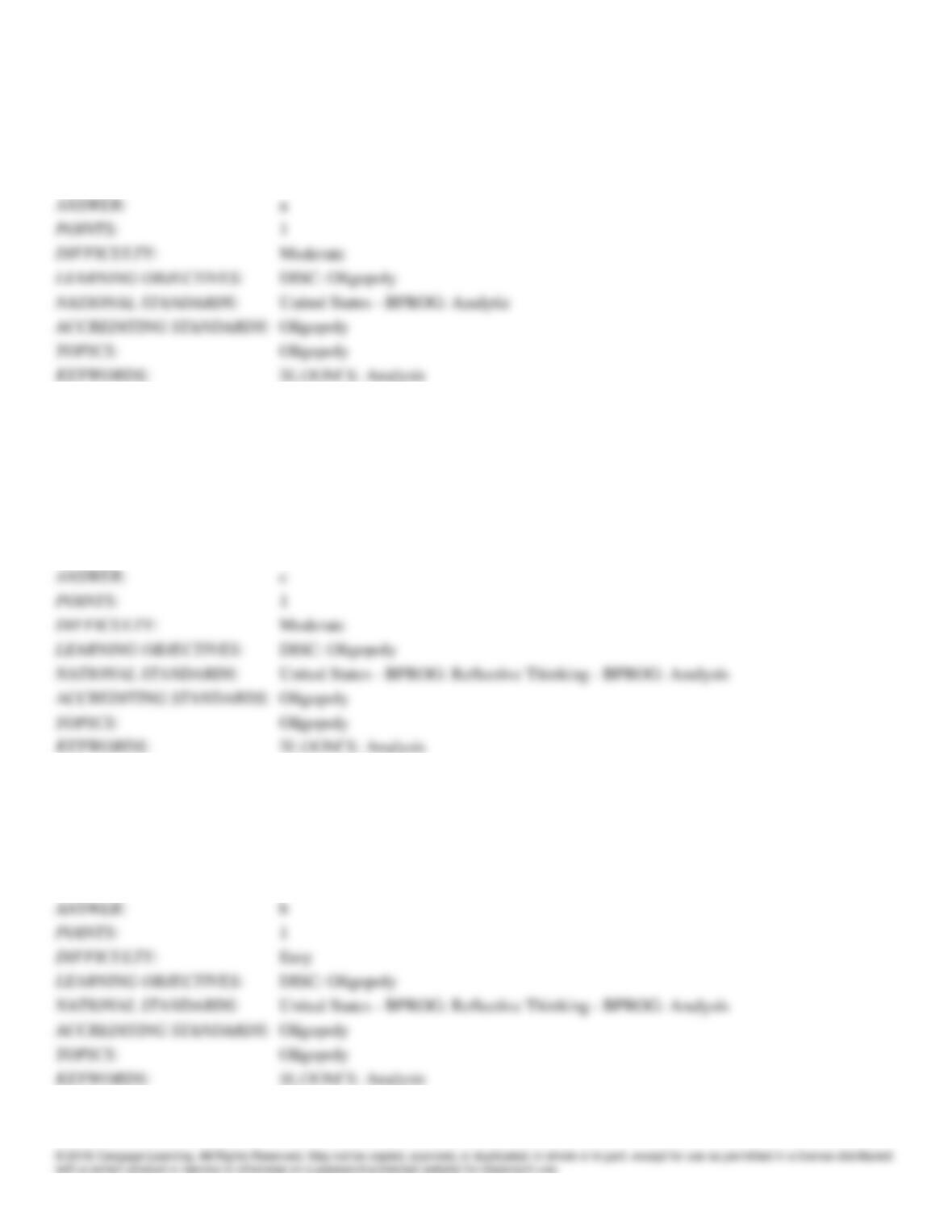
171. Oligopolist A cuts price in an attempt to enlarge his share of the market. His competitors fail to retaliate with price
cuts. In this case, in Figure 12–3, oligopolist A will move from point A to which point?
a.
B
b.
C
c.
D
d.
E
a
Moderate
DISC: Oligopoly
United States – BPROG: Analytic
Oligopoly
Oligopoly
172. In Figure 12–3, demand curve CAD represents a market in which oligopolists will match the price changes of rivals
and demand curve EAB represents a market in which oligopolists will ignore the price changes of rivals. According to the
kinked demand model, the relevant demand curve will be
a.
demand curve CAB.
b.
demand curve CAD.
c.
demand curve EAD.
d.
demand curve EAB.
c
Moderate
DISC: Oligopoly
United States – BPROG: Reflective Thinking – BPROG: Analysis
Oligopoly
Oligopoly
173. In Figure 12–3, according to economic theory, the kink in the demand curve will occur at point
a.
E.
b.
A.
c.
C.
d.
D.
Easy
DISC: Oligopoly
United States – BPROG: Reflective Thinking – BPROG: Analysis
Oligopoly
Oligopoly
174. The game theory approach to the analysis of oligopoly assumes that oligopolists
a.
ignore their interdependence.
b.
behave with little forethought.
c.
do not take their businesses seriously.
d.
act strategically.
DISC: Oligopoly
United States – BPROG: Analytic
175. The payoff matrix is a fundamental tool of
a.
monopolistic competition.
b.
game theory.
c.
corporate finance theory.
d.
regulatory oversight.
DISC: Oligopoly
United States – BPROG: Analytic
176. A duopoly is
a.
a cartel in which all members try to cheat on the cartel.
b.
an industry with only two sellers.
c.
an industry with only two buyers.
d.
a cartel with only two members.
DISC: Oligopoly
United States – BPROG: Analytic
177. Game theory can be used to investigate
a.
why cartels break down.
b.
why some firms maintain excess productive capacity.
c.
how oligopolists set prices.
d.
All of the above are correct.
Difficult
DISC: Oligopoly
United States – BPROG: Analytic
Oligopoly
Oligopoly
178. The most widely used approach for the analysis of oligopoly behavior is
a.
game theory.
b.
role playing.
c.
strategic engineering.
d.
input-output analysis.
a
Moderate
DISC: Oligopoly
United States – BPROG: Analytic
Oligopoly
Oligopoly
179. Game theory applies to problems that arise in
a.
perfect competition.
b.
monopolies.
c.
oligopolies.
d.
pure competition.
c
Easy
DISC: Oligopoly
United States – BPROG: Analytic
Oligopoly
Oligopoly
180. Displayed below is the payoff matrix of firm A for four different strategies, A1, A2, A3, and A4, and the potential
retaliatory responses of firm B (B1, B2, B3, B4).
Table 12-1
B1
B2
B3
B4
A1
100
50
25
10
A2
10
60
150
200
A3
50
75
200
250
A4
30
50
100
150
If firm A uses the maximin criterion, which strategy will it choose?
a.
A1
b.
A2
c.
A3
d.
A4
DISC: Oligopoly
United States – BPROG: Reflective Thinking – BPROG: Analysis
181. Displayed below is the payoff matrix of firm B for four different strategies, B1, B2, B3, and B4, and the potential
retaliatory responses of firm A (A1, A2, A3, A4).
Table 12-2
B1
B2
B3
B4
A1
100
50
25
200
A2
10
60
150
150
A3
50
75
200
75
A4
70
90
250
15
If firm B uses the maximin criterion, which strategy will it choose?
a.
B1
b.
B2
c.
B3
d.
B4
DISC: Oligopoly
United States – BPROG: Reflective Thinking – BPROG: Analysis
182. For collusion to make sense, the payoff matrix must be a
a.
positive-sum game.
b.
zero-sum game.
c.
negative-sum game.
d.
negative-positive-sum game.
DISC: Oligopoly
United States – BPROG: Analytic
Oligopoly
Oligopoly
183. The development of game theory was the work of
a.
Joan Robinson and Edward Chamberlin.
b.
John von Neumann and Oskar Morgenstern.
c.
Wassily Leontief and Joseph Schumpeter.
d.
John Maynard Keynes.
Easy
DISC: Oligopoly
United States – BPROG: Analytic
Oligopoly
Oligopoly
184. In John Rawls’ A Theory of Justice, people choose the rules for distributing income from behind a veil of ignorance.
People understand that ability determines income, but they do not know their abilities or the abilities of others. Rawls
argues that people are risk averse and will choose the distribution rule that maximizes their income in the worst case
scenario (they have relatively little ability). An economist would call this strategy
a.
minimax.
b.
maximin.
c.
irrational.
d.
tacit collusion.
Moderate
DISC: Oligopoly
United States – BPROG: Analytic
Oligopoly
Oligopoly
185. The maximin criterion can be defined as which of the following?
a.
One seeks the maximum of the minimum payoffs to the various available strategies.
b.
One seeks the minimum of the maximum losses among the various available strategies.
c.
One seeks the maximum of the minimum losses to the various available strategies.
d.
One seeks the maximum of the maximum gains of the various available strategies.
a
DISC: Oligopoly
United States – BPROG: Analytic
Oligopoly
Oligopoly
186. A situation in which both players can adopt moves such that each player’s move is its most profitable response to the
move of the other is the
a.
prisoner’s dilemma.
b.
Nash equilibrium.
c.
maximin criterion.
d.
tacit collusion.
Moderate
DISC: Oligopoly
United States – BPROG: Analytic
Oligopoly
Oligopoly
187. ____ is one in which exactly the amount one competitor gains must be lost by other competitors.
a.
Nash equilibrium
b.
Prisoner’s dilemma
c.
A win-win situation
d.
A zero-sum game
Moderate
DISC: Oligopoly
United States – BPROG: Analytic
Oligopoly
Oligopoly
188. Industries, where economies of scale dictate that only a few firms produce, will be efficient if the markets in which
they sell are
a.
perfect.
b.
contestable.
c.
close to each other.
d.
protected from entry.
Moderate
DISC: Oligopoly
United States – BPROG: Analytic
Oligopoly
Monopolistic Competition, Oligopoly, and Public Welfare