
2) “UK Inflation Surges to 16-year High”
According to the story, “High inflation in July will also lead to … “further rises next January …”
Economists also noted that inflation may get worse because the current data did not yet include
“announced rises in gas and electricity prices.”
www.ft.com, 8/12/2008
The story reflects the concept of
A) cost-push inflation.
B) the short-run Phillips curve.
C) demand-pull inflation.
D) the long-run Phillips curve.
3) “Inflation Gives Saudis Food for Thought”
“My boss sent me back to return the milk – it’s too expensive,” said the Pakistani driver for a
middle-class Saudi family at the checkout counter of the Al-Othaim supermarket. …Saudi Arabia
is enjoying an unprecedented economic boom …as sectors [have] increased activity to meet the
big internal demand.”
www.ft.com, 1/18/2008
The type of inflation described in the story
A) begins with stagflation.
B) starts with an increase in aggregate demand.
C) is the result of money wage rate spiral.
D) starts with a decrease in aggregate demand.
4) “Inflation Gives Saudis Food for Thought”
“My boss sent me back to return the milk – it’s too expensive,” said the Pakistani driver for a
middle-class Saudi family at the checkout counter of the Al-Othaim supermarket. …Saudi Arabia
is enjoying an unprecedented economic boom …as sectors [have] increased activity to meet the
big internal demand.”
www.ft.com, 1/18/2008
The story describes
A) cost-push inflation.
B) demand-pull inflation.
C) a rightward shift in the short-run Phillips curve.
D) stagflation.

5) “Shoe Industry under Pressure Amid Rising Costs ”
Rising costs have forced about 15 per cent of shoe manufacturers in a major south China
industrial centre to shut down or relocate in the past year… [the firms have] identified rising
wages as a key factor behind the closures and relocations from Dongguan…The problems in the
footwear industry reflect broader issues affecting manufacturers across China’s Pearl River
Delta…”
www.ft.com, 2/26/2008
As the same pressures affect other industries across China, we expect to see
A) demand-pull inflation.
B) a combination of cost-push and demand-pull inflation.
C) cost-push inflation.
D) a downward movement along the short-run Phillips curve.
6) “Shoe Industry under Pressure Amid Rising Costs”
Rising costs have forced about 15 per cent of shoe manufacturers in a major south China
industrial centre to shut down or relocate in the past year… [the firms have] identified rising
wages as a key factor behind the closures and relocations from Dongguan…The problems in the
footwear industry reflect broader issues affecting manufacturers across China’s Pearl River
Delta…”
www.ft.com, 2/26/2008
Using an AS/AD framework to describe the events in the story, there would be a
A) leftward shift in the AD curve.
B) leftward shift in the SAS curve.
C) rightward shift in the AD curve.
D) rightward shift in the SAS curve.

7) “All for One, but None for All”
In an article regarding how Great Britain and France are addressing the economic crisis in 2008,
Britain’s prime minister “is eager to encourage consumer spending” while France’s president
“wants to boost investment in both the private and public sectors.” Both leaders are concerned
because “hardly a day goes by without some manufacturing company announcing painful
restructuring, plant closures or temporary lay-offs.”
www.ft.com, 11/24/2008
If the governments can increase consumption or investment while holding the expected inflation
constant, there would be
A) a rightward shift of the long-run Phillips curve.
B) a movement down along the short-run Phillips curve
C) a movement up along the short-run Phillips curve.
D) a leftward shift of the AD curve.
8) “All for One, but None for All”
In an article regarding how Great Britain and France are addressing the economic crisis in 2008,
Britain’s prime minister “is eager to encourage consumer spending” while France’s president
“wants to boost investment in both the private and public sectors.” Both leaders are concerned
because “hardly a day goes by without some manufacturing company announcing painful
restructuring, plant closures or temporary lay-offs.”
www.ft.com, 11/24/2008
If consumption and investment are increased by the governments’ policies, we would expect
________ and a ________ the short-run Phillips curve.
A) increase in aggregate demand; rightward shift of
B) increase in aggregate demand; movement up along
C) movement up along the AD curve; rightward shift of
D) movement down along the AD curve; movement down along

9) In a speech to Asia Pacific Economic Cooperation summit in Peru in November 2008,
President Hu of China commented on his country’s $586 billion fiscal stimulus plan by saying,
“Instead of relying mainly on investment and export we will adopt a coordinated approach that
combines consumption, investment and export to boost the economy. And instead of relying
heavily on higher consumption of material resources we will achieve development by making
scientific and technological progress.” If his country’s plan works and the expected inflation rate
does not change, there will be a
A) movement up along the short-run Phillips curve.
B) movement down along the short-run Phillips curve.
C) rightward shift of the long-run Phillips curve.
D) leftward shift of the long-run Phillips curve.
10) In late 2008, Great Britain’s inflation rate fell from 5.2 percent to 4.5 percent while
unemployment was increased from 5.4 percent to 6 percent. These changes would be shown as a
A) leftward shift of the long-run Phillips curve.
B) movement up along the short-run Phillips curve.
C) movement down the short-run Phillips curve.
D) rightward shift of the long-run Phillips curve.
11) As world economies recover from the financial crisis in 2008 and 2009, the U.S. economy
returns to full employment and expected inflation equals actual inflation
A) there will be a movement back to the long-run Phillips curve.
B) the long-run Phillips curve will shift leftward.
C) there will be a movement upward along the short-run Phillips curve.
D) there will be a movement downward along the short-run Phillips curve.

12) A story from www.ft.com (1/31/2005) describing Ireland’s transformation to a prosperous
economy noted that “Ireland’s story is unique: a small, English-speaking, non-industrialized
country on the edge of Europe was able to secure structural funds from the EU, cut taxes,
deregulate faster than its neighbours and attract lots of foreign companies in the process.”
If the natural rate of unemployment in Ireland decreased as a result of these policies, then
________ would shift ________.
A) the long-run and short-run Phillips curves; rightward
B) the long-run and short-run Phillips curves; leftward
C) only the long-run Phillips curve; leftward
D) only the short-run Phillips curve; rightward
13) Over the last several years, the money supply in Indonesia as increased by 9 percent in 2003
to 14 percent in 2005 and 23 percent in 2007. At the same time, real GDP has grown steadily at
over 4 percent annually.
These changes would be shown as
I. rightward shifts of the AD curve
II. a movement down along the short-run Phillips curve
III. rightward shifts of the LAS curve
A) I and III.
B) I, II and III.
C) II only.
D) I only.
14) In a story from www.Forbes.com (5/30/2003), it was reported that the Chief Technology
Officer of the U.S. plans for the country to spend $58.1 billion on technology that year. He was
planning to buy technology from Cisco Systems, Oracle and Sun Microsystems in addition to
other software makers.
This story reports on technological change which is the stressed in the ________ of business
cycles.
A) real business cycle theory
B) new Keynesian cycle theory
C) new classical cycle theory
D) monetarist cycle theory
6 Essay Questions
1) What is demand-pull inflation?
2) What are sources that can start a demand-pull inflation?
3) Describe how a demand-pull inflation can occur.
4) What was the U.S. experience with demand pull inflation during the 1960s and early 1970s?
5) What is a cost-push inflation?
6) What factors can start a cost-push inflation? What must the Fed’s response be for the inflation
to continue?
7) What is the Phillips curve? Discuss both the short-run and long-run Phillips curve.
8) “The short-run Phillips curve shows the relationship between real GDP and inflation.” Is the
previous statement correct or incorrect? Briefly explain you answer.
9) Define and describe the short-run Phillips curve.
10) “The short-run Phillips curve is vertical at the natural unemployment rate.” Is the previous
statement correct or incorrect?
11) What does the short-run Phillips curve indicate about the relationship between inflation and
unemployment?
12) “The short-run Phillips curve shifts leftward when the inflation rate rises.” Is the previous
statement correct or incorrect?
13) If the short-run Phillips curve shifts rightward, what happens to the relationship between
inflation and unemployment? If the short-run Phillips curve shifts leftward, what happens to the
relationship between inflation and unemployment?
14) Explain how the expected inflation rate affects the short-run Phillips curve. Be sure to
mention the role played by the money wage rate.
15) “The long-run Phillips curve is downward sloping.” Is the previous statement correct or
incorrect?
16) “The long-run Phillips curve is vertical at the expected inflation rate.” Is the previous
statement correct or incorrect?
17) In the long run, what is the tradeoff between inflation and unemployment? Explain your
answer using Phillips curve analysis.
18) Distinguish between the short-run and long-run Phillips curves.
19) Explain how the short-run and long-run Phillips curves are related.
20) When the expected inflation rate changes, what happens to the short-run Phillips curve? To
the long-run Phillips curve?
21) When the natural unemployment rate changes, what happens to the short-run Phillips curve?
To the long-run Phillips curve?
22) Using the Phillips curves, what are the short-run and long-run effects of a decrease in the
inflation rate?
23) What is the factor that leads to business cycles in the Keynesian cycle theory?
24) What is the factor that leads to business cycles in the monetarist cycle theory?
25) Compare and contrast the Keynesian and Monetarist business cycle theories.
26) What is the factor that leads to business cycles in the new classical cycle theory?
27) What is the factor that leads to business cycles in the new Keynesian cycle theory?
28) What is the impulse in the real business cycle theory of the business cycle?
29) What is the impulse that leads to business cycle in the real business cycle, RBC, theory?
30) What is the intertemporal substitution effect and what role does it play in the real business
cycle model?
31) What are criticisms of the real business cycle theory?
32) How do defenders of the real business cycle theory, (RBC theory) respond to critics of the
theory?
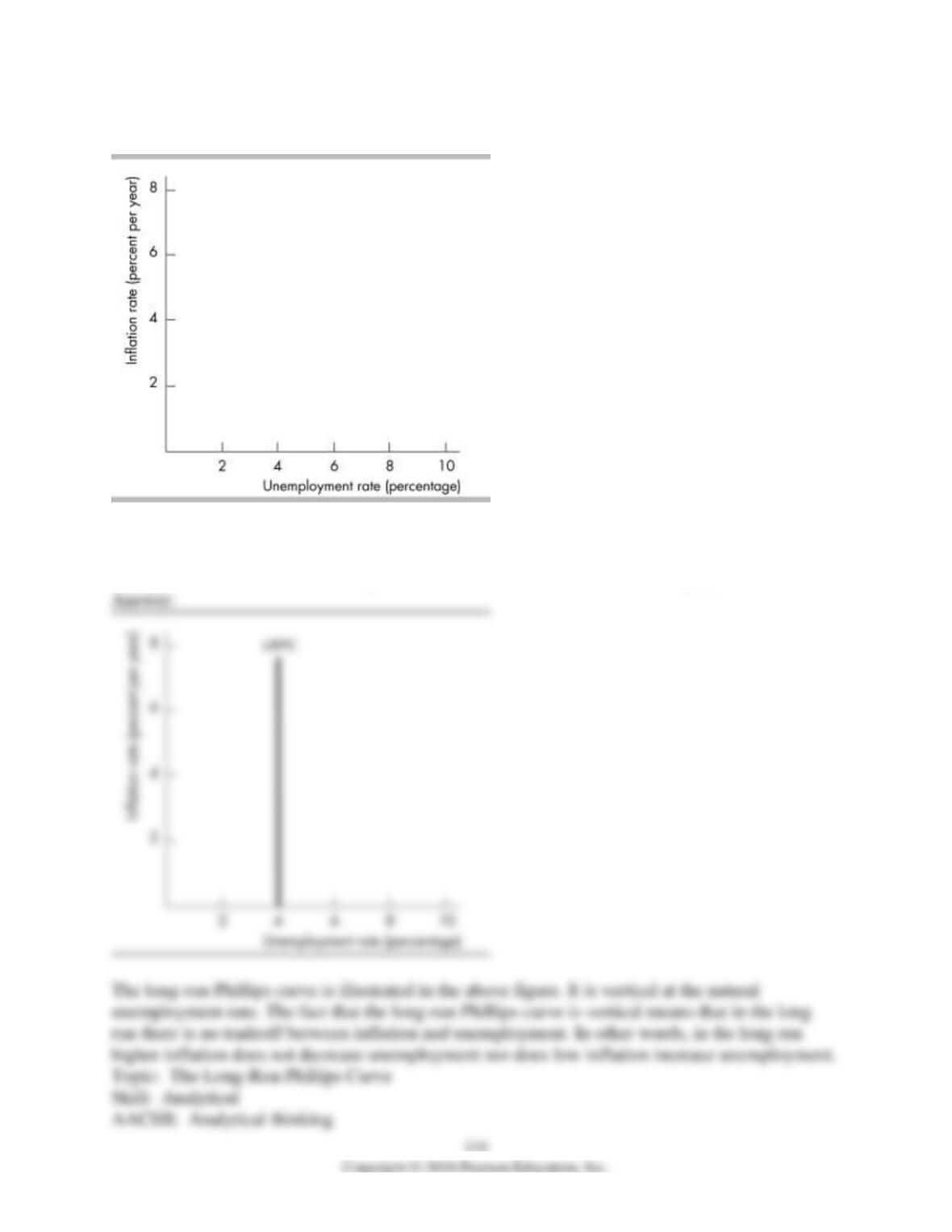
7 Numeric and Graphing Questions
1) Suppose the natural unemployment rate is 4 percent and the expected inflation rate is 6
percent. In the above figure, illustrate the long-run Phillips curve. What does the long-run
Phillips curve reveal about the long-run tradeoff between inflation and unemployment?