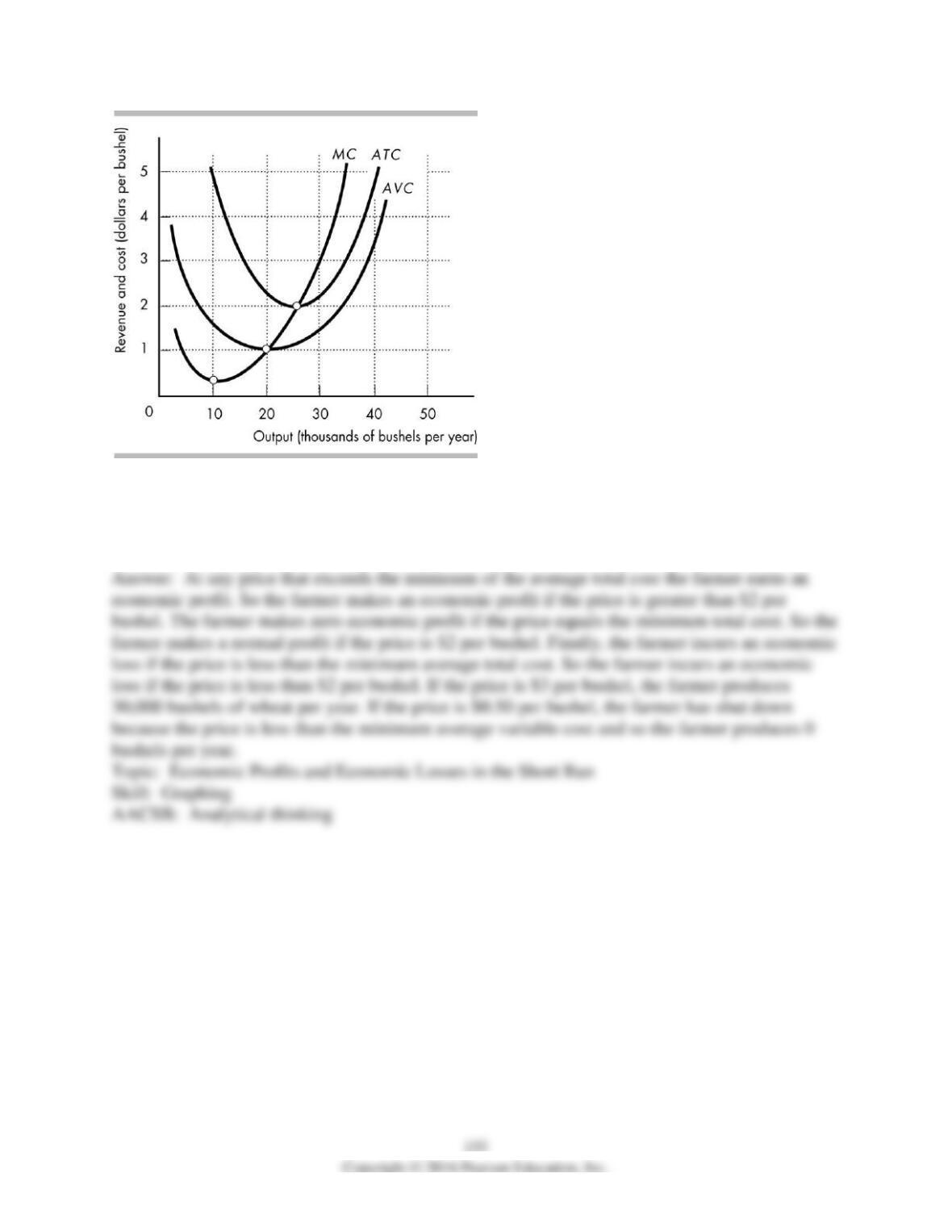
14) The above diagram shows the cost curves for a perfectly competitive wheat farmer. At what
price(s) does the wheat farmer make an economic profit? Make zero economic profit? Incur an
economic loss? How many bushels of wheat does the farmer produce if the price is $3 per
bushel? If the price is $0.50 per bushel?
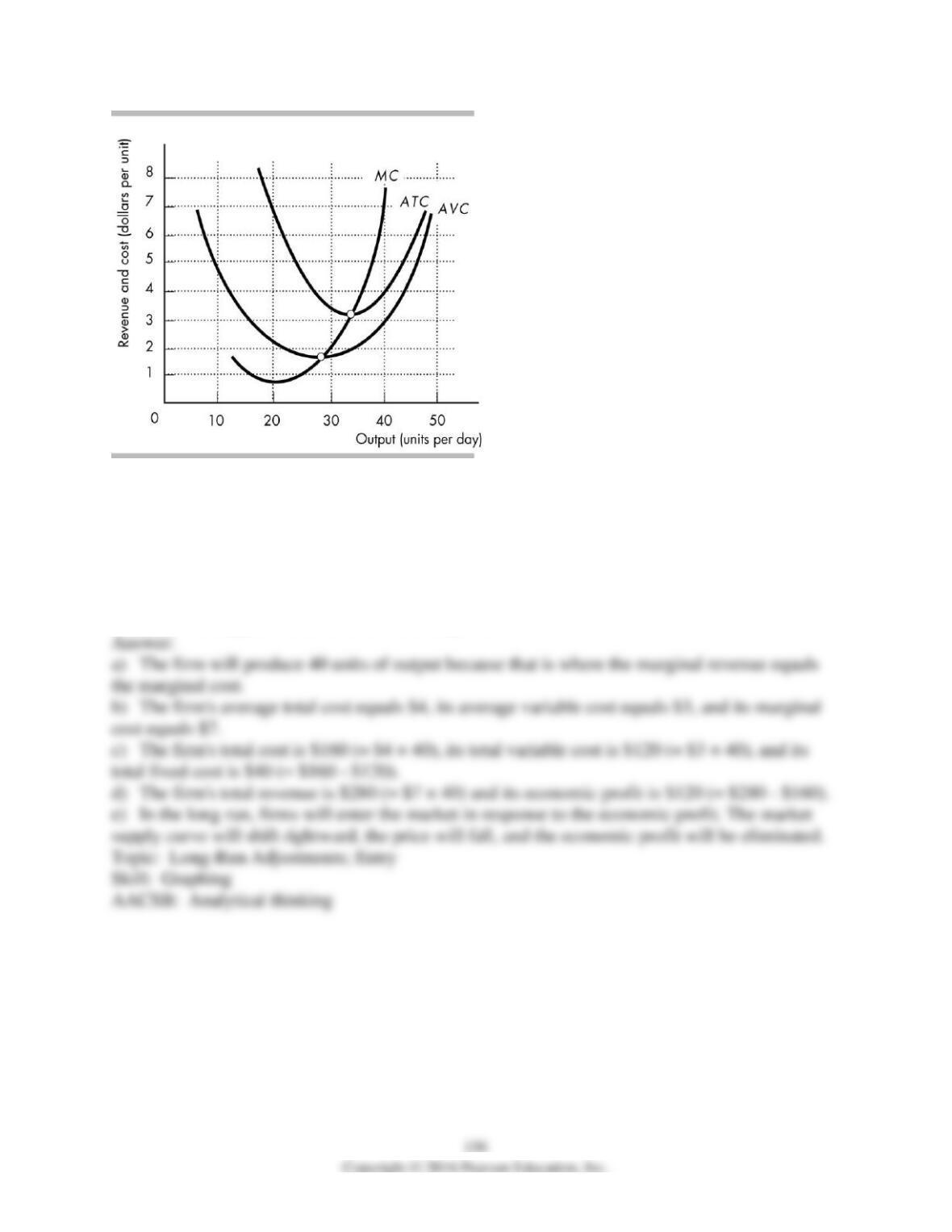
15) The above figure shows the cost curves of a profit-maximizing perfectly competitive firm. If
the price equals $7,
a) how much will the firm produce?
b) how much is the firm’s average total, average variable, and marginal costs?
c) how much is the firm’s total, total variable, and total fixed costs?
d) how much is the firm’s total revenue and economic profit?
e) what will happen in this market in the long run?
157
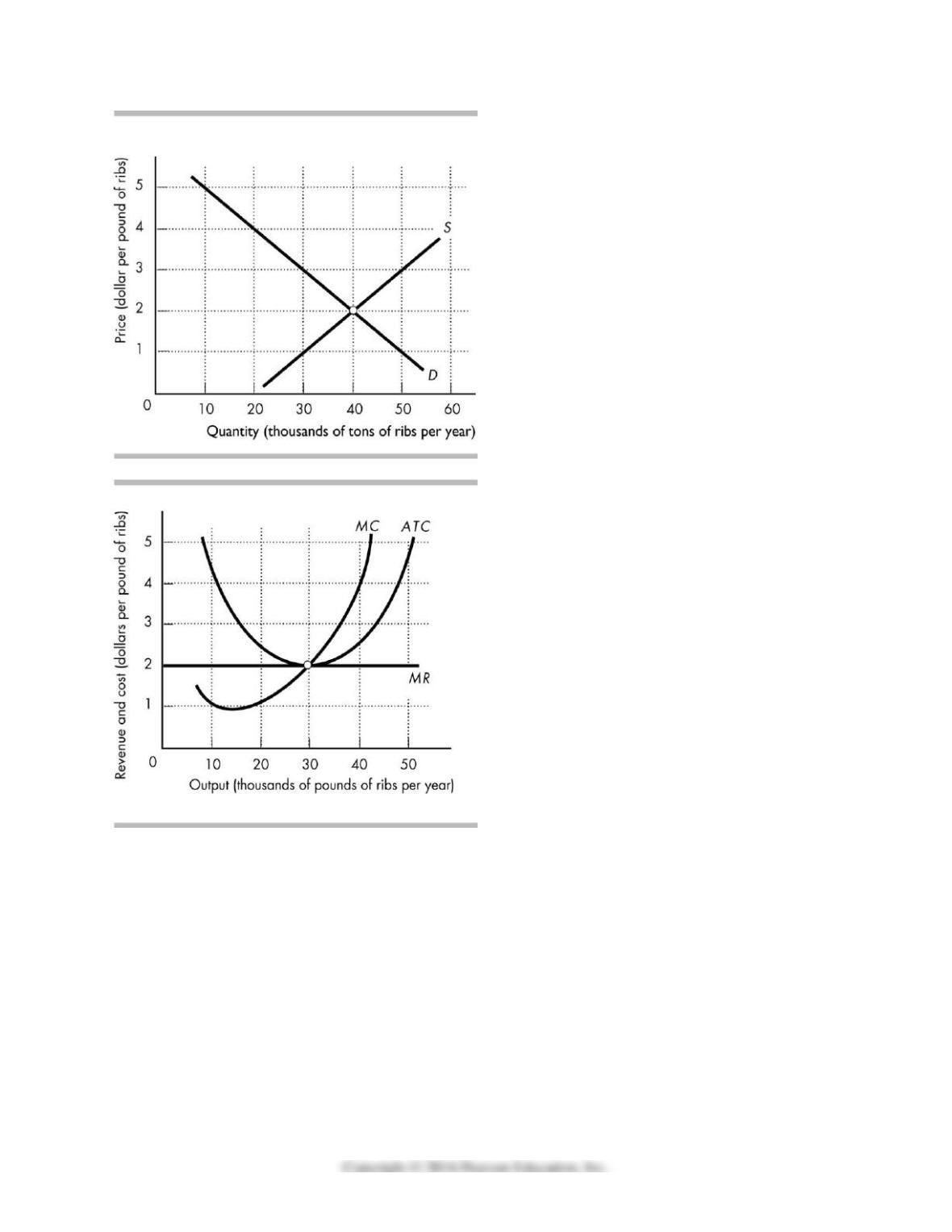
16) American restaurants receive their supply of baby back-ribs from American farms and from
farms in Denmark. In the figures above, the first diagram shows the perfectly competitive market
for baby back ribs in the United States. The second figure shows the situation at Premium
Standard Farm in Kansas, one of the many U.S. farms supplying these ribs.
Now assume that the United States imposes a ban on European meat in response to the foot-and-
mouth disease that has infected livestock in Europe. (Which the United States did several years
ago.) In particular, suppose that the U.S. ban decreases the supply by 40 tons a year. Using the
first figure, show the impact of this ban on the baby back rib market. Using the second figure,
show the impact on Premium Standard Farm in Kansas.
17) Suppose the bobby pin industry is perfectly competitive. The price of a packet of bobby pins
is $2.00. Pins and Needles, Inc. is a firm in this industry and is producing 1,000 packets of bobby
pins per day at the point where the MC = MR. The average cost of production at this output level
is $1.50 per packet.
a) What is the marginal cost of the 1,000th packet?
b) Is this firm making an economic profit, zero economical profit, or an economic loss? How
much?
c) Is the firm in long-run equilibrium? Why or why not?
10 True or False
1) In a perfectly competitive market, many firms sell an identical product.
2) Perfectly competitive firms are price takers.
3) A perfectly competitive firm produces so that its marginal cost equals the price.
4) A perfectly competitive firm maximizes its profit by producing the level of output so that its
average total cost equals the market price.
5) If a firm is maximizing profits, the extra revenue it receives from selling its last unit of output
exceeds the extra cost of producing that unit.
6) In perfect competition, firms enter the market whenever the market price exceeds the
minimum average variable cost.
7) A perfectly competitive firm definitely will shut down in the short run if its price is below its
average total cost.
8) A firm’s shutdown point is the output and price at which the firm’s total revenue just equals its
total variable cost.
9) Perfectly competitive firms will sometimes operate even though they incur an economic loss
in the short run.
10) The supply curve for a perfectly competitive firm is the portion of its marginal cost curve
that lies above its marginal revenue curve.
11) The supply curve for a perfectly competitive firm is the portion of its marginal cost curve
that lies above the average variable cost curve.
12) In the long run, a perfectly competitive firm can make an economic profit because its
marginal cost equals its average total cost.
13) In the long run, perfectly competitive firms cannot earn an economic profit.
14) Entry of new firms into a perfectly competitive market raises the product’s price.
15) Entry of new firms into a perfectly competitive market lowers the profits of the existing
firms.
16) In the long run, a perfectly competitive firm leaves the market if the market price is less than
the firm’s average total cost.
17) Easy entry and exit ensure that perfectly competitive firms cannot make a long-run economic
profit.
18) In the long run, perfectly competitive firms make zero economic profit, that is, their owners
make a normal profit.
19) In a perfectly competitive market, in the long run a permanent decrease in the market
demand results in a smaller number of firms.
20) When the market demand increases in a perfect competition, the long-run result is a larger
number of firms, a higher price, and a permanent economic profit for the firms.
11 Extended Problems
Quantity
(gallons per
day)
Total cost
(dollars per day)
0
500
100
713
200
800
300
838
400
900
500
1,063
600
1,400
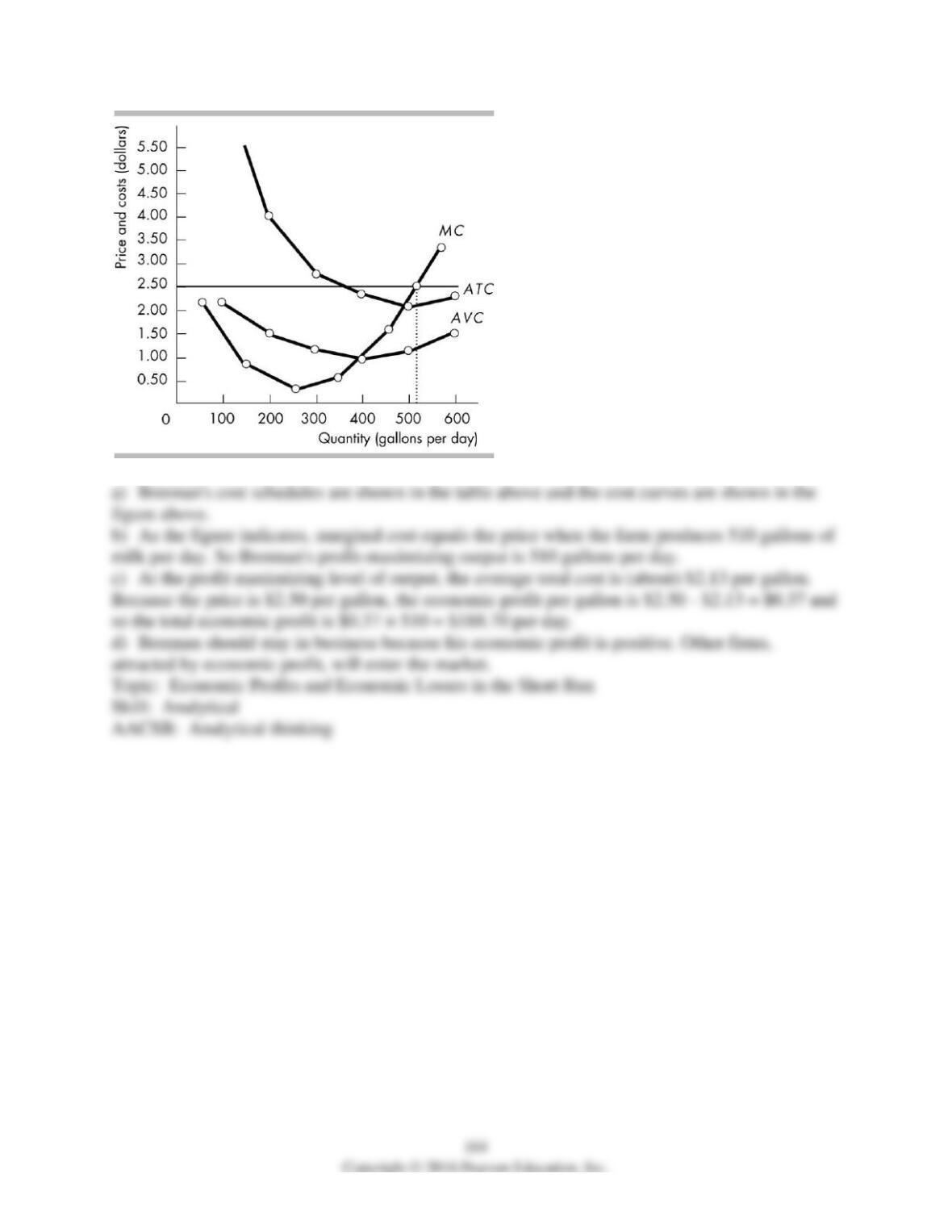
1) Brennan’s Farm produces and sells milk. The market for milk is perfectly competitive. The
market price of milk is $2.50 per gallon. The relationship between the farm’s output and total
costs is shown in the table above.
a) Draw Brennan’s average variable, average total, and marginal cost curves.
b) Use your graphs to find Brennan’s profit-maximizing output.
c) If Brennan maximizes his profit, how much profit does he make?
d) Should Brennan stay in business? Will other farms with costs the same as Brennan’s enter the
milk market? Explain.
Quantity
(gallons per
day)
Total cost
(dollars per day)
0
400
100
703
200
880
300
1,008
400
1,160
500
1,410
600
1,840
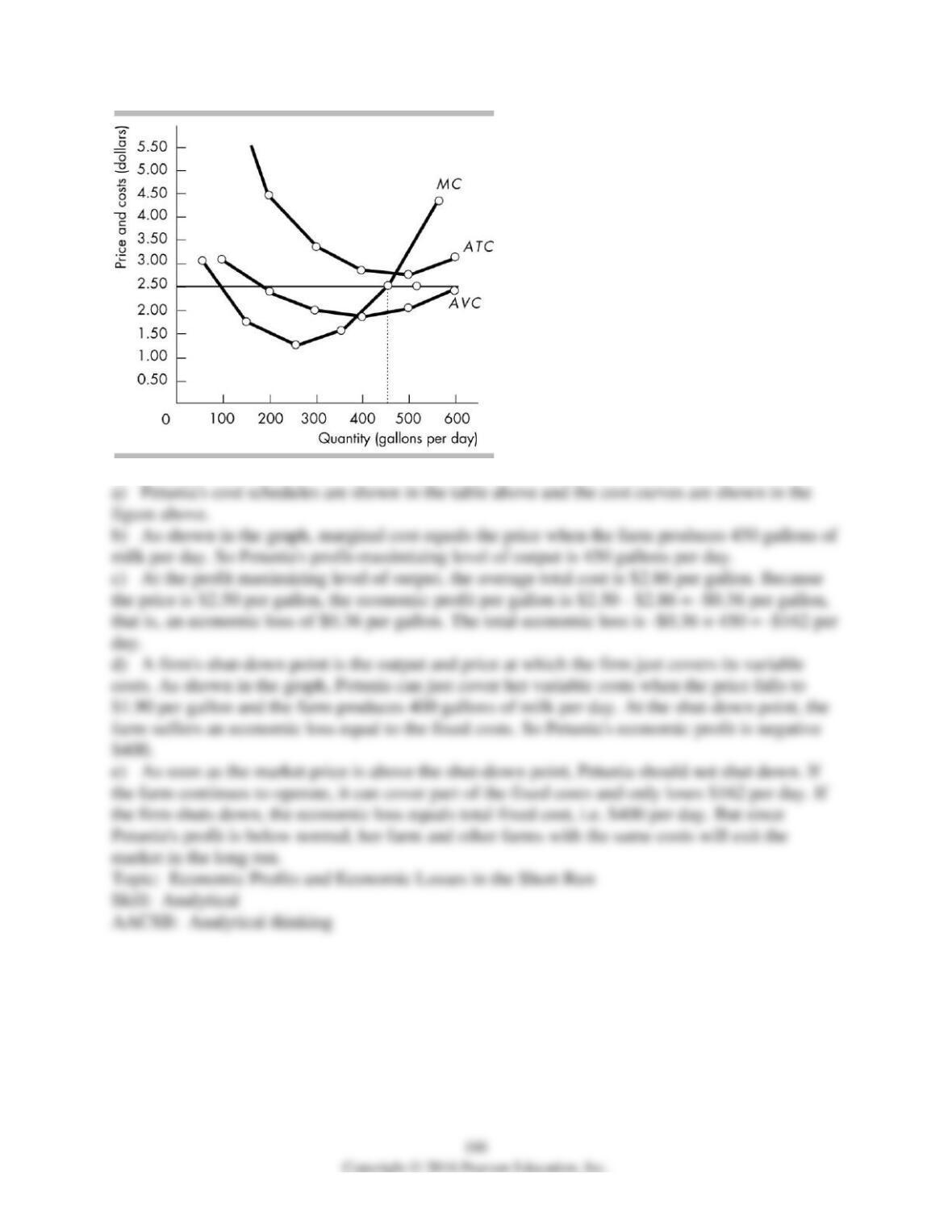
2) Petunia’s Farm produces and sells milk. The market for milk is perfectly competitive. The
market price of milk is $2.50 per gallon. The relationship between the farm’s output and total
costs is shown in the table above.
a) Draw Petunia’s average variable, average total, and marginal cost curves.
b) Use your graphs to find Petunia’s profit-maximizing output.
c) If Petunia maximizes her profit, how much profit does she make?
d) What is Petunia’s shutdown point? What is her economic profit at the shut-down point?
e) Should Petunia shut down? Will farms with costs the same as Petunia’s enter or exit the milk
market? Explain.
167
Price
(dollars per
gallon)
Quantity demanded
(thousands of gallons
per day)
2.50
600
3.50
500
4.50
400
3) The market for milk is perfectly competitive. There are 1,000 farms in the industry and the
relationship between a typical farm’s output and total costs is the same as in Problem 2. The
market demand schedule for milk is shown in the table above.
a) What is a typical farm’s supply schedule and what is the market supply schedule?
b) What is the market price? What quantity of milk is sold?
c) What is the output produced by each farm? What type of profit or loss is made by each farm?
d) Do farms enter or exit the market?
2.50
4.50