53) The table above shows some of the costs for a perfectly competitive firm. If the price is $160
per unit, how many units of output will the firm produce?
A) 8
B) 9
C) 10
D) more than 10
54) The table above provides cost data for a perfectly competitive firm producing toy cars. The
firm is producing non-divisible goods. If the market price is $70 and the firm is a profit
maximizer, the firm can earn a maximum economic profit of ________.
A) a loss of $500
B) a loss of $10
C) a loss of $510
D) $210
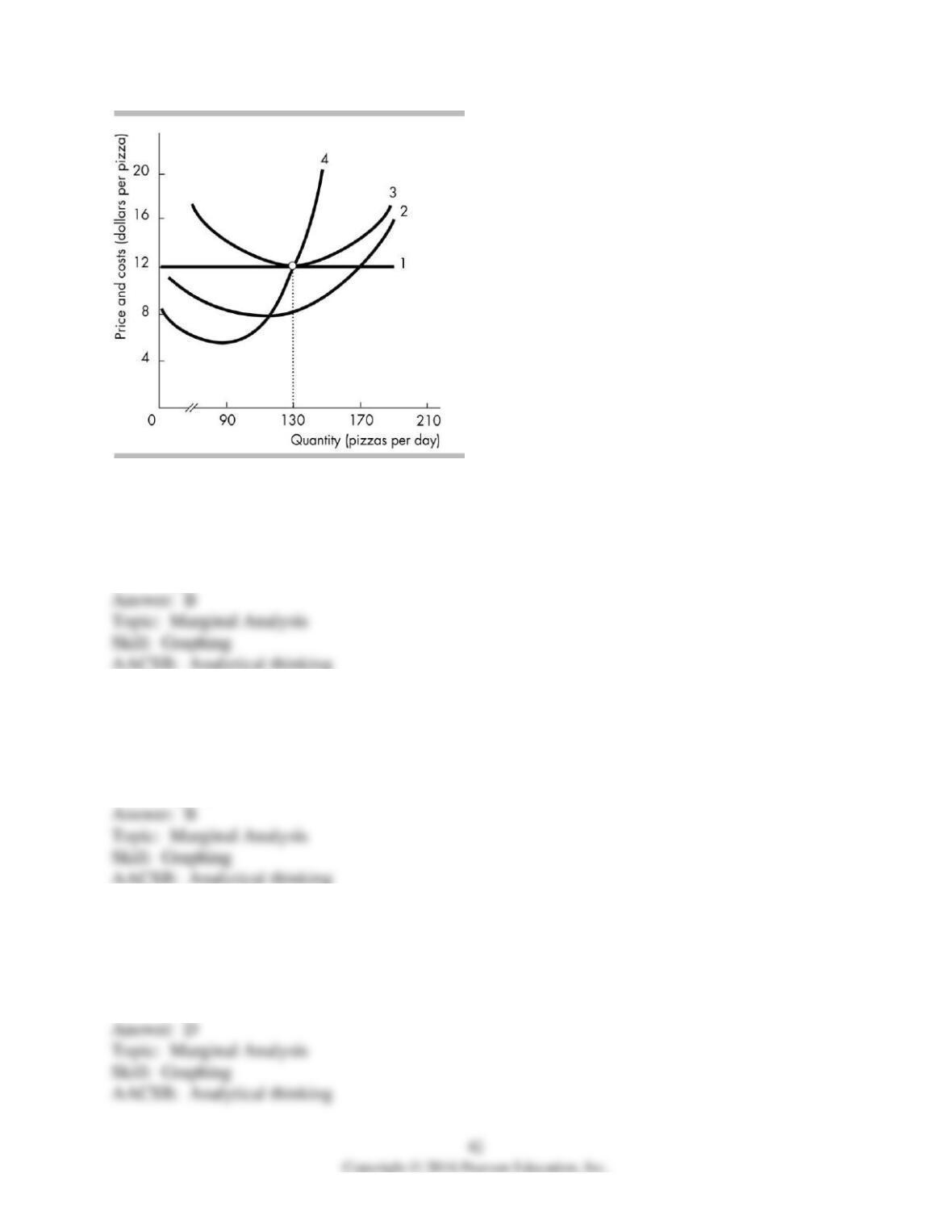
55) In the above figure, the line represented by the “2” is the
A) average fixed cost.
B) average variable cost.
C) total cost.
D) average total cost.
56) In the above figure, the line represented by the “1” is the
A) average fixed cost.
B) marginal revenue.
C) total cost.
D) average total cost.
57) In the above figure, the line represented by the “4” is the
A) average fixed cost.
B) marginal revenue.
C) average total cost.
D) marginal cost.
Quantity
(coats per day)
Total cost
(dollars per coat)
7
1,410
8
1,640
9
1,910
10
2,210
11
2,560
58) The table above shows the total cost incurred by Sue’s Coat Shop, a perfectly competitive
firm. If the market price of a coat is $285, Sue’s will maximize economic profit by selling
________ coats a day.
A) 7
B) 11
C) 8
D) 9
59) Tammy sells woolen hats in a perfectly competitive market. The marginal cost of producing
1 hat is $24. The marginal cost of producing a second hat is $26 and the marginal cost of
producing a third hat is $28. The market price of a hat is $26. To maximize profit, Tammy
produces ________ per day.
A) 1 hat
B) 3 hats
C) 2 hats
D) as many hats as possible
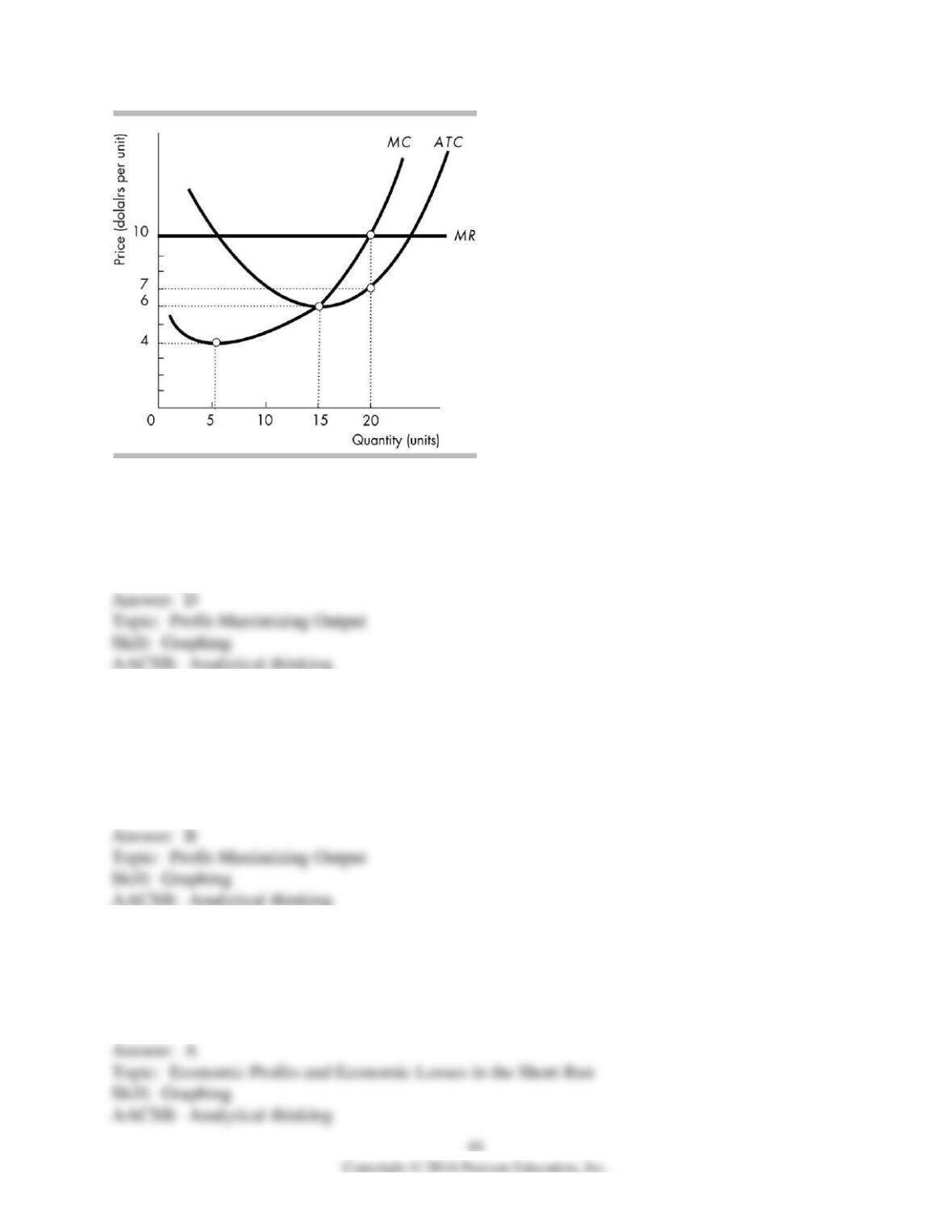
60) In the above figure, the firm will produce
A) 0 units.
B) 5 units.
C) 15 units.
D) 20 units.
61) In the above figure, the marginal cost of the last unit produced by the profit maximizing firm
is
A) $5.
B) $10.
C) $15.
D) $20.
62) In the above figure, the firm’s total economic profit is equal to
A) $60.
B) $200.
C) $150.
D) MR – MC.
63) By producing less, a firm can reduce
A) its fixed costs and its variable costs.
B) its fixed costs but not its variable costs.
C) its variable costs but not its fixed costs.
D) neither its variable costs nor its fixed costs.
64) The costs incurred even when no output is produced are called
A) fixed costs.
B) variable costs.
C) external costs.
D) marginal costs.
65) A firm’s shutdown point is the quantity and price at which the firm’s total revenue just equals
its
A) total cost.
B) total variable cost.
C) total fixed cost.
D) marginal cost.
66) A perfectly competitive firm shuts down if the price of its product is
A) greater than its minimum average variable cost.
B) less than its minimum average variable cost.
C) greater than its maximum variable cost.
D) less than its minimum total cost.
67) The owners will shut down a perfectly competitive firm if the price of its good falls below its
minimum
A) average total cost.
B) average marginal cost.
C) average variable cost.
D) wage rate.
68) A firm’s shutdown point is the output and price at which the firm just covers its
A) total fixed cost.
B) total variable cost.
C) total cost.
D) marginal cost.
69) For a perfectly competitive firm, the shutdown point is the
A) amount of output at which price equals minimum average variable cost.
B) amount of output at which price equals minimum average total cost.
C) price at which economic profit is zero.
D) price at which total opportunity cost is zero.
70) A perfectly competitive firm’s short-run shutdown point is the level of output at which
A) price equals average total cost.
B) price equals average fixed cost.
C) price equals the minimum average variable cost.
D) price is above the minimum average total cost but below the minimum average fixed cost.
71) In the short run a perfectly competitive firm will
A) never shut down.
B) shut down if P < ATC.
C) shut down if P < AVC.
D) shut down if P > AFC.
72) A perfectly competitive firm will shut down rather than produce if its
A) price is less than average variable cost.
B) price is less than total variable cost.
C) total revenue is less than total cost.
D) price is less than marginal cost.
73) In the short run, a perfectly competitive firm will shut down if
A) it incurs any economic loss.
B) price equals average cost.
C) total revenue is less than total variable cost.
D) total revenue is less than total fixed cost.
74) In the short run, a perfectly competitive firm will shut down if at the profit maximizing
quantity the
A) P < AVC.
B) AVC < ATC.
C) P > ATC.
D) P > MC.
75) If a perfectly competitive firm decides to shut down in the short run, its loss will equal its
A) minimum average variable cost, AVC.
B) total variable cost, TVC.
C) total fixed cost, TFC.
D) average total cost, ATC.
76) A firm that shuts down and produces no output incurs a loss equal to its
A) total fixed costs.
B) total variable costs.
C) marginal costs.
D) marginal revenue.
77) In the short run, a firm will
A) not produce if its total revenue does not cover its total cost.
B) produce and incur an economic loss if its total revenue covers its total variable cost but not its
total cost.
C) produce and break even if its total revenue covers its total fixed cost but not its total variable
cost.
D) produce and earn an economic profit if its total revenue is equal to its total cost.
78) The shutdown point occurs at the level of output for which the ________ is at its minimum.
A) marginal cost
B) average variable cost
C) average fixed cost
D) total cost
79) A perfectly competitive firm is more likely to shut down during a recession, when the
demand for its product declines, than during an economic expansion, because during the
recession it might be unable to cover its
A) fixed costs.
B) variable costs.
C) external costs.
D) depreciation due to machinery becoming obsolete.
80) If the price of its product falls below the minimum point on the AVC curve, the best a
perfectly competitive firm can do is to
A) keep producing and incur an economic loss equal to its total variable cost.
B) keep producing and incur an economic loss equal to its total fixed cost.
C) shut down and incur an economic loss equal to its total variable cost.
D) shut down and incur an economic loss equal to its total fixed cost.
81) When a perfectly competitive firm produces the profit-maximizing output and it is at its
shutdown point, the firm’s ________.
A) marginal revenue equals its average fixed cost
B) total revenue equals its total variable cost
C) marginal cost is less than its average variable cost
D) total revenue is less than its total variable cost
82) At its shutdown point, a perfectly competitive firm earns total revenue that
A) exceeds its total cost.
B) generates a normal profit.
C) just equals its total variable cost.
D) exceeds its total variable cost.
83) If the market price of a perfectly competitive firm’s product is below its average variable
cost, then the firm’s
A) marginal revenue is zero.
B) total revenue is as large as possible.
C) total revenue if it stayed open would be less than its total variable costs.
D) total revenue if it stayed open is less than its total cost but greater than its total fixed costs.
84) In the short run, a perfectly competitive firm NEVER
A) earns an economic profit.
B) incurs a loss greater than its total fixed costs.
C) produces where MR = MC.
D) earns a normal profit.
85) In the short run, a perfectly competitive firm might
A) set its price above marginal cost.
B) set its price above marginal revenue.
C) adjust the size of its fixed inputs.
D) operate even though it is incurring an economic loss.
86) In the short run, a perfectly competitive firm
A) shuts down if it incurs any economic loss.
B) incurs an economic loss if it shuts down.
C) does not consider total revenue in its shut down decision.
D) can earn a small economic profit while being shut down.
87) A perfectly competitive firm will operate and incur an economic loss in the short run if
A) the loss is smaller than its total fixed costs.
B) it knows it can recoup the loss in the long run.
C) shareholders do not know about the loss.
D) the loss can offset future profits.
88) If the price of its product just equals the average variable cost of production for a competitive
firm,
A) total revenue equals total fixed cost and the firm’s loss equals total variable cost.
B) total revenue equals total variable cost and the firm’s loss equals total fixed cost.
C) total fixed cost is zero.
D) total variable cost equals total fixed cost.
89) If the market price in a perfectly competitive market is less than a firm’s minimum average
variable cost, then the firm’s total revenue will always ________.
A) exceed its total fixed cost
B) be less than its total economic loss
C) equal its total cost
D) be less than its total variable cost
Output
(tons of rice
per year)
Total cost
(dollars per
ton)
0
$1,000
1
$1,200
2
$1,600
3
$2,200
4
$3,000
5
$4,000
90) Based on the table above which shows Chip’s costs, if rice sells for $600 a ton, Chip’s profit-
maximizing output is
A) less than one ton.
B) between two and three tons.
C) between three and four tons.
D) between one and two tons.
91) Based on the table above which shows Chip’s costs, if rice sells for $600 a ton, Chip will
A) shut down because he incurs an economic loss.
B) shut down because the price is below his minimum average variable cost.
C) stay open because he makes an economic profit.
D) stay open because the price is above his minimum average variable cost.
92) Based on the table above which shows Chip’s costs, if rice sells for $600 a ton, Chip
A) makes an economic profit and should stay open in the short run.
B) makes an economic profit, but should shut down in the short run.
C) incurs an economic loss, but should stay open in the short run.
D) incurs an economic loss and should shut down in the short run.
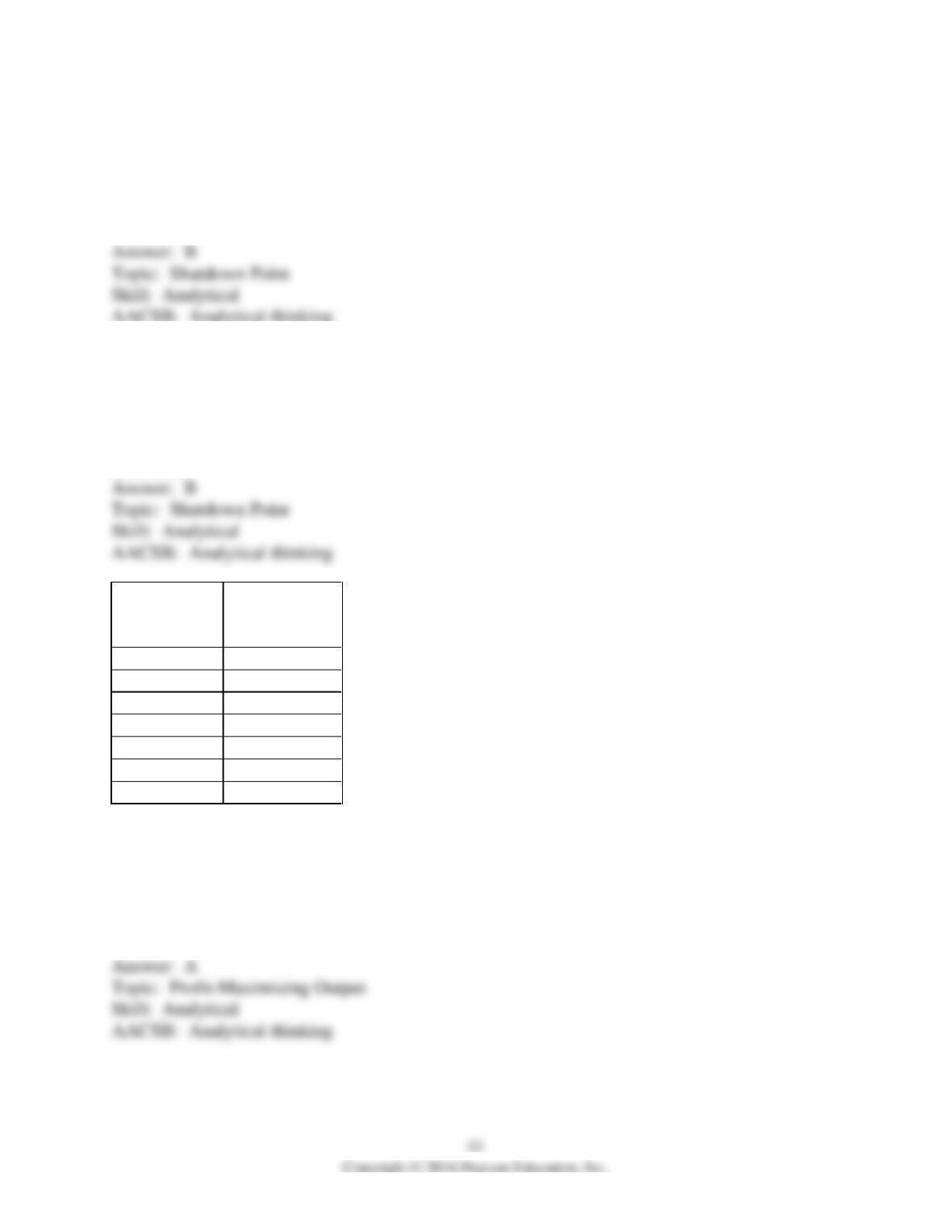
93) Based on the table above which shows Chip’s costs, if Chip shuts down in the short run, his
total cost will be
A) $0.
B) $1,000.
C) $1,200.
D) $4,000.
94) Based on the table above which shows Chip’s costs, if Chip shuts down in the short run, his
economic loss will be
A) $0.
B) $1,000.
C) $1,200.
D) $4,000.
Quantity
(pizzas per
hour)
Total cost, TC
(dollars per
hour)
0
10
1
18
2
30
3
48
4
70
5
98
6
120
95) Giuseppe’s Pizza is a perfectly competitive firm. The firm’s costs are shown in the table
above. If the market price is $15, what is Giuseppe’s profit-maximizing output?
A) 2 pizzas per hour
B) 3 pizzas per hour
C) 4 pizzas per hour
D) 0 pizzas per hour
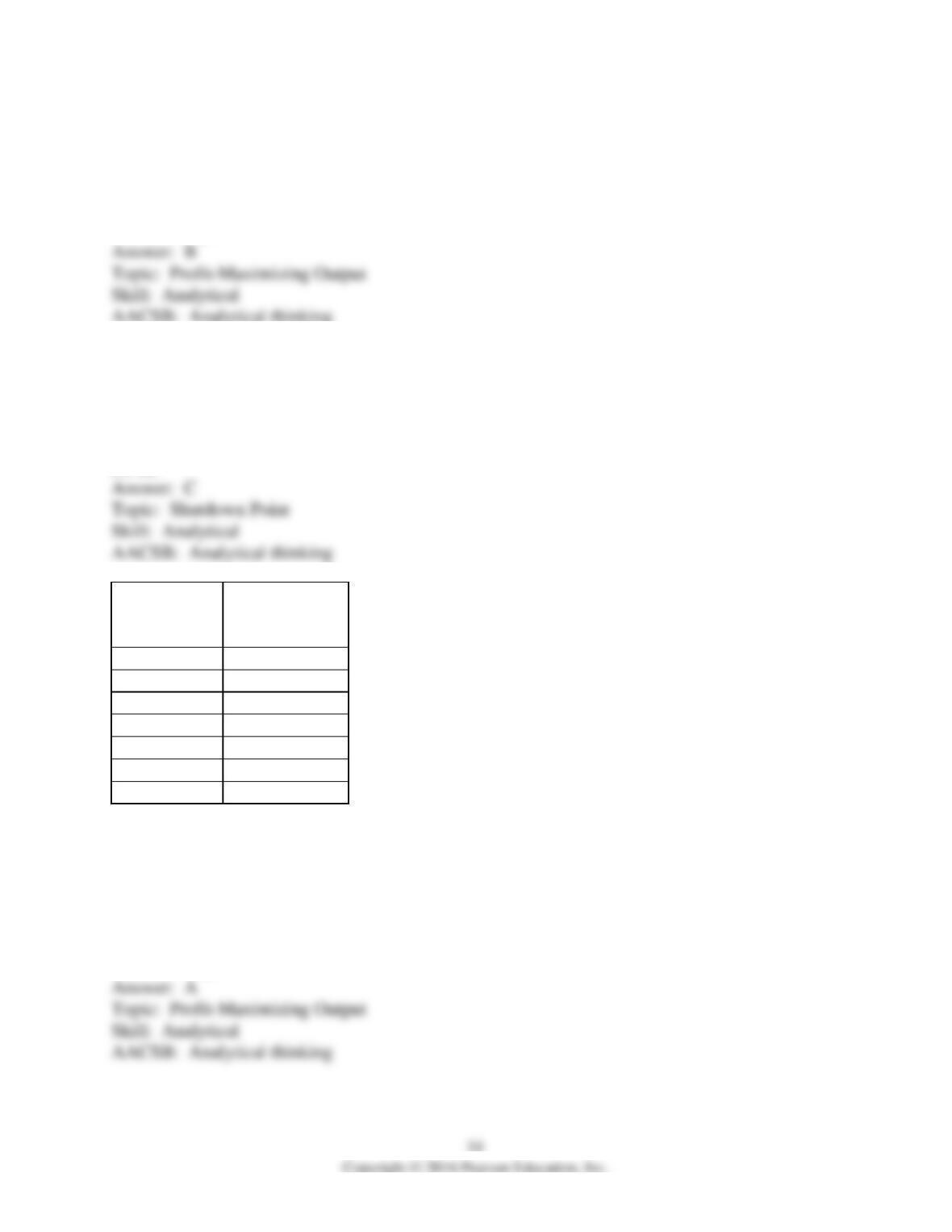
96) Giuseppe’s Pizza is a perfectly competitive firm. The firm’s costs are shown in the table
above. If the market price is $20, what is Giuseppe’s profit-maximizing output?
A) 2 pizzas per hour
B) 3 pizzas per hour
C) 4 pizzas per hour
D) 0 pizzas per hour
97) Giuseppe’s Pizza is a perfectly competitive firm. The firm’s costs are shown in the table
above. The firm’s shutdown point is
A) $12.
B) $17.
C) $8.
D) $2.
Quantity
(tattoos per
hour)
Total cost, TC
(dollars per
hour)
0
10
1
25
2
35
3
50
4
70
5
95
6
125
98) Archibald’s Tattoos is a perfectly competitive firm. The firm’s costs are shown in the table
above. If the market price of a tattoo is $12.50 and if Archibald’s does not shut down, what is the
firm’s profit-maximizing output?
A) 2 tattoos per hour
B) 3 tattoos per hour
C) 4 tattoos per hour
D) 5 tattoos per hour
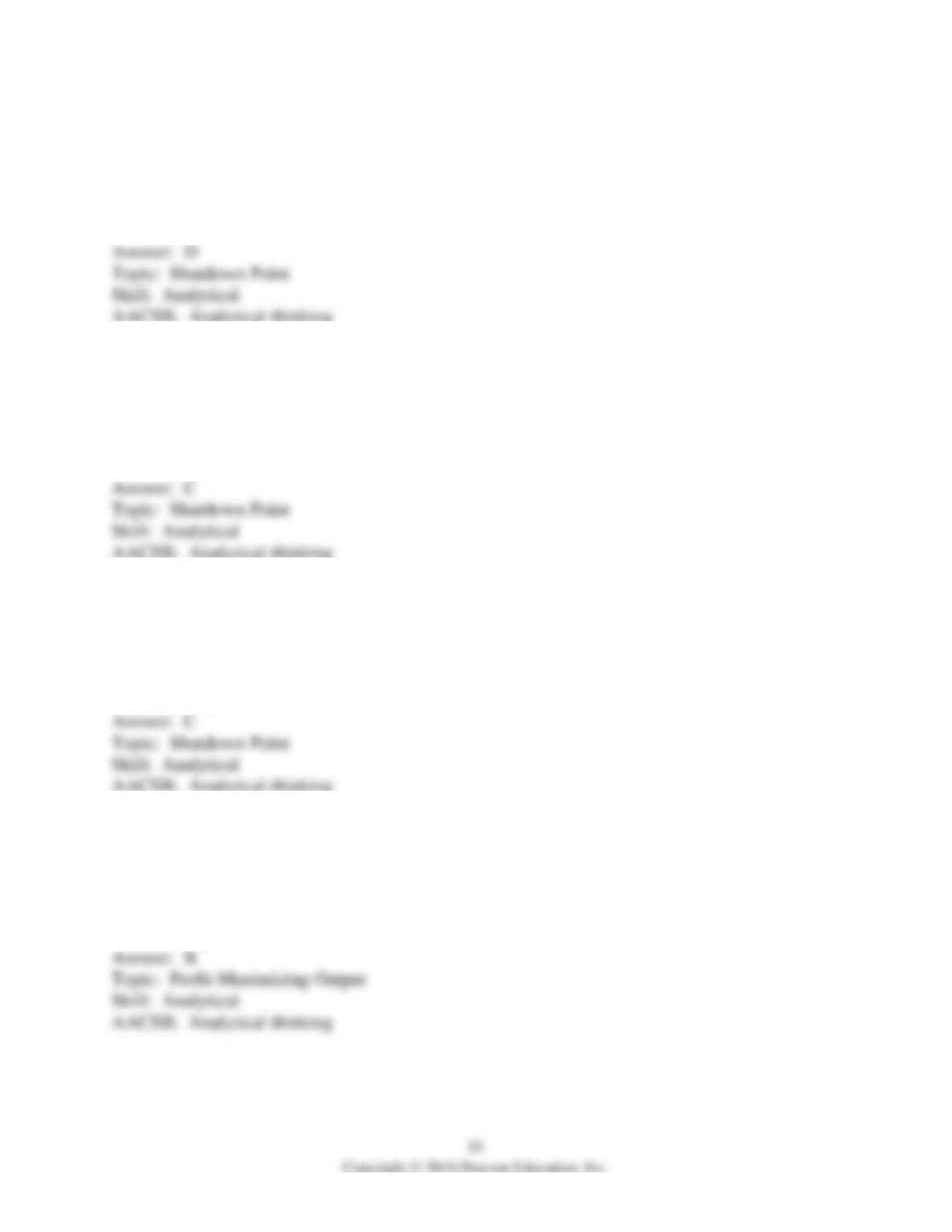
99) Archibald’s Tattoos is a perfectly competitive firm. The firm’s costs are shown in the table
above. What is Archibald’s shut-down point?
A) $10.00
B) $16.67
C) $15.00
D) $12.50
100) Archibald’s Tattoos is a perfectly competitive firm. The firm’s costs are shown in the table
above. If the market price of a tattoo is $12.50 what is the firm’s economic profit?
A) zero
B) $10 per hour
C) -$10 per hour
D) $20 per hour
101) Archibald’s Tattoos is a perfectly competitive firm. The firm’s costs are shown in the table
above. If the market price of a tattoo is $12, the firm
A) incurs an economic loss, but will not shut down.
B) will not shut down in the short run, but will leave the industry in the long run.
C) will shut down.
D) is breaking even.
102) Archibald’s Tattoos is a perfectly competitive firm. The firm’s costs are shown in the table
above. If the market price of a tattoo is $17.50 what is the firm’s profit-maximizing output?
A) 2 tattoos per hour
B) 3 tattoos per hour
C) 4 tattoos per hour
D) 5 tattoos per hour
Output
(sandwiches per hour)
Average total cost
($ per sandwich)
1
17.00
2
10.00
3
8.00
4
8.00
5
8.80
6
10.00
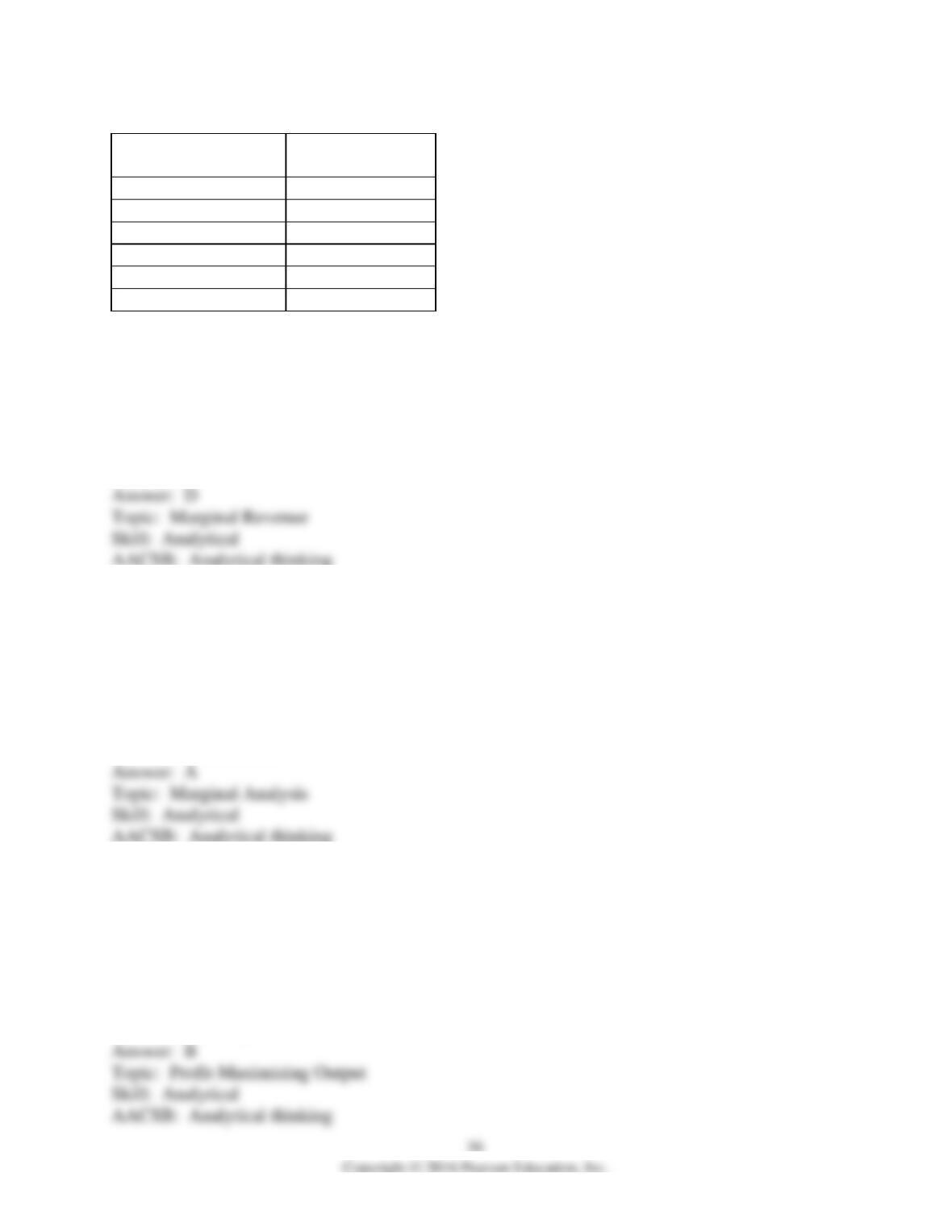
103) The table above shows output and costs of Evan’s Subs, a typical perfectly competitive firm
in a local market for sandwiches. Evan’s fixed cost is $9 per hour. The current market price of a
sandwich is $6. What is Evan’s marginal revenue from the 2nd sandwich sold?
A) $10.00
B) $13.50
C) $3.00
D) $6.00
104) The table above shows output and costs of Evan’s Subs, a typical perfectly competitive firm
in a local market for sandwiches. Evan’s fixed cost is $9 per hour. The current market price of a
sandwich is $6. If Evan’s sells the 5th sandwich, the marginal cost is ________ the marginal
revenue, so the firm’s profit ________.
A) greater than; decreases
B) greater than; increases
C) less than; increases
D) less than; decreases
105) The table above shows output and costs of Evan’s Subs, a typical perfectly competitive firm
in a local market for sandwiches. Evan’s fixed cost is $9 per hour. The current market price of a
sandwich is $6. What quantity of sandwiches produced will maximize Evan’s economic profit in
the short run?
A) 2 sandwiches per hour
B) 3 sandwiches per hour
C) 4 sandwiches per hour
D) 5 sandwiches per hour
106) The table above shows output and costs of Evan’s Subs, a typical perfectly competitive firm
in a local market for sandwiches. Evan’s fixed cost is $9 per hour. The current market price of a
sandwich is $6. What is Evan’s maximum short-run economic profit?
A) $6 per hour
B) $1 per hour
C) -$6 per hour
D) zero
107) The table above shows output and costs of Evan’s Subs, a typical perfectly competitive firm
in a local market for sandwiches. Evan’s fixed cost is $9 per hour. The current market price of a
sandwich is $6. What is Evan’s shut-down price?
A) $6 per sandwich
B) $4 per sandwich
C) $3 per sandwich
D) $5 per sandwich
108) The table above shows output and costs of Evan’s Subs, a typical perfectly competitive firm
in a local market for sandwiches. Evan’s fixed cost is $9 per hour. The current market price of a
sandwich is $6. If the market price does not change, Evan’s will
A) continue to operate in the short run, but will exit the industry in the long run.
B) continue to operate in the short run and in the long run.
C) shut down.
D) increase its production in the long run.
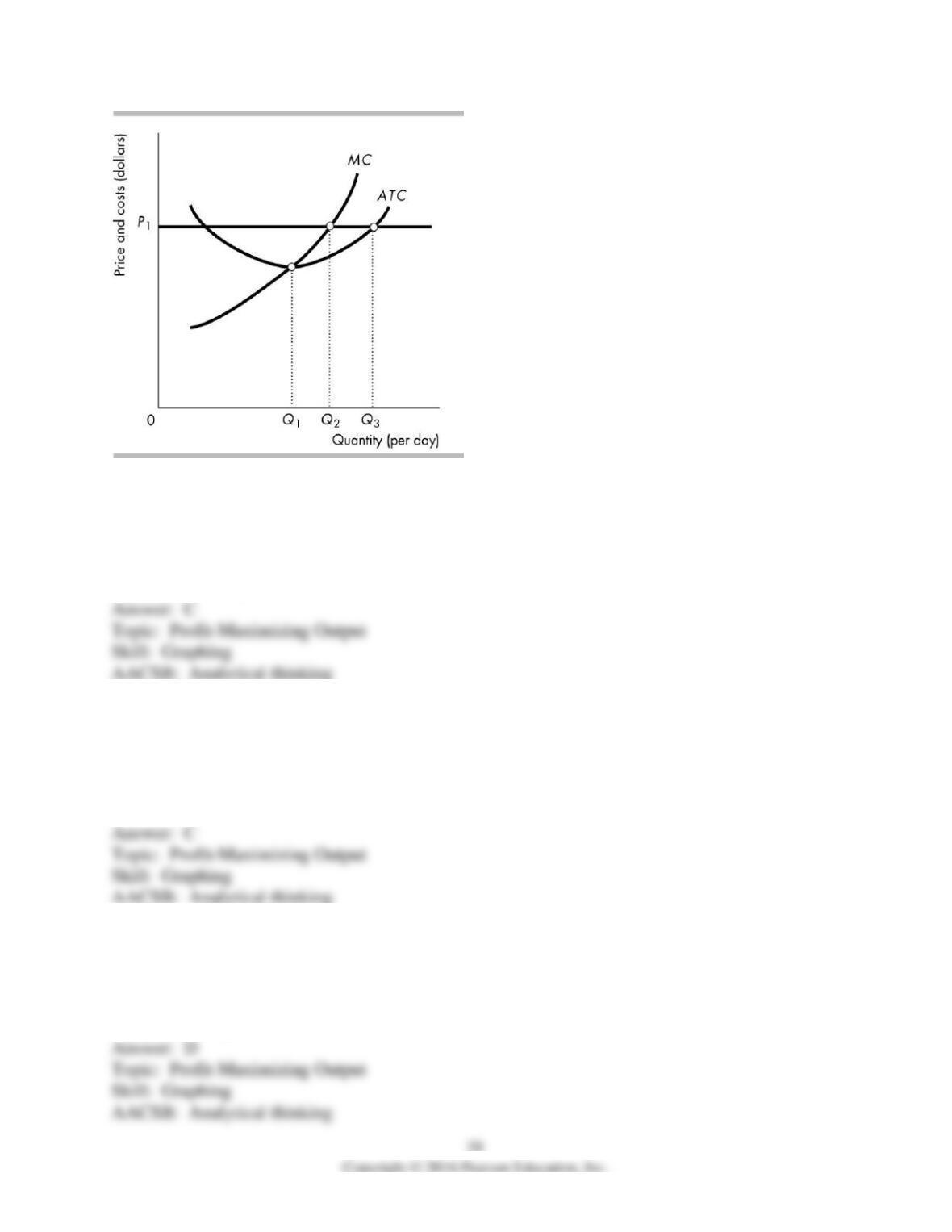
109) In the above figure, if the price is P1, the firm will produce
A) nothing.
B) where MC equals ATC.
C) where MC equals P1.
D) where ATC equals P1.
110) In the above figure, if the price is P1, the firm maximizes its profit by producing
A) nothing.
B) where MC equals ATC.
C) where MC equals P1.
D) where ATC equals P1.
111) In the above figure, if the firm increases its output from Q1 to Q2, it will
A) reduce its marginal revenue.
B) increase its marginal revenue.
C) decrease its profit.
D) increase its profit.
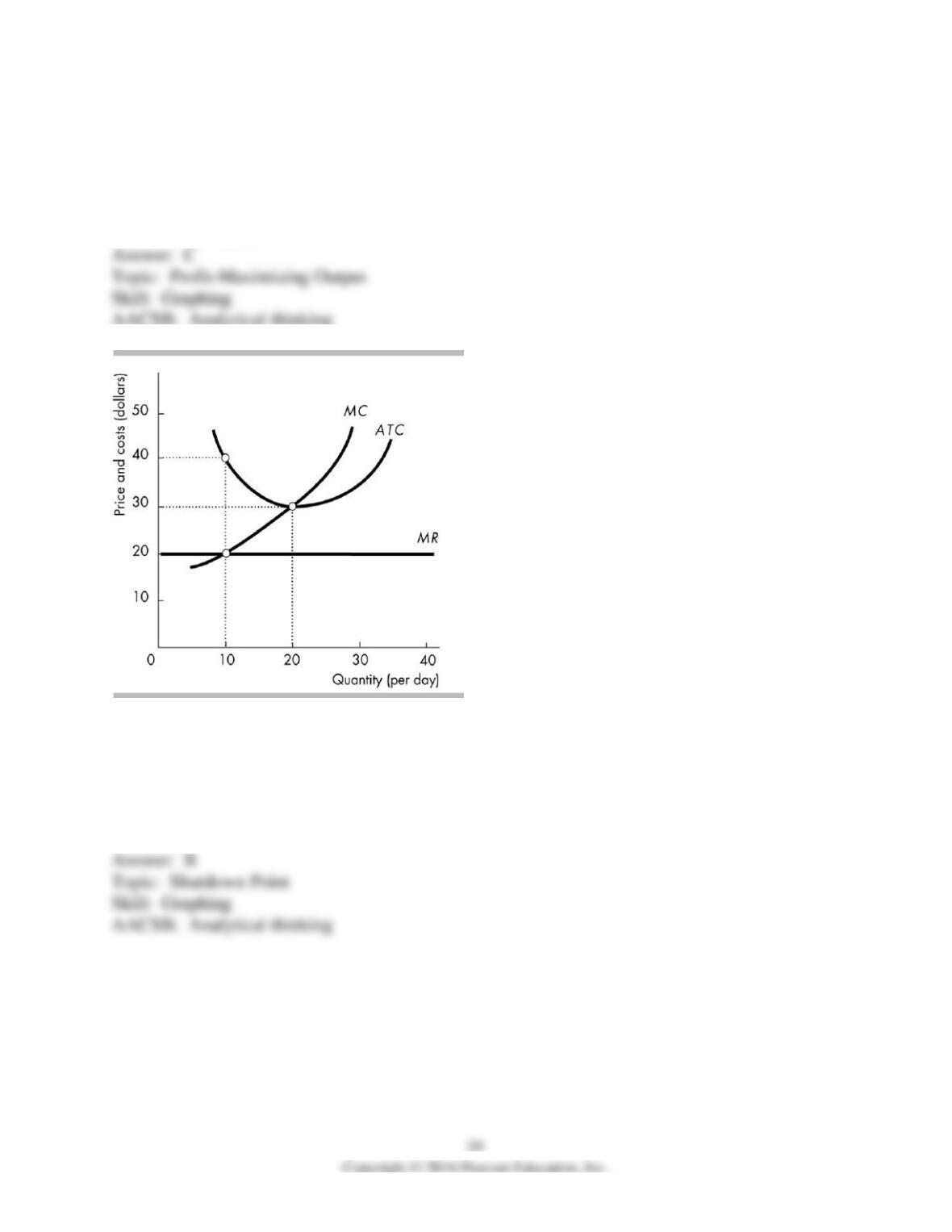
112) In the above figure, if the firm increases its output from Q2 to Q3, it will
A) reduce its marginal revenue.
B) increase its marginal revenue.
C) decrease its profit.
D) increase its profit.
113) The figure above shows a perfectly competitive firm. In the short run, the firm will shut
down
A) only if the AVC of producing 10 units is less than $20.
B) only if the AVC of producing 10 units is more than $20.
C) only if the AVC curve reaches its minimum before 10 units are produced.
D) always.
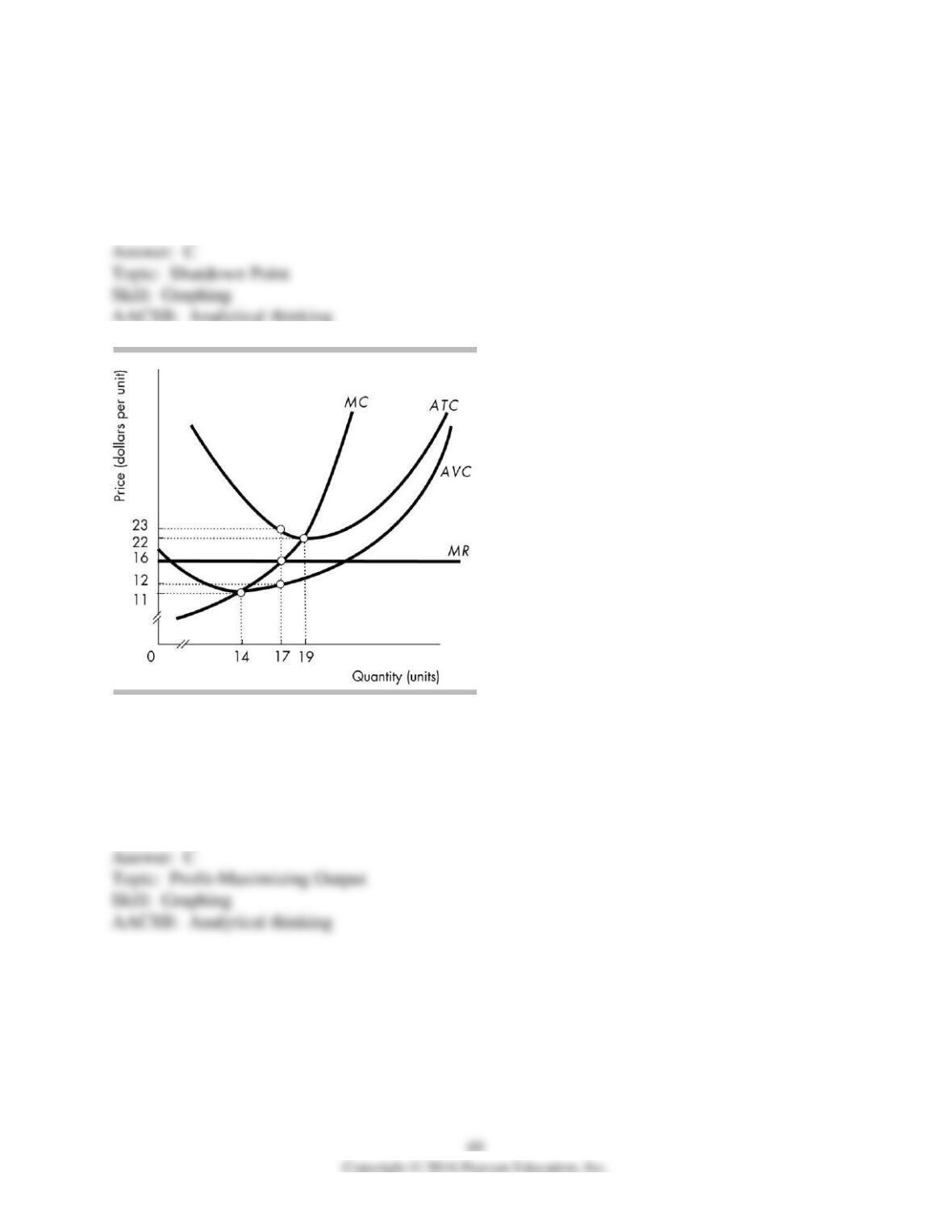
114) The figure above shows a perfectly competitive firm. The firm will shut down in the short
run if total fixed costs
A) are between $201 and $400.
B) exceed $401.
C) are less than $200.
D) exceed total costs.
115) Consider the perfectly competitive firm in the above figure. The profit maximizing level of
output for the firm is equal to
A) 0 units.
B) 14 units.
C) 17 units.
D) 19 units.