Chapter 12: Cash Flow Estimation and Risk Analysis
Equipment life, years
Equipment cost
Depreciation: Rate = 33.333%
Sales revenues
Operating income (EBIT)
EBIT(1 − T)
60.
Clemson Software is considering a new project whose data are shown below. The required equipment has a 3–
year
tax life, after which it will be worthless, and it will be depreciated by the straight-line method over 3
years. Revenues
and other operating costs are expected to be constant over the project’s 3-year life. What is the
project’s Year 1
cash flow?
Equipment cost (depreciable basis)
$65,000
Straight-line depreciation rate
33.333%
Sales revenues, each year
$60,000
Operating costs (excl. depreciation)
$25,000
Tax rate
a. $28,115
35.0%
b. $28,836
c. $29,575
d. $30,333
e. $31,092
Sales revenues
Operating income (EBIT)
EBIT(1 − T)
61.
As a member of UA Corporation’s financial staff, you must estimate the Year 1 cash flow for a proposed
project
with the following data. What is the Year 1 cash flow?
Sales revenues, each year
$42,500
Depreciation
$10,000
Other operating costs
$17,000
Interest expense
$4,000
Tax rate
a. $16,351
35.0%
b. $17,212
c. $18,118
d. $19,071
e. $20,075
Sales revenues
Operating income (EBIT)
62.
You work for Whittenerg Inc., which is considering a new project whose data are shown below. What is the
project’s Year 1 cash flow?
Sales revenues, each year
$62,500
Depreciation
$8,000
Other operating costs
$25,000
Interest expense
$8,000
Tax rate
a. $25,816
35.0%
b. $27,175
c. $28,534
d. $29,960
e. $31,458
Equipment cost
Depreciation rate
Sales revenues
Operating income (EBIT)
63.
Fool Proof Software is considering a new project whose data are shown below. The equipment that would be
used
has a 3-year tax life, and the allowed depreciation rates for such property are 33%, 45%, 15%, and 7% for
Years 1
through 4. Revenues and other operating costs are expected to be constant over the project’s 10-year
expected life.
What is the Year 1 cash flow?
Equipment cost (depreciable basis)
$65,000
Sales revenues, each year
$60,000
Operating costs (excl. depreciation)
$25,000
Tax rate
a. $30,258
35.0%
b. $31,770
c. $33,359
d. $35,027
e. $36,778
Equipment cost
Depreciation rate, Year 4
Sales revenues
Operating income (EBIT)
64.
Your company, CSUS Inc., is considering a new project whose data are shown below. The required equipment
has a 3-year tax life, and the accelerated rates for such property are 33%, 45%, 15%, and 7% for Years 1
through 4. Revenues and other operating costs are expected to be constant over the project’s 10-year expected
operating life. What is the project’s Year 4 cash flow?
Equipment cost (depreciable basis)
$70,000
Sales revenues, each year
$42,500
Operating costs (excl. depreciation)
$25,000
Tax rate
a. $11,814
35.0%
b. $12,436
c. $13,090
d. $13,745
e. $14,432
Sales revenues
Operating income (EBIT)
EBIT(1 − T)
+ Depreciation
65.
Temple Corp. is considering a new project whose data are shown below. The equipment that would be used has
a 3- year tax life, would be depreciated by the straight-line method over its 3-year life, and would have a zero
salvage value. No change in net operating working capital would be required. Revenues and other operating
costs are expected to be constant over the project’s 3-year life. What is the project’s NPV?
Risk-adjusted WACC
10.0%
Net investment cost (depreciable basis)
$65,000
Straight-line depreciation rate
33.3333%
Sales revenues, each year
$65,500
Annual operating costs (excl. depreciation)
$25,000
Tax rate
a. $15,740
35.0%
b. $16,569
c. $17,441
d. $18,359
e. $19,325
66.
Liberty Services is now at the end of the final year of a project. The equipment originally cost $22,500, of
which
75% has been depreciated. The firm can sell the used equipment today for $6,000, and its tax rate is
40%. What is
the equipment’s after-tax salvage value for use in a capital budgeting analysis? Note that if the
equipment’s final
market value is less than its book value, the firm will receive a tax credit as a result of the
sale.
a.
$5,558
b.
$5,850
c.
$6,143
d.
$6,450
e.
$6,772
67.
Marshall-Miller & Company is considering the purchase of a new machine for $50,000, installed. The machine
has a
tax life of 5 years, and it can be depreciated according to the depreciation rates below. The firm expects
to operate
the machine for 4 years and then to sell it for $12,500. If the marginal tax rate is 40%, what will the
after-tax salvage
value be when the machine is sold at the end of Year 4?
Year Depreciation Rate
1 0.20
2 0.32
3 0.19
4 0.12
5 0.11
6 0.06
a. $ 8,878
b. $ 9,345
c. $ 9,837
d. $10,355
e. $10,900
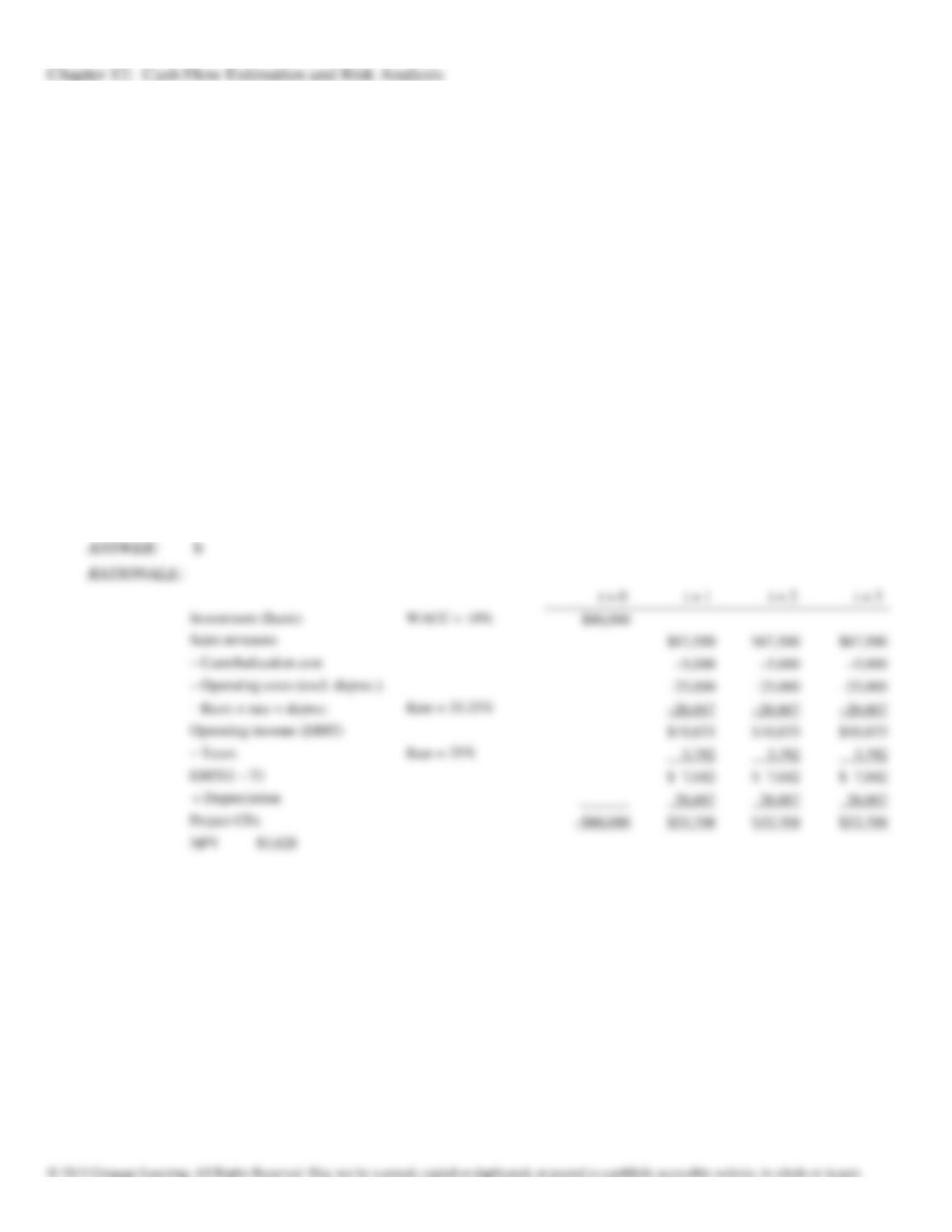
68.
TexMex Food Company is considering a new salsa whose data are shown below. The equipment to be used
would
be depreciated by the straight-line method over its 3-year life and would have a zero salvage value, and
no change in
net operating working capital would be required. Revenues and other operating costs are expected
to be constant
over the project’s 3-year life. However, this project would compete with other TexMex products
and would reduce
their pre-tax annual cash flows. What is the project’s NPV? (Hint: Cash flows are constant in
Years 1–3.)
WACC
10.0%
Pre-tax cash flow reduction for other products (cannibalization)
−$5,000
Investment cost (depreciable basis)
$80,000
Straight-line depreciation rate
33.333%
Annual sales revenues
$67,500
Annual operating costs (excl. depreciation)
−$25,000
Tax rate
a. $3,636
35.0%
b. $3,828
c. $4,019
d. $4,220
e. $4,431
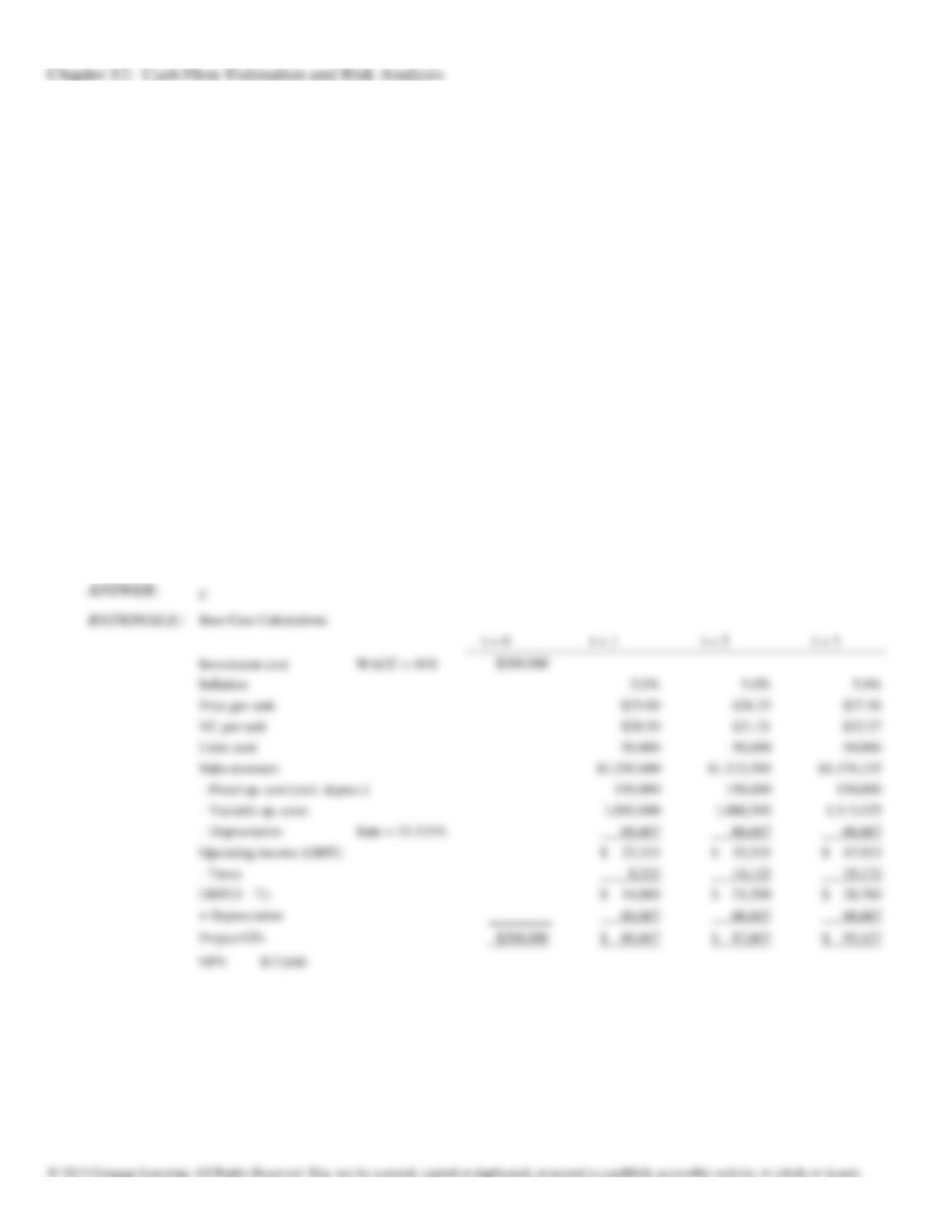
69.
Desai Industries is analyzing an average-risk project, and the following data have been developed. Unit sales
will be
constant, but the sales price should increase with inflation. Fixed costs will also be constant, but
variable costs should
rise with inflation. The project should last for 3 years, it will be depreciated on a straight-
line basis, and there will be
no salvage value. No change in net operating working capital would be required.
This is just one of many projects for
the firm, so any losses on this project can be used to offset gains on other
firm projects. What is the project’s
expected NPV?
WACC
10.0%
Net investment cost (depreciable basis)
$200,000
Units sold
50,000
Average price per unit, Year 1
$25.00
Fixed oper. costs excl. depreciation (constant)
$150,000
Variable oper. cost/unit, Year 1
$20.20
Annual depreciation rate
33.333%
Expected inflation rate per year
5.00%
Tax rate
a. $15,925
40.0%
b. $16,764
c. $17,646
d. $18,528
e. $19,455
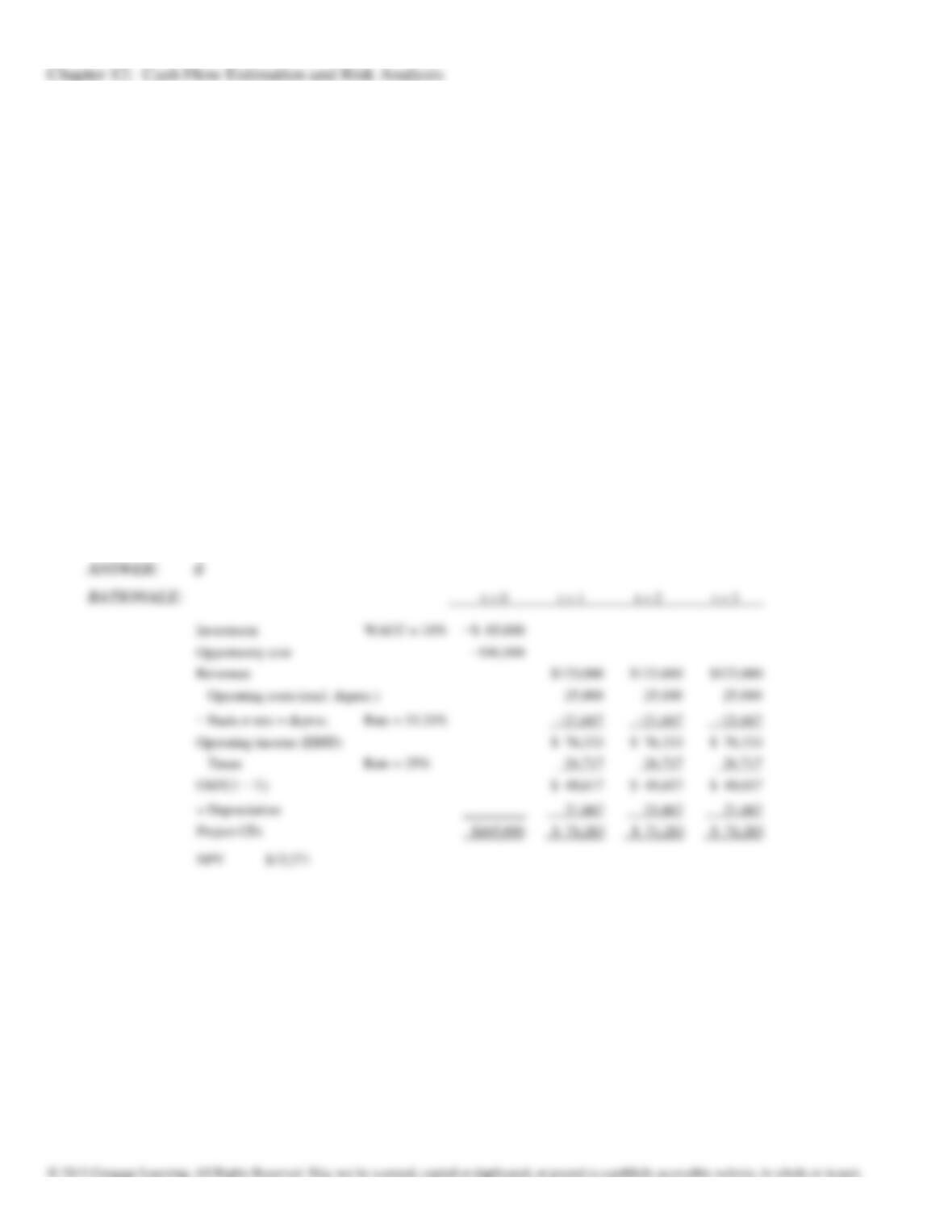
70.
Sub-Prime Loan Company is thinking of opening a new office, and the key data are shown below. The
company
owns the building that would be used, and it could sell it for $100,000 after taxes if it decides not to
open the new
office. The equipment for the project would be depreciated by the straight-line method over the
project’s 3-year life,
after which it would be worth nothing and thus it would have a zero salvage value. No
change in net operating
working capital would be required, and revenues and other operating costs would be
constant over the project’s 3–
year life. What is the project’s NPV? (Hint: Cash flows are constant in Years 1–
3.)
WACC
10.0%
Opportunity cost
$100,000
Net equipment cost (depreciable basis)
$65,000
Straight-line depreciation rate for equipment
33.333%
Annual sales revenues
$123,000
Annual operating costs (excl. depreciation)
$25,000
Tax rate
a. $10,521
35%
b. $11,075
c. $11,658
d. $12,271
e. $12,885
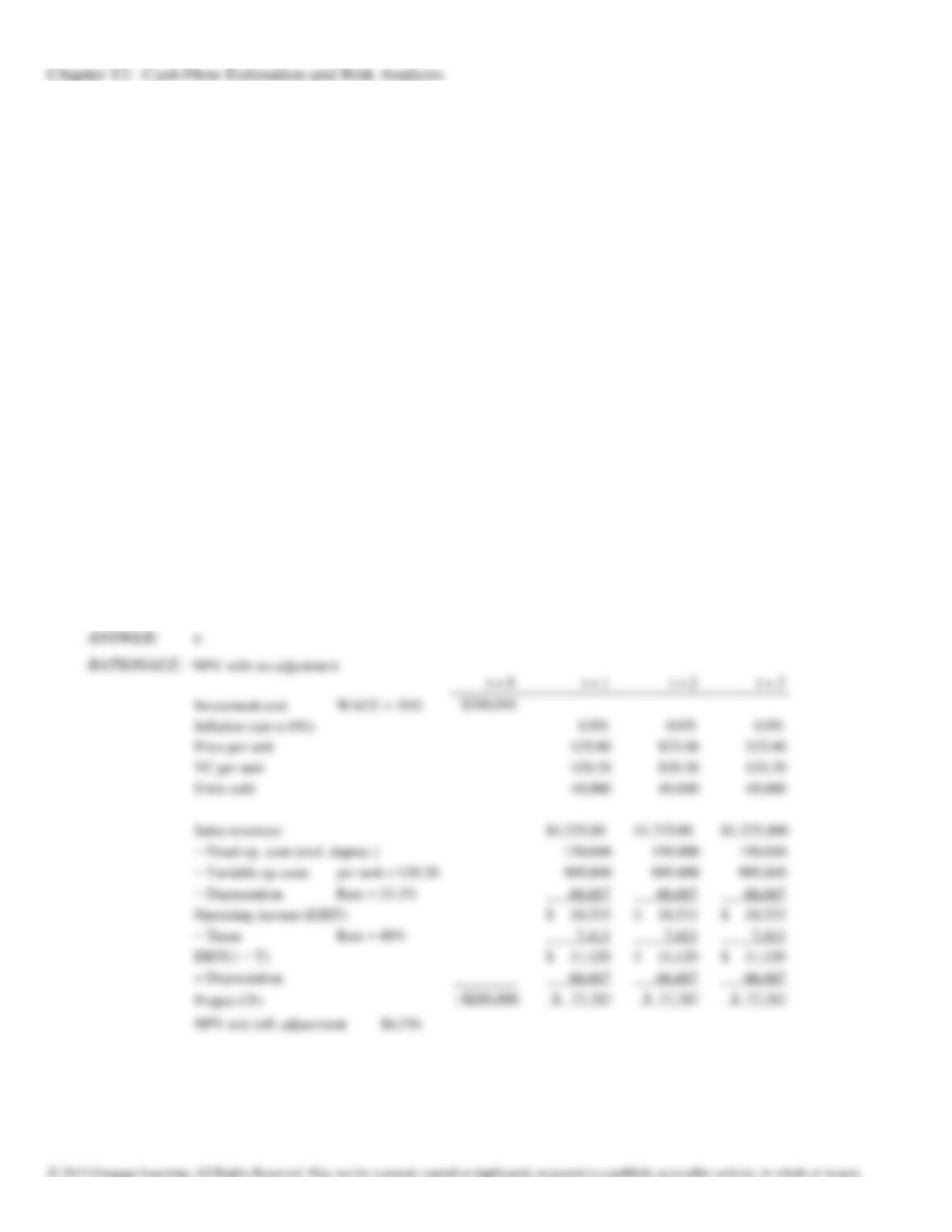
71.
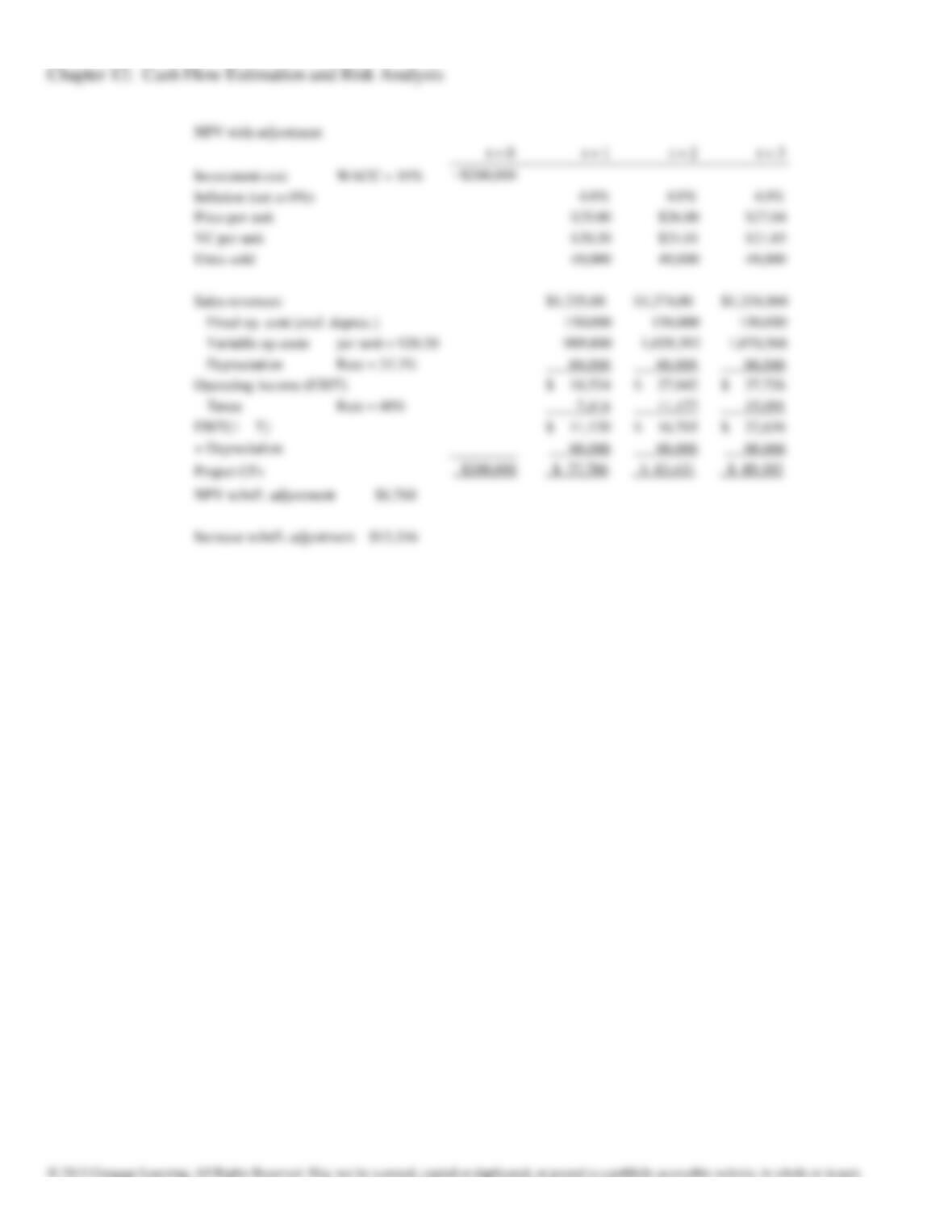
Poulsen Industries is analyzing an average-risk project, and the following data have been developed. Unit sales
will
be constant, but the sales price should increase with inflation. Fixed costs will also be constant, but
variable costs
should rise with inflation. The project should last for 3 years, it will be depreciated on a straight–
line basis, and there
will be no salvage value. No change in net operating working capital would be required.
This is just one of many
projects for the firm, so any losses on this project can be used to offset gains on other
firm projects. The marketing
manager does not think it is necessary to adjust for inflation since both the sales
price and the variable costs will rise
at the same rate, but the CFO thinks an inflation adjustment is required.
What is the difference in the expected NPV
if the inflation adjustment is made versus if it is not made?
WACC
10.0%
Net investment cost (depreciable basis)
$200,000
Units sold
50,000
Average price per unit, Year 1
$25.00
Fixed oper. costs excl. depreciation (constant)
$150,000
Variable oper. cost/unit, Year 1
$20.20
Annual depreciation rate
33.333%
Expected inflation
4.00%
Tax rate
a. $12,018
40.0%
b. $12,650
c. $13,316
d. $13,982
e. $14,681
72.
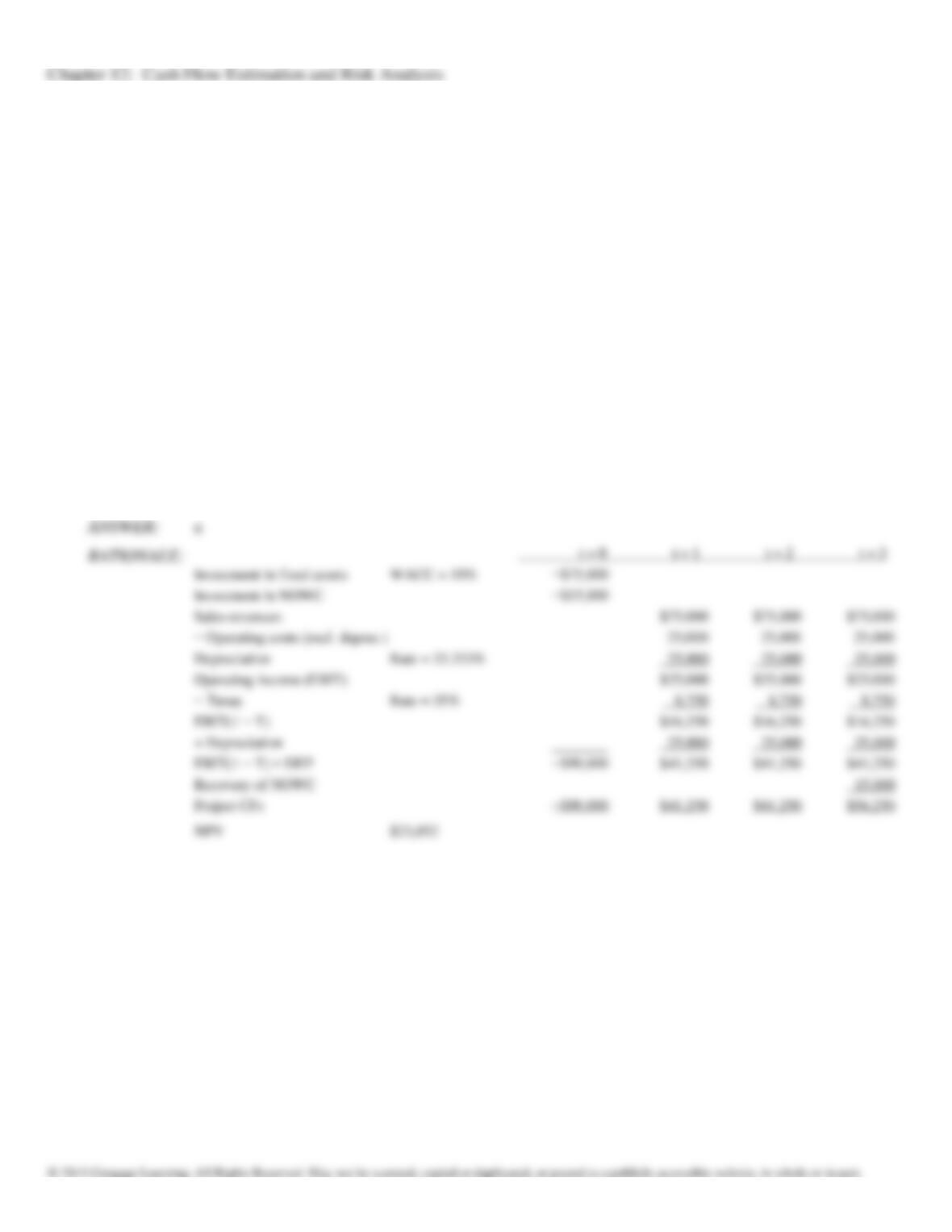
Foley Systems is considering a new investment whose data are shown below. The equipment would be
depreciated
on a straight-line basis over the project’s 3-year life, would have a zero salvage value, and would
require additional
net operating working capital that would be recovered at the end of the project’s life.
Revenues and other operating
costs are expected to be constant over the project’s life. What is the project’s
NPV? (Hint: Cash flows from
operations are constant in Years 1 to 3.)
WACC
10.0%
Net investment in fixed assets (basis)
$75,000
Required net operating working capital
$15,000
Straight-line depreciation rate
33.333%
Annual sales revenues
$75,000
Annual operating costs (excl. depreciation)
$25,000
Tax rate
a. $23,852
35.0%
b. $25,045
c. $26,297
d. $27,612
e. $28,993
73.
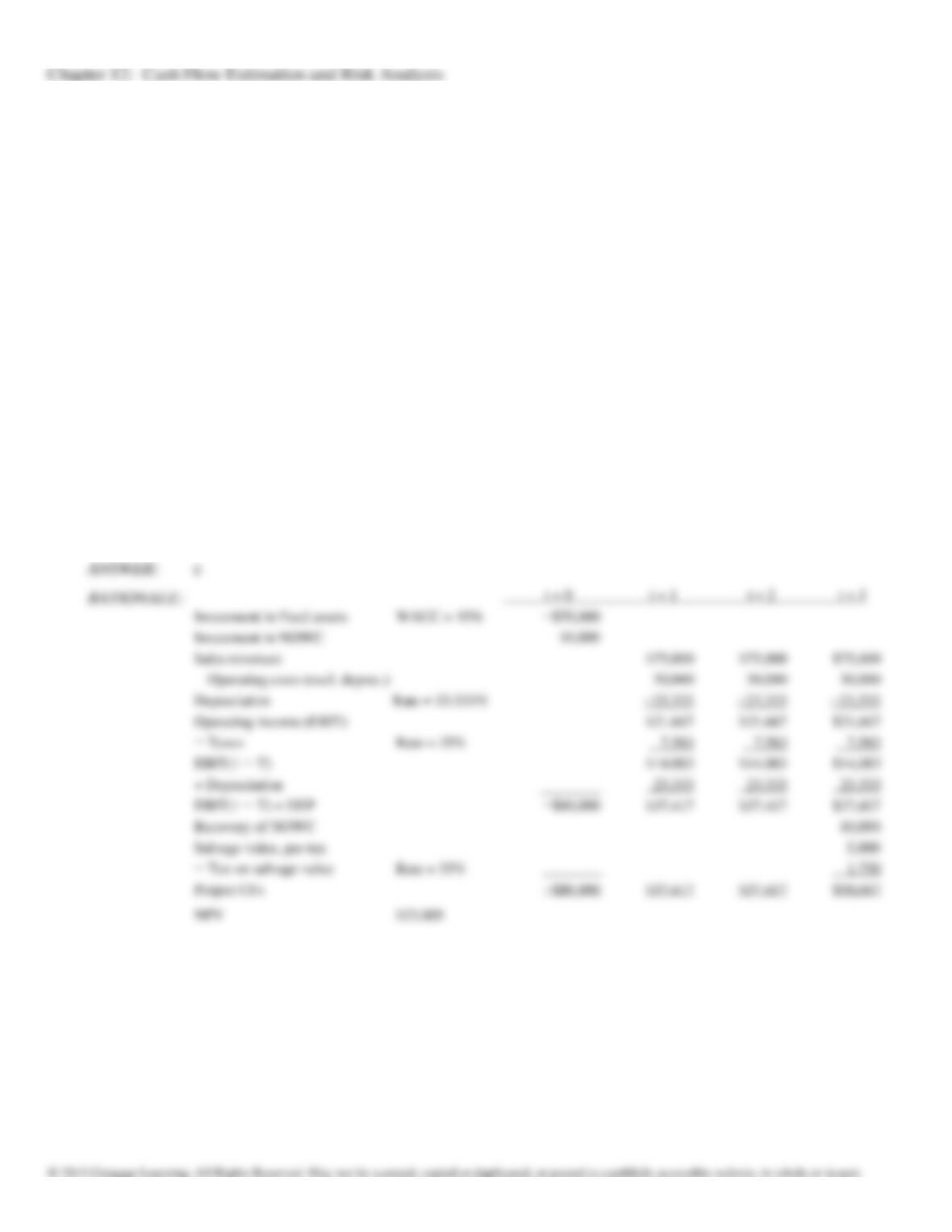
Thomson Media is considering some new equipment whose data are shown below. The equipment has a 3-year
tax
life and would be fully depreciated by the straight-line method over 3 years, but it would have a positive
pre-tax
salvage value at the end of Year 3, when the project would be closed down. Also, additional net
operating working
capital would be required, but it would be recovered at the end of the project’s life.
Revenues and other operating
costs are expected to be constant over the project’s 3-year life. What is the
project’s NPV?
WACC
10.0%
Net investment in fixed assets (depreciable basis)
$70,000
Required net operating working capital
$10,000
Straight-line depreciation rate
33.333%
Annual sales revenues
$75,000
Annual operating costs (excl. depreciation)
$30,000
Expected pre-tax salvage value
$5,000
Tax rate
a. $20,762
35.0%
b. $21,854
c. $23,005
d. $24,155
e. $25,363
74.
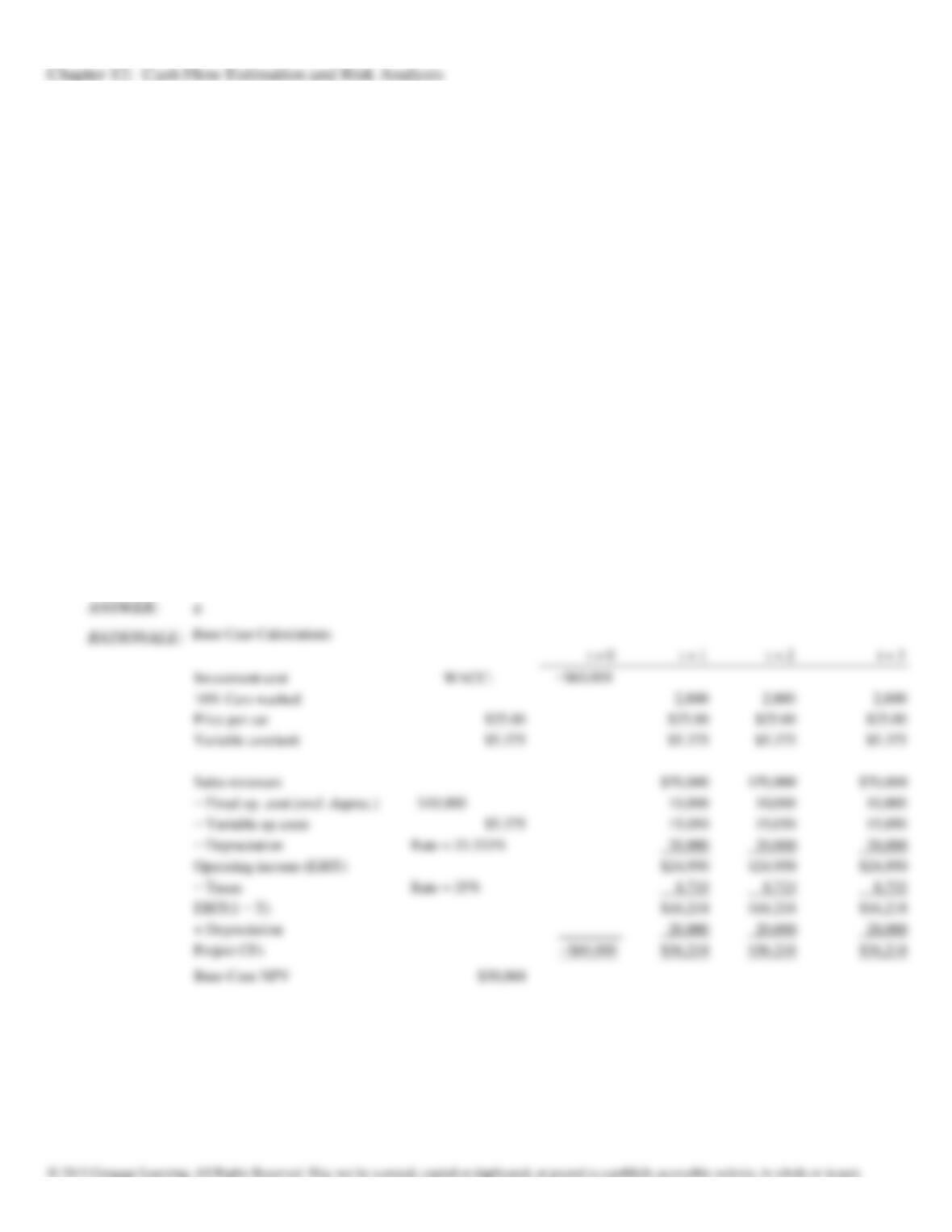
Florida Car Wash is considering a new project whose data are shown below. The equipment to be used has a 3–
year
tax life, would be depreciated on a straight-line basis over the project’s 3-year life, and would have a zero
salvage
value after Year 3. No change in net operating working capital would be required. Revenues and other
operating
costs will be constant over the project’s life, and this is just one of the firm’s many projects, so any
losses on it can be
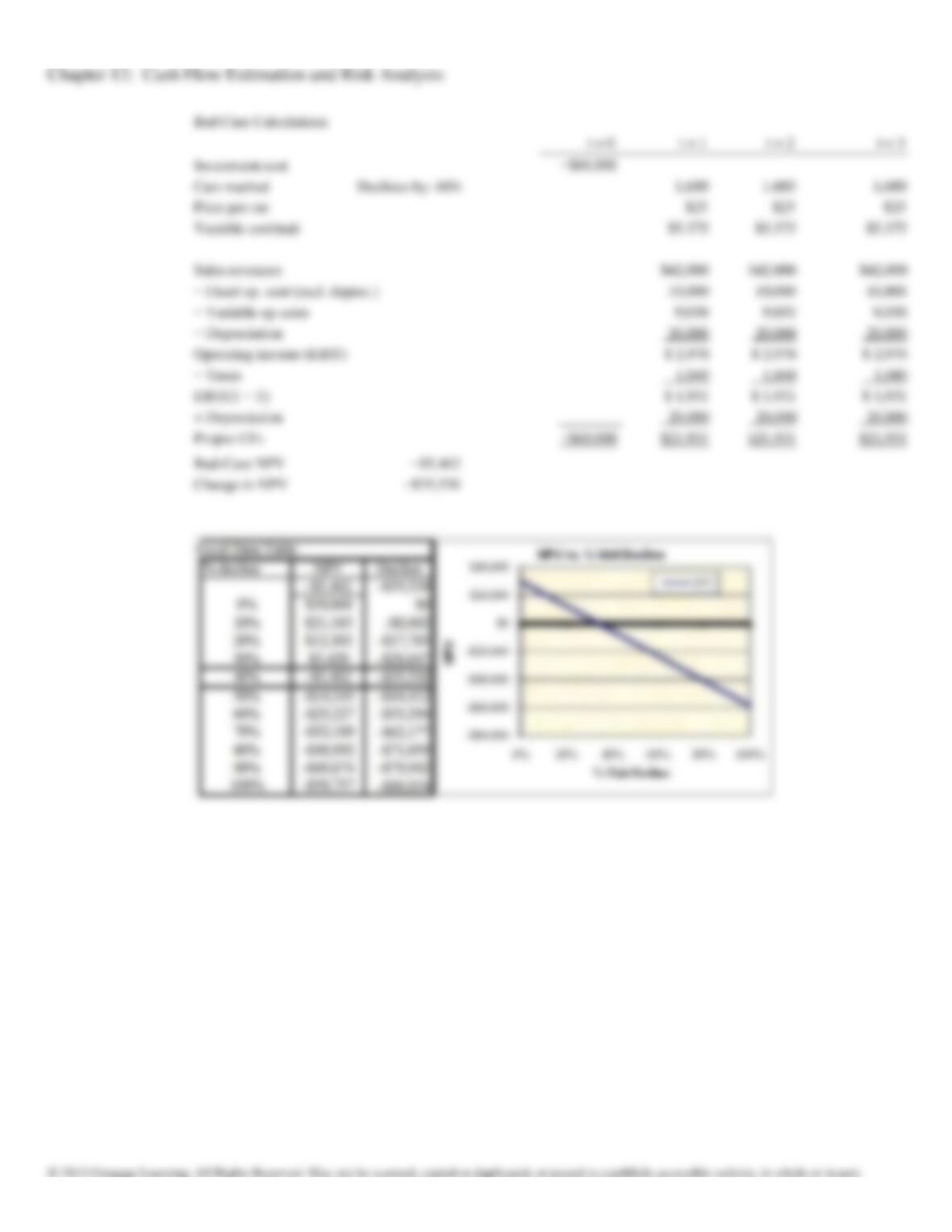
used to offset profits in other units. If the number of cars washed declined by 40% from the
expected level, by how
much would the project’s NPV change? (Hint: Note that cash flows are constant at the
Year 1 level, whatever that
level is.)
WACC
10.0%
Net investment cost (depreciable basis)
$60,000
Number of cars washed
2,800
Average price per car
$25.00
Fixed oper. costs (excl. depreciation)
$10,000
Variable oper. cost/unit (i.e., VC per car washed)
$5.375
Annual depreciation
$20,000
Tax rate
a. −$28,939
35.0%
b. −$30,462
c. −$32,066
d. −$33,753
e. −$35,530
75.
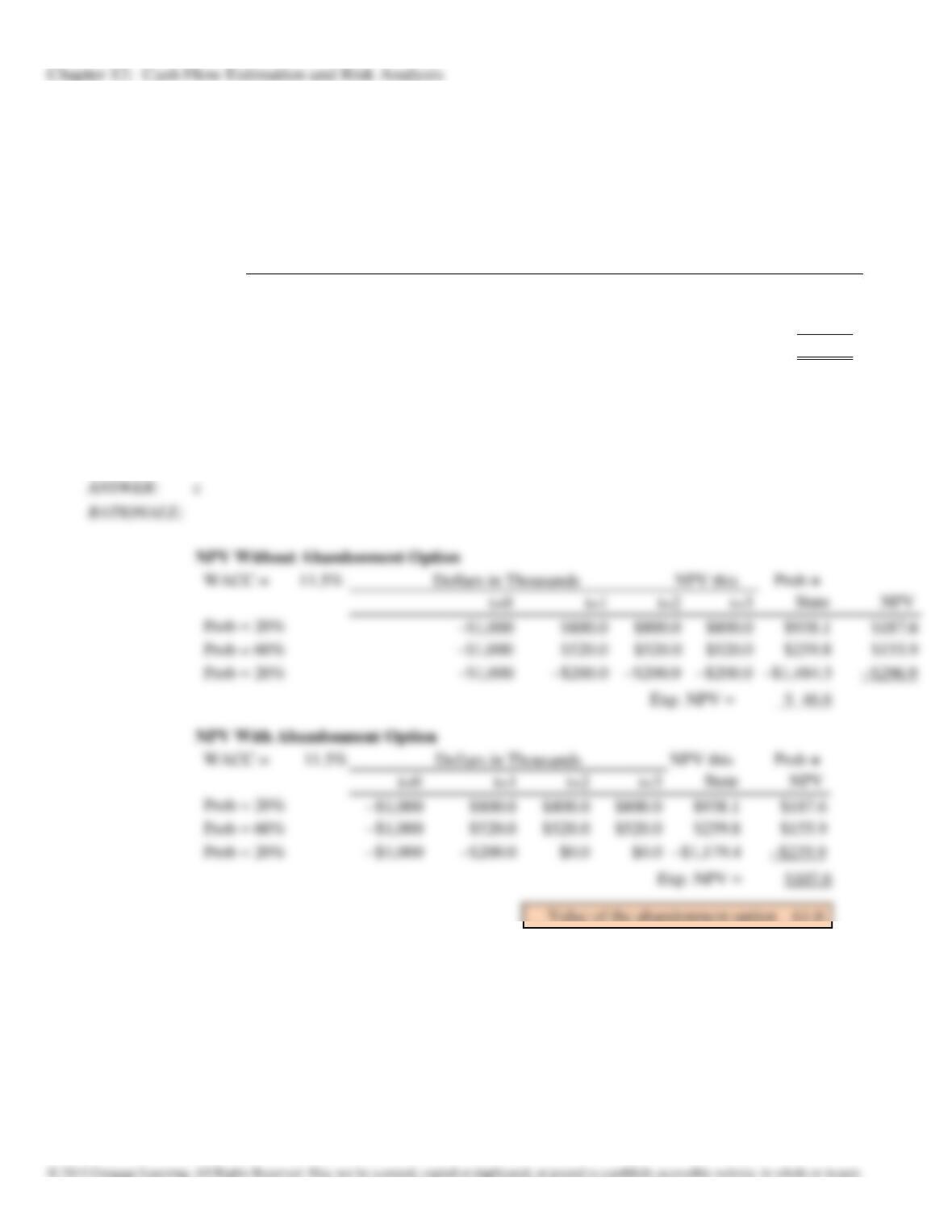
Aggarwal Enterprises is considering a new project that has a cost of $1,000,000, and the CFO set up the
following
simple decision tree to show its three most-likely scenarios. The firm could arrange with its work
force and suppliers
to cease operations at the end of Year 1 should it choose to do so, but to obtain this
abandonment option, it would
have to make a payment to those parties. How much is the option to abandon
worth to the firm?
WACC = 11.5%
Dollars in Thousands
NPV This
Prob. ×
t = 0
t = 1
t = 2
t = 3
State
NPV
Prob. = 20% –$1,000 $800.0 $800.0 $800.0 $938.1 $187.6
Prob. = 60% –$1,000 $520.0 $520.0 $520.0 $259.8 $155.9
Prob. = 20% –$1,000 –$200.0 –$200.0 –$200.0 –$1,454.5 –$296.9
Exp. NPV = $ 46.6
a. $55.0
b. $58.0
c. $61.0
d. $64.1
e. $67.3