79) Which of the following is ALWAYS true for a perfectly competitive firm?
A) P = MR
B) P = ATC
C) MR = ATC
D) P = AVC
80) In perfect competition, the firm’s marginal revenue curve
A) cuts its demand curve from below, going from left to right.
B) cuts its demand curve from above, going from left to right.
C) always lies below its demand curve.
D) is the same as its demand curve.
81) The marginal revenue curve for a perfectly competitive firm is
A) an upward sloping curve.
B) a downward sloping curve.
C) a horizontal line.
D) None of the above answers is correct.
Quantity
(units)
Price
(dollars per unit)
Total revenue
(dollars)
9
10
90
10
10
100
11
10
110
82) Based on the table above, what is the marginal revenue of the tenth unit of output?
A) $190
B) $100
C) $10
D) $9
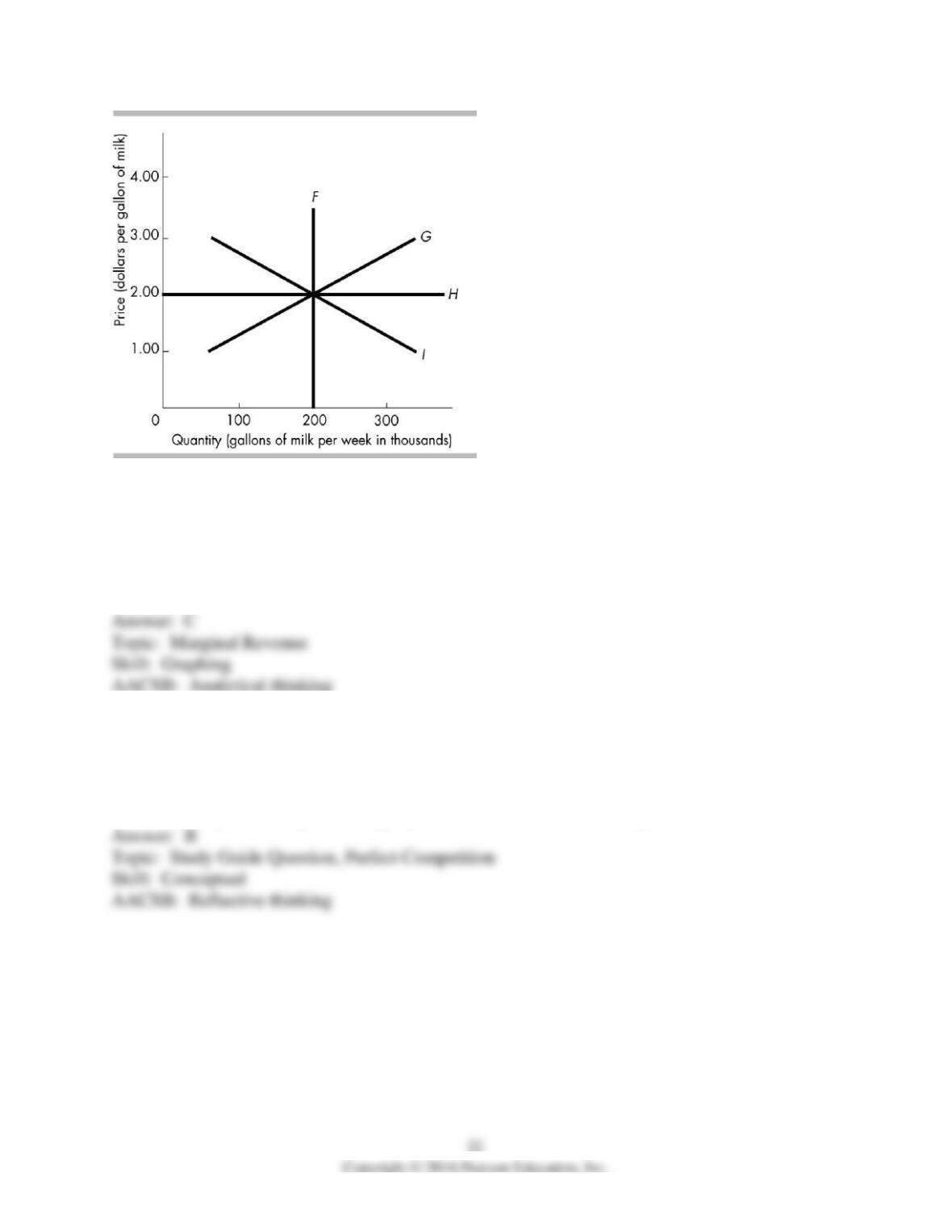
83) In the above figure, if the milk industry is perfectly competitive, then the firm’s marginal
revenue curve is represented by
A) curve F.
B) curve G.
C) curve H.
D) curve I.
84) Which of the following characterizes a perfectly competitive market?
A) The market demand curve is vertical.
B) The demand for each individual firm’s product is perfectly elastic.
C) Each firm sets a different price.
D) Each firm produces a product slightly different from that of its competitors.
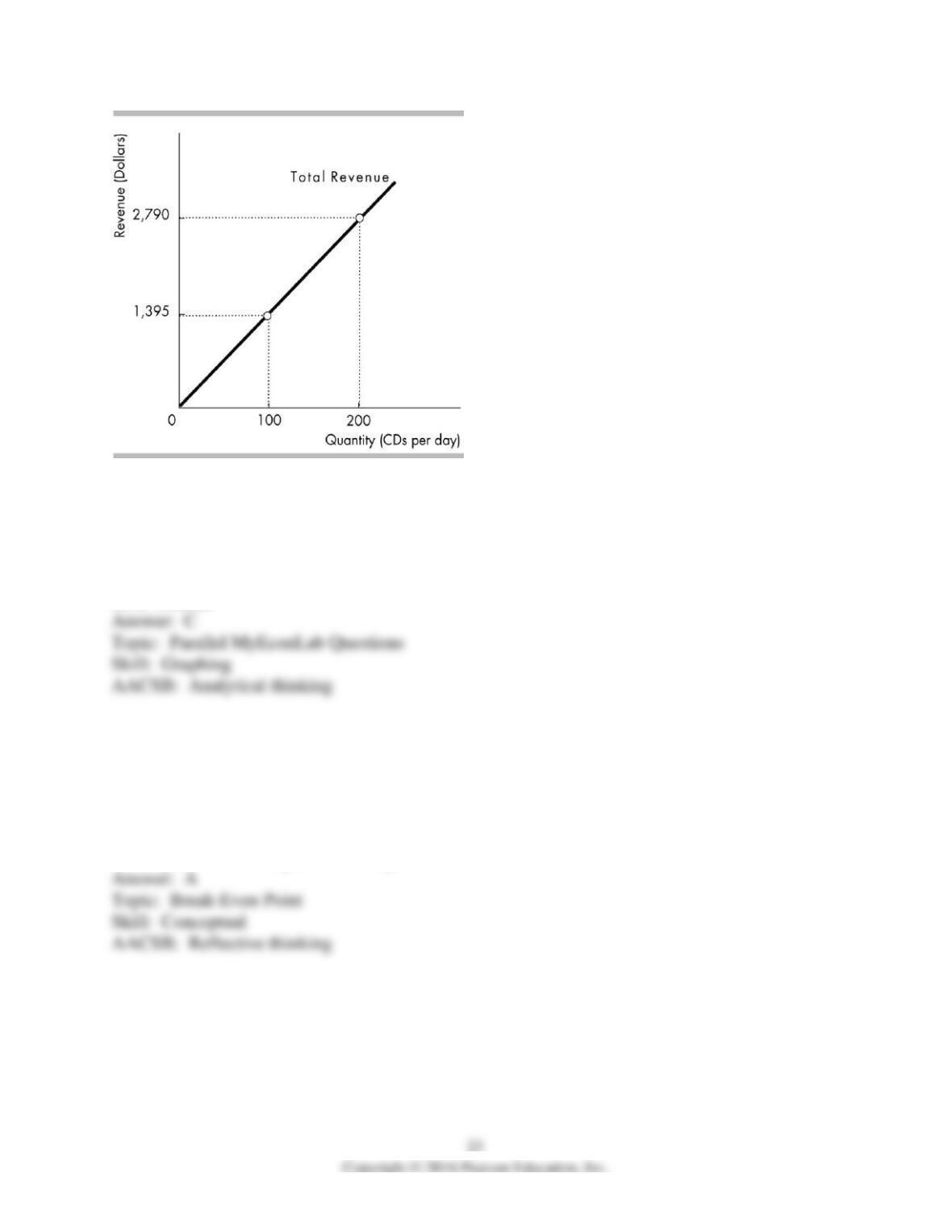
85) The above figure shows the total revenue curve for Dizzy Discs. The demand curve for CDs
sold by Dizzy Discs
A) has negative slope.
B) has positive slope.
C) is horizontal.
D) is vertical.
2 The Firm’s Output Decision
1) At a firm’s break-even point, its
A) total revenue equals its total opportunity cost.
B) marginal revenue exceeds its marginal cost.
C) marginal revenue equals its average variable cost.
D) marginal revenue equals its average fixed cost.
2) When Sidney’s Sweaters, Inc. makes exactly zero economic profit, Sidney, the owner
A) is taking a loss.
B) will shut down in the short run.
C) makes an income equal to his best alternative forgone income.
D) will boost output.
3) The break-even point is defined as occurring at an output rate at which
A) total revenue equals total opportunity cost.
B) economic profit is maximized.
C) marginal revenue equals marginal cost.
D) total cost is minimized.
4) A perfectly competitive firm that is producing a positive quantity of a good maximizes its
economic profit if it produces so that
A) total revenue = total cost.
B) marginal revenue = marginal cost.
C) average revenue = average total cost.
D) average total cost = average variable cost.
5) The difference between a perfectly competitive firm’s total revenue and its total cost is
A) always positive.
B) always negative.
C) always zero.
D) greatest at the profit-maximizing level of output.
6) A perfectly competitive firm maximizes its profit by
A) setting its price so that it exceeds the marginal revenue.
B) choosing to produce the quantity that sets MC equal to MR.
C) cutting wages.
D) manipulating demand.
7) A firm is producing the profit-maximizing amount of output when it is producing where its
________ curve intersects its ________ curve.
A) MC; MR
B) MC; AVC
C) MC; ATC
D) MC; TR
8) A perfectly competitive firm’s economic profit is maximized by producing the amount of
output such that
A) total revenue equals total variable cost.
B) marginal revenue equals marginal cost.
C) total revenue equals total cost.
D) marginal revenue is equal to total revenue.
9) A perfectly competitive firm maximizes its profits by producing the amount of output such
that
A) MR = P.
B) MR = MC.
C) P = AVC.
D) P = ATC.
10) A perfectly competitive firm maximizes its economic profit when it produces the quantity
that sets
A) MR = MC.
B) TR = TC.
C) MC =.AVC.
D) MC = ATC.
11) When the firm produces the quantity that sets marginal revenue equal to marginal cost, a
perfectly competitive firm is
A) determining the price it will set.
B) maximizing its revenues.
C) maximizing its profit.
D) establishing its shutdown point.
12) As long as it does not shut down, a perfectly competitive firm earns the maximum profit as
long as it operates so that
A) its price exceeds its average total cost.
B) market demand is inelastic.
C) its price exceeds its marginal revenue.
D) its marginal revenue equals its marginal cost.
13) As long as it does not shut down, a profit-maximizing perfectly competitive firm will
A) always earn an economic profit.
B) produce so that marginal revenue equals marginal cost.
C) produce so that price equals average cost.
D) never set its price equal to its marginal revenue.
14) Charlie’s Chimps is a perfectly competitive firm that produces cuddly chimps for children.
The market price of a chimp is $10, and Charlie’s produces 100 chimps. The marginal cost of the
100th chimp is $9. Charlie’s ________.
A) is maximizing its profit
B) will maximize its profit if it produces more than 100 chimps
C) will maximize its profit if it lowers the price to $9 a chimp
D) will maximize its profit if it produces fewer than 100 chimps
15) For a perfectly competitive firm, as its output increases its marginal revenue ________ and
its marginal cost ________.
A) changes; changes
B) changes; does not change
C) does not change; changes
D) does not change; does not change
Output
Total Revenue
Total Cost
0
$0
$25
1
$30
$49
2
$60
$69
3
$90
$91
4
$120
$117
5
$150
$147
6
$180
$180
16) In the above table, the price of the product is
A) $30.
B) $147.
C) $150.
D) $180.
17) In the above table, the firm
A) must be in a perfectly competitive market because its marginal revenue is constant.
B) must be in a perfectly competitive market because its marginal cost curve eventually rises.
C) cannot be in a perfectly competitive market because its short-run economic profits are greater
than zero.
D) cannot be in a perfectly competitive market because its long-run economic profits are greater
than zero.
18) In the above table, the marginal revenue from the fourth unit of output is
A) $30.
B) $147.
C) $150.
D) $180.
19) In the above table, if the firm produces 2 units of output, it will
A) make an economic profit of $9.
B) make an economic profit of $60.
C) incur an economic loss of $9.
D) incur an economic loss of $60.
Price
(dollars per CD)
Quantity demanded
(CDs per week)
8.00
30,000
8.50
25,000
9.00
20,000
9.50
15,000
10.00
10,000
Quantity
(CDs per week)
Marginal cost
(dollars per CD)
50
8.50
100
9.00
150
9.50
200
10.00
250
10.20
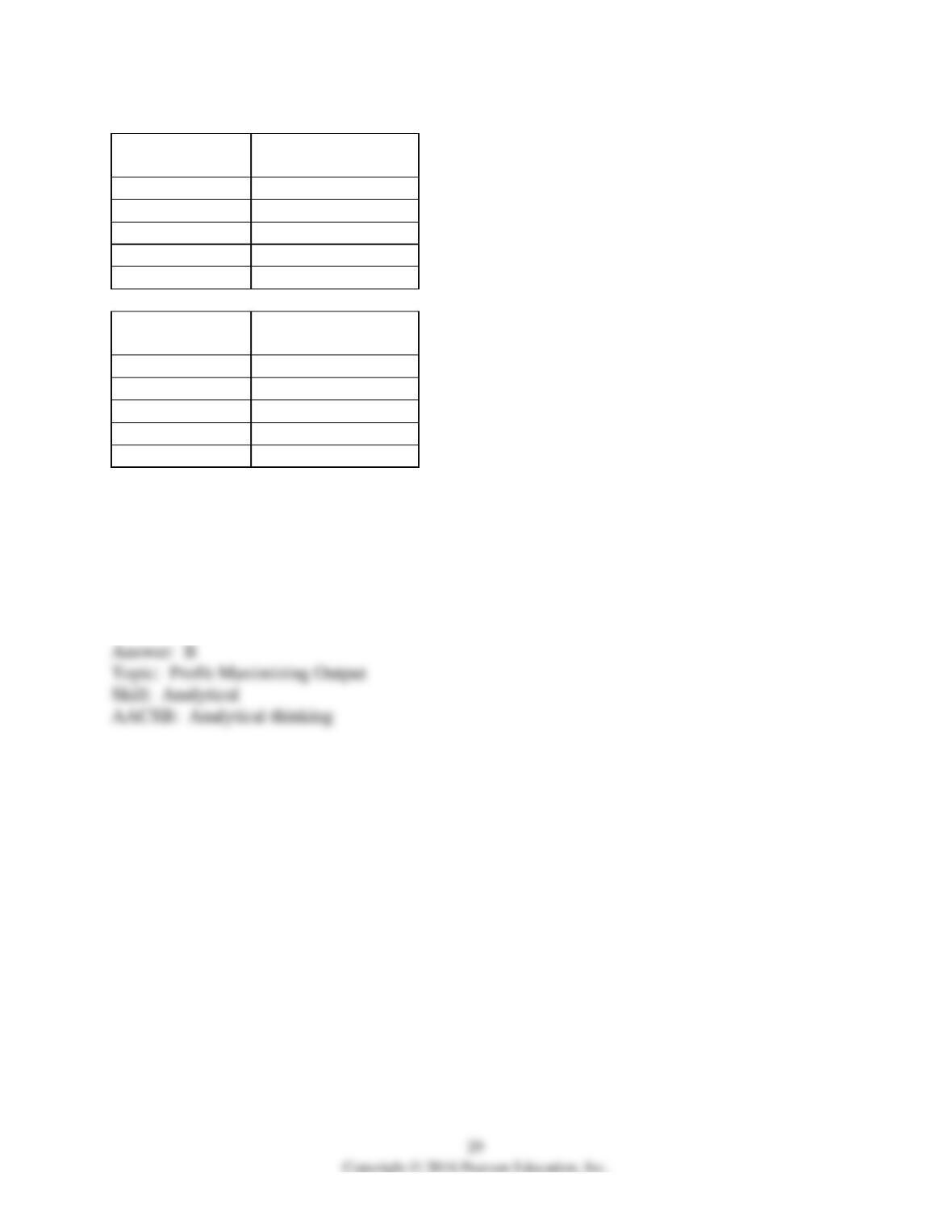
20) The first table shows the market demand schedule for CDs, and the second table shows the
cost structure of each firm. The CD market is perfectly competitive and there are 100 identical
firms. The market price of a CD is ________, and ________ CDs are produced and sold.
A) $9.00; 20,000
B) $9.50; 15,000
C) $10.00; 10,000
D) $8.50; 24,000
Output
(balloons per
hour)
Total Cost
(dollars per hour)
0
$4.00
1
$7.00
2
$8.00
3
$12.50
4
$17.20
5
$22.00
6
$29.00
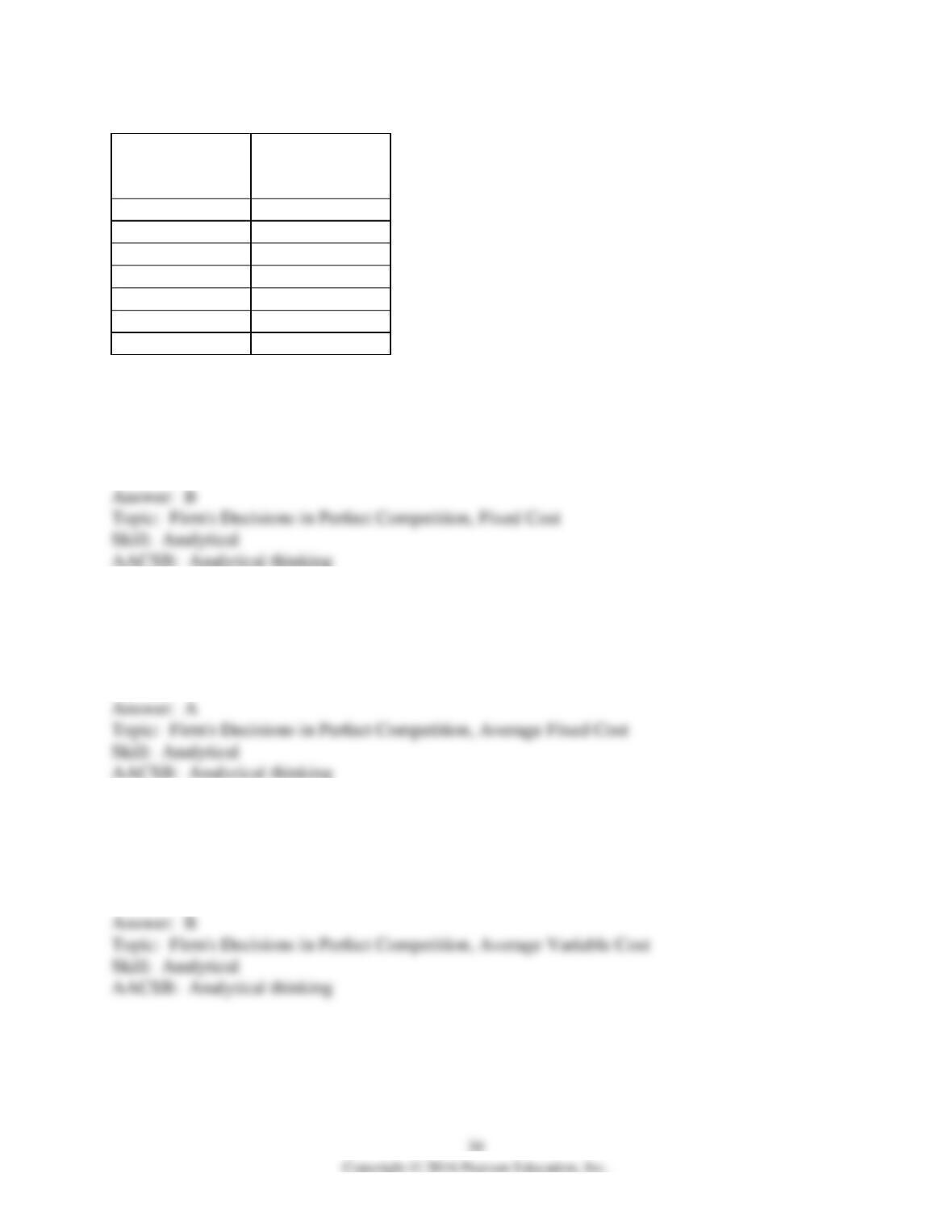
21) In the above table, the firm’s total fixed cost of production is
A) $3.00.
B) $4.00.
C) $7.00.
D) $29.00.
22) In the above table, the average fixed cost at 4 units of output is
A) $1.00.
B) $4.50.
C) $4.70.
D) $4.80.
23) In the above table, the average variable cost at 2 units of output is
A) $1.00.
B) $2.00.
C) $4.00.
D) $4.80.
24) In the above figure, by increasing its output from Q1 to Q2, the firm
A) reduces its marginal revenue.
B) increases its marginal revenue.
C) decreases its profit.
D) increases its profit.
25) In the above figure, by increasing its output from Q2 to Q3, the firm
A) reduces its marginal revenue.
B) increases its marginal revenue.
C) decreases its profit.
D) increases its profit.
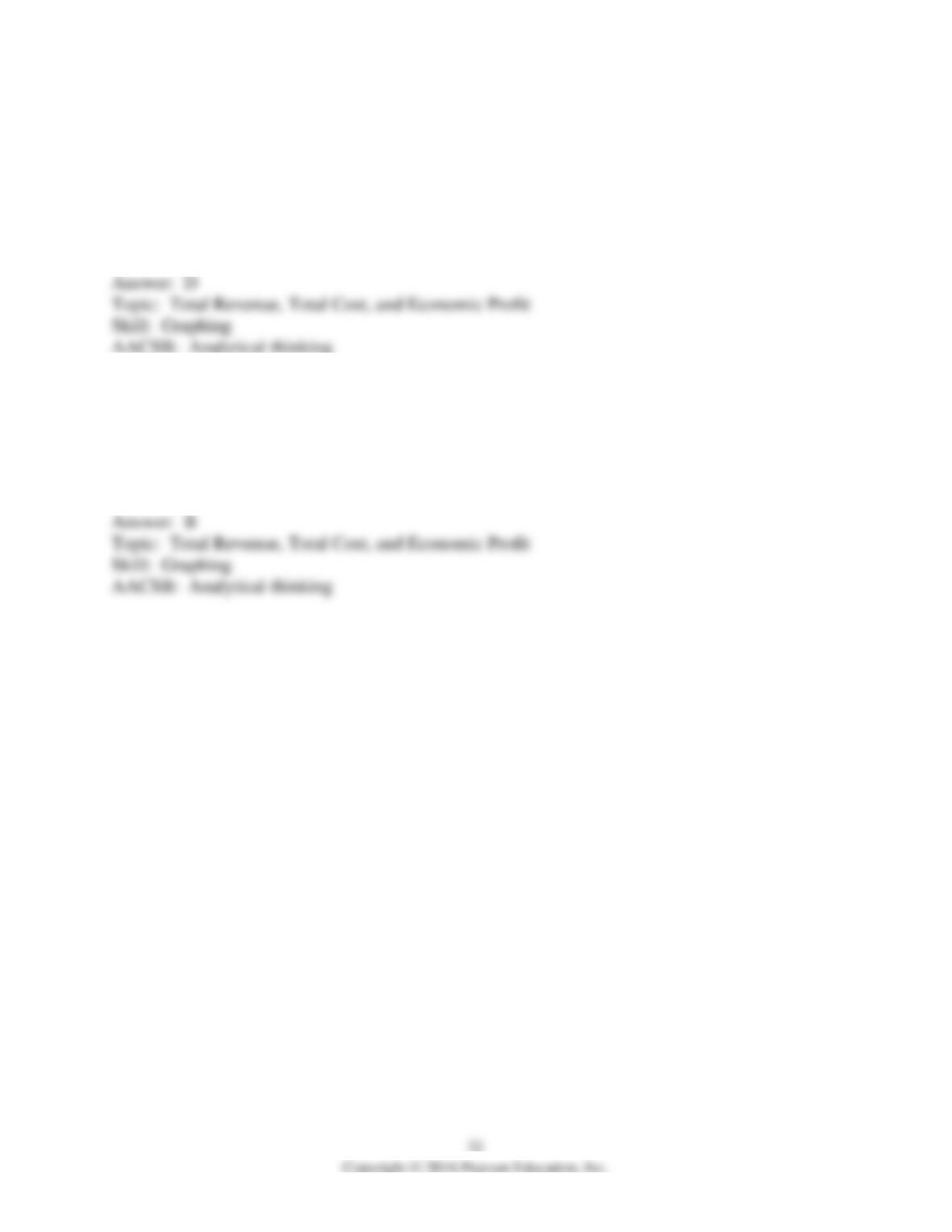
26) The above figure illustrates a firm’s total revenue and total cost curves. Which one of the
following statements is FALSE?
A) Economic profit is the vertical distance between the total revenue curve and the total cost
curve.
B) At output Q1 the firm makes zero economic profit.
C) At an output above Q3 the firm incurs an economic loss.
D) At output Q2 the firm incurs an economic loss.
27) The feature of the above figure that indicates that the firm is a perfectly competitive firm is
the
A) shape of the total cost curve.
B) shape of the total revenue curve.
C) fact that the total cost and total revenue curves are farthest apart at output is Q2.
D) fact that the total cost and total revenue curves cross twice.
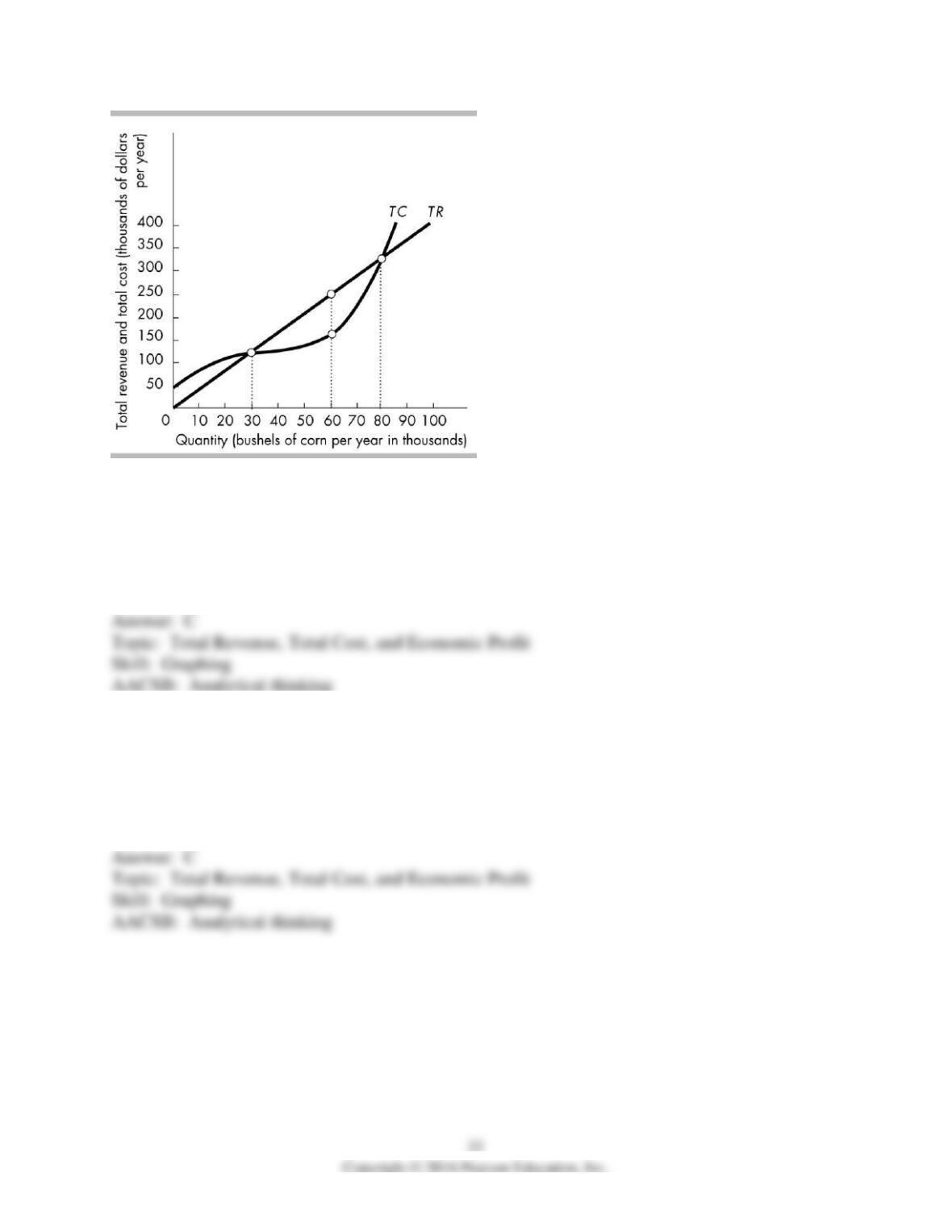
28) Given the total cost and total revenue curves in the above figure, what are the output levels at
which the perfect competitor will earn a positive economic profit?
A) from 0 to 30,000 bushels
B) from 0 to 60,000 bushels
C) between 30,000 and 80,000 bushels
D) over 80,000 bushels
29) Given the total cost and total revenue curves in the above figure, what are the output levels at
which the perfect competitor will incur economic losses?
A) below 80,000 bushels
B) from 30,000 to 80,000 bushels
C) below 30,000 bushels and over 80,000 bushels
D) at 30,000 bushels and at 80,000 bushels
30) Given the total cost and total revenue curves in the figure above, what is the profit–
maximizing output level?
A) 30,000 bushels
B) 60,000 bushels
C) 80,000 bushels
D) All output levels occur between 30,000 and 80,000 bushels are profit-maximizing output
levels.
31) In the above figure, the firm is incurring an economic loss at
A) point a.
B) point c.
C) points b and d.
D) points a, b, and d.
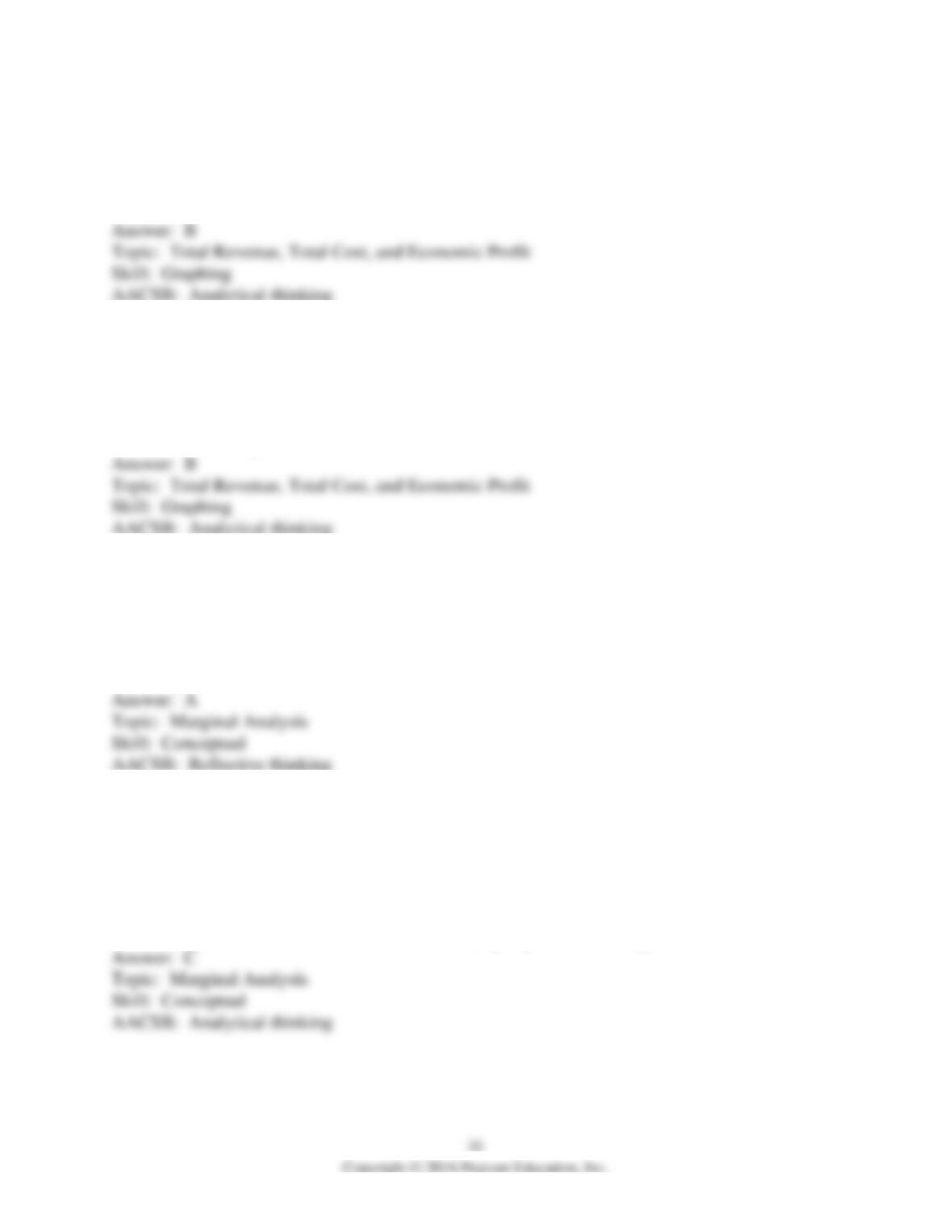
32) In the above figure, the firm is breaking even at points
A) a and c.
B) b and d.
C) c and d.
D) a and d.
33) In the above figure, when the firm produces output corresponding to point c, the firm’s
marginal cost
A) is less than its marginal revenue.
B) equals its marginal revenue.
C) exceeds its marginal revenue.
D) equals its average revenue.
34) A perfectly competitive firm maximizes its profit by producing the output at which its
marginal cost equals its
A) marginal revenue.
B) average total cost.
C) average variable cost.
D) average fixed cost.
35) For a firm in perfect competition, a diagram shows quantity on the horizontal axis and both
the firm’s marginal cost (MC) and its marginal revenue (MR) on the vertical axis. The firm’s
profit-maximizing quantity occurs at the point where the
A) slope of the MC curve is zero.
B) MC and MR curves are parallel.
C) MC curve intersects the MR curve from below, going from left to right.
D) MC curve intersects the MR curve from above, going from left to right.
36) A firm will expand the amount of output it produces as long as its
A) average total revenue exceeds its average total cost.
B) average total revenue exceeds its average variable cost.
C) marginal cost exceeds its marginal revenue.
D) marginal revenue exceeds its marginal cost.
37) A perfectly competitive firm is producing at the point where its marginal cost equals its
marginal revenue. If the firm boosts its output, its total revenue will ________ and its profit will
________.
A) rise; rise
B) rise; fall
C) fall; rise
D) fall; fall
38) A perfectly competitive firm is producing at the point where its marginal cost equals its
marginal revenue. If the firm boosts its output, its total revenue will
A) rise and its total variable cost will rise even more.
B) rise and its total variable cost will rise, but not by as much.
C) fall but its total variable cost will rise.
D) fall and its total variable cost will fall, but not by as much.
39) A perfectly competitive firm’s marginal revenue exceeds its marginal cost at its current
output. To increase its profit, the firm will
A) lower its price.
B) raise its price.
C) decrease its output.
D) increase its output.
40) A perfectly competitive firm’s marginal cost exceeds its marginal revenue at its current
output. To increase its profit, the firm will
A) lower its price.
B) raise its price.
C) decrease its output.
D) increase its output.
41) A perfectly competitive firm is producing more than the profit-maximizing amount of its
product. You can conclude that its
A) total cost exceeds its total revenue.
B) average total cost exceeds the price of the product.
C) marginal revenue is less than the price of the product.
D) marginal cost exceeds the price of the product.
42) If a perfectly competitive firm finds that it is producing an amount of output such that MR >
MC and P > AVC, it will
A) leave the industry.
B) decrease its output.
C) increase its output.
D) not change its behavior.
43) If marginal revenue exceeds marginal cost, to increase its profit the firm will
A) decrease its output.
B) increase its output.
C) keep its output the same.
D) shut down.
44) If the price exceeds the average variable cost, by producing the level of output such that
marginal revenue equals marginal cost, the firm ensures that it will
A) earn an economic profit.
B) not suffer any losses.
C) earn the largest profit possible.
D) survive in the long run.
45) In a perfectly competitive market, if a firm finds it is producing an amount of output such
that its marginal cost exceeds its price, it will
A) immediately shut down for the short run.
B) be maximizing profits.
C) increase its output to increase its profit.
D) decrease its output to increase its profit.
46) Jane’s Garage Cleaning is a perfectly competitive firm that currently cleans 40 garages a
week. Jane’s marginal cost is less than the price she charges. Jane can increase her profit if she
A) charges a higher price.
B) charges a lower price.
C) cleans fewer than 40 garages a week.
D) cleans more than 40 garages a week.
47) Bob’s Lawn Care Services is a perfectly competitive firm that currently mows 22 lawns a
week. Bob’s marginal cost exceeds the price he charges. Bob can increase his profit if he
A) charges a higher price.
B) charges a lower price.
C) mows fewer than 22 lawns a week.
D) mows more than 22 lawns a week.
Quantity
(pounds of
cookies)
Total revenue
(dollars)
Total cost,
(dollars)
1
15
13
2
30
24
3
45
39
4
60
58
5
75
81
48) The table above gives the total revenue and total cost for a perfectly competitive firm
producing chocolate chip cookies. If the firm increases its output from 2 pounds of cookies to 3
pounds, the marginal revenue is ________ per pound of cookies.
A) $11
B) $15
C) $30
D) $45
49) The table above gives the total revenue and total cost for a perfectly competitive firm
producing chocolate chip cookies. If the firm increases its output from 2 pounds of cookies to 3
pounds, the marginal cost is ________ per pound of cookies.
A) $11
B) $15
C) $24
D) $39
50) The table above gives the total revenue and total cost for a perfectly competitive firm
producing chocolate chip cookies. If the firm is producing 1 pound of cookies, to maximize its
profit it will
A) increase its output.
B) decrease its output.
C) continue producing 1 pound of cookies.
D) shut down.
51) The table above gives the total revenue and total cost for a perfectly competitive firm
producing chocolate chip cookies. If the firm is producing 4 pounds of cookies, to maximize its
profit it will
A) increase its output.
B) decrease its output.
C) continue producing 4 pounds of cookies.
D) shut down.
Quantity
Total fixed
cost, TFC
(dollars)
Total variable
cost, TVC
(dollars)
0
500
0
1
500
100
2
500
180
3
500
220
4
500
300
5
500
390
6
500
500
7
500
640
8
500
800
9
500
1000
10
500
1250
52) The table above shows some of the costs for a perfectly competitive firm. The firm will
produce 9 units of output if the price per unit is
A) $1750.
B) $200.
C) $300.
D) $500.