
66. Stone Inc. is evaluating a project with an initial cost of $9,500. Cash inflows are expected to be $1,500,
$1,500, and $10,000 in the three years over which the project will produce cash flows. If the discount rate is
6%, what is the net present value of the project?
67. Assuming that a firm has no capital rationing constraint and that a firm’s investment alternatives are not
mutually exclusive, the firm should accept all investment proposals
68. If projects are mutually exclusive
69. The internal rate of return and net present value methods
70. A characteristic of capital budgeting is that

12–15
71. A project requires an investment of $2,500 and has a net present value of $430. If the internal rate of
return is 10%, what is the profitability index for the project?
72. With non-mutually exclusive projects,
73. The net present value method (NPV) is a more conservative technique for selecting investment projects
than the internal rate of return method because the NPV method
74. The _________ assumes returns are reinvested at the cost of capital.

75. In using the internal rate of return method, it is assumed that cash flows can be reinvested at
76. For acceptable investments, the reinvestment assumption under the internal rate of return is generally
77. The internal rate of return assumes that funds are reinvested at the
78. If an investment project has a positive net present value, then the internal rate of return is
79. As the cost of capital increases

80. The net present value (NPV) method is considered to be a better method of evaluation than the internal
rate of return (IRR) method because the NPV method
81. The modified internal rate of return (MIRR) assumes that
82. The modified internal rate of return (MIRR) is used to
83. Capital rationing
84. If a firm is experiencing no capital rationing, it should accept all investment proposals

85. A firm may adopt capital rationing because
86. Capital rationing assumes that
87. The net present value profile
88. Which of the following is not a step in creating the net present value profile?
89. Using higher discount rates,

12–19
90. Which statement, or statements, are true about depreciation?
91. The Wet Corp. has an investment project that will reduce expenses by $25,000 per year for three
years. The project’s cost is $55,000. If the asset is part of the three-year MACRS category (33% first year
depreciation) and the company’s tax rate is 34%, what is the cash flow from the project in year 1?
92. An asset fitting into the 7-year MACRS category was purchased two years ago for $72,000. The book
value of this asset is now ________.
93. For MACRS depreciation, automobiles and light trucks fit into the
A. 3-year MACRS category.

94. With the exception of real estate investments, MACRS depreciation is beneficial to corporations
because it
95. A firm purchases an asset falling into the 3-year MACRS category for $48,000. The second year’s
depreciation expense for this asset would be ________.
96. Which of the following does MACRS depreciation provide to corporations?
97. Elective expensing has the following characteristic:

12–21
98. At higher tax rates, depreciation is
99. If the capital budgeting decision includes a replacement analysis, then
100. An equipment replacement decision, under incremental analysis, requires
101. In a replacement decision, if an old asset sells below its book value
102. Firm X is considering the replacement of an old machine with one that has a purchase price of
$70,000. The current market value of the old machine is $18,000 but the book value is $32,000. The firm’s
tax rate is 30%. What is the net cash outflow for the new machine after considering the sale of the old
machine? Disregard the effect of depreciation of the new machine if acquired.

103. A firm is selling an old asset below book value in a replacement decision. As the firm’s tax rate is
raised, the net cash outflow (purchase price less proceeds from the sale of the old asset) would
104. Project X has a cost of $100,000 and provides the following annual earnings: year 1 $35,000; year 2
$25,000; year 3 $175,000; and year 4 $10,000. Under the payback method, in which year is the investment
recouped?
105. Project XYZ has a cost of $200,000 and provides the following annual cash inflows: year 1 $35,000;
year 2 $25,000; year 3 $175,000; and year 4 $10,000. What is the net present value of this investment,
assuming the discount rate is 8%?

12–23
106. All of the following is information required to create a net present value profile except for which one?
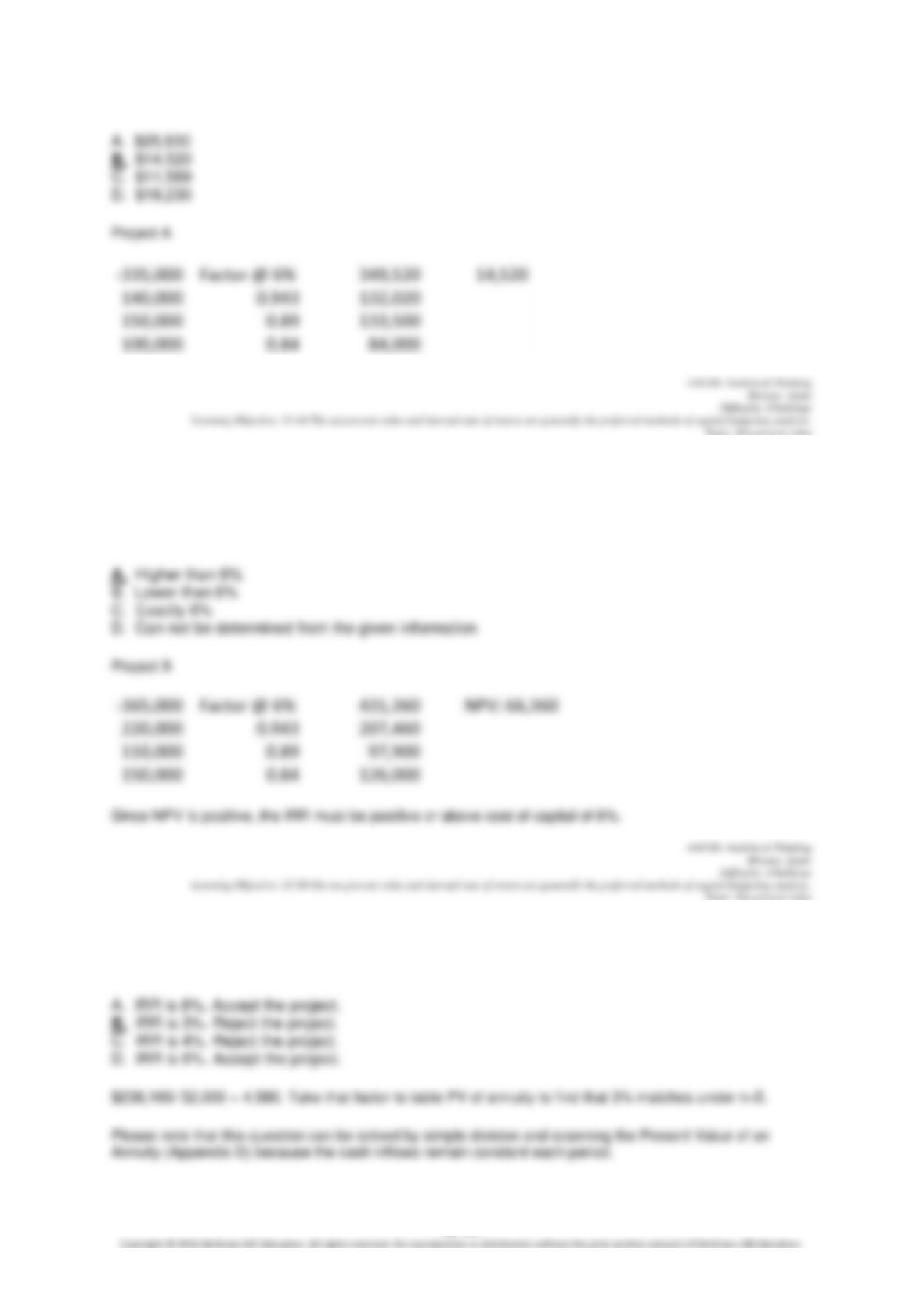
107. A firm utilizes a strategy of capital rationing, which is currently $375,000 and is considering the
following two projects: Project A has a cost of $335,000 and the following cash flows: year 1 $140,000;
year 2 $150,000; and year 3 $100,000. Project B has a cost of $365,000 and the following cash flows: year
1 $220,000; year 2 $110,000; and year 3 $150,000. Using a 6% cost of capital, which decision should the
financial manager make?
108. A firm utilizes a strategy of capital rationing, which is currently $375,000 and is considering the
following two projects: Project A has a cost of $335,000 and the following cash flows: year 1 $140,000;
year 2 $150,000; and year 3 $100,000. Project B has a cost of $365,000 and the following cash flows: year
1 $220,000; year 2 $110,000; and year 3 $150,000. Using a 6% cost of capital, what is the net present
value of project A?
12–24
109. A firm utilizes a strategy of capital rationing, which is currently $375,000 and is considering the
following two projects: Project A has a cost of $335,000 and the following cash flows: year 1 $140,000;
year 2 $150,000; and year 3 $100,000. Project B has a cost of $365,000 and the following cash flows: year
1 $220,000; year 2 $110,000; and year 3 $150,000. Using a 6% cost of capital, what is the internal rate of
return of project B?
110. Technology Corp. is considering a $238,160 investment in a new marketing campaign that it
anticipates will provide annual cash flows of $52,000 for the next five years. The firm has a 6% cost of
capital. What should the analysis indicate to the firm’s managers?

12–25
Chapter 12 Test Bank – Static Summary
Category
# of Questions
AACSB: Analytical Thinking
94
AACSB: Ethics
3
AACSB: Reflective Thinking
15
Accessibility: Keyboard Navigation
97
Blooms: Analyze
3
Blooms: Apply
19
Blooms: Evaluate
3
Blooms: Remember
15
Blooms: Understand
71
Difficulty: Basic
33
Difficulty: Challenge
15
Difficulty: Intermediate
62
Learning Objective: 12-01 A capital budgeting decision represents a long-term investment
decision.
12
Learning Objective: 12-02 Cash flow rather than earnings is used in the capital budgeting
decision.
33
Learning Objective: 12-03 The payback method considers the importance of liquidity, but
fails to consider the time value of money.
13
Learning Objective: 12-04 The net present value and internal rate of return are generally the
preferred methods of capital budgeting analysis.
49
Learning Objective: 12-05 The discount or cut off rate is normally the cost of capital.
7
Topic: Capital budgeting
23
Topic: Cash flow
1
Topic: Depreciation methods
17
Topic: Ethics, governance, and regulation
2
Topic: Internal rate of return
14
Topic: Market and book values
1
Topic: Modified internal rate of return
3
Topic: Mutually exclusive projects
3
Topic: Net present value
18
Topic: Noncash items
2
Topic: Operating cash flow
3
Topic: Payback
12
Topic: Profitability index
2
Topic: Project analysis and evaluation
6
Topic: Taxes
3