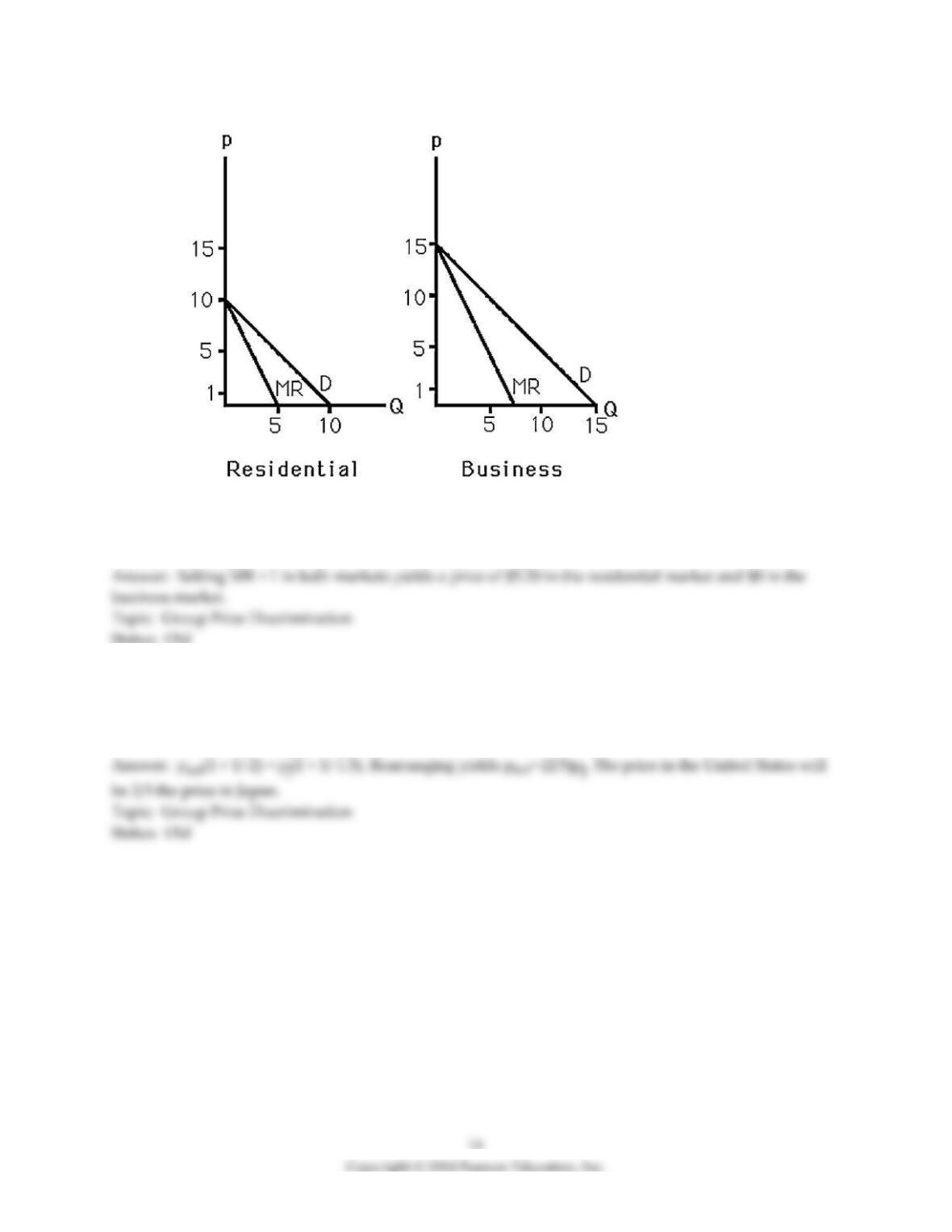
16) Bob is the only carpet installer in a small isolated town. The above figure shows the demand curves of
two distinct groups of customers-residential and business. If the marginal cost of installing carpet is a
constant $1 per sq yard, what price does Bob charge each segment?
17) A specialized rice grower sells rice in two markets, the United States and Japan, and the marginal cost
the same in both markets. The price elasticity of demand in the United States is -2.0, and the price
elasticity of demand in Japan is -1.5. If the grower practices multimarket price discrimination, which
country’s consumers will pay a higher price and by how much?
18) A weapons producer sells guns to two countries that are at war with each other. The guns can be
produced at a constant marginal cost of $10. The demand for guns from the two countries can be
represented as:
QA = 100 – 2p
QB = 80 – 4p
Why is the weapons producer able to price discriminate?
What price will it charge to each country?
19) If a firm sells to two distinct identifiable markets and resale is impossible, why is price discrimination
more profitable than setting a single price?
20) A hotel with market power charges customers who check in before 5:00 pm more than those who
check in after 5:00 pm. Those who check in early are much more likely to use the hotel’s pool. Explain
why this price difference may not be price discrimination.
21) Consider a monopolist which sells output in two markets, the home market and the foreign market.
Initially the monopolist is unable to price discriminate and sets a single price for both markets. However,
the demand in the foreign market is such that at the price the monopoly sets, no goods are sold in the
foreign market. If the monopolist is then able to price discriminate, will the overall deadweight loss
increase or decrease? Explain.
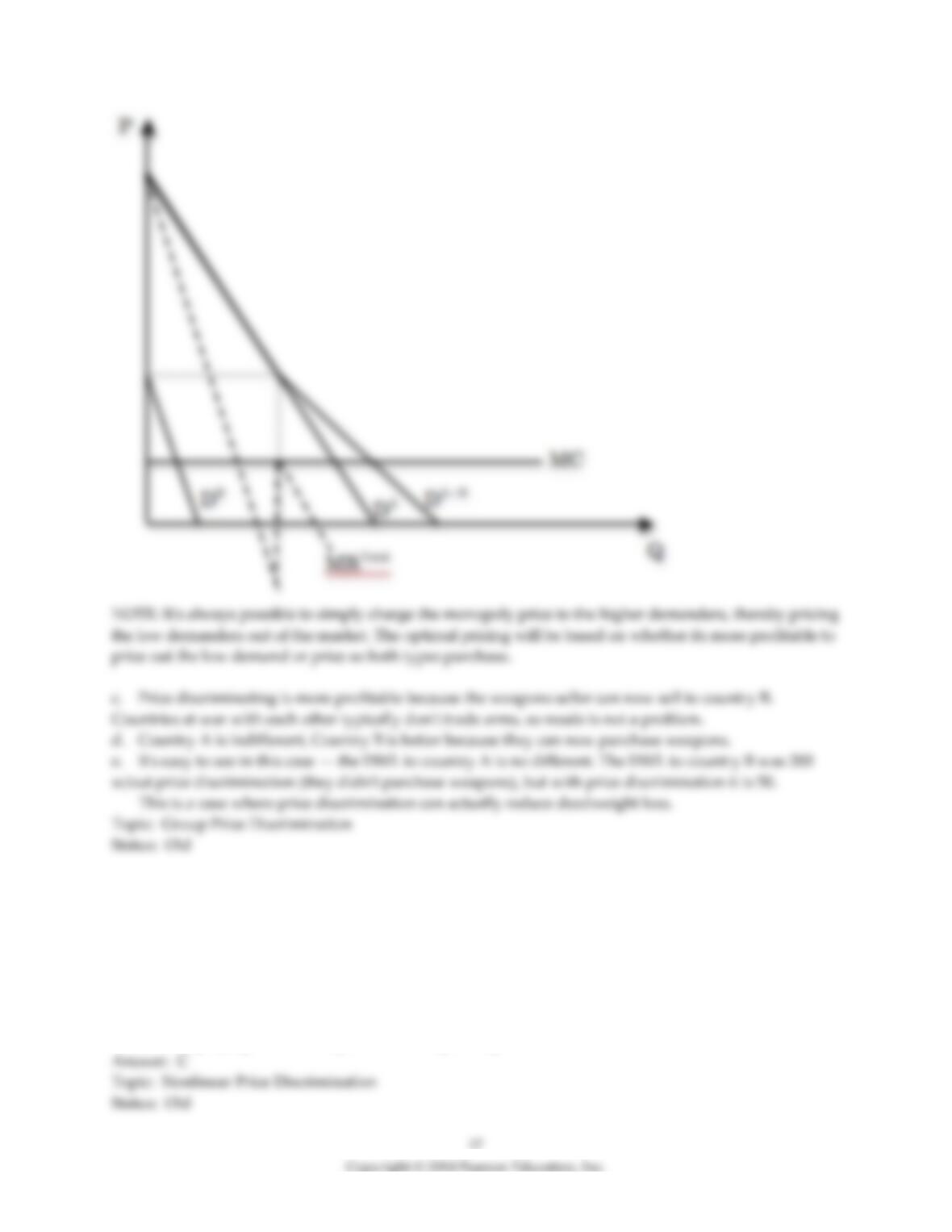
22) Consider a weapons producer that is selling guns to two countries that are at war with one another.
Guns can be produced at a constant marginal cost of $10 per gun. The demand for guns in each of the
countries is given by:
p = 50 – 0.5Q (Country A)
p = 20 – 0.25Q (Country B)
a. If the weapons producer can charge different prices to each country, what price and quantity will it
sell to each?
b. If the weapons producer cannot price discriminate, what price and quantity of guns will it sell to each
country?
c. Will the weapons manufacturer make more profit from price discriminating? Briefly explain. Why is
it that the manufacturer will likely be able to price discriminate?
d. Which country will benefit from price discrimination? Which country will be worse off from price
discrimination? Explain briefly.
e. Is the deadweight loss higher under price discrimination or a single-price? Show mathematically.
12.4 Nonlinear Price Discrimination
1) If a monopoly charges higher prices to consumers who buy smaller quantities than to consumers who
buy larger quantities, then
A) consumer surplus is larger than under single-price monopoly.
B) social welfare is larger than under perfect competition.
C) the monopoly’s profits are larger than under single-price monopoly.
D) the monopoly’s profits are larger than under perfect price discrimination.
2) If a monopoly charges higher prices to consumers who buy smaller quantities than to consumers who
buy larger quantities, then
A) consumers that buy larger quantities have a higher price elasticity of demand.
B) consumers that buy larger quantities have a lower price elasticity of demand.
C) consumers that buy smaller quantities have a lower price elasticity of demand.
D) Both A and C.
3) Quantity discrimination makes sense if
A) buyers of smaller quantities are more price sensitive than buyers of larger quantities.
B) buyers of smaller quantities are less price sensitive than buyers of larger quantities.
C) demand for the good is perfectly elastic.
D) the lower price for larger quantities encourages all consumers to purchase the larger quantity.
4) The more block prices a monopoly can set instead of setting a single price, the
A) smaller the deadweight loss.
B) the more producer surplus.
C) the larger the total welfare.
D) All of the above.
For the following, please answer “True” or “False” and explain why.
5) A mail-order clothing company offers a discount if customers purchase two shirts instead of only one.
This is necessarily an example of quantity discrimination.
6) When a firm uses a form of quantity discrimination it is the high quantity purchasers that generate
most profit.
7) An electric utility is going to use a block-pricing schedule. They plan to charge P1 for the first Q1 units
and P2 for the subsequent units. The units sold at P2 are the total units sold, Q2, minus the total units
sold at P1. The inverse demand curve is P = $100 – Q, and the marginal and average cost is $40. Use
calculus to solve for P1, P2, Q1, Q2.
12.5 Two-Part Pricing
1) Two-part tariffs offer a mechanism whereby the firm can
A) charge two different prices to distinct groups of customers.
B) collect two times as much from consumers as a single–price monopoly can.
C) capture some or all of the consumer surplus.
D) reduce some of its fixed costs.
2) At the current price of a good, Al’s consumer surplus equals eight, and Ben’s consumer surplus equals
15. By charging a two-part tariff, a monopolist could increase his profit by
A) 8.
B) 16.
C) 15.
D) 30.
3) At the current price of a good, Al’s consumer surplus equals 15, and Ben’s consumer surplus equals 15.
By charging a two-part tariff, a monopolist could increase his profit by
A) 8.
B) 16.
C) 15.
D) 30.
4) Many theme parks charge an entrance fee and a per-ride fee equal to zero. This is an example of
A) bundling.
B) a two-tier tariff.
C) multimarket price discrimination.
D) perfect price discrimination.
5) Suppose all individuals are identical, and their monthly demand for Internet access from a certain
leading provider can be represented as p = 5 – (1/2)q where p is price in $ per hour and q is hours per
month. The firm faces a constant marginal cost of $1. Potential consumer surplus equals
A) $4.
B) $8.
C) $16.
D) $32.
6) Suppose all individuals are identical, and their monthly demand for Internet access from a certain
leading provider can be represented as p = 5 – (1/2)q where p is price in $ per hour and q is hours per
month. The firm faces a constant marginal cost of $1. The profit-maximizing two-part tariff yields total
revenue of
A) $24.
B) $40.
C) $16.
D) $32.
7) Suppose all individuals are identical, and their monthly demand for Internet access from a certain
leading provider can be represented as p = 5 – (1/2)q where p is price in $ per hour and q is hours per
month. The firm faces a constant marginal cost of $1. The profit maximizing two-part tariff yields results
in the firm selling
A) 4.5 hours.
B) 10 hours.
C) 5 hours.
D) 8 hours.
8) Suppose all individuals are identical, and their monthly demand for Internet access from a certain
leading provider can be represented as p = 5 – (1/2)q where p is price in $ per hour and q is hours per
month. The firm faces a constant marginal cost of $1. If the firm will charge a monthly access fee plus a
per hour rate, the monthly access fee will equal
A) $1.
B) $5.
C) $8.
D) $16.
9) Suppose there are two types of consumers with two different demand curves, and the marginal cost of
the monopoly is $10. What could be the possible price under two-part pricing that will maximize the
monopoly profit?
A) $8
B) $9
C) $10
D) $12
For the following, please answer “True” or “False” and explain why.
10) Two-part tariffs allow the monopoly firm to capture all of the potential consumer surplus generated
by the sale of its product.
11) For a theme park a two-tier tariff can include a positive admission price and a zero per-ride fee.
12) Each identical consumer has the following demand for golf, q = 100 – p, where q is the number of
rounds of golf played per year and p is the price per round. The only golf course in an isolated town
incurs a marginal cost of $10 per round of golf. It wishes to charge a membership fee and a fee per round
of golf. What price will it set for each fee?
13) Explain why a monopoly that knows the demand curve of identical consumers can set a two-part
tariff with the lump sum tariff equal to the total amount of potential consumer surplus.
12.6 Tie-In Sales
1) The sales of shoes that include shoelaces is a tie-in sale that most likely
A) greatly increases the shoe producer’s profit.
B) increases transactions costs.
C) increases efficiency.
D) None of the above.
2) If Ben values good X more than good Y, and Catherine values good Y more than good X, a firm can
increase its profits by
A) charging the same price for both goods.
B) bundling the goods.
C) selling the goods in a competitive market.
D) charging one price per good.
3) Tie-in sales are most advantageous to the seller when
A) the demands for the two goods are negatively correlated.
B) the demands for the two goods are positively correlated.
C) the demands for the two goods are unrelated.
D) there are economies of scope.
4) A photograph processing machine company requiring customers that buy a processing machine to
purchase chemicals and photographic paper from them is an example of
A) bundling.
B) a requirement tie-in sale.
C) quantity discrimination.
D) a two-part tariff.
For the following, please answer “True” or “False” and explain why.
5) If both Ben and Catherine value good X more than good Y, a firm can increase profits by bundling the
two products.
6) Suppose a monopoly produces film and cameras. Consumers demand pictures, which require film and
one camera. Two different types of consumers have the following demand for film, qA = 100 – 10p and
qB = 80 – 10p. The monopoly cannot price discriminate in the market for film or the market for cameras,
but it can bundle the products. The monopoly produces film at a constant marginal cost of $1 per roll.
What price will the monopoly set for film and for cameras?
12.7 Advertising
1) A monopolist will spend resources to advertise its product so long as
A) net profits increase.
B) gross profits increase.
C) demand increases.
D) total revenue increases.
2) Suppose a monopolist is considering starting a $500,000 advertising campaign. The current demand for
its product is given by
p = 150 – 3Q
where Q is the quantity of output in thousands. If the monopolist undertakes the advertising campaign, it
expects demand to increase to
p = 200 – 4Q
The (non-advertising) cost for the monopolist is C(Q) = 30Q.
a. Determine whether the monopolist should undertake the advertising campaign assuming that it is
correctly anticipating the potential increase in demand.
b. What is the most the monopolist will invest towards this advertising campaign?
3) A monopolist’s demand curve is given by:
p = 100 + A1/2 – Q
where Q is the quantity of output and A is the quantity of advertising. Suppose the cost of advertising
and output is given by:
C(Q,A) = 10Q + A
Determine the profit maximizing quantity of output and advertising.
4) Indoor Life, a TV periodical sells subscriptions (Q) and advertising spaces (N). The demand curve for
subscriptions is
p = 50 – 0.002Q – 0.001N2
The magazine has negligible costs of printing and writing (the editor basically sits at home and watches
TV), so the production costs are said to be zero.
The advertising is sold in a competitive market. The price advertisers pay (per unit of N) is based on the
number of subscriptions the magazine sells times 0.001. Thus the market price for advertising spots can
be represented with the equation:
pN = 0.01Q
Compute the optimal number of subscriptions and advertisements for the magazine.