Microeconomics: Theory and Applications with Calculus, 3e (Perloff)
Chapter 12 Pricing and Advertising
12.1 Conditions for Price Discrimination
1) Which of the following conditions must be true so that a firm can price discriminate?
A) There are no other firms in the market.
B) The good is a non-durable.
C) The good cannot be easily resold.
D) All of the above.
2) Why do firms engage in price discrimination?
A) to decrease cost
B) to increase profits
C) to increase consumer surplus
D) to prohibit the resale of their products
3) When firms price discriminate they turn ________ into ________.
A) producer surplus, revenue
B) consumer surplus, profit
C) total cost, profit
D) producer surplus, consumer surplus
4) Theatres charge lower prices for a matinee and usually don’t accept coupons for the night showing of
movies because
A) consumers that attend the matinee have a higher price elasticity of demand.
B) consumers that attend the night show have a lower price elasticity of demand.
C) it increases profits compared to charging a single price.
D) All of the above.
5) At many municipal golf courses, local residents pay a lower fee to play than other golfers do. One
necessary condition for the golf course to be able to successfully price discriminate according to residency
is that
A) they can check the identification cards of golfers.
B) local resident golfers and other golfers have the same price elasticity of demand to play at the
municipal course.
C) there are many golf courses nearby from which golfers can choose.
D) they require all golfers to rent a cart.
6) If consumers are identical, then
A) price discrimination is impossible.
B) price discrimination can occur if each consumer has a downward-sloping demand curve for the
product.
C) perfect price discrimination is the only form of price discrimination that can increase a monopoly’s
profit.
D) tie-in sales cannot increase a monopoly’s profit.
7) Charging a higher price for a motel room to customers with dogs or cats than to customers with no
pets is most likely an example of
A) first-degree price discrimination.
B) second-degree price discrimination.
C) third-degree price discrimination.
D) actual cost differences.
8) Which of the following is NOT an example of firms trying to prevent resale?
A) Movie theatres check student ID for students’ discounted tickets.
B) An aluminum company starts its own wire production firm to sell to the aircraft parts at a higher price.
C) Government limits the sale of international edition textbooks in the U.S. market.
D) Milk producers sell the milk to processed dairy products producers at a lower price.
9) “Kids eat free” in a fast food restaurant is an example of
A) first-degree price discrimination.
B) second-degree price discrimination.
C) third-degree price discrimination.
D) no price discrimination.
10) A coffee shop sells a small cup of coffee at $3, while a large cup, which is twice as big, at $5. This is an
example of
A) first-degree price discrimination.
B) second-degree price discrimination.
C) third-degree price discrimination.
D) actual cost differences.
11) Which of the following is NOT an example for third-degree price discrimination?
A) discounted coupons for toothpastes in the newspapers
B) discounts for Saturday night stayovers
C) discounts for bulk orders
D) discounts for senior citizens at amusement parks
12) If two markets have the same price elasticity of demand at every price, a monopoly will not practice
multimarket price discrimination.
13) Firms price discriminate to maximize total revenue.
14) Explain why a firm can earn more profit by price discrimination than from setting a uniform price.
15) Suppose two countries, A and B, are at war with each other. Country A is very wealthy; country B is
very poor. The XYZ Co. produces tanks. Is XYZ able to set a different price for the tank sold to country A
than the price for the tank sold to country B? Explain.
16) Can a perfectly competitive firm successfully price discriminate? Hint: What does the demand curve
look like for a perfectly competitive firm?
12.2 Perfect Price Discrimination
1) A perfect price discriminator
A) charges each buyer her reservation price.
B) charges different prices to each customer based upon different costs of delivery.
C) generates a deadweight loss to society.
D) charges lower prices to customers who buy greater quantities.
2) A perfect-price-discriminating monopoly’s marginal revenue curve
A) lies below the demand curve.
B) is the demand curve.
C) varies for each consumer.
D) is the same as the monopolist’s marginal revenue curve.
3) Which of the following sellers is most able to perfectly price discriminate?
A) a college or university
B) the post office
C) a clothing store
D) a grocery supermarket
4) The deadweight loss generated by a perfect-price-discriminating monopoly
A) equals the deadweight loss of a single-price monopoly.
B) is greater than the deadweight loss of a single–price monopoly.
C) equals zero.
D) equals the sum of all lost consumer surplus.
5) A perfect price discriminating equilibrium maximizes
A) consumer surplus.
B) the associated deadweight loss.
C) the market inefficiency.
D) total welfare.
6) Perfect price discrimination is
A) realistic.
B) practiced by many firms.
C) a purely theoretical possibility.
D) very common.
7) When a firm has a monopoly in a market and also perfectly price discriminates, total welfare
A) is maximized.
B) is lower than in a perfectly competitive market.
C) is higher than in a perfectly competitive market.
D) is minimized.
8) If a market is controlled by a perfect-price-discriminating monopoly, then
A) a deadweight loss is generated.
B) there is no consumer surplus.
C) consumer surplus is the same as under perfect competition.
D) output is less than that of a single-price monopoly.
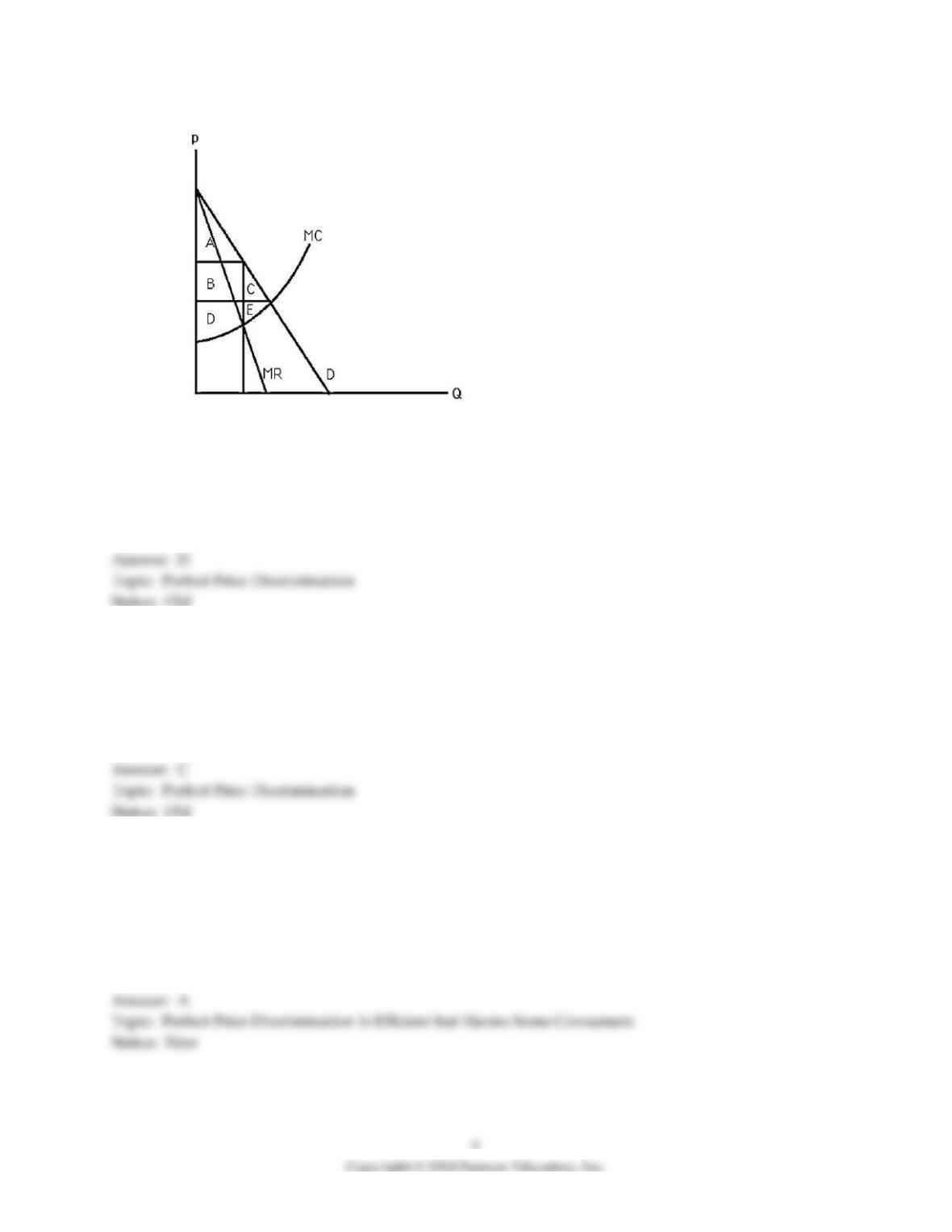
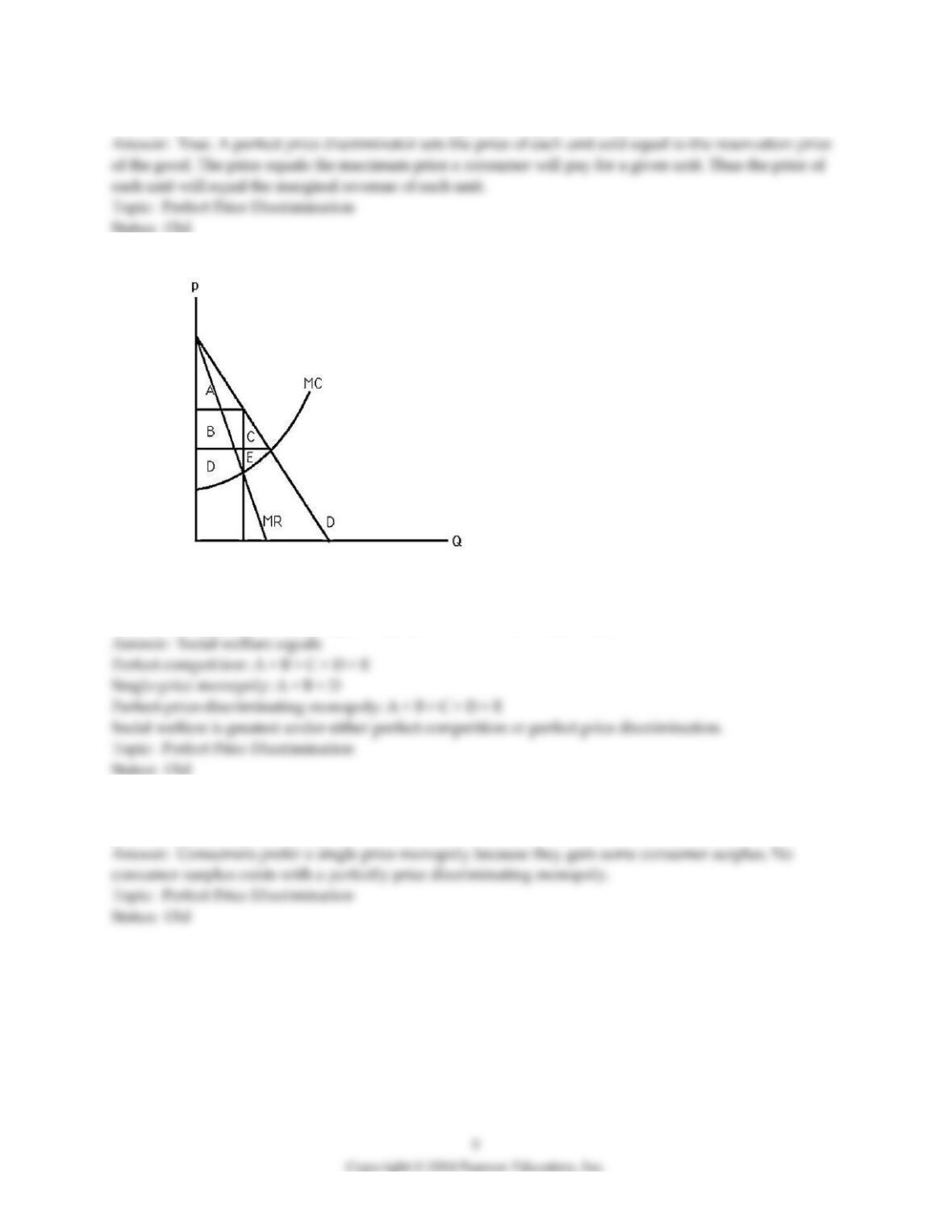
9) The above figure shows the market for a particular good. If the market is controlled by a perfect-price-
discriminating monopoly, consumer surplus equals
A) A.
B) A + B + C.
C) C.
D) zero.
10) The above figure shows the market for a particular good. If the market is controlled by a perfect-price-
discriminating monopoly, social welfare equals
A) A.
B) A + B + C.
C) A + B + C + D + E.
D) zero.
11) The above figure shows the market for a particular good. If the market is controlled by a perfect-price-
discriminating monopoly, compared to a monopoly who charges a single price, the change in consumer
surplus is
A) A.
B) A + B + C.
C) A + B + C + D + E.
D) zero.
12) The above figure shows the market for a particular good. If the market is controlled by a perfect-price-
discriminating monopoly, compared to a perfectly competitive market, the change in consumer surplus is
A) A.
B) A + B + C.
C) A + B + C + D + E.
D) zero.
13) The above figure shows the market for a particular good. If the market is controlled by a perfect-price-
discriminating monopoly, producer surplus equals
A) A + B + C + D + E.
B) D + E.
C) E.
D) zero.
14) The above figure shows the market for a particular good. If the market is controlled by a perfect-price-
discriminating monopoly, the deadweight loss equals
A) C + E.
B) A + B + C.
C) C.
D) zero.
15) The above figure shows the market for a particular good. If the market is controlled by a perfect-price-
discriminating monopoly, compared to a monopoly who charges a single price, the change in total
surplus is
A) A + B + C.
B) A + B + D.
C) A.
D) C + E.
16) The above figure shows the market for a particular good. If the market is controlled by a perfect-price-
discriminating monopoly, compared to a monopoly who charges a single price, the change in producer
surplus is
A) B + D.
B) A.
C) A + C + E.
D) B + C + D + E.
17) The above figure shows the market for a particular good. If the market is controlled by a perfect-price-
discriminating monopoly, compared to a perfectly competitive market, the change in producer surplus is
A) B + C.
B) D + E.
C) A + B + C.
D) A + B + C + D + E.
18) A monopoly will not be able to perfectly price discriminate if
A) obtaining information about each buyer’s reservation price is too costly.
B) demand is very elastic.
C) demand is very inelastic.
D) resale is impossible.
19) A monopoly will not be able to perfectly price discriminate if
A) each consumer does not reveal her reservation price.
B) demand is very elastic.
C) the firm’s marginal cost curve is upward sloping.
D) All of the above.
For the following, please answer “True” or “False” and explain why.
20) A perfect-price-discriminating monopoly maximizes social welfare as measured by the sum of
producer surplus plus consumer surplus.
21) A perfect price discriminator receives a price equal to marginal revenue for each unit.
22) The above figure shows the market for a given product. Defining welfare as consumer surplus plus
producer surplus, calculate the social welfare associated with perfect competition, single-price monopoly,
and a perfect-price-discriminating monopoly. Which market structure(s) maximize social welfare?
23) Explain using welfare measures whether consumers prefer a single price monopoly or a perfectly
price discriminating monopoly.
12.3 Group Price Discrimination
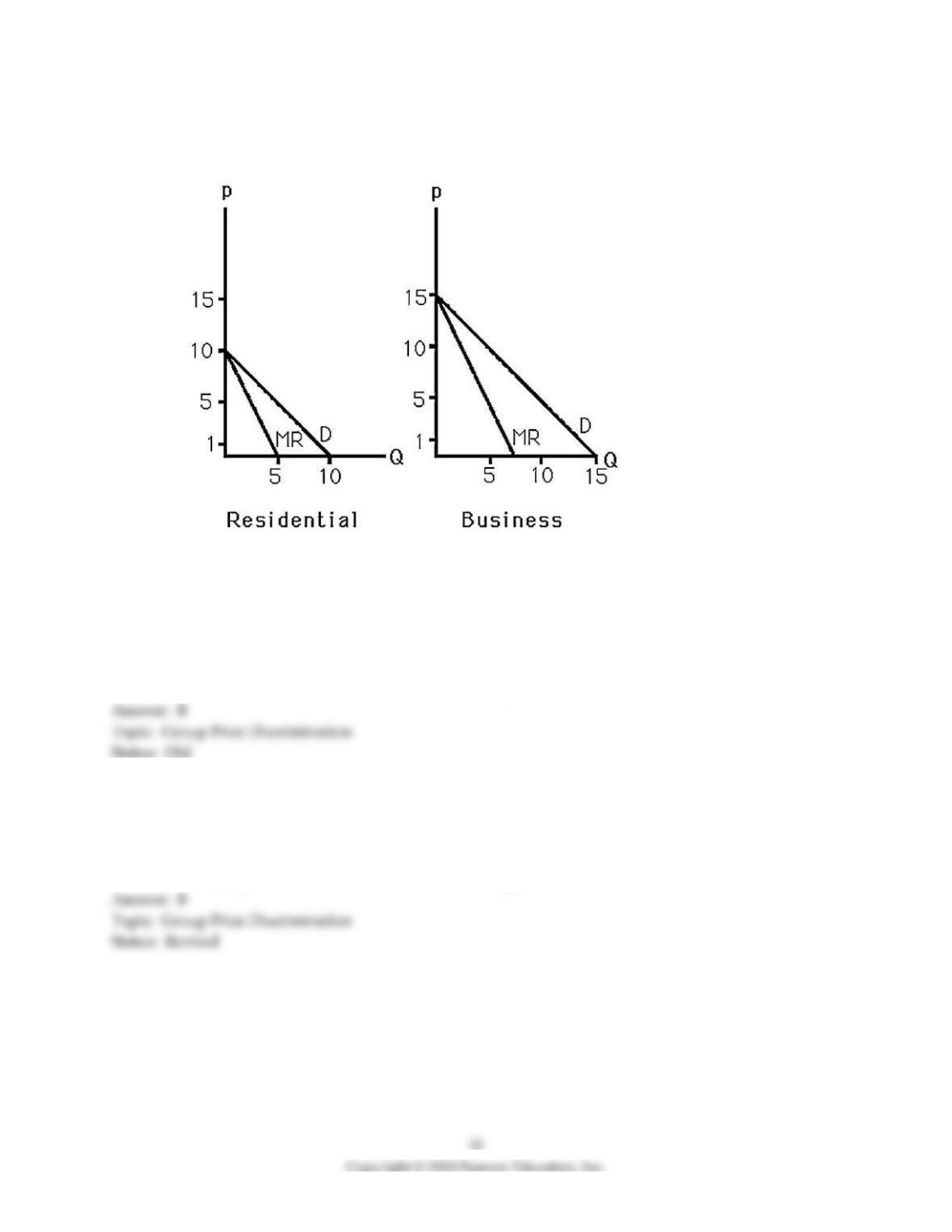
1) Bob is the only carpet installer in a small isolated town. The above figure shows the demand curves of
two distinct groups of customers-residential and business. If the marginal cost of installing carpet is a
constant $1 per sq yard, what price does Bob charge each segment?
A) $1 in each market
B) $5.50 in the residential market and $8 in the business market
C) $1 in the residential market and $5 in the business market
D) $10 in the residential market and $15 in the business market
2) Which of the following is an example for group price discrimination?
A) a BMW selling for more than a VW
B) local residents receiving a discount at the local golf course
C) the fact that a razor is cheap and blades are expensive
D) a hotel charging more for a room if the customers bring pets
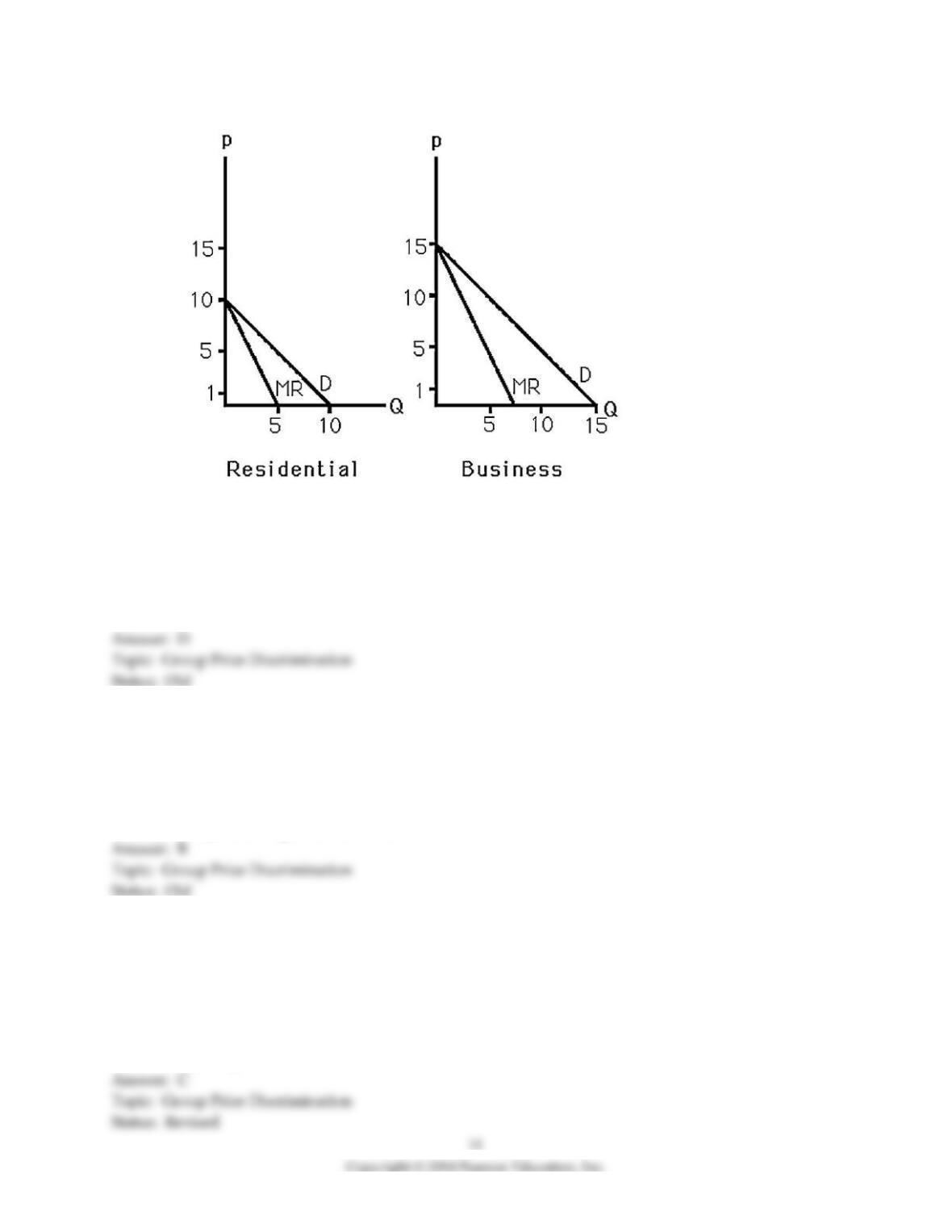
3) Bob is the only carpet installer in a small isolated town. The above figure shows the demand curves of
two distinct groups of customers-residential and business. Bob is likely to price discriminate because
A) elasticities differ across markets.
B) the installation of carpets cannot be resold.
C) Bob can probably identify which consumers belong to which segment.
D) All of the above.
4) If two identifiable markets differ with respect to their price elasticity of demand and resale is
impossible, a firm with market power will
A) set a higher price in the market that is more price elastic.
B) set a lower price in the market that is more price elastic.
C) set price so as to equate the elasticity of demand across markets.
D) set price equal to marginal cost in both markets.
5) A group price discriminator sells its product in Florida for three times the price it sets in New York.
Assuming the firm faces the same constant marginal cost in each market and the price elasticity of
demand in New York is -2.0, the demand in Florida
A) has an elasticity of -6.0.
B) is more price elastic than the demand in New York.
C) has an elasticity of -1.2.
D) has an elasticity of -0.67.

6) Suppose group price discrimination is possible; however, a firm sets the same price in each market. As
a result,
A) price elasticity of demand is the same in each market.
B) the price-inelastic market will buy zero units.
C) marginal revenue in the more price-elastic market exceeds marginal revenue in the less price-elastic
market.
D) the deadweight loss is less than if the firm price discriminated.
7) If the demand for air travel were to change so that business travelers and vacationers have the same
price elasticity of demand for air travel,
A) airlines would charge the same price to each type of flyer.
B) airlines would still charge business flyers a higher fare since the traveler’s employer pays anyway.
C) airlines would be driven out of business.
D) airlines would counter by charging vacationers a higher fare.
8) If somebody posing as a vacationer were able to purchase large numbers of airline tickets from the
airlines and later resell them to business travelers,
A) group price discrimination on the part of airlines would no longer be profitable.
B) group price discrimination on the part of airlines would no longer be profit maximizing.
C) the airlines would respond by raising further the price charged to business flyers.
D) this person would not earn any economic profit.
9) Relative to a single-price monopoly, the effect of group price discrimination on social welfare is
A) beneficial.
B) detrimental.
C) neutral.
D) ambiguous.
10) Coupons represent a form of price discrimination because they offer a low-cost way for firms to
A) identify customers with apparently more elastic demand and offer them a lower price.
B) retain loyal customers who are not price sensitive.
C) offer discounts to consumers who buy larger quantities.
D) perfectly price discriminate.
11) Airlines offer lower prices to vacationers than to business travelers because
A) of government regulations requiring them to do so.
B) business travelers do not care at all about costs.
C) business travelers are less flexible in their travel plans than vacationers are.
D) airlines know that business travelers enjoy flying more than vacationers do.
12) Suppose a profit-maximizing monopoly is able to employ group price discrimination. The marginal
cost of providing the good is constant and the same in both markets. The marginal revenue the firm earns
on the last unit sold in the market with the higher price will be
A) greater than the marginal revenue the firm earns on the last unit sold in the market with the higher
price.
B) less than the marginal revenue the firm earns on the last unit sold in the market with the higher price.
C) equal to the marginal revenue the firm earns on the last unit sold in the market with the higher price.
D) greater than the marginal cost of the last unit.
13) Pizza joints often offer substantially lower prices for pizza picked up at the shop compared to
delivered pizza prices. This may be an attempt at
A) perfect price discrimination.
B) group price discrimination.
C) quantity discrimination.
D) second-degree price discrimination.
For the following, please answer “True” or “False” and explain why.
14) A firm that practices multimarket price discrimination will set the lower price in the market that has
the most elastic demand.
15) While price discrimination is possible between two markets it is not possible in more than two.