CHAPTER 12: Monopolistic Competition and Advertising
MULTIPLE CHOICE
1. Monopolistic competition means that
a. firms are in a monopoly, but they compete.
b. firms are in perfect competition, but they collude similar to monopolies.
c. firms differentiate their output, which makes them price makers, but barriers to entry are low
or nonexistent.
d. oligopoly firms collude until they become monopolies.
e. firms have downward-sloping demand.
2. If one were to discuss why the term “monopolistic competition” is used, the best description would
be that the industry is “monopolistic” because it
a. has high barriers to entry, but is “competitive” because it has many firms.
b. has low barriers to entry, but is “competitive” because it has few firms.
c. has product differentiation, but is “competitive” because it has many firms.
d. has a monopoly, but is “competitive” because there are low barriers to entry, meaning it has
potential rivals.
e. holds patents, but is “competitive” because other firms might invent similar patentable
products.
3. Which of the following industry structures is best associated with low barriers to entry?
a. monopoly d. monopolistic competition
b. a cartel e. a collusive industry
c. oligopoly
4. One critical characteristic of monopolistic competition is that
a. one firm dominates the industry.
b. a few firms collude with each other by agreeing on price.
c. a few firms compete without agreeing on price.
d. there are many small firms in the industry.
e. there is one large firm in the industry, but it has no control over the price.
5. A monopolistically competitive market is characterized by
a. many small sellers selling a differentiated product.
b. a single seller of a unique product that has few or no substitutes.
c. very high barriers to entry.
d. many small sellers selling an identical product.
e. a few firms producing either differentiated or identical products.
6. Which of the following is the best description of monopolistic competition?
a. easy entry, low markup
b. barriers to entry, high markup
c. horizontal demand curve for the firm
d. firm has no control over price
e. barriers to entry, low markup
7. Which of the following most closely approximates the conditions of monopolistic competition?
a. the market for Grade A sorghum (milo), which is characterized by many firms producing a
homogeneous product
b. the restaurant industry, which is characterized by many firms producing differentiated products
in an industry with free entry and exit
c. a cable television service, where a licensed supplier competes with firms offering satellite
service
d. the market for jumbo aircraft, where one major domestic firm competes with one major foreign
firm
e. the tobacco market, which is characterized by a few firms producing a differentiated product
with difficult entry
8. Which of the following is the best example of a monopolistically competitive market?
a. corn d. retail clothing stores
b. gasoline e. wheat
c. electric utilities
9. Which of the following is the best example of a firm operating in a monopolistically competitive
market?
a. a Nebraska corn farmer
b. Applebee’s, a casual dining restaurant
c. the U.S. Postal Service
d. Chevron, a gasoline station
e. electric companies prior to deregulation
10. Firms in a monopolistically competitive industry produce
a. homogeneous goods and services.
b. differentiated products.
c. monopolistic goods only.
d. only industrial products—and no consumer products.
e. only consumer products—and no industrial products.
11. Which of the following is the best example of a monopolistic competitor?
a. a corn farmer d. a gas station
b. a weight-loss program e. a localized cement company
c. the U.S. Postal Service
12. If all monopolistically competitive firms had identical cost curves, then
a. the industry would remain monopolistically competitive because of product differentiation.
b. long-run profit for each firm would be positive.
c. short-run profit for each firm would be negative.
d. excessive brand proliferation would result.
e. the industry would become perfectly competitive.
13. We could state correctly that the minimum characteristic necessary to distinguish among
price-making firms is
a. product differentiation.
b. price discrimination.
c. the level of the concentration ratio.
d. the number of firms in the industry.
e. whether they produce industrial or consumer products.
14. If a monopoly firm suddenly lost its barriers to entry and faced new competition, yet consumers
thought that the former monopoly’s products were somewhat different than its new competitors,
then
a. the industry has probably become perfectly competitive.
b. long-run profit for this firm will likely exist.
c. the industry has probably become a monopolistically competitive industry.
d. the industry is probably cooperating to maximize joint profits.
e. the industry has probably become a monopoly.
15. Which of the following statements best describes firms under monopolistic competition?
a. There is little price or quality competition.
b. The firms compete using quality, location, and style.
c. Firms do not compete using advertising.
d. There is little competition between firms.
e. There are a few firms that collude to set the highest price.
16. Product differentiation
a. refers to firms’ attempts to make their products look the same as other products in the industry.
b. refers to firms’ attempts to make real or apparent differences in essentially substitutable
products look different in the minds of consumers.
c. refers to the advantage big firms have in research and development.
d. is a common characteristic of a perfectly competitive market structure.
e. is employed only in a monopoly market structure.
17. Which of the following is always associated with monopolistic competition?
a. identical products
b. economic profits in the short run
c. demand curve that lies below the marginal revenue curve
d. demand curves that become more inelastic as new entry occurs
e. product differentiation
18. The movie You’ve Got Mail features a successful small bookstore competing with a new book
superstore around the block. The big superstore offers deep discounts, while the small independent
bookstore has better service and a more knowledgeable staff. The movie best illustrates which of
the following?
a. For monopolistically competitive firms, profits will be positive in the long run.
b. Homogeneous products are produced by both firms because consumers perceive books from
either store as the same.
c. Product differentiation occurs because consumers perceive the bookstores as different.
d. Monopoly production occurs because the movie is copyrighted.
e. Perfect competition occurs because many movie theaters are showing identical movies.
19. The movie You’ve Got Mail features a successful small bookstore competing with a new book
superstore around the block. The big superstore offers deep discounts, while the small independent
bookstore has better service and a more knowledgeable staff. The movie best illustrates which of
the following?
a. Small producers can’t compete based on costs.
b. Large producers offer differentiated products and compete most effectively through product
differentiation.
c. Small producers offer differentiated products and compete most effectively through product
differentiation.
d. The big superstore bookstore best illustrates a perfectly competitive firm.
e. The small independent bookstore best illustrates a monopoly firm.
20. Shopping at the clothing store Abercrombie & Fitch instead of Ann Taylor best illustrates
a. differentiation by style or type. d. homogeneous products.
b. differentiation by location. e. high barriers to entry.
c. differentiation by quality.
21. You shop at the local drugstore because it is convenient. This situation is best described as
a. differentiation by style or type.
b. differentiation by a cartel.
c. monopolistic competition with differentiation by location.
d. a market with horizontal demand.
e. perfect competition because there are so many drugstores in the area.
22. A convenience store is generally able to charge and obtain a higher price for its candy bars than
Walmart because the convenience store
a. differentiates based on style.
b. differentiates based on location.
c. differentiates based on quality.
d. advertises that its candy bars are identical to those sold at Walmart.
e. differentiates based on high barriers to entry, such as patents.
23. At one time, Heinz made its own brand of soups. The company also produced those same soups to
be sold as store brands. The Heinz soups and store-brand soups were differentiated only by their
label. If Harris Pilton bought Heinz soup because she said, “Everyone knows the store-brand soup
is nasty,” this indicates
a. consumer cooperation. d. a cartel exists.
b. product homogeneity. e. monopolization by Heinz.
c. product differentiation.
24. Which of the following best describes DiGiorno’s incentive for quality control versus that of the
generic brands of pizza?
a. Their incentives are identical.
b. Generic brands have more incentive for high quality and high-quality control.
c. DiGiorno has more incentive for high quality and high-quality control.
d. Generic brands purposefully have lower quality because they charge a lower price and need to
maintain consumer perception that they should expect lower quality at the lower price.
e. DiGiorno tries to match the same quality as the generic brands.
25. Fantasia’s Ice Cream distinguishes itself from other firms through great service by attractive
servers. Fantasia’s Ice Cream faces competition from firms that produce similar but not identical
products. Based on this information, Fantasia’s Ice Cream
a. is probably in a perfectly competitive industry.
b. probably has a horizontal demand curve.
c. is probably in a monopolistically competitive industry.
d. is probably in an oligopoly industry.
e. has a monopoly.
26. Monopolistic competition
a. is the same as monopoly.
b. is more similar to perfect competition than to monopoly.
c. is just like monopoly, but with more market power.
d. is a combination of oligopoly and monopoly.
e. cannot legally exist in the United States because of antitrust laws.
27. If barriers to entry are high and products are somewhat differentiated, then
a. the industry is probably perfectly competitive.
b. the industry is probably monopolistically competitive.
c. the industry is probably a differentiated monopsony.
d. economic profit might be sustainable.
e. the situation cannot exist.
28. Which of the following market structures describes an industry in which all firms produce
differentiated output and there are few barriers to entry?
a. perfect competition d. a cartel
b. monopoly e. monopolistic competition
c. oligopoly
29. Which of the following is the most accurate description of industries?
a. A monopolistically competitive industry is more competitive than any other industry form.
b. Monopolies are more competitive than monopolistically competitive firms.
c. Monopolistically competitive firms are located between monopoly and perfect competition.
d. All firms can make a long-run economic profit, but only perfect competitors can make a
short-run profit.
e. All firms engage in short-run loss minimization by selecting the point where marginal revenue
equals price.
30. If a firm has substantial market power, it must be operating in an industry that would be classified
as
a. a monopoly.
b. perfectly competitive.
c. monopolistically competitive.
d. perfectly competitive or monopolistically competitive.
e. perfectly competitive or monopolistic.
31. If the marginal revenue curve lies above the demand curve for a firm, then
a. this is not a firm that exists in any traditional industries.
b. both curves are upward-sloping.
c. both curves are parallel.
d. this must be a monopolistically competitive firm.
e. both curves are downward-sloping.
32. A monopolistically competitive firm usually charges less than a monopoly firm because
a. it is part of a group of firms that has formally agreed to control the price and the output of a
product.
b. its primary goal is to reap monopoly profits by replacing competition with cooperation.
c. producing homogenous output is more expensive than producing differentiated output.
d. it faces some degree of competition due to low barriers to entry.
e. it has a monopoly, but potential entrants exist in the form of contestable markets.
33. Monopolistic competition is like monopoly in that
a. price changes are dictated by changes in supply.
b. both industries represent price-taking firms.
c. both industries represent price-making firms.
d. both industries have high barriers to entry.
e. neither industry has high barriers to entry.
34. The shape and/or slope of the marginal revenue curve under monopolistic competition is
a. U-shaped.
b. horizontal.
c. vertical.
d. upward-sloping.
e. downward-sloping and steeper than the demand curve.
35. Which of the following statements best describes the price, output, and profit conditions of
monopolistic competition?
a. Price will equal marginal cost at the profit-maximizing level of output, and profits will be
positive in the long run.
b. Price will always equal average variable cost in the short run, and either profits or losses may
result in the long run.
c. Marginal revenue will equal marginal cost in the short run at a profit-maximizing level of
output; in the long run, economic profit will be zero.
d. Marginal revenue will equal average total cost in the short run, and long-run economic profits
are generally positive but could be zero.
e. Output is equal to the amount for which marginal revenue equals price.
36. The descriptor “monopolistic” in the term “monopolistic competition” best describes
a. high barriers to entry.
b. product differentiation resulting in a downward-sloping demand curve for the firm’s product.
c. production of a unique product.
d. a single producer.
e. a few small firms.
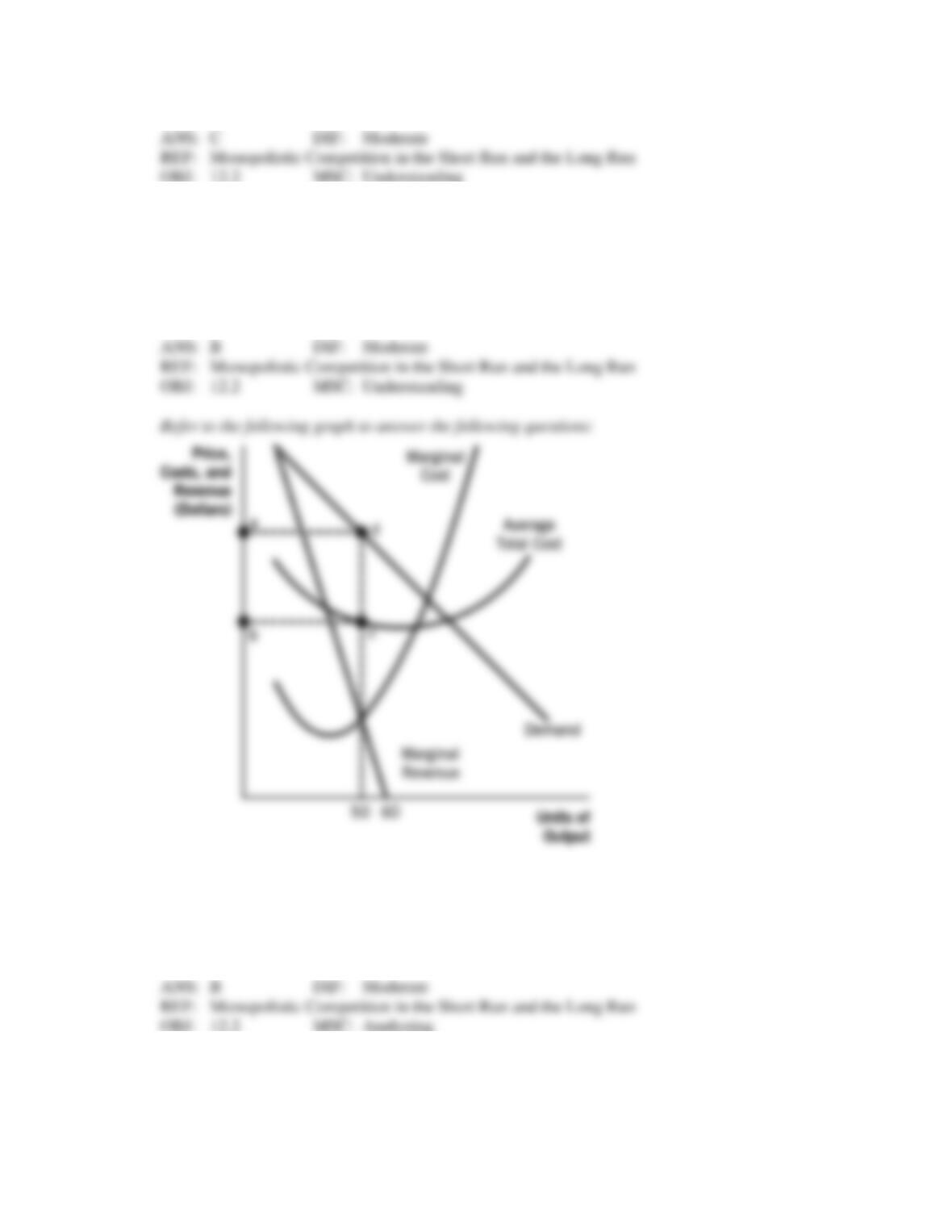
37. The short-run profit-maximizing output for the monopolistic competitive firm is ________ units
per week.
a. 0 (zero) d. 85
b. 50 e. 90
c. 60
38. The maximum long-run economic profit earned by this monopolistically competitive firm is
a. 0 (zero).
b. represented by the rectangle a, b, c, d.
c. represented by the rectangle enclosed by the points 50, 0, c, and b.
d. represented by the area below the demand curve and above marginal cost.
e. greater than 0, but can’t be shown in the diagram because it is an indefinable area.
39. If all firms in a monopolistically competitive industry have demand and cost curves like those
shown, we would expect, in the long run, that
a. all firms will leave the industry.
b. a certain percentage of existing firms will exit the industry.
c. firms in the industry will earn negative economic profits.
d. new firms will enter the industry.
e. enough new firms will enter the industry that it will become perfectly competitive.
40. The short-run equilibrium for a monopolistically competitive firm is at price equals $29, average
total cost equals $22, and marginal cost equals marginal revenue equals $18. Which of the
following is true?
a. Per-unit profit is $11.
b. More firms will be attracted into the industry.
c. The firm could increase the price and increase profits.
d. The firm could decrease the price and increase profits.
e. The firm is operating in the upward-sloping portion of average total cost (ATC).
41. In long-run equilibrium for both a competitive market and monopolistic competition
a. accounting profit is zero. d. economic profit is zero.
b. price equals marginal revenue. e. productive efficiency is achieved.
c. long-run average cost is minimized.
42. In the long run, both monopolistic competition and competitive markets result in
a. a wide variety of brand-name choices for consumers.
b. an inefficient allocation of resources.
c. zero economic profit for firms.
d. excess capacity.
e. insufficient capacity.
43. In the long run, surviving firms in monopolistic competition earn
a. higher than normal economic profit.
b. zero economic profit.
c. less than normal profits.
d. significant economic losses.
e. praise from the government for achieving allocative efficiency.
44. If monopolistically competitive firms are incurring losses, existing firms would
a. reduce their costs. d. leave the industry.
b. charge higher prices. e. begin to collude illegally.
c. make demand more inelastic.
45. If monopolistically competitive firms are making zero economic profit, then these firms would
a. leave the industry. d. remain in the industry.
b. charge higher prices. e. begin to collude illegally.
c. make demand more inelastic.
46. Monopolistically competitive firms that are earning zero economic profit would most likely
a. reduce their costs. d. leave the industry.
b. charge higher prices. e. remain in the industry.
c. make demand more inelastic.
47. In the long run, in monopolistic competition
a. the demand curve is tangent to the marginal cost curve.
b. price equals marginal cost.
c. price equals minimum average total cost.
d. firms have an incentive to leave.
e. economic profits are zero.
48. Monopolistically competitive firms
a. eventually become perfectly competitive.
b. follow the price leader.
c. earn long-run economic profits.
d. necessarily earn short-run economic profits.
e. “compete away” economic profit to zero.
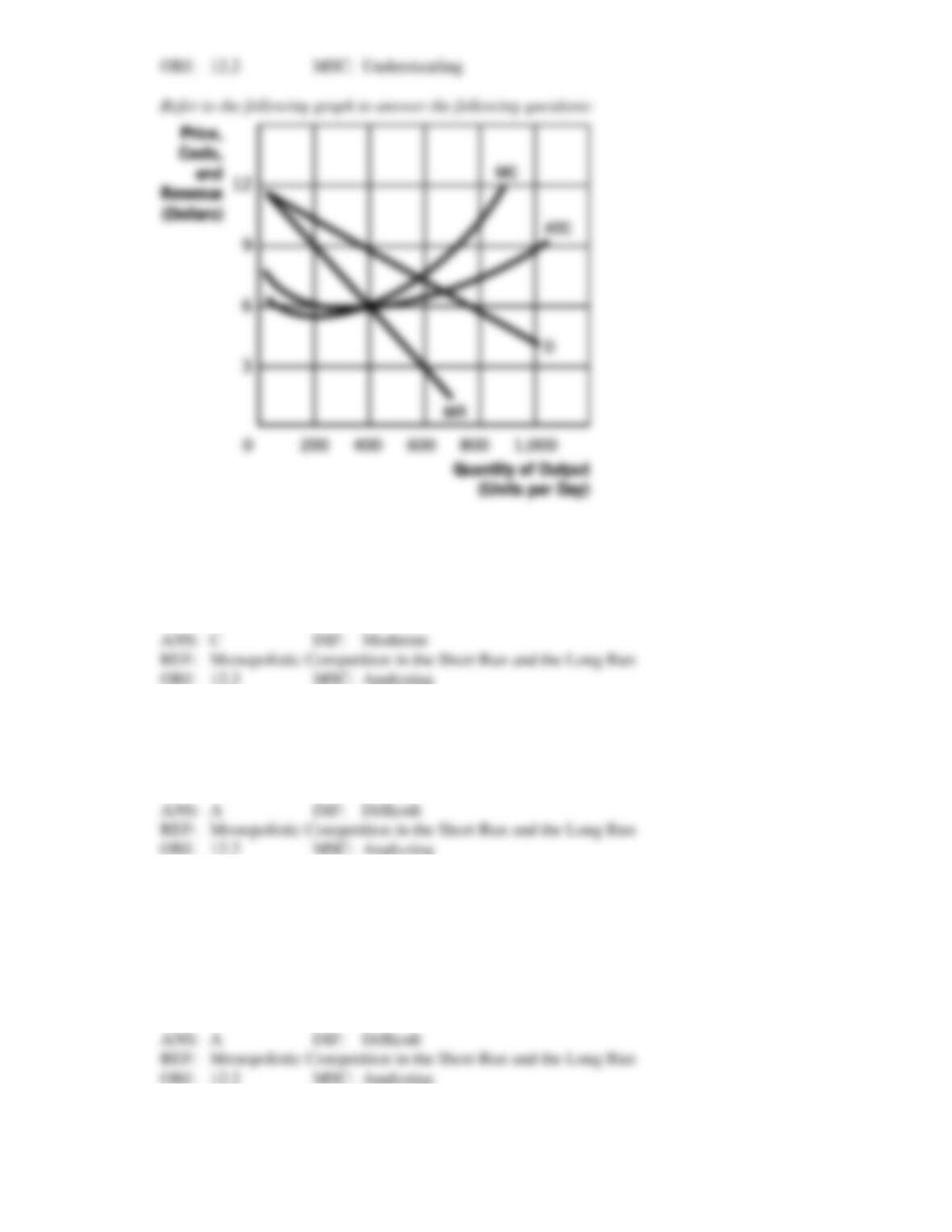
49. The short-run profit-maximizing output for the monopolistic competitive firm is ________ units
per day.
a. 0 (zero) d. 600
b. 200 e. 800
c. 400
50. The maximum long-run economic profit earned by this monopolistic competitive firm is
a. 0 (zero). d. $1,800 per day.
b. $600 per day. e. $20 per hour.
c. $1,200 per day.
51. In the long run, the demand curve for the monopolistically competitive firm would
a. shift leftward.
b. remain the same, causing the entry of new firms to be impossible.
c. shift rightward.
d. move closer to the marginal revenue curve, but the marginal revenue curve would be held
constant.
e. shift rightward, causing the entry of new firms into the industry.
52. In the long run, which of the following is true for the profit-maximizing firm?
a. The firm’s demand curve shifts leftward.
b. The firm’s average total cost curve shifts upward.
c. Profit is $1,200 per day.
d. Profit is $1,500 per day.
e. The firm’s average total cost curve shifts downward, while the marginal cost curve shifts
upward.
53. If all firms in the industry are the same as the monopolistically competitive firm shown, the long
run will reflect
a. firms leaving the industry.
b. all firms earning positive economic profits.
c. some firms earning positive economic profit and others experiencing economic loss.
d. competition from new firms that enter the industry.
e. all firms earning economic profit of exactly $300 per day.
54. In the long run, the positive economic profits of Wings N Things, a monopolistic competitor, are
a. not driven out because competition is not perfect.
b. not driven out because the demand curve slopes downward.
c. eliminated due to the entry of firms into the industry.
d. eliminated due to the departure of firms from the industry.
e. not driven out because firms cannot enter the industry.
55. The theory of monopolistic competition predicts that, in long-run equilibrium, a monopolistically
competitive firm will
a. produce the output level at which price equals long-run average cost.
b. produce the output at which short-run average total cost equals marginal cost.
c. produce the output level at which price equals long-run marginal cost.
d. operate at minimum long-run average cost.
e. operate where price equals long-run average fixed cost.
56. A monopolistically competitive firm
a. faces a downward-sloping demand curve and a steeper downward-sloping marginal revenue
curve.
b. faces a vertical demand curve and identical marginal revenue curve.
c. produces a product that is undifferentiated by style, location, or quality.
d. faces an upward-sloping demand curve.
e. faces a downward-sloping demand and a horizontal marginal revenue curve.
57. Profit-maximizing, monopolistically competitive firms
a. are guaranteed an economic profit in the short run.
b. never lose money.
c. produce only those goods for which they can acquire a barrier to entry, such as a patent (hence
the term “monopolistically”).
d. necessarily earn long-run economic profits.
e. cannot be guaranteed an economic profit in any period and might incur losses.
58. The fast-food, bottled water, and cereal markets are all examples of
a. perfectly competitive markets.
b. monopolies.
c. monopolistically competitive markets.
d. oligopolies.
e. homogeneously competitive markets.
59. If a monopolistically competitive firm is incurring losses, then at the profit–maximizing output
amount
a. price is above the average total cost curve.
b. price is below the average total cost curve.
c. price is equal to marginal revenue.
d. price is less than marginal revenue.
e. average total cost equals marginal cost.
60. Fast-food restaurants are a good illustration of
a. oligopolistic competition. d. monopolistic competition.
b. perfect competition. e. oligopoly.
c. monopoly.
61. Caskets are produced in a monopolistic competitive market. One producer, Final Boxes, sells 20
caskets a week at a price of $550 each. Its average total cost is $600. From this information, we
know that
a. new casket firms will want to enter.
b. this producer is losing $1,000 a week.
c. this producer is making an economic profit of $500.
d. this producer is setting marginal revenue equals marginal cost.
e. this producer should increase production.
62. The greeting card industry is
a. most likely a competitive market and has low markups.
b. most likely a monopoly and has high markups.
c. most likely monopolistically competitive and has substantial markups.
d. most likely an oligopoly with low markups.
e. characterized by firms that advertise and are mutually interdependent.
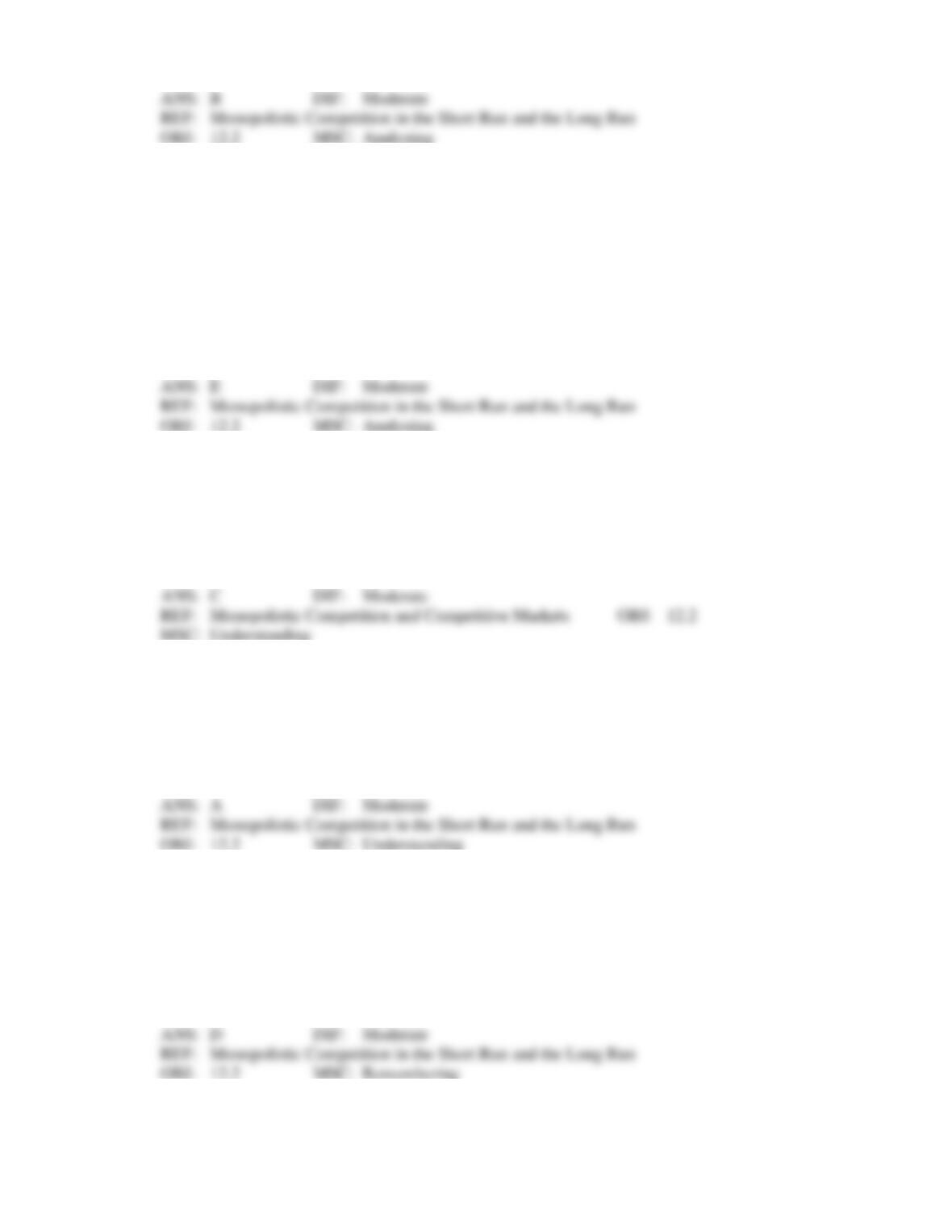
63. The maximum short-run economic profit earned by this monopolistic competitive firm is
a. $20.
b. $66.
c. $272.
d. none; this firm must shut down or lose all of its fixed cost.
e. inconclusive; the maximum short-run profit can’t be determined from the information given.
64. Profit-maximizing output for the monopolistically competitive firm is ________ units.
a. 0 (zero) d. 30
b. 20 e. 35
c. 25
65. To maximize profit, the monopolistically competitive firm shown will charge a price per unit of
a. 0 (zero). d. $16.87.
b. $20.17. e. $15.87.
c. $18.17.
66. If there are exactly 20 firms in the monopolistically competitive industry that are identical to the
firm shown, in the long run, we would expect that
a. total industry economic profit would be exactly equal to 20 times the profit of each individual
firm.
b. total industry economic profit would be greater than 20 times the profit of each individual
firm.
c. industry costs would rise.
d. new firms would desire to enter the industry, but would not be able to because of high entry
barriers.
e. total industry economic profit would be zero.
67. Both competitive and monopolistically competitive firms
a. can maximize profit by raising price.
b. cannot control or set their own price.
c. can maximize profit by producing to the point where marginal cost equals marginal revenue.
d. can enforce price arrangements vigorously in court.
e. sell products that are identical.
68. The marginal revenue of a monopolistically competitive firm will always be
a. less than the price.
b. more than the price.
c. the same as the price.
d. identical to the marginal cost curve.
e. identical to the average total cost curve.
69. Firms in a monopolistically competitive market structure maximize their profit by producing an
output where
a. price equals average total cost.
b. marginal cost equals average variable cost.
c. average revenue equals marginal revenue.
d. marginal revenue equals marginal cost.
e. total revenue equals total cost.
70. The correct level of output for a profit-maximizing, monopolistically competitive firm always
matches the point where
a. total revenue equals total cost.
b. marginal revenue equals marginal cost.
c. price equals average total cost.
d. price equals marginal cost.
e. average revenue equals marginal revenue.
71. Which of the following best describes the relationship between price and marginal revenue for
monopolistic competitors?
a. They are always equal.
b. They are equal only when there are relatively few firms in the industry.
c. Price is below marginal revenue, as a general rule, regardless of the number of firms in the
monopolistically competitive industry.
d. Price is above marginal revenue, as a general rule, regardless of the number of firms in the
monopolistically competitive industry.
e. At low levels of output, price is above marginal revenue. At high levels of output, price is
below marginal revenue as long as the number of firms is not too many because, if it is too large,
the monopolistically competitive industry will become perfectly competitive.
72. Costume jewelry is produced in a monopolistically competitive market. A profit-maximizing
producer finds that marginal revenue equals marginal cost equals $4.50 when output is 700 rings.
An economist studying this information can conclude that
a. the producer is charging a price of $4.50.
b. economic profit is $3,150.
c. the producer charges a price greater than $4.50.
d. new firms will not want to enter this market.
e. this producer should produce more than 700 rings.
73. Which of the following is true for a profit-maximizing firm operating in a competitive market,
monopolistic competition, and monopoly?
a. Firms earn positive economic profits in the long run.
b. Firms earn zero economic profits in the long run.
c. Profits are maximized when marginal cost equals marginal revenue.
d. Price equals marginal revenue.
e. Entry into the industry is impossible.
74. If the price that determined where marginal revenue equaled marginal cost were below the bottom
of the average variable cost curve, then the profit-maximizing, monopolistically competitive firm
would
a. produce an output amount where marginal cost equals marginal revenue and make a small
profit.
b. produce an output amount that corresponded to the place where marginal cost equals marginal
revenue and break even.
c. produce an output amount that corresponded to the place where marginal cost equals marginal
revenue, but make a small loss.
d. shut down because it would cost more to produce and sell output than it would to shut down
and lose all fixed costs.
e. produce an output amount that corresponded to the place where average total cost equals
average variable cost and incur a small loss.
75. An increase in marginal cost causes a profit-maximizing, monopolistically competitive firm to
a. keep price and output the same. d. raise price and raise output.
b. raise price and decrease output. e. lower price and lower output.
c. lower price and increase output.
76. Profit-maximizing, monopolistically competitive firms
a. consider the actions of their competitors when determining price.
b. consider the actions only of the price leader in their market when determining price.
c. consider only marginal cost and marginal revenue, which determine the level of output—and
the level of output determines price.
d. consider only average total cost and average variable cost, which determine the level of
output—and the level of output determines price.
e. take their price from the industry price, as do perfectly competitive firms.
77. If positive economic profit exists in monopolistic competition, there is
a. incentive for new firms to enter.
b. a motive for existing firms to increase prices.
c. proof that advertising works.
d. a motive for existing firms to decrease prices.
e. product differentiation.
78. If monopolistically competitive firms are making positive economic profits, then new firms would
a. reduce their costs. d. leave the industry.
b. charge higher prices. e. begin to enter the industry.
c. make demand more inelastic.
79. As new firms enter a monopolistically competitive industry, it can be expected that
a. market price will rise.
b. the output of existing firms will rise.
c. profits of existing firms will fall.
d. market demand will rise.
e. the profits of existing firms will rise.
80. Entry of new firms will continue in a monopolistically competitive industry until
a. marginal cost equals 0 (zero).
b. marginal revenue equals 0 (zero).
c. marginal revenue equals marginal cost.
d. economic profit equals 0 (zero).
e. economic profit is negative.
81. We can represent the entry of new firms into a monopolistically competitive market by shifting the
existing firms’
a. demand curves downward. d. cost curves upward.
b. demand curves upward. e. cost curves downward.
c. marginal revenue curves upward.
82. The entry of new firms into a monopolistically competitive industry causes the
a. market demand curve to shift right.
b. market demand curve to shift left.
c. existing firms’ demand curve to shift right.
d. existing firms’ demand curve to shift left.
e. market supply curve to shift left.
83. You operate a monopolistically competitive firm and you notice that your company is making an
economic profit. Which of the following is most likely to happen?
a. Other firms in your industry will raise their prices.
b. Other firms will enter your industry and your demand curve will shift left.
c. Other firms will enter your industry and your demand curve will shift right.
d. Your firm will be forced to exit the industry.
e. Government regulators will investigate your firm for “excessive economic profit.”
84. The demand curve for a monopolistically competitive firm is downward-sloping because of
a. high barriers to entry. d. government regulation.
b. product differentiation. e. identical cost curves for each firm.
c. the lack of firms in the industry.
85. Market power is best described as when the firm’s demand curve is
a. positively sloped. d. downward-sloping.
b. a horizontal line. e. above the industry demand curve.
c. a vertical line.
86. One could argue correctly that
a. all firms in any industry can earn short-run but not necessarily long-run positive economic
profit.
b. all firms in any industry can earn long-run but not necessarily short-run positive economic
profit.
c. all firms in any industry can earn both short-run and long-run positive economic profit.
d. no firm in any industry can earn long-run positive economic profit because all price changes
made by any firm will be followed by all of the other firms.
e. all firms in any industry can earn short-run positive profit if economies of scale exist.
87. The difference between price and marginal cost is
a. marginal revenue.
b. per-unit profit.
c. average total revenue.
d. markup.
e. nothing in the long run; they must be the same.
88. A monopolistically competitive firm usually charges more than a perfectly competitive firm
because
a. it is part of a group of firms that has formally agreed to control the price and the output of a
product.
b. its primary goal is to reap monopoly profits by replacing competition with cooperation.
c. producing homogenous output is more expensive than producing differentiated output.
d. producing differentiated output is more expensive than producing homogenous output.
e. it has a monopoly, but potential entrants exist in the form of contestable markets.