Chapter 11 – Monopolistic Competition and Oligopoly (+ Appendix)
211. As it relates to oligopoly, game theory focuses on the strategic behavior of rival firms.
212. The highest possible value of the Herfindahl index is 1,000.
213. The U.S. breakfast cereal industry is an example of differentiated oligopoly.
214. The U.S. steel industry is an example of homogeneous oligopoly.
Chapter 11 – Monopolistic Competition and Oligopoly (+ Appendix)
215. Homogenous oligopolists tend to advertise more than do differentiated oligopolists.
216. Oligopolists use limit pricing to maximize short-run profits.
217. Both collusive and noncollusive oligopoly models suggest that price changes will be
relatively infrequent in these types of industries.
218. Collusion among firms always involves formal agreements.
Chapter 11 – Monopolistic Competition and Oligopoly (+ Appendix)
219. Firms are more likely to collude when the economy is in a recession.
220. A simultaneous game is said to exist when:
221. A positive-sum game occurs:
Chapter 11 – Monopolistic Competition and Oligopoly (+ Appendix)
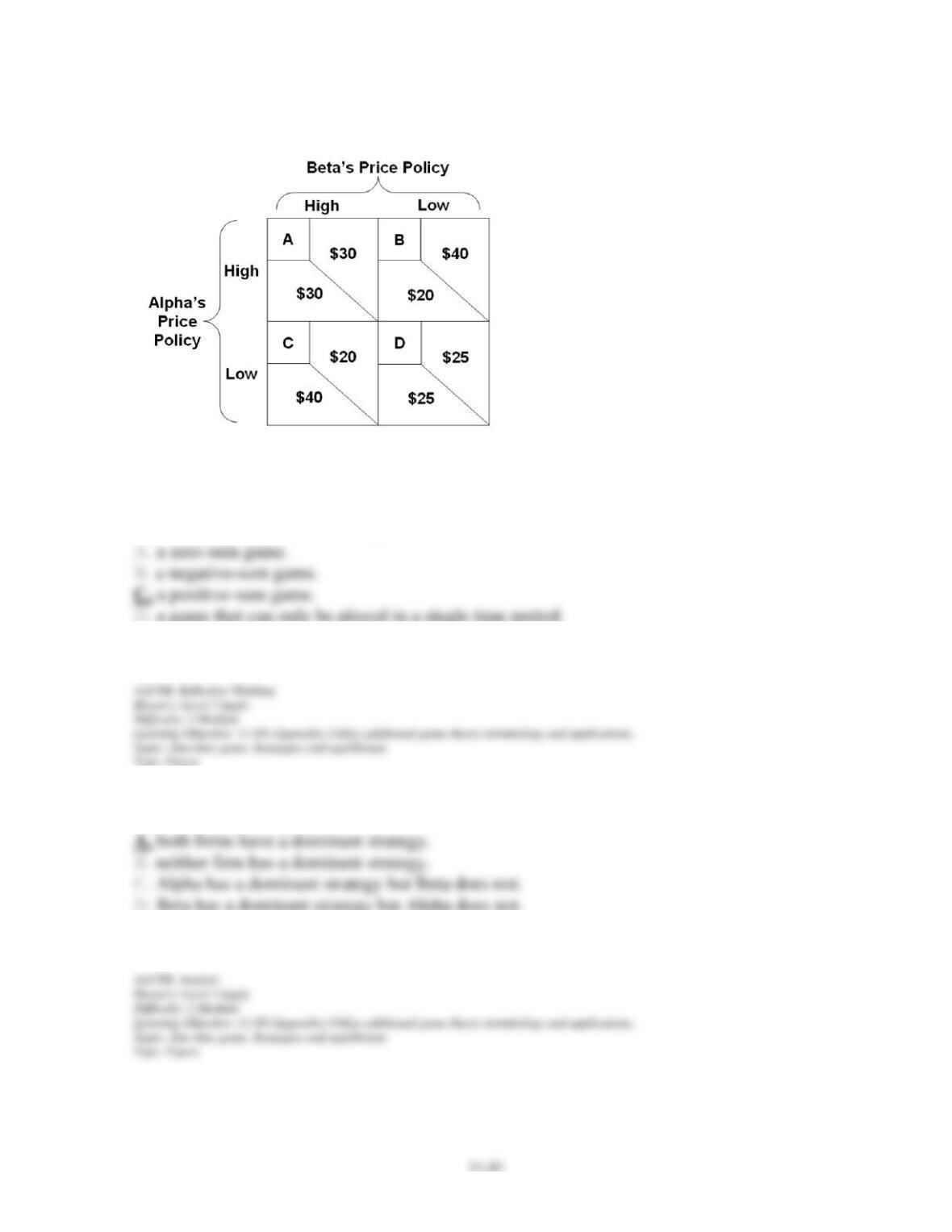
222. The payoff matrix above represents:
223. In the payoff matrix above:
Chapter 11 – Monopolistic Competition and Oligopoly (+ Appendix)
224. In the payoff matrix shown above:
225. Refer to the above payoff matrix. Which cell represents the outcome of this game?
226. Refer to the above payoff matrix. Which of the following statements is true regarding the
outcome of this game?
Chapter 11 – Monopolistic Competition and Oligopoly (+ Appendix)
227. Refer to the above payoff matrix. Which of the following statements is true regarding the
outcome of this game?
228. Refer to the above payoff matrix. Suppose that Alpha and Beta agree that they will both
pursue a high price strategy. If Beta then cheats on the agreement in order to increase profits,
229. Collusive agreements between two firms are most likely to be honored when the game:
Chapter 11 – Monopolistic Competition and Oligopoly (+ Appendix)
230. Zippy’s and Tony’s are rival pizza restaurants in a small town (together they form a local
duopoly). Zippy’s management determines that if it increases its advertising expenditures, it
will increase profits regardless of whether Tony’s increases its advertising budget. Based on
this information, we can conclude that:
231. Larry’s Lizards and Ronaldo’s Reptiles are competing pet store franchises. Both are
considering opening a store in the small town Turtleville. If Ronaldo’s opens a profitable store
in Turtleville and Larry’s management determines that it is not profitable to also open a store,
then:
232. In a sequential game, the first mover into a new market:
Chapter 11 – Monopolistic Competition and Oligopoly (+ Appendix)
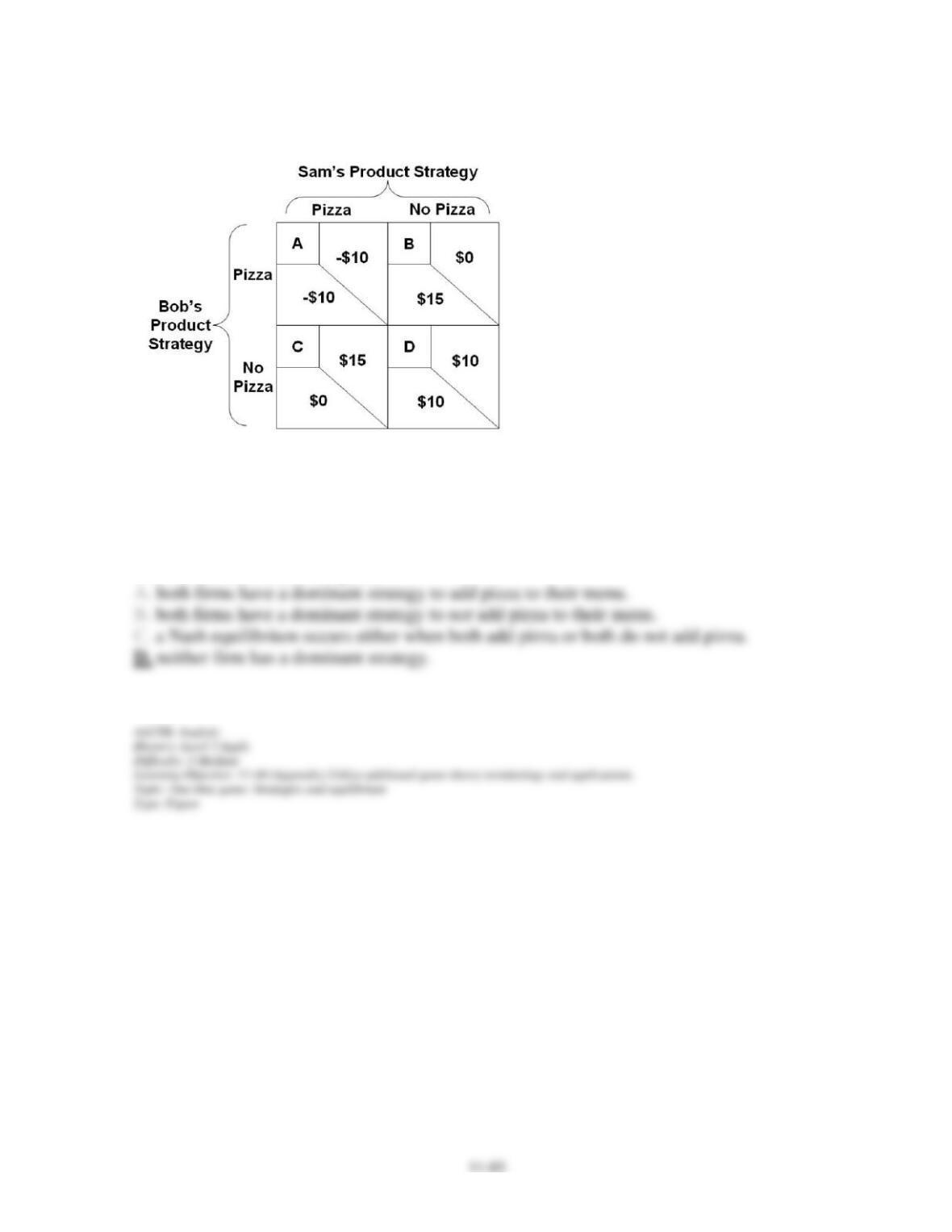
233. Refer to the above payoff matrix. Bob’s Burgers and Sam’s Sandwiches are competing
restaurants in a small town. Both are considering adding pizza to their line of products. If this
is a one-time simultaneous game:
Chapter 11 – Monopolistic Competition and Oligopoly (+ Appendix)
234. Refer to the above payoff matrix. Bob’s Burgers and Sam’s Sandwiches are competing
restaurants in a small town. Both are considering adding pizza to their line of products. If this
is a sequential game:
235. Refer to the above payoff matrix. Bob’s Burgers and Sam’s Sandwiches are competing
restaurants in a small town. Both are considering adding pizza to their line of products. If this
is a sequential game and Bob’s moves first, which cell represents the final outcome?
Chapter 11 – Monopolistic Competition and Oligopoly (+ Appendix)
236. Refer to the above payoff matrix. Bob’s Burgers and Sam’s Sandwiches are competing
restaurants in a small town. Both are considering adding pizza to their line of products. If this
is a sequential game but we don’t know who moves first, what can we say about the final
outcome?
237. In a sequential game with two firms, the first mover into a new market:
Chapter 11 – Monopolistic Competition and Oligopoly (+ Appendix)
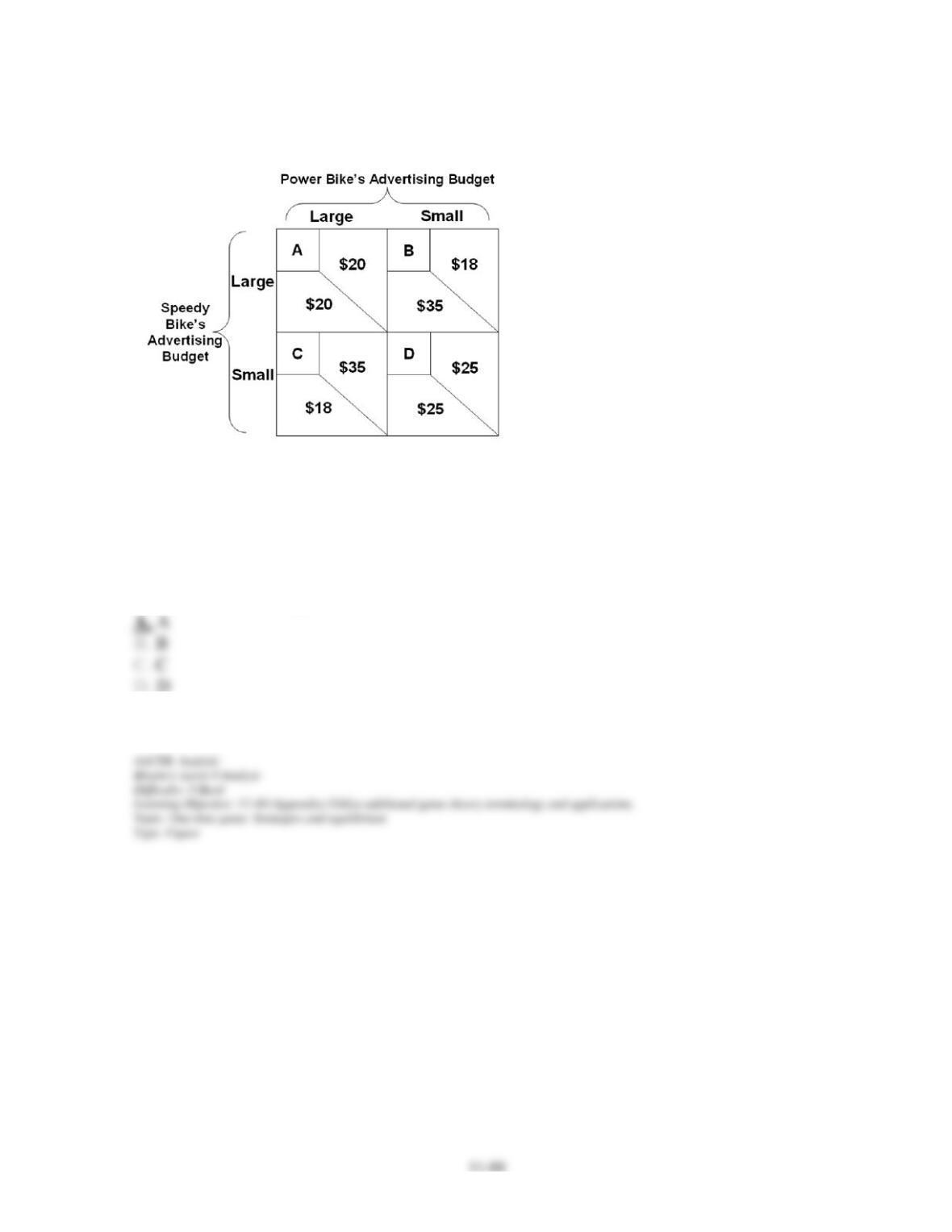
238. Refer to the above payoff matrix. Suppose that Speedy Bike and Power Bike are the only
two bicycle manufacturing firms serving the market. Both can choose large or small
advertising budgets. If this is a one-time, simultaneous game, which cell represents the final
outcome we would expect to occur?
Chapter 11 – Monopolistic Competition and Oligopoly (+ Appendix)
239. Refer to the above payoff matrix. Suppose that Speedy Bike and Power Bike are the only
two bicycle manufacturing firms serving the market. Both can choose large or small
advertising budgets. If this is a repeated game with no cooperation or reciprocity, which cell
represents the final outcome we would expect to occur?
240. Refer to the above payoff matrix. Suppose that Speedy Bike and Power Bike are the only
two bicycle manufacturing firms serving the market. Both can choose large or small
advertising budgets. If this is a repeated game with no cooperation or reciprocity, cell A:
Chapter 11 – Monopolistic Competition and Oligopoly (+ Appendix)
241. Refer to the above payoff matrix. Suppose that Speedy Bike and Power Bike are the only
two bicycle manufacturing firms serving the market. Both can choose large or small
advertising budgets. Is there a Nash equilibrium solution to this game?
242. Refer to the above payoff matrix. Suppose that Speedy Bike and Power Bike are the only
two bicycle manufacturing firms serving the market. Both can choose large or small
advertising budgets. If this is a repeated game and the firms cooperate to maximize profits,
which of the following outcomes would we expect to occur?
Chapter 11 – Monopolistic Competition and Oligopoly (+ Appendix)
243. Refer to the above payoff matrix. Suppose that Speedy Bike and Power Bike are the only
two bicycle manufacturing firms serving the market. Both can choose large or small
advertising budgets. If this is a repeated game, it is in the long-term best interests of both
players to:
244. Which of the following best describes a Nash equilibrium?
245. In game theory, the credibility of a threat:
Chapter 11 – Monopolistic Competition and Oligopoly (+ Appendix)
246. If one player in game has a dominant strategy, the other player must also have a
dominant strategy.
247. A player is said to have a dominant strategy when one of the options available is
superior, regardless of what strategy the other player chooses.
248. If neither player has an incentive to deviate from the outcome of a game, the outcome is
a Nash equilibrium.
249. A Nash equilibrium can only occur in repeated games.
Chapter 11 – Monopolistic Competition and Oligopoly (+ Appendix)
250. One characteristic of sequential games is that they all have first-mover advantages.
251. Repeated games may involve either simultaneous or sequential decision-making.
252. Negative-sum games do not exist because neither player has an incentive to play the
game.
253. In a zero-sum game, the gains by one player will be exactly offset by the losses of the
other.
Chapter 11 – Monopolistic Competition and Oligopoly (+ Appendix)
254. In repeated games, players may be willing to accept lower payoffs in the short run in
exchange for greater net payoffs over the long run.
255. In repeated games, credible threats are necessary for the players to reach a Nash
equilibrium.
256. The first mover in a sequential game always has the advantage over the second mover.