Chapter 11 – Monopolistic Competition and Oligopoly (+ Appendix)
153. In which set of market models are there the most significant barriers to entry?
154. Which of the following factors tends to foster the development of an oligopoly?
155. Monopolistically competitive firms exist due to high barriers to entry.
Chapter 11 – Monopolistic Competition and Oligopoly (+ Appendix)
156. Monopolistically competitive firms have some control over the price of their products.
157. Brand names and packaging are forms of product differentiation under monopolistic
competition.
158. The demand curve faced by a monopolistically competitive firm is more elastic than the
monopolist’s demand curve.
159. The larger the number of firms in an industry and the less the extent of product
differentiation, the greater will be the elasticity of the individual seller’s demand curve.
Chapter 11 – Monopolistic Competition and Oligopoly (+ Appendix)
160. If the representative firm in a monopolistically competitive industry has an optimal
output where P < ATC, the industry will expand in the long run.
161. In long-run equilibrium, a monopolistically competitive firm will produce where P > MR
= MC > minimum ATC.
162. In the long run, typical firms that are monopolistically competitive earn economic
profits.
163. Monopolistically competitive firms will achieve the most efficient allocation of society’s
resources because there are no significant barriers to entry into the industry.
Chapter 11 – Monopolistic Competition and Oligopoly (+ Appendix)
164. Pure competition results in a lower price but identical output level compared to those in
monopolistic competition.
165. A homogeneous oligopoly means that the few firms in the industry have identical cost
and demand curves.
167. Game-theory view of oligopoly behavior suggests that oligopolists will benefit from
collusion.
Chapter 11 – Monopolistic Competition and Oligopoly (+ Appendix)
168. Prices in oligopolistic industries are predicted to fluctuate widely and frequently
compared to other market structures.
169. An oligopolist producing where MR > MC should lower its price and increase output to
maximize its profits.
170. If an oligopolist’s competitors follow its price cuts but ignore its price increases, the
oligopolist will face a “gap” in its marginal revenue schedule.
171. A cartel of four firms that controls 100 percent of the output in a market, and faces the
same cost schedules that a monopolist would have, will set a price somewhat lower than the
monopoly price for its product.
Chapter 11 – Monopolistic Competition and Oligopoly (+ Appendix)
172. OPEC functions as a classic example of a kinked demand curve oligopoly.
173. A firm in a cartel typically cheats on its collusive agreement by raising its price and
restricting output more than it agreed to with other cartel members.
174. Mutually-cancelling advertising by oligopolistic firms tend to improve economic
efficiency in the industry.
175. Advertising increases the costs of firms and could be manipulative, therefore it does not
really have a positive economic effect.
Chapter 11 – Monopolistic Competition and Oligopoly (+ Appendix)
176. Unlike a monopoly, an oligopoly tends to achieve allocative efficiency due to the rivalry
among several firms.
177. A game in which one firm’s gain must equal the other firm’s loss is called a
178. A strategy that is better than any alternative strategy-regardless of what the other firm
does-is called a
Chapter 11 – Monopolistic Competition and Oligopoly (+ Appendix)
179. A statement of coercion by one firm is
180. In a repeated game,
181. In some games, one firm may avoid taking advantage of another firm because it knows
that the other firm can take advantage of it in subsequent games. This behavior is called
Chapter 11 – Monopolistic Competition and Oligopoly (+ Appendix)
11–65
182. Which of the following statements is true?
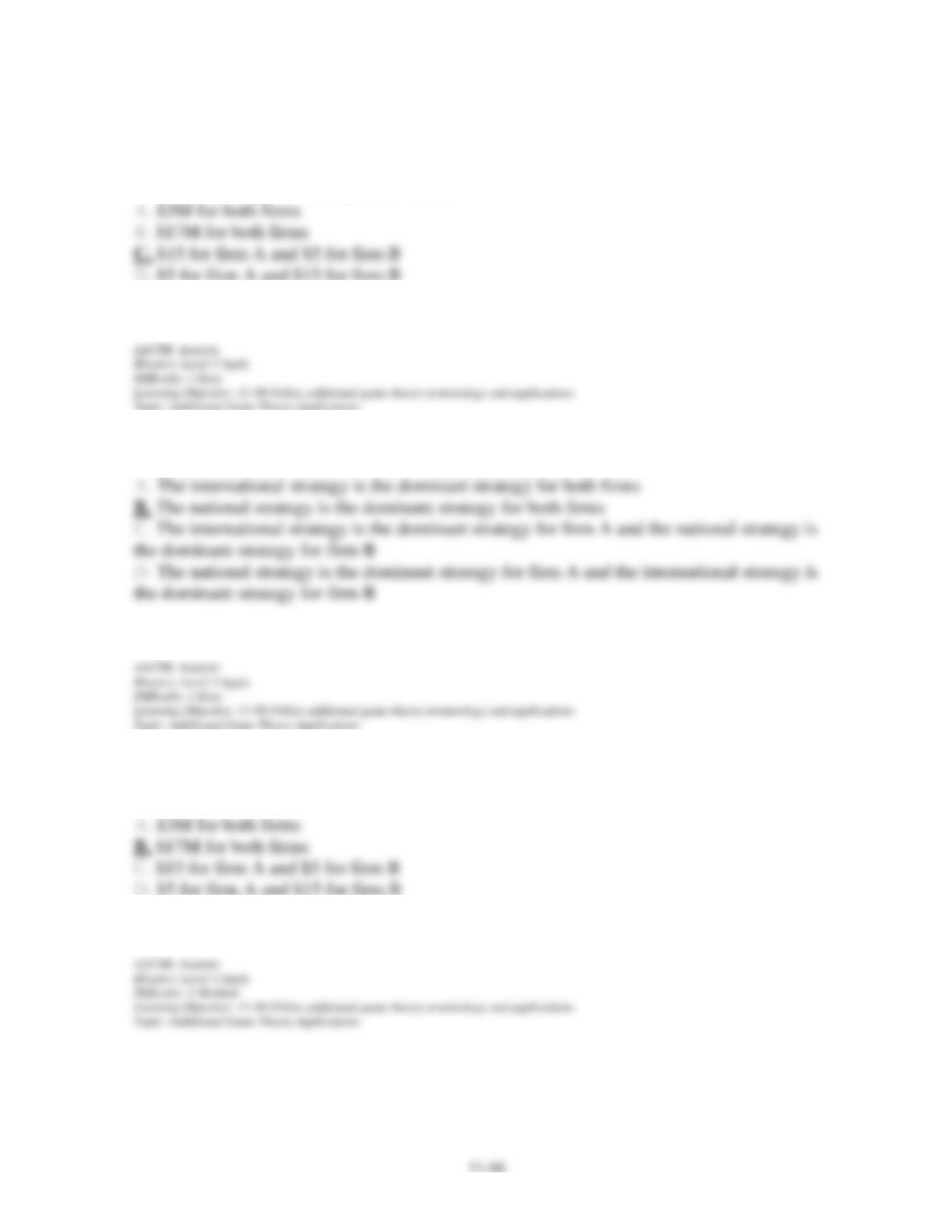
Answer the question based on the following payoff matrix for a duopoly in which the
numbers indicate the profit from following either an international strategy or a national
strategy.
Chapter 11 – Monopolistic Competition and Oligopoly (+ Appendix)
183. Refer to the above table. If firm A chooses an international strategy while firm B chooses
a national strategy, then the payoffs will be
184. Refer to the above table. Which of the following is true?
185. Refer to the above table. When this game reaches a Nash equilibrium, the payoffs will
be
Chapter 11 – Monopolistic Competition and Oligopoly (+ Appendix)
186. Refer to the above table. If firm A chooses its dominant strategy and firm B chooses a
strategy that is not dominant, then the payoffs will be
Chapter 11 – Monopolistic Competition and Oligopoly (+ Appendix)
11–68
Answer the question based on the following payoff matrices for a repeated game involving
two firms that are considering introducing new products to the market. The numbers indicate
the profit from following either a strategy to introduce a new product or a strategy to not
introduce a new product.
First game:
Second game:
Chapter 11 – Monopolistic Competition and Oligopoly (+ Appendix)
187. Refer to the above table. In the first game,
188. Refer to the above table. In the second game,
189. Refer to the above table. In the first game, if firm B doesn’t introduce a new product and
firm A does, then firm A would be better off if
Chapter 11 – Monopolistic Competition and Oligopoly (+ Appendix)
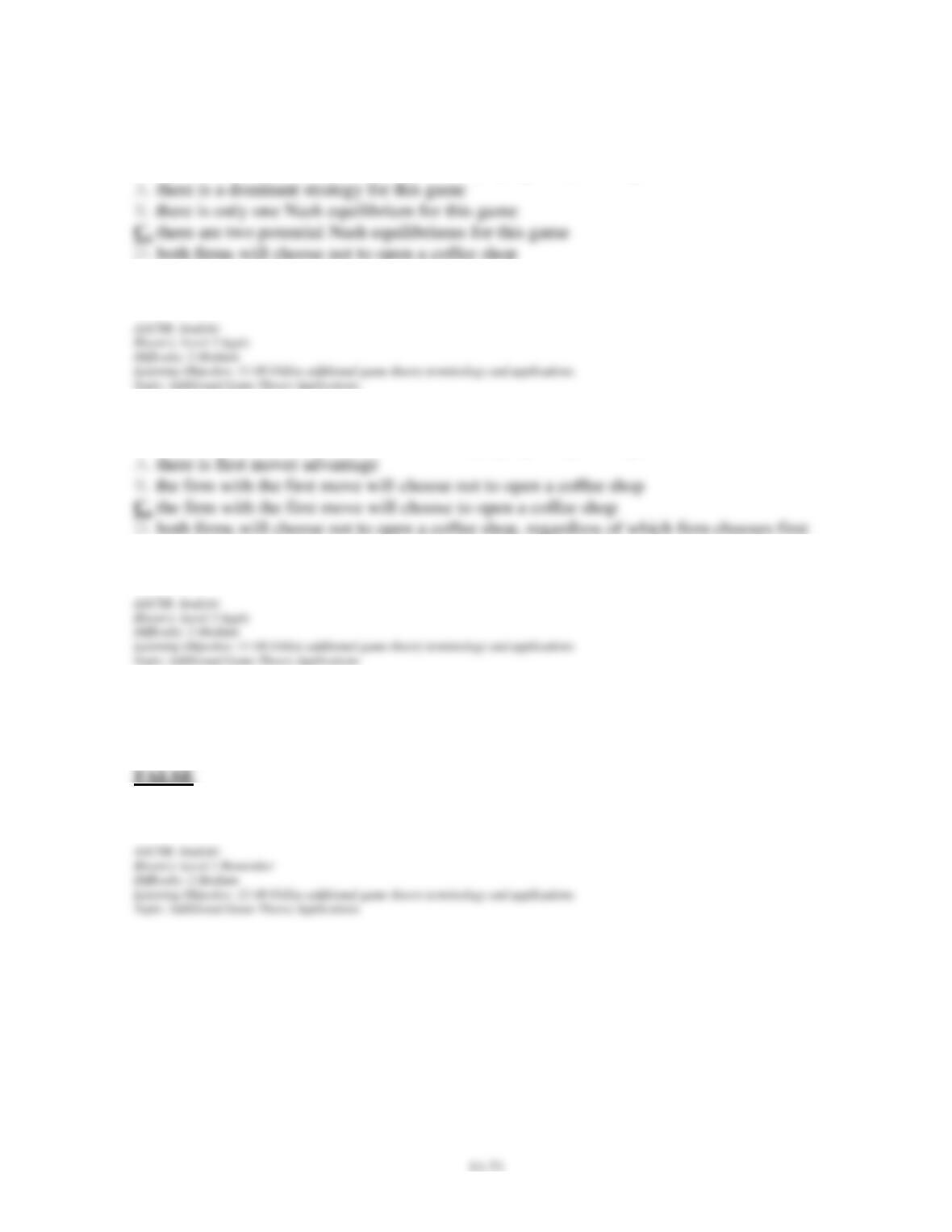
Answer the question based on the following payoff matrix for a duopoly in which the
numbers indicate the profit from either opening a coffee shop in a small town or not opening
the coffee shop.
190. Refer to the above table. If both firms choose their strategies simultaneously, then
Chapter 11 – Monopolistic Competition and Oligopoly (+ Appendix)
191. Refer to the above table. If the firms are playing a sequential game, then
192. Refer to the above table. If the firms are playing a sequential game, then
193. According to the definition of a one-time game, firms must choose their strategies at the
same time.
Chapter 11 – Monopolistic Competition and Oligopoly (+ Appendix)
194. Nash equilibriums can exist even in games that lack dominant strategies.
195. An empty threat is a statement of coercion that is not believed by the threatened firm.
196. In game theory, credible threats can be used to maintain collusive agreements between
firms.