Chapter 11 – Monopolistic Competition and Oligopoly (+ Appendix)
109. In a duopoly, if one firm increases its price, then the other firm can:
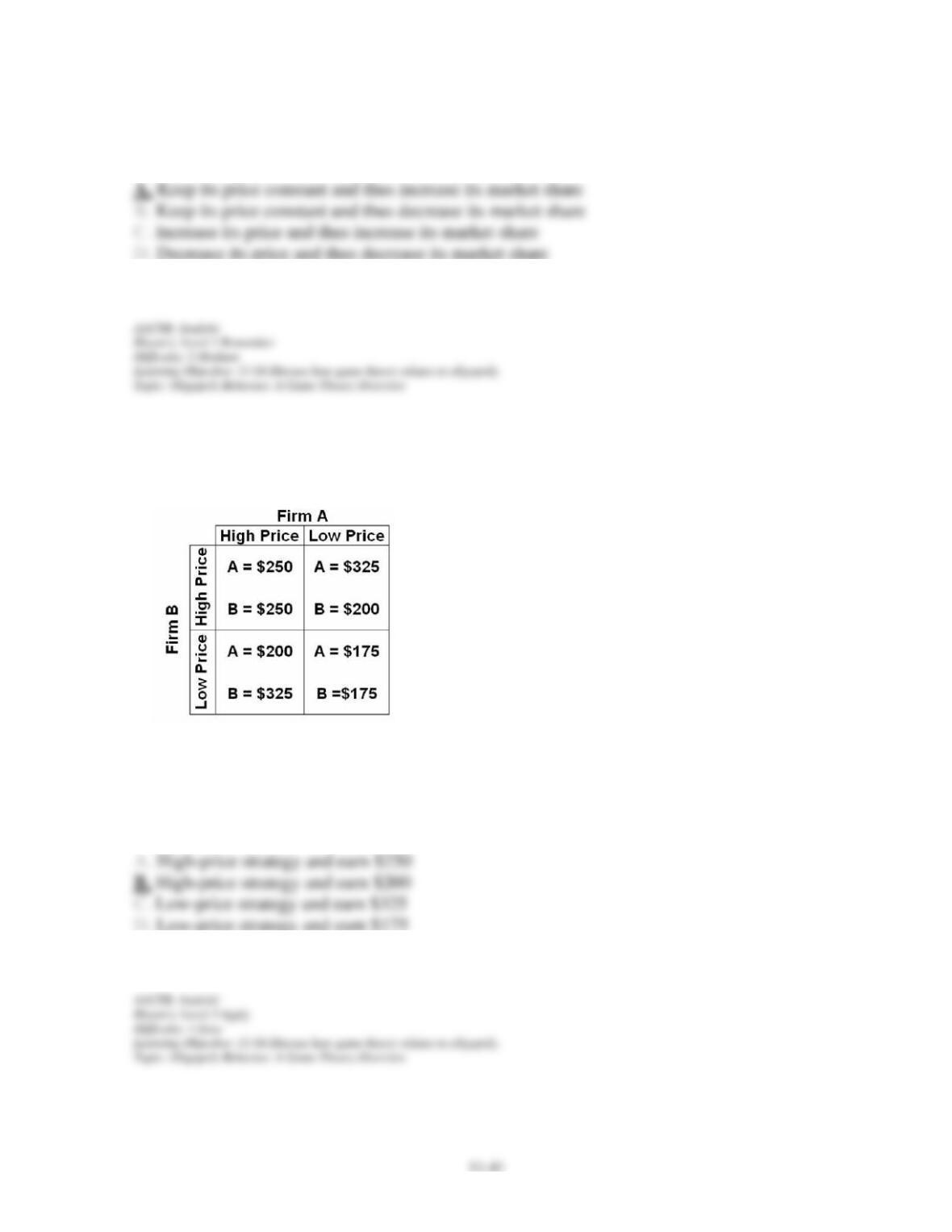
Answer the question based on the following payoff matrix for a duopoly in which the
numbers indicate the profit in millions of dollars for each firm:
110. Refer to the payoff matrix above. If Firm A adopts the low-price strategy, then Firm B
would adopt the:
Chapter 11 – Monopolistic Competition and Oligopoly (+ Appendix)
111. Refer to the above payoff matrix. Assume that firm B adopts a low-price strategy while
firm A maintains a high-price strategy. Compared to the results from a high-price strategy for
both firms, firm B will now:
112. Refer to the above payoff matrix. If the two firms collude to maximize joint profits, the
total profits for the two firms will be:
113. Refer to the above payoff matrix. If the two firms collude to maximize joint profits:
Chapter 11 – Monopolistic Competition and Oligopoly (+ Appendix)
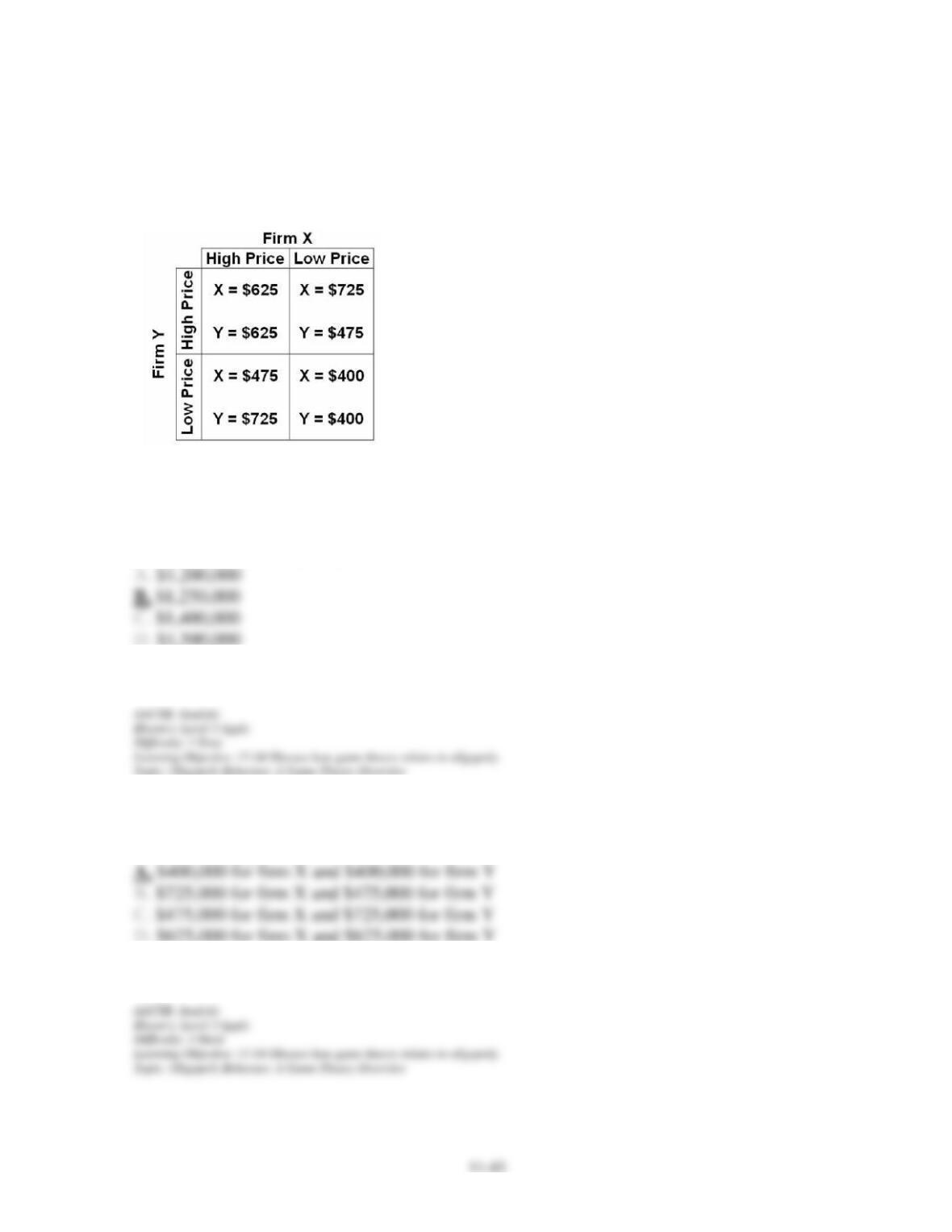
Answer the question based on the following payoff matrix for a duopoly in which the
numbers indicate the profit in thousands of dollars for a high-price or a low-price strategy
114. Refer to the above payoff matrix. If both firms collude to maximize joint profits, the total
profits for the two firms will be:
115. Refer to the above payoff matrix. If both firms operate independently and do not collude,
the most likely profit is:
Chapter 11 – Monopolistic Competition and Oligopoly (+ Appendix)
116. Under oligopoly, if one firm in an industry significantly increases advertising
expenditures in order to capture a greater market share, it is most likely that other firms in that
industry will:
117. The kinked demand model of oligopoly assumes that:
118. If an oligopolist’s demand curve has a “kink” in it, then:
Chapter 11 – Monopolistic Competition and Oligopoly (+ Appendix)
119. A major prediction of the kinked demand curve model is:
120. Which statement concerning the kinked demand curve model of oligopoly is false?
121. In the kinked demand model of oligopoly, if one firm increases its price, the most likely
reaction of the other firms will be to:
Chapter 11 – Monopolistic Competition and Oligopoly (+ Appendix)
122. In the kinked demand model, there will be a vertical break in the firm’s:
123. If output is set at the kink of the kinked demand model, then there:
124. A prediction from the kinked demand curve model of oligopoly is that, for an individual
firm, small changes in:
Chapter 11 – Monopolistic Competition and Oligopoly (+ Appendix)
125. One shortcoming of the kinked demand curve model of oligopoly is that it does not
explain:
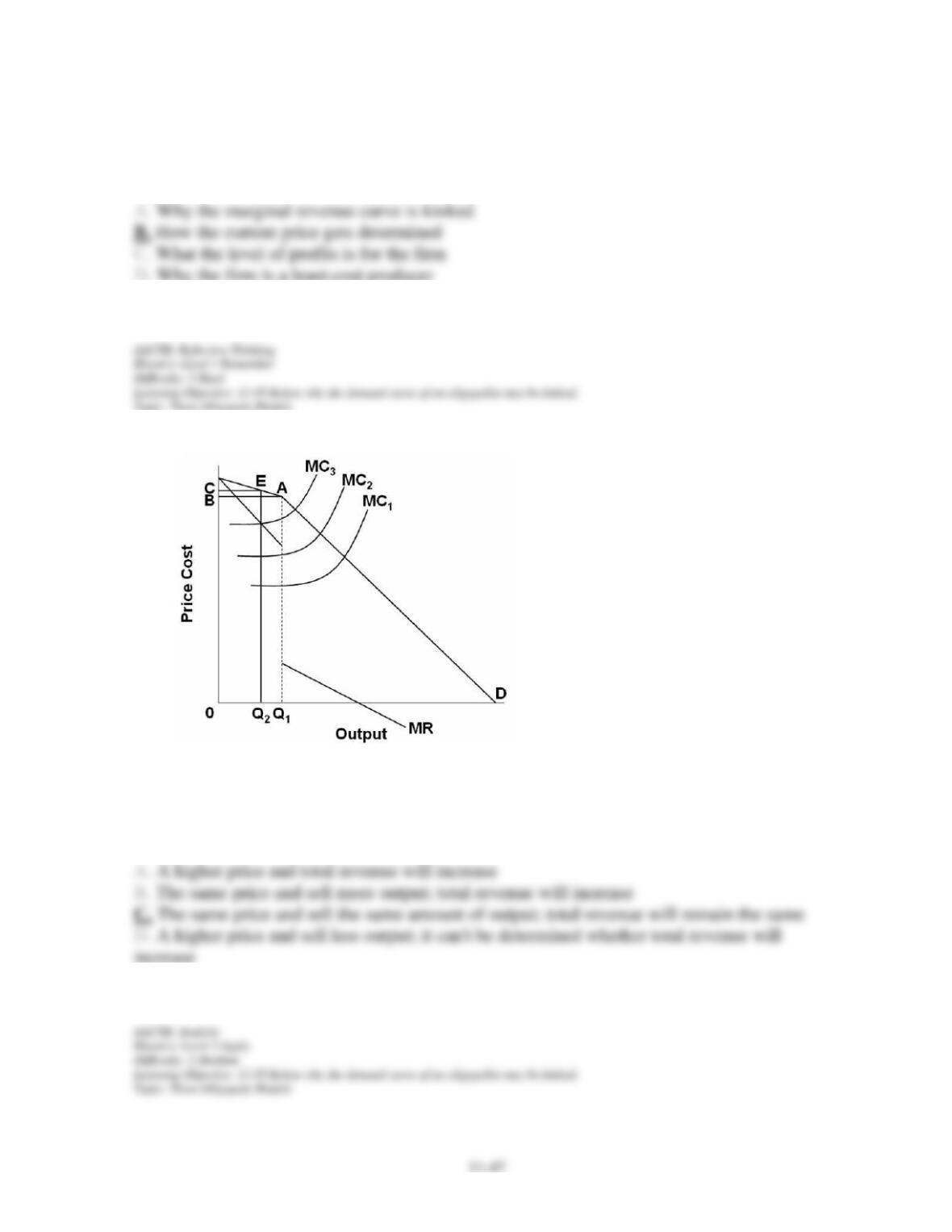
126. On the above graph, if the oligopolist’s MC curve shifts from MC1 to MC2, the firm will
charge:
Chapter 11 – Monopolistic Competition and Oligopoly (+ Appendix)
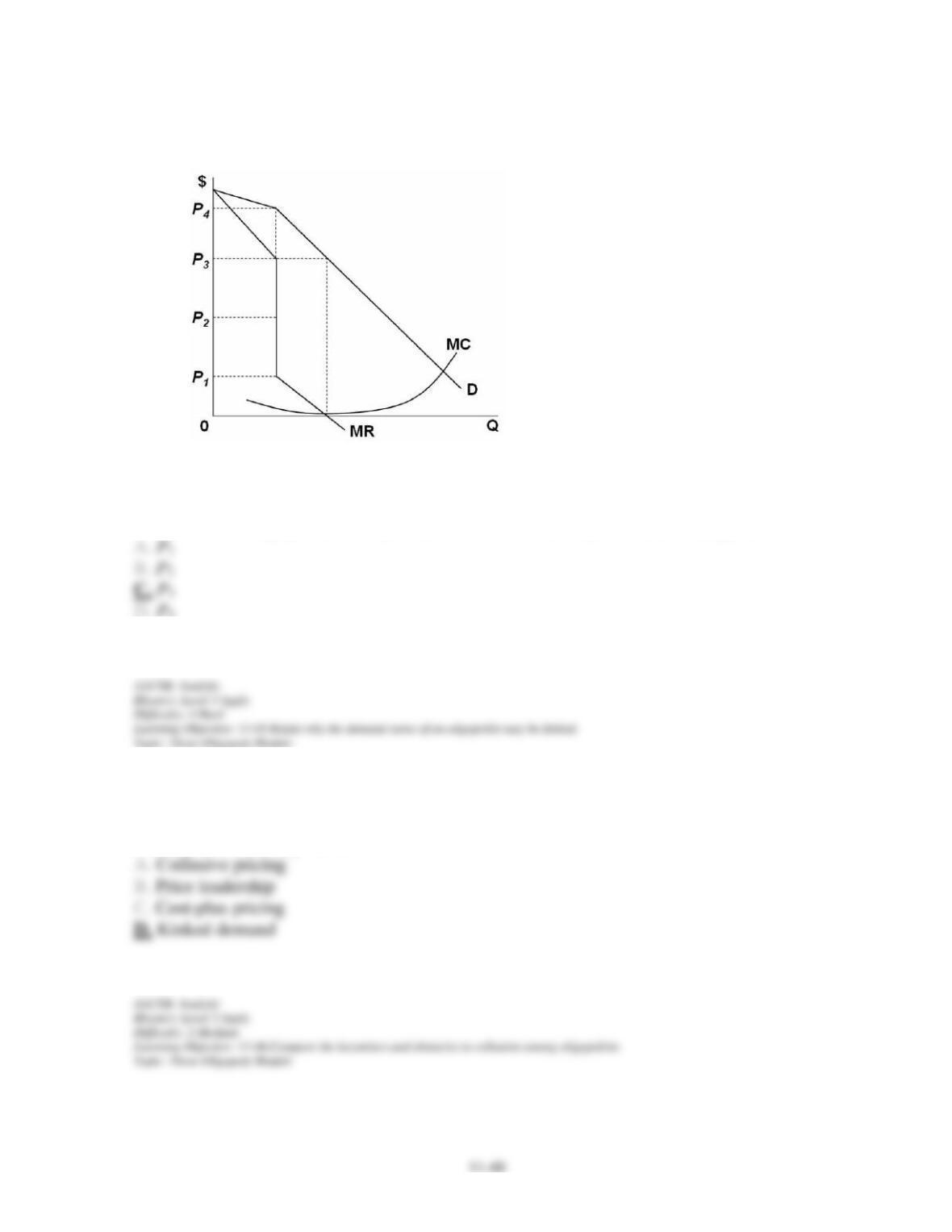
127. Given the oligopolistic firm pictured above, what is the profit-maximizing price?
128. An oligopolistic firm finds that marginal revenue can range from $10 to $25 at an output
level of 2,500 units. This information would suggest that the oligopolistic model for this
industry is most likely one of:
Chapter 11 – Monopolistic Competition and Oligopoly (+ Appendix)
129. Collusive control over price may permit oligopolists to:
130. If oligopolistic firms facing similar cost and demand conditions successfully collude,
price and output results in this industry will be most accurately predicted by which of the
following models?
131. A cartel is:
Chapter 11 – Monopolistic Competition and Oligopoly (+ Appendix)
132. A major reason that firms form a cartel is to:
133. Collusion among oligopolistic firms:
134. The incentive to cheat within a cartel increases with an increase in the following factors,
except:
Chapter 11 – Monopolistic Competition and Oligopoly (+ Appendix)
135. In an oligopoly, producers’ agreements to restrict output tend to be unstable because each
firm has an incentive to:
136. Other things being equal, a firm in a cartel will most likely cheat on a price-fixing
agreement by:
137. Which would make it easier to maintain an effective collusive agreement in a cartel?
Chapter 11 – Monopolistic Competition and Oligopoly (+ Appendix)
138. The Organization of Petroleum Exporting Countries (OPEC) is an international cartel. If
the cartel were to hire a consulting firm to monitor the production rates of member countries,
the economic reason for this monitoring is to:
139. Informal collusion to restrict output and increase prices is sometimes referred to as a:
140. Which constitutes an obstacle to collusion among oligopolists?
Chapter 11 – Monopolistic Competition and Oligopoly (+ Appendix)
141. One of the tactics used by a leader in the price leadership model of oligopoly is:
142. The strategy of establishing a price that prevents the entry of new firms is called:
143. If a particular bank regularly announces changes in its interest rate schedules before its
competitors, which then set rates very close to those announced by that bank, this could be
described as:
Chapter 11 – Monopolistic Competition and Oligopoly (+ Appendix)
144. Price leadership represents a situation where oligopolistic firms:
145. In competing with rivals, oligopolistic firms will tend to use:
146. A potential negative effect of advertising for society is that it can:
Chapter 11 – Monopolistic Competition and Oligopoly (+ Appendix)
147. A positive effect of advertising for society is that it:
148. In an oligopolistic market there is likely to be:
149. In the long run an oligopoly:
Chapter 11 – Monopolistic Competition and Oligopoly (+ Appendix)
150. Which would describe how many economists would view efficiency in oligopoly?
151. Which would be a qualification to the view that oligopoly is allocatively and
productively inefficient?