Chapter 11 – Monopolistic Competition and Oligopoly (+ Appendix)
51. Refer to the above graph for a representative firm in monopolistic competition in a
constant-cost industry. This firm:
52. The long-run equilibrium position of the monopolistically competitive firm is where
average costs are:
53. Which is not true for a monopolistically competitive industry?
Chapter 11 – Monopolistic Competition and Oligopoly (+ Appendix)
54. Which statement concerning monopolistic competition is false?
55. In long-run equilibrium in a monopolistically competitive industry:
56. In long-run equilibrium, a profit-maximizing firm in a monopolistically competitive
industry will produce the quantity of output where:
Chapter 11 – Monopolistic Competition and Oligopoly (+ Appendix)
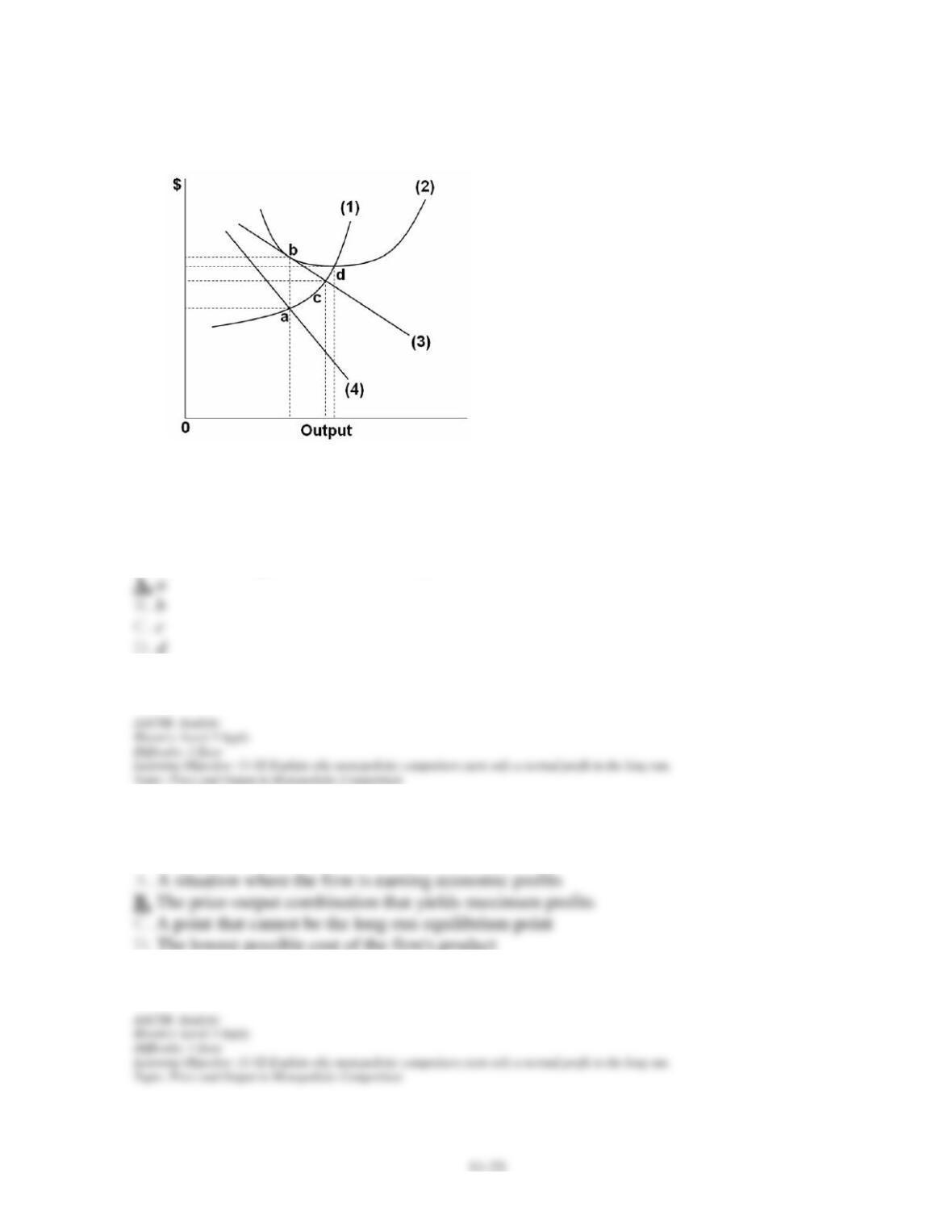
57. Refer to the above graph of the representative firm in monopolistic competition. Marginal
revenue and marginal cost intersect at point:
58. Refer to the above graph of the representative firm in monopolistic competition. Point b
indicates:
Chapter 11 – Monopolistic Competition and Oligopoly (+ Appendix)
59. Monopolistic competition is characterized by excess capacity because:
60. In monopolistic competition there is an underallocation of resources at the profit-
maximizing level of output, which means that:
Chapter 11 – Monopolistic Competition and Oligopoly (+ Appendix)
61. Refer to the above graph of the representative firm in monopolistic competition. The long-
run equilibrium price and output for this firm will be:
62. Refer to the above graph of the representative firm in monopolistic competition. Excess
capacity for this firm would be illustrated by the quantity:
63. Monopolistic competitive firms are productively inefficient because production occurs
where:
Chapter 11 – Monopolistic Competition and Oligopoly (+ Appendix)
64. In the long run, the representative firm in monopolistic competition tends to have:
65. Compared to pure competition, monopolistic competition:
66. At long-run equilibrium in monopolistic competition, there is:
Chapter 11 – Monopolistic Competition and Oligopoly (+ Appendix)
67. The economic inefficiency of monopolistic competition means that:
68. The variety of products and features which consumers may choose from in
monopolistically competitive industries:
69. Product variety in monopolistic competition comes at the cost of:
Chapter 11 – Monopolistic Competition and Oligopoly (+ Appendix)
70. In monopolistic competition, product differentiation and variety tends to:
71. Compared to a purely competitive firm in long-run equilibrium, the monopolistic
competitor has a:
72. Which statement is true?
Chapter 11 – Monopolistic Competition and Oligopoly (+ Appendix)
73. Which statement concerning monopolistic competition is false?
74. Which is true of pure competition but not of monopolistic competition?
75. Which is not a common form of nonprice competition in monopolistic competition?
Chapter 11 – Monopolistic Competition and Oligopoly (+ Appendix)
76. The stronger the product differentiation in monopolistic competition, the:
77. In an oligopolistic market there are:
78. The characteristic most closely associated with oligopoly is:
Chapter 11 – Monopolistic Competition and Oligopoly (+ Appendix)
79. The U.S. primary steel industry is best described as a(n):
80. Which is an example of a differentiated oligopoly?
81. A unique feature of an oligopolistic industry is:
Chapter 11 – Monopolistic Competition and Oligopoly (+ Appendix)
82. Mergers of firms in an industry tend to:
83. A major distinction between a monopolistically competitive firm and an oligopolistic firm
is that:
84. Mutual interdependence means that each firm in an oligopoly:
Chapter 11 – Monopolistic Competition and Oligopoly (+ Appendix)
85. Mutual interdependence means that:
86. In which market model is there mutual interdependence?
87. A firm in an oligopoly is similar to a monopoly in that:
Chapter 11 – Monopolistic Competition and Oligopoly (+ Appendix)
88. Which cannot be a characteristic of an oligopolistic industry?
89. Which statement about oligopoly is false?
90. A high concentration ratio indicates that:
Chapter 11 – Monopolistic Competition and Oligopoly (+ Appendix)
91. A low concentration ratio means that:
92. The larger the Herfindahl index, the:
93. Which industry would be considered to be oligopolistic based on the four-firm
concentration ratio and the Herfindahl index data?
Chapter 11 – Monopolistic Competition and Oligopoly (+ Appendix)
94. The increased use of plastic bags instead of paper bags in grocery stores and retail shops is
an example of:
95. Assume that an industry is significantly affected by import competition from foreign
suppliers. Taking this factor into account, it would mean that:
Chapter 11 – Monopolistic Competition and Oligopoly (+ Appendix)
97. You are told that the four-firm concentration ratio in an industry is 20. Based on this
information you can conclude that:
98. Industry Y is dominated by five large firms that hold market shares of 20, 20, 25, 25, and
10. The Herfindahl index for this industry is:
99. Industry Y is dominated by five large firms that hold market shares of 20, 25, 15, 10, and
25 percent. The four-firm concentration ratio for this industry is:
Chapter 11 – Monopolistic Competition and Oligopoly (+ Appendix)
100. The Herfindahl index for an industry is 2550. Which of the following sets of market
shares and industry with four firms would produce such an index?
101. Industry A is composed of four large firms that hold market shares of 60, 20, 10, and 10.
The Herfindahl index and four-firm concentration ration for this industry are:
102. Which has not contributed to the development of oligopolies in the U.S. economy?
Chapter 11 – Monopolistic Competition and Oligopoly (+ Appendix)
103. Interindustry competition refers to the fact that:
104. One major problem with concentration ratios is that they fail to take into account:
105. When firms in an industry reach an agreement to fix prices, divide up market share, or
otherwise restrict competition, they are practicing the strategy of:
Chapter 11 – Monopolistic Competition and Oligopoly (+ Appendix)
106. Game theory, which is used in studying oligopoly behavior, originated from the study of
games such as the following, except:
107. Collusion refers to a situation where rival firms decide to:
108. In game theory, each player is assumed to have the following, except: