Chapter 11 – Monopolistic Competition and Oligopoly (+ Appendix)
53. Which of the following statements is correct?
54. For a monopolistically competitive firm in long-run equilibrium:
55. In long-run equilibrium both purely competitive and monopolistically competitive firms
will:
Chapter 11 – Monopolistic Competition and Oligopoly (+ Appendix)
11–22
56. In long-run equilibrium monopolistic competition entails:
57. Which of the following statements concerning a monopolistically competitive industry is
correct?
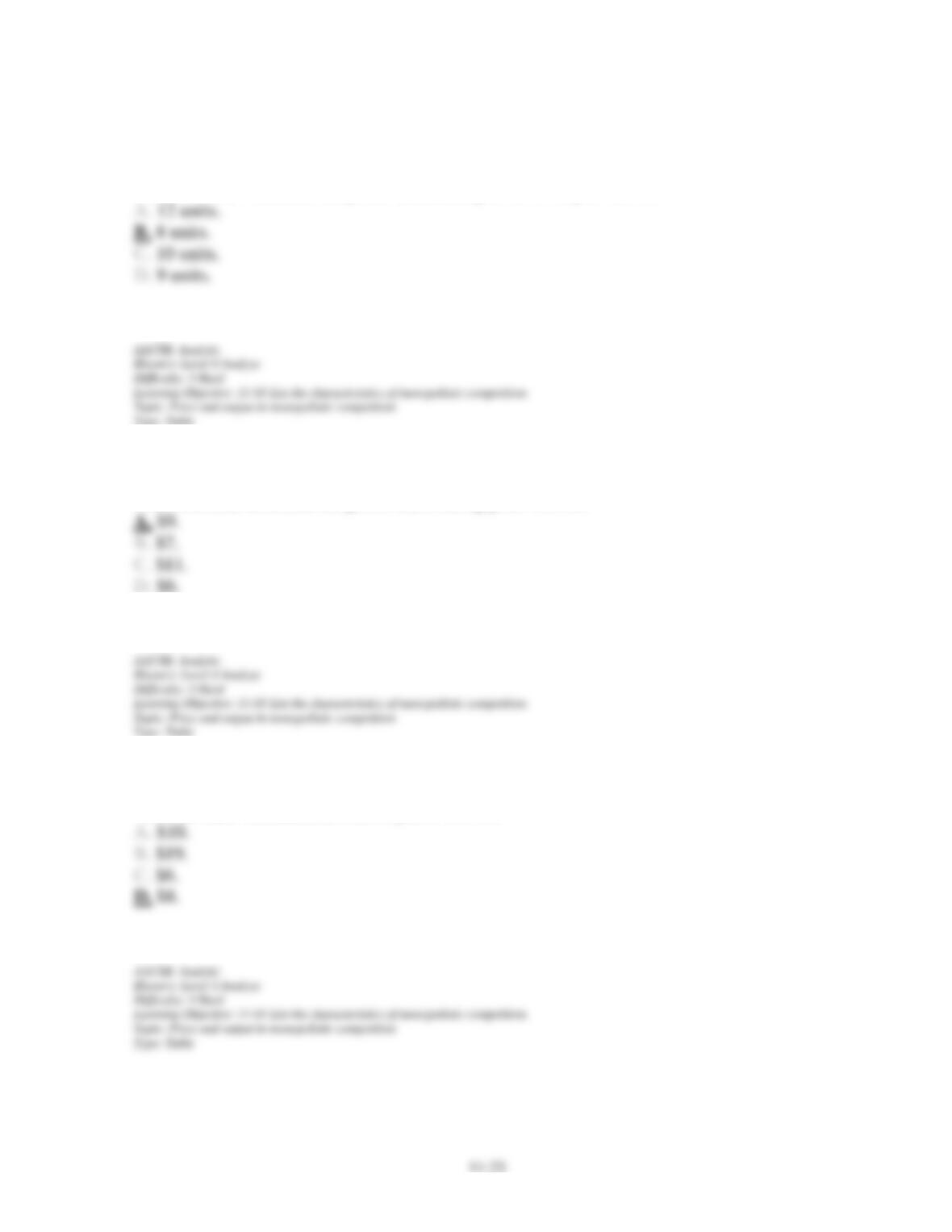
Answer the question on the basis of the following demand and cost data for a specific firm:
Chapter 11 – Monopolistic Competition and Oligopoly (+ Appendix)
58. Refer to the above data. If columns (1) and (3) of the demand data shown above are this
firm’s demand schedule, the profit-maximizing level of output will be:
59. Refer to the above data. If columns (1) and (3) of the demand data shown above are this
firm’s demand schedule, the profit-maximizing price will be:
60. Refer to the above data. If columns (1) and (3) of the demand data shown above are this
firm’s demand schedule, economic profit will be:
Chapter 11 – Monopolistic Competition and Oligopoly (+ Appendix)
61. Refer to the above data. Suppose that entry into the industry changes this firm’s demand
schedule from columns (1) and (3) shown above to columns (2) and (3). Economic profit
will:
62. Refer to the above data. Suppose that entry into this industry changes this firm’s demand
schedule from columns (1) and (3) shown above to columns (2) and (3). We can conclude that
this industry is:
63. Refer to the above data. With the demand schedule shown above by columns (2) and (3),
in long-run equilibrium:
Chapter 11 – Monopolistic Competition and Oligopoly (+ Appendix)
64. An important similarity between a monopolistically competitive firm and a purely
competitive firm is that:
65. An important similarity between a monopolistically competitive firm and a pure
monopolist is that both:
66. The less elastic a monopolistic competitor’s long-run demand curve, the:
Chapter 11 – Monopolistic Competition and Oligopoly (+ Appendix)
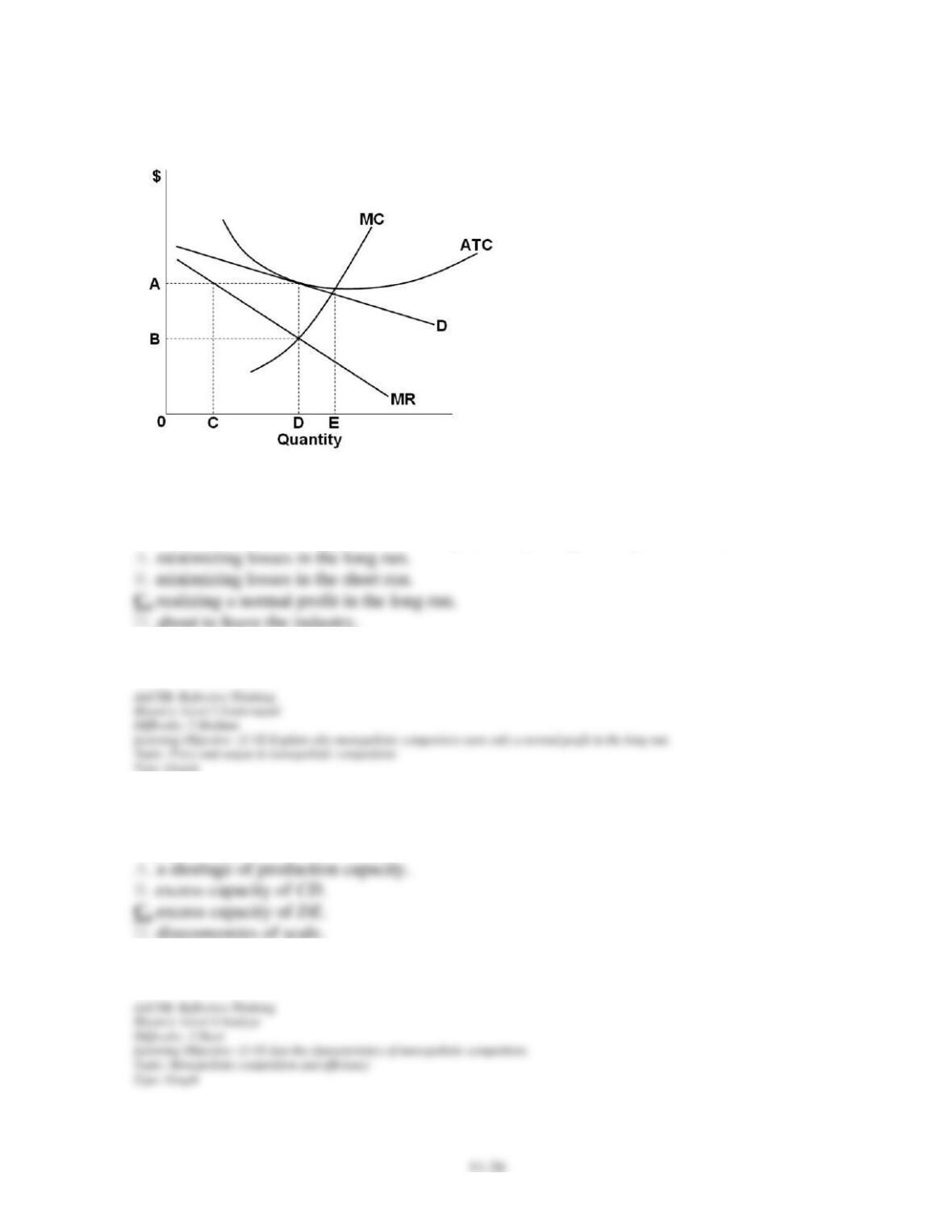
67. Refer to the above diagram for a monopolistically competitive producer. The firm is:
68. Refer to the above diagram for a monopolistically competitive producer. This firm is
experiencing:
Chapter 11 – Monopolistic Competition and Oligopoly (+ Appendix)
69. Refer to the above diagram for a monopolistically competitive producer. If this firm were
to realize productive efficiency, it would:
70. In the long run a monopolistically competitive firm:
71. Monopolistically competitive industries are inefficient because:
Chapter 11 – Monopolistic Competition and Oligopoly (+ Appendix)
72. The economic inefficiencies of monopolistic competition may be offset by the fact that:
73. A significant benefit of monopolistic competition compared with pure competition is:
74. Product variety is likely to be greater in:
Chapter 11 – Monopolistic Competition and Oligopoly (+ Appendix)
75. Which of the following is correct?
76. In monopolistically competitive markets, resources are:
77. In long-run equilibrium a monopolistically competitive producer achieves:
Chapter 11 – Monopolistic Competition and Oligopoly (+ Appendix)
78. The less elastic a monopolistic competitor’s long-run demand curve, the:
79. The more elastic a monopolistic competitor’s long-run demand curve, the:
80. In which of these continuums of degrees of competition (highest to lowest) is oligopoly
properly placed?
Chapter 11 – Monopolistic Competition and Oligopoly (+ Appendix)
81. The term oligopoly indicates:
82. In an oligopolistic market:
83. Oligopolistic industries are characterized by:
Chapter 11 – Monopolistic Competition and Oligopoly (+ Appendix)
84. The automobile, household appliance, and automobile tire industries are all illustrations
85. Use your basic knowledge and your understanding of market structures to answer this
question. Which of the following companies most closely approximates a differentiated
oligopolist in a highly concentrated industry?
86. Use your basic knowledge and your understanding of market structures to answer this
question. Which of the following companies most closely approximates a homogenous
oligopolist in a highly concentrated industry?
Chapter 11 – Monopolistic Competition and Oligopoly (+ Appendix)
87. The mutual interdependence that characterizes oligopoly arises because:
88. The copper, aluminum, cement, and industrial alcohol industries are examples of:
89. Which of the following is the best example of oligopoly?
Chapter 11 – Monopolistic Competition and Oligopoly (+ Appendix)
90. If there are significant economies of scale in an industry, then:
91. In which of the following market models do demand and marginal revenue diverge?
92. Oligopoly is more difficult to analyze than other market models because:
Chapter 11 – Monopolistic Competition and Oligopoly (+ Appendix)
93. Which of the following is an illustration of differentiated oligopoly?
94. Which of the following industries is an illustration of homogeneous oligopoly?
95. Differentiated oligopoly exists where a small number of firms are:
Chapter 11 – Monopolistic Competition and Oligopoly (+ Appendix)
96. Homogeneous oligopoly exists where a small number of firms are:
97. Which of the following is a unique feature of oligopoly?
98. Prices are likely to be least flexible:
Chapter 11 – Monopolistic Competition and Oligopoly (+ Appendix)
99. Mutual interdependence means that each oligopolistic firm:
100. Clear-cut mutual interdependence with respect to the price-output policies exists in:
101. Concentration ratios measure the:
Chapter 11 – Monopolistic Competition and Oligopoly (+ Appendix)
102. If the four-firm concentration ratio for industry X is 80:
103. An industry having a four-firm concentration ratio of 85 percent:
104. As a general rule, oligopoly exists when the four-firm concentration ratio:
Chapter 11 – Monopolistic Competition and Oligopoly (+ Appendix)
105. Aluminum competes with copper in the market for power transmission lines. This
illustrates:
106. The Herfindahl index for a pure monopolist is:
107. Industries X and Y both have four-firm concentration ratios of 65 percent, but the
Herfindahl index for X is 1,500 while that for Y is 2,000. These data suggest:
Chapter 11 – Monopolistic Competition and Oligopoly (+ Appendix)
108. Suppose that total sales in an industry in a particular year are $600 million and sales by
the top four sellers are $200 million, $150 million, $100 million, and $50 million,
respectively. We can conclude that:
109. The four-firm sales concentration ratio for an industry measures the:
110. Concentration ratios: