Chapter 11 – Monopolistic Competition and Oligopoly (+ Appendix)
1. Which of the following is a characteristic of monopolistic competition?
2. A monopolistically competitive industry is like a purely competitive industry in that:
Chapter 11 – Monopolistic Competition and Oligopoly (+ Appendix)
3. Which assumption is part of the model of monopolistic competition?
4. Monopolistic competition is characterized by firms:
5. In which industry is monopolistic competition most likely to be found?
Chapter 11 – Monopolistic Competition and Oligopoly (+ Appendix)
6. One difference between monopolistic competition and pure competition is that:
7. For which market model can we not assume a homogeneous product?
8. Which set of characteristics below best describes the basic features of monopolistic
competition?
Chapter 11 – Monopolistic Competition and Oligopoly (+ Appendix)
9. The goal of product differentiation and advertising in monopolistic competition is to make:
10. Which industry would be considered to be monopolistically competitive?
11. Which industry would be most probably monopolistically competitive?
Chapter 11 – Monopolistic Competition and Oligopoly (+ Appendix)
12. Which of the following is a measure of the degree of industry concentration?
13. The following are the respective numbers for the four-firm concentration ratio and
Herfindahl index in an industry. Which set of numbers would suggest that the industry was
monopolistically competitive?
Chapter 11 – Monopolistic Competition and Oligopoly (+ Appendix)
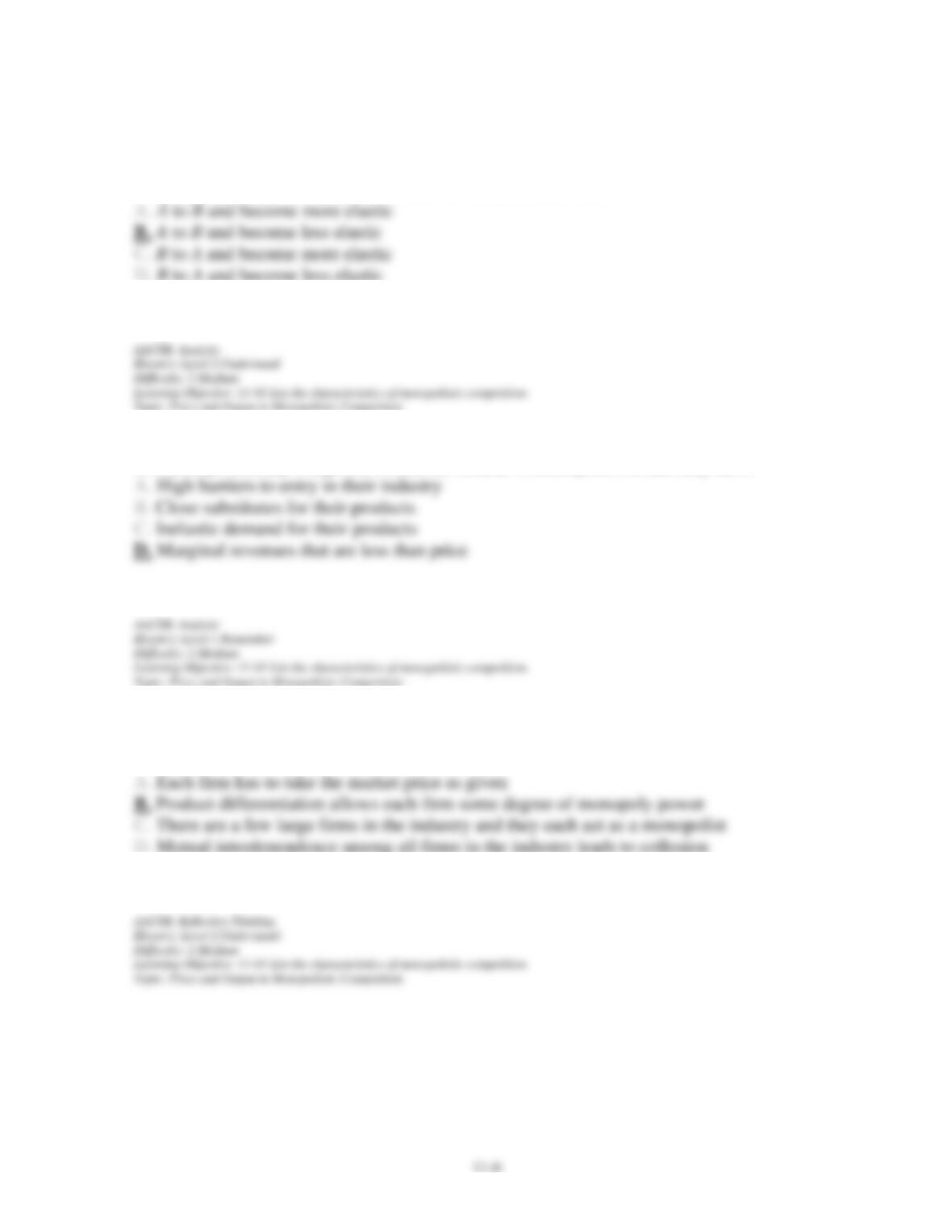
14. Refer to the above graph for a monopolistically competitive firm. A successful advertising
campaign by the firm will cause its demand curve to shift from:
15. Monopolistically competitive firms are similar to monopolies in that they have:
16. Demand and marginal revenue curves are downsloping for monopolistically competitive
firms because:
Chapter 11 – Monopolistic Competition and Oligopoly (+ Appendix)
17. The downward-sloping demand curve of a monopolistic competitor:
18. The monopolistically competitive seller’s demand curve will become more elastic the:
19. The demand curve faced by a monopolistically competitive firm:
Chapter 11 – Monopolistic Competition and Oligopoly (+ Appendix)
20. In monopolistic competition, which of the following would make an individual firm’s
demand curve less elastic?
21. A monopolistically competitive firm is producing at an output level in the short run where
average total cost is $4.50, price is $4.00, marginal revenue is $2.50, and marginal cost is
$2.50. This firm is operating:
22. A monopolistically competitive firm in the short run is producing where price is $3.00 and
marginal cost is $1.50. To maximize profits:
Chapter 11 – Monopolistic Competition and Oligopoly (+ Appendix)
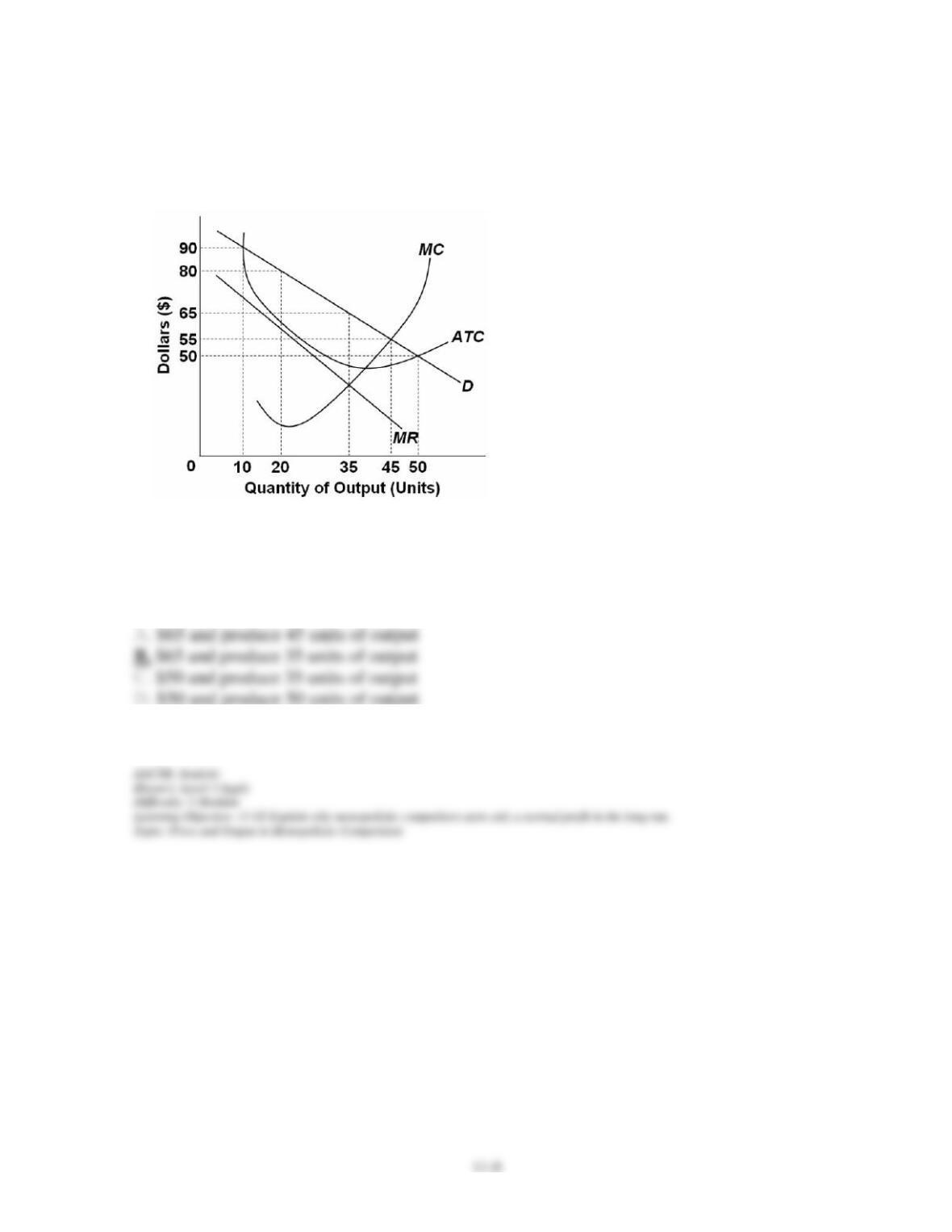
The graph depicts a monopolistically competitive firm
23. Refer to the above graph. In the short run, this monopolistically competitive firm will set
price at:
Chapter 11 – Monopolistic Competition and Oligopoly (+ Appendix)
24. Refer to the above graph. At the profit-maximizing level of short-run output, this
monopolistically competitive firm will be making a profit of:
25. Refer to the above graph. This monopolistically competitive firm is earning economic
profits in the short run and:
26. A monopolistically competitive firm is producing at a short-run output level where
average total cost is $10.00, marginal cost is $5.00, marginal revenue is $6.00, and price is
$12.00. In the short run, the firm should:
Chapter 11 – Monopolistic Competition and Oligopoly (+ Appendix)
27. A monopolistically competitive firm is operating at a short-run level of output where price
is $21, average total cost is $15, marginal cost is $13, and marginal revenue is $13. In the
short run this firm should:
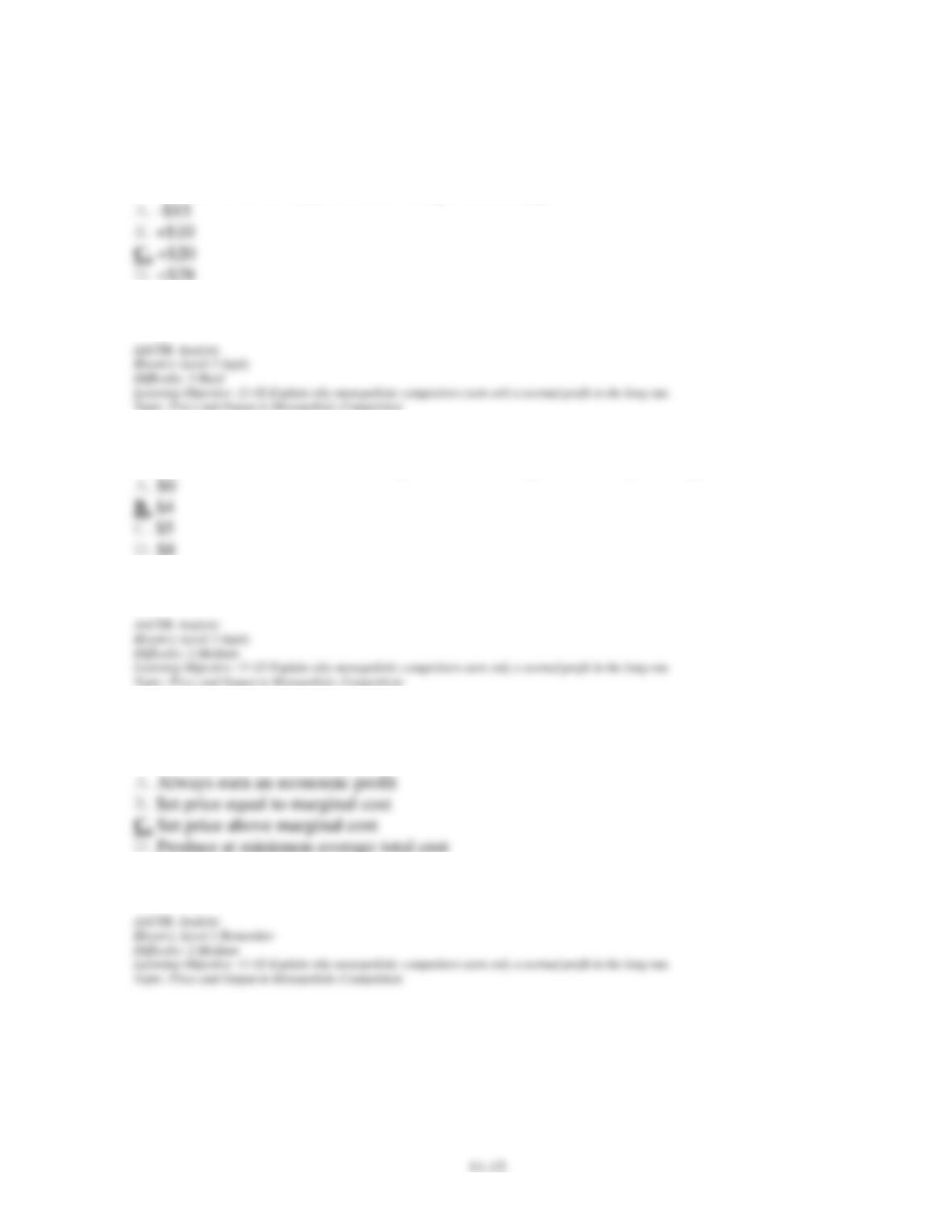
Answer the question based on the demand and cost schedules for a monopolistically
competitive firm given in the table below
28. Refer to the above table. What output will the monopolistically competitive firm
produce?
Chapter 11 – Monopolistic Competition and Oligopoly (+ Appendix)
29. Refer to the above table. What will be the economic profit or loss for this monopolistically
competitive firm at the profit-maximizing level of output?
30. Refer to the above table. At the profit-maximizing level of output, marginal revenue is:
31. In monopolistic competition, a firm has a limited degree of “price-making” ability. This
means that the firm will:
Chapter 11 – Monopolistic Competition and Oligopoly (+ Appendix)
32. Assume that in a monopolistically competitive industry, firms are earning economic
profit. This situation will:
33. If monopolistically competitive firms in an industry are making an economic profit, then
new firms will enter the industry and the product demand facing existing firms will:
Chapter 11 – Monopolistic Competition and Oligopoly (+ Appendix)
11–14
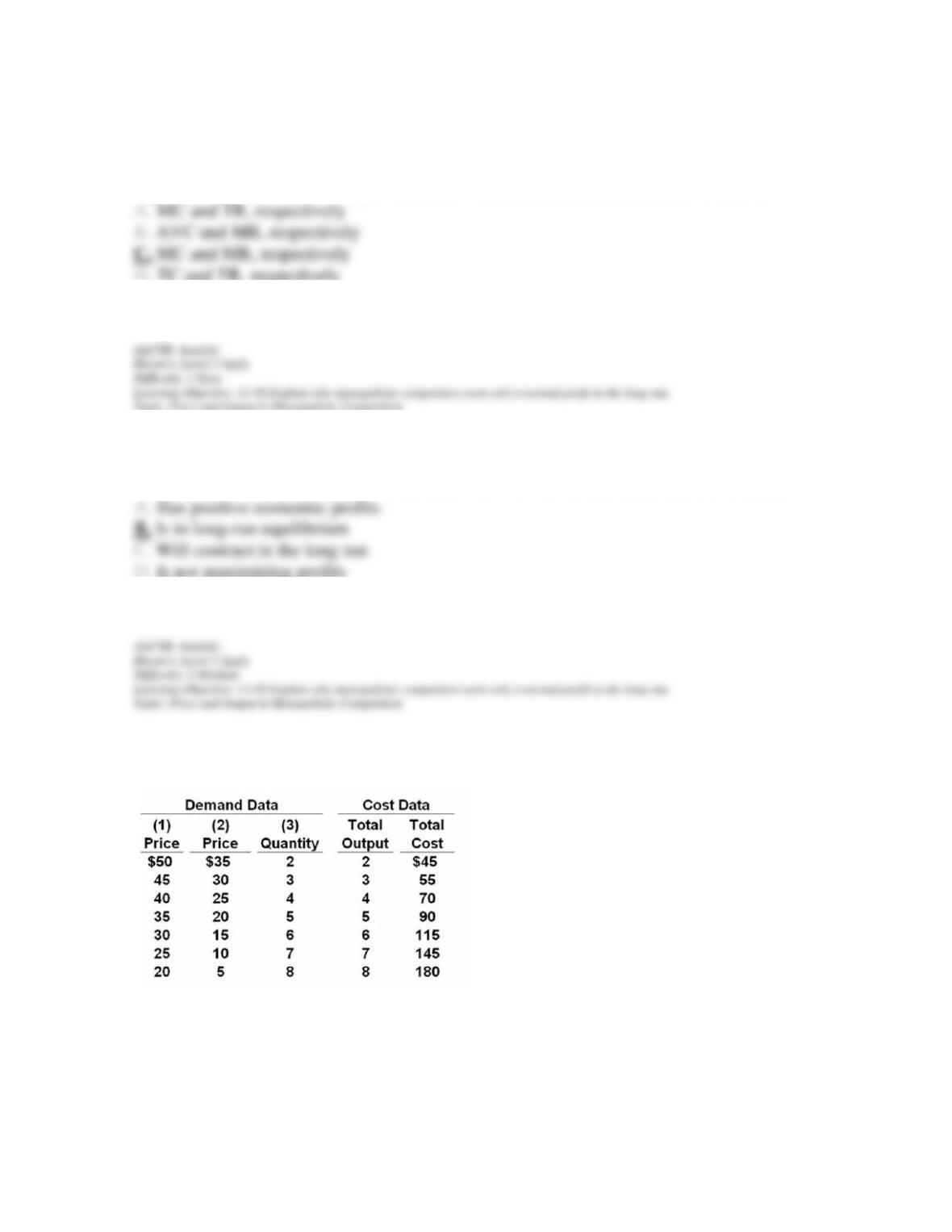
34. Refer to the above graph of a representative firm in monopolistic competition. If curve (2)
represents ATC and line (3) represents demand, then curve (1) and line (4) would be:
35. Refer to the above graph of a representative firm in monopolistic competition. If curve (2)
represents ATC and line (3) represents demand, then we can conclude that the industry:
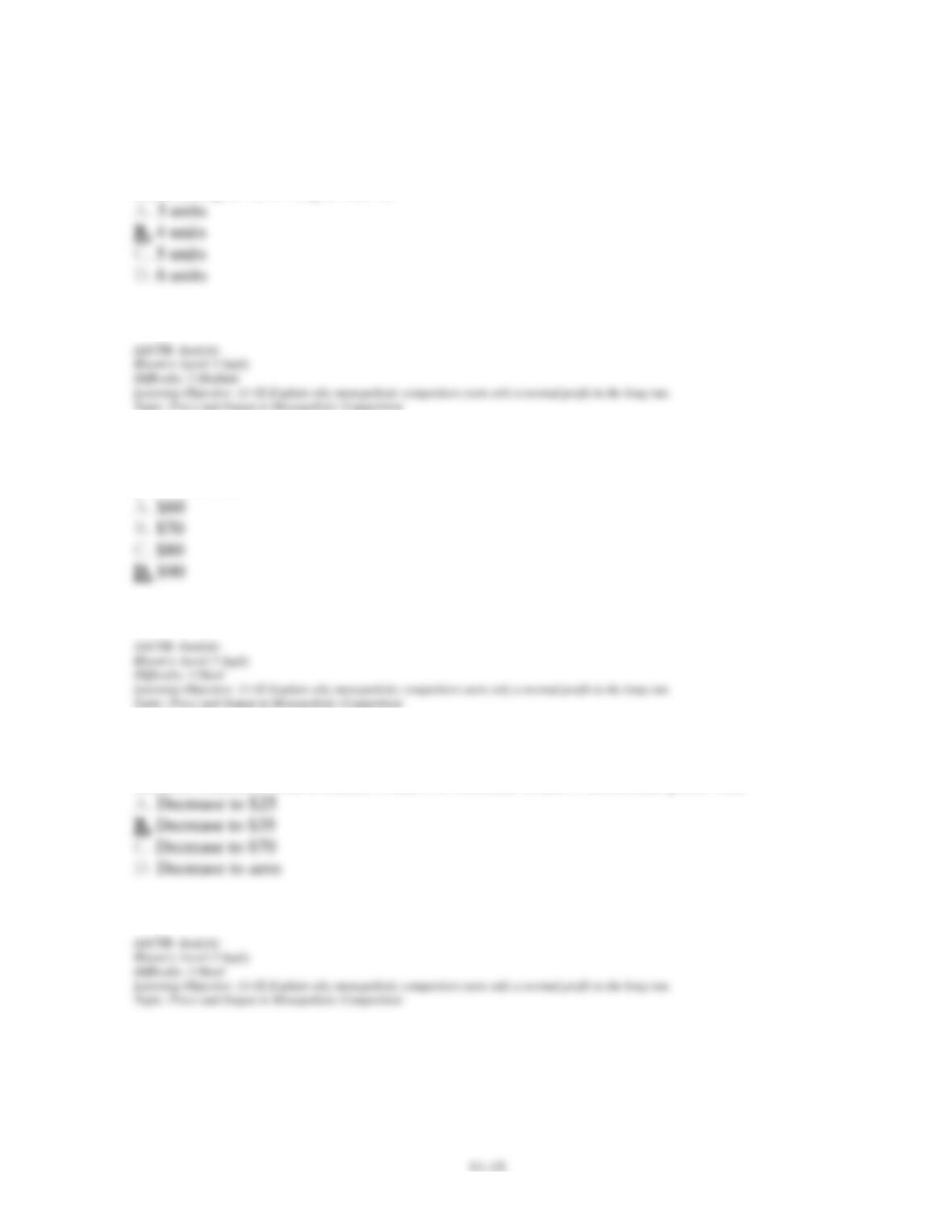
Answer the question on the basis of the following demand and cost data for a specific firm
Chapter 11 – Monopolistic Competition and Oligopoly (+ Appendix)
36. Refer to the above data. If columns 1 and 3 are this firm’s demand schedule, the profit-
maximizing level of output will be:
37. Refer to the above data. If columns 1 and 3 are this firm’s demand schedule, economic
profit will be:
38. Refer to the above data. Suppose that entry of firms into the industry changes this firm’s
demand schedule from columns 1 and 3 to columns 2 and 3. Economic profit will:
Chapter 11 – Monopolistic Competition and Oligopoly (+ Appendix)
39. Refer to the above data. In the long run, the number of firms in this monopolistic
competitive industry will most likely:
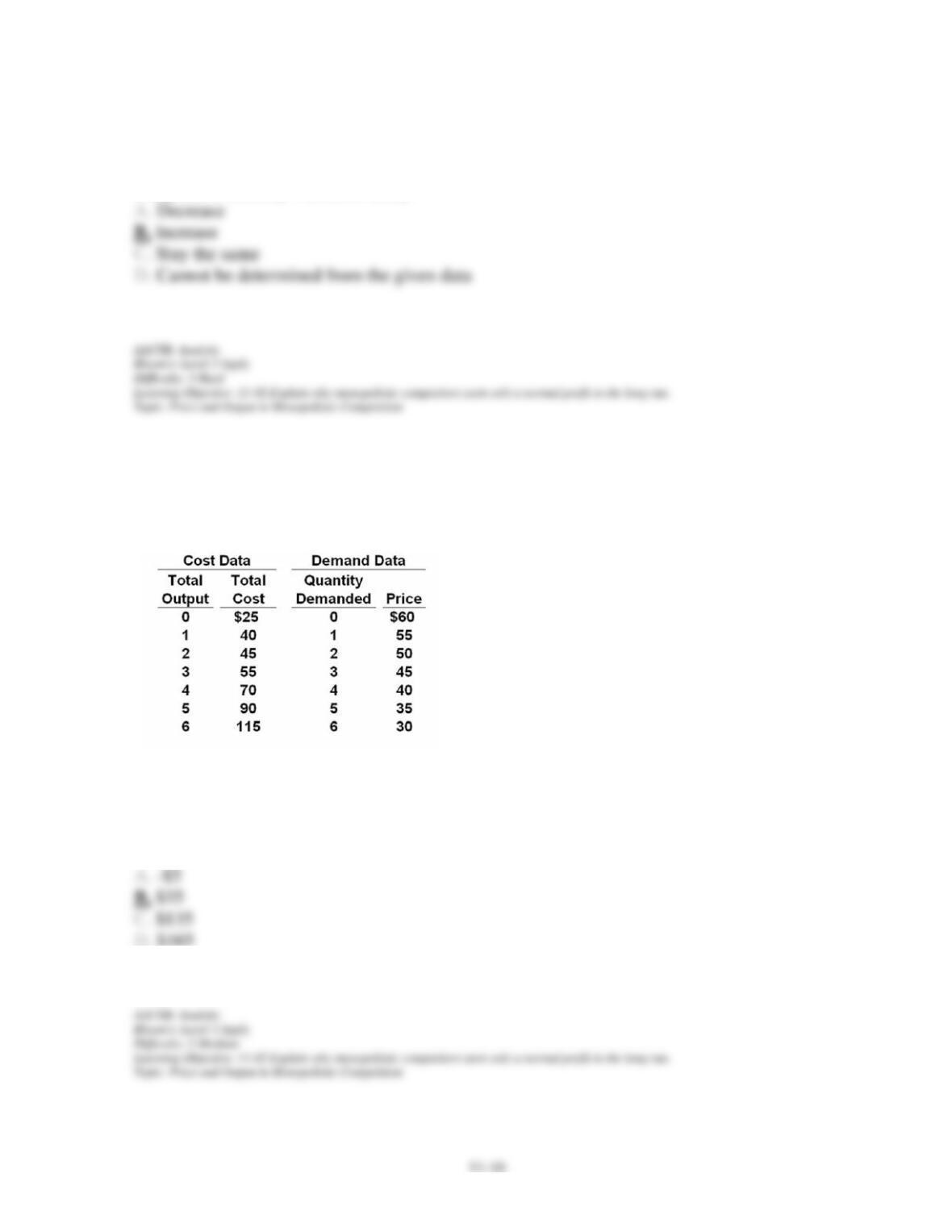
Assume that the short-run cost and demand data given in the table below confront a
monopolistic competitor selling a given product and engaged in a given amount of product
promotion
40. Refer to the above table and information. If the firm sells 3 units of output, marginal
revenue will be:
Chapter 11 – Monopolistic Competition and Oligopoly (+ Appendix)
41. Refer to the above table and information. At what output and price levels will the firm
produce in the short run?
42. Refer to the above table and information. What will total profits be at the profit-
maximizing output and price?
43. In the long run, a representative firm in a monopolistically competitive industry will end
up:
Chapter 11 – Monopolistic Competition and Oligopoly (+ Appendix)
44. In the short run, the monopolistically competitive firm will experience:
45. In the long run, the economic profits for a monopolistically competitive firm will be:
46. Firms in an industry will not earn long-run economic profits if:
Chapter 11 – Monopolistic Competition and Oligopoly (+ Appendix)
47. Suppose some firms exit an industry characterized by monopolistic competition. We
would expect the demand curve of a firm already in the industry to:
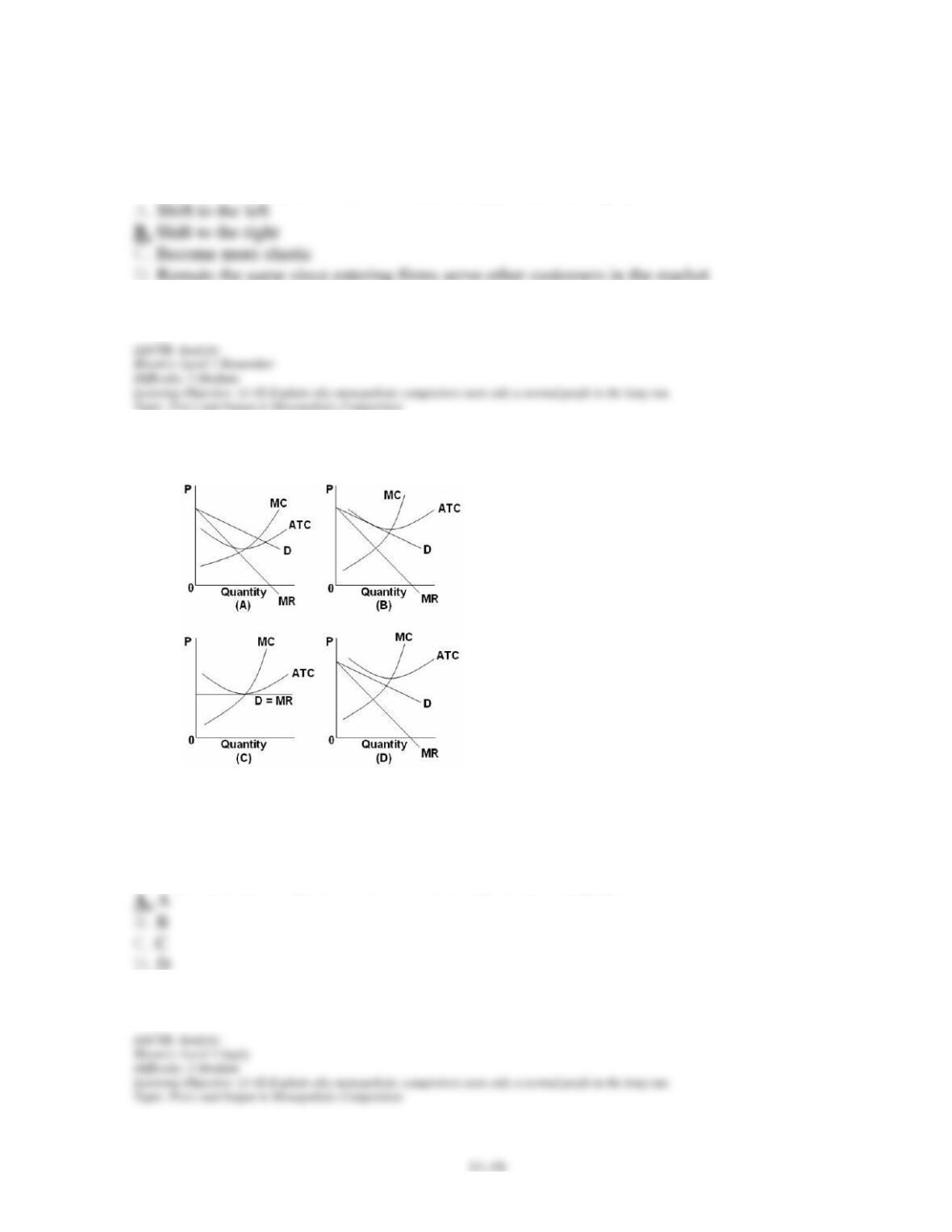
48. Refer to the above graphs. A short-run equilibrium that would produce profits for a
monopolistically competitive firm would be represented by graph:
Chapter 11 – Monopolistic Competition and Oligopoly (+ Appendix)
49. Refer to the above graphs. A short-run equilibrium that would produce losses for a
monopolistically competitive firm would be represented by graph:
50. Refer to the above graphs. The long-run equilibrium for a monopolistically competitive
firm is represented by graph: